
Question 743 marksEasy
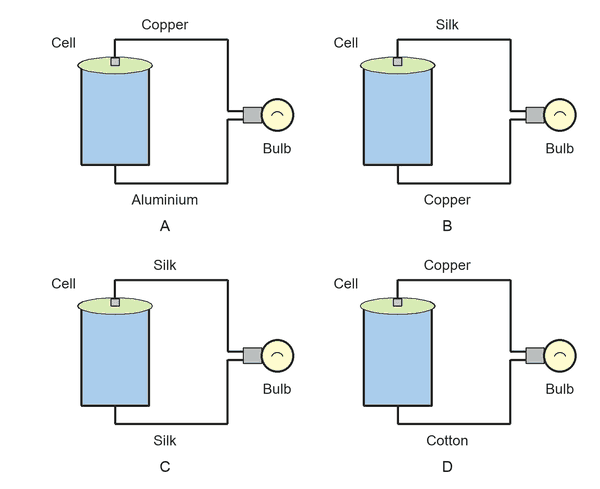
The following diagram (Fig. 7.40) shows four circuits A, B, C and D. Each circuit has a cell and a torch bulb. Name the circuits in which the bulb will glow? Give reason to your answer.
Confirming your payment
Sign up now and get 250 free tokens.
Electricity and Magnetism · Question 74 of 76
The following diagram (Fig. 7.40) shows four circuits A, B, C and D. Each circuit has a cell and a torch bulb. Name the circuits in which the bulb will glow? Give reason to your answer.
Solution:
Concept: A bulb glows only if every part of the circuit is made of conductors. One insulator anywhere in the path makes the circuit incomplete.
Step 1 — Check the wires of each circuit.
The table lists the two connecting wires in each circuit of Fig. 7.40 and whether both are conductors.
| Circuit | Wires | Both conductors? | Bulb |
|---|---|---|---|
| A | copper and aluminium | yes | glows |
| B | silk and copper | no, silk is an insulator | does not glow |
| C | silk and silk | no, both are insulators | does not glow |
| D | copper and cotton | no, cotton is an insulator | does not glow |
Step 2 — Give the reason.
In circuit A both wires, copper and aluminium, are metals and so are conductors. The circuit is complete and current flows through the bulb. In circuits B, C and D at least one wire is of silk or cotton, which are insulators, so the circuit is incomplete and no current flows.
Therefore, the bulb will glow only in circuit A, because only there both connecting wires are conductors.