
Opening your dashboard
Class 7 Physics Chapter 7 Electricity and Magnetism: Competency-Based Questions (CBQ)
40 questions on Chapter 7, each worked through on its own page with the AI tutor. Class 7 Physics, ICSE 2026-27.
40 questions
1–5 marks · Mixed difficulty
- 11 mark
Question 1
Competency: Application
Three ring magnets are slipped, one after another, over a wooden pencil held upright. The lowest magnet rests on the table. The middle magnet floats a little above it, and the top magnet floats a little above the middle one. The upper face of the lowest magnet is a north pole. Which pole is on the upper face of the top magnet, and why ?
- 21 mark
Question 2
Competency: Analysis
Two electromagnets hang side by side from threads, with end P of one facing end Q of the other. Divya stands between them. The figure shows the direction of the current that she sees in the coil when she looks straight at end P, and when she turns round and looks straight at end Q.
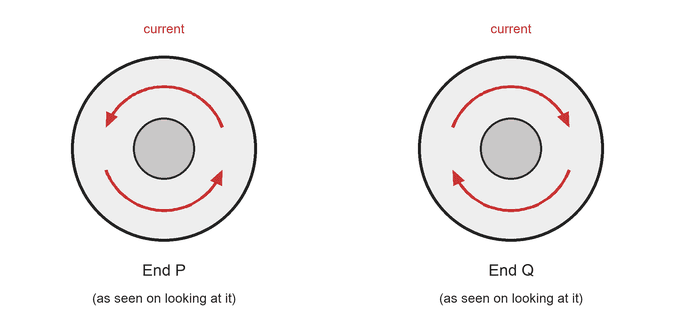
What happens to the two electromagnets when the current is switched on ?
- 31 mark
Question 3
Competency: Application
Farhan joins a new cell, a torch bulb and two plastic-coated copper wires to make a circuit, but the bulb does not glow. He checks and finds that the cell and the bulb both work in his friend's circuit. He then notices that at one end of one wire the plastic coating has not been removed, and this covered end is pressed against the terminal of the cell. Why does the bulb not glow ?
- 41 mark
Question 4
Competency: Analysis
A school corridor has three lamps and one switch. A teacher notes two things. When one lamp fuses, the other two keep glowing. When the switch is put off, all three lamps go off together. How are the lamps and the switch connected ?
- 51 mark
Question 5
Competency: Understanding
Assertion (A): At every place on the earth, the north pole of a compass needle points exactly towards the geographic north pole.
Reason (R): The earth behaves like a magnet whose magnetic poles are not at the same places as its geographic poles.
- 61 mark
Question 6
Competency: Understanding
Assertion (A): A wall clock that runs on a dry cell stops after some months, and starts again when a new cell is put in.
Reason (R): A cell changes chemical energy into electrical energy, so it can supply current only as long as its chemicals last.
- 72 marks
Question 7
Competency: Analysis
A compass lies on a table with its needle pointing north. Ishaan places a bar magnet to the east of the compass, with the north pole of the magnet towards the compass. He notes the angle through which the needle turns from the north for different distances of the magnet.
Distance of the magnet from the compass (in cm) 50 40 30 20 10 Angle turned by the needle (in degree) 0 3 10 35 75 (a) What do these readings show about the magnetic field of the bar magnet ?
(b) Towards which side, east or west, does the north pole of the needle turn ? What will be seen if the magnet, kept at 20 cm, is turned round so that its south pole is towards the compass ?
- 82 marks
Question 8
Competency: Evaluation
Riya draws the circuit diagram of her torch, which has two cells, a switch S and a bulb B, as shown. Below the diagram she writes, "The bulb is glowing."

(a) Find the two mistakes in Riya's diagram for a glowing torch.
(b) State how each mistake should be corrected, and give the reason.
- 92 marks
Question 9
Competency: Application
Three sources of electricity are a battery of dry cells, the mains and a solar cell (solar panel).
(a) Choose the most suitable source for each of these and give one reason for each choice: a television remote, an electric geyser, a lamp on a lonely highway far from any power line.
(b) Why is a battery of dry cells not used to run an electric geyser ?
- 102 marks
Question 10
Competency: Application
A bar magnet is taped along the roof of a toy car, with the north pole of the magnet at the front of the car and the south pole at the back. Ali holds a second bar magnet in his hand and wants to move the car without touching it.
(a) He stands behind the car. Which pole of his magnet should he bring near the back of the car to drive it forward ? Give a reason.
(b) He now brings the north pole of his magnet near the back of the car. What happens ? Why can a plain iron rod never be used to drive the car forward from behind ?
- 113 marks
Question 11
Competency: Analysis
Case study: In an electric bell, the current from the battery passes through the bell push, the coil of the horse-shoe electromagnet, the springy metal strip and the contact screw that touches the strip, and returns to the battery. A soft iron armature fixed on the strip carries the hammer. A mechanic receives three bells, each with one fault.
Bell Fault 1 The contact screw has been turned back, so that it no longer touches the springy strip. 2 The contact screw has been screwed in too far, so that it keeps touching the strip even after the armature has moved up to the electromagnet. 3 The battery has been put in the other way round. For each bell, predict what will happen when the bell push is pressed, and explain your answer.
(a) Bell 1
(b) Bell 2
(c) Bell 3
- 124 marks
Question 12
Competency: Analysis & Evaluation
Case study: Meera makes the two circuits X and Y shown below. All the bulbs are alike and both cells are new and alike. With the switches closed she notes the following.
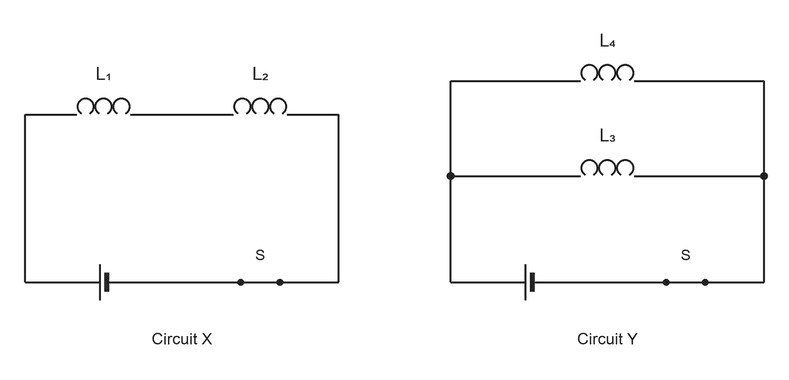
Circuit X Circuit Y Bulbs Both glow dimly Both glow brightly (a) Name the way in which the two bulbs are connected in circuit X, and in circuit Y. How many paths does the current have in each circuit ?
(b) Meera unscrews bulb L₁ from its holder in circuit X, and bulb L₃ from its holder in circuit Y. Predict what happens to L₂ and to L₄. Explain each by tracing the path of the current.
(c) Meera's brother says, "In circuit Y the switch S can put off only one of the two bulbs." Judge his statement. Where should a second switch be put so that it controls L₄ alone ?
- 133 marks
Question 13
Competency: Application & Analysis
Case study: A group of scouts camps at four towns. At each town they compare the direction of the north pole of a compass needle with the true (geographic) north marked on a map.
Town Direction of the north pole of the needle P 2° east of true north Q exactly along true north R 5° west of true north S 1° west of true north (a) What is the angle between the direction of the needle and the true north called ? Why is there such an angle at all ?
(b) At which town can the compass be used to find true north without any correction ? At which town will a scout who trusts the needle blindly make the greatest error ?
(c) At town R, through what angle and towards which side must a scout turn from the direction of the needle to face true north ? Compared with true north, by how many degrees do the directions of the needles at P and R differ ?
- 144 marks
Question 14
Competency: Analysis & Evaluation
Case study: Kunal makes a tester by joining a battery, a small LED lamp (which lights up even with a very small current) and two free wire ends. He holds different things between the two wire ends, or dips the ends in a liquid without letting them touch each other.
Thing tested LED Iron nail glows brightly Dry wooden stick does not glow Distilled (pure) water does not glow Tap water glows dimly Water with common salt dissolved in it glows brightly The same wooden stick after soaking it in salt water glows dimly (a) From the table, name two conductors and two insulators of electricity.
(b) Pure water does not make the LED glow, but tap water and salt water do. What makes the difference ? Why does the soaked wooden stick make the LED glow ?
(c) Kunal's sister says, "Pure water is an insulator, so it is safe to touch a switch with wet hands." Use the results to judge her statement.
- 154 marks
Question 15
Competency: Creation & Application
Sana wants to find out whether the strength of an electromagnet depends on the number of turns of wire in its coil. She has a long iron nail, a long piece of insulated copper wire, two dry cells in a holder, a switch and a box of steel pins.
(a) Plan her experiment. Say how the electromagnet is made and connected, and how its strength is measured.
(b) Which one thing should she change, and which things must she keep the same, to make it a fair test ? Rule a table in which she can record her observations.
(c) What result should she expect ? How can she show, with the same things, that the nail is only a temporary magnet ?
(d) State one precaution she should take while doing the experiment.
- 161 mark
Question 16
Competency: Understanding
At a science fair, Kabir hides a bar magnet under a sheet of thick cardboard. On the cardboard he places a steel paper-clip and an aluminium paper-clip of the same size. When he moves the magnet below the cardboard, only the steel clip follows it and the aluminium clip stays where it is. Which explanation is correct ?
- 171 mark
Question 17
Competency: Analysis
A bar magnet is kept on a table. Four identical small compasses P, Q, R and T are placed round it, as in the figure. The red half of each needle is its north pole. The needles have settled, but the north pole of one needle has been drawn pointing the wrong way.
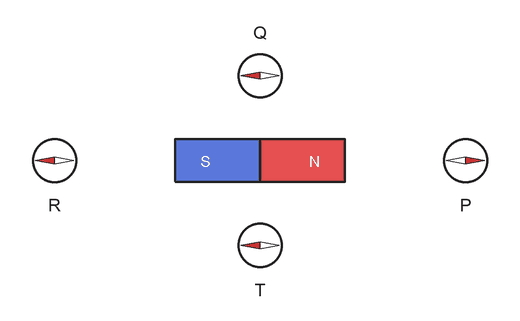
Which compass is drawn wrongly, and why ?
- 181 mark
Question 18
Competency: Understanding
In an electric bell, four events happen after the bell push is pressed. Event P: the electromagnet pulls the soft iron armature towards it, and the hammer moves towards the gong. Event Q: the coil of the electromagnet carries current and becomes a magnet. Event R: the springy strip moves away from the contact screw, the circuit breaks and the coil loses its magnetism. Event S: the springy strip pulls the armature back until the strip touches the contact screw again. In which order do these events happen the first time ?
- 191 mark
Question 19
Competency: Understanding
Assertion (A): When the connections of a battery to the coil of an electromagnet are reversed, the north pole of the electromagnet becomes its south pole.
Reason (R): The poles of an electromagnet depend on the number of turns of wire in its coil.
- 201 mark
Question 20
Competency: Analysis
On the board, the teacher draws a circuit diagram with a battery of two cells, a circle with a dot at its centre, and a zig-zag line, all joined one after another in a single loop by connecting wires. There is no bulb in the circuit. Anita says, "No current flows in this circuit, because it has no bulb." Which statement about the circuit is correct ?
- 211 mark
Question 21
Competency: Understanding
Assertion (A): A bar magnet that is hung freely by a thread comes to rest along the north-south direction.
Reason (R): When a bar magnet is dipped in iron filings and taken out, most of the filings cling near its two ends.
- 221 mark
Question 22
Competency: Evaluation
In a torch, one cell, one bulb and one switch are joined in series in a single loop. Four students make claims about where the switch may be fitted. Who is right ?
- 231 mark
Question 23
Competency: Application
Reena's pocket calculator has no dry cell or battery inside it. Above its keys there is a small dark strip. The calculator works well in a brightly lit room, but when Reena covers the strip with her thumb, the display fades and goes blank. What is the strip, and what change of energy takes place in it ?
- 241 mark
Question 24
Competency: Analysis
Lata has three identical new cells. She joins the positive terminals of all three cells to one wire, and the negative terminals of all three cells to a second wire. She then joins a torch bulb between the two wires, and the bulb glows. Which statement about her arrangement is correct ?
- 251 mark
Question 25
Competency: Analysis
In the circuit in the figure, a cell supplies current to two branches. The upper branch has two bulbs P and Q, one after the other. The middle branch has one bulb R. All the bulbs are alike and all of them are glowing.
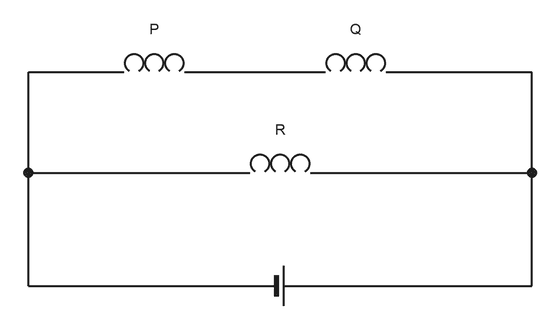
The filament of bulb P now breaks. Which bulbs continue to glow ?
- 262 marks
Question 26
Competency: Application
A refrigerator door has a soft rubber strip with a thin magnetic strip inside it. The strip holds the door shut by sticking to the steel body of the refrigerator.
(a) Why does the strip stick to the steel body, but it would not stick to a wooden cupboard door ?
(b) A fridge magnet shaped like a fish clings to the steel door. Will it cling to a sheet of aluminium foil ? Give a reason.
- 272 marks
Question 27
Competency: Analysis
Divya places a sheet of paper over a bar magnet, sprinkles iron filings evenly over the paper and taps the paper gently. The filings settle into a pattern, and thick bunches of filings form near the two ends of the magnet, while only a few filings lie near the middle.
(a) What does the pattern show about the region round the magnet ?
(b) What does it show about the strength of the magnet at its different parts ?
- 282 marks
Question 28
Competency: Evaluation
The wall clock in a windowless storeroom runs on a dry cell. Ishaan says, "We should fit a solar cell to the clock instead, because a solar cell never has to be replaced."
(a) Is Ishaan's plan a good one for this clock ? Give a reason.
(b) Name one place where a solar cell is a good source of electricity, and say why it suits that place.
- 292 marks
Question 29
Competency: Evaluation
Zoya says, "A cell stores current, like a tank stores water, and the current is used up in the bulb." Joseph says, "The current is the flow of charge. The cell makes the charge flow round the complete circuit, from its positive terminal through the bulb to its negative terminal."
(a) Which student describes the current better ?
(b) Give one reason why Zoya's description does not fit what happens when the switch is open.
- 302 marks
Question 30
Competency: Application
In an electric room heater, the same current flows through the copper connecting wires and through the heater coil. After a short time the coil glows red hot, but the copper wires leading to it stay only slightly warm.
(a) Which property of the coil's material makes it glow, and what does this property do ?
(b) Why are the connecting wires made of copper ?
- 312 marks
Question 31
Competency: Understanding
Sara holds a magnet close to some objects in the science laboratory. A small nickel strip, a cobalt strip and an iron nail are attracted. A brass key, a piece of copper wire and a strip of aluminium foil are not attracted.
(a) What name is given to the materials of the first group, and to the materials of the second group ?
(b) Sara now finds a small grey metal disc that is attracted by her magnet. Can she be sure that the disc is made of iron ? Give a reason.
- 323 marks
Question 32
Competency: Analysis
Neel joins a battery of two cells, a key, a torch bulb and a resistor one after another in a single loop.
(a) With the key open, does the bulb glow ? Give a reason.
(b) With the key closed, the bulb glows dimly. Neel takes out the resistor and joins the gap with a short copper wire. Will the bulb now glow more brightly or less brightly ? Explain.
(c) Neel puts the resistor back and uses a battery of three cells joined in series instead of two. Compared with the dim glow in (b), how will the bulb glow ? Give a reason.
- 333 marks
Question 33
Competency: Application
The gate of a school building has an electric lock. An electromagnet is fixed in the door frame, and a flat plate of soft iron is fixed on the door, facing it. While current flows in the coil, the door cannot be pulled open. Pressing an "Exit" button opens a switch in the circuit of the coil.
(a) Why can the door not be pulled open while current flows in the coil ?
(b) Explain why the door can be opened as soon as the Exit button is pressed.
(c) Why is the plate on the door made of soft iron and not of brass ?
- 343 marks
Question 34
Competency: Analysis
The pole marks on four bar magnets A, B, C and D have worn off. The two ends of each magnet are called 1 and 2 (A1, A2, B1, B2 and so on). Kiran hangs magnet A freely from a thread, and end A1 comes to rest pointing towards the north. She then brings the ends together in pairs and notes the results.
Ends brought together Result A1 and B2 Repel B1 and C1 Attract C2 and D1 Repel (a) Which pole is A1, and which pole is A2 ?
(b) Find the poles at B1, B2, C1 and C2. Give the reason for each step.
(c) Find the poles at D1 and D2. If magnet D is hung freely, which end will point towards the north ?
- 353 marks
Question 35
Competency: Evaluation
A crane in a steel yard carries a heap of iron beams with a large electromagnet. While it is above a group of workers, there is a power cut.
(a) What happens to the beams, and why ?
(b) The engineer fits a back-up battery that starts supplying the coil by itself whenever the mains supply fails. Judge whether this makes the crane safer, and give one thing that must be checked regularly for it to work.
(c) Suggest one precaution that should be taken while the crane works.
- 363 marks
Question 36
Competency: Evaluation
A student claims, "The magnetic field of a bar magnet exists only at its poles and nowhere else."
(a) Is the claim correct ?
(b) Describe one observation with a compass that goes against the claim.
(c) Suggest what the student may have seen that led to this idea.
- 374 marks
Question 37
Competency: Analysis
Case: Tanya clamps a bar magnet above a table. She ties a steel paper-clip to the table with a thread, so that the clip is pulled up by the magnet and hangs in the air, about 1 cm below the magnet, without touching it. She then slides thin sheets of different materials, one at a time, into the gap between the magnet and the clip. (Hypothetical data.)
Sheet slid into the gap What happens to the clip Paper Stays up in the air Glass Stays up in the air Aluminium Stays up in the air Plastic Stays up in the air Iron Falls down (a) Which sheets let the force of the magnet pass through them ? What is common to their materials ?
(b) Suggest why the clip falls when the iron sheet is slid in.
(c) A watchmaker wants to protect the parts of a watch from strong magnets nearby. Using the results, which material should she use for a thin cover round the parts ? Give a reason.
- 385 marks
Question 38
Competency: Application
Case: Electricity made at a power station travels over long wires to Rohan's city. From the electric pole it reaches the main board of his flat, where an electric meter is fixed, and then goes to all the rooms. During a power cut, the building runs its lift and corridor lamps on a generator that is turned by a diesel engine. Rohan notes the meter reading at 8 a.m. on three days. (Hypothetical data.)
Date Meter reading (units) 1 June, 8 a.m. 2 June, 8 a.m. 3 June, 8 a.m. (a) What change of energy takes place in the generator ?
(b) What does the electric meter measure ? Find the units used in each of the two days, and say in which day more electricity was used.
(c) The electricity board charges ₹7 for each unit used (hypothetical rate). Find the cost of the electricity used from 8 a.m. on 1 June to 8 a.m. on 3 June.
- 394 marks
Question 39
Competency: Analysis
Case: Arjun makes two electromagnets that are alike in every way except the core: one has a soft iron core and the other a steel core of the same size. He joins each to the same battery and counts the steel pins it holds. He then switches off the current and, after one minute, counts the pins that are still clinging. (Hypothetical data.)
Core Pins held with the current on Pins still held 1 minute after switching off Soft iron Steel (a) Which core makes the stronger electromagnet while the current flows ? Use the data.
(b) Which core keeps some magnetism after the current is switched off ? Which core gives a temporary magnet ?
(c) A toy maker wants to put a bar in a coil, pass a current for a short time, and get a bar that stays a magnet afterwards for fridge picture hooks. Which of the two materials should he use ? Give a reason from the data.
- 405 marks
Question 40
Competency: Creation
Case: A shopkeeper wants a simple alarm that rings an electric bell whenever the back door of his shop is opened at night. He has a battery of cells, an electric bell, connecting wires, a key and two springy brass strips. The strips can be fixed on the door frame so that the closed door keeps them apart, and they spring together and touch when the door opens.
(a) Describe how you will join the parts into one circuit. Name the job of each part.
(b) Explain how your alarm starts ringing when the door opens, and why the bell keeps ringing instead of giving a single stroke.
(c) Suggest two ways to improve the alarm, and state one limitation of it.