
Opening your dashboard
Class 7 Physics Chapter 2: Motion Solutions
63 textbook questions with step-by-step answers, free to read, for ICSE 2026-27.
Get talked through Ch 2, not just shown the answer
Reading a finished solution is not the same as being able to do it. The AI tutor takes one question at a time and works it with you, in your own words, until you can.
- Ask it out loud, in your own words
- It gives you the next step, not the answer
- Stuck on part (ii)? Start there
63 questions with solutions
1–4 marks · Mixed difficulty
- 11 mark
Question 1
A book lying on a table is an example of :
Solve with AIAnswer
- Correct
(A) a body at rest
(B) a body in motion
(C) a body neither at rest nor in motion
(D) none of these.
Answer: (A) a body at rest
Concept: A body is at rest if it does not change its position with respect to a fixed point in its surroundings. It is in motion if it keeps changing its position with time with respect to that point.
Step 1 — See what the question asks.
We must decide whether a book lying on a table changes its position with respect to its surroundings.
Step 2 — Compare its position with the surroundings.
The book stays at the same place on the table. Its position with respect to the table and the walls of the room does not change with time.
Step 3 — Name the state.
A body that does not change its position with respect to its surroundings is at rest. So the book is an example of a body at rest.
Watch out: The words at rest always mean at rest with respect to the surroundings named; here they are the table and the room.
Why the other options are wrong:
- (B) a body in motion: The book does not change its position with respect to the table or the room, so it is not in motion.
- (C) a body neither at rest nor in motion: With respect to chosen surroundings, every body is either at rest or in motion; there is no third state.
- (D) none of these: Option (A) is correct, so “none of these” cannot be the answer.
Therefore, a book lying on a table is a body at rest, option (A).
- 21 mark
Question 2
The motion of a pendulum is :
Solve with AIAnswer
(A) rotatory
- Correct
(B) oscillatory
(C) curvilinear
(D) rectilinear
Answer: (B) oscillatory
Concept: Oscillatory motion is a to and fro motion about a mean (rest) position. Vibratory motion is a to and fro motion of a part of a body while another part stays fixed. A periodic motion repeats itself after a regular interval of time, and random motion follows no fixed direction.
Step 1 — Follow the bob.
The bob of a pendulum starts at its mean (rest) position, swings to one side, comes back through the mean position, swings to the other side and returns again.
Step 2 — Name this kind of motion.
A motion that goes to and fro about a mean position is called oscillatory motion. So the motion of a pendulum is oscillatory (and, as it repeats after a fixed time, it is also periodic).
Watch out: The bob moves along a short arc, but the name of the motion comes from its going to and fro about the mean position.
Why the other options are wrong:
- (A) rotatory: In rotatory motion a body turns about a fixed axis, like a fan; a pendulum only swings to and fro.
- (C) curvilinear: The bob does move on a small arc, but because it keeps going back and forth over the same path about its mean position, the motion is described as oscillatory, which is the better answer.
- (D) rectilinear: The bob does not move along a straight line, so its motion is not rectilinear.
Therefore, the motion of a pendulum is oscillatory, option (B).
- 31 mark
Question 3
A car moving on a straight road is an example of :
Solve with AIAnswer
(A) rotatory motion
- Correct
(B) rectilinear motion
(C) oscillatory motion
(D) periodic motion
Answer: (B) rectilinear motion
Concept: Motion is named by the path a body follows. Rectilinear (linear) motion is along a straight line and curvilinear motion is along a curved path; both are kinds of translatory motion. In circular motion a body moves along a circle round a fixed centre, and in rotatory motion a body turns about a fixed axis.
Step 1 — Look at the path.
A car moving on a straight road moves along a straight line.
Step 2 — Name the motion.
Motion along a straight line is called rectilinear (linear) motion. So the car has rectilinear motion.
Watch out: The wheels of the car rotate, but the question is about the car as a whole moving along the road.
Why the other options are wrong:
- (A) rotatory motion: The car as a whole does not turn about a fixed axis; only its wheels rotate.
- (C) oscillatory motion: The car does not move to and fro about a mean position.
- (D) periodic motion: The car's motion along the road does not repeat itself after a regular interval of time.
Therefore, a car moving on a straight road is an example of rectilinear motion, option (B).
- 41 mark
Question 4
A ball falls down vertically. Its motion is :
Solve with AIAnswer
(A) periodic
- Correct
(B) linear
(C) circular
(D) vibratory
Answer: (B) linear
Concept: Motion is named by the path a body follows. Rectilinear (linear) motion is along a straight line and curvilinear motion is along a curved path; both are kinds of translatory motion. In circular motion a body moves along a circle round a fixed centre, and in rotatory motion a body turns about a fixed axis.
Step 1 — Look at the path.
A ball falling down vertically moves along a straight vertical line.
Step 2 — Name the motion.
Motion along a straight line is linear (rectilinear) motion. So the falling ball has linear motion.
Watch out: The words linear and rectilinear are two names for the same motion along a straight line.
Why the other options are wrong:
- (A) periodic: The fall happens only once; it does not repeat after a regular interval of time.
- (C) circular: The ball does not move along a circle round a fixed centre.
- (D) vibratory: The ball does not move to and fro with one part of it fixed.
Therefore, the motion of a ball falling vertically is linear, option (B).
- 51 mark
Question 5
If a body covers equal distances in equal intervals of time, the motion is said to be :
Solve with AIAnswer
- Correct
(A) uniform
(B) non-uniform
(C) oscillatory
(D) rotatory
Answer: (A) uniform
Concept: A body is in uniform motion if it travels equal distances in equal intervals of time, so its speed stays the same. It is in non-uniform motion if it travels unequal distances in equal intervals of time, so its speed keeps changing.
Step 1 — Read the condition.
The body covers equal distances in equal intervals of time, for example 30 km in every hour.
Step 2 — Match it with the definition.
This is exactly the definition of uniform motion. The distance covered in each unit of time, that is the speed, stays the same.
Watch out: Uniform and non-uniform describe the speed; oscillatory and rotatory describe the kind of path.
Why the other options are wrong:
- (B) non-uniform: In non-uniform motion a body covers unequal distances in equal intervals of time.
- (C) oscillatory: Oscillatory motion is a to and fro motion about a mean position; it describes the path, not equal distances in equal times.
- (D) rotatory: Rotatory motion is a turning about a fixed axis; it also describes the kind of motion, not the speed.
Therefore, the motion is said to be uniform, option (A).
- 61 mark
Question 6
A boy goes from his house to school by bus at a speed of 20 km h and returns back through the same route at a speed of 30 km h. The average speed of his journey is :
Solve with AIAnswer
- Correct
(A) 24 km h
(B) 25 km h
(C) 30 km h
(D) 20 km h
Answer: (A) 24 km h
Concept: For a body in non-uniform motion we use its average speed, which is the total distance travelled divided by the total time taken.
Step 1 — Choose a distance for working.
The distance to school is not given, and the answer does not depend on it. So we take the school to be 60 km away, a number that divides by both 20 and 30.
Step 2 — Find the time for each way.
Time is distance divided by speed. The boy takes this long to go:
He takes this long to come back:
Step 3 — Find the totals.
The boy covers the distance twice, once each way, so we add the two distances and the two times.
Step 4 — Divide total distance by total time.
Average speed is the total distance divided by the total time.
Watch out: Do not just average the two speeds. The boy spends more time at the slower speed, so the average is less than 25 km h.
Why the other options are wrong:
- (B) 25 km h: This is the simple average of 20 and 30. It would be right only if he spent equal times at each speed, but he spends 3 h at 20 km h and only 2 h at 30 km h.
- (C) 30 km h: This is only his speed on the way back.
- (D) 20 km h: This is only his speed on the way to school.
Therefore, the average speed of his journey is 24 km h, option (A).
- 71 mark
Question 7
The earth attracts a body of mass 1 kg with a force of 10 N. The mass of a boy is 50 kg. His weight will be :
Solve with AIAnswer
(A) 50 kg
- Correct
(B) 500 N
(C) 50 N
(D) 5 N
Answer: (B) 500 N
Concept: Weight is the force with which the earth (or any heavenly body) pulls a body towards its centre. Its S.I. unit is the newton (N). On the earth a mass of 1 kg weighs 1 kgf, which is about 10 N.
Step 1 — Read the pull per kilogram.
The earth pulls a mass of 1 kg with a force of 10 N. So it pulls every kilogram with 10 N, which we write as .
Step 2 — Multiply by the boy's mass.
The weight of a body is its mass times the pull on each kilogram.
Watch out: Weight is a force, so its unit is the newton (N), not the kilogram (kg).
Why the other options are wrong:
- (A) 50 kg: The kilogram is the unit of mass, not of weight; 50 kg is the boy's mass.
- (C) 50 N: 50 N would be the weight of a 5 kg body, not of a 50 kg boy.
- (D) 5 N: 5 N would be the weight of a 0.5 kg body.
Therefore, his weight will be 500 N, option (B).
- 81 mark
Question 8
A cyclist taking a turn on a road is an example of .......... motion.
Solve with AIAnswer
(A) rectilinear
(B) translatory
- Correct
(C) curvilinear
(D) circular
Answer: (C) curvilinear
Concept: Motion is named by the path a body follows. Rectilinear (linear) motion is along a straight line and curvilinear motion is along a curved path; both are kinds of translatory motion. In circular motion a body moves along a circle round a fixed centre, and in rotatory motion a body turns about a fixed axis.
Step 1 — Look at the path.
A cyclist taking a turn on a road moves along a curved path, not a straight line.
Step 2 — Name the motion.
Motion along a curved path is called curvilinear motion. The chapter itself gives the motion of a cycle while taking a turn on the road as its example of curvilinear motion.
Step 3 — Compare the two possible names.
Curvilinear motion is one kind of translatory motion, so “translatory” also describes the cyclist in a general way. The question asks for the exact type of path, and curvilinear is the more exact name.
Watch out: A turn on a road is a curve, not a whole circle round a fixed centre, so it is not called circular motion.
Why the other options are wrong:
- (A) rectilinear: Rectilinear motion is along a straight line, but the cyclist is turning.
- (B) translatory: Translatory is the general family name that includes both rectilinear and curvilinear motion. It is not false, but curvilinear names the curved path exactly, so it is the better answer.
- (D) circular: In circular motion the distance from a fixed centre stays the same; a turn on a road is not part of a fixed circle.
Therefore, a cyclist taking a turn on a road is an example of curvilinear motion, option (C).
- 91 mark
Question 9
In ........... motion, the distance of a point on the body remains constant from a fixed reference point.
Solve with AIAnswer
(A) vibratory
(B) rectilinear
(C) curvilinear
- Correct
(D) circular
Answer: (D) circular
Concept: Motion is named by the path a body follows. Rectilinear (linear) motion is along a straight line and curvilinear motion is along a curved path; both are kinds of translatory motion. In circular motion a body moves along a circle round a fixed centre, and in rotatory motion a body turns about a fixed axis.
Step 1 — Read the condition.
A point on the body stays at the same distance from a fixed reference point all the time.
Step 2 — Picture the path.
All points at the same distance from a fixed point lie on a circle with that point as its centre. So the body moves along a circle.
Step 3 — Name the motion.
Such motion is circular motion. It is a special kind of curvilinear motion in which the distance from the centre does not change.
Why the other options are wrong:
- (A) vibratory: In vibratory motion a part of the body moves to and fro while another part stays fixed; the distance of the moving part from a fixed point keeps changing.
- (B) rectilinear: In rectilinear motion the body moves along a straight line, so its distance from a fixed point changes.
- (C) curvilinear: In general curvilinear motion the path is curved but the distance from a fixed point does not stay the same.
Therefore, the distance stays constant from a fixed point in circular motion, option (D).
- 101 mark
Question 10
The following question is Assertion-Reason based. Choose the answer based on the codes given below.
Assertion (A) : Weight is equal to mass in deep space.
Reason (R) : Weight depends on gravitational force.
Solve with AIAnswer
(A) Both A and R are true and R is the correct explanation of A
(B) Both A and R are true and R is not the correct explanation of A
(C) A is true but R is false
- Correct
(D) A is false but R is true
Answer: (D) A is false but R is true
Concept: Mass is the quantity of matter in a body. Its S.I. unit is the kilogram (kg), it has magnitude only, and it does not change from place to place. Weight is the force with which the earth (or any heavenly body) pulls a body towards its centre. Its S.I. unit is the newton (N). On the earth a mass of 1 kg weighs 1 kgf, which is about 10 N.
Step 1 — Judge the assertion.
The assertion is false. Mass and weight are different quantities with different units, kg and N. In deep space, far from the earth and other heavenly bodies, there is almost no gravitational pull, so the weight becomes nearly zero while the mass stays the same. So weight is not equal to mass there.
Step 2 — Judge the reason.
The reason is true. Weight is the pull of gravity on a body, , so it depends on the gravitational force at that place.
Step 3 — Choose the code.
The assertion is false and the reason is true, which is the last code.
Watch out: A mass can never become zero, but a weight can become nearly zero where gravity is very weak.
Why the other options are wrong:
- (A): This code needs both statements to be true, but the assertion is false.
- (B): This code also needs both statements to be true, but the assertion is false.
- (C): The reason is true, not false, and the assertion is false, not true.
Therefore, A is false but R is true, option (D).
- 111 mark
Question 11
The following question is Assertion-Reason based. Choose the answer based on the codes given below.
Assertion (A) : If a moving body travels equal distances in equal intervals of time, its motion is said to be uniform.
Reason (R) : For uniform motion, the speed of the moving body remains constant.
Solve with AIAnswer
- Correct
(A) Both A and R are true and R is the correct explanation of A
(B) Both A and R are true and R is not the correct explanation of A
(C) A is true but R is false
(D) A is false but R is true
Answer: (A) Both A and R are true and R is the correct explanation of A
Concept: A body is in uniform motion if it travels equal distances in equal intervals of time, so its speed stays the same. It is in non-uniform motion if it travels unequal distances in equal intervals of time, so its speed keeps changing. Speed is the distance travelled by a body in unit time.
Step 1 — Judge the assertion.
The assertion is true. It is the definition of uniform motion given in the chapter.
Step 2 — Judge the reason.
The reason is true. If a body covers equal distances in every equal interval of time, the distance covered in each unit of time, that is the speed, stays the same.
Step 3 — Check whether R explains A.
Equal distances in equal intervals of time means exactly that the speed does not change. This constant speed is why the motion is called uniform, so R is the correct explanation of A.
Why the other options are wrong:
- (B): R does explain A, because constant speed and equal distances in equal times describe the same thing.
- (C): The reason is true, not false.
- (D): The assertion is true, not false.
Therefore, both A and R are true and R is the correct explanation of A, option (A).
- 121 mark
Question 12
Fill in the blank :
Two boys cycling on the road with the same speed are .............. relative to each other.
Solve with AIWritten solution
Solution:
Concept: Rest and motion are relative. A body can be at rest with respect to one object and in motion with respect to another object at the same time, so we must always say what it is compared with.
Step 1 — Compare the two boys.
The two boys ride side by side in the same direction with the same speed. So the distance between them and the position of one with respect to the other do not change.
Step 2 — Name the state.
A body whose position does not change with respect to another body is at rest relative to it. Both boys are in motion relative to the road, but at rest relative to each other.
Watch out: The boys are at rest only relative to each other; with respect to the road both of them are moving.
Therefore, two boys cycling on the road with the same speed are at rest relative to each other.
- 131 mark
Question 13
Fill in the blank :
The motion in a .............. is rectilinear motion.
Solve with AIWritten solution
Solution:
Concept: Motion is named by the path a body follows. Rectilinear (linear) motion is along a straight line and curvilinear motion is along a curved path; both are kinds of translatory motion. In circular motion a body moves along a circle round a fixed centre, and in rotatory motion a body turns about a fixed axis.
Step 1 — Recall the meaning of the word.
“Rectilinear” means “along a straight line” (rectus = straight).
Step 2 — Fill in the blank.
So rectilinear motion is motion in a straight line, for example a car moving on a straight road or a ball falling vertically.
Therefore, the motion in a straight line is rectilinear motion.
- 141 mark
Question 14
Fill in the blank :
One to and fro motion of a clock pendulum takes time = ..............
Solve with AIWritten solution
Solution:
Concept: Oscillatory motion is a to and fro motion about a mean (rest) position. Vibratory motion is a to and fro motion of a part of a body while another part stays fixed. A periodic motion repeats itself after a regular interval of time, and random motion follows no fixed direction.
Step 1 — Recall the clock pendulum.
The pendulum of a wall clock repeats its motion after a fixed time, which is why its motion is periodic.
Step 2 — Read off the time.
The chapter states that the pendulum of a wall clock repeats its motion after every 2 s. In one second it swings from one side to the other, and in the next second it swings back.
Watch out: One to and fro motion is a full swing there and back (2 s), not a single swing from one side to the other (1 s).
Therefore, one to and fro motion of a clock pendulum takes time = 2 s.
- 151 mark
Question 15
Fill in the blank :
36 km h = .............. m s.
Solve with AIWritten solution
Solution:
Concept: To change a speed from km h into m s, use 1 km = 1000 m and 1 h = 3600 s. This is the same as dividing by 3.6.
Step 1 — Write the speed in metres and seconds.
A speed of 36 km h means 36 km in 1 h. We change kilometres into metres and hours into seconds.
Step 2 — Simplify.
Now we work out the fraction.
Watch out: Multiply by 1000 for kilometres and divide by 3600 for hours; dividing by 3.6 does both at once.
Therefore, 36 km h = 10 m s.
- 161 mark
Question 16
Fill in the blank :
Total distance travelled = .............. × total time taken.
Solve with AIWritten solution
Solution:
Concept: For a body in non-uniform motion we use its average speed, which is the total distance travelled divided by the total time taken.
Step 1 — Write the formula.
Average speed is defined as the total distance travelled divided by the total time taken.
Step 2 — Rearrange it.
Multiplying both sides by the total time taken gives the total distance.
Therefore, total distance travelled = average speed × total time taken.
- 171 mark
Question 17
Fill in the blank :
The weight of a girl is 36 kgf. Her mass will be ..............
Solve with AIWritten solution
Solution:
Concept: Weight is the force with which the earth (or any heavenly body) pulls a body towards its centre. Its S.I. unit is the newton (N). On the earth a mass of 1 kg weighs 1 kgf, which is about 10 N.
Step 1 — Recall what 1 kgf means.
1 kgf is the weight of a body of mass 1 kg on the earth. So, on the earth, a body of mass kg weighs kgf.
Step 2 — Use it for the girl.
Her weight is 36 kgf, so her mass is 36 kg, in the same way as a 5 kg body weighs 5 kgf.
Watch out: Kgf is a unit of weight (force) and kg is a unit of mass; the numbers are equal only on the earth.
Therefore, the weight of a girl is 36 kgf, so her mass will be 36 kg.
- 181 mark
Question 18
Fill in the blank :
The weight of a body is measured using .........
Solve with AIWritten solution
Solution:
Concept: Weight is the force with which the earth (or any heavenly body) pulls a body towards its centre. Its S.I. unit is the newton (N). On the earth a mass of 1 kg weighs 1 kgf, which is about 10 N.
Step 1 — Recall the two instruments.
A beam balance compares masses, so it measures mass. A spring balance measures the pull of the earth on a body, so it measures weight.
Step 2 — See how a spring balance works.
The weight of the hung body stretches the spring, and the stretch is proportional to the weight. So the pointer reads the weight on its scale.
Watch out: A beam balance gives the same reading everywhere, so it measures mass, not weight.
Therefore, the weight of a body is measured using a spring balance.
- 191 mark
Question 19
Write true or false for the statement :
Two trains going in opposite directions with the same speed are at rest relative to each other.
Solve with AIWritten solution
Solution:
Concept: Rest and motion are relative. A body can be at rest with respect to one object and in motion with respect to another object at the same time, so we must always say what it is compared with.
Step 1 — Picture the two trains.
The trains move in opposite directions. They first come closer to each other and, after passing, move farther apart.
Step 2 — Decide the relative state.
So each train keeps changing its position with respect to the other. They are in motion relative to each other, so the statement is false.
Step 3 — Give the correct statement.
Only two trains moving in the same direction with the same speed are at rest relative to each other.
Watch out: The same speed is not enough; the direction must also be the same for relative rest.
Therefore, the statement is false: two trains going in opposite directions with the same speed are in motion relative to each other.
- 201 mark
Question 20
Write true or false for the statement :
A ball is thrown vertically upwards. Its motion is uniform throughout.
Solve with AIWritten solution
Solution:
Concept: A body is in uniform motion if it travels equal distances in equal intervals of time, so its speed stays the same. It is in non-uniform motion if it travels unequal distances in equal intervals of time, so its speed keeps changing.
Step 1 — Follow the ball.
The ball slows down as it goes up, stops for an instant at the top, and then speeds up as it comes down.
Step 2 — Compare distances in equal times.
Because its speed keeps changing, the ball covers unequal distances in equal intervals of time. So its motion is non-uniform, and the statement is false.
Therefore, the statement is false: the motion of a ball thrown vertically upwards is non-uniform.
- 211 mark
Question 21
Write true or false for the statement :
The motion of a train starting from one station and reaching at another station is non-uniform.
Solve with AIWritten solution
Solution:
Concept: A body is in uniform motion if it travels equal distances in equal intervals of time, so its speed stays the same. It is in non-uniform motion if it travels unequal distances in equal intervals of time, so its speed keeps changing.
Step 1 — Follow the train.
The train starts from rest, picks up speed, may run at a steady speed for some time, and then slows down to stop at the next station.
Step 2 — Decide the type of motion.
Its speed keeps changing, so it covers unequal distances in equal intervals of time. Its motion is non-uniform, so the statement is true.
Therefore, the statement is true: the motion of a train from one station to another is non-uniform.
- 221 mark
Question 22
Write true or false for the statement :
A motion which repeats itself after a fixed interval of time is called periodic motion.
Solve with AIWritten solution
Solution:
Concept: Oscillatory motion is a to and fro motion about a mean (rest) position. Vibratory motion is a to and fro motion of a part of a body while another part stays fixed. A periodic motion repeats itself after a regular interval of time, and random motion follows no fixed direction.
Step 1 — Compare with the definition.
“Periodic” means repeating after a regular period of time. A motion that repeats itself after a fixed interval of time is exactly what is called periodic motion.
Step 2 — Give examples.
The pendulum of a wall clock repeats its motion every 2 s, and the earth goes round the sun once in about 365¼ days. So the statement is true.
Therefore, the statement is true: a motion which repeats itself after a fixed interval of time is called periodic motion.
- 231 mark
Question 23
Write true or false for the statement :
A ball thrown by a boy from a roof-top has oscillatory motion.
Solve with AIWritten solution
Solution:
Concept: Oscillatory motion is a to and fro motion about a mean (rest) position. Vibratory motion is a to and fro motion of a part of a body while another part stays fixed. A periodic motion repeats itself after a regular interval of time, and random motion follows no fixed direction.
Step 1 — Follow the ball.
The ball leaves the boy's hand, moves away from the roof and falls to the ground once. It does not move to and fro about a mean position.
Step 2 — Name its motion.
So its motion is not oscillatory, and the statement is false. The ball has translatory motion: curvilinear if it is thrown sideways, rectilinear if it is thrown straight down.
Therefore, the statement is false: a ball thrown from a roof-top has translatory (not oscillatory) motion.
- 241 mark
Question 24
Write true or false for the statement :
Mass has both magnitude and direction.
Solve with AIWritten solution
Solution:
Concept: Mass is the quantity of matter in a body. Its S.I. unit is the kilogram (kg), it has magnitude only, and it does not change from place to place.
Step 1 — Recall how mass is written.
Mass is stated by a number and a unit only, for example 5.0 kg. No direction is needed or given.
Step 2 — Decide.
So mass has only magnitude, and the statement is false. It is weight, a force, that has both magnitude and direction.
Therefore, the statement is false: mass has only magnitude, not direction.
- 251 mark
Question 25
Write true or false for the statement :
Weight always acts vertically downwards.
Solve with AIWritten solution
Solution:
Concept: Weight is the force with which the earth (or any heavenly body) pulls a body towards its centre. Its S.I. unit is the newton (N). On the earth a mass of 1 kg weighs 1 kgf, which is about 10 N.
Step 1 — Recall what weight is.
Weight is the force with which the earth pulls a body towards its centre.
Step 2 — Find its direction.
A pull towards the centre of the earth acts straight down, along the vertical at that place. So weight always acts vertically downwards, and the statement is true.
Therefore, the statement is true: weight always acts vertically downwards.
- 261 mark
Question 26
Write true or false for the statement :
Mass varies from place to place but weight does not.
Solve with AIWritten solution
Solution:
Concept: Mass stays the same everywhere because the amount of matter does not change. Weight depends on the pull of gravity at the place, so it changes from place to place; on the moon it is about one-sixth of its value on the earth.
Step 1 — Check the mass.
The amount of matter in a body is the same everywhere, so mass does not change from place to place.
Step 2 — Check the weight.
The pull of gravity is different at different places; for example, it is much less on the moon. So weight changes from place to place.
Step 3 — Decide.
The statement has the two quantities the wrong way round, so it is false.
Therefore, the statement is false: weight varies from place to place but mass does not.
- 271 mark
Question 27
Match the following :
Column A : Circular motion
Choose from Column B :
Column B (i) a running fan (ii) a car moving in a market (iii) movement of the hands of a clock (iv) motion of wire of a guitar (v) motion of pendulum of a clock Solve with AIWritten solution
Solution:
Concept: Motion is named by the path a body follows. Rectilinear (linear) motion is along a straight line and curvilinear motion is along a curved path; both are kinds of translatory motion. In circular motion a body moves along a circle round a fixed centre, and in rotatory motion a body turns about a fixed axis.
Step 1 — Recall circular motion.
In circular motion a body moves along a circle, keeping the same distance from a fixed centre.
Step 2 — Pick the matching item.
Column B lists a running fan, a car moving in a market, the hands of a clock, the wire of a guitar and the pendulum of a clock. The tip of each hand of a clock moves round a circle about the centre of the dial, always at the same distance from it. So circular motion matches item (iii).
Therefore, circular motion matches (iii), the movement of the hands of a clock.
- 281 mark
Question 28
Match the following :
Column A : Periodic motion
Choose from Column B :
Column B (i) a running fan (ii) a car moving in a market (iii) movement of the hands of a clock (iv) motion of wire of a guitar (v) motion of pendulum of a clock Solve with AIWritten solution
Solution:
Concept: Oscillatory motion is a to and fro motion about a mean (rest) position. Vibratory motion is a to and fro motion of a part of a body while another part stays fixed. A periodic motion repeats itself after a regular interval of time, and random motion follows no fixed direction.
Step 1 — Recall periodic motion.
A periodic motion repeats itself after a regular interval of time.
Step 2 — Pick the matching item.
Column B lists a running fan, a car moving in a market, the hands of a clock, the wire of a guitar and the pendulum of a clock. The pendulum of a clock repeats its swing after every 2 s, so periodic motion matches item (v). Its motion is oscillatory as well.
Watch out: The hands of a clock and a running fan also repeat their turns, but in this list they are kept for circular and rotatory motion, so the pendulum is the item left for periodic motion.
Therefore, periodic motion matches (v), the motion of the pendulum of a clock.
- 291 mark
Question 29
Match the following :
Column A : Vibratory motion
Choose from Column B :
Column B (i) a running fan (ii) a car moving in a market (iii) movement of the hands of a clock (iv) motion of wire of a guitar (v) motion of pendulum of a clock Solve with AIWritten solution
Solution:
Concept: Oscillatory motion is a to and fro motion about a mean (rest) position. Vibratory motion is a to and fro motion of a part of a body while another part stays fixed. A periodic motion repeats itself after a regular interval of time, and random motion follows no fixed direction.
Step 1 — Recall vibratory motion.
In vibratory motion a part of a body moves to and fro while another part stays fixed.
Step 2 — Pick the matching item.
Column B lists a running fan, a car moving in a market, the hands of a clock, the wire of a guitar and the pendulum of a clock. The ends of a guitar wire are fixed, and when it is plucked its middle moves to and fro rapidly. So vibratory motion matches item (iv).
Therefore, vibratory motion matches (iv), the motion of the wire of a guitar.
- 301 mark
Question 30
Match the following :
Column A : Rotatory motion
Choose from Column B :
Column B (i) a running fan (ii) a car moving in a market (iii) movement of the hands of a clock (iv) motion of wire of a guitar (v) motion of pendulum of a clock Solve with AIWritten solution
Solution:
Concept: Motion is named by the path a body follows. Rectilinear (linear) motion is along a straight line and curvilinear motion is along a curved path; both are kinds of translatory motion. In circular motion a body moves along a circle round a fixed centre, and in rotatory motion a body turns about a fixed axis.
Step 1 — Recall rotatory motion.
In rotatory motion a body turns about a fixed axis.
Step 2 — Pick the matching item.
Column B lists a running fan, a car moving in a market, the hands of a clock, the wire of a guitar and the pendulum of a clock. The blades of a running fan turn about the fixed axis of the fan. So rotatory motion matches item (i).
Therefore, rotatory motion matches (i), a running fan.
- 311 mark
Question 31
Match the following :
Column A : Non uniform motion
Choose from Column B :
Column B (i) a running fan (ii) a car moving in a market (iii) movement of the hands of a clock (iv) motion of wire of a guitar (v) motion of pendulum of a clock Solve with AIWritten solution
Solution:
Concept: A body is in uniform motion if it travels equal distances in equal intervals of time, so its speed stays the same. It is in non-uniform motion if it travels unequal distances in equal intervals of time, so its speed keeps changing.
Step 1 — Recall non-uniform motion.
In non-uniform motion a body covers unequal distances in equal intervals of time, because its speed keeps changing.
Step 2 — Pick the matching item.
Column B lists a running fan, a car moving in a market, the hands of a clock, the wire of a guitar and the pendulum of a clock. In a busy market a car has to slow down, stop and start again many times, so it does not cover equal distances in equal times. So non-uniform motion matches item (ii).
Therefore, non-uniform motion matches (ii), a car moving in a market.
- 322 marks
Question 32
Comment on the statement 'rest and motion are relative terms'. Give an example.
Solve with AIWritten solution
Solution:
Concept: A body is at rest if it does not change its position with respect to a fixed point in its surroundings. It is in motion if it keeps changing its position with time with respect to that point. Rest and motion are relative. A body can be at rest with respect to one object and in motion with respect to another object at the same time, so we must always say what it is compared with.
Step 1 — Comment on the statement.
Whether a body is at rest or in motion depends on the objects we compare it with. A body can be in motion relative to one set of objects and, at the same time, at rest relative to another set. So we cannot call a body simply “at rest” or “in motion”; we must say with respect to what. That is why rest and motion are relative terms.
Step 2 — Give an example.
Think of a passenger sitting in a moving bus.
- With respect to the driver and the other passengers, he does not change his position, so he is at rest.
- With respect to the trees and buildings by the roadside, he keeps changing his position, so he is in motion.
Step 3 — Conclude.
The same passenger is at rest and in motion at the same time, depending on what he is compared with.
Therefore, rest and motion are relative terms; for example, a passenger in a moving bus is at rest relative to the driver but in motion relative to the roadside trees.
- 333 marks
Question 33
Fill in the blanks using one of the words : at rest, in motion.
(a) A person walking in a compartment of a stationary train is ……..… relative to the compartment and is ……..... relative to the platform.
(b) A person sitting in a compartment of a moving train is ………… relative to the other person sitting by his side and is………… relative to the platform.
Solve with AIWritten solution
Solution:
Concept: A body is at rest if it does not change its position with respect to a fixed point in its surroundings. It is in motion if it keeps changing its position with time with respect to that point. Rest and motion are relative. A body can be at rest with respect to one object and in motion with respect to another object at the same time, so we must always say what it is compared with.
Step 1 — Part (a): walking in a stationary train.
The person changes his position inside the compartment, so he is in motion relative to the compartment. The train is not moving, so changing his place in the compartment also changes his position with respect to the platform. He is in motion relative to the platform too.
Step 2 — Part (b): sitting in a moving train.
The two persons sitting side by side move together with the train, so their positions relative to each other do not change. He is at rest relative to the person beside him. Both keep changing their position with respect to the platform, so he is in motion relative to the platform.
Watch out: In (a) the train is stationary, so the compartment and the platform do not move with respect to each other; a body moving relative to one is moving relative to the other.
Therefore, (a) the person is in motion relative to the compartment and in motion relative to the platform; (b) the person is at rest relative to the person by his side and in motion relative to the platform.
- 342 marks
Question 34
Name five different types of motion you know.
Solve with AIWritten solution
Solution:
Concept: Motion is named by the path a body follows. Rectilinear (linear) motion is along a straight line and curvilinear motion is along a curved path; both are kinds of translatory motion. In circular motion a body moves along a circle round a fixed centre, and in rotatory motion a body turns about a fixed axis. Oscillatory motion is a to and fro motion about a mean (rest) position. Vibratory motion is a to and fro motion of a part of a body while another part stays fixed. A periodic motion repeats itself after a regular interval of time, and random motion follows no fixed direction.
Step 1 — Classify by the path.
Looking at the path, we get translatory motion (rectilinear or curvilinear), for example a car moving on a road, rotatory motion, for example a ceiling fan, and circular motion, for example the tip of the hand of a clock.
Step 2 — Classify by to and fro movement.
Looking at to and fro movement, we get oscillatory motion, for example the pendulum of a wall clock, and vibratory motion, for example a plucked guitar string.
Step 3 — Note other types.
Periodic, non-periodic and random motion are other types that may also be named.
Therefore, five types of motion are translatory, rotatory, circular, oscillatory and vibratory motion.
- 352 marks
Question 35
What do you mean by translatory motion ? Give one example.
Solve with AIWritten solution
Solution:
Concept: In translatory motion the whole body shifts from one place to another, and every point of the body moves through the same distance in the same time.
Step 1 — Define translatory motion.
If an object moves in such a way that every point of it moves through the same distance in the same time, its motion is called translatory motion.
Step 2 — Give an example.
A cycle moving on a road has translatory motion. When it moves from one place to another, its front wheel, back wheel, handle and the cyclist all move through equal distances.
Step 3 — Note its two kinds.
Translatory motion can be rectilinear (along a straight line) or curvilinear (along a curved path). An apple falling from a tree and a man walking on a road are other examples.
Watch out: The wheels of the cycle also turn, but the cycle as a whole moves forward, which is the translatory part.
Therefore, translatory motion is motion in which every point of a body moves through the same distance in the same time; for example, a cycle moving on a road.
- 362 marks
Question 36
What is rotatory motion? Give two examples.
Solve with AIWritten solution
Solution:
Concept: A rotating body turns about an axis; as a whole it does not move from its place.
Step 1 — Define rotatory motion.
A body is said to be in rotatory motion if it moves about a fixed axis.
Step 2 — Give two examples.
The motion of a ceiling fan about its axis and the motion of a spinning top are rotatory motions. A potter's wheel and the earth turning about its own axis are other examples.
Step 3 — Notice how the parts move.
In rotatory motion, different parts of the body move through different distances in the same time. The parts near the axis travel a smaller distance than the parts far from it.
Therefore, rotatory motion is the motion of a body about a fixed axis; for example, a ceiling fan and a spinning top.
- 372 marks
Question 37
What is meant by circular motion? Give one example.
Solve with AIWritten solution
Solution:
Concept: Circular motion is motion along a circle, at a fixed distance from a centre.
Step 1 — Define circular motion.
The motion of a body along a circular path is called circular motion. It is a special type of curvilinear motion in which the distance of the moving body from a fixed point, the centre, does not change.
Step 2 — Give an example.
A stone tied to the end of a string and whirled round in a circle has circular motion. The tip of the hand of a clock and a satellite going round the earth are other examples.
Therefore, circular motion is the motion of a body along a circular path; for example, a stone whirled on a string.
- 382 marks
Question 38
How does rotatory motion differ from circular motion?
Solve with AIWritten solution
Solution:
Concept: The difference lies in where the axis is: it passes through the body in rotatory motion, and lies outside the body in circular motion.
Step 1 — Compare the two motions point by point.
The table sets the two motions side by side.
Rotatory motion Circular motion The body moves about a fixed axis that passes through the body itself. The body moves along a circular path about an axis (centre) that lies outside the body. The body as a whole stays at its place; it only turns. The body as a whole moves from place to place along the circle. Example: the earth spinning about its own axis; a ceiling fan. Example: a satellite moving round the earth; a stone whirled on a string. Step 2 — Use one body to see the difference.
The earth spinning about its own axis is in rotatory motion, while a satellite going round the earth is in circular motion.
Therefore, in rotatory motion the axis passes through the body and the body only turns, while in circular motion the centre lies outside the body and the whole body moves round it.
- 392 marks
Question 39
What is vibratory motion? Give one example
Solve with AIWritten solution
Solution:
Concept: Oscillatory motion is a to and fro motion about a mean (rest) position. Vibratory motion is a to and fro motion of a part of a body while another part stays fixed. A periodic motion repeats itself after a regular interval of time, and random motion follows no fixed direction.
Step 1 — Define vibratory motion.
The to and fro motion of a part of a body, while the rest of it stays fixed, is called vibratory motion. It is a kind of oscillatory motion, and during it the shape of the body changes slightly.
Step 2 — Give an example.
Take a wire stretched between two fixed supports and pluck it in the middle. Its ends stay fixed while its middle moves to and fro. The strings of a guitar or sitar and our vocal cords when we speak are other examples.
Therefore, vibratory motion is the to and fro motion of a part of a body with another part fixed; for example, a plucked guitar string.
- 402 marks
Question 40
What is random motion? Give an example.
Solve with AIWritten solution
Solution:
Concept: Oscillatory motion is a to and fro motion about a mean (rest) position. Vibratory motion is a to and fro motion of a part of a body while another part stays fixed. A periodic motion repeats itself after a regular interval of time, and random motion follows no fixed direction.
Step 1 — Define random motion.
The motion of an object that follows no fixed direction, keeps changing its direction in an irregular way, is called random (zig-zag or irregular) motion.
Step 2 — Give an example.
The molecules of a liquid or a gas move in zig-zag paths in no fixed direction. A housefly flying in a room and a player running about on a football field are other examples.
Therefore, random motion is motion with no fixed direction or pattern; for example, the motion of gas molecules.
- 413 marks
Question 41
Name the type/types of motion being performed by each of the following :
(a) Vehicle on a straight road
(b) Blades of an electric fan in motion
(c) Pendulum of a wall clock
(d) Smoke particles from chimney
(e) Hands of a clock
(f) Earth around the sun
(g) A spinning top.
Solve with AIWritten solution
Solution:
Concept: Motion is named by the path a body follows. Rectilinear (linear) motion is along a straight line and curvilinear motion is along a curved path; both are kinds of translatory motion. In circular motion a body moves along a circle round a fixed centre, and in rotatory motion a body turns about a fixed axis. Oscillatory motion is a to and fro motion about a mean (rest) position. Vibratory motion is a to and fro motion of a part of a body while another part stays fixed. A periodic motion repeats itself after a regular interval of time, and random motion follows no fixed direction.
Step 1 — Paths along a line or about an axis.
We first take the bodies that move along a line or turn about an axis.
(a) A vehicle on a straight road moves along a straight line, so it has rectilinear (linear) motion, a kind of translatory motion. Its wheels also rotate.
(b) The blades of an electric fan turn about the fixed axis of the fan, so they have rotatory motion. As they repeat the same turn again and again at a steady speed, the motion is periodic too.
(g) A spinning top turns about its own axis, so it has rotatory motion.
Step 2 — To and fro and irregular paths.
Next we take the bodies that move to and fro or in no fixed direction.
(c) The pendulum of a wall clock moves to and fro about its mean position, so it has oscillatory motion. It repeats every 2 s, so it is also periodic.
(d) Smoke particles from a chimney move in no fixed direction, so they have random (zig-zag) motion.
Step 3 — Paths round a centre.
Last we take the bodies that go round a centre.
(e) The tips of the hands of a clock go round the dial, so they have circular motion. They repeat each round after a fixed time (60 minutes for the minute hand), so it is also periodic.
(f) The earth goes round the sun along a nearly circular path, so it has circular (curvilinear) motion. It completes one round in about 365¼ days, so it is also periodic.
Therefore, (a) rectilinear, (b) rotatory and periodic, (c) oscillatory and periodic, (d) random, (e) circular and periodic, (f) circular and periodic, (g) rotatory.
- 423 marks
Question 42
State the types of motion of the following :
(a) The needle of a sewing machine
(b) The wheel of a bicycle
(c) The drill machine
(d) The carpenter's saw
Solve with AIWritten solution
Solution:
Concept: Some bodies have more than one type of motion at the same time; this is called mixed motion.
Step 1 — Part (a): the needle of a sewing machine.
The needle moves up and down again and again about a mean position, so it has oscillatory motion. It repeats the same movement after a regular interval, so the motion is also periodic.
Step 2 — Part (b): the wheel of a bicycle.
The wheel turns about its axle, which is rotatory motion. At the same time the whole wheel moves forward along the road, which is translatory motion.
Step 3 — Part (c): the drill machine.
The bit of the drill turns about its own axis, which is rotatory motion, and at the same time its tip moves ahead into the wood, which is translatory motion.
Step 4 — Part (d): the carpenter's saw.
The saw moves to and fro, which is oscillatory motion, and at the same time it moves down into the wood, which is translatory motion.
Therefore, (a) oscillatory and periodic, (b) rotatory and translatory, (c) rotatory and translatory, (d) oscillatory and translatory.
- 432 marks
Question 43
Define the term weight and state its S.I. unit.
Solve with AIWritten solution
Solution:
Concept: Weight is the force with which the earth (or any heavenly body) pulls a body towards its centre. Its S.I. unit is the newton (N). On the earth a mass of 1 kg weighs 1 kgf, which is about 10 N.
Step 1 — Define weight.
The weight of a body is the force with which the earth attracts it, that is, the force of gravity on it. It is written as .
Step 2 — Write the relation with mass.
Weight is the mass times the pull of the earth on each kilogram, , which is nearly 10 N kg.
Step 3 — State the unit.
Weight is a force, so its S.I. unit is the newton (N). Another unit in common use is the kilogram-force (kgf), where 1 kgf is nearly 10 N.
Watch out: Kg is the unit of mass, not of weight.
Therefore, weight is the force with which the earth attracts a body, and its S.I. unit is the newton (N).
- 442 marks
Question 44
How are the units of weight, kgf and newton related ?
Solve with AIWritten solution
Solution:
Concept: 1 kgf is the weight of a body of mass 1 kg on the earth, that is, the force with which the earth pulls 1 kg.
Step 1 — Use the pull on 1 kg.
The earth pulls a mass of 1 kg with a force of about 10 N. Since 1 kgf is the weight of 1 kg, it equals this force.
Step 2 — State the more exact value.
More exactly, the pull of the earth on 1 kg is about 9.8 N.
Step 3 — Turn it round.
So 1 newton is nearly the weight of a body of mass 0.1 kg (100 g).
Therefore, 1 kgf = 10 N nearly (more exactly, about 9.8 N).
- 452 marks
Question 45
Which quantity : mass or weight, does not change by change of place ?
Solve with AIWritten solution
Solution:
Concept: Mass stays the same everywhere because the amount of matter does not change. Weight depends on the pull of gravity at the place, so it changes from place to place; on the moon it is about one-sixth of its value on the earth.
Step 1 — Think about mass.
Mass is the amount of matter in the body. Taking the body to another place does not add or remove any matter, so its mass stays the same on the earth, on the moon or anywhere else.
Step 2 — Think about weight.
Weight depends on the pull of gravity at the place, so it changes when the place changes.
Therefore, mass does not change by change of place.
- 462 marks
Question 46
State which of the quantities, mass or weight is always directed vertically downwards.
Solve with AIWritten solution
Solution:
Concept: Only a force has a direction; mass has only magnitude.
Step 1 — Look at weight.
Weight is the force with which the earth pulls a body towards its centre. So it always acts vertically downwards.
Step 2 — Look at mass.
Mass is stated only by its magnitude, such as 5 kg; it has no direction.
Therefore, weight is always directed vertically downwards.
- 473 marks
Question 47
Explain the meaning of the terms rest and motion.
Solve with AIWritten solution
Solution:
Concept: Rest and motion are decided by comparing the position of a body with a fixed point in its surroundings over a period of time.
Step 1 — Explain rest.
A body is said to be at rest if it does not change its position with respect to a fixed point in its surroundings, that is, its position does not change with time. For example, a book lying on a table, a bench fixed under a tree, and a tree seen by a person standing on a railway platform.
Step 2 — Explain motion.
A body is said to be in motion if it keeps changing its position with time with respect to a fixed point in its surroundings. For example, a car moving past a lamp post, a flying bird, and a train leaving the station.
Step 3 — Note that both are relative.
A body may be at rest with respect to one object and in motion with respect to another. A passenger sitting in a moving bus is at rest with respect to the driver, but in motion with respect to the trees outside. So we must always say with respect to what a body is at rest or in motion.
Therefore, a body is at rest if its position with respect to its surroundings does not change with time, and in motion if it keeps changing with time.
- 484 marks
Question 48
Explain the meanings of (i) rectilinear motion, and (ii) curvilinear motion. Give one example of each.
Solve with AIWritten solution
Solution:
Concept: Both are kinds of translatory motion; they differ in the shape of the path, straight or curved.
Step 1 — Explain rectilinear motion.
If a body moves along a straight line, its motion is called rectilinear (or linear) motion. Example: a car moving on a straight road. A ball falling straight down and soldiers marching on a straight road are other examples.
Step 2 — Explain curvilinear motion.
If a body moves along a curved path, its motion is called curvilinear motion. Example: a cycle taking a turn on the road. A ball thrown by an athlete is another example.
Step 3 — Compare the two.
The table sets the two motions side by side.
Rectilinear motion Curvilinear motion Path straight line curved path Direction of motion stays the same keeps changing Therefore, rectilinear motion is along a straight line (a car on a straight road) and curvilinear motion is along a curved path (a cycle taking a turn).
- 493 marks
Question 49
Explain oscillatory motion by giving one example.
Solve with AIWritten solution
Solution:
Concept: Oscillatory motion is a repeated to and fro motion of a body about its mean (rest) position.
Step 1 — Define oscillatory motion.
The to and fro motion of a body about its rest position (mean position) is called oscillatory motion.
Step 2 — Follow a pendulum through one oscillation.
Take the pendulum of a wall clock.
- The bob starts from its rest position O and moves to one side A.
- It comes back to the rest position O.
- It then moves to the other side B.
- It comes back again to the rest position O.
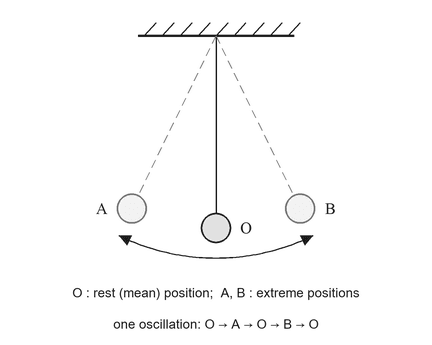
Step 3 — See that it repeats.
This to and fro movement is repeated again and again. Because it repeats after a regular interval of time, oscillatory motion is also a periodic motion. The motion of a swing is another example.
Therefore, oscillatory motion is the to and fro motion of a body about its mean position; for example, the pendulum of a wall clock.
- 503 marks
Question 50
Differentiate between periodic and non-periodic motions by giving an example of each.
Solve with AIWritten solution
Solution:
Concept: The difference is whether or not the motion repeats after a regular interval of time.
Step 1 — Compare the two motions.
The table sets the two motions side by side.
Periodic motion Non-periodic motion A motion which repeats itself after a regular interval of time. A motion which does not repeat itself after a regular interval of time. We can tell in advance when the motion will be repeated. We cannot tell when, or whether, the motion will repeat. Example: the pendulum of a wall clock repeats its motion every 2 s; the earth goes round the sun in about 365¼ days. Example: a footballer running on a field; a ball rolling on the ground that slowly stops. Step 2 — State the key test.
To decide, ask whether the same motion comes back again after a fixed time. If it does, the motion is periodic; if it does not, it is non-periodic.
Therefore, periodic motion repeats after a regular interval of time (a clock pendulum), while non-periodic motion does not (a footballer running on a field).
- 513 marks
Question 51
Give two examples to illustrate that a body can have two or more types of motion simultaneously.
Solve with AIWritten solution
Solution:
Concept: When a body has more than one type of motion at the same time, its motion is called mixed motion.
Step 1 — Example 1: the wheel of a moving cycle.
The wheel turns about its axle, which is rotatory motion. At the same time the whole wheel moves forward along the road, which is translatory motion.
Step 2 — Example 2: the earth.
The earth spins about its own axis, which is rotatory motion. At the same time it goes round the sun along a nearly circular path, which is circular (curvilinear) motion. It completes each round in about 365¼ days, so this motion is also periodic.
Step 3 — Other examples.
A carpenter's drill has rotatory and translatory motion, and a carpenter's saw has oscillatory and translatory motion.
Therefore, the wheel of a moving cycle (rotatory and translatory) and the earth (rotatory and circular) show that a body can have two or more types of motion at the same time.
- 523 marks
Question 52
Distinguish between uniform and non-uniform motions, giving an example of each.
Solve with AIWritten solution
Solution:
Concept: A body is in uniform motion if it travels equal distances in equal intervals of time, so its speed stays the same. It is in non-uniform motion if it travels unequal distances in equal intervals of time, so its speed keeps changing.
Step 1 — Compare the two motions.
The table sets the two motions side by side.
Uniform motion Non-uniform motion The body travels equal distances in equal intervals of time. The body travels unequal distances in equal intervals of time. Its speed stays the same. Its speed keeps changing. Example: a car covering 30 km in each hour from 9 a.m. to 12 noon, so its speed stays 30 km h. The tip of the second hand of a clock also moves with uniform speed. Example: a car covering 4 km in the first hour, 8 km in the second hour and 3 km in the third hour. A bicycle moving slowly in a busy market and fast on a clear road. Step 2 — Describe non-uniform motion.
For a body in non-uniform motion we cannot give one steady speed, so we describe its motion by its average speed.
Therefore, uniform motion covers equal distances in equal intervals of time (a car covering 30 km every hour), and non-uniform motion covers unequal distances in equal intervals of time (a car covering 4 km, 8 km and 3 km in three hours).
- 533 marks
Question 53
How do you determine the average speed of a body in non-uniform motion ?
Solve with AIWritten solution
Solution:
Concept: For a body in non-uniform motion we use its average speed, which is the total distance travelled divided by the total time taken.
Step 1 — Write the rule.
In non-uniform motion the speed keeps changing, so we find one average value for the whole journey.
Step 2 — Follow the method.
Add up all the distances travelled in the different parts of the journey. Then add up all the times taken for those parts. Finally, divide the total distance by the total time.
Step 3 — Work an example.
A car travels 4 km in the first hour, 8 km in the second hour and 3 km in the third hour. We first add the distances.
The journey lasts 3 h, so we divide 15 km by 3 h.
Watch out: The average speed is not the simple average of the speeds of the separate parts unless all the parts take equal times.
Therefore, the average speed of a body in non-uniform motion is found by dividing the total distance travelled by the total time taken.
- 543 marks
Question 54
State three differences between mass and weight.
Solve with AIWritten solution
Solution:
Concept: Mass is the quantity of matter in a body. Its S.I. unit is the kilogram (kg), it has magnitude only, and it does not change from place to place. Weight is the force with which the earth (or any heavenly body) pulls a body towards its centre. Its S.I. unit is the newton (N). On the earth a mass of 1 kg weighs 1 kgf, which is about 10 N.
Step 1 — List three differences.
The table compares mass and weight point by point.
Mass Weight 1. It is the quantity of matter contained in a body. 1. It is the force with which the earth attracts the body. 2. Its S.I. unit is the kilogram (kg). 2. Its S.I. unit is the newton (N); another unit is the kilogram-force (kgf), where 1 kgf is nearly 10 N. 3. It is constant for a body and does not change from place to place. 3. It is not constant for a body; it changes from place to place. Step 2 — Note other differences.
Mass is measured with a beam balance, while weight is measured with a spring balance. Mass has only magnitude, while weight has magnitude and direction (vertically downwards). Mass is never zero, but weight becomes zero at the centre of the earth and nearly zero in deep space, far from every heavenly body.
Therefore, mass is the quantity of matter (unit kg, the same everywhere), while weight is the earth's pull on the body (unit N, changing from place to place).
- 553 marks
Question 55
A car covers a distance of 160 km between two cities in 4 h. What is the average speed of the car ?
Solve with AIWritten solution
Solution:
Concept: For a body in non-uniform motion we use its average speed, which is the total distance travelled divided by the total time taken.
Given: Total distance = 160 km, total time = 4 h.
Step 1 — Write the formula.
We divide the total distance by the total time.
Step 2 — Put in the values.
The distance is 160 km and the time is 4 h.
Therefore, the average speed of the car is 40 km h.
- 563 marks
Question 56
A train travels a distance of 300 km with an average speed of 60 km h. How much time does it take to cover the distance ?
Solve with AIWritten solution
Solution:
Concept: For a body in non-uniform motion we use its average speed, which is the total distance travelled divided by the total time taken.
Given: Distance = 300 km, average speed = 60 km h.
Step 1 — Rearrange the formula.
Average speed is distance divided by time, so time is distance divided by average speed.
Step 2 — Put in the values.
The distance is 300 km and the average speed is 60 km h.
Therefore, the train takes 5 h to cover the distance.
- 573 marks
Question 57
A boy travels with an average speed of 10 m s for 20 min. How much distance does he travel ?
Solve with AIWritten solution
Solution:
Concept: For a body in non-uniform motion we use its average speed, which is the total distance travelled divided by the total time taken.
Given: Average speed = 10 m s, time = 20 min.
Step 1 — Change the time into seconds.
The speed is in metres per second, so the time must be in seconds too. One minute is 60 s.
Step 2 — Find the distance.
Distance is average speed multiplied by time.
Step 3 — Express it in kilometres.
Since 1000 m make 1 km, 12 000 m is 12 km.
Watch out: Multiplying 10 m s by 20 min directly would mix units and give the wrong number (200).
Therefore, the boy travels 12 000 m, that is, 12 km.
- 584 marks
Question 58
A boy walks a distance of 30 m in 1 minute and another 30 m in 1.5 minute. Describe the type of motion of the boy and find his average speed in m s.
Solve with AIWritten solution
Solution:
Concept: A body is in uniform motion if it travels equal distances in equal intervals of time, so its speed stays the same. It is in non-uniform motion if it travels unequal distances in equal intervals of time, so its speed keeps changing. For a body in non-uniform motion we use its average speed, which is the total distance travelled divided by the total time taken.
Given: First 30 m in 1 min; next 30 m in 1.5 min.
Step 1 — Change the times into seconds.
The answer is wanted in m s, so we write each time in seconds. The first 30 m take 1 min, or 60 s, and the next 30 m take 1.5 min.
Step 2 — Describe the type of motion.
The boy covers equal distances (30 m each) in unequal times (60 s and 90 s). So he does not cover equal distances in equal intervals of time, and his motion is non-uniform.
Step 3 — Find the totals.
We add the two distances and the two times.
Step 4 — Find the average speed.
Average speed is the total distance divided by the total time.
Watch out: Equal distances in unequal times is also non-uniform motion; uniform motion needs equal distances in equal times.
Therefore, the motion of the boy is non-uniform, and his average speed is 0.4 m s.
- 594 marks
Question 59
A cyclist travels a distance of 1 km in the first hour, 0.5 km in the second hour and 0.3 km in the third hour. Find the average speed of the cyclist in (i) km h, (ii) m s.
Solve with AIWritten solution
Solution:
Concept: For a body in non-uniform motion we use its average speed, which is the total distance travelled divided by the total time taken. To change a speed from km h into m s, use 1 km = 1000 m and 1 h = 3600 s. This is the same as dividing by 3.6.
Given: Distances 1 km, 0.5 km and 0.3 km in three successive hours.
Step 1 — Find the total distance.
We add the distances covered in the three hours.
Step 2 — Find the total time.
Each part lasts 1 h, and there are three parts, so the total time is 3 h.
Step 3 — Part (i): average speed in km h.
We divide the total distance by the total time.
Step 4 — Part (ii): change to m s.
We write 0.6 km as 600 m and 1 h as 3600 s.
Watch out: The time for each part is 1 h, so the total time is 3 h, not 1 h.
Therefore, the average speed of the cyclist is (i) 0.6 km h and (ii) 1/6 m s, that is about 0.167 m s.
- 604 marks
Question 60
A car travels with speed 30 km h for 30 minutes and then with speed 40 km h for one hour. Find :
(a) the total distance travelled by the car
(b) the total time of travel, and
(c) the average speed of car
Solve with AIWritten solution
Solution:
Concept: For each part of a journey, the distance is the speed multiplied by the time. The average speed for the whole journey is the total distance divided by the total time.
Given: 30 km h for 30 min, then 40 km h for 1 h.
Step 1 — Change 30 minutes into hours.
The speeds are in km h, so the time must be in hours. Thirty minutes is half an hour, 0.5 h.
Step 2 — Part (a): find each distance and add.
In the first part the car runs at 30 km h for 0.5 h.
In the second part it runs at 40 km h for 1 h.
We add the two distances.
Step 3 — Part (b): find the total time.
We add the times of the two parts.
Step 4 — Part (c): find the average speed.
We divide the total distance by the total time.
Watch out: The average speed is not the simple average of 30 and 40 (35 km h), because the car runs longer at 40 km h.
Therefore, (a) the total distance is 55 km, (b) the total time is 1.5 h, and (c) the average speed is about 36.67 km h.
- 614 marks
Question 61
On earth the weight of a body of mass 1.0 kg is 10 N. What will be the weight of a boy of mass 37 kg in (a) kgf (b) N ?
Solve with AIWritten solution
Solution:
Concept: Weight is the force with which the earth (or any heavenly body) pulls a body towards its centre. Its S.I. unit is the newton (N). On the earth a mass of 1 kg weighs 1 kgf, which is about 10 N.
Given: Mass of the boy = 37 kg; on the earth, 1 kg weighs 10 N.
Step 1 — Part (a): weight in kgf.
On the earth a mass of 1 kg weighs 1 kgf. So a boy of mass 37 kg weighs 37 kgf.
Step 2 — Part (b): weight in newtons.
The weight of 1 kg on the earth is 10 N, so the earth pulls each kilogram with 10 N. We multiply the mass by this pull.
Therefore, the weight of the boy is (a) 37 kgf and (b) 370 N.
- 624 marks
Question 62
The weight of a body of mass 6.0 kg on moon is 10 N. If a boy of mass 30 kg goes from earth to the moon surface, what will be his (a) mass, (b) weight ?
Solve with AIWritten solution
Solution:
Concept: Mass stays the same everywhere because the amount of matter does not change. Weight depends on the pull of gravity at the place, so it changes from place to place; on the moon it is about one-sixth of its value on the earth.
Given: On the moon a 6.0 kg mass weighs 10 N; mass of the boy = 30 kg.
Step 1 — Part (a): mass on the moon.
Mass is the quantity of matter in the boy. Going to the moon does not change the amount of matter, so his mass stays 30 kg.
Step 2 — Find the pull of the moon on 1 kg.
On the moon a 6.0 kg mass weighs 10 N, so the pull on each kilogram is 10 N shared among 6 kg.
Step 3 — Part (b): weight of the boy on the moon.
We multiply his mass by the moon's pull on each kilogram.
Step 4 — Check with the earth value.
On the earth he would weigh 30 × 10 N = 300 N, and 50 N is one-sixth of 300 N, as expected for the moon.
Watch out: The mass does not change on the moon; only the weight becomes less.
Therefore, on the moon the boy's (a) mass is 30 kg and (b) weight is 50 N.
- 633 marks
Question 63
A body has a mass of 100 kg on earth. What will be its mass on moon, considering gravity of moon is 1/6th of earth ? What will be its weight on earth and moon ?
Solve with AIWritten solution
Solution:
Concept: Mass stays the same everywhere because the amount of matter does not change. Weight depends on the pull of gravity at the place, so it changes from place to place; on the moon it is about one-sixth of its value on the earth. Weight is ; take on the earth.
Given: Mass = 100 kg on the earth; gravity on the moon = 1/6 of that on the earth.
Step 1 — Mass on the moon.
Mass is the quantity of matter in the body, which does not change with place. So its mass on the moon is still 100 kg.
Step 2 — Weight on the earth.
We multiply the mass by the earth's pull on each kilogram.
This is the same as 100 kgf.
Step 3 — Weight on the moon.
The moon's gravity is one-sixth of the earth's, so the weight there is one-sixth of the weight on the earth.
This is about 16.67 kgf.
Watch out: The mass stays 100 kg on the moon; only the weight becomes one-sixth.
Therefore, the mass on the moon is 100 kg, the weight on the earth is 1000 N (100 kgf), and the weight on the moon is about 166.67 N (about 16.67 kgf).
What Class 7 Physics Ch 2 covers
The sections of the chapter, in the order the book takes them. Every question above comes from one of these.
- 01Rest and Motion
- 02Rest and Motion Are Relative
- 03Different Types of Motion
- 04Mixed Motion
- 05Speed
- 06Uniform Motion
More ways to study this chapter
The same chapter asked three other ways. Practise it, revise it, and see what the board has set on Ch 2 before.
Class 7 Physics Ch 2 questions students ask
How many questions are there in Class 7 Physics Ch 2?
63 questions. Every one is solved step by step on this page.
Are these Class 7 Physics solutions free?
Yes. Every question and its full working is free to read, with no account needed.
Can I download the Class 7 Physics Ch 2 solutions as a PDF?
There is no PDF to download. Every solution is on this page instead, which means it is searchable, always the current syllabus, and readable on a phone. Use your browser's print option if you want it on paper.