
Opening your dashboard
Class 7 Physics Chapter 2 Motion: Practice Questions
40 questions on Chapter 2, each worked through on its own page with the AI tutor. Class 7 Physics, ICSE 2026-27.
40 questions
1–5 marks · Mixed difficulty
- 11 mark
Question 1
Bloom's level: Remember
An object is said to be in motion if, with time, there is a change in its :
- 21 mark
Question 2
Bloom's level: Remember
In which type of motion does one part of the body always remain fixed, while the rest of it moves to and fro so that its shape changes ?
- 31 mark
Question 3
Bloom's level: Understand
A lamp post by the side of a road is said to be at rest because :
- 41 mark
Question 4
Bloom's level: Understand
Which of the following is an example of circular motion (and not rotatory motion) ?
- 51 mark
Question 5
Bloom's level: Apply
A bus travels 45 km in the first hour and then 15 km in the next half hour. Its average speed for the whole journey is :
- 61 mark
Question 6
Bloom's level: Apply
A spring balance shows the weight of a bag of rice as 120 N. Taking the force of gravity on 1 kg as 10 N, the mass of the rice is :
- 71 mark
Question 7
Bloom's level: Analyse
The position of a toy car on a straight track was noted every 2 seconds :
Time (in s) 0 2 4 6 8 Position (in cm) 0 10 20 30 40 Which statement about the motion of the toy car is correct ?
- 81 mark
Question 8
Bloom's level: Evaluate
An astronaut says, "When I land on the moon, my mass will become one-sixth of my mass on the earth." Which is the best judgement of this statement ?
- 91 mark
Question 9
Bloom's level: Understand
A boy is riding a bicycle along a straight road. The motion of a pedal of the bicycle is :
- 101 mark
Question 10
Bloom's level: Understand
Read the Assertion (A) and the Reason (R) and choose the correct option.
Assertion (A): To a passenger in a train, another train moving with the same speed in the same direction on the next track appears to be at rest.
Reason (R): The position of the other train does not change with respect to the passenger.
- 111 mark
Question 11
Bloom's level: Understand
Read the Assertion (A) and the Reason (R) and choose the correct option.
Assertion (A): The motion of a car through a busy market is non-uniform.
Reason (R): The speedometer of a car shows its average speed for the whole journey.
- 121 mark
Question 12
Bloom's level: Remember
Read the Assertion (A) and the Reason (R) and choose the correct option.
Assertion (A): The S.I. unit of weight is kilogram.
Reason (R): The weight of a body is the force with which the earth attracts it.
- 132 marks
Question 13
Bloom's level: Understand
A sparrow sits on the branch of a tree for a minute and then flies to the roof of a house. During which part of this time is the sparrow in motion ? Explain how you decide.
- 142 marks
Question 14
Bloom's level: Apply
With respect to the school building, state whether each of the following is at rest or in motion, giving a reason :
(a) students marching round the playground
(b) the flag-pole
(c) a kite flying above the school
(d) a bus parked at the school gate
- 152 marks
Question 15
Bloom's level: Apply
Name the type of motion in each of the following :
(a) a child sliding down a straight slide
(b) a cabin of a giant wheel at a fair
(c) a plucked string of a guitar
(d) dust particles seen moving in a beam of sunlight in a dark room
- 162 marks
Question 16
Bloom's level: Apply
During a storm, Riya hears the thunder 3 s after she sees the lightning flash. The speed of sound in air is 330 m s, and light reaches her almost at once. How far away is the lightning ?
- 172 marks
Question 17
Bloom's level: Understand
Is the motion of the tip of the second hand of a clock uniform ? Is it periodic ? Explain both answers.
- 182 marks
Question 18
Bloom's level: Apply
A delivery scooter covers 300 m, 500 m, 500 m and 200 m in four successive minutes through a town.
(a) Why is its motion called non-uniform ?
(b) Find its average speed in km h.
- 192 marks
Question 19
Bloom's level: Apply
A school bus goes 6 km from the depot to the school in 20 min, waits at the school for 10 min, and returns to the depot by the same road in 30 min. Find the average speed of the bus for the whole trip (including the wait) in km h.
- 202 marks
Question 20
Bloom's level: Evaluate
A shopkeeper says, "This bag of flour weighs 5 kg." Is the shopkeeper using the correct unit for weight ? Justify your answer and state the weight correctly (take 1 kgf = 10 N).
- 212 marks
Question 21
Bloom's level: Analyse
An astronaut of mass 60 kg is measured on the earth with a beam balance and with a spring balance (marked in kgf). Both read 60. Which reading will change when the same measurement is made on the moon, and what will it become ? Give a reason.
- 222 marks
Question 22
Bloom's level: Remember
Write the symbol and the S.I. unit of each of the following quantities :
(a) speed (b) mass (c) weight
- 234 marks
Question 23
Bloom's level: Apply
A family drives 90 km on a highway at a steady speed of 60 km h, stops for 30 minutes for lunch, and then drives 40 km on a hilly road at a steady speed of 20 km h.
(a) Find the time taken for each part of the drive.
(b) Find the average speed for the whole trip, including the lunch stop.
(c) Is the motion for the whole trip uniform or non-uniform ? Give a reason.
- 244 marks
Question 24
Bloom's level: Analyse
Two runners P and Q run a 200 m race on a straight track. Their distances from the start are noted every 10 s :
Time (in s) 0 10 20 30 40 Distance of P (in m) 0 50 100 150 200 Distance of Q (in m) 0 30 70 130 200 (a) Whose motion is uniform and whose is non-uniform ? Give a reason.
(b) Find the speed of P and the average speed of Q for the whole race.
(c) In which 10 s interval does Q run the fastest ? Find Q's average speed in that interval.
(d) Who is ahead at 20 s, and by how much ? Who wins the race ?
- 254 marks
Question 25
Bloom's level: Analyse
Case study: Arjun is sitting in a train standing at a platform. Another train is standing on the next track. Looking out of the window, Arjun suddenly sees the other train moving backwards and feels that his own train has started moving forward. His mother is sitting opposite him.
(a) With respect to Arjun, is his mother at rest or in motion ? Is the other train at rest or in motion ?
(b) Give two different situations that could make Arjun see the other train moving backwards.
(c) How can Arjun find out which train is really moving with respect to the platform ? Explain why this works.
- 264 marks
Question 26
Bloom's level: Apply
Case study: An astronaut packs a kit bag of mass 30 kg for a mission to the moon. On the earth, the force of gravity on 1 kg is 10 N; on the moon, it is one-sixth of that on the earth. On the way, the spacecraft circles the earth for some time, and the bag floats freely inside it.
(a) Find the weight of the bag on the earth in kgf and in newton.
(b) Find the mass and the weight (in newton) of the bag on the moon.
(c) What are the mass and the weight of the bag inside the spacecraft circling the earth ? Why is the mass not zero there ?
- 273 marks
Question 27
Bloom's level: Analyse
Each of the following has more than one type of motion at the same time. Name the types of motion in each.
(a) a rolling pin (belan) being rolled forward over a ball of dough
(b) the blades of a table fan whose head turns slowly from side to side and back
(c) the earth
Which of these motions are periodic ?
- 283 marks
Question 28
Bloom's level: Evaluate
A cyclist rides 12 km from his village to a town at a speed of 12 km h, and comes back by the same road at 6 km h. His friend says, "The average speed for the whole journey is km h."
Check the friend's method. Find the correct average speed and explain why the friend's method gives a wrong answer here.
- 295 marks
Question 29
Bloom's level: Create
Design a simple activity to show that a toy car rolling down a sloping board and then along the floor has non-uniform motion. Include :
(a) the things you need and how you will set them up,
(b) what you will measure and how,
(c) an observation table with your own sample readings,
(d) how your readings show non-uniform motion, and the average speed of the car from your readings.
- 304 marks
Question 30
Bloom's level: Create
A metro train runs on an 18 km route. Between two stations 1.8 km apart it moves at a steady speed and takes 2 minutes; the whole route, including the stops at stations, takes 30 minutes.
Using this information, frame two word problems - one on the speed of a body in uniform motion and one on average speed - and solve both, giving the answers in km h (and m s for the first).
- 311 mark
Question 31
A cricket ball rolling along the ground towards the boundary has :
- 321 mark
Question 32
A bus is moving at a speed of 54 km h. Its speed in m s is :
- 331 mark
Question 33
A body is imagined to be taken from the surface of the earth to the centre of the earth. Which of the following statements is correct ?
- 341 mark
Question 34
Fill in the blank :
A body is said to be at rest if it does not change its .............. with respect to its surroundings with time.
- 351 mark
Question 35
Write true or false :
A stone lying on the ground is at rest with respect to the sun.
- 362 marks
Question 36
Differentiate between oscillatory motion and vibratory motion. Give one example of each.
- 372 marks
Question 37
An aeroplane flies along a straight path with a uniform speed of 720 km h.
(a) Express this speed in m s.
(b) How far does the aeroplane fly in 25 s ?
- 384 marks
Question 38
(a) What is meant by oscillatory motion ?
(b) Draw a labelled diagram of the pendulum of a wall clock in motion. Mark its rest position O and its two extreme positions A and B. With the help of the diagram, describe one complete to and fro motion of the bob.
(c) The pendulum of a wall clock repeats its motion after every 2 s. What is such a motion called ? How many complete to and fro motions does this pendulum make in one minute ?
- 394 marks
Question 39
The figure shows the positions of a truck moving along a straight highway at 6 a.m., 7 a.m., 8 a.m. and 9 a.m., and the distance it covers in each hour.
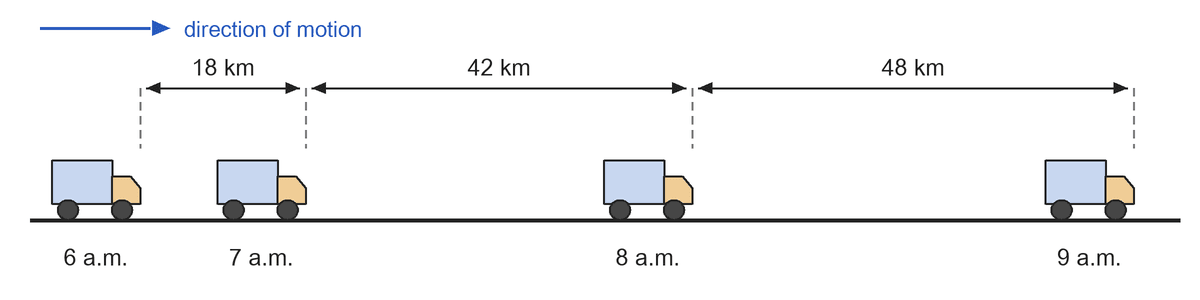
(a) Write the distance travelled by the truck in each of the three hours in the form of a table.
(b) Is the motion of the truck uniform or non-uniform ? Give a reason for your answer.
(c) Calculate the average speed of the truck from 6 a.m. to 9 a.m. in (i) km h, (ii) m s.
- 405 marks
Question 40
A rover (a robot vehicle) of mass 900 kg is sent from the earth to the planet Mars. The force of gravity on a mass of 1 kg is 10 N on the earth and about 4 N on Mars.
(a) Find the weight of the rover on the earth in (i) newton, (ii) kgf. (Take 1 kgf = 10 N.)
(b) What is the mass of the rover on Mars ? Give a reason for your answer.
(c) Find the weight of the rover on Mars in newton. By how many newton is it less than its weight on the earth ?