
Opening your dashboard
Class 7 Physics Chapter 2 Motion: Competency-Based Questions (CBQ)
40 questions on Chapter 2, each worked through on its own page with the AI tutor. Class 7 Physics, ICSE 2026-27.
40 questions
1–5 marks · Mixed difficulty
- 11 mark
Question 1
Competency: Application
In a shopping mall, Meera stands still on a step of an escalator (moving staircase) that is carrying her up from the ground floor to the first floor. Which statement describes her state correctly ?
- 21 mark
Question 2
Competency: Analysis
Three delivery riders P, Q and R note the distance they cover and the time they take on a straight stretch of road.
Rider Distance covered Time taken P 400 m 80 s Q 21.6 km 1 h R 1.5 km 5 min Each rider moves at a steady speed. Which conclusion is correct ?
- 31 mark
Question 3
Competency: Analysis
At a fair, Rohan stands at the gate with a stop-watch. He notes the times at which two moving things pass the gate.
What passes the gate Times of passing the gate (in s) A child sitting on a horse of a merry-go-round 0, 12, 24, 36 A balloon seller walking round and round the same path 0, 40, 95, 130 Which conclusion do these readings support ?
- 41 mark
Question 4
Competency: Application
A notice inside the cabin of a cable car (ropeway) reads : "Maximum load 4000 N". A group of tourists, each of mass 68 kg, wants to ride in it. The force of gravity on a mass of 1 kg is 10 N. What is the greatest number of these tourists that the cabin can carry safely at one time ?
- 51 mark
Question 5
Competency: Understanding
Assertion (A): A spinning top that slowly drifts across a smooth floor has a mixed motion.
Reason (R): The top turns about its own axis and, at the same time, moves as a whole from one place to another.
- 61 mark
Question 6
Competency: Understanding & Analysis
Assertion (A): A bus that covers 30 km in each hour of a three-hour journey through towns and villages is certainly in uniform motion.
Reason (R): A body is in uniform motion if it covers equal distances in equal intervals of time.
- 72 marks
Question 7
Competency: Application
At a pedestrian crossing, the road is 18 m wide and the green "walk" signal stays on for 24 s. Arun walks at a steady speed of 1.2 m s and his grandmother walks at a steady speed of 0.6 m s. Both start as soon as the signal turns green.
(a) Show by calculation whether each of them can cross the road before the signal changes.
(b) Find the least steady speed at which a person must walk to cross this road in 24 s.
- 82 marks
Question 8
Competency: Application & Analysis
A carpenter fixes two wooden planks together. He hammers a straight nail into one plank, and he drives a screw into the other plank with a screwdriver. The screw is 3 cm long, and he notices that it goes 2 mm deeper into the wood with each complete turn.
(a) Compare the motion of the nail with the motion of the screw as each goes into the wood. Which of the two has a mixed motion ?
(b) How many complete turns are needed to drive the whole length of the screw into the plank ?
- 92 marks
Question 9
Competency: Evaluation
Kavya sits in a small boat that is drifting down a river with the flow of the water. A wooden log floats beside the boat and stays beside it all the time. Kavya says, "The log is at rest." Her brother, standing on the bank, says, "No, the log is moving."
(a) Who is correct ? Justify your answer.
(b) Kavya now rows against the flow so that her boat stays exactly opposite a tree on the bank, while the log goes on floating down the river. State, with a reason, whether the boat is now at rest or in motion relative to the tree, and whether the log is at rest or in motion relative to the boat.
- 102 marks
Question 10
Competency: Application & Analysis
In a soft-drink factory, filled bottles stand in a line on a moving belt, 30 cm apart from one another. A machine fixed above the belt presses a cap down once every 2 s, and each bottle must be exactly below the machine when the cap comes down.
(a) With what speed, in cm s, must the belt move ? What type of motion must it have ?
(b) One day the belt still carries 30 bottles past the machine in every minute, but its motion has become non-uniform. Explain what will go wrong.
- 113 marks
Question 11
Competency: Analysis & Evaluation
Case study: A camera fixed high above a playground takes two photographs, 5 s apart. Chalk lines divide the ground into squares of side 1 m. The photographs show a tree, a bench, two children (Asha and Ravi) and a dog.
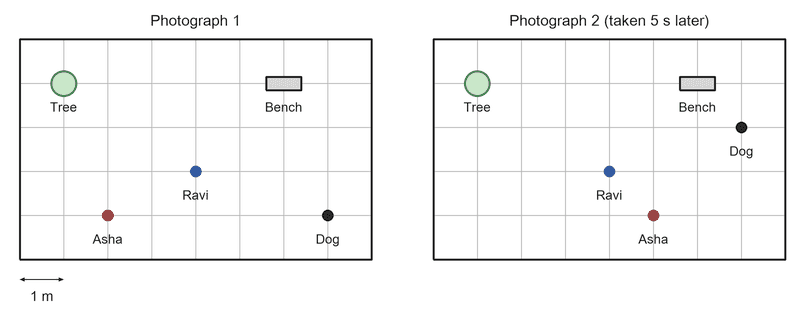
(a) Which of Asha, Ravi and the dog were in motion relative to the ground during these 5 s ? Explain how the photographs show this.
(b) Asha and the dog each moved along a straight line at a steady speed. Find the speed of each.
(c) Ravi says, "My place is the same in both photographs, so I am at rest for everyone in the playground." Use the photographs to judge whether he is correct.
- 124 marks
Question 12
Competency: Analysis
Case study: A tanker moving along a straight road has a small leak. One drop of oil falls on the road every 2 s. Later, a student lays a measuring tape along the road and marks the places of seven drops, taking the first drop as the 0 m mark.
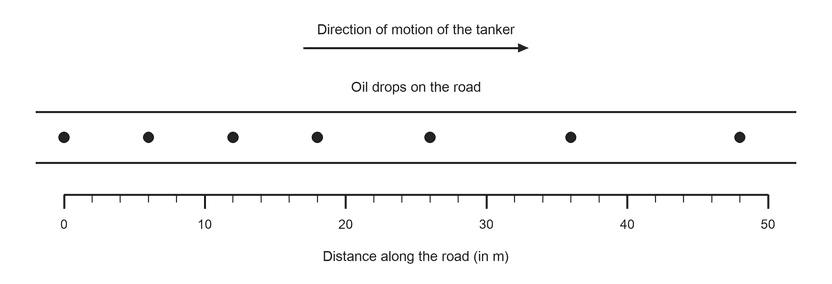
(a) Read the position of each drop from the figure. Make a table showing the distance travelled by the tanker in each interval of 2 s.
(b) Over which part of this stretch was the motion of the tanker uniform ? Find its speed there.
(c) Describe the motion of the tanker over the rest of the stretch, giving a reason from your table.
(d) If the tanker goes on in the same way, at what mark will the next (eighth) drop fall ? Show your reasoning.
- 134 marks
Question 13
Competency: Analysis & Evaluation
Case study: Nisha, a school athlete, runs four laps of a 400 m track without stopping. Her sports watch records the time she takes for each lap.
Lap 1 2 3 4 Time taken (in s) 100 80 125 95 (a) Without calculating, state in which lap she was the fastest and in which she was the slowest. Then find her speed in these two laps.
(b) Find her average speed for the whole run.
(c) Her coach wants her to finish a 2000 m race (five laps) in 480 s. If she runs the first four laps exactly as in the table, at what speed must she run the fifth lap ? Judging from her record, is this plan a sensible one ? Give a reason.
- 143 marks
Question 14
Competency: Application & Analysis
Case study: A chart in a science centre shows what a spring balance would read if the same school bag were hung from it at three different places. The force of gravity on a mass of 1 kg on the earth is 10 N.
Place On the earth On the moon On a giant planet Reading of the spring balance (in N) 120 20 300 (a) Find the mass of the bag on the earth. What is its mass at the other two places ? Give a reason.
(b) Compare the weight of the bag on the moon, and on the giant planet, with its weight on the earth.
(c) A weightlifter can pull upwards with a force of at most 600 N. Find the greatest mass that he can lift at each of the three places.
- 154 marks
Question 15
Competency: Creation
Tara ties a small stone to one end of a thread about 1 m long and hangs it from a hook, so that the stone can swing freely to and fro. She has a stop-watch. She wants to find out by experiment whether the to and fro motion of the stone is periodic.
(a) Plan the experiment for her : say what she should do and what she should measure.
(b) Why is it better to time 20 complete to and fro motions together than to time just one ?
(c) In three trials Tara finds that 20 complete to and fro motions take 40.2 s, 39.8 s and 40.0 s. What do these readings show about the motion ? Find the time taken for one complete to and fro motion.
(d) State one precaution she should take.
- 161 mark
Question 16
Competency: Analysis
A bus moves along a straight road at a steady speed. Anil sits in a seat of the bus. Bela walks slowly along the aisle from the back of the bus towards the front. Chandan stands at the roadside and watches the bus go by.
Which statement is correct ?
- 171 mark
Question 17
Competency: Application
On a Sunday morning at home, Tanvi notices four moving things: the blade of a mixer-grinder that is running, a drawer that is pulled straight out of a cupboard, the pendulum of the wall clock, and a paper plane that she throws across the room, which glides along a curved path before it lands.
Which option names the type of motion of each of these correctly ?
- 181 mark
Question 18
Competency: Analysis
A marble rolls along a straight groove beside a ruler. First it moves on a smooth tile and then it enters a patch of sand. A camera flashes once every second and records the position of the marble on the ruler. The picture shows the positions at 0 s, 1 s, 2 s, 3 s, 4 s and 5 s.

Which statement describes the motion of the marble ?
- 191 mark
Question 19
Competency: Application
On a sports day, Imran's camera records four things in the school ground. In which of them does the moving object have a mixed motion, that is, a motion in which it turns about its own axis and also moves from one place to another ?
- 201 mark
Question 20
Competency: Application
The speedometer of Kabir's bicycle shows a steady reading of 18 km h. A shop is 1.5 km away along a straight road. How long will Kabir take to reach the shop if he keeps this speed ?
- 211 mark
Question 21
Competency: Application
A taxi goes from the airport to a hotel. It covers the first 9 km, on city roads, in 15 minutes. Then it covers the next 30 km, on an open highway, in 30 minutes. What is the average speed of the taxi for the whole journey ?
- 221 mark
Question 22
Competency: Analysis
At a moon base, a packet X of mass 6 kg is weighed with a spring balance. At the same time, a packet Y of mass 1 kg is weighed with a spring balance in a laboratory on the earth. On the earth the force of gravity on 1 kg is 10 N, and on the moon it is one-sixth of that on the earth. Which statement about the two packets is correct ?
- 231 mark
Question 23
Competency: Application
A spring balance on a rover on Mars shows a pull of 74 N for a scientific instrument hung from it. On Mars the force of gravity on a mass of 1 kg is 3.7 N, and on the earth it is 10 N. What is the mass of the instrument, and what will be its weight on the earth ?
- 241 mark
Question 24
Competency: Understanding
Assertion (A): A body in uniform motion must always move along a straight line.
Reason (R): In uniform motion the distance covered is the same in every equal interval of time, whatever the shape of the path.
- 251 mark
Question 25
Competency: Understanding
Assertion (A): The mass of a body is the same on the earth and on the moon.
Reason (R): The weight of a body is the same at all places in the universe.
- 262 marks
Question 26
Competency: Evaluation
A delivery shop advertises, "Our scooter reaches any home within 15 minutes." On a straight road the scooter, moving at a steady speed, covers 15 km in 20 minutes. Mr Das lives 12 km from the shop along this road. (Hypothetical data.)
(a) Find the speed of the scooter in km h.
(b) Is the shop's claim true for Mr Das's home ? Support your answer with a calculation.
- 272 marks
Question 27
Competency: Application
During an air show, a large tanker aircraft refuels a fighter jet in the air. A hose from the tanker is joined to the fighter, and for several minutes both aircraft fly side by side in the same direction at a steady 600 km h relative to the ground. (Hypothetical data.)
(a) During refuelling, is the fighter jet at rest or in motion relative to the tanker, and relative to a person watching from the ground ? Give a reason for each.
(b) Why must the pilot keep the fighter jet at rest relative to the tanker while the hose is joined ?
- 282 marks
Question 28
Competency: Evaluation
Neel says, "All periodic motions are to and fro motions."
(a) Is Neel right ? Give one example of a periodic motion that is not a to and fro motion, and explain why it is periodic.
(b) State what must be true of any motion for it to be called periodic.
- 292 marks
Question 29
Competency: Application
A lift in a hotel moves upwards at a steady speed of 1.5 m s. Each floor is 3 m above the floor below it. The lift starts from the ground floor.
(a) How long does it take to reach the 12th floor ?
(b) How many seconds after the start does it pass the 5th floor ?
- 302 marks
Question 30
Competency: Creativity
Rohit wants to find the distance from his house to the park and his average speed when he cycles there. He has no measuring tape, only a stop-watch, a piece of chalk and his bicycle, whose front wheel moves forward 2 m on the ground in one complete turn. (Hypothetical data.)
(a) Plan how Rohit can use the wheel to find the distance from his house to the park.
(b) In his trial, the front wheel makes 750 complete turns on the way, and the ride takes 6 minutes 15 seconds. Find the distance and his average speed in m s.
- 312 marks
Question 31
Competency: Understanding
Zoya writes in her notebook, "My weight is 40 kg and my mass is 400 N." The force of gravity on a mass of 1 kg is 10 N on the earth.
(a) Point out the two mistakes in her sentence.
(b) Write a correct sentence for her.
- 323 marks
Question 32
Competency: Analysis
A school bus takes students to a museum 30 km away. To arrive on time, the bus must cover the whole distance at an average speed of 40 km h. Because of traffic in the town, it covers the first 10 km in 20 minutes. (Hypothetical data.)
(a) How much time is allowed for the whole trip ?
(b) At what steady speed must the bus cover the remaining distance to arrive on time ?
(c) The driver says, "I will drive the rest of the way at 40 km h, the required average speed, so we will be on time." Is he right ? If not, how many minutes late will the bus be ?
- 333 marks
Question 33
Competency: Analysis
In a school sports practice, Anu runs 100 m in 20 s and Bhanu runs 100 m in 16 s. Each runs at a steady speed. (Hypothetical data.)
(a) Find the speed of each girl.
(b) To make the race fairer, Anu is allowed to start 15 m ahead of the starting line, and both run to the same finishing line 100 m from the starting line. Who wins, and by how many seconds ?
(c) What head start would make the race a dead heat (both reach the finishing line together) ?
- 343 marks
Question 34
Competency: Analysis
A space probe lands on a distant planet P. Its spring balance is used to weigh three standard masses, and two readings are recorded. (Hypothetical data.) On the earth the force of gravity on 1 kg is 10 N.
Mass 2 kg 5 kg 8 kg Reading of the spring balance 7 N 17.5 N not recorded (a) Find the force of gravity on a mass of 1 kg on planet P.
(b) What reading should the spring balance show for the 8 kg mass ?
(c) Compare the weight of the 5 kg mass on planet P with its weight on the earth. What is its mass on planet P ?
- 353 marks
Question 35
Competency: Evaluation
Ananya says, "Nothing in the universe is truly at rest." Her teacher asks her to explain this using the bench in the school garden. The earth spins about its axis and goes round the sun.
(a) Is the bench at rest or in motion relative to the school building ? Give a reason.
(b) Is the bench at rest or in motion relative to the sun ? Give a reason.
(c) Is Ananya's statement acceptable ? Why do we still say in daily life that the bench is at rest ?
- 363 marks
Question 36
Competency: Application
At a fair, a Ferris wheel has a radius of 21 m. It completes 15 rotations in 30 minutes, turning at a steady rate. Take . (Hypothetical data.)
(a) Name the type of motion of a rider's seat on the wheel. Is it periodic ?
(b) Find the time taken for one rotation, that is, the time period of the motion.
(c) Find the distance a rider travels in one rotation and the speed of the rider.
- 374 marks
Question 37
Competency: Analysis
Case study: Ravi leaves home on his bicycle for the weekly market. A cycle computer fitted to the bicycle records the total distance he has covered since leaving home, once every 10 minutes. On the way he stops for some time at a roadside shop to buy a gift, and then he rides on. His readings are given in the table. (Hypothetical data.)
Time since leaving home (min) 0 10 20 30 40 50 60 Distance covered (km) 0 3 6 9 9 9 12 (a) Between which times was the motion of Ravi uniform ? Find his speed in km h during these times.
(b) What was Ravi doing between 30 min and 50 min ? How do the readings show this ?
(c) Find his average speed for the whole hour. Why is it less than his speed while he was cycling ?
- 384 marks
Question 38
Competency: Creativity
Case study: A school is planning a small children's park. The planning committee has listed four rides for children of Classes 5 to 7: a straight slide, a merry-go-round, a swing and a see-saw. Every ride will be used all afternoon, and the children will take turns on it. The committee wants the students to say what kind of motion each ride gives to a child, and to suggest one more ride that gives a mixed motion.
(a) Name the type of motion of a child on each of the four rides.
(b) Which of the four rides give a periodic motion when they are used continuously ? Give a reason.
(c) Suggest a fifth ride that gives a mixed motion. State the two motions that a child on it has together.
- 395 marks
Question 39
Competency: Analysis
Case study: Asha walks from her home H to a shop S, and then from the shop to the library L. The two paths meet at a right angle at S, as the map shows. She walks from H to S in 5 minutes and from S to L in 10 minutes, each at a steady speed. The straight-line distance from H to L is 1000 m. (Hypothetical data.)
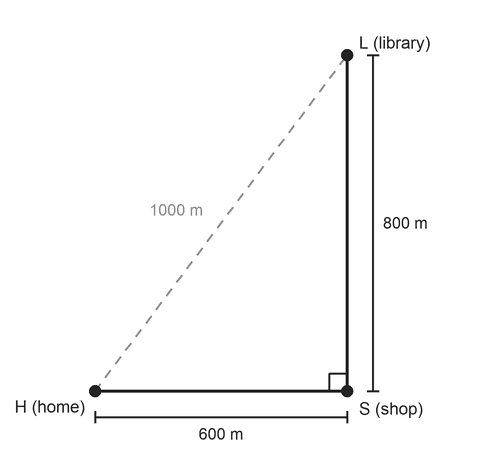
(a) Find Asha's speed on each of the two stretches in m s.
(b) Find her average speed for the whole walk in m s and in km h.
(c) A toy drone flies straight from H to L at a steady 5 m s. How many seconds earlier than Asha does it reach L ?
- 405 marks
Question 40
Competency: Evaluation
Case study: On a straight stretch of an expressway, a traffic camera photographs every car at point A and again at point B, which is 2 km ahead along the road. The speed limit on this stretch is 60 km h, and the traffic police want to find out which drivers have crossed it. The times taken by three cars to go from A to B are in the table. (Hypothetical data.)
Car P Q R Time taken from A to B (s) 90 120 144 (a) Find the average speed of each car in km h.
(b) Which car, if any, has gone faster than the limit on average ?
(c) The driver of car P says, "My speedometer never showed more than 55 km h." Can this be true ? Support your answer with a calculation.