
Question 305 marksMedium
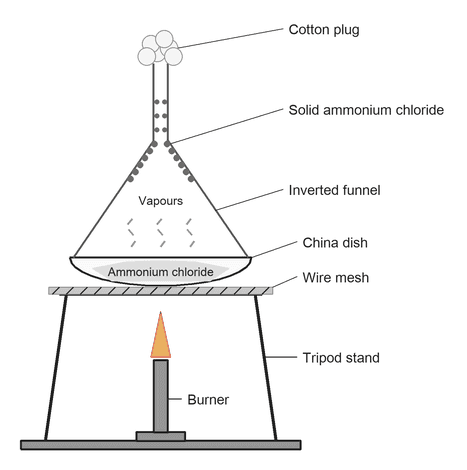
(a) Draw a well-labelled diagram to show the process of sublimation.
(b) Is sublimation a physical change or a chemical change ? Explain.
(c) Name two substances which can sublime.
Confirming your payment
Sign up now and get 250 free tokens.
Physical and Chemical Changes · Question 30 of 32
(a) Draw a well-labelled diagram to show the process of sublimation.
(b) Is sublimation a physical change or a chemical change ? Explain.
(c) Name two substances which can sublime.
Solution:
Concept: Sublimation is the change of a solid directly into vapour on heating, without passing through the liquid state; the solid formed again when the vapour cools is the sublimate.
Step 1 — (a) Describe and draw the set-up.
Solid ammonium chloride is heated in a china dish placed on a wire gauze over a tripod stand and burner. The dish is covered by an inverted funnel whose stem is closed with a cotton plug. The vapours rise and change back into solid on the cooler upper walls of the funnel.
Step 2 — (b) Decide the type of change.
Sublimation is a physical change. Only the state changes, from solid to vapour and back to solid, and no new substance is formed: the solid collected on the funnel is the same substance as the one heated. The change is reversible, since cooling the vapour gives back the original solid.
Step 3 — (c) Name two substances which sublime.
Camphor and iodine change directly into vapour on heating (naphthalene and dry ice are other examples).
Watch out: The cotton plug stops the vapours escaping through the stem, so that they condense on the funnel.
Note: ammonium chloride does not truly sublime. On heating it splits into ammonia and hydrogen chloride gases, which join again into the white solid on the cool funnel; camphor or iodine sublime truly. The fumes are irritating, so the heating is done in a fume cupboard.
Therefore, (a) the set-up is a china dish of the solid under an inverted, plugged funnel, (b) sublimation is a physical change, and (c) camphor and iodine sublime.