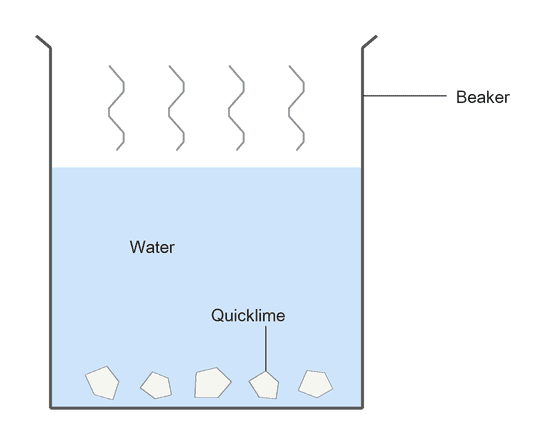
Solution:
Concept: Quicklime (calcium oxide) reacts with water to form a new substance, slaked lime (calcium hydroxide), and gives out a lot of heat.
Step 1 — (a) State what is observed.
The pieces of quicklime crumble with a hissing sound, and a large amount of heat is given out, so the water becomes hot and may even steam. A white solid, slaked lime, forms; a little of it dissolves to give lime water and the rest settles at the bottom of the beaker.
Step 2 — (b) Explain why the beaker becomes hot.
Quicklime reacts with water, and this reaction gives out heat energy, which warms the water and the beaker.
CaO+H2O→Ca(OH)2+heat
Step 3 — (c) Name the type of change.
A new substance, calcium hydroxide, is formed and quicklime cannot be got back simply, so it is a chemical change.
Step 4 — (d) Draw the conclusion.
The adding of quicklime to water is a chemical change in which energy is given out as heat; that is, a chemical change is accompanied by an energy change.
Watch out: The beaker gets hot because of the reaction itself, not because the water was heated; never hold quicklime in wet hands.
Therefore, (a) quicklime crumbles and hisses as much heat is given out, (b) the reaction gives out heat, (c) it is a chemical change, and (d) a chemical change is accompanied by an energy change.