
Opening your dashboard
Class 7 Chemistry Chapter 2: Physical and Chemical Changes Solutions
32 textbook questions with step-by-step answers, free to read, for ICSE 2026-27.
Get talked through Ch 2, not just shown the answer
Reading a finished solution is not the same as being able to do it. The AI tutor takes one question at a time and works it with you, in your own words, until you can.
- Ask it out loud, in your own words
- It gives you the next step, not the answer
- Stuck on part (ii)? Start there
32 questions with solutions
1–5 marks · Mixed difficulty
- 11 mark
Question 1
A substance which cannot sublime is :
Solve with AIAnswer
(A) iodine
(B) camphor
- Correct
(C) sugar
(D) dry ice
Answer: (C) sugar
Concept: Sublimation is the change of a solid directly into vapour on heating, without passing through the liquid state.
Step 1 — Check what each substance does on heating.
Iodine gives violet vapours, camphor slowly turns into vapour, and dry ice (solid carbon dioxide) turns straight into carbon dioxide gas; none of them melts first. Sugar, however, first melts into a liquid and then chars (turns black).
Step 2 — Pick the one that does not sublime.
Sugar passes through a liquid stage and then changes into new substances, so it cannot sublime.
Watch out: Dry ice does not melt at ordinary pressure; it sublimes, which is why it leaves no puddle.
Why the other options are wrong:
- (A) iodine: Iodine changes directly into violet vapour on heating, so it does sublime.
- (B) camphor: Camphor changes directly into vapour, so it does sublime.
- (D) dry ice: Dry ice changes directly into carbon dioxide gas, so it does sublime.
Therefore, sugar is the substance that cannot sublime, option (C).
- 21 mark
Question 2
When you put some ice cubes in a glass, droplets of water are formed on the outer wall of the glass. This explains the phenomenon of :
Solve with AIAnswer
(A) melting
(B) freezing
- Correct
(C) condensation
(D) evaporation
Answer: (C) condensation
Concept: Condensation is the change of a vapour (gas) into a liquid on cooling.
Step 1 — Find where the water comes from.
Air always contains some water vapour. The ice cubes make the outer wall of the glass very cold.
Step 2 — Name the change.
Water vapour from the air touches the cold wall, cools down and changes into tiny drops of liquid water. A vapour changing into a liquid on cooling is condensation.
Watch out: The droplets do not leak through the glass; they come from the water vapour in the surrounding air.
Why the other options are wrong:
- (A) melting: Melting is a solid changing into a liquid; the ice inside melts, but that does not put droplets on the outside.
- (B) freezing: Freezing is a liquid changing into a solid; no ice forms on the outer wall.
- (D) evaporation: Evaporation is a liquid changing into vapour, which is the opposite of what forms the droplets.
Therefore, the droplets on the outer wall show condensation, option (C).
- 31 mark
Question 3
Burning is a :
Solve with AIAnswer
(A) slow process
- Correct
(B) fast process
(C) natural process
(D) none of the above
Answer: (B) fast process
Concept: Burning is a chemical change in which a substance reacts quickly with the oxygen of the air, giving out heat and light.
Step 1 — Think about how long burning takes.
A matchstick, a piece of paper or a candle flame burns within seconds or minutes, giving out heat and light at once.
Step 2 — Compare with a slow change.
Rusting of iron, by contrast, takes days or weeks. Burning is over quickly, so it is a fast process.
Why the other options are wrong:
- (A) slow process: Burning is over in a short time, so it is not a slow process; rusting is an example of a slow process.
- (C) natural process: Burning may be natural (a forest fire caused by lightning) or man-made (burning fuel or a candle), so "natural process" does not describe burning in general.
- (D) none of the above: Option (B) is correct, so "none of the above" is wrong.
Therefore, burning is a fast process, option (B).
- 41 mark
Question 4
Which one of the following is volatile in nature ?
Solve with AIAnswer
(A) common salt
- Correct
(B) petrol
(C) water
(D) milk
Answer: (B) petrol
Concept: A volatile substance changes into vapour very easily, even at room temperature.
Step 1 — Compare how easily each changes into vapour.
Common salt does not evaporate at room temperature. Water and milk evaporate only slowly. Petrol evaporates very quickly, which is why its smell spreads at once and a spilt drop soon disappears.
Step 2 — Pick the volatile one.
So petrol is volatile.
Why the other options are wrong:
- (A) common salt: Common salt is a solid that does not change into vapour at room temperature.
- (C) water: Water evaporates only slowly at room temperature, so it is not called volatile.
- (D) milk: Milk is mostly water and evaporates slowly, so it is not volatile.
Therefore, petrol is volatile in nature, option (B).
- 51 mark
Question 5
An example of both physical and chemical change is :
Solve with AIAnswer
- Correct
(A) burning of candle
(B) melting of ice
(C) cooking of food
(D) glowing of bulb
Answer: (A) burning of candle
Concept: In a physical change no new substance is formed; only the state, shape, size or appearance changes. In a chemical change one or more new substances with different properties are formed.
Step 1 — Look at what happens to a burning candle.
The heat of the flame melts the wax, and the molten wax that drips down solidifies again. Only the state changes, so this part is a physical change.
Step 2 — Look at the flame itself.
At the same time the wax vapour burns, forming new substances, carbon dioxide and water vapour, with heat and light. This part is a chemical change.
Step 3 — Choose the option.
A burning candle clearly shows both kinds of change side by side, so it is the answer.
Why the other options are wrong:
- (B) melting of ice: Melting of ice is only a physical change; no new substance is formed.
- (C) cooking of food: Cooking forms new substances with a new taste and texture, so it is mainly a chemical change. Some physical changes also happen (water boils off, fat melts), but the burning candle is the clearer example of both together.
- (D) glowing of bulb: A glowing bulb is only a physical change; the filament returns to its original state when switched off.
Therefore, burning of a candle is an example of both a physical and a chemical change, option (A).
- 61 mark
Question 6
The compound rust is a hydrated oxide of :
Solve with AIAnswer
(A) copper
(B) aluminium
- Correct
(C) iron
(D) gold
Answer: (C) iron
Concept: Rusting is the slow reaction of iron with the oxygen of the air in the presence of moisture. The reddish-brown product, rust, is a hydrated oxide of iron (iron oxide combined with water).
Step 1 — Recall which metal rusts.
Only iron (and steel, which is mostly iron) forms rust.
Step 2 — Pick the metal.
So rust is a hydrated oxide of iron.
Watch out: Other metals also corrode, but the word "rust" is used only for iron and steel.
Why the other options are wrong:
- (A) copper: Copper forms a green coating in moist air, not reddish-brown rust.
- (B) aluminium: Aluminium gets a thin, protective oxide layer; it does not rust.
- (D) gold: Gold does not react with air and moisture, so it stays shiny.
Therefore, rust is a hydrated oxide of iron, option (C).
- 71 mark
Question 7
When sugar is heated, its colour changes into :
Solve with AIAnswer
(A) red
(B) blue
- Correct
(C) black
(D) grey
Answer: (C) black
Concept: Heating sugar is a chemical change: sugar breaks down into new substances.
Step 1 — Follow the colour changes.
On heating, sugar first melts, then turns light brown and reddish-brown (caramel), and finally becomes black and charred, with a smell of burning.
Step 2 — Name the final colour.
The black residue is mostly carbon (charcoal), so the final colour is black.
Watch out: The question asks for the colour sugar finally changes into; the brown stage comes on the way.
Why the other options are wrong:
- (A) red: Sugar passes through a reddish-brown stage, but its final colour is black.
- (B) blue: Sugar does not turn blue at any stage of heating.
- (D) grey: The residue is black charcoal, not grey.
Therefore, heated sugar changes into black, option (C).
- 81 mark
Question 8
A pop sound is heard when a lighted match stick is brought near the mouth of a jar. This indicates the release of :
Solve with AIAnswer
(A) oxygen gas
- Correct
(B) hydrogen gas
(C) nitrogen gas
(D) water vapour
Answer: (B) hydrogen gas
Concept: Each common gas has a simple test. Hydrogen burns with a pop sound when a lighted match stick is brought near it.
Step 1 — Recall the pop test.
A small amount of hydrogen mixed with air burns very quickly near a flame and makes a small "pop".
Step 2 — Name the gas.
So the pop sound shows that hydrogen gas is being given out, for example when zinc reacts with dilute hydrochloric acid.
Watch out: The test is done with only a small test tube of gas, held away from the face; a large amount of hydrogen mixed with air can explode.
Why the other options are wrong:
- (A) oxygen gas: Oxygen makes a glowing splinter burst into flame; it does not give a pop sound.
- (C) nitrogen gas: Nitrogen does not burn; it puts out the flame without any pop.
- (D) water vapour: Water vapour does not burn and gives no pop sound.
Therefore, the pop sound shows that hydrogen gas is released, option (B).
- 91 mark
Question 9
When we add water to the following substances, which one will show a chemical change ?
Solve with AIAnswer
(A) salt
(B) sugar
(C) oil
- Correct
(D) quick lime
Answer: (D) quick lime
Concept: In a physical change no new substance is formed; only the state, shape, size or appearance changes. In a chemical change one or more new substances with different properties are formed.
Step 1 — Check what happens to each substance in water.
Salt and sugar simply dissolve and can be got back by evaporating the water. Oil does not mix with water and floats on top. Quick lime (calcium oxide) reacts with water, hisses and gives out a lot of heat.
Step 2 — Write the change for quick lime.
Quick lime and water form a new substance, slaked lime (calcium hydroxide), so this is a chemical change.
Watch out: Dissolving is not a chemical change, because the dissolved substance is still there and can be recovered.
Why the other options are wrong:
- (A) salt: Salt simply dissolves in water and can be got back by evaporation, so this is a physical change.
- (B) sugar: Sugar simply dissolves in water and can be got back, so this is a physical change.
- (C) oil: Oil does not mix with water at all; it floats on top and no new substance is formed.
Therefore, quick lime shows a chemical change with water, option (D).
- 101 mark
Question 10
Assertion (A) : The dissolution of salt in water is a physical change.
Reason (R) : Salt retains its composition and properties in solution.
Solve with AIAnswer
- Correct
(A) Both A and R are true and R is the correct explanation of A.
(B) Both A and R are true but R is not the correct explanation of A.
(C) A is true but R is false.
(D) A is false but R is true.
Answer: (A) Both A and R are true and R is the correct explanation of A.
Concept: Judge the Assertion (A) first, then the Reason (R), and only then decide whether R explains A.
Step 1 — Judge the Assertion.
When salt dissolves in water, no new substance is formed; the salt can be got back by evaporating the water. So dissolving salt is a physical change, and A is true.
Step 2 — Judge the Reason.
In the solution the salt is still salt: the water tastes salty, and the same salt is left behind on evaporation. So the salt keeps its composition and properties, and R is true.
Step 3 — Decide whether R explains A.
A change is physical exactly when the substance keeps its composition and properties. So R explains A.
Why the other options are wrong:
- (B): R is not just a true statement beside A; it is exactly the reason why the change is physical.
- (C): R is true: salt does keep its composition and properties in solution.
- (D): A is true: dissolving salt in water is a physical change.
Therefore, both A and R are true and R is the correct explanation of A, option (A).
- 111 mark
Question 11
Assertion (A) : Naphthalene balls disappear from the cupboard after sometime.
Reason (R) : Naphthalene balls undergo evaporation.
Solve with AIAnswer
(A) Both A and R are true and R is the correct explanation of A.
(B) Both A and R are true but R is not the correct explanation of A.
- Correct
(C) A is true but R is false.
(D) A is false but R is true.
Answer: (C) A is true but R is false.
Concept: Judge the Assertion (A) first, then the Reason (R), and only then decide whether R explains A.
Step 1 — Judge the Assertion.
Naphthalene balls kept in a cupboard become smaller and finally disappear. So A is true.
Step 2 — Judge the Reason.
Evaporation is the change of a liquid into vapour. Naphthalene is a solid that changes directly into vapour, which is sublimation, not evaporation. So R is false.
Step 3 — Choose the option.
A is true and R is false, which is option (C).
Watch out: Evaporation always starts from a liquid; a solid changing straight into vapour is sublimation.
Why the other options are wrong:
- (A): R is false, so it cannot be the correct explanation of A.
- (B): This needs R to be true, but R is false.
- (D): A is true: the balls really do disappear.
Therefore, A is true but R is false, option (C).
- 121 mark
Question 12
Assertion (A) : During a chemical change, new substances with entirely different properties are formed.
Reason (R) : Bursting of a cracker is a chemical change.
Solve with AIAnswer
(A) Both A and R are true and R is the correct explanation of A.
- Correct
(B) Both A and R are true but R is not the correct explanation of A.
(C) A is true but R is false.
(D) A is false but R is true.
Answer: (B) Both A and R are true but R is not the correct explanation of A.
Concept: Judge the Assertion (A) first, then the Reason (R), and only then decide whether R explains A.
Step 1 — Judge the Assertion.
In a chemical change, new substances with entirely different properties are formed. So A is true.
Step 2 — Judge the Reason.
When a cracker bursts, its chemicals burn to form new gases and smoke, with heat, light and sound. So it is a chemical change, and R is true.
Step 3 — Decide whether R explains A.
R only gives one example of a chemical change. An example does not explain why new substances are formed in a chemical change, so R does not explain A.
Watch out: An example of a rule is not the reason for the rule.
Why the other options are wrong:
- (A): R is only an example, not the explanation of A.
- (C): R is true: bursting of a cracker is a chemical change.
- (D): A is true: forming new substances is what makes a change chemical.
Therefore, both A and R are true but R is not the correct explanation of A, option (B).
- 131 mark
Question 13
Assertion (A) : Heating of iron with sulphur is a physical change.
Reason (R) : A new substance, iron sulphide is formed, when iron and sulphur are heated together.
Solve with AIAnswer
(A) Both A and R are true and R is the correct explanation of A.
(B) Both A and R are true but R is not the correct explanation of A.
(C) A is true but R is false.
- Correct
(D) A is false but R is true.
Answer: (D) A is false but R is true.
Concept: Judge the Assertion (A) first, then the Reason (R), and only then decide whether R explains A.
Step 1 — Judge the Reason.
When iron and sulphur are heated together, they combine to form a new black substance, iron sulphide. It is not attracted by a magnet and does not dissolve in carbon disulphide, unlike iron and sulphur. So R is true.
Step 2 — Judge the Assertion.
A new substance is formed, so heating iron with sulphur is a chemical change, not a physical one. So A is false.
Step 3 — Choose the option.
A is false and R is true, which is option (D).
Watch out: A mixture of iron filings and sulphur (unheated) is only a physical mixture; it is the heating that makes them react.
Why the other options are wrong:
- (A): A is false, so R cannot explain it.
- (B): This needs A to be true, but A is false.
- (C): It is the other way round: A is false and R is true.
Therefore, A is false but R is true, option (D).
- 145 marks
Question 14
Fill in the blanks.
(a) A new substance is always formed in a ________ change.
(b) Melting of ice is a ________ change.
(c) When a candle burns, wax melts. Melting of wax is a ________ change.
(d) Chemical change occurs as a result of ________ between two substances.
(e) Burning of a fuel is a ________ change.
(f) Revolution of the earth around the sun is a ________ change.
(g) Growing of a seedling into a plant is a ________ change.
Solve with AIWritten solution
Solution:
Concept: In a physical change no new substance is formed; only the state, shape, size or appearance changes. In a chemical change one or more new substances with different properties are formed. A change that repeats at regular intervals of time is a periodic change.
Step 1 — (a) Where a new substance forms.
A new substance is always formed in a chemical change.
Step 2 — (b) Melting of ice.
Ice only changes its state into water, so melting of ice is a physical change.
Step 3 — (c) Melting of wax.
Molten wax sets back into solid wax on cooling, so melting of wax is a physical change.
Step 4 — (d) Cause of a chemical change.
A chemical change happens as a result of a chemical reaction between two substances.
Step 5 — (e) Burning of a fuel.
A burning fuel forms new substances such as carbon dioxide and water, so it is a chemical change.
Step 6 — (f) Revolution of the earth.
The earth goes round the sun once every year, again and again, so this is a periodic change.
Step 7 — (g) Seedling into a plant.
A growing plant makes new substances from carbon dioxide, water and minerals, so growth is a chemical change (also slow, natural and irreversible).
Watch out: In (c) the candle shows both changes: the melting is physical, while the burning of the wax vapour is chemical.
Therefore, (a) chemical, (b) physical, (c) physical, (d) chemical reaction, (e) chemical, (f) periodic, (g) chemical.
- 155 marks
Question 15
Write true or false against the following statements :
(a) Cutting of paper into pieces is a chemical change.
(b) Rusting of iron is a chemical change.
(c) Earthquake is a desirable change.
(d) Melting of ice is a physical change.
(e) Burning of sugar is a temporary change.
Solve with AIWritten solution
Solution:
Concept: In a physical change no new substance is formed; only the state, shape, size or appearance changes. In a chemical change one or more new substances with different properties are formed. A change we want is desirable, one that does harm is undesirable, and a change that cannot be reversed is permanent.
Step 1 — (a) Cutting paper.
Cutting paper only changes its size and shape; no new substance is formed. It is a physical change, so the statement is false.
Step 2 — (b) Rusting of iron.
Rust is a new reddish-brown substance with properties different from iron. The statement is true.
Step 3 — (c) Earthquake.
An earthquake causes loss of life and property, so it is an undesirable change. The statement is false.
Step 4 — (d) Melting of ice.
Ice only changes its state into water; no new substance is formed. The statement is true.
Step 5 — (e) Burning of sugar.
Burning sugar forms black charcoal and gases, and sugar cannot be got back, so it is a permanent change. The statement is false.
Therefore, (a) false, (b) true, (c) false, (d) true, (e) false.
- 165 marks
Question 16
Match the following.
Column A Column B (a) Evaporation of water (i) Non-periodic change (b) Milk turning sour (ii) Periodic change (c) Earthquake (iii) Chemical change (d) Change of seasons (iv) Physical change (e) Glowing of bulb (v) Reversible change Solve with AIWritten solution
Solution:
Concept: Each item of Column A is matched with one entry of Column B, and each entry is used once.
Step 1 — Match the items with only one possible partner.
Milk turning sour forms new sour substances, so it is a chemical change. An earthquake does not come at regular intervals, so it is a non-periodic change. The seasons repeat in the same order every year, so their change is a periodic change.
Step 2 — Match the last two items.
Evaporation of water and the glowing of a bulb are both physical and both reversible. Water vapour is simply water in another state, so evaporation is matched with physical change; the bulb stops glowing and returns to its original state when switched off, so it is matched with reversible change.
Column A Column B (a) Evaporation of water (iv) Physical change (b) Milk turning sour (iii) Chemical change (c) Earthquake (i) Non-periodic change (d) Change of seasons (ii) Periodic change (e) Glowing of bulb (v) Reversible change Note: the pairs (a) with (v) and (e) with (iv) are equally true, since both changes are physical and reversible; either pairing is accepted.
Therefore, (a) matches (iv), (b) matches (iii), (c) matches (i), (d) matches (ii), (e) matches (v).
- 175 marks
Question 17
State whether the following are physical or chemical changes.
(a) glowing of a bulb
(b) burning of sugar
(c) heating of water
(d) growing of a piglet into a pig
(e) burning of wood
(f) passing electric current through a heater's rod
(g) water cycle in nature
(h) respiration in living beings
(i) shaping a piece of glass
(j) lightning
(k) dissolving sugar in water
(l) heating a mixture of iron filings and sulphur
(m) mixing oil with water
(n) cutting wood into small pieces.
(o) photosynthesis
(p) Digestion of food
(q) Melting of wax
(r) Boiling of an egg
(s) Slaking of lime
Solve with AIWritten solution
Solution:
Concept: If a new substance is formed, the change is chemical; if only the state, shape, size or temperature changes, it is physical.
Step 1 — Sort the everyday changes.
Ask for each change whether something new is made.
Change Type Reason (a) glowing of a bulb physical the filament only gets hot and glows (b) burning of sugar chemical black charcoal and gases form (c) heating of water physical only the temperature (or state) changes (d) piglet growing into a pig chemical the body builds new substances from food (e) burning of wood chemical ash, smoke and gases form (f) current through a heater's rod physical the rod only gets hot and glows (g) water cycle in nature physical water only evaporates, condenses and falls (h) respiration chemical food and oxygen form carbon dioxide and water (i) shaping a piece of glass physical only the shape changes (j) lightning chemical the spark makes nitrogen and oxygen combine Step 2 — Sort the remaining changes.
The same test is used for the rest of the list.
Change Type Reason (k) dissolving sugar in water physical the sugar can be got back (l) heating iron filings with sulphur chemical iron sulphide forms (m) mixing oil with water physical the oil just floats; nothing new forms (n) cutting wood into pieces physical only the size changes (o) photosynthesis chemical glucose (food) and oxygen form (p) digestion of food chemical food is broken into new, simpler substances (q) melting of wax physical only the state changes (r) boiling an egg chemical the egg's proteins change for good (s) slaking of lime chemical slaked lime forms, with much heat Step 3 — Write the change in lightning.
In (j) the flash of electricity heats the air so strongly that nitrogen and oxygen combine to form a new gas, nitric oxide.
Watch out: A change of temperature or of state alone, as in (c) and (q), never makes a change chemical.
Therefore, (a), (c), (f), (g), (i), (k), (m), (n) and (q) are physical changes, and (b), (d), (e), (h), (j), (l), (o), (p), (r) and (s) are chemical changes.
- 183 marks
Question 18
Find the odd one out from the following :
(a) Burning of wood, cooking of food, glowing of bulb, formation of curd.
(b) Water turning into ice, cutting a glass into pieces, dissolving sugar into water, boiling an egg.
(c) Drying of clothes, ripening of fruits, photosynthesis, rusting of iron.
Solve with AIWritten solution
Solution:
Concept: In a physical change no new substance is formed; only the state, shape, size or appearance changes. In a chemical change one or more new substances with different properties are formed. In each set, three changes are of one kind and one is of the other kind.
Step 1 — (a) Find the odd one.
Burning of wood, cooking of food and formation of curd all form new substances, so they are chemical changes. The glowing of a bulb forms nothing new, so it is a physical change and the odd one out.
Step 2 — (b) Find the odd one.
Water turning into ice, cutting glass and dissolving sugar form nothing new, so they are physical changes. Boiling an egg changes its proteins for good, so it is a chemical change and the odd one out.
Step 3 — (c) Find the odd one.
Ripening of fruits, photosynthesis and rusting of iron all form new substances, so they are chemical changes. Drying of clothes is only the evaporation of water, a physical change, so it is the odd one out.
Therefore, the odd ones out are (a) glowing of bulb, (b) boiling an egg, (c) drying of clothes.
- 195 marks
Question 19
Mention a change which is always
(a) desirable
(b) undesirable
(c) periodic
Solve with AIWritten solution
Solution:
Concept: A desirable change is one we want because it is useful; an undesirable change is harmful; a periodic change repeats itself at regular intervals of time.
Step 1 — (a) A desirable change.
Ripening of fruits makes them sweet and good to eat, so it is wanted (formation of curd from milk and cooking of food are other examples).
Step 2 — (b) An undesirable change.
Rusting of iron weakens and eats away iron objects, so it is not wanted (an earthquake and the spoiling of food are other examples).
Step 3 — (c) A periodic change.
The change of day and night repeats every 24 hours (the change of seasons and the phases of the moon are other examples).
Watch out: Whether a change is desirable can depend on our need; the examples above are the ones that are wanted or unwanted in everyday life.
Therefore, (a) ripening of fruits, (b) rusting of iron, (c) change of day and night.
- 205 marks
Question 20
Name a chemical change which takes place in the presence of :
(a) Heat
(b) Light
(c) Electricity
Solve with AIWritten solution
Solution:
Concept: Many chemical changes need energy to take place, supplied as heat, light or electricity.
Step 1 — (a) A change caused by heat.
Cooking of food needs heat; the food changes into new substances with a new taste and texture (burning of paper is another example).
Step 2 — (b) A change caused by light.
Photosynthesis: green plants make food (glucose) and oxygen from carbon dioxide and water only in the presence of sunlight.
Step 3 — (c) A change caused by electricity.
Electrolysis of water: when an electric current is passed through water with a little acid added, the water breaks down into hydrogen and oxygen gases.
Watch out: Pure water hardly conducts electricity, so a little acid is added to let the current pass.
Therefore, (a) cooking of food, (b) photosynthesis, (c) electrolysis (decomposition) of water.
- 215 marks
Question 21
What do you observe when :
(a) water is boiled,
(b) a piece of paper is burnt,
(c) some ice cubes are kept in a glass tumbler,
(d) solid ammonium chloride is heated,
(e) an iron nail is kept in tap water for few days,
(f) a spoon of sugar is heated in a pan,
(g) a lighted match stick is brought near the mouth, of the test tube containing hydrogen gas,
(h) quick lime is dissolved in water,
(i) little amount of curd is added to a bowl containing warm milk and kept for five hours ?
Solve with AIWritten solution
Solution:
Concept: Write only what can actually be seen, heard, smelt or felt in each case.
Step 1 — (a) Water is boiled.
Bubbles form all through the water and rise, and the water changes into steam (water vapour) at its boiling point, 100 °C at normal atmospheric pressure; the amount of water slowly decreases.
Step 2 — (b) Paper is burnt.
The paper catches fire and burns with a flame, giving out heat, light and smoke, and leaves a black or grey ash that cannot be turned back into paper.
Step 3 — (c) Ice cubes in a tumbler.
Tiny droplets of water appear on the outer wall of the tumbler, as water vapour from the air condenses on the cold surface, and the ice cubes slowly melt.
Step 4 — (d) Ammonium chloride is heated.
Dense white fumes rise from the solid without its melting, and a white solid collects again on the cooler upper part of the test tube.
Step 5 — (e) Iron nail in tap water.
A reddish-brown coating of rust forms on the nail.
Step 6 — (f) Sugar is heated in a pan.
The sugar first melts, then turns brown and finally black (charred), giving off a smell of burning; a black residue, mostly carbon (charcoal), is left.
Step 7 — (g) Match near hydrogen.
The hydrogen burns with a pop sound, and the match flame usually goes out.
Step 8 — (h) Quick lime in water.
The quick lime crumbles with a hissing sound and a large amount of heat is given out, so the container becomes hot; a white solid, slaked lime, is formed.
Step 9 — (i) Curd added to warm milk.
After five hours the milk sets into curd: it becomes thick and tastes sour.
Watch out: In (c) the droplets come from the air outside the tumbler, not from the ice inside it.
Note: the book calls (d) sublimation. In fact ammonium chloride splits into two gases, ammonia and hydrogen chloride, which join again into the white solid on the cooler part, as the equation shows. The fumes are irritating, so this is done in a fume cupboard or near an open window.
Therefore, the observations are: (a) steam, (b) flame and ash, (c) droplets outside and melting ice, (d) white fumes and a white solid higher up, (e) rust, (f) melting then charring, (g) a pop sound, (h) hissing and much heat, (i) milk setting into sour curd.
- 222 marks
Question 22
Is burning a physical change or a chemical change ? Why ?
Solve with AIWritten solution
Solution:
Concept: In a physical change no new substance is formed; only the state, shape, size or appearance changes. In a chemical change one or more new substances with different properties are formed.
Step 1 — Look at what burning forms.
In burning, the substance reacts with the oxygen of the air and new substances are formed, such as carbon dioxide, water vapour and ash.
Step 2 — Look at the energy and the permanence.
Burning gives out heat and light, and the original substance cannot be got back from the ash and gases, so the change is permanent.
Step 3 — Draw the conclusion.
A change that forms new substances is a chemical change.
Watch out: The melting of wax in a candle is physical, but the burning of the wax is chemical.
Therefore, burning is a chemical change, because new substances are formed and the change cannot be reversed.
- 235 marks
Question 23
(a) Define :
(i) a physical change
(ii) a chemical change
(b) Give two examples for each of the above two changes.
Solve with AIWritten solution
Solution:
Concept: The difference between the two changes lies in whether a new substance is formed.
Step 1 — (a)(i) Define a physical change.
A physical change is a change in which no new substance is formed; the composition and chemical properties stay the same, though the state, size, shape or colour may change. It is usually temporary and can often be reversed.
Step 2 — (a)(ii) Define a chemical change.
A chemical change is a change in which new substances are formed whose composition and properties are completely different from those of the original substances. It is usually permanent.
Step 3 — (b) Give two examples of each.
Examples are chosen by asking whether anything new is made.
- Physical changes: melting of ice, dissolving sugar in water (also cutting paper, glowing of a bulb).
- Chemical changes: burning of paper, rusting of iron (also formation of curd, cooking of food).
Watch out: A change of colour alone does not prove a chemical change; heating a glass rod till it glows changes its colour but forms nothing new.
Therefore, a physical change forms no new substance (melting of ice, dissolving sugar), while a chemical change forms new substances (burning of paper, rusting of iron).
- 243 marks
Question 24
What are reversible and irreversible changes? Give one example of each.
Solve with AIWritten solution
Solution:
Concept: The question is whether the original substance can be got back by reversing the conditions.
Step 1 — Define a reversible change.
A reversible change is one that can be undone, so that the substance comes back to its original form when the conditions are reversed (for example, cooling instead of heating). Example: melting of ice, because the water can be frozen back into ice.
Step 2 — Define an irreversible change.
An irreversible change is one that cannot be undone, so the original substance cannot be got back. Example: burning of paper, because the ash and smoke cannot be changed back into paper.
Watch out: Most physical changes are reversible and most chemical changes are irreversible, but cutting paper is a physical change that cannot be undone.
Therefore, a reversible change can be undone (melting of ice), while an irreversible change cannot (burning of paper).
- 253 marks
Question 25
A burning candle shows both physical and chemical changes. Explain.
Solve with AIWritten solution
Solution:
Concept: In a physical change no new substance is formed; only the state, shape, size or appearance changes. In a chemical change one or more new substances with different properties are formed. A burning candle shows both, because two different things happen to the wax at the same time.
Step 1 — Describe the physical change.
The heat of the flame melts the wax near the wick. Some molten wax drips down the side and solidifies again. Only the state of the wax changes and no new substance is formed, so this is a physical change.
Step 2 — Describe the chemical change.
At the same time, molten wax rises up the wick, turns into vapour and burns in the flame. New substances, carbon dioxide and water vapour, are formed, and heat and light are given out.
Step 3 — Connect the two.
The candle becomes shorter as the burnt wax is used up and cannot be got back, which shows the chemical change; the dripped wax that sets again shows the physical change.
Watch out: The wax that drips and sets is still wax; only the wax that burns is changed into new substances.
Therefore, a burning candle shows a physical change (melting and setting of wax) and a chemical change (burning of wax vapour) at the same time.
- 263 marks
Question 26
State three differences between evaporation and boiling.
Solve with AIWritten solution
Solution:
Concept: Evaporation and boiling both change a liquid into vapour, but they differ in speed, in where they happen and in the temperature at which they happen.
Step 1 — Compare the two processes.
The table sets out the three differences.
Evaporation Boiling 1. It is a slow process. 1. It is a fast process. 2. It takes place only at the surface of the liquid. 2. It takes place throughout the liquid; bubbles of vapour form inside it. 3. It takes place at all temperatures, below the boiling point too. 3. It takes place at one fixed temperature, the boiling point (100 °C for water at normal pressure). Watch out: Wet clothes dry without boiling, which shows that evaporation does not need the boiling point.
Therefore, evaporation is slow, happens at the surface and at any temperature, while boiling is fast, happens throughout the liquid and only at the boiling point.
- 273 marks
Question 27
State four differences between physical and chemical changes.
Solve with AIWritten solution
Solution:
Concept: In a physical change no new substance is formed; only the state, shape, size or appearance changes. In a chemical change one or more new substances with different properties are formed.
Step 1 — Compare the two kinds of change point by point.
The table sets out four differences.
Physical change Chemical change 1. No new substance is formed; only physical properties such as state or shape change. 1. New substances with entirely different properties are formed. 2. It is usually temporary. 2. It is usually permanent. 3. It can usually be reversed by simple methods such as cooling or evaporating. 3. It usually cannot be reversed by simple methods. 4. Heat or light may or may not be given out or taken in. 4. It is usually accompanied by heat or light being given out or taken in. Watch out: The most reliable test is whether a new substance is formed; the other three differences have exceptions.
Therefore, a physical change forms no new substance and is usually temporary and reversible, while a chemical change forms new substances and is usually permanent, irreversible and accompanied by an energy change.
- 285 marks
Question 28
Give reasons :
(a) Burning is a chemical change.
(b) Cutting of a mango into pieces is a physical change.
(c) Rusting of iron is an undesirable change.
Solve with AIWritten solution
Solution:
Concept: Decide each reason by asking whether a new substance is formed, or whether the change is useful or harmful.
Step 1 — (a) Why burning is a chemical change.
In burning, a substance reacts with the oxygen of the air to form new substances such as ash, smoke and gases, giving out heat and light. The original substance cannot be got back, so burning is a chemical change.
Step 2 — (b) Why cutting a mango is a physical change.
Cutting a mango changes only its size and shape. The pieces have the same colour, taste and smell as the whole mango, so no new substance is formed and it is a physical change, even though the pieces cannot be joined back.
Step 3 — (c) Why rusting is undesirable.
Rust is weak and flaky, and it slowly eats away iron objects such as bridges, railings, tools and vehicles. This causes damage and costs money, so rusting is not wanted; it is an undesirable change.
Watch out: In (b) a change that cannot be undone can still be physical; the test is whether a new substance forms.
Therefore, (a) burning forms new substances, (b) cutting a mango forms none, and (c) rusting damages iron objects.
- 295 marks
Question 29
The diagram given ahead shows an experiment in which a few pieces of quicklime are added to water.
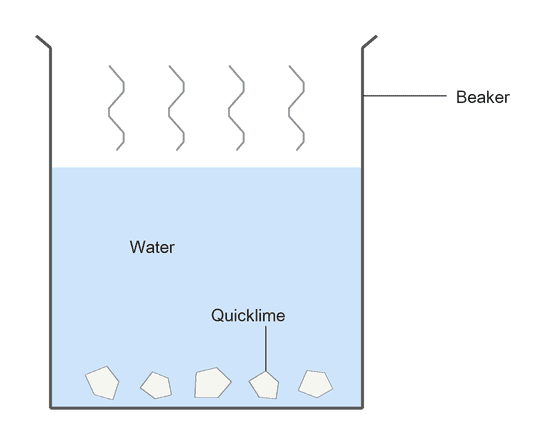
(a) What do you observe when quicklime is added to water ?
(b) Why does the beaker become hot ?
(c) What type of change is depicted here ?
(d) What conclusion can be drawn on the basis of your observation ?
Solve with AIWritten solution
Solution:
Concept: Quicklime (calcium oxide) reacts with water to form a new substance, slaked lime (calcium hydroxide), and gives out a lot of heat.
Step 1 — (a) State what is observed.
The pieces of quicklime crumble with a hissing sound, and a large amount of heat is given out, so the water becomes hot and may even steam. A white solid, slaked lime, forms; a little of it dissolves to give lime water and the rest settles at the bottom of the beaker.
Step 2 — (b) Explain why the beaker becomes hot.
Quicklime reacts with water, and this reaction gives out heat energy, which warms the water and the beaker.
Step 3 — (c) Name the type of change.
A new substance, calcium hydroxide, is formed and quicklime cannot be got back simply, so it is a chemical change.
Step 4 — (d) Draw the conclusion.
The adding of quicklime to water is a chemical change in which energy is given out as heat; that is, a chemical change is accompanied by an energy change.
Watch out: The beaker gets hot because of the reaction itself, not because the water was heated; never hold quicklime in wet hands.
Therefore, (a) quicklime crumbles and hisses as much heat is given out, (b) the reaction gives out heat, (c) it is a chemical change, and (d) a chemical change is accompanied by an energy change.
- 305 marks
Question 30
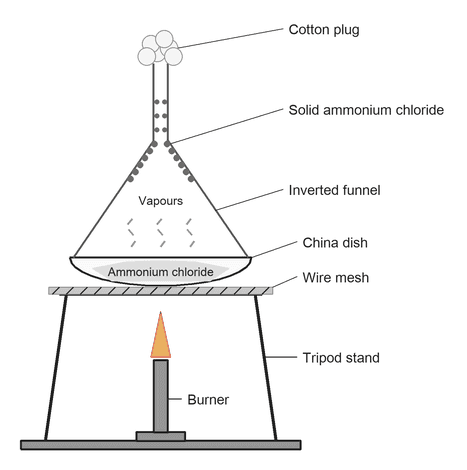
(a) Draw a well-labelled diagram to show the process of sublimation.
(b) Is sublimation a physical change or a chemical change ? Explain.
(c) Name two substances which can sublime.
Solve with AIWritten solution
Solution:
Concept: Sublimation is the change of a solid directly into vapour on heating, without passing through the liquid state; the solid formed again when the vapour cools is the sublimate.
Step 1 — (a) Describe and draw the set-up.
Solid ammonium chloride is heated in a china dish placed on a wire gauze over a tripod stand and burner. The dish is covered by an inverted funnel whose stem is closed with a cotton plug. The vapours rise and change back into solid on the cooler upper walls of the funnel.
Step 2 — (b) Decide the type of change.
Sublimation is a physical change. Only the state changes, from solid to vapour and back to solid, and no new substance is formed: the solid collected on the funnel is the same substance as the one heated. The change is reversible, since cooling the vapour gives back the original solid.
Step 3 — (c) Name two substances which sublime.
Camphor and iodine change directly into vapour on heating (naphthalene and dry ice are other examples).
Watch out: The cotton plug stops the vapours escaping through the stem, so that they condense on the funnel.
Note: ammonium chloride does not truly sublime. On heating it splits into ammonia and hydrogen chloride gases, which join again into the white solid on the cool funnel; camphor or iodine sublime truly. The fumes are irritating, so the heating is done in a fume cupboard.
Therefore, (a) the set-up is a china dish of the solid under an inverted, plugged funnel, (b) sublimation is a physical change, and (c) camphor and iodine sublime.
- 314 marks
Question 31
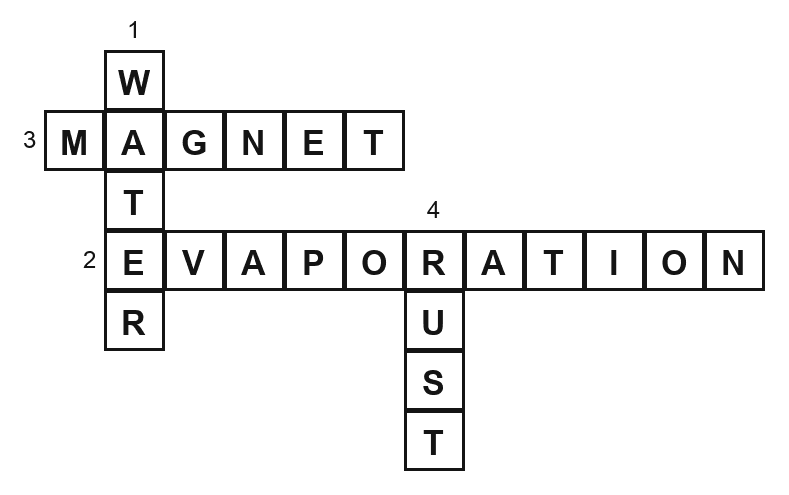
Solve the crossword puzzle given below with the help of the following clues :

Down :
1. A large amount of energy is given out when quicklime is added to this substance.
4. A reddish-brown substance formed when iron is exposed to moist air
Across :
2. It is a physical change in which a liquid changes into vapour.
3. An object which attracts iron fillings.
Solve with AIWritten solution
Solution:
Concept: Fit each answer into its row of squares; where two words cross, the shared square must carry the same letter.
Step 1 — Solve the Down clues.
1 Down: quicklime gives out a large amount of heat when added to WATER (5 squares). 4 Down: the reddish-brown substance formed on iron in moist air is RUST (4 squares).
Step 2 — Solve the Across clues.
2 Across: the physical change of a liquid into vapour is EVAPORATION (11 squares). 3 Across: the object that attracts iron filings is a MAGNET (6 squares).
Step 3 — Check the crossing squares.
The A of MAGNET is the 2nd letter of WATER, the E that starts EVAPORATION is the 4th letter of WATER, and the R of EVAPORATION (its 6th letter) is the first letter of RUST, so all the words fit together.
Watch out: The words "iron fillings" in clue 3 mean iron filings, the fine powder of iron that a magnet picks up.
Therefore, 1 Down is WATER, 4 Down is RUST, 2 Across is EVAPORATION and 3 Across is MAGNET.
- 325 marks
Question 32
Ravi had brought some iron nails to fix pictures on the walls of his room. However, he got busy and he left those nails in the courtyard of his house to work with later. Upon returning to the courtyard after a few days, he saw that a reddish-brown substance was deposited on the nails. His father told him that this is a common phenomenon on iron articles, especially during rainy season.

(a) Name the reddish-brown substance formed on the iron nails.
(b) Is it a physical change ? Justify your answer.
(c) What will you observe when a magnet is brought near the nails ?
(d) State two conditions under which the above phenomenon takes place. Why is this faster during rainy season ?
Solve with AIWritten solution
Solution:
Concept: The nails have rusted: iron has reacted slowly with the oxygen of the air in the presence of moisture to form rust, a hydrated oxide of iron.
Step 1 — (a) Name the substance.
The reddish-brown substance is rust (hydrated iron oxide).
Step 2 — (b) Decide the type of change.
No, it is not a physical change; it is a chemical change. Rust is a new substance whose properties (reddish-brown colour, flaky, not attracted by a magnet) differ from those of iron, and iron cannot be got back from rust by any simple method.
Step 3 — (c) Predict what the magnet does.
The nails are still attracted by the magnet, because under the thin coating most of each nail is still iron. The rust itself is not attracted: loose flakes of rust do not cling to the magnet.
Step 4 — (d) State the conditions and the effect of rain.
Rusting needs both oxygen (air) and moisture (water). It is faster in the rainy season because the air is humid, holding much more moisture, and the nails also get wet with rain water.
Watch out: A nail kept in dry air, or with no air (in boiled water under a layer of oil), does not rust; both air and water are needed.
Note: saying only that the rust is not attracted is not enough; the iron under the rust still makes the nails cling to the magnet.
Therefore, (a) rust, (b) a chemical change, (c) the nails are still attracted but the rust is not, and (d) oxygen and moisture are needed, and humid rainy weather supplies more moisture.
What Class 7 Chemistry Ch 2 covers
The sections of the chapter, in the order the book takes them. Every question above comes from one of these.
- 01Types of Changes
- 02Physical Change
- 03Terms Involved in Some Physical Changes
- 04Chemical Change
- 05Importance of Chemical Changes
More ways to study this chapter
The same chapter asked three other ways. Practise it, revise it, and see what the board has set on Ch 2 before.
Class 7 Chemistry Ch 2 questions students ask
How many questions are there in Class 7 Chemistry Ch 2?
32 questions. Every one is solved step by step on this page.
Are these Class 7 Chemistry solutions free?
Yes. Every question and its full working is free to read, with no account needed.
Can I download the Class 7 Chemistry Ch 2 solutions as a PDF?
There is no PDF to download. Every solution is on this page instead, which means it is searchable, always the current syllabus, and readable on a phone. Use your browser's print option if you want it on paper.