Solution:
Concept: Coelenterates (phylum Cnidaria) have a hollow, sac-like body with one opening, the mouth, which is surrounded by tentacles carrying stinging cells.
Step 1 — (i) Name the organisms.
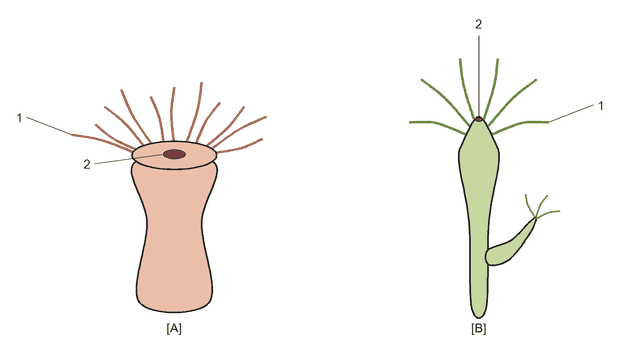
Organism [A] is a sea anemone, a large flower-like animal that usually stays attached to rocks. Organism [B] is a hydra, a small, slender fresh-water animal.
Step 2 — (ii) Label the guidelines.
Guideline 1 points to the tentacles; guideline 2 points to the mouth.
Step 3 — (iii) Phylum.
Yes, both have a sac-like body with one opening surrounded by tentacles, so both belong to phylum Cnidaria (Coelenterata).
Step 4 — (iv) Two functions of the tentacles.
The tentacles catch food (their stinging cells stun small animals) and push it into the mouth. They also help in movement: a hydra moves by somersaulting on its tentacles. They also defend the animal.
Step 5 — (v) Reproduction in [B].
A small hydra grows out from the side of the parent. This is budding, a kind of asexual reproduction, because only one parent is involved.
Watch out: The outgrowth on the hydra is a bud (a new young hydra), not a branch or a tentacle.
Therefore, (i) sea anemone and hydra; (ii) 1 tentacles, 2 mouth; (iii) yes, Cnidaria (Coelenterata); (iv) catching food and movement; (v) budding, which is asexual.