
Opening your dashboard
Class 7 Biology Chapter 3: Classification of Animals Solutions
36 textbook questions with step-by-step answers, free to read, for ICSE 2026-27.
Get talked through Ch 3, not just shown the answer
Reading a finished solution is not the same as being able to do it. The AI tutor takes one question at a time and works it with you, in your own words, until you can.
- Ask it out loud, in your own words
- It gives you the next step, not the answer
- Stuck on part (ii)? Start there
36 questions with solutions
1–14 marks · Mixed difficulty
- 11 mark
Question 1
Identify the aquatic animal with scaly skin which breathe with gills —
Solve with AIAnswer
- Correct
(A) Rohu
(B) Tortoise
(C) Sparrow
(D) Rat
Answer: (A) Rohu
Concept: Vertebrates (phylum Chordata) have a backbone. They are grouped into five classes: Pisces (fishes), Amphibia, Reptilia, Aves (birds) and Mammalia. Fishes live in water, have scales and breathe through gills.
Step 1 — List the three clues.
The animal lives in water, has a scaly skin and breathes with gills.
Step 2 — Match the clues to a class.
These three features together describe a fish (class Pisces). Rohu is a common fresh-water fish of India, so the answer is option (A).
Watch out: A tortoise also has scales, but it breathes air through lungs, even when it swims.
Why the other options are wrong:
- (B) Tortoise: a tortoise is a reptile; it has scales but breathes through lungs, and it lives on land.
- (C) Sparrow: a sparrow is a bird; it has feathers, lives on land and breathes through lungs.
- (D) Rat: a rat is a mammal; it has hair, lives on land and breathes through lungs.
Therefore, the aquatic animal with scaly skin that breathes with gills is the rohu, option (A).
- 21 mark
Question 2
Identify the bird which cannot fly —
Solve with AIAnswer
(A) Peacock
(B) House sparrow
- Correct
(C) Ostrich
(D) Pigeon
Answer: (C) Ostrich
Concept: Most birds can fly, but a few large birds have small wings and heavy bodies and cannot fly; they are called flightless birds (ostrich, emu, kiwi, penguin).
Step 1 — Check each bird.
The peacock, the house sparrow and the pigeon can all fly. The ostrich is the largest living bird. Its wings are too small to lift its heavy body, but it runs very fast on its strong legs.
Step 2 — Pick the option.
The ostrich is the bird that cannot fly, so the answer is option (C).
Watch out: The peacock looks heavy, but it can fly, though only for short distances.
Why the other options are wrong:
- (A) Peacock: a peacock can fly up into trees, though only for short distances.
- (B) House sparrow: a house sparrow is a small bird that flies well.
- (D) Pigeon: a pigeon is a strong flier.
Therefore, the bird which cannot fly is the ostrich, option (C).
- 31 mark
Question 3
Identify the animal which is not an Arthropod —
Solve with AIAnswer
(A) Prawn
(B) Butterfly
- Correct
(C) Earthworm
(D) Spider
Answer: (C) Earthworm
Concept: Arthropods (phylum Arthropoda) have jointed legs, a segmented body and a hard outer covering.
Step 1 — Look for jointed legs.
The prawn, the butterfly and the spider all have jointed legs, so all three are arthropods.
Step 2 — Find the odd one.
The earthworm has a soft body made of ring-like segments and no legs at all. It belongs to phylum Annelida (segmented worms). So the answer is option (C).
Watch out: A segmented body alone does not make an animal an arthropod; the earthworm is segmented but has no jointed legs.
Why the other options are wrong:
- (A) Prawn: a prawn has jointed legs; it is an arthropod (class Crustacea).
- (B) Butterfly: a butterfly has three pairs of jointed legs; it is an arthropod (class Insecta).
- (D) Spider: a spider has four pairs of jointed legs; it is an arthropod (class Arachnida).
Therefore, the animal which is not an arthropod is the earthworm, option (C).
- 41 mark
Question 4
Which of the following organisms is not an invertebrate ?
Solve with AIAnswer
(A) Round worm
(B) Butterfly
(C) Sea anemone
- Correct
(D) Lizard
Answer: (D) Lizard
Concept: Animals without a backbone are invertebrates. The chapter groups them into eight phyla: Porifera, Cnidaria (Coelenterata), Platyhelminthes, Nematoda, Annelida, Arthropoda, Mollusca and Echinodermata.
Step 1 — Recall what invertebrate means.
An invertebrate is an animal without a backbone.
Step 2 — Check each animal.
The roundworm, the butterfly and the sea anemone have no backbone. The lizard is a reptile with a backbone, so it is a vertebrate. The answer is option (D).
Watch out: Read "not an invertebrate" carefully: the question asks for the animal that HAS a backbone.
Why the other options are wrong:
- (A) Round worm: a roundworm (phylum Nematoda) has no backbone, so it is an invertebrate.
- (B) Butterfly: a butterfly (phylum Arthropoda) has no backbone, so it is an invertebrate.
- (C) Sea anemone: a sea anemone (phylum Cnidaria) has no backbone, so it is an invertebrate.
Therefore, the organism which is not an invertebrate is the lizard, option (D).
- 51 mark
Question 5
Liver fluke belongs to :
Solve with AIAnswer
(A) Nematoda
- Correct
(B) Platyhelminthes
(C) Annelida
(D) Cnidaria
Answer: (B) Platyhelminthes
Concept: Flatworms (phylum Platyhelminthes) have a thin, soft, flat body. Many of them, such as the liver fluke and the tapeworm, live as parasites.
Step 1 — Recall the body of a liver fluke.
The liver fluke is a leaf-like, thin and flat worm that lives as a parasite in the liver of sheep and cattle (and sometimes humans).
Step 2 — Pick the phylum.
A flat body puts it in phylum Platyhelminthes, option (B).
Watch out: Do not confuse flatworms with roundworms; a roundworm such as Ascaris has a rounded, thread-like body.
Why the other options are wrong:
- (A) Nematoda: Nematoda are roundworms with a rounded body, such as Ascaris; the liver fluke is flat.
- (C) Annelida: Annelida are segmented worms such as the earthworm; the liver fluke is not made of rings.
- (D) Cnidaria: Cnidaria are hollow, sac-like animals with tentacles, such as hydra.
Therefore, the liver fluke belongs to Platyhelminthes, option (B).
- 61 mark
Question 6
Which of the following structures is not found in the body of birds ?
Solve with AIAnswer
- Correct
(A) Teeth
(B) Scales
(C) Beak
(D) Claws
Answer: (A) Teeth
Concept: In birds the jaws are covered by a horny beak. Birds living today have no teeth; they pick up and tear food with the beak, and many grind it in a muscular gizzard.
Step 1 — Check each structure.
Birds have a beak, scales on their legs and feet, and claws at the ends of their toes.
Step 2 — Find the missing one.
Birds have no teeth, so the structure not found in birds is option (A).
Watch out: Many students forget that birds have scales; look at a hen's legs and you will see them.
Why the other options are wrong:
- (B) Scales: birds do have scales, on their legs and feet.
- (C) Beak: every bird has a beak.
- (D) Claws: the toes of birds end in claws.
Therefore, teeth are not found in birds, option (A).
- 71 mark
Question 7
The locomotory structures of Echinoderms are :
Solve with AIAnswer
(A) Tentacles
(B) Jointed legs
(C) Fins
- Correct
(D) Tube feet
Answer: (D) Tube feet
Concept: Echinoderms (spiny-skinned animals) such as the starfish move slowly on many small, water-filled tube feet on the underside of their arms.
Step 1 — Recall how a starfish moves.
A starfish has rows of tiny tube feet. They stretch, grip the surface and pull the animal along.
Step 2 — Pick the option.
So the locomotory structures of echinoderms are tube feet, option (D).
Why the other options are wrong:
- (A) Tentacles: tentacles are found in cnidarians such as hydra; they mainly catch food.
- (B) Jointed legs: jointed legs are the mark of arthropods such as insects and crabs.
- (C) Fins: fins are used for swimming by fishes.
Therefore, the locomotory structures of echinoderms are tube feet, option (D).
- 81 mark
Question 8
Radial symmetry can be found in :
Solve with AIAnswer
(A) Coelenterata
(B) Platyhelminthes
(C) Echinodermata
- Correct
(D) Both (a) and (c)
Answer: (D) Both (a) and (c)
Concept: An animal has radial symmetry when its body parts are arranged round a central axis, so it can be cut into similar halves along more than one plane through the centre. An animal with bilateral symmetry has only one such plane, giving a left and a right side.
Step 1 — Check Coelenterata.
Hydra, jellyfish and sea anemone have their parts arranged round the mouth, so coelenterates are radially symmetrical.
Step 2 — Check Echinodermata.
An adult starfish has five arms arranged round a central disc, so adult echinoderms are also radially symmetrical.
Step 3 — Check Platyhelminthes.
Flatworms have a head end, a tail end and a left and a right side, so they are bilaterally symmetrical.
Step 4 — Pick the option.
Radial symmetry is found in both Coelenterata and Echinodermata, option (D).
Watch out: The larvae of echinoderms are bilaterally symmetrical; only the adults are radial.
Why the other options are wrong:
- (A) Coelenterata: Coelenterata are radial, but Echinodermata are radial too, so this answer is incomplete.
- (B) Platyhelminthes: flatworms have a left and a right side; they are bilaterally symmetrical.
- (C) Echinodermata: Echinodermata are radial, but Coelenterata are radial too, so this answer is incomplete.
Therefore, radial symmetry is found in both Coelenterata and Echinodermata, option (D).
- 91 mark
Question 9
Which class of vertebrates have animals with dry and scaly skin ?
Solve with AIAnswer
(A) Aves
(B) Amphibia
- Correct
(C) Reptilia
(D) Pisces
Answer: (C) Reptilia
Concept: Vertebrates (phylum Chordata) have a backbone. They are grouped into five classes: Pisces (fishes), Amphibia, Reptilia, Aves (birds) and Mammalia.
Step 1 — Recall the skin of each class.
Fishes have wet scales, amphibians have a moist, slimy skin without scales, birds are covered with feathers, and reptiles have a dry, scaly skin.
Step 2 — Pick the option.
Animals with a dry and scaly skin, such as lizards and snakes, belong to class Reptilia, option (C).
Watch out: Fishes also have scales, but their skin is always wet; the word "dry" points to reptiles.
Why the other options are wrong:
- (A) Aves: birds (Aves) are covered with feathers; they have scales only on their legs.
- (B) Amphibia: amphibians have a moist, slimy skin without scales.
- (D) Pisces: fishes have scales, but their skin is wet and covered with slime because they live in water.
Therefore, the class with dry and scaly skin is Reptilia, option (C).
- 101 mark
Question 10
What is the main distinguishing feature of arachnids ?
Solve with AIAnswer
(A) Six legs
(B) Segmented body
(C) Nephridia
- Correct
(D) Four pairs of legs
Answer: (D) Four pairs of legs
Concept: Arachnids (spiders, scorpions, ticks and mites) are arthropods with four pairs (eight) of jointed legs and no antennae.
Step 1 — Recall the leg count of each arthropod group.
Insects have three pairs of legs (six), while arachnids have four pairs (eight).
Step 2 — Pick the distinguishing feature.
Four pairs of legs mark an arachnid, so the answer is option (D).
Watch out: A feature shared by many groups (like a segmented body) cannot distinguish one group.
Why the other options are wrong:
- (A) Six legs: six legs (three pairs) are the mark of insects, not arachnids.
- (B) Segmented body: a segmented body is found in annelids and in all arthropods, so it does not single out arachnids.
- (C) Nephridia: nephridia are the excretory organs of annelids such as the earthworm.
Therefore, the main distinguishing feature of arachnids is four pairs of legs, option (D).
- 111 mark
Question 11
Assertion (A): Tapeworm has a long, ribbon-like segmented body that can occur in human intestines as a parasite.
Reason (R): Tapeworm belongs to the phylum annilida (segmented worms). It breathes with the help of moist skin.
Solve with AIAnswer
(A) (1) Both A and R are true and R is the correct explanation of A.
(B) (2) Both A and R are true but R is not the correct explanation of A.
- Correct
(C) (3) A is true but R is false.
(D) (4) A is false but R is true.
Answer: (C) (3) A is true but R is false.
Concept: In an assertion-reason item, first judge the Assertion (A) and the Reason (R) separately as true or false; only when both are true do we ask whether R correctly explains A.
Step 1 — Judge the Assertion.
A is true. The tapeworm has a long, ribbon-like body made of many segments and lives as a parasite in the human intestine.
Step 2 — Judge the Reason.
R is false. The tapeworm is a flatworm (phylum Platyhelminthes), not an annelid. It has no respiratory organs; it lives in the intestine where there is very little oxygen and takes in what it needs through its body surface. It is the earthworm, an annelid, that breathes through a moist skin.
Step 3 — Pick the option.
A is true and R is false, so the answer is option (C).
Watch out: Being segmented does not make an animal an annelid; the tapeworm's segments do not make it a segmented worm.
Note: The stem's "annilida" is a misprint for Annelida.
Why the other options are wrong:
- (A): R is false, so it cannot explain A.
- (B): R is false, so "both A and R are true" cannot be right.
- (D): A is true, not false.
Therefore, A is true but R is false, option (C).
- 121 mark
Question 12
Assertion (A): An insect's body is divided into three regions — head, thorax and abdomen.
Reason (R): The division of an insect's body in three parts is very suitable for its locomotion as one pair of legs is attached with each body part with proper gap/space.
Solve with AIAnswer
(A) (1) Both A and R are true and R is the correct explanation of A.
(B) (2) Both A and R are true but R is not the correct explanation of A.
- Correct
(C) (3) A is true but R is false.
(D) (4) A is false but R is true.
Answer: (C) (3) A is true but R is false.
Concept: In an assertion-reason item, first judge the Assertion (A) and the Reason (R) separately as true or false; only when both are true do we ask whether R correctly explains A.
Step 1 — Judge the Assertion.
A is true. The body of an insect is divided into three regions: head, thorax and abdomen.
Step 2 — Judge the Reason.
R is false. An insect has three pairs of legs, but all three pairs are on the thorax. The head and the abdomen bear no legs, so the legs are not one pair on each body part.
Step 3 — Pick the option.
A is true and R is false, so the answer is option (C).
Watch out: Three body regions and three pairs of legs do not mean one pair per region.
Why the other options are wrong:
- (A): R is false, so it cannot explain A.
- (B): R is false, so "both A and R are true" cannot be right.
- (D): A is true, not false.
Therefore, A is true but R is false, option (C).
- 131 mark
Question 13
Assertion (A): Most animals move from one place to another mainly in search of food or shelter but plants do not move.
Reason (R): Animals are heterotrophs whereas plants are autotrophs. Hence, plants are capable of making their own food and do not move from one place to another.
Solve with AIAnswer
- Correct
(A) (1) Both A and R are true and R is the correct explanation of A.
(B) (2) Both A and R are true but R is not the correct explanation of A.
(C) (3) A is true but R is false.
(D) (4) A is false but R is true.
Answer: (A) (1) Both A and R are true and R is the correct explanation of A.
Concept: In an assertion-reason item, first judge the Assertion (A) and the Reason (R) separately as true or false; only when both are true do we ask whether R correctly explains A.
Step 1 — Judge the Assertion.
A is true. Most animals move from place to place (locomotion) to find food and shelter, while plants stay fixed in one place.
Step 2 — Judge the Reason.
R is true. Animals are heterotrophs: they cannot make their own food. Green plants are autotrophs: they make their own food from carbon dioxide and water in sunlight.
Step 3 — Check whether R explains A.
An animal must go out and find its food, so it needs to move. A plant makes its food where it stands, so it does not need to move. R gives the reason for A, so the answer is option (A).
Watch out: "Most animals" matters: a few animals such as sponges and corals stay fixed in one place.
Why the other options are wrong:
- (B): R does explain A: the need to find food is why animals move.
- (C): R is a true statement.
- (D): A is a true statement.
Therefore, both A and R are true and R is the correct explanation of A, option (A).
- 141 mark
Question 14
Assertion (A): Tortoises and crocodiles belong to the class — amphibia of the phylum — chordata.
Reason (R): They can live in water as well as on the land and reproduce successfully.
Solve with AIAnswer
(A) (1) Both A and R are true and R is the correct explanation of A.
(B) (2) Both A and R are true but R is not the correct explanation of A.
(C) (3) A is true but R is false.
- Correct
(D) (4) A is false but R is true.
Answer: (D) (4) A is false but R is true.
Concept: In an assertion-reason item, first judge the Assertion (A) and the Reason (R) separately as true or false; only when both are true do we ask whether R correctly explains A.
Step 1 — Judge the Assertion.
A is false. Tortoises and crocodiles have a dry, scaly skin, breathe through lungs and lay eggs with shells on land. They belong to class Reptilia of phylum Chordata, not to class Amphibia.
Step 2 — Judge the Reason.
R is true as the book intends it. Crocodiles and turtles spend much time in water but come on land, where they lay their eggs and reproduce successfully.
Step 3 — Pick the option.
A is false and R is true, so the answer is option (D).
Watch out: Living both in water and on land does not make an animal an amphibian; the skin and the eggs decide it.
Note: Strictly, R fits crocodiles and turtles; most tortoises live only on land. Read that way, both statements are false and no option fits, so the printed key (A false, R true) is kept.
Why the other options are wrong:
- (A): A is false, so R cannot explain it.
- (B): A is false, so "both A and R are true" cannot be right.
- (C): this says A is true and R is false; in fact A is false.
Therefore, A is false but R is true, option (D).
- 151 mark
Question 15
Assertion (A): Most mammals give birth to young ones and feed them with milk produced in the mother's mammary glands.
Reason (R): Aquatic and flying mammals do not feed their babies with milk as their surroundings make it difficult.
Solve with AIAnswer
(A) (1) Both A and R are true and R is the correct explanation of A.
(B) (2) Both A and R are true but R is not the correct explanation of A.
- Correct
(C) (3) A is true but R is false.
(D) (4) A is false but R is true.
Answer: (C) (3) A is true but R is false.
Concept: In an assertion-reason item, first judge the Assertion (A) and the Reason (R) separately as true or false; only when both are true do we ask whether R correctly explains A.
Step 1 — Judge the Assertion.
A is true. Most mammals give birth to young ones, which suckle milk made in the mother's mammary glands.
Step 2 — Judge the Reason.
R is false. Aquatic mammals (whales, dolphins) and flying mammals (bats) also feed their babies with milk. A baby whale suckles under water and a baby bat clings to its mother to feed.
Step 3 — Pick the option.
A is true and R is false, so the answer is option (C).
Watch out: Every mammal feeds its young on milk; even the egg-laying platypus and spiny anteater do.
Why the other options are wrong:
- (A): R is false, so it cannot explain A.
- (B): R is false, so "both A and R are true" cannot be right.
- (D): A is true, not false.
Therefore, A is true but R is false, option (C).
- 164 marks
Question 16
Name one example each of an animal which shows the following characteristics :
(i) Fixed animals with a pore-bearing body
(ii) Star-shaped body
(iii) Can live in water as well as on land
(iv) Has a flattened ribbon-like body
Solve with AIWritten solution
Solution:
Concept: Each feature in the list is the main mark of one group of animals, so we name a well-known animal of that group.
Step 1 — (i) Fixed animal with pores.
Sponges stay attached to rocks and have a body full of tiny pores. Example: sponge (phylum Porifera).
Step 2 — (ii) Star-shaped body.
A five-armed, star-shaped body belongs to the starfish (phylum Echinodermata).
Step 3 — (iii) Lives in water and on land.
Amphibians live both in water and on land. Example: frog (class Amphibia).
Step 4 — (iv) Flattened, ribbon-like body.
The tapeworm has a long, flat, ribbon-like body (phylum Platyhelminthes).
Therefore, (i) sponge, (ii) starfish, (iii) frog, (iv) tapeworm.
- 176 marks
Question 17
Match the animals given under column A with their respective classification group given under column B :
Column A Column B (i) Sponge (a) Amphibia (ii) Snail (b) Reptilia (iii) Butterfly (c) Echinodermata (iv) Toad (d) Mollusca (v) Lizard (e) Arthropoda (vi) Starfish (f) Porifera Solve with AIWritten solution
Solution:
Concept: To place an animal in its group, look at its main features: pores (Porifera), a soft body with a shell (Mollusca), jointed legs (Arthropoda), slimy skin (Amphibia), dry scaly skin (Reptilia), spiny skin and tube feet (Echinodermata).
Step 1 — Match each animal by its features.
The table gives each animal with its group and the feature that decides it.
Column A Column B Deciding feature (i) Sponge (f) Porifera Body full of pores; fixed (ii) Snail (d) Mollusca Soft body in a shell; muscular foot (iii) Butterfly (e) Arthropoda Jointed legs (iv) Toad (a) Amphibia Moist skin; lives in water and on land (v) Lizard (b) Reptilia Dry, scaly skin (vi) Starfish (c) Echinodermata Spiny skin; tube feet Watch out: A toad has a dry, warty skin but it is still an amphibian; it lays its eggs in water.
Therefore, (i) matches (f), (ii) matches (d), (iii) matches (e), (iv) matches (a), (v) matches (b) and (vi) matches (c).
- 187 marks
Question 18
Categorise the following animals under their appropriate columns of classfication :
ANIMALS :
Dog, Grasshopper, Rat, Scorpion, Toad, Butterfly, Lizard, Turtle, Frog, Bat, Snail, Honey bee, Pigeon, Liverfluke, Leech, Cattle, Snake, Rohu, Parrot, Ascaris, Earthworm, Cow, Rabbit, Monkey, Elephant
CLASSIFICATION :
WORMS MOLLUSCS FISHES AMPHIBIANS REPTILES BIRDS MAMMALS .......... .......... .......... .......... .......... .......... .......... .......... .......... .......... .......... .......... .......... .......... .......... .......... .......... .......... .......... .......... .......... .......... .......... .......... .......... .......... .......... .......... Solve with AIWritten solution
Solution:
Concept: Sort each animal by its main features. "Worms" here takes in flatworms, roundworms and segmented worms.
Step 1 — Place every animal in its column.
The table lists the animals under each column of the given classification.
Group Animals Worms Liverfluke, Ascaris, Earthworm, Leech Molluscs Snail Fishes Rohu Amphibians Toad, Frog Reptiles Lizard, Turtle, Snake Birds Pigeon, Parrot Mammals Dog, Rat, Bat, Cattle, Cow, Rabbit, Monkey, Elephant Step 2 — Deal with the animals that fit no column.
Grasshopper, scorpion, butterfly and honey bee have jointed legs, so they are arthropods. The given table has no column for arthropods, so they are left out.
Watch out: The bat flies, but it is a mammal (it has hair and feeds its young on milk), not a bird.
Therefore, the animals are sorted as in the table; grasshopper, scorpion, butterfly and honey bee are arthropods and fit none of the given columns.
- 191 mark
Question 19
Animals cannot prepare their own food. What scientific name is given to such organisms.
Solve with AIWritten solution
Solution:
Concept: Hetero means "other" and troph means "nourishment". An organism that depends on others for its food is a heterotroph.
Step 1 — Recall the term.
Animals cannot prepare their own food; they depend directly or indirectly on plants for it. Such organisms are called heterotrophs, and their nutrition is heterotrophic.
Therefore, organisms that cannot prepare their own food are called heterotrophs.
- 205 marks
Question 20
Identify the phylum/class with the help of the following clues and give one example of each.
(i) Body is covered by a slimy and slippery skin.
(ii) Body bears many tiny pores.
(iii) Body has jointed legs.
(iv) Animals swim with the help of fins.
(v) Body has special excretory organs called nephridia.
Solve with AIWritten solution
Solution:
Concept: Each clue is the main feature of one group, so we name the group and then one animal from it.
Step 1 — (i) Slimy, slippery skin.
Class Amphibia. Example: frog.
Step 2 — (ii) Many tiny pores.
Phylum Porifera. Example: sponge.
Step 3 — (iii) Jointed legs.
Phylum Arthropoda. Example: butterfly.
Step 4 — (iv) Swim with fins.
Class Pisces. Example: rohu.
Step 5 — (v) Nephridia for excretion.
Phylum Annelida. Example: earthworm.
Therefore, (i) Amphibia, frog; (ii) Porifera, sponge; (iii) Arthropoda, butterfly; (iv) Pisces, rohu; (v) Annelida, earthworm.
- 215 marks
Question 21
Given below are sets of four terms. Choose the odd one and write the category of the remaining terms :
(i) Jellyfish, Dogfish, Sea anemone, Hydra
(ii) Electric ray fish, Dogfish, Starfish, Shark
(iii) Myriapoda, Mammalia, Arachnida, Crustacea
(iv) Turtle, Tortoises, Crocodiles, Frog
(v) Sucker, Tube feet, Muscular foot, Fins
Solve with AIWritten solution
Solution:
Concept: In each set, three terms share one group; the odd one belongs somewhere else.
Step 1 — (i) Jellyfish, Dogfish, Sea anemone, Hydra.
Jellyfish, sea anemone and hydra are Cnidaria (Coelenterata). The dogfish is a small shark, a fish. Odd one: dogfish.
Step 2 — (ii) Electric ray fish, Dogfish, Starfish, Shark.
The electric ray, dogfish and shark are fishes (Pisces). The starfish is an echinoderm, not a fish. Odd one: starfish.
Step 3 — (iii) Myriapoda, Mammalia, Arachnida, Crustacea.
Myriapoda, Arachnida and Crustacea are groups (classes) of Arthropoda. Mammalia is a class of vertebrates. Odd one: Mammalia.
Step 4 — (iv) Turtle, Tortoises, Crocodiles, Frog.
Turtles, tortoises and crocodiles are reptiles (Reptilia). The frog is an amphibian. Odd one: frog.
Step 5 — (v) Sucker, Tube feet, Muscular foot, Fins.
Tube feet (echinoderms), muscular foot (molluscs) and fins (fishes) are organs of locomotion. Suckers mainly help an animal attach itself, for example a tapeworm or liver fluke to its host. Odd one: sucker.
Watch out: Names can mislead: the dogfish is a real fish (a small shark), while the starfish is not a fish at all.
Therefore, the odd ones are (i) dogfish, (ii) starfish, (iii) Mammalia, (iv) frog and (v) sucker.
- 225 marks
Question 22
Correct the following statements by changing the first/last word only :
(i) Amphibians breathe through lungs and gills.
(ii) Slimy scales are found on the body of reptiles.
(iii) Fins are covered and protected by an operculum.
(iv) Ascaris is a segmented flatworm.
(v) Insects have four pairs of jointed legs.
Solve with AIWritten solution
Solution:
Concept: Change only the first or the last word of each sentence so that it becomes a true statement.
Step 1 — (i) Amphibians breathe through lungs and gills.
Adult amphibians breathe through lungs and through their moist skin; gills are found in their tadpoles. Corrected: Amphibians breathe through lungs and skin.
Step 2 — (ii) Slimy scales are found on the body of reptiles.
Reptiles have a dry skin with scales. Corrected: Dry scales are found on the body of reptiles.
Step 3 — (iii) Fins are covered and protected by an operculum.
The operculum (gill cover) covers the gills, not the fins. Corrected: Gills are covered and protected by an operculum.
Step 4 — (iv) Ascaris is a segmented flatworm.
Ascaris is an unsegmented roundworm, while the tapeworm is a flatworm whose body is made of segments. Corrected: Tapeworm is a segmented flatworm.
Step 5 — (v) Insects have four pairs of jointed legs.
Insects have three pairs of legs; four pairs belong to arachnids. Corrected: Arachnids have four pairs of jointed legs.
Watch out: Change only the word allowed; rewriting the middle of a sentence is not what the question asks.
Therefore, the changed words are (i) skin, (ii) Dry, (iii) Gills, (iv) Tapeworm and (v) Arachnids.
- 235 marks
Question 23
Name the following :
(i) Eight phyla of Invertebrates
(ii) Five classes of Vertebrates
(iii) Four classes of Arthropoda
(iv) Three main regions of the body of Arthropods
(v) Three flightless birds
Solve with AIWritten solution
Solution:
Concept: Animals without a backbone are invertebrates. The chapter groups them into eight phyla: Porifera, Cnidaria (Coelenterata), Platyhelminthes, Nematoda, Annelida, Arthropoda, Mollusca and Echinodermata. vertebrates (phylum Chordata) have a backbone. They are grouped into five classes: Pisces (fishes), Amphibia, Reptilia, Aves (birds) and Mammalia.
Step 1 — (i) Eight phyla of invertebrates.
Porifera, Cnidaria (Coelenterata), Platyhelminthes, Nematoda, Annelida, Arthropoda, Mollusca and Echinodermata.
Step 2 — (ii) Five classes of vertebrates.
Pisces, Amphibia, Reptilia, Aves and Mammalia.
Step 3 — (iii) Four classes of Arthropoda.
Crustacea (prawn, crab), Myriapoda (centipede, millipede), Insecta (butterfly, ant) and Arachnida (spider, scorpion).
Step 4 — (iv) Three regions of an arthropod's body.
Head, thorax and abdomen (in some arthropods, such as spiders and prawns, the head and thorax are joined).
Step 5 — (v) Three flightless birds.
Ostrich, penguin and kiwi (the emu is another).
Therefore, (i) Porifera, Cnidaria, Platyhelminthes, Nematoda, Annelida, Arthropoda, Mollusca, Echinodermata; (ii) Pisces, Amphibia, Reptilia, Aves, Mammalia; (iii) Crustacea, Myriapoda, Insecta, Arachnida; (iv) head, thorax, abdomen; (v) ostrich, penguin, kiwi.
- 2410 marks
Question 24
Define the terms given below :
(i) Heterotrophs
(ii) Locomotion
(iii) Invertebrates
(iv) Vertebrates
(v) Mammals
Solve with AIWritten solution
Solution:
Concept: A definition says exactly what a term means in one clear sentence, often with an example.
Step 1 — (i) Heterotrophs.
Organisms which cannot prepare their own food and depend on plants or other animals for it are heterotrophs, for example all animals.
Step 2 — (ii) Locomotion.
The movement of an animal from one place to another, mainly in search of food or shelter, is called locomotion.
Step 3 — (iii) Invertebrates.
Animals which do not have a backbone (vertebral column) are invertebrates, for example the earthworm and the butterfly.
Step 4 — (iv) Vertebrates.
Animals which have a backbone (vertebral column) are vertebrates, for example fishes, frogs and humans.
Step 5 — (v) Mammals.
Mammals are vertebrates whose body is covered with hair, which have external ears and which feed their young on milk from mammary glands. Most of them give birth to young ones, for example the cow and humans.
Watch out: The platypus and the spiny anteater are mammals that lay eggs, but they too have hair and feed milk.
Therefore, heterotrophs depend on others for food, locomotion is movement from place to place, invertebrates lack a backbone while vertebrates have one, and mammals have hair and feed their young on milk.
- 2510 marks
Question 25
Write one important function of the following structures along with the group (phyla/class) of animals in which they are found :
(i) Tentacles
(ii) Nephridia
(iii) Gills
(iv) Muscular foot
(v) Mammary glands
Solve with AIWritten solution
Solution:
Concept: Each structure does one main job, and it is the mark of one group of animals.
Step 1 — (i) Tentacles.
Tentacles catch food and push it into the mouth; in hydra they also help in movement. Group: Cnidaria (Coelenterata).
Step 2 — (ii) Nephridia.
Nephridia are organs of excretion; they remove wastes from the body. Group: Annelida.
Step 3 — (iii) Gills.
Gills are organs for breathing in water; they take in oxygen dissolved in the water. Group: Pisces (fishes). Tadpoles and prawns also breathe with gills.
Step 4 — (iv) Muscular foot.
The muscular foot helps in movement (locomotion), as in a snail creeping along. Group: Mollusca.
Step 5 — (v) Mammary glands.
Mammary glands produce milk to feed the young ones. Group: Mammalia.
Therefore, tentacles catch food (Cnidaria), nephridia excrete (Annelida), gills breathe in water (Pisces), the muscular foot moves the animal (Mollusca) and mammary glands make milk (Mammalia).
- 266 marks
Question 26
Give two examples of each of the following :
(i) Amphibians
(ii) Segmented worms
(iii) Reptiles
(iv) Coelenterates
(v) Arthropods
(vi) Flatworms
Solve with AIWritten solution
Solution:
Concept: Two common examples are named for each group; any correct examples are accepted.
Step 1 — (i) Amphibians.
Frog and toad.
Step 2 — (ii) Segmented worms.
Earthworm and leech.
Step 3 — (iii) Reptiles.
Lizard and snake.
Step 4 — (iv) Coelenterates.
Hydra and jellyfish.
Step 5 — (v) Arthropods.
Butterfly and prawn.
Step 6 — (vi) Flatworms.
Tapeworm and liver fluke.
Therefore, (i) frog, toad; (ii) earthworm, leech; (iii) lizard, snake; (iv) hydra, jellyfish; (v) butterfly, prawn; (vi) tapeworm, liver fluke.
- 271 mark
Question 27
Give names of two animals which are found as parasites inside the human intestine.
Solve with AIWritten solution
Solution:
Concept: A parasite lives in or on another living being (the host) and takes its food from it. Some worms live as parasites in the human intestine.
Step 1 — Name two intestinal parasites.
The tapeworm (a flatworm) and the roundworm, Ascaris (a roundworm) both live in the human intestine and feed on the digested food there.
Therefore, the tapeworm and the roundworm (Ascaris) are found as parasites in the human intestine.
- 288 marks
Question 28
Write one difference each between the following pairs :
(i) Porifera and Coelenterata.
(ii) Arthropoda and Mollusca.
(iii) Invertebrates and Vertebrates.
(iv) Platyhelminthes and Nematoda.
Solve with AIWritten solution
Solution:
Concept: For each pair, give one feature in which the two groups clearly differ, stating both sides.
Step 1 — (i) Porifera and Coelenterata.
Porifera have a body with many tiny pores and stay fixed to one place. Coelenterata have a sac-like body with only one opening (the mouth), surrounded by tentacles.
Step 2 — (ii) Arthropoda and Mollusca.
Arthropods have jointed legs and a hard outer covering. Molluscs have no legs; they have a soft body, usually inside a hard shell, and move with a muscular foot.
Step 3 — (iii) Invertebrates and Vertebrates.
Invertebrates have no backbone; vertebrates have a backbone.
Step 4 — (iv) Platyhelminthes and Nematoda.
Platyhelminthes have a thin, flat body; Nematoda have a rounded (cylindrical), unsegmented body.
Watch out: Some molluscs, such as the slug and the octopus, have no outer shell, so the shell is not the safest difference; jointed legs are.
Therefore, (i) pores and fixed body versus a sac with one mouth and tentacles; (ii) jointed legs versus a soft body with a muscular foot; (iii) no backbone versus a backbone; (iv) flat body versus rounded body.
- 2914 marks
Question 29
Draw a neat diagram of a fish and label the five kinds of fins, operculum and mouth. Answer the following questions :
(i) Name the phylum and the class to which fishes belong.
(ii) What is the one advantage of their specific body shape ?
(iii) Do they breathe through nostrils ? If not, mention the role of nostrils.
(iv) Mention the breathing and locomotory structures in fishes.
(v) Give any two examples of fishes.
Solve with AIWritten solution
Solution:
Concept: A fish is a vertebrate built for life in water: a streamlined body, fins for swimming and gills for breathing, covered by a bony flap, the operculum.
Step 1 — Draw and label the fish.
The diagram shows a fish from the side with its five kinds of fins, the operculum and the mouth.
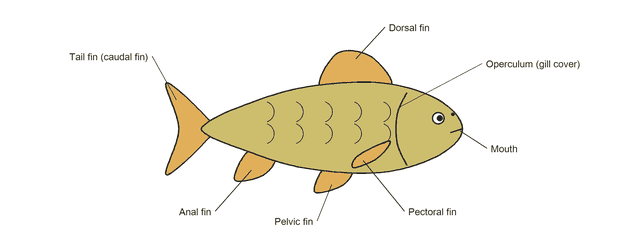
Labels: dorsal fin, tail (caudal) fin, anal fin, pelvic fin, pectoral fin, operculum (gill cover), mouth.
Step 2 — (i) Phylum and class.
Fishes have a backbone, so they belong to phylum Chordata, class Pisces.
Step 3 — (ii) Advantage of the body shape.
The body is streamlined: narrow at both ends and broad in the middle. It meets less resistance from water, so the fish swims easily and fast.
Step 4 — (iii) Nostrils.
No, fishes do not breathe through their nostrils; they breathe through gills. Their nostrils are used for smelling, which helps them find food and sense danger.
Step 5 — (iv) Breathing and locomotory structures.
Breathing: gills. Locomotion: fins, with the tail fin and the muscular body pushing the fish forward.
Step 6 — (v) Two examples.
Rohu and catla (others: shark, sea horse).
Watch out: A fish's nostrils are not joined to its gills; water for breathing enters through the mouth.
Therefore, (i) Chordata, Pisces; (ii) the streamlined body cuts through water easily; (iii) no, the nostrils are for smell; (iv) gills and fins; (v) rohu and catla.
- 3010 marks
Question 30
Given alongside are the figures of two organisms. Study the organisms and answer the following questions :
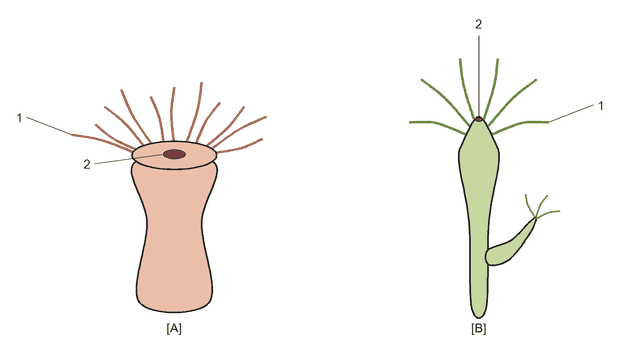
(i) Name the organisms [A] and [B].
(ii) Label the guidelines 1 and 2.
(iii) Do they belong to the same phylum ? If yes, name the phylum.
(iv) What are the two important functions of part 1 ?
(v) Mention the mode of reproduction shown in figure [B]. Is it a kind of asexual or sexual reproduction ?
Solve with AIWritten solution
Solution:
Concept: Coelenterates (phylum Cnidaria) have a hollow, sac-like body with one opening, the mouth, which is surrounded by tentacles carrying stinging cells.
Step 1 — (i) Name the organisms.
Organism [A] is a sea anemone, a large flower-like animal that usually stays attached to rocks. Organism [B] is a hydra, a small, slender fresh-water animal.
Step 2 — (ii) Label the guidelines.
Guideline 1 points to the tentacles; guideline 2 points to the mouth.
Step 3 — (iii) Phylum.
Yes, both have a sac-like body with one opening surrounded by tentacles, so both belong to phylum Cnidaria (Coelenterata).
Step 4 — (iv) Two functions of the tentacles.
The tentacles catch food (their stinging cells stun small animals) and push it into the mouth. They also help in movement: a hydra moves by somersaulting on its tentacles. They also defend the animal.
Step 5 — (v) Reproduction in [B].
A small hydra grows out from the side of the parent. This is budding, a kind of asexual reproduction, because only one parent is involved.
Watch out: The outgrowth on the hydra is a bud (a new young hydra), not a branch or a tentacle.
Therefore, (i) sea anemone and hydra; (ii) 1 tentacles, 2 mouth; (iii) yes, Cnidaria (Coelenterata); (iv) catching food and movement; (v) budding, which is asexual.
- 3110 marks
Question 31
The figure given alongside represents an animal. Study the same and answer the following questions :
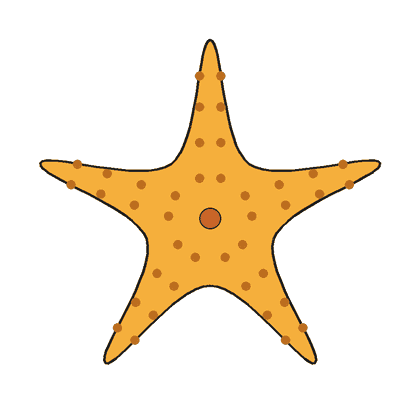
(i) Name the animal and write the phylum to which it belongs.
(ii) Mention the locomotory structure of the animal.
(iii) What kind of symmetry is found in the body of this animal ?
(iv) Write a suitable habitat where animals of this phylum are found.
(v) Mention one characteristic feature of the body of this animal.
Solve with AIWritten solution
Solution:
Concept: A star-shaped animal with five arms and a rough, spiny skin is a starfish, a member of phylum Echinodermata (spiny-skinned animals).
Step 1 — (i) Name and phylum.
The animal is a starfish; it belongs to phylum Echinodermata.
Step 2 — (ii) Locomotory structure.
It moves on many small tube feet on the underside of its arms.
Step 3 — (iii) Symmetry.
Its arms are arranged round a central disc, so the adult shows radial symmetry.
Step 4 — (iv) Habitat.
Echinoderms live only in the sea (they are marine), on rocks and on the sea floor.
Step 5 — (v) A feature of the body.
The skin is rough and spiny (hence "spiny-skinned").
Watch out: A starfish is not a fish: it has no backbone, no gills like a fish's and no fins.
Therefore, (i) starfish, Echinodermata; (ii) tube feet; (iii) radial symmetry; (iv) the sea; (v) a rough, spiny skin.
- 3211 marks
Question 32
Given alongside is the figure of an animal. Study the same and answer the following questions :
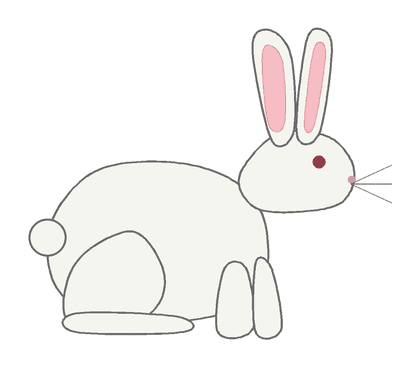
(i) Name the animal.
(ii) Write the phylum and class to which this animal belongs.
(iii) Mention one distinguishing feature of this phylum.
(iv) Give two more examples of organisms belonging to this phylum.
(v) Are these animals cold-blooded or warm-blooded ? Explain .
Solve with AIWritten solution
Solution:
Concept: A rabbit has hair on its body, external ears (pinnae) and feeds its young on milk, so it is a mammal.
Step 1 — (i) Name the animal.
The animal is a rabbit.
Step 2 — (ii) Phylum and class.
Phylum Chordata, class Mammalia.
Step 3 — (iii) A distinguishing feature of the phylum.
The vertebrate members of phylum Chordata, such as the rabbit, have a backbone (vertebral column). Strictly, every chordate has a stiff rod called the notochord at some stage of life; in vertebrates the backbone replaces it.
Step 4 — (iv) Two more examples.
Cow and dog. Any other vertebrate is also correct.
Step 5 — (v) Warm-blooded or cold-blooded.
Mammals are warm-blooded: their body temperature stays nearly constant whether the surroundings are hot or cold. The hair on the body traps air and helps to keep the body warm.
Watch out: A warm-blooded animal is not always warmer than the air; it keeps a steady body temperature.
Therefore, (i) rabbit; (ii) Chordata, Mammalia; (iii) a backbone; (iv) cow and dog; (v) warm-blooded, with a nearly constant body temperature.
- 333 marks
Question 33
Give three characteristic features of Amphibians which help to differentiate them from fishes.
Solve with AIWritten solution
Solution:
Concept: Amphibians live both in water and on land, while fishes live only in water; their skin and breathing differ too.
Step 1 — Habitat.
Amphibians live in water as well as on land; fishes live only in water.
Step 2 — Breathing.
Adult amphibians breathe through lungs and their moist skin; fishes breathe through gills.
Step 3 — Skin.
Amphibians have a moist, slimy skin without scales; fishes have a body covered with scales.
Step 4 — Limbs.
Amphibians have two pairs of limbs for walking and jumping; fishes have fins instead.
Watch out: A tadpole breathes with gills like a fish; the differences above are for the adult amphibian.
Therefore, unlike fishes, amphibians live in water and on land, breathe through lungs and skin, and have a moist skin without scales.
- 344 marks
Question 34
Why fishes are said to have a streamlined body ? Name their respiratory organs.
Solve with AIWritten solution
Solution:
Concept: A body that is narrow at both ends and broad in the middle (like a boat) is streamlined; it moves through water with the least resistance.
Step 1 — Why the body is called streamlined.
The body of a fish is narrow at both ends and broad in the middle. Such a shape lets water flow smoothly past it, so it cuts through water with little resistance and the fish swims easily.
Step 2 — Respiratory organs.
Fishes breathe through gills, which take in the oxygen dissolved in water.
Therefore, fishes are called streamlined because their spindle-shaped body slips through water easily; their respiratory organs are gills.
- 355 marks
Question 35
Give two characteristic features of birds which enable them to fly. Name any two birds which cannot fly.
Solve with AIWritten solution
Solution:
Concept: A bird's body is built for flight: wings, feathers and a light body.
Step 1 — Two features that help flying.
The forelimbs are changed into wings, and the body is covered with feathers, which give a large, light flying surface. Many of the bones are hollow and filled with air, which makes the body light.
Step 2 — Two birds which cannot fly.
The ostrich and the penguin (the kiwi and the emu are also flightless).
Therefore, wings with feathers and light, hollow bones help birds fly; the ostrich and the penguin cannot fly.
- 365 marks
Question 36
While watering the garden, Renu spotted a shiny black ant dragging a crumb almost twice its size. She noticed its segmented body, six jointed legs and a tough outer covering that glistened in the sunlight. Curious, she followed the ant as it rushed back towards its anthill.
(i) Name the phylum to which this organism belongs.
(ii) What are the three body segments found in black ants ?
(iii) What is the hard outer covering made of ?
(iv) Give two more examples of organisms from the same phylum.
(v) What are the sensory structures present on the ant's head called ?
Solve with AIWritten solution
Solution:
Concept: Jointed legs, a segmented body and a tough outer covering mark an animal as an arthropod; six legs make it an insect.
Step 1 — (i) Phylum.
The ant belongs to phylum Arthropoda (class Insecta).
Step 2 — (ii) Body segments.
Its body has three regions: head, thorax and abdomen.
Step 3 — (iii) The hard outer covering.
The outer covering (exoskeleton) is made of chitin.
Step 4 — (iv) Two more examples.
Butterfly and prawn (or spider, cockroach).
Step 5 — (v) Sensory structures on the head.
The ant has a pair of antennae (feelers) on its head for touch and smell.
Therefore, (i) Arthropoda; (ii) head, thorax and abdomen; (iii) chitin; (iv) butterfly and prawn; (v) antennae.
What Class 7 Biology Ch 3 covers
The sections of the chapter, in the order the book takes them. Every question above comes from one of these.
- 01Porifera (Pore-bearing Animals)
- 02Cnidaria or Coelenterata (Hollow Sac-like Animals)
- 03Platyhelminthes (Flatworms)
- 04Nematoda (Roundworms)
- 05Annelida (Segmented Worms)
- 06Arthropoda (Animals with Jointed Legs)
More ways to study this chapter
The same chapter asked three other ways. Practise it, revise it, and see what the board has set on Ch 3 before.
Class 7 Biology Ch 3 questions students ask
How many questions are there in Class 7 Biology Ch 3?
36 questions. Every one is solved step by step on this page.
Are these Class 7 Biology solutions free?
Yes. Every question and its full working is free to read, with no account needed.
Can I download the Class 7 Biology Ch 3 solutions as a PDF?
There is no PDF to download. Every solution is on this page instead, which means it is searchable, always the current syllabus, and readable on a phone. Use your browser's print option if you want it on paper.