Solution:
Concept: A fish is a vertebrate built for life in water: a streamlined body, fins for swimming and gills for breathing, covered by a bony flap, the operculum.
Step 1 — Draw and label the fish.
The diagram shows a fish from the side with its five kinds of fins, the operculum and the mouth.
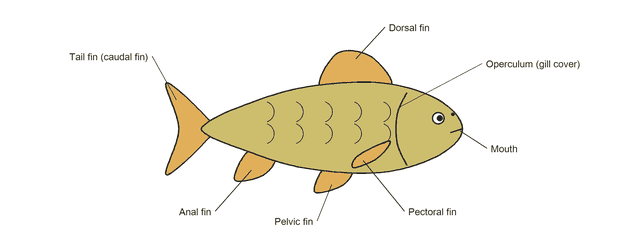
Labels: dorsal fin, tail (caudal) fin, anal fin, pelvic fin, pectoral fin, operculum (gill cover), mouth.
Step 2 — (i) Phylum and class.
Fishes have a backbone, so they belong to phylum Chordata, class Pisces.
Step 3 — (ii) Advantage of the body shape.
The body is streamlined: narrow at both ends and broad in the middle. It meets less resistance from water, so the fish swims easily and fast.
Step 4 — (iii) Nostrils.
No, fishes do not breathe through their nostrils; they breathe through gills. Their nostrils are used for smelling, which helps them find food and sense danger.
Step 5 — (iv) Breathing and locomotory structures.
Breathing: gills. Locomotion: fins, with the tail fin and the muscular body pushing the fish forward.
Step 6 — (v) Two examples.
Rohu and catla (others: shark, sea horse).
Watch out: A fish's nostrils are not joined to its gills; water for breathing enters through the mouth.
Therefore, (i) Chordata, Pisces; (ii) the streamlined body cuts through water easily; (iii) no, the nostrils are for smell; (iv) gills and fins; (v) rohu and catla.
