
Opening your dashboard
Class 6 Physics Chapter 6: Magnetism Solutions
57 textbook questions with step-by-step answers, free to read, for ICSE 2026-27.
Get talked through Ch 6, not just shown the answer
Reading a finished solution is not the same as being able to do it. The AI tutor takes one question at a time and works it with you, in your own words, until you can.
- Ask it out loud, in your own words
- It gives you the next step, not the answer
- Stuck on part (ii)? Start there
57 questions with solutions
1–4 marks · Easy difficulty
- 11 mark
Question 1
If we suspend a magnet freely, it will settle in:
Solve with AIAnswer
(A) east-west direction
- Correct
(B) north-south direction
(C) north-east direction
(D) east-south direction
Answer: (B) north-south direction
Concept: Directive property: a magnet that is free to turn comes to rest in the north-south direction, with its north pole pointing towards the geographic north. The earth behaves like a huge magnet whose magnetic south pole lies near the geographic north, so it pulls the north pole of the magnet that way.
Step 1 — Recall the directive property.
A freely suspended magnet swings for a while and then comes to rest with its north pole towards the geographic north and its south pole towards the geographic south.
Step 2 — Check it again.
If it is disturbed, it swings back to the same north-south line, because the earth's magnetism keeps pulling its poles that way.
Why the other options are wrong:
- (A) east-west direction: East-west is at right angles to the line along which the earth's magnetism pulls the poles.
- (C) north-east direction: North-east is not the line along which the earth's magnetism pulls the poles of the magnet.
- (D) east-south direction: East-south is not the line along which the earth's magnetism pulls the poles of the magnet.
Therefore, a freely suspended magnet settles in the north-south direction, option (B).
- 21 mark
Question 2
Making a magnetic substance a magnet by bringing it closer to another magnet without touching it, is :
Solve with AIAnswer
- Correct
(A) magnetic induction method
(B) single touch method
(C) double touch method
(D) electrical method
Answer: (A) magnetic induction method
Concept: Magnetic induction: a piece of iron placed near a magnet becomes a magnet itself, without touching it. The end nearer the magnet's pole gets the opposite pole. The iron stays a magnet only while the magnet is near it.
Step 1 — Read the method described.
The magnetic substance only has to be brought close to a magnet; the two never touch.
Step 2 — Name the method.
Becoming a magnet just by being near a magnet is called magnetic induction.
Why the other options are wrong:
- (B) single touch method: In the single touch method one pole of a magnet is stroked along the bar, so the magnet touches it.
- (C) double touch method: In the double touch method two magnets are stroked along the bar, so they touch it.
- (D) electrical method: In the electrical method a current is passed through a coil wound on the bar; no magnet is needed.
Therefore, the method is magnetic induction, option (A).
- 31 mark
Question 3
An example of natural magnet is :
Solve with AIAnswer
(A) iron
(B) steel
- Correct
(C) lodestone
(D) none of above
Answer: (C) lodestone
Concept: Natural magnets (lodestone, an ore of iron called magnetite) are found in nature; they are weak and of odd shapes. Artificial magnets are made by us from iron or steel in useful shapes, such as bar, cylindrical, U-shaped and horse-shoe magnets, magnetic needles and compasses, and they are much stronger.
Step 1 — Recall where natural magnets come from.
A natural magnet is found in nature already magnetised; nobody has to make it.
Step 2 — Name it.
Lodestone, a naturally magnetised ore of iron (magnetite), is such a magnet.
Why the other options are wrong:
- (A) iron: Iron is a magnetic substance; an ordinary piece of iron is not a magnet by itself.
- (B) steel: Steel is a magnetic substance from which artificial magnets are made; it is not a natural magnet.
- (D) none of above: Lodestone is a natural magnet, so “none of above” cannot be right.
Therefore, lodestone is a natural magnet, option (C).
- 41 mark
Question 4
The artificial magnet used to detect direction in the laboratory is :
Solve with AIAnswer
(A) U-shaped magnet
(B) horse shoe magnet
(C) electromagnet
- Correct
(D) magnetic compass
Answer: (D) magnetic compass
Concept: A magnetic compass has a small magnetised needle pivoted so that it can turn freely. It rests in the north-south direction, so it is used to find directions.
Step 1 — See what is needed.
To find a direction we need a small magnet that is free to turn and settles in the north-south line.
Step 2 — Name the device.
The magnetic compass has exactly such a pivoted needle, so it is used to find directions.
Why the other options are wrong:
- (A) U-shaped magnet: A U-shaped magnet is used to attract iron objects; it is not pivoted to show direction.
- (B) horse shoe magnet: A horse-shoe magnet is also used to attract iron objects, not to show direction.
- (C) electromagnet: An electromagnet is used in electric bells and cranes; it is not used to find direction.
Therefore, the magnetic compass is used to detect direction, option (D).
- 51 mark
Question 5
A ......... is used to find the geographic direction at a place because its needle rests in geographic north south direction.
Solve with AIAnswer
- Correct
(A) Magnetic compass
(B) Bar magnet
(C) U-shaped magnet
(D) None of these
Answer: (A) Magnetic compass
Concept: A magnetic compass has a small magnetised needle pivoted so that it can turn freely. It rests in the north-south direction, so it is used to find directions.
Step 1 — Use the clue in the question.
The device has a needle that rests in the geographic north-south direction.
Step 2 — Name it.
A pivoted magnetic needle in a case is a magnetic compass, which sailors and pilots use to find directions.
Why the other options are wrong:
- (B) Bar magnet: A bar magnet shows direction only when it is hung freely; it has no needle and is not the instrument used to find direction.
- (C) U-shaped magnet: A U-shaped magnet is used to attract iron objects, not to find directions.
- (D) None of these: The magnetic compass fits the description, so “none of these” cannot be right.
Therefore, a magnetic compass is used to find the geographic direction, option (A).
- 61 mark
Question 6
The attraction property of a magnet is maximum at its :
Solve with AIAnswer
(A) centre
(B) north pole
(C) south pole
- Correct
(D) both (B) and (C)
Answer: (D) both (B) and (C)
Concept: The attraction of a magnet is greatest near its two ends, called its poles: the north pole (N) and the south pole (S). The poles always occur in pairs; even a tiny piece of a magnet has both.
Step 1 — Recall the iron-filings test.
When a bar magnet is dipped in iron filings or nails, most of them cling near its two ends and hardly any near its middle.
Step 2 — Name the ends.
These two ends are the poles. The north pole and the south pole attract iron equally strongly, so the attraction is maximum at both poles.
Why the other options are wrong:
- (A) centre: The attraction is least, almost nil, at the centre of the magnet.
- (B) north pole: The north pole attracts strongly, but so does the south pole; this option leaves it out.
- (C) south pole: The south pole attracts strongly, but so does the north pole; this option leaves it out.
Therefore, the attraction is maximum at both the north and the south pole, option (D).
- 71 mark
Question 7
The following question is Assertion-Reason based. Choose the answer based on the codes given below.
Assertion (A) : The magnetic field of electromagnet can be adjusted as per requirement.
Reason (R) : This can be achieved by varying the electric current in the coil.
Solve with AIAnswer
- Correct
(A) Both A and R are true and R is the correct explanation of A
(B) Both A and R are true and R is not the correct explanation of A
(C) A is true but R is false
(D) A is false but R is true
Answer: (A) Both A and R are true and R is the correct explanation of A
Concept: An electromagnet is a soft iron core with a coil of insulated copper wire wound on it. It is a magnet only while a current flows in the coil. Its strength grows with the current and with the number of turns.
Step 1 — Judge the Assertion.
The strength of an electromagnet can be changed as needed, and it can even be switched on and off. So the Assertion is true.
Step 2 — Judge the Reason.
Increasing the current in the coil makes the electromagnet stronger, and decreasing it makes it weaker. So the Reason is true.
Step 3 — Decide whether R explains A.
Changing the current is exactly how the magnetic field of an electromagnet is adjusted, so the Reason correctly explains the Assertion.
Why the other options are wrong:
- (B): The Reason does explain the Assertion, so this code is wrong.
- (C): The Reason is true, so this code is wrong.
- (D): The Assertion is true, so this code is wrong.
Therefore, both are true and the Reason correctly explains the Assertion, option (A).
- 81 mark
Question 8
The following question is Assertion-Reason based. Choose the answer based on the codes given below.
Assertion (A) : A bar magnet when split in two parts will have only one pole.
Reason (R) : Magnetic poles always exist in pairs.
Solve with AIAnswer
(A) Both A and R are true and R is the correct explanation of A
(B) Both A and R are true and R is not the correct explanation of A
(C) A is true but R is false
- Correct
(D) A is false but R is true
Answer: (D) A is false but R is true
Concept: The attraction of a magnet is greatest near its two ends, called its poles: the north pole (N) and the south pole (S). The poles always occur in pairs; even a tiny piece of a magnet has both.
Step 1 — Judge the Assertion.
When a bar magnet is broken into two parts, each part is a complete magnet with both a north pole and a south pole; new poles form at the broken ends. So the Assertion is false.
Step 2 — Judge the Reason.
Magnetic poles always exist in pairs, and a single pole can never be separated. So the Reason is true.
Why the other options are wrong:
- (A): This needs both statements to be true, but the Assertion is false.
- (B): This needs both statements to be true, but the Assertion is false.
- (C): It is the other way round: the Assertion is false and the Reason is true.
Therefore, the Assertion is false but the Reason is true, option (D).
- 91 mark
Question 9
Fill in the blanks :
Temporary magnets are usually made up of ...............
Solve with AIWritten solution
Solution:
Concept: A temporary magnet, usually of soft iron, is magnetised easily and loses its magnetism as soon as the magnet or the current is removed. A permanent magnet, usually of steel, keeps its magnetism for a long time.
Step 1 — Recall the material.
A temporary magnet must lose its magnetism as soon as the magnet or current is removed, and soft iron does exactly that.
Step 2 — Fill the blank.
So temporary magnets are usually made of soft iron.
Therefore, temporary magnets are usually made up of soft iron.
- 101 mark
Question 10
Fill in the blanks :
Rough handling destroys the ............... properties of a magnet.
Solve with AIWritten solution
Solution:
Concept: A magnet loses its magnetism (is demagnetised) by rough handling, by repeated hammering or dropping, by heating it strongly, and by passing alternating current through a coil around it.
Step 1 — Recall what spoils a magnet.
Dropping, hammering or other rough handling makes a magnet lose its magnetism.
Step 2 — Fill the blank.
So rough handling destroys the magnetic properties of a magnet.
Therefore, rough handling destroys the magnetic properties of a magnet.
- 111 mark
Question 11
Fill in the blanks :
Like poles ............... each other.
Solve with AIWritten solution
Solution:
Concept: Law of magnetic poles: like poles (N and N, or S and S) repel each other, and unlike poles (N and S) attract each other.
Step 1 — Apply the law of magnetic poles.
Two north poles, or two south poles, push each other away.
Step 2 — Fill the blank.
So like poles repel each other.
Therefore, like poles repel each other.
- 121 mark
Question 12
Fill in the blanks :
A freely suspended magnet points in the ............... direction.
Solve with AIWritten solution
Solution:
Concept: Directive property: a magnet that is free to turn comes to rest in the north-south direction, with its north pole pointing towards the geographic north. The earth behaves like a huge magnet whose magnetic south pole lies near the geographic north, so it pulls the north pole of the magnet that way.
Step 1 — Recall the directive property.
A magnet that is free to turn always comes to rest in the same line.
Step 2 — Fill the blank.
That line is the north-south direction.
Therefore, a freely suspended magnet points in the north-south direction.
- 131 mark
Question 13
Fill in the blanks :
In a magnet, ............... have the maximum attractive property.
Solve with AIWritten solution
Solution:
Concept: The attraction of a magnet is greatest near its two ends, called its poles: the north pole (N) and the south pole (S). The poles always occur in pairs; even a tiny piece of a magnet has both.
Step 1 — Recall where filings cling.
Iron filings cling mostly near the two ends of a bar magnet and hardly at all near its middle.
Step 2 — Fill the blank.
These ends are the poles, so the poles have the maximum attractive property.
Therefore, in a magnet, the poles have the maximum attractive property.
- 141 mark
Question 14
Fill in the blanks :
A magnet has ............... poles.
Solve with AIWritten solution
Solution:
Concept: The attraction of a magnet is greatest near its two ends, called its poles: the north pole (N) and the south pole (S). The poles always occur in pairs; even a tiny piece of a magnet has both.
Step 1 — Recall how poles occur.
Every magnet has a north pole and a south pole, and they always occur in pairs.
Step 2 — Fill the blank.
So a magnet has two poles.
Therefore, a magnet has two poles.
- 151 mark
Question 15
Write true or false for the statement.
Artificial magnets are weaker than natural magnets.
Solve with AIWritten solution
Solution:
Concept: Natural magnets (lodestone, an ore of iron called magnetite) are found in nature; they are weak and of odd shapes. Artificial magnets are made by us from iron or steel in useful shapes, such as bar, cylindrical, U-shaped and horse-shoe magnets, magnetic needles and compasses, and they are much stronger.
Step 1 — Compare the two kinds.
Natural magnets such as lodestone are weak. Artificial magnets of iron or steel can be made much stronger.
Step 2 — Judge the statement.
Artificial magnets are stronger, not weaker, so the statement is false.
Therefore, the statement is false: artificial magnets are stronger than natural magnets.
- 161 mark
Question 16
Write true or false for the statement.
Poles of a magnet cannot be separated.
Solve with AIWritten solution
Solution:
Concept: The attraction of a magnet is greatest near its two ends, called its poles: the north pole (N) and the south pole (S). The poles always occur in pairs; even a tiny piece of a magnet has both.
Step 1 — Think of breaking a magnet.
If a magnet is broken, each piece again has both a north pole and a south pole.
Step 2 — Judge the statement.
A single pole can never be separated, so the statement is true.
Therefore, the statement is true.
- 171 mark
Question 17
Write true or false for the statement.
A magnet can attract only a magnetic substance.
Solve with AIWritten solution
Solution:
Concept: A magnet is a substance that attracts iron and other magnetic substances (steel, cobalt and nickel). Substances that a magnet does not attract, such as wood, plastic, copper and glass, are non-magnetic substances.
Step 1 — Recall what a magnet attracts.
A magnet attracts magnetic substances such as iron, steel, cobalt and nickel.
Step 2 — Judge the statement.
It does not attract non-magnetic substances such as wood, plastic, copper or glass, so the statement is true.
Therefore, the statement is true.
- 181 mark
Question 18
Write true or false for the statement.
A magnet has no effect when it is heated to a high temperature.
Solve with AIWritten solution
Solution:
Concept: A magnet loses its magnetism (is demagnetised) by rough handling, by repeated hammering or dropping, by heating it strongly, and by passing alternating current through a coil around it.
Step 1 — Recall the effect of heat.
Strong heating is one of the ways in which a magnet is demagnetised.
Step 2 — Judge the statement.
Heating does have an effect: the magnet loses its magnetism. So the statement is false.
Therefore, the statement is false: a magnet loses its magnetism when heated to a high temperature.
- 191 mark
Question 19
Write true or false for the statement.
Permanent magnets get easily demagnetised.
Solve with AIWritten solution
Solution:
Concept: A temporary magnet, usually of soft iron, is magnetised easily and loses its magnetism as soon as the magnet or the current is removed. A permanent magnet, usually of steel, keeps its magnetism for a long time.
Step 1 — Recall what permanent means.
A permanent magnet, usually of steel, keeps its magnetism for a long time.
Step 2 — Judge the statement.
It is temporary magnets of soft iron that lose their magnetism easily, so the statement is false.
Therefore, the statement is false: permanent magnets are not easily demagnetised.
- 201 mark
Question 20
Write true or false for the statement.
Magnetic poles occur in pairs.
Solve with AIWritten solution
Solution:
Concept: The attraction of a magnet is greatest near its two ends, called its poles: the north pole (N) and the south pole (S). The poles always occur in pairs; even a tiny piece of a magnet has both.
Step 1 — Recall how poles occur.
Every magnet, however small, has both a north pole and a south pole.
Step 2 — Judge the statement.
Poles always come as a pair, so the statement is true.
Therefore, the statement is true.
- 211 mark
Question 21
Write true or false for the statement.
Single touch method is better than the electrical method for making a magnet.
Solve with AIWritten solution
Solution:
Concept: A piece of iron can be made a magnet by magnetic induction (placing it near a magnet), by the single touch or double touch method (stroking it with a magnet) and by the electrical method (passing a current through a coil of insulated wire wound on it).
Step 1 — Compare the two methods.
The electrical method makes a strong magnet quickly, and its strength can be raised by increasing the current or the number of turns. The single touch method needs many strokes and gives only a weak magnet.
Step 2 — Judge the statement.
The electrical method is the better one, so the statement is false.
Therefore, the statement is false: the electrical method is better than the single touch method.
- 221 mark
Question 22
Write true or false for the statement.
Magnetic keeper is a wooden piece.
Solve with AIWritten solution
Solution:
Concept: Magnetic keepers are pieces of soft iron placed across the poles of stored magnets. Opposite poles are induced in them, so the magnets and keepers form a closed loop and the magnets keep their magnetism.
Step 1 — Recall what a keeper must do.
Poles have to be induced in a keeper, so it must be made of a magnetic material, soft iron.
Step 2 — Judge the statement.
A piece of wood is placed between the two stored magnets, but the keepers across their ends are of soft iron. So the statement is false.
Therefore, the statement is false: a magnetic keeper is a piece of soft iron.
- 231 mark
Question 23
Write true or false for the statement.
Copper cannot be magnetised.
Solve with AIWritten solution
Solution:
Concept: A magnet is a substance that attracts iron and other magnetic substances (steel, cobalt and nickel). Substances that a magnet does not attract, such as wood, plastic, copper and glass, are non-magnetic substances.
Step 1 — Recall what copper is.
Copper is a non-magnetic substance: a magnet does not attract it.
Step 2 — Judge the statement.
A non-magnetic substance cannot be made into a magnet, so the statement is true.
Therefore, the statement is true.
- 241 mark
Question 24
Match the following columns :
Column A : Steel
Choose from Column B :
Column B (i) to store magnets (ii) temporary magnet (iii) permanent magnet (iv) electromagnet Solve with AIWritten solution
Solution:
Concept: A temporary magnet, usually of soft iron, is magnetised easily and loses its magnetism as soon as the magnet or the current is removed. A permanent magnet, usually of steel, keeps its magnetism for a long time.
Step 1 — Recall the property of steel.
Steel is hard to magnetise, but once magnetised it keeps its magnetism for a long time.
Step 2 — Match it.
So steel is used for permanent magnets: steel matches (iii) permanent magnet.
Therefore, steel matches (iii) permanent magnet.
- 251 mark
Question 25
Match the following columns :
Column A : Soft iron
Choose from Column B :
Column B (i) to store magnets (ii) temporary magnet (iii) permanent magnet (iv) electromagnet Solve with AIWritten solution
Solution:
Concept: A temporary magnet, usually of soft iron, is magnetised easily and loses its magnetism as soon as the magnet or the current is removed. A permanent magnet, usually of steel, keeps its magnetism for a long time.
Step 1 — Recall the property of soft iron.
Soft iron becomes a magnet easily and loses its magnetism as soon as the magnet or current is removed.
Step 2 — Match it.
So soft iron matches (ii) temporary magnet.
Therefore, soft iron matches (ii) temporary magnet.
- 261 mark
Question 26
Match the following columns :
Column A : Used in electric bell
Choose from Column B :
Column B (i) to store magnets (ii) temporary magnet (iii) permanent magnet (iv) electromagnet Solve with AIWritten solution
Solution:
Concept: An electromagnet is a soft iron core with a coil of insulated copper wire wound on it. It is a magnet only while a current flows in the coil. Its strength grows with the current and with the number of turns.
Step 1 — See what a bell needs.
An electric bell needs a magnet that can be switched on and off again and again to pull and release the hammer.
Step 2 — Match it.
An electromagnet does this, so the item used in an electric bell matches (iv) electromagnet.
Therefore, used in electric bell matches (iv) electromagnet.
- 271 mark
Question 27
Match the following columns :
Column A : Magnetic keepers
Choose from Column B :
Column B (i) to store magnets (ii) temporary magnet (iii) permanent magnet (iv) electromagnet Solve with AIWritten solution
Solution:
Concept: Magnetic keepers are pieces of soft iron placed across the poles of stored magnets. Opposite poles are induced in them, so the magnets and keepers form a closed loop and the magnets keep their magnetism.
Step 1 — Recall what keepers do.
Soft iron keepers placed across the poles of stored magnets form a closed loop with them, so the magnets do not lose their magnetism.
Step 2 — Match it.
So magnetic keepers match (i) to store magnets.
Therefore, magnetic keepers match (i) to store magnets.
- 282 marks
Question 28
What is a magnet ?
Solve with AIWritten solution
Solution:
Concept: A magnet is a substance that attracts iron and other magnetic substances (steel, cobalt and nickel). Substances that a magnet does not attract, such as wood, plastic, copper and glass, are non-magnetic substances.
Step 1 — Define a magnet.
A magnet is a substance which has the property of attracting iron and other magnetic substances such as steel, cobalt and nickel.
Step 2 — Add its second property.
When a magnet is suspended freely, it always comes to rest in the north-south direction.
Step 3 — Give examples.
A bar magnet, a U-shaped magnet, a horse-shoe magnet, a compass needle and lodestone are magnets.
Therefore, a magnet is a substance that attracts iron and rests in the north-south direction when freely suspended.
- 293 marks
Question 29
What are magnetic and non-magnetic substances? Give two examples of each.
Solve with AIWritten solution
Solution:
Concept: A magnet is a substance that attracts iron and other magnetic substances (steel, cobalt and nickel). Substances that a magnet does not attract, such as wood, plastic, copper and glass, are non-magnetic substances.
Step 1 — Define magnetic substances.
Substances that are attracted by a magnet are called magnetic substances. Examples: iron and nickel (also steel and cobalt).
Step 2 — Define non-magnetic substances.
Substances that are not attracted by a magnet are called non-magnetic substances. Examples: wood and plastic (also copper, paper, rubber, glass and aluminium).
Watch out: A metal is not always magnetic; copper, aluminium, gold and silver are not attracted.
Therefore, magnetic substances (iron, nickel) are attracted by a magnet, and non-magnetic substances (wood, plastic) are not.
- 302 marks
Question 30
What are natural and artificial magnets ?
Solve with AIWritten solution
Solution:
Concept: Natural magnets (lodestone, an ore of iron called magnetite) are found in nature; they are weak and of odd shapes. Artificial magnets are made by us from iron or steel in useful shapes, such as bar, cylindrical, U-shaped and horse-shoe magnets, magnetic needles and compasses, and they are much stronger.
Step 1 — Natural magnets.
Lodestone, a naturally magnetised ore of iron (magnetite), found in nature, is a natural magnet. Natural magnets have irregular, odd shapes and are weak, so they are of little use.
Step 2 — Artificial magnets.
Magnets made by us from iron or steel are artificial magnets. They are strong and are made in the shapes needed, such as bar, cylindrical, U-shaped and horse-shoe magnets, magnetic needles and compasses.
Therefore, natural magnets are found in nature, while artificial magnets are made by us from iron or steel.
- 312 marks
Question 31
How is an artificial magnet prepared from a natural magnet ?
Solve with AIWritten solution
Solution:
Concept: A piece of iron can be made a magnet by magnetic induction (placing it near a magnet), by the single touch or double touch method (stroking it with a magnet) and by the electrical method (passing a current through a coil of insulated wire wound on it).
Step 1 — Choose the method.
A natural magnet can magnetise a bar of iron or steel by the single touch method, in which the bar is stroked with one pole of the magnet.
Step 2 — Stroke the bar.
Place the bar on a table. Put one end of the lodestone on one end of the bar and move it along the bar to the other end. Lift it there, bring it back through the air to the first end, and stroke again in the same direction.
Step 3 — Repeat.
Repeat this about 20 times. Then turn the bar over and stroke it about 20 times more in the same way.
Watch out: Always stroke in the same direction and lift the magnet on the way back; stroking to and fro undoes the effect.
Therefore, an artificial magnet is made by stroking an iron or steel bar many times in one direction with one pole of the natural magnet.
- 322 marks
Question 32
State two ways of magnetising an iron piece.
Solve with AIWritten solution
Solution:
Concept: A piece of iron can be made a magnet by magnetic induction (placing it near a magnet), by the single touch or double touch method (stroking it with a magnet) and by the electrical method (passing a current through a coil of insulated wire wound on it).
Step 1 — First way: the electrical method.
Wind insulated copper wire round the iron piece and pass an electric current through the wire.
Step 2 — Second way: the single touch method.
Stroke the iron piece from one end to the other with one pole of a magnet about 20 times, always in the same direction.
Note: magnetic induction and the double touch method are two more ways.
Therefore, an iron piece can be magnetised by the electrical method or by the single touch method.
- 332 marks
Question 33
How can magnetic properties of a magnet be destroyed?
Solve with AIWritten solution
Solution:
Concept: A magnet loses its magnetism (is demagnetised) by rough handling, by repeated hammering or dropping, by heating it strongly, and by passing alternating current through a coil around it.
Step 1 — Name the process.
Destroying the magnetic properties of a magnet is called demagnetisation.
Step 2 — List the ways.
A magnet is demagnetised in these ways.
- by rough handling;
- by hammering it repeatedly;
- by dropping it repeatedly on a hard surface;
- by heating it to a high temperature;
- by passing alternating current through a coil around it, kept in the east-west direction.
Therefore, the magnetic properties of a magnet are destroyed by rough handling, hammering, dropping, heating or alternating current.
- 342 marks
Question 34
Why does a freely suspended magnet always rest in north-south direction ?
Solve with AIWritten solution
Solution:
Concept: Directive property: a magnet that is free to turn comes to rest in the north-south direction, with its north pole pointing towards the geographic north. The earth behaves like a huge magnet whose magnetic south pole lies near the geographic north, so it pulls the north pole of the magnet that way.
Step 1 — See the earth as a magnet.
The earth behaves like a huge magnet. Its magnetic south pole lies near the geographic north, and its magnetic north pole near the geographic south.
Step 2 — Apply the law of poles.
Unlike poles attract. So the north pole of the suspended magnet is pulled towards the geographic north, and its south pole towards the geographic south.
Step 3 — Conclude.
These two pulls turn the magnet until it lies along the north-south line, where it rests.
Watch out: The earth's magnetic pole in the north is a south pole; that is why it attracts the north pole of a magnet.
Therefore, a freely suspended magnet rests in the north-south direction because the earth acts as a huge magnet and attracts its poles.
- 352 marks
Question 35
Why are artificial magnets preferred over the natural magnets ?
Solve with AIWritten solution
Solution:
Concept: Natural magnets (lodestone, an ore of iron called magnetite) are found in nature; they are weak and of odd shapes. Artificial magnets are made by us from iron or steel in useful shapes, such as bar, cylindrical, U-shaped and horse-shoe magnets, magnetic needles and compasses, and they are much stronger.
Step 1 — Compare strength.
Natural magnets are weak, while artificial magnets can be made strong.
Step 2 — Compare shape.
Natural magnets have irregular, odd shapes, while artificial magnets can be made in any shape and size needed, such as a bar, a U-shape, a horse-shoe or a needle.
Therefore, artificial magnets are preferred because they are stronger and can be made in any useful shape.
- 362 marks
Question 36
State four important properties of a bar magnet.
Solve with AIWritten solution
Solution:
Concept: The attraction of a magnet is greatest near its two ends, called its poles: the north pole (N) and the south pole (S). The poles always occur in pairs; even a tiny piece of a magnet has both.
Step 1 — List the properties.
A bar magnet has these four important properties.
- It attracts small pieces of iron, most strongly at its poles.
- When suspended freely, it comes to rest in the north-south direction.
- Like poles repel each other and unlike poles attract each other.
- Its poles exist in pairs and cannot be separated.
Therefore, a bar magnet attracts iron, points north-south when free, obeys the law of poles, and always has two poles.
- 373 marks
Question 37
How are the magnets kept safely ? What is the role of keepers in storing magnets ?
Solve with AIWritten solution
Solution:
Concept: Magnetic keepers are pieces of soft iron placed across the poles of stored magnets. Opposite poles are induced in them, so the magnets and keepers form a closed loop and the magnets keep their magnetism.
Step 1 — Store the magnets.
A magnet slowly loses its magnetism if left alone, so it is not stored by itself. Two bar magnets A and B are placed side by side with opposite poles on the same side and a piece of wood between them. Two pieces of soft iron, the keepers P and Q, are placed across their ends.

Step 2 — Explain the keepers.
By magnetic induction, opposite poles form at the ends of each keeper. The magnets and keepers then form a closed loop, which keeps the magnets from losing their magnetism.
Step 3 — Other care.
A horse-shoe magnet needs only one keeper across its two poles. Magnets are also kept away from heat and are never dropped or hammered.
Therefore, magnets are stored in pairs with soft iron keepers across their ends, and the keepers form a closed loop that prevents loss of magnetism.
- 382 marks
Question 38
State two ways of increasing the strength of an electromagnet.
Solve with AIWritten solution
Solution:
Concept: An electromagnet is a soft iron core with a coil of insulated copper wire wound on it. It is a magnet only while a current flows in the coil. Its strength grows with the current and with the number of turns.
Step 1 — First way.
Increase the current in the coil, for example by using two or three cells in series.
Step 2 — Second way.
Increase the number of turns of wire in the coil.
Therefore, an electromagnet is made stronger by increasing the current or the number of turns of its coil.
- 392 marks
Question 39
State three important uses of a magnet.
Solve with AIWritten solution
Solution:
Concept: An electromagnet is a soft iron core with a coil of insulated copper wire wound on it. It is a magnet only while a current flows in the coil. Its strength grows with the current and with the number of turns.
Step 1 — List three uses.
Magnets have many uses; three important ones are given here.
- Electromagnets are used in electric bells, telephone receivers and loudspeakers.
- Strong electromagnets in cranes lift and unload scrap iron.
- The magnetic compass is used by sailors and pilots to find directions.
Note: magnets are also used in electric motors, generators and many measuring instruments.
Therefore, magnets are used in electric bells, in cranes for lifting scrap iron and in the magnetic compass.
- 403 marks
Question 40
In which direction does a suspended bar magnet come to rest ? Give reason.
Solve with AIWritten solution
Solution:
Concept: Directive property: a magnet that is free to turn comes to rest in the north-south direction, with its north pole pointing towards the geographic north. The earth behaves like a huge magnet whose magnetic south pole lies near the geographic north, so it pulls the north pole of the magnet that way.
Step 1 — State the direction.
A freely suspended bar magnet comes to rest in the north-south direction, with its north pole towards the geographic north.
Step 2 — Give the reason.
The earth behaves like a huge magnet with its magnetic south pole near the geographic north. Unlike poles attract, so the north pole of the bar magnet is pulled towards the geographic north and its south pole towards the geographic south.
Therefore, a suspended bar magnet rests in the north-south direction because the earth acts as a huge magnet.
- 412 marks
Question 41
State three differences between temporary and permanent magnets.
Solve with AIWritten solution
Solution:
Concept: A temporary magnet, usually of soft iron, is magnetised easily and loses its magnetism as soon as the magnet or the current is removed. A permanent magnet, usually of steel, keeps its magnetism for a long time.
Step 1 — Compare them.
The differences are shown in the table.
Temporary magnet Permanent magnet 1. Made of soft iron. 1. Made of steel. 2. A magnet only while a current flows in its coil or a magnet is near it. 2. Stays a magnet after the current or the magnet is removed. 3. Easily demagnetised. 3. Not easily demagnetised. Step 2 — Add one more difference.
The strength of a temporary electromagnet can be changed by changing the current, but that of a permanent magnet cannot.
Therefore, a temporary magnet is of soft iron and loses its magnetism easily, while a permanent magnet is of steel and keeps it.
- 422 marks
Question 42
State three ways of demagnetising a magnet.
Solve with AIWritten solution
Solution:
Concept: A magnet loses its magnetism (is demagnetised) by rough handling, by repeated hammering or dropping, by heating it strongly, and by passing alternating current through a coil around it.
Step 1 — List three ways.
Any of these makes a magnet lose its magnetism.
- Hammering it repeatedly (or other rough handling).
- Dropping it repeatedly on a hard surface.
- Heating it to a high temperature.
Note: passing alternating current through a coil around the magnet also demagnetises it.
Therefore, a magnet is demagnetised by hammering, dropping or heating it.
- 432 marks
Question 43
Suggest one way to recognise the magnetic field of the earth.
Solve with AIWritten solution
Solution:
Concept: Directive property: a magnet that is free to turn comes to rest in the north-south direction, with its north pole pointing towards the geographic north. The earth behaves like a huge magnet whose magnetic south pole lies near the geographic north, so it pulls the north pole of the magnet that way.
Step 1 — Hang a magnet freely.
Suspend a bar magnet by a silk thread, far from other magnets and iron objects.
Step 2 — Observe it.
It always comes to rest in the north-south direction, and if it is turned it swings back. Some force must act on it to do this; that force comes from the earth's magnetic field.
Therefore, the earth's magnetic field is recognised by a freely suspended magnet (or a compass needle) that always rests north-south.
- 443 marks
Question 44
Name the material of core of an electromagnet for (a) temporary magnet (b) permanent magnet.
Solve with AIWritten solution
Solution:
Concept: A temporary magnet, usually of soft iron, is magnetised easily and loses its magnetism as soon as the magnet or the current is removed. A permanent magnet, usually of steel, keeps its magnetism for a long time.
Step 1 — Temporary magnet.
The core must lose its magnetism when the current stops, so it is made of soft iron.
Step 2 — Permanent magnet.
The core must keep its magnetism after the current stops, so it is made of steel.
Therefore, (a) the core of a temporary magnet is soft iron, and (b) the core of a permanent magnet is steel.
- 453 marks
Question 45
What are magnetic keepers ? Name its material.
Solve with AIWritten solution
Solution:
Concept: Magnetic keepers are pieces of soft iron placed across the poles of stored magnets. Opposite poles are induced in them, so the magnets and keepers form a closed loop and the magnets keep their magnetism.
Step 1 — Define keepers.
Magnetic keepers are pieces of magnetic material placed across the poles of stored magnets. Opposite poles are induced in them, and the closed loop they form stops the magnets losing their magnetism.
Step 2 — Name the material.
They are made of soft iron, which is easily magnetised by induction.
Therefore, magnetic keepers are soft iron pieces placed across the poles of stored magnets.
- 462 marks
Question 46
How are the north and south poles of a magnet located ? Explain.
Solve with AIWritten solution
Solution:
Concept: Directive property: a magnet that is free to turn comes to rest in the north-south direction, with its north pole pointing towards the geographic north. The earth behaves like a huge magnet whose magnetic south pole lies near the geographic north, so it pulls the north pole of the magnet that way.
Step 1 — Hang the magnet freely.
Suspend the magnet from a wooden stand by a silk thread so that it can swing freely. It swings for a while and then rests in the north-south direction.
Step 2 — Name the poles.
The end pointing towards the geographic north is the north-seeking pole, or north pole (N). The end pointing towards the geographic south is the south pole (S).
Step 3 — Mark them.
The poles are then marked N and S. The poles lie a little inside the ends, not exactly at them.
Therefore, the poles are located by hanging the magnet freely: the end that points north is the north pole and the other is the south pole.
- 473 marks
Question 47
Draw diagrams of artificial magnets of four different shapes.
Solve with AIWritten solution
Solution:
Concept: Natural magnets (lodestone, an ore of iron called magnetite) are found in nature; they are weak and of odd shapes. Artificial magnets are made by us from iron or steel in useful shapes, such as bar, cylindrical, U-shaped and horse-shoe magnets, magnetic needles and compasses, and they are much stronger.
Step 1 — Name four shapes.
Four common shapes of artificial magnets are the bar magnet, the cylindrical magnet, the U-shaped magnet and the horse-shoe magnet. Each has a north pole and a south pole at its ends.

Note: a magnetic needle and a compass are two more artificial magnets.
Therefore, the bar, cylindrical, U-shaped and horse-shoe magnets are four shapes of artificial magnets.
- 484 marks
Question 48
Describe an experiment to show that the maximum attractive property is at the poles of a magnet.
Solve with AIWritten solution
Solution:
Concept: The attraction of a magnet is greatest near its two ends, called its poles: the north pole (N) and the south pole (S). The poles always occur in pairs; even a tiny piece of a magnet has both.
Step 1 — Set up the experiment.
Take a bar magnet and spread some small iron nails (or iron filings) on a sheet of paper.
Step 2 — Do the experiment.
Roll the bar magnet in the nails and then lift it up.
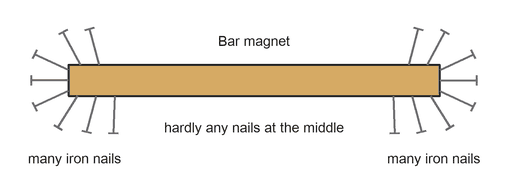
Step 3 — Observe.
Many nails cling near the two ends of the magnet and hardly any cling near the middle.
Step 4 — Conclude.
The attraction is not the same all along the magnet. It is maximum near the ends, and these ends are the poles.
Therefore, the experiment shows that the attractive property of a magnet is maximum at its poles.
- 494 marks
Question 49
Explain the attractive property of a magnet with the help of an experiment.
Solve with AIWritten solution
Solution:
Concept: A magnet is a substance that attracts iron and other magnetic substances (steel, cobalt and nickel). Substances that a magnet does not attract, such as wood, plastic, copper and glass, are non-magnetic substances.
Step 1 — Collect objects.
Take iron nails, pins, a steel spoon, a piece of wood, a plastic scale, an eraser, a copper wire and a piece of paper.
Step 2 — Test each object.
Bring a bar magnet near each object in turn. The iron nails, pins and steel spoon are pulled towards the magnet and cling to it. Wood, plastic, rubber, copper and paper are not attracted.
Step 3 — Dip the magnet in nails.
Roll the magnet in a heap of iron nails and lift it. Most nails cling near the two ends and hardly any near the middle.
Step 4 — Conclude.
A magnet attracts magnetic substances such as iron and steel, but not non-magnetic substances. The attraction is strongest at the poles.
Therefore, a magnet attracts iron and other magnetic substances, most strongly at its poles.
- 504 marks
Question 50
Describe a method by which an iron bar can be made a magnet.
Solve with AIWritten solution
Solution:
Concept: A piece of iron can be made a magnet by magnetic induction (placing it near a magnet), by the single touch or double touch method (stroking it with a magnet) and by the electrical method (passing a current through a coil of insulated wire wound on it).
Step 1 — Place the bar and the magnet.
Place the iron bar AB on a table. Hold a bar magnet nearly upright with its north pole on the end A.
Step 2 — Stroke the bar.
Move the magnet along the bar to the end B. Lift it there and bring it back through the air to A, then stroke again from A to B.
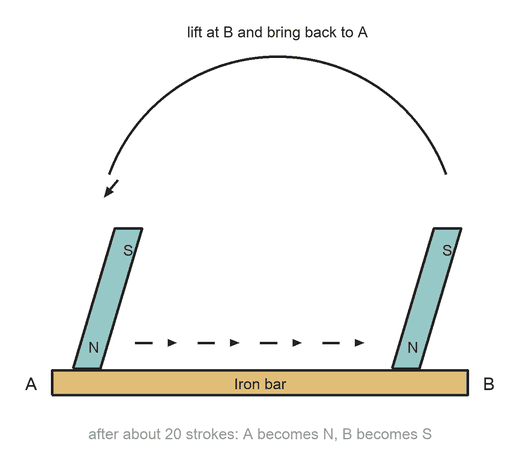
Step 3 — Repeat.
Repeat about 20 times. Then turn the bar over and stroke it about 20 times more.
Step 4 — Find the poles.
The bar becomes a magnet. The end touched last gets the pole opposite to the stroking pole. The stroking pole is N and the end touched last is B, so B becomes S and A becomes N.
Watch out: Always stroke in one direction only; to-and-fro strokes undo the magnetism.
Therefore, by the single touch method the iron bar becomes a magnet with A as the north pole and B as the south pole.
- 514 marks
Question 51
Define the term magnetic field of a magnet. How will you recognise it experimentally ?
Solve with AIWritten solution
Solution:
Concept: The magnetic field of a magnet is the space around it in which a magnetic substance or another magnet feels a force. It is shown by field lines, which go out of the north pole and into the south pole.
Step 1 — Define the magnetic field.
The space around a magnet in which a magnetic substance, such as a small piece of iron, feels a force of attraction is called the magnetic field of the magnet.
Step 2 — Set up the experiment.
Place a bar magnet under a sheet of stiff paper. Sprinkle iron filings evenly on the paper and tap the sheet gently.
Step 3 — Observe.
The filings arrange themselves in a definite pattern of curved lines running from one pole of the magnet to the other.

Step 4 — Interpret.
This pattern shows the magnetic field. Outside the magnet the field lines go from the north pole to the south pole. The lines are crowded near the poles, where the field is strong, and spread out far away, where it is weak.
Therefore, the magnetic field is the space around a magnet where it exerts a force, and it is recognised by the pattern of iron filings (or by a compass needle placed at different points).
- 524 marks
Question 52
How will you make a bar of iron an electromagnet ? Draw a diagram showing the polarities of an electromagnet.
Solve with AIWritten solution
Solution:
Concept: An electromagnet is a soft iron core with a coil of insulated copper wire wound on it. It is a magnet only while a current flows in the coil. Its strength grows with the current and with the number of turns.
Step 1 — Make the electromagnet.
Take a soft iron bar and wind many turns of insulated copper wire closely on it. Join the two ends of the wire to a cell through a key (switch).
Step 2 — Switch on.
Close the key so that a current flows in the coil. The bar becomes a magnet and attracts iron pins. When the current is switched off, it loses its magnetism, so it is a temporary magnet.
Step 3 — Find the polarities.
Look at each end of the bar. The end at which the current flows clockwise (seen from that end) becomes the south pole. The end at which it flows anticlockwise becomes the north pole. In the diagram the left end is S and the right end is N.
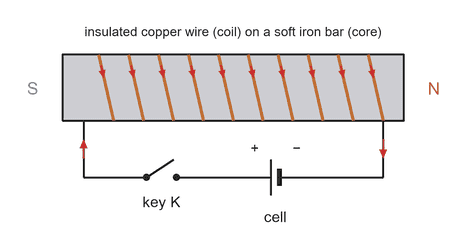
Watch out: Reversing the current reverses the poles.
Therefore, a soft iron bar with a current-carrying coil becomes an electromagnet; the end with clockwise current is S and the other end is N.
- 533 marks
Question 53
Suppose you are given a long bar magnet and you are asked to break it into four small magnets. Draw diagrams showing the polarities of each broken part.
Solve with AIWritten solution
Solution:
Concept: The attraction of a magnet is greatest near its two ends, called its poles: the north pole (N) and the south pole (S). The poles always occur in pairs; even a tiny piece of a magnet has both.
Step 1 — Draw the broken pieces.
When the long bar magnet (S at the left, N at the right) is broken into four parts, each part becomes a complete magnet.

Step 2 — Mark the poles.
In every piece the S pole is on the side of the original S pole and the N pole on the side of the original N pole. At every break a new N forms on one piece and a new S on the next, so the pieces read S N, S N, S N, S N.
Therefore, each of the four pieces is a complete magnet with its own north and south pole, showing that the poles can never be separated.
- 544 marks
Question 54
What is magnetic induction ? Explain with the help of a diagram.
Solve with AIWritten solution
Solution:
Concept: Magnetic induction: a piece of iron placed near a magnet becomes a magnet itself, without touching it. The end nearer the magnet's pole gets the opposite pole. The iron stays a magnet only while the magnet is near it.
Step 1 — Define magnetic induction.
When a piece of iron is placed near a magnet, it becomes a magnet itself without touching it. It loses this magnetism when the magnet is taken away. This is magnetic induction.
Step 2 — Explain with the diagram.
Place the north pole of a bar magnet near an iron piece AB. The end A, near the north pole, becomes a south pole, and the far end B becomes a north pole. Iron pins now cling to the iron piece.
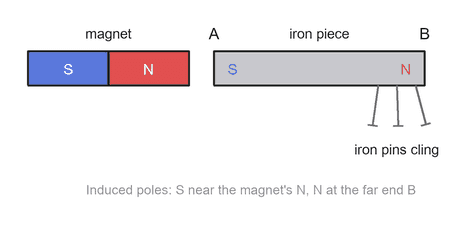
Step 3 — Remove the magnet.
When the magnet is removed, the pins fall off, because the iron piece is no longer a magnet.
Note: this is why a magnet attracts iron: an opposite pole is induced on the near end of the iron, and unlike poles attract.
Therefore, magnetic induction makes a piece of iron a temporary magnet while a magnet is near it, with the opposite pole on its nearer end.
- 554 marks
Question 55
You are given an iron nail, a torch cell and a long piece of insulated copper wire. With the help of a labelled neat diagram, describe in steps how you will make the nail, an electromagnet.
Solve with AIWritten solution
Solution:
Concept: An electromagnet is a soft iron core with a coil of insulated copper wire wound on it. It is a magnet only while a current flows in the coil. Its strength grows with the current and with the number of turns.
Step 1 — Draw the arrangement.
The diagram shows the coil on the nail joined to the torch cell.
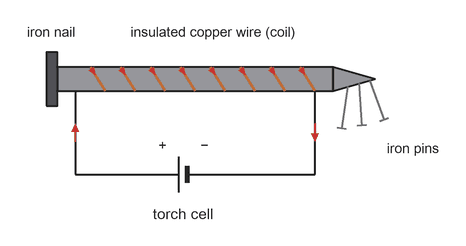
Step 2 — Prepare the wire.
Remove a little insulation from the two ends of the insulated copper wire.
Step 3 — Wind the coil.
Wrap the wire closely round the iron nail in many turns, all in the same direction, leaving the two ends free.
Step 4 — Connect the cell.
Join the free ends of the wire to the two terminals of the torch cell. A current flows through the coil.
Step 5 — Test the nail.
Bring the tip of the nail near some iron pins. They cling to it, so the nail has become an electromagnet. Disconnect one end of the wire: the current stops and the pins fall off.
Note: joining two or three cells in series increases the current and makes the electromagnet stronger.
Therefore, an iron nail wound with insulated copper wire and joined to a torch cell becomes an electromagnet.
- 564 marks
Question 56
Describe an experiment to illustrate that like poles repel while unlike poles attract.
Solve with AIWritten solution
Solution:
Concept: Law of magnetic poles: like poles (N and N, or S and S) repel each other, and unlike poles (N and S) attract each other.
Step 1 — Set up.
Suspend a bar magnet A by a silk thread from a stand so that it can turn freely; it rests in the north-south direction. Hold another bar magnet B in your hand.
Step 2 — Bring like poles together.
Bring the north pole of B near the north pole of A without touching. A turns away from B.

Step 3 — Bring unlike poles together.
Now bring the south pole of B near the north pole of A. A turns towards B.
Step 4 — Conclude.
Two north poles push apart, while a south pole and a north pole pull together.
Therefore, like poles repel each other and unlike poles attract each other.
- 573 marks
Question 57
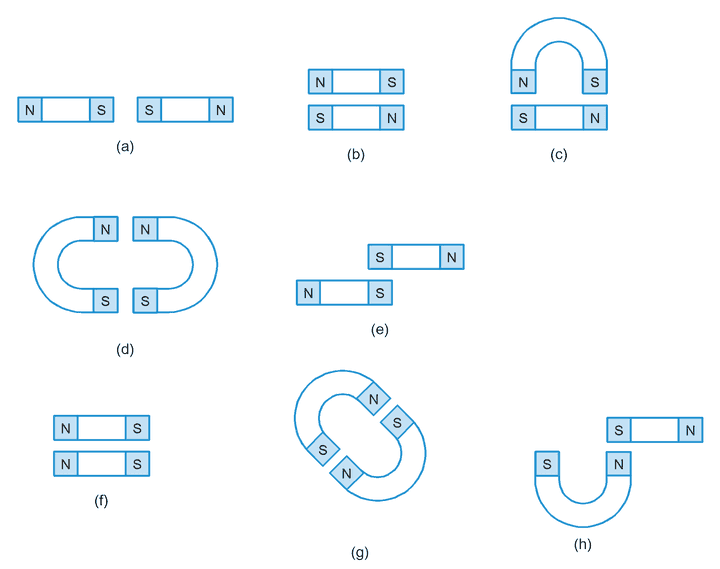
In the figures given below, state whether the pair of magnets would attract each other or repel each other.
 Solve with AI
Written solution
Solution:
Concept: Law of magnetic poles: like poles (N and N, or S and S) repel each other, and unlike poles (N and S) attract each other.
Step 1 — Look at the facing poles.
In each figure we look only at the poles that face, or lie next to, each other.
Figure Facing poles Result (a) S faces S repel (b) N is above S, and S is above N attract (c) the U-magnet's N is above S, and its S above N attract (d) N faces N, and S faces S repel (e) S of the upper magnet is just above S of the lower repel (f) N is above N, and S is above S repel (g) at both gaps N faces S attract (h) S of the bar magnet is just above N of the U-magnet attract Step 2 — Apply the law.
Like poles repel and unlike poles attract, which gives the results in the table.
Therefore, the pairs in (b), (c), (g) and (h) attract each other, and the pairs in (a), (d), (e) and (f) repel each other.
What Class 6 Physics Ch 6 covers
The sections of the chapter, in the order the book takes them. Every question above comes from one of these.
- 01Discovery of Magnets
- 02Artificial Magnets
- 03Magnetic and Non-Magnetic Substances
- 04Properties of Magnets
- 05Magnetic Field Around a Magnet
- 06Making a Magnet
More ways to study this chapter
The same chapter asked three other ways. Practise it, revise it, and see what the board has set on Ch 6 before.
Class 6 Physics Ch 6 questions students ask
How many questions are there in Class 6 Physics Ch 6?
57 questions. Every one is solved step by step on this page.
Are these Class 6 Physics solutions free?
Yes. Every question and its full working is free to read, with no account needed.
Can I download the Class 6 Physics Ch 6 solutions as a PDF?
There is no PDF to download. Every solution is on this page instead, which means it is searchable, always the current syllabus, and readable on a phone. Use your browser's print option if you want it on paper.