
Opening your dashboard
Class 6 Physics Chapter 6 Magnetism: Practice Questions
42 questions on Chapter 6, each worked through on its own page with the AI tutor. Class 6 Physics, ICSE 2026-27.
42 questions
1–5 marks · Mixed difficulty
- 11 mark
Question 1
Bloom's level: Remember
The word 'magnet' comes from the name of a place where large deposits of magnetite were found. The place is :
- 21 mark
Question 2
Bloom's level: Understand
Which group contains only magnetic substances ?
- 31 mark
Question 3
Bloom's level: Analyse
Two bars P and Q look exactly alike. One is a magnet and the other is a plain iron bar. When an end of P is brought near the middle of Q, there is hardly any pull. When an end of Q is brought near the middle of P, there is a strong pull. What can you conclude ?
- 41 mark
Question 4
Bloom's level: Understand
A compass needle, which normally rests in the north-south direction, turns and rests in a different direction when a bar magnet is placed near it. This shows that :
- 51 mark
Question 5
Bloom's level: Apply
In the single touch method, the north pole of a bar magnet is placed on end A of an iron bar AB and moved along the bar to end B, then lifted and brought back to A. This is repeated many times. The bar becomes a magnet with :
- 61 mark
Question 6
Bloom's level: Apply
A crane's electromagnet in a scrap yard is unable to lift a heavy iron block. Which change will help it lift the block ?
- 71 mark
Question 7
Bloom's level: Understand
In which of the following is a permanent magnet used ?
- 81 mark
Question 8
Bloom's level: Evaluate
Neha says, "If I heat my bar magnet strongly over a flame, it will become a stronger magnet." Which is the best judgement ?
- 91 mark
Question 9
Bloom's level: Understand
Two bar magnets are to be stored in a box for the summer holidays. The best way to store them is :
- 101 mark
Question 10
Bloom's level: Understand
Read the Assertion (A) and the Reason (R) and choose the correct option.
Assertion (A): An iron nail held near the north pole of a magnet picks up pins, but drops them when the magnet is taken away.
Reason (R): By magnetic induction an iron piece becomes a magnet only as long as another magnet is near it.
- 111 mark
Question 11
Bloom's level: Understand
Read the Assertion (A) and the Reason (R) and choose the correct option.
Assertion (A): A freely suspended magnet can be used to find directions.
Reason (R): A magnet attracts small pieces of iron.
- 121 mark
Question 12
Bloom's level: Understand
Read the Assertion (A) and the Reason (R) and choose the correct option.
Assertion (A): The north and south poles of an electromagnet can be interchanged.
Reason (R): The core of every electromagnet is made of steel.
- 131 mark
Question 13
Bloom's level: Remember
What are the two ends of a freely suspended magnet called ? Which letters mark them ?
- 142 marks
Question 14
Bloom's level: Apply
Choose the most suitable artificial magnet from - bar magnet, U-shaped (horse shoe) magnet, magnetic compass - for each job, and give a reason :
(a) finding the way on a trek in a forest,
(b) picking up a pin from between two books using both poles together,
(c) studying the pattern of iron filings around a magnet on a sheet of paper.
- 152 marks
Question 15
Bloom's level: Apply
A rag-picker moves a strong magnet over a heap of waste containing a steel spoon, aluminium foil, a copper wire, an iron nail, a brass key and a glass bottle. Which items will stick to the magnet ? Why are the others left behind ?
- 162 marks
Question 16
Bloom's level: Apply
End R of magnet Z is a north pole. End Q of magnet Y attracts end R. End P of magnet X repels end Q. Name the poles Q and P, giving a reason for each.
- 172 marks
Question 17
Bloom's level: Analyse
Iron filings are sprinkled on a sheet of paper placed over a bar magnet and the sheet is tapped. The filings crowd thickly near the two ends of the magnet, form curved lines from end to end, and are hardly disturbed far from the magnet. A compass kept 2 m away still points north-south. What two conclusions can you draw about the magnetic field of the magnet ?
- 182 marks
Question 18
Bloom's level: Apply
In the double touch method, two magnets are placed at the centre of an iron bar XY. The north pole of one magnet is moved towards end X, and the south pole of the other towards end Y, again and again. Which end becomes the north pole and which the south pole ?
- 192 marks
Question 19
Bloom's level: Analyse
Aman makes electromagnets by winding insulated wire on the same iron nail and counts how many pins each one picks up :
Electromagnet Turns of wire Cells joined in series Pins picked up A 20 1 6 B 40 1 12 C 40 2 22 (a) Which two electromagnets show the effect of the number of turns ? What is the effect ?
(b) Which two show the effect of the current ? What is the effect ?
- 202 marks
Question 20
Bloom's level: Apply
A shopkeeper's old bar magnet was kept on a hot stove plate and often dropped on the stone floor. Now it hardly picks up any pins. Explain what has happened, and give two tips to avoid it.
- 211 mark
Question 21
Bloom's level: Remember
Why was the naturally found magnetite also called lodestone ?
- 222 marks
Question 22
Bloom's level: Evaluate
Ravi says, "A scrap-yard crane should use a strong permanent magnet instead of an electromagnet, so that no electricity is wasted." Do you agree ? Justify your answer.
- 233 marks
Question 23
Bloom's level: Analyse
A bar magnet with unmarked ends X and Y lies on a table, with a compass on its line beyond each end. The red half of each needle is its north end.
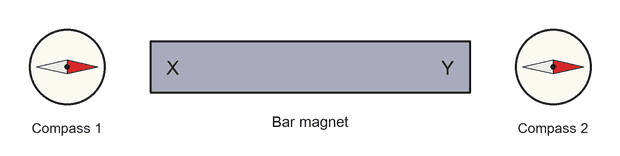
(a) Which end of the bar magnet is its north pole ? Explain using both compasses.
(b) The magnet is turned round so that X and Y change places. In which direction will the red ends of the needles now point ?
(c) How will the needles rest if the magnet is taken far away ?
- 244 marks
Question 24
Bloom's level: Apply
Case study: At a science fair, Sara holds the north pole of a strong magnet just above a steel paper clip. The clip jumps up and sticks to the magnet, and she hangs a second clip below the first and a third below the second, making a chain.
(a) Name the process that makes the clips behave like magnets.
(b) What poles are formed at the top and the bottom of the first clip ? Why does the second clip stick to it ?
(c) Sara gently slides the top clip off the magnet while holding it. What do you expect to happen to the chain, and why ?
- 254 marks
Question 25
Bloom's level: Apply
Case study: For a school project, Kiran winds a long insulated copper wire around a big iron screw and connects the ends of the wire to a dry cell. The screw picks up 4 paper clips. When she disconnects the cell, the clips fall off.
(a) What has Kiran made ? Why do the clips fall when the cell is disconnected ?
(b) Suggest two ways to make it pick up more clips.
(c) She connects the cell the other way round. What change will this make to the screw's poles ? Would the screw keep its magnetism after switching off if it were made of steel instead of soft iron ?
- 263 marks
Question 26
Bloom's level: Remember
Answer in one word or one line each :
(a) Name the scientist who first found that an electric current produces a magnetic field, and the year.
(b) Near which geographic direction is the earth's magnetic south pole ?
(c) What are magnetic substances also called ?
(d) Which end of an electromagnet becomes its south pole ?
(e) Name the four methods of making a magnet from a piece of iron.
(f) Around when was magnetite first found ?
- 274 marks
Question 27
Bloom's level: Evaluate
Rohan and Priya are given an iron bar and asked whether it is a magnet.
Rohan: "I brought one end of the bar near an iron nail and the nail was attracted. So the bar is surely a magnet."
Priya: "I brought each end of the bar near the north pole of a hanging magnet. One end repelled it. So the bar is surely a magnet."
Judge each conclusion. Whose test is the sure test, and why ?
- 284 marks
Question 28
Bloom's level: Analyse
Four rods K, L, M and N are tested as shown below.
Rod Picks up iron pins at its ends ? Hung freely, rests north-south every time ? Any end repels the N pole of a compass ? K Yes Yes Yes L No No No M No (but is attracted by a magnet) No No N Yes, only while connected to a cell through a coil Not tested Yes, only while connected Classify each rod as a permanent magnet, a temporary magnet, a magnetic substance (not a magnet) or a non-magnetic substance. Give a reason for each and suggest a possible material.
- 295 marks
Question 29
Bloom's level: Create
Design a way to make your own magnetic compass at home using a steel sewing needle, a bar magnet, a small piece of cork and a bowl of water. Include :
(a) how you will turn the needle into a magnet, and which end will become the north pole,
(b) how you will set up the compass,
(c) how you will check that it works and that the needle really is a magnet,
(d) two precautions.
- 305 marks
Question 30
Bloom's level: Create
Your school laboratory has four bar magnets, two horse shoe magnets and some compasses. Many magnets have become weak because they were thrown loosely into a drawer. Prepare a storage plan for the laboratory. Include :
(a) how the bar magnets and the horse shoe magnets will be stored (describe or draw the arrangement),
(b) what keepers are and what material you will use for them, and why they help,
(c) a list of three 'Do not' rules to put up on the cupboard, each with a reason.
- 311 mark
Question 31
Which of the following objects will not be attracted by a bar magnet ?
- 321 mark
Question 32
A bar magnet is cut into three pieces. The total number of magnetic poles on all the three pieces taken together is :
- 331 mark
Question 33
A bar magnet keeps its magnetism for the longest time when it is :
- 341 mark
Question 34
Fill in the blank :
The natural magnet, which is an ore of iron called magnetite, is also known as ..............
- 351 mark
Question 35
Write true or false :
For storing, two bar magnets are kept side by side with their like poles on the same side.
- 362 marks
Question 36
(a) Name the instrument used by sailors and pilots to find directions. Which property of a magnet is made use of in it ?
(b) State two uses of electromagnets.
- 372 marks
Question 37
A bar magnet M is hung by a thread so that it can turn freely. When the north pole of another magnet is brought near the end P of M, the end P moves away from it.
(a) Name the pole at the end P. Give a reason for your answer.
(b) What will be observed if the south pole of the second magnet is now brought near the end P ? Why ?
- 384 marks
Question 38
The figure shows a steel bar XY lying on a table. It is stroked with the south pole S of a bar magnet from the end X to the end Y. At Y the magnet is lifted, brought back to X through the air, and the bar is stroked again. This is repeated about 20 times.

(a) Name this method of making a magnet.
(b) Which pole is formed at the end X, and which at the end Y ? State the rule you have used.
(c) State two things which must be taken care of while stroking the bar.
- 394 marks
Question 39
(a) What is an electromagnet ?
(b) The core of the electromagnet of an electric bell is made of soft iron and not of steel. Give a reason.
(c) The connections of the cell joined to an electromagnet are interchanged, so that the current now flows through the coil in the opposite direction. State the effect of this on the polarity and on the strength of the electromagnet.
- 404 marks
Question 40
(a) What is meant by the magnetic field of a magnet ?
(b) Draw a diagram to show the pattern of the magnetic field around a bar magnet (the curved lines along which iron filings arrange themselves). Mark the poles of the magnet and show the direction of the field by arrows.
(c) A small iron pin kept 2 cm from a pole of a bar magnet jumps to the magnet, but the same pin kept 50 cm away from it does not move. Explain this observation.
- 411 mark
Question 41
Find the odd one out. Give a reason for your answer.
Plastic, brass, iron, copper
- 421 mark
Question 42
Which one of these does not belong with the other three ? Say why.
Iron, nickel, cobalt, aluminium