
Opening your dashboard
Class 6 Physics Chapter 6 Magnetism: Competency-Based Questions (CBQ)
40 questions on Chapter 6, each worked through on its own page with the AI tutor. Class 6 Physics, ICSE 2026-27.
40 questions
1–5 marks · Mixed difficulty
- 11 mark
Question 1
Competency: Application
A toy has two ring-shaped magnets slipped over an upright wooden rod. The flat faces of each ring are its two poles. The upper ring does not rest on the lower ring: it stays floating a little above it.
Tara lifts the upper ring off the rod, turns it upside down and slips it back on the rod. What will she see, and why?
- 21 mark
Question 2
Competency: Analysis & Evaluation
Anu brings a bar magnet near six metal objects and records what she sees.
Object Made of Attracted by the magnet? key iron yes sewing needle steel yes wire copper no foil aluminium no strip nickel yes ring gold no She concludes, "Every metal is a magnetic substance." Which is the best judgement of her conclusion?
- 31 mark
Question 3
Competency: Application & Analysis
Ravi winds insulated copper wire around a soft iron bar AB and connects the wire to a cell through a switch. Looking at the bar from end A, he sees that the current goes round the coil in the clockwise direction. He keeps a small compass close to end A, in line with the bar, and closes the switch.
He then opens the switch, connects the cell the other way round and closes the switch again.
Which end of the compass needle points towards end A in the two cases?
- 41 mark
Question 4
Competency: Understanding & Application
A toy maker needs magnets for two jobs.
- Job 1: a catch that keeps the steel door of a toy cupboard shut all the time, without any cell.
- Job 2: a toy crane that picks up iron clips while a button is pressed and drops them when the button is released.
Which choice is suitable for both jobs?
- 51 mark
Question 5
Competency: Understanding
Assertion (A): A horse shoe magnet is put away in its box with a piece of soft iron placed across its two poles.
Reason (R): By magnetic induction, opposite poles are developed at the ends of the soft iron piece, so that the magnet and the soft iron piece form a closed loop, which helps the magnet keep its magnetism.
- 61 mark
Question 6
Competency: Understanding & Application
Assertion (A): A bar magnet that is used every day as a hammer to drive small nails into wood will keep its magnetism unchanged.
Reason (R): Hammering a magnet repeatedly makes it lose its magnetism gradually.
- 72 marks
Question 7
Competency: Application & Analysis
Sana wants to turn a steel sewing needle into a magnet for a home-made compass. She will stroke it with a bar magnet by the single touch method. She wants the pointed end of the needle to become its north pole.
(a) Describe two different ways of stroking the needle that will give this result. For each, say which pole of the bar magnet she uses, at which end of the needle she starts and at which end she lifts the magnet off.
(b) Her brother offers her a soft iron needle of the same size instead. Should she use it for the compass? Give a reason.
- 82 marks
Question 8
Competency: Understanding & Evaluation
A school museum has a lump of lodestone and a steel bar magnet. Dev tests both and notes the following.
Lodestone Steel bar magnet Shape irregular lump straight bar with flat ends Pins it can lift 3 28 Dev says, "The lodestone is found in nature, so it is the better magnet. Our laboratory should buy lodestones and not bar magnets."
(a) Judge Dev's statement, using both rows of the table.
(b) Lodestone was still useful to travellers long ago. Which property of a magnet did they make use of, and how?
- 92 marks
Question 9
Competency: Analysis
Zoya lays a bar magnet on a wooden table, far from any other magnet or iron object. She places a compass at different distances from one pole of the magnet. Each time she notes the angle through which the needle has turned away from its usual north-south direction.
Distance of the compass from the pole (cm) 5 10 20 40 80 Angle turned by the needle 80° 55° 20° 5° 0° (a) What do the readings tell you about the magnetic field of the bar magnet as the distance from it increases? Quote two readings.
(b) At 80 cm the needle rests exactly north-south. Zoya says, "So there is no magnetic field of any kind at this place." Is she right? Explain.
- 102 marks
Question 10
Competency: Application & Analysis
A mechanic's steel screwdriver has a magnetised tip, so that small iron screws stick to it. At the end of each week he counts how many screws the tip can lift.
Week What happened to the screwdriver Screws lifted at the end of the week 1 used for turning screws, kept in its rack 8 2 used for turning screws, kept in its rack 8 3 used as a chisel and struck many times with a hammer 5 4 its tip was heated strongly in a flame to loosen a stuck screw 1 (a) In which weeks did the tip lose magnetism? Give the cause each time, and say in which of these weeks the loss was greater.
(b) Describe how the mechanic can make the tip a good magnet again with the help of a bar magnet.
- 113 marks
Question 11
Competency: Analysis & Evaluation
Case study: A group of students marks five places P, Q, R, S and T, equally spaced along a bar magnet 20 cm long. P and T are at the two ends, R is at the middle, Q is halfway between P and R, and S is halfway between R and T. They touch each place in turn to a heap of iron pins, lift the magnet and count the pins clinging at that place. The bar chart shows their results.
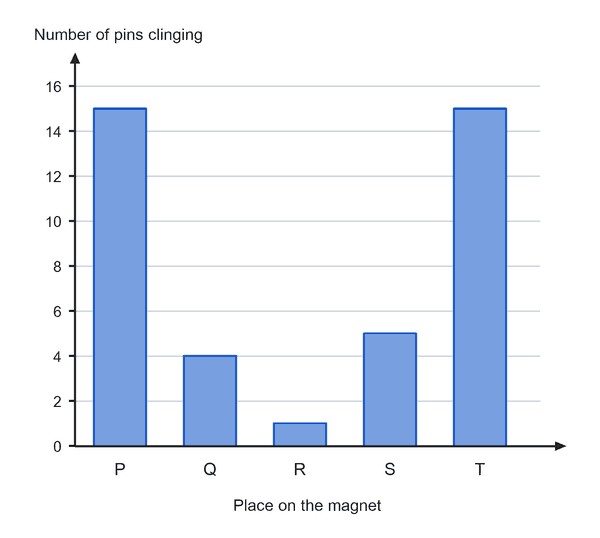
(a) Read from the chart the number of pins at each of the five places. How many pins clung to the magnet altogether, and what fraction of them clung at the two ends P and T together?
(b) What does the chart show about the attraction at different places of a magnet? What are the places of greatest attraction called?
(c) The magnet is then cut into two equal pieces at R. Rohan predicts, "The piece PR will hold many pins at P and almost none at R, just as before." Is his prediction right? Give a reason.
- 124 marks
Question 12
Competency: Application & Analysis
Case study: For a science exhibition, Farah makes an electromagnet by winding insulated copper wire on a soft iron nail and joining the ends of the wire to a dry cell. She counts the paper clips the nail can lift with 10, 20, 30 and 40 turns of wire. She then repeats the test with two cells joined in series. Her results are shown on the graph.
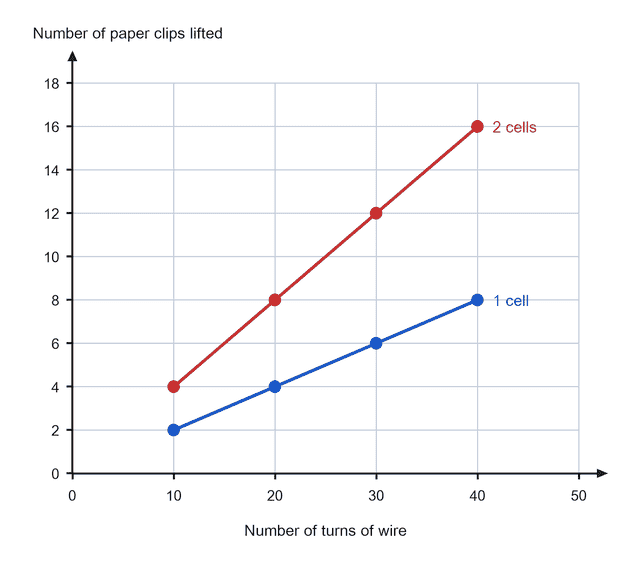
(a) Read from the graph the number of clips lifted with 30 turns and one cell, and with 20 turns and two cells.
(b) State the two things the graph shows about the strength of an electromagnet. Support each with a pair of readings.
(c) Farah needs her electromagnet to lift 12 clips. Which arrangement on the graph does this? If she had only one cell, how many turns would she need, if the pattern of the graph continues? Show your working.
- 134 marks
Question 13
Competency: Analysis & Evaluation
Case study: A laboratory assistant puts away two bar magnets A and B in a box, as shown in the figure.
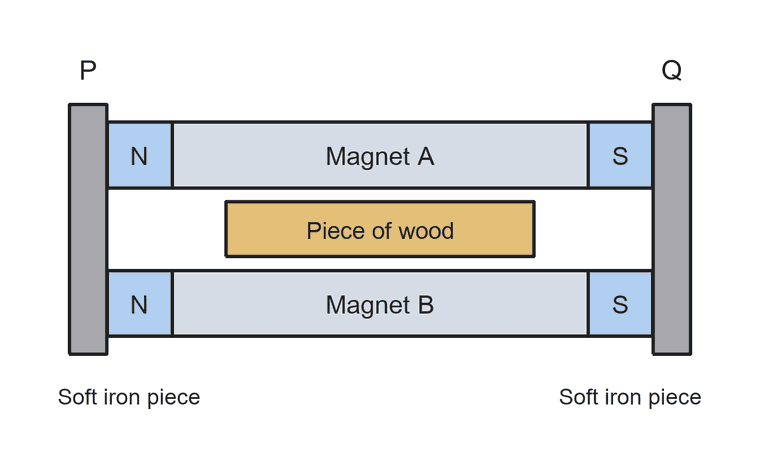
The school has three such pairs of bar magnets. All of them could lift 20 pins at the beginning of the term. They were stored in different ways and tested again at the end of the term.
Pair How the pair was stored Pins lifted at the beginning Pins lifted at the end X opposite poles facing on each side, wood in between, soft iron pieces across the ends 20 19 Y as in the figure 20 14 Z loose in a drawer among iron tools, without soft iron pieces 20 8 (a) Look at the figure. What is wrong with the way magnets A and B are placed? What one change will correct it?
(b) After the correction, the end of soft iron piece P that touches magnet A is against a north pole. What pole is developed at this end of P, and what pole at its other end? How do the soft iron pieces help the magnets?
(c) Find the number of pins lost by each pair during the term. The assistant says, "All magnets become weak with time, so the way they are stored does not matter." Judge his statement using your answers.
- 144 marks
Question 14
Competency: Creation
Your teacher wants to know which makes the better permanent magnet, soft iron or steel. She asks your group to design a fair test using the electrical method of making a magnet.
You are given: a soft iron nail and a steel nail of the same size, a long piece of insulated copper wire, a dry cell, a switch and a box of iron pins.
(a) Write the steps of your test.
(b) State two things you will keep the same so that the test is fair, and draw the table in which you will record your readings.
(c) What result do you expect? What will you conclude about the material to choose for a permanent magnet and for the core of an electric bell's electromagnet?
- 154 marks
Question 15
Competency: Analysis & Evaluation
Case study: A recycling plant receives empty food cans. Some are made of steel and the rest of aluminium. The cans move on a belt under a large electromagnet. The electromagnet is switched on above the belt, swung over a bin and then switched off. Every can it lifts is a steel can. A supervisor checks three batches.
Batch Cans on the belt Steel cans in the batch Cans lifted by the electromagnet 1 200 120 108 2 250 150 135 3 300 180 162 (a) Why is no aluminium can lifted? Why is the electromagnet switched off over the bin?
(b) For each batch, find the number of steel cans that were missed. Then find the fraction of the steel cans that was lifted in each batch. What do you notice?
(c) To miss fewer steel cans, a worker suggests, "Replace the soft iron core of the electromagnet by a steel core. Steel makes a permanent magnet, so it will hold the cans better." Judge this suggestion, and give two changes that will really help.
- 161 mark
Question 16
Competency: Understanding
Anil reads an old story. A shepherd named Magnes found that the iron nails of his shoes and the iron tip of his stick stuck to a rock lying on a hillside. The rock was later found to be an ore of iron called magnetite.
Which statement about this rock is correct?
- 171 mark
Question 17
Competency: Analysis
The letters that marked the poles of Sunil's bar magnet have rubbed off, and one end of the magnet is painted red. He hangs the magnet from a thread in a room that has no other magnet or iron object. He sets it swinging and lets it come to rest. The red end settles pointing towards the geographic north.
Which conclusion is correct?
- 181 mark
Question 18
Competency: Understanding
Gita's notebook has the steps for making a magnet from an iron bar AB by the double touch method, but the steps are not in order.
P. Then turn the bar upside down and repeat the whole process about 20 times.
Q. Move the two magnets together, with the cork between them, towards the end B.
R. Place two magnets upright at the centre of the bar, with their opposite poles on one side and a cork between the two poles.
S. Without lifting the magnets, move them back to the end A, and repeat the to-and-fro movement about 20 times.
In which order should the steps be carried out?
- 191 mark
Question 19
Competency: Analysis
Meena winds 30 turns of bare copper wire, with no insulating covering, tightly on an iron nail, so that the turns touch one another and the nail. She joins the ends of the wire to a dry cell through a switch and closes the switch. The nail picks up hardly any pins, although the same nail wound with 30 turns of insulated wire picks up many. (Hypothetical data.)
What is the most likely reason?
- 201 mark
Question 20
Competency: Analysis
Assertion (A): A soft iron bar kept for many days under the ground in the north-south direction behaves as a magnet.
Reason (R): A huge bar magnet lies buried inside the earth.
- 211 mark
Question 21
Competency: Analysis
Assertion (A): When the north pole of a magnet is held near the head of an iron nail, the head of the nail becomes a north pole.
Reason (R): Unlike poles of two magnets attract each other, so the nail is attracted towards the magnet.
- 221 mark
Question 22
Competency: Understanding
A school is setting up a display table with the label 'Artificial magnets: made by us'. Only objects that are artificial magnets may be placed on it.
Which set of objects can all go on this table?
- 231 mark
Question 23
Competency: Application
A scrap dealer passes a strong magnet over a tray that holds 60 small objects, and the magnet lifts every object that it can attract. (Hypothetical data.)
Made of Number of objects iron 18 steel 12 nickel 6 cobalt 4 aluminium 10 copper 6 brass 4 What fraction of the objects is left on the tray?
- 241 mark
Question 24
Competency: Analysis
A toy company's chart lists some devices and the kind of magnet used in each. One row of the chart is wrong.
Row Device Kind of magnet used 1 Electric bell Temporary electromagnet 2 Magnetic compass needle Electromagnet that needs a cell 3 Crane that loads and unloads scrap iron Strong electromagnet 4 Ammeter and voltmeter Permanent magnet Which row is wrong?
- 251 mark
Question 25
Competency: Application
A school laboratory is putting away its magnets for the summer holidays. It has 6 bar magnets, which will be stored in pairs, and 4 horse shoe magnets. A pair of bar magnets needs 2 soft iron keepers, and a horse shoe magnet needs 1 soft iron keeper. The laboratory already has 7 soft iron keepers.
How many more soft iron keepers must the laboratory get?
- 262 marks
Question 26
Competency: Application
A watch repairer's steel tweezers have become magnetised, so the tiny steel screws of watches cling to their tips and are hard to put in place. He wants the tweezers to lose their magnetism, but he must not spoil them.
(a) Name two ways of demagnetising a magnet that he should not use on the tweezers, and say why.
(b) Which way of demagnetising should he use? Describe how it is done.
- 272 marks
Question 27
Competency: Understanding
Ravi has four rods of the same size, made of iron, nickel, cobalt and copper. He strokes each rod about 20 times with one pole of a strong magnet, using the single touch method, and then holds it near a heap of iron pins.
(a) Which of the rods will pick up pins?
(b) Which rod will not pick up pins, and why? To which group do the other three rods belong?
- 282 marks
Question 28
Competency: Analysis
A bar magnet has its north pole at the end A and its south pole at the end B. It is cut into two equal pieces at the middle. Piece 1 has the end A and the cut face C1. Piece 2 has the end B and the cut face C2.
(a) Name the poles at C1 and at C2. If the two pieces are placed end to end so that C1 and C2 almost touch, will they attract or repel each other?
(b) Piece 2 is turned end to end, and the end of piece 2 that is now nearest to C1 is brought close to C1. What will happen? Give a reason.
- 292 marks
Question 29
Competency: Application
A strong bar magnet lies on a table with its south pole at the left end and its north pole at the right end. Three small magnetic compasses P, Q and R are placed as shown. P is just above the middle of the magnet, Q is on the line of the magnet beyond its north pole, and R is on the line of the magnet beyond its south pole. Each compass is so close to the magnet that the earth's magnetic field can be ignored.
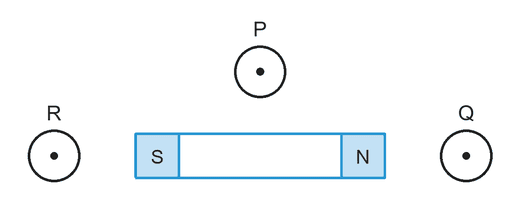
For each compass, say whether the north end of its needle points to the left or to the right of the figure, and give a reason.
- 302 marks
Question 30
Competency: Evaluation
Meena wants to make a magnet from an iron bar AB by the single touch method. She places the north pole of a bar magnet on the end A and moves it along the bar to the end B. At B she does not lift the magnet but moves it straight back to A along the bar, and she repeats this to-and-fro stroke about 40 times. The bar picks up almost no pins.
(a) Find her mistake.
(b) How should she stroke the bar? Name the pole that forms at each end of the bar when she does it correctly.
- 312 marks
Question 31
Competency: Application
Two iron bars P and Q, each wound with insulated copper wire, are placed end to end with a small gap between them, so that the right end of P faces the left end of Q. When the switch is closed, the current goes round the coil on P in the anticlockwise direction when seen from the right end of P, and round the coil on Q in the clockwise direction when seen from the left end of Q. (Hypothetical data.)
(a) Name the poles at the two facing ends. Will P and Q attract or repel each other?
(b) The connections of the coil on Q alone are then interchanged, and the switch is closed again. What will happen?
- 323 marks
Question 32
Competency: Analysis
Two sketches of magnetic fields are drawn below. One of them shows the earth's magnetic field in a small region, and the other shows the magnetic field around a bar magnet.
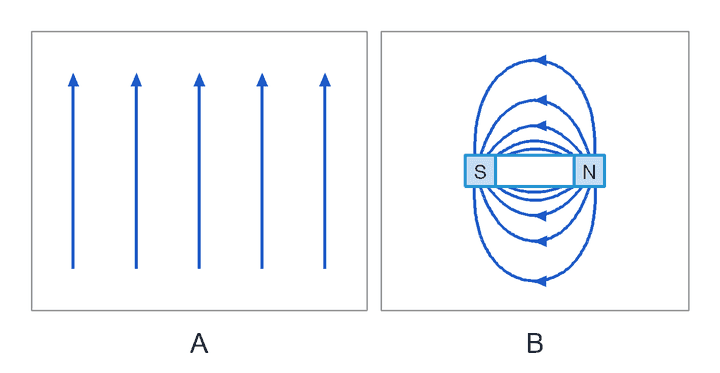
(a) Which sketch shows the field around the bar magnet? Give two clues from the sketch.
(b) A compass is moved from place to place in each sketch. In which sketch will the needle rest in the same direction at every place, and in which will its direction change?
(c) In sketch B, where is the field strongest? How does the sketch show this?
- 333 marks
Question 33
Competency: Analysis
A teacher makes magnets by four methods. For each, she counts the iron pins lifted by one end of the bar, once while the method is in use, and once a few minutes later, after the helping magnet has been taken away or the current has been switched off. (Hypothetical data.)
Row What is done Pins lifted during Pins lifted later 1 A soft iron bar is held with one end near the pole of a strong magnet. 12 0 2 A soft iron bar is placed in a coil of insulated wire joined to a cell. 20 0 3 A steel bar is stroked 20 times along each of its two sides with one pole of a strong magnet, which is lifted at the end of every stroke. 9 9 4 A steel bar is placed in a coil of insulated wire joined to a cell. 14 13 (a) Name the method of making a magnet used in each of the rows 1 to 4.
(b) Which rows give temporary magnets and which give permanent magnets? What decides this?
(c) Which row would you choose for the core of a crane that loads scrap iron and drops it, and which for a compass needle? Give a reason for each choice.
- 343 marks
Question 34
Competency: Application
A magnetic compass is fixed on the deck of a ship, with a mark on its case showing the front of the ship. When the ship faces due north, the north end of the needle points to the front mark. Ignore the effect of any iron in the ship.
(a) The ship turns and now faces due east. Towards which side of the ship (front, back, left or right) does the north end of the needle now point?
(b) The ship then turns and faces due south. Towards which side of the ship does the north end of the needle point?
(c) Explain why the needle does not turn round with the ship, and name the property of a magnet that makes the compass useful to a sailor.
- 353 marks
Question 35
Competency: Evaluation
A toy shop puts up an advertisement for its 'Super Magnet Stick', which is an ordinary steel bar magnet. The advertisement makes three claims.
Claim 1: "It pulls iron equally strongly all along its length, so you can pick up pins with any part of it."
Claim 2: "Hang it from a thread so that it swings freely, and it will come to rest pointing north and south, so you can use it to find directions."
Claim 3: "It is so strong that it even picks up brass keys and pieces of aluminium foil."
Judge each claim as true or false, and give a reason for each.
- 363 marks
Question 36
Competency: Application
A tailor spills a box of steel pins into a bucket of dry sand. To collect them quickly, his daughter Lata wraps a strong bar magnet in a thin sheet of paper and moves it through the sand. The pins stick to the paper-covered magnet. Paper and sand are non-magnetic substances. Lata then pulls the wrapped magnet out of the sand over a tray and slides the magnet out of the paper, and all the pins drop into the tray.
(a) Why does the magnet lift the pins but not the sand?
(b) Why does the magnet still attract the pins through the paper?
(c) Why do the pins drop when the magnet is slid out of the paper?
- 374 marks
Question 37
Competency: Analysis
Case study: Imran and Lata want to find how objects near the school affect a magnetic compass. In the middle of the playground, far from any building, the north end of the needle points to the geographic north. They carry the compass to four more places and note the angle through which the needle turns away from its north-south direction. A loudspeaker box, which has a strong magnet inside it, lay at spot 4. (Hypothetical data.)
Spot Place Angle turned by the needle 1 Middle of the playground 0° 2 Beside a wooden bench 0° 3 Beside the steel water tank 18° 4 Next to the loudspeaker box 75° 5 3 m from the loudspeaker box 6° (a) At which spots does the needle rest in the north-south direction of the earth's field? Why is the bench not able to turn it?
(b) What do the readings at spots 4 and 5 show about the magnetic field of the loudspeaker magnet?
(c) At spot 4 the north end of the needle turns towards the box. Which pole of the magnet inside the box is nearest to the compass? If the box is turned round, which way will the needle turn?
- 384 marks
Question 38
Competency: Evaluation
Case study: A toy factory has to magnetise 120 identical steel needles for compass toys. In each needle the pointed end must become the north pole. The manager asks two workers to suggest a method and to say how long it will take. Arun suggests the single touch method, and Chitra suggests the electrical method. Their plans are given in the table. (Hypothetical data.)
Worker Method Needles done at a time Arun Single touch: each needle is stroked 40 times in all, at 3 seconds per stroke. 1 needle at a time Chitra Electrical method: 30 needles at a time are put into a coil of insulated wire joined to a cell for 4 minutes, and 1 minute is needed to load and unload each lot. 30 needles at a time (a) Arun says, "The electrical method gives only a temporary magnet, so Chitra's needles will lose their magnetism when the current is switched off." Judge his statement.
(b) Find the time in minutes that each worker needs for all 120 needles.
(c) Chitra puts every needle in the coil with its pointed end towards the same end of the coil. In which direction must the current appear to go round the coil when seen from the end that the pointed ends face, so that all the pointed ends become north poles?
- 395 marks
Question 39
Competency: Creation
Case study: The science club will run a stall called 'The Magic Car'. A small plastic toy car moves across the top of a wooden board when a magnet is moved under the board, and nobody touches the car. Plastic and wood are non-magnetic substances, and they do not stop a magnet from attracting a piece of iron or steel through them. The club has a plastic toy car, a steel clip, two small bar magnets X and Y of the same size, each with its poles marked N and S, two pieces of soft iron, a thin strip of wood and a wooden board.
(a) Plan how to fit the car so that it follows magnet X moved under the board. Say what you fix in the car and explain why the car follows the magnet.
(b) Visitors ask for a second trick, in which the car moves away from the magnet under the board. Plan how to fit the car and how to hold magnet X. Explain with a property of magnets.
(c) The stall runs for three days. State two ways in which the club can keep both bar magnets strong, using what it has been given.
- 404 marks
Question 40
Competency: Analysis
Case study: Farhan wants to find how heating affects a steel bar magnet. He has seven identical bar magnets, and each one picks up 40 iron pins at room temperature (20 °C). He keeps one magnet at room temperature. He heats each of the other six to a different temperature for 10 minutes, lets each cool to room temperature, and counts the pins that it picks up now. The graph shows his results. (Hypothetical data.)
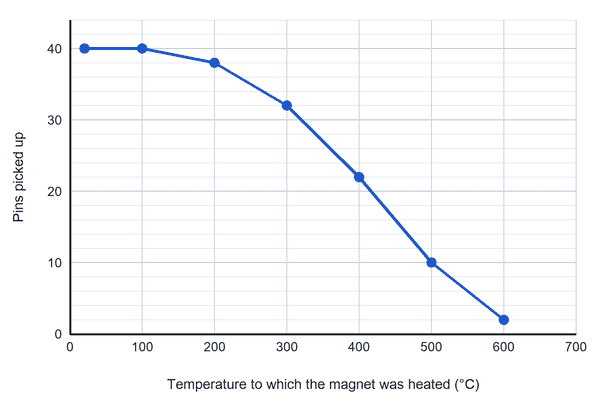
(a) Read from the graph the number of pins lifted after heating to 300 °C and after heating to 500 °C. How many pins did the magnet lose between these two temperatures?
(b) Between which two neighbouring temperatures of the graph is the loss of pins the greatest? Give the number of pins lost.
(c) What percentage of its first number of pins does the magnet lift after heating to 400 °C? Name one way, other than heating, in which a magnet loses its magnetism.