
Competency: Analysis & Evaluation
Case study: A group of students marks five places P, Q, R, S and T, equally spaced along a bar magnet 20 cm long. P and T are at the two ends, R is at the middle, Q is halfway between P and R, and S is halfway between R and T. They touch each place in turn to a heap of iron pins, lift the magnet and count the pins clinging at that place. The bar chart shows their results.
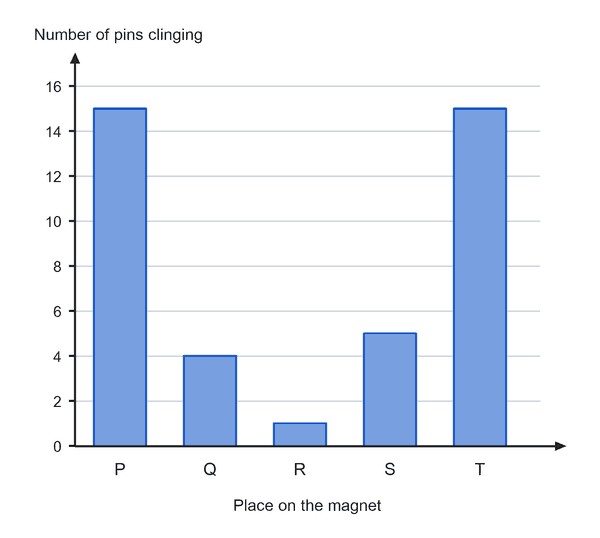
(a) Read from the chart the number of pins at each of the five places. How many pins clung to the magnet altogether, and what fraction of them clung at the two ends P and T together?
(b) What does the chart show about the attraction at different places of a magnet? What are the places of greatest attraction called?
(c) The magnet is then cut into two equal pieces at R. Rohan predicts, "The piece PR will hold many pins at P and almost none at R, just as before." Is his prediction right? Give a reason.