
Opening your dashboard
Class 6 Maths Chapter 4: Negative Numbers and Integers Solutions
28 textbook questions with step-by-step answers, free to read, for ICSE 2026-27.
Get talked through Ch 4, not just shown the answer
Reading a finished solution is not the same as being able to do it. The AI tutor takes one question at a time and works it with you, in your own words, until you can.
- Ask it out loud, in your own words
- It gives you the next step, not the answer
- Stuck on part (ii)? Start there
28 questions with solutions
1–3 marks · Mixed difficulty
- 13 marks
Question 1
Fill in the blanks :
(i) Negative of is ..........
(ii) Negative of is ..........
(iii) Negative of is ..........
(iv) If represents gain of ₹ , then represents ..........
(v) If going South is negative, then going North is ..........
(vi) Because , therefore .......... .
(vii) If , then is on the .......... of .
(viii) If , then is on the .......... of .
Solve with AIWritten solution
Solution:
Concept: Integers are the numbers …, −3, −2, −1, 0, 1, 2, 3, … . They go on for ever in both directions. The negative (opposite) of a number has the same size and the opposite sign; the opposite of 0 is 0, since 0 is neither positive nor negative. On a number line the numbers increase from left to right. So of two integers, the one on the right is greater and the one on the left is smaller. Every positive integer is greater than 0, and 0 is greater than every negative integer.
Step 1 — Parts (i) to (iii).
The negative of a number changes only its sign. So the negative of is 20, the negative of 0 is 0 (zero has no sign), and the negative of 8 is .
Step 2 — Part (iv).
If stands for a gain of ₹ 10, the opposite number stands for the opposite of a gain: a loss of ₹ 10.
Step 3 — Part (v).
North is the opposite direction to South. If South is negative, North is positive.
Step 4 — Part (vi).
On the number line, 5 lies to the left of 7, so lies to the right of (the picture is reflected about 0). The number on the right is greater, so .
Step 5 — Parts (vii) and (viii).
The greater number lies on the right. Since , 3 is on the right side of ; since , is on the left side of .
Watch out: For negative numbers the bigger-looking number is the smaller one: −7 is less than −5.
Therefore, (i) 20; (ii) 0; (iii) −8; (iv) loss of ₹ 10; (v) positive; (vi) >; (vii) right side; (viii) left side.
- 23 marks
Question 2
Use a number line to write the following integers in ascending (increasing) order :
(i) and
(ii) and
Solve with AIWritten solution
Solution:
Concept: On a number line the numbers increase from left to right. So of two integers, the one on the right is greater and the one on the left is smaller. Every positive integer is greater than 0, and 0 is greater than every negative integer.
Step 1 — Part (i): mark the integers.
We put a dot at each integer on a number line.

Step 2 — Part (i): read the order.
Reading the dots from left to right gives the integers from smallest to greatest.
Step 3 — Part (ii): mark the integers.
We put a dot at each integer on a number line.

Step 4 — Part (ii): read the order.
Reading the dots from left to right gives the integers from smallest to greatest.
Watch out: The integer −14 is the smallest here, because it is farthest to the left; do not order negatives by their size alone.
Therefore, (i) −14 < −9 < −5 < 0 < 4 < 8 < 12; (ii) −9 < −6 < 0 < 5 < 7 < 9.
- 33 marks
Question 3
Use a number line to write the following integers in descending (decreasing) order :
(i) and
(ii) and .
Solve with AIWritten solution
Solution:
Concept: On a number line the numbers increase from left to right. So of two integers, the one on the right is greater and the one on the left is smaller. Every positive integer is greater than 0, and 0 is greater than every negative integer.
Step 1 — Part (i): mark the integers.
We put a dot at each integer on a number line.

Step 2 — Part (i): read the order.
Reading the dots from right to left gives the integers from greatest to smallest.
Step 3 — Part (ii): mark the integers.
We put a dot at each integer on a number line.

Step 4 — Part (ii): read the order.
Reading the dots from right to left gives the integers from greatest to smallest.
Watch out: In descending order −1 comes before −4, because −1 is to the right of −4.
Therefore, (i) 12 > 11 > 5 > 3 > 0 > −1 > −4 > −10; (ii) 6 > 3 > −4 > −7 > −8 > −12.
- 43 marks
Question 4
Fill in the blanks, using the following number line :

(i) An integer, on the given number line, is .......... than every number on its left.
(ii) An integer on the given number line is greater than every number to its ..........
(iii) is greater than implies is to the .......... of .
(iv) is .......... than and is .......... than .
(v) is .......... than and is .......... than .
(vi) is .......... than and is .......... than .
(vii) is .......... than and the opposite of is .......... than opposite of .
(viii) is .......... than and is .......... than .
Solve with AIWritten solution
Solution:
Concept: On a number line the numbers increase from left to right. So of two integers, the one on the right is greater and the one on the left is smaller. Every positive integer is greater than 0, and 0 is greater than every negative integer.
Step 1 — Parts (i) to (iii).
Numbers increase from left to right. So an integer is greater than every number on its left, and greater than every number to its left; and means 2 lies to the right of .
Step 2 — Part (iv).
The integer lies to the left of 2, so is less than 2. And 3 lies to the right of , so 3 is greater than .
Step 3 — Part (v).
The integer lies to the right of , so is greater than . But 4 lies to the left of 8, so 4 is less than 8.
Step 4 — Part (vi).
5 is greater than 2. Their negatives swap the order: lies to the left of , so is less than .
Step 5 — Part (vii).
The integer is less than 3. The opposite of is 6 and the opposite of 3 is ; 6 is greater than .
Step 6 — Part (viii).
8 is greater than , and is less than 5.
Watch out: Taking opposites reverses the order: 5 > 2 but −5 < −2.
Therefore, (i) greater; (ii) left; (iii) right; (iv) less, greater; (v) greater, less; (vi) greater, less; (vii) less, greater; (viii) greater, less.
- 53 marks
Question 5
In each of the following pairs, state which integer is greater :
(i)
(ii)
(iii)
(iv)
Solve with AIWritten solution
Solution:
Concept: On a number line the numbers increase from left to right. So of two integers, the one on the right is greater and the one on the left is smaller. Every positive integer is greater than 0, and 0 is greater than every negative integer.
Step 1 — Part (i).
The integer is nearer to 0 than , so it lies to the right of . So is greater.
Step 2 — Part (ii).
A positive integer is greater than any negative integer, so 15 is greater than .
Step 3 — Part (iii).
Every positive integer is greater than 0, so 8 is greater.
Step 4 — Part (iv).
0 is greater than every negative integer, so 0 is greater than .
Watch out: The integer −23 has the larger size, but it is the smaller integer.
Therefore, (i) −15; (ii) 15; (iii) 8; (iv) 0.
- 63 marks
Question 6
In each of the following pairs, state which integer is smaller :
(i)
(ii)
(iii)
(iv)
Solve with AIWritten solution
Solution:
Concept: On a number line the numbers increase from left to right. So of two integers, the one on the right is greater and the one on the left is smaller. Every positive integer is greater than 0, and 0 is greater than every negative integer.
Step 1 — Parts (i) to (iii).
In each pair one integer is negative. A negative integer lies to the left of 0 and of every positive integer, so the smaller integers are , and .
Step 2 — Part (iv).
0 lies to the left of every positive integer, so 0 is smaller than 13.
Watch out: The integer −51 is smaller than 15 even though 51 is bigger than 15.
Therefore, (i) −6; (ii) −3; (iii) −51; (iv) 0.
- 73 marks
Question 7
In each of the following pairs, replace * with or to make the statement true :
(i)
(ii)
(iii)
(iv)
(v)
(vi)
(vii)
Solve with AIWritten solution
Solution:
Concept: On a number line the numbers increase from left to right. So of two integers, the one on the right is greater and the one on the left is smaller. Every positive integer is greater than 0, and 0 is greater than every negative integer.
Step 1 — Compare each pair.
For each pair we ask which number lies further to the right on the number line; that one is greater. For two negative integers, the one nearer to 0 is greater.
Watch out: The integer −8 is greater than −18, because −8 is nearer to 0; do not compare only 8 and 18.
Therefore, (i) 3 > 0; (ii) 0 > −8; (iii) −9 < −3; (iv) −3 < 3; (v) 5 > −1; (vi) −13 < 0; (vii) −8 > −18.
- 83 marks
Question 8
In each case, arrange the given integers in ascending order, using a number line :
(i)
(ii)
Solve with AIWritten solution
Solution:
Concept: On a number line the numbers increase from left to right. So of two integers, the one on the right is greater and the one on the left is smaller. Every positive integer is greater than 0, and 0 is greater than every negative integer.
Step 1 — Part (i): mark the integers.
We put a dot at each integer on a number line.

Step 2 — Part (i): read the order.
Reading the dots from left to right gives the integers from smallest to greatest.
Step 3 — Part (ii): mark the integers.
We put a dot at each integer on a number line.

Step 4 — Part (ii): read the order.
Reading the dots from left to right gives the integers from smallest to greatest.
Watch out: Ascending means from the smallest, so start with the dot farthest to the left.
Therefore, (i) −8 < −5 < −1 < 0 < 4 < 5; (ii) −7 < −6 < −3 < 0 < 2 < 3 < 4.
- 93 marks
Question 9
In each case, arrange the given integers in descending order, using a number line :
(i)
(ii)
Solve with AIWritten solution
Solution:
Concept: On a number line the numbers increase from left to right. So of two integers, the one on the right is greater and the one on the left is smaller. Every positive integer is greater than 0, and 0 is greater than every negative integer.
Step 1 — Part (i): mark the integers.
We put a dot at each integer on a number line.

Step 2 — Part (i): read the order.
Reading the dots from right to left gives the integers from greatest to smallest.
Step 3 — Part (ii): mark the integers.
We put a dot at each integer on a number line.

Step 4 — Part (ii): read the order.
Reading the dots from right to left gives the integers from greatest to smallest.
Watch out: Descending means from the greatest, so start with the dot farthest to the right.
Therefore, (i) 15 > 8 > 0 > −2 > −3 > −5; (ii) 23 > 12 > 7 > 6 > 0 > −11.
- 103 marks
Question 10
For each of the statements given below, state whether it is true or false :
(i) The smallest integer is .
(ii) The opposite of is .
(iii) The opposite of zero is zero.
(iv) Every negative integer is smaller than .
(v) is greater than every positive integer.
(vi) Since zero is neither negative nor positive, it is not an integer.
Solve with AIWritten solution
Solution:
Concept: Integers are the numbers …, −3, −2, −1, 0, 1, 2, 3, … . They go on for ever in both directions. The negative (opposite) of a number has the same size and the opposite sign; the opposite of 0 is 0, since 0 is neither positive nor negative. On a number line the numbers increase from left to right. So of two integers, the one on the right is greater and the one on the left is smaller. Every positive integer is greater than 0, and 0 is greater than every negative integer.
Step 1 — Part (i).
The integers are all smaller than 0, and the integers never end on the left. So there is no smallest integer, and the statement is false.
Step 2 — Parts (ii) and (iii).
The opposite of is 17, since ; and the opposite of 0 is 0 itself. Both statements are true.
Step 3 — Parts (iv) and (v).
Every negative integer lies to the left of 0, so it is smaller than 0: (iv) is true. Every positive integer lies to the right of 0, so it is greater than 0: (v) is false.
Step 4 — Part (vi).
Zero is neither positive nor negative, but it is still an integer (it is in the list …, −1, 0, 1, …). So the statement is false.
Watch out: 0 is the smallest whole number, but not the smallest integer.
Therefore, (i) false; (ii) true; (iii) true; (iv) true; (v) false; (vi) false.
- 113 marks
Question 11
Use number lines to evaluate each of the following :
(i)
(ii)
(iii)
Solve with AIWritten solution
Solution:
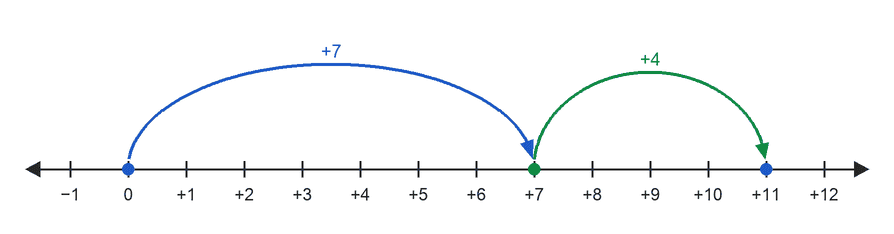
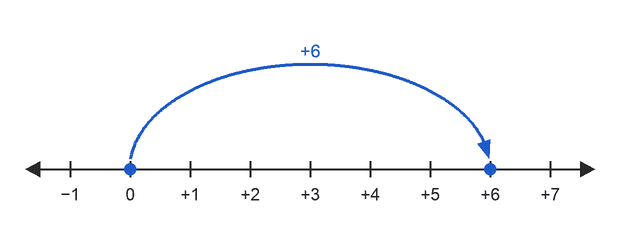
Concept: To add on a number line, we start at 0 and jump to the first number. Then we jump the second number: to the right if it is positive, to the left if it is negative. Where we land is the sum.
Step 1 — Part (i).
We start at 0 and jump 7 units to the right to reach . Then we jump 4 units to the right and land on .
Step 2 — Part (ii).
We start at 0; the first number is 0, so there is no first jump. Then we jump 6 units to the right and land on .
Step 3 — Part (iii).
We start at 0 and jump 5 units to the right to reach . Adding 0 means no jump, so we stay there.

Watch out: Adding 0 needs no jump, so the answer is the other number.
Therefore, (i) +11; (ii) +6; (iii) +5.
- 123 marks
Question 12
Use number lines to evaluate each of the following :
(i)
(ii)
(iii)
Solve with AIWritten solution
Solution:
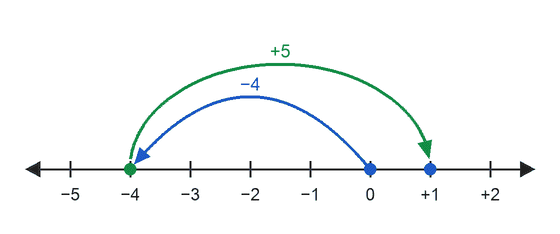
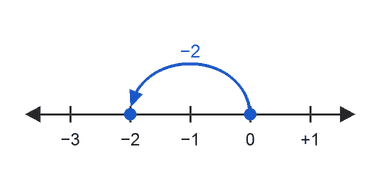
Concept: To add on a number line, we start at 0 and jump to the first number. Then we jump the second number: to the right if it is positive, to the left if it is negative. Where we land is the sum.
Step 1 — Part (i).
We start at 0 and jump 4 units to the left to reach . Then we jump 5 units to the right and land on .
Step 2 — Part (ii).
We start at 0; the first number is 0, so there is no first jump. Then we jump 2 units to the left (the second number is negative) and land on .
Step 3 — Part (iii).
We start at 0 and jump 1 units to the left to reach . Then we jump 4 units to the right and land on .
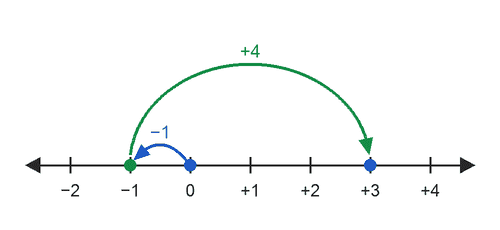
Watch out: Jump the first number from 0 first; the second jump starts where the first one ends.
Therefore, (i) +1; (ii) −2; (iii) +3.
- 133 marks
Question 13
Use number lines to evaluate each of the following :
(i)
(ii)
(iii)
Solve with AIWritten solution
Solution:
Concept: To add on a number line, we start at 0 and jump to the first number. Then we jump the second number: to the right if it is positive, to the left if it is negative. Where we land is the sum.
Step 1 — Part (i).
We start at 0 and jump 4 units to the right to reach . Then we jump 2 units to the left (the second number is negative) and land on .
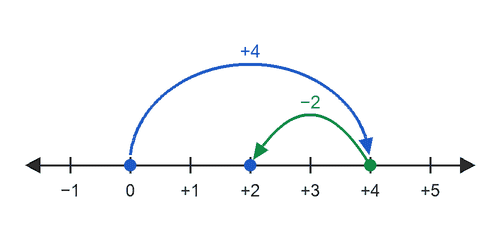
Step 2 — Part (ii).
We start at 0 and jump 3 units to the right to reach . Then we jump 6 units to the left (the second number is negative) and land on .

Step 3 — Part (iii).
We start at 0 and jump 3 units to the right to reach . Then we jump 7 units to the left (the second number is negative) and land on .
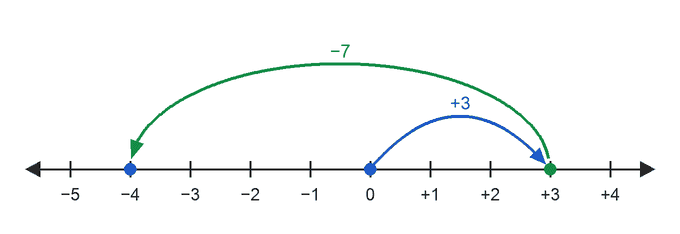
Watch out: A negative second number means a jump to the left, even when you start on the right of 0.
Therefore, (i) +2; (ii) −3; (iii) −4.
- 143 marks
Question 14
Use number lines to evaluate each of the following :
(i)
(ii)
(iii)
Solve with AIWritten solution
Solution:
Concept: To add on a number line, we start at 0 and jump to the first number. Then we jump the second number: to the right if it is positive, to the left if it is negative. Where we land is the sum.
Step 1 — Part (i).
We start at 0 and jump 1 units to the left to reach . Then we jump 2 units to the left (the second number is negative) and land on .
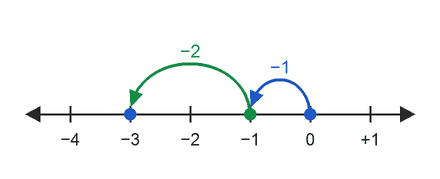
Step 2 — Part (ii).
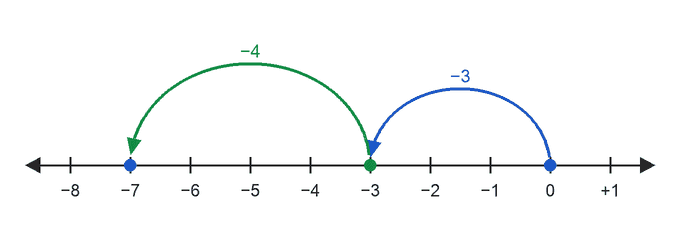
We start at 0 and jump 3 units to the left to reach . Then we jump 4 units to the left (the second number is negative) and land on .
Step 3 — Part (iii).
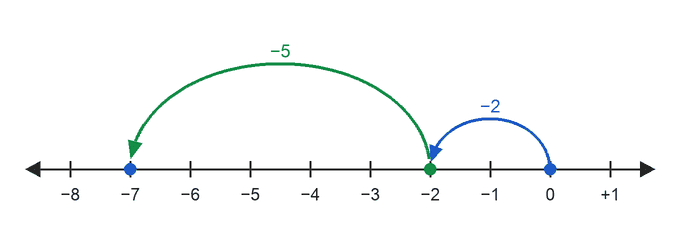
We start at 0 and jump 2 units to the left to reach . Then we jump 5 units to the left (the second number is negative) and land on .
Watch out: Two negative numbers give two jumps to the left, so the sum is negative.
Therefore, (i) −3; (ii) −7; (iii) −7.
- 153 marks
Question 15
Use number lines to evaluate each of the following :
(i)
(ii)
(iii)
(iv)
(v)
(vi)
Solve with AIWritten solution
Solution:
Concept: To find on a number line, we mark both numbers and count the steps from to . Steps towards the right give a positive answer; steps towards the left give a negative answer. 'Subtract from ' means . (This agrees with the rule .)
Step 1 — Part (i).
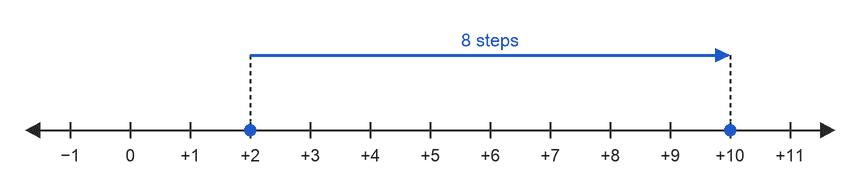
We mark and . From we need 8 steps towards the right to reach , so the answer is positive.
Step 2 — Part (ii).
We mark and . From we need 13 steps towards the right to reach , so the answer is positive.

Step 3 — Part (iii).
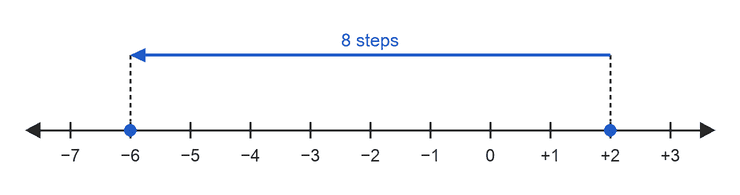
We mark and . From we need 8 steps towards the left to reach , so the answer is negative.
Step 4 — Part (iv).
We mark and . From we need 12 steps towards the left to reach , so the answer is negative.
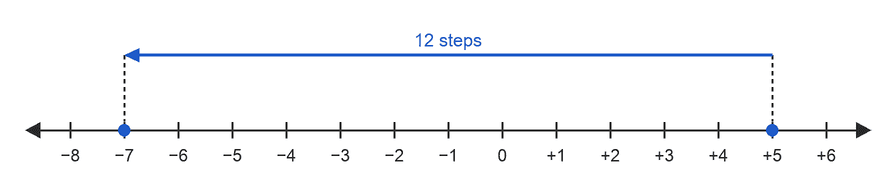
Step 5 — Part (v).
We mark and . From we need 6 steps towards the right to reach , so the answer is positive.
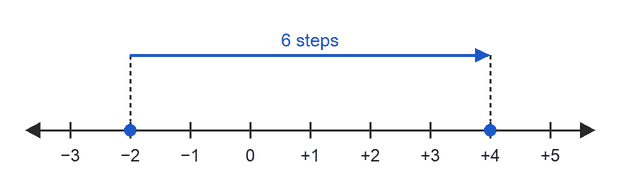
Step 6 — Part (vi).
We mark and . From we need 4 steps towards the left to reach , so the answer is negative.

Watch out: Count from the number being subtracted to the other number, not the other way round.
Therefore, (i) +8; (ii) +13; (iii) −8; (iv) −12; (v) +6; (vi) −4.
- 163 marks
Question 16
Using a number line, find the integer which is :
(i) more than
(ii) less than
(iii) more than
(iv) less than
(v) more than
(vi) less than
Solve with AIWritten solution
Solution:
Concept: 'More than' means a jump to the right (adding); 'less than' means a jump to the left (subtracting).
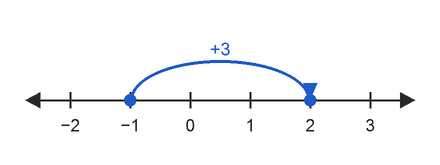
Step 1 — Part (i).
3 more than means we start at and jump 3 units to the right.
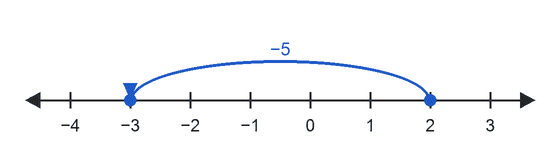
Step 2 — Part (ii).
5 less than means we start at and jump 5 units to the left.
Step 3 — Part (iii).
5 more than means we start at and jump 5 units to the right.
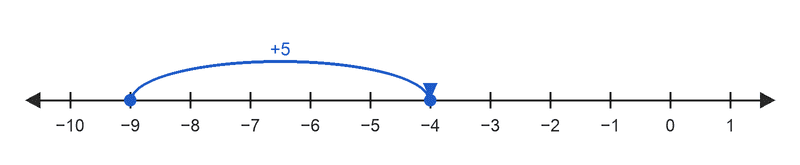
Step 4 — Part (iv).
4 less than means we start at and jump 4 units to the left.
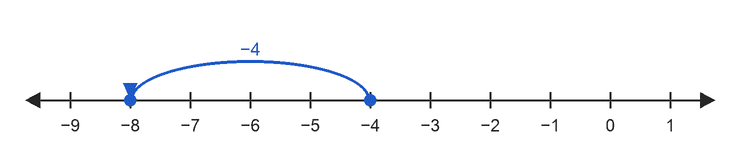
Step 5 — Part (v).
7 more than means we start at and jump 7 units to the right.

Step 6 — Part (vi).
7 less than means we start at and jump 7 units to the left.

Watch out: The words '5 less than 2' mean start at 2 and move left; that is 2 − 5, not 5 − 2.
Therefore, (i) 2; (ii) −3; (iii) −4; (iv) −8; (v) 7; (vi) −15.
- 173 marks
Question 17
Add using a number line :
(i) and
(ii) and
(iii) and
(iv) and
Solve with AIWritten solution
Solution:
Concept: To add on a number line, we start at 0 and jump to the first number. Then we jump the second number: to the right if it is positive, to the left if it is negative. Where we land is the sum.
Step 1 — Part (i).
We start at 0 and jump 13 units to the right to reach . Then we jump 15 units to the right and land on .
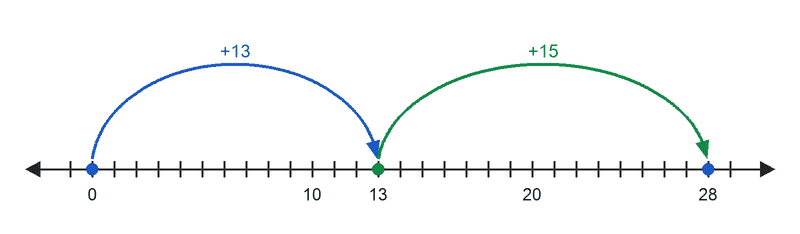
Step 2 — Part (ii).
We start at 0 and jump 13 units to the left to reach . Then we jump 15 units to the right and land on .
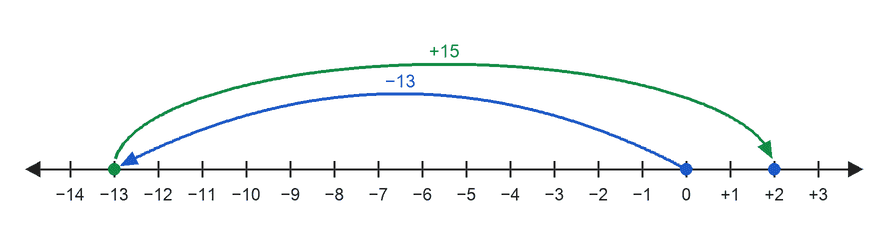
Step 3 — Part (iii).
We start at 0 and jump 13 units to the right to reach . Then we jump 15 units to the left (the second number is negative) and land on .

Step 4 — Part (iv).
We start at 0 and jump 13 units to the left to reach . Then we jump 15 units to the left (the second number is negative) and land on .
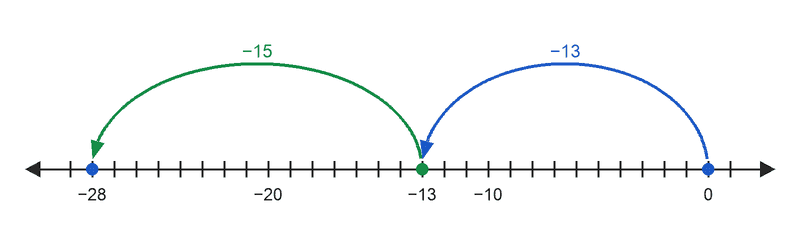
Watch out: With large numbers, label only a few ticks, but count the jump lengths exactly.
Therefore, (i) +28; (ii) +2; (iii) −2; (iv) −28.
- 183 marks
Question 18
Subtract using a number line :
(i) from
(ii) from
(iii) from
(iv) from
(v) from
(vi) from
Solve with AIWritten solution
Solution:
Concept: To find on a number line, we mark both numbers and count the steps from to . Steps towards the right give a positive answer; steps towards the left give a negative answer. 'Subtract from ' means . (This agrees with the rule .)
Step 1 — Part (i).
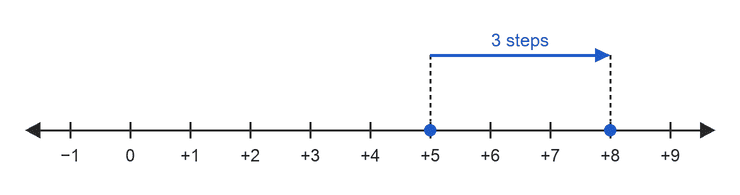
Subtracting from means . We mark and . From we need 3 steps towards the right to reach , so the answer is positive.
Step 2 — Part (ii).
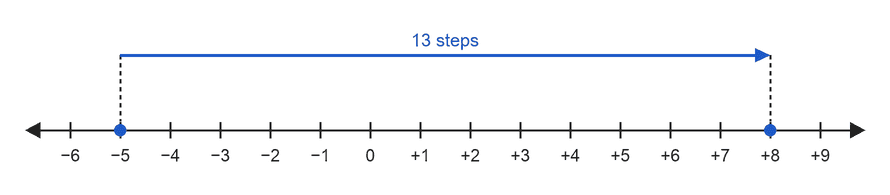
Subtracting from means . We mark and . From we need 13 steps towards the right to reach , so the answer is positive.
Step 3 — Part (iii).
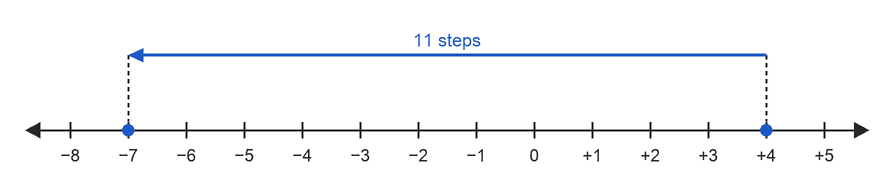
Subtracting from means . We mark and . From we need 11 steps towards the left to reach , so the answer is negative.
Step 4 — Part (iv).
Subtracting from means . We mark and . From we need 6 steps towards the right to reach , so the answer is positive.
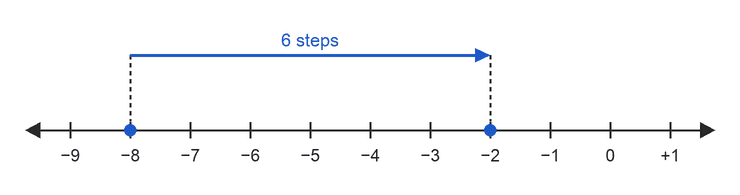
Step 5 — Part (v).
Subtracting from means . We mark and . From we need 15 steps towards the right to reach , so the answer is positive.
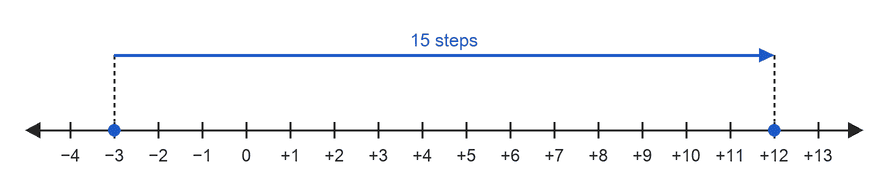
Step 6 — Part (vi).
Subtracting from means . We mark and . From we need 3 steps towards the right to reach , so the answer is positive.
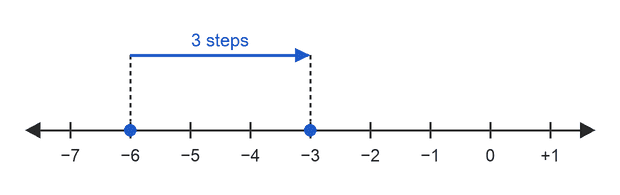
Watch out: The words 'subtract −5 from 8' mean 8 − (−5); the number after 'from' comes first.
Therefore, (i) +3; (ii) +13; (iii) −11; (iv) +6; (v) +15; (vi) +3.
- 191 mark
Question 19
If A , then B is :
 Solve with AI
Answer
(A)
- Correct
(B)
(C)
(D)
Answer: (B)
Concept: On a number line the ticks are equally spaced. Points to the right of 0 are positive and points to the left are negative; the number of ticks from 0 gives the size.
Step 1 — Find the size of one tick.
A is 5 ticks to the right of 0 and A , so each tick is 1 unit.
Step 2 — Read B.
B is 3 ticks to the left of 0. Left of 0 means negative, so B is .
Watch out: Count the ticks from 0, not from A.
Note: The value is sometimes given as the answer here. It equals , while B is three units to the left of 0, so the correct value of B is .
Why the other options are wrong:
- (A) : 3 is 3 ticks to the right of 0, but B is on the left of 0.
- (C) : is positive, but B is on the left of 0.
- (D) : is only 2 ticks left of 0; B is 3 ticks left of 0.
Therefore, B is −3, option (B).
- 201 mark
Question 20
If and are two negative integers such that , then :
Solve with AIAnswer
(A)
- Correct
(B)
(C)
(D) none of these
Answer: (B)
Concept: If , then : subtracting a number that is not larger leaves 0 or more. Subtracting a negative number means adding its opposite.
Step 1 — Use the condition m ≥ n.
Taking a smaller (or equal) number away from cannot give a negative answer. For example, with and , is ; and if , is 0. So .
Step 2 — Compare with the options.
Option (B) states exactly this result, .
Watch out: M ≥ n allows m = n, but does not force it.
Note: Read on its own, option (C) is true as well, because two negative integers always have a negative sum. The question asks what follows from , and that is (B).
Why the other options are wrong:
- (A): also allows , for example , so need not equal .
- (C): This is also a true statement about two negative integers (their sum is negative), but it follows from their being negative, not from the condition ; the result the condition gives is (B).
- (D): (B) is correct, so 'none of these' is wrong.
Therefore, , option (B).
- 211 mark
Question 21
P is an integer such that P (negative of P) ; then :
Solve with AIAnswer
(A) P is a positive integer
(B) P is a negative integer
- Correct
(C) P is positive or negative
(D) P is positive and negative
Answer: (C) P is positive or negative
Concept: Every integer added to its negative (opposite) gives 0. This is true for positive and negative integers alike (and for 0 itself).
Step 1 — Test a positive and a negative value.
For , ; for , . The rule works for both, so P may be positive or negative.
Watch out: No integer can be positive and negative at the same time.
Note: P can also be 0, since 0 + 0 = 0; of the given options, (C) is the one that fits.
Why the other options are wrong:
- (A): P need not be positive: too.
- (B): P need not be negative: too.
- (D): No integer is positive and negative at the same time.
Therefore, P is positive or negative, option (C).
- 221 mark
Question 22
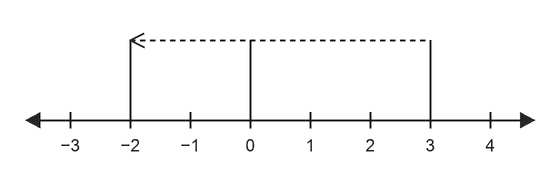
The given number line shows :
 Solve with AI
Answer
(A)
(B)
(C)
- Correct
(D)
Answer: (D)
Concept: A jump to the right on a number line adds its length, and a jump to the left subtracts it. So a jump that starts at and moves units shows (to the right) or (to the left).
Step 1 — Read the figure.
The dotted arrow starts at the line through 3 and points to the left, ending at the line through −2. So it is a jump of 5 units to the left from 3.
Step 2 — Write the jump as a calculation.
A jump to the left subtracts, so the figure shows 3 − 5, which lands on −2.
Watch out: The arrow starts at 3, so 3 comes first in the expression.
Note: Options (A) and (D) are printed exactly the same, so both describe the figure; (D) is taken as the answer.
Why the other options are wrong:
- (A): This option is printed exactly the same as (D), 3 − 5, which does describe the figure; the key is given as (D).
- (B): −3 + 2 would start at −3 and jump 2 to the right, but the arrow starts at 3.
- (C): −2 + 5 would start at −2 and jump to the right, but the arrow points to the left.
Therefore, the number line shows 3 − 5, option (D).
- 231 mark
Question 23
The given number line shows :
 Solve with AI
Answer
(A)
(B)
(C)
- Correct
(D)
Answer: (D)
Concept: A jump to the right on a number line adds its length, and a jump to the left subtracts it. So a jump that starts at and moves units shows (to the right) or (to the left).
Step 1 — Read the figure.
The jump starts at −1 and moves 3 units to the right, ending at 2.
Step 2 — Write the jump as a calculation.
A jump to the right adds, so the figure shows −1 + 3.
Watch out: Read where the jump starts and how far it goes, not only where it ends.
Note: Options (A) and (B) both have the value 1, but they describe different jumps (from −1 two units to the right, and from 2 one unit to the left); neither is the jump in the figure.
Why the other options are wrong:
- (A): −1 + 2 starts at −1 but moves only 2 units, ending at 1.
- (B): 2 − 1 would start at 2 and move to the left, ending at 1.
- (C): 1 + 2 would start at 1, not at −1.
Therefore, the number line shows −1 + 3, option (D).
- 241 mark
Question 24
The given number line shows :
 Solve with AI
Answer
(A)
(B)
(C)
- Correct
(D)
Answer: (D)
Concept: A jump to the right on a number line adds its length, and a jump to the left subtracts it. So a jump that starts at and moves units shows (to the right) or (to the left).
Step 1 — Read the figure.
The jump starts at 4 and moves 5 units to the left, ending at −1.
Step 2 — Write the jump as a calculation.
A jump to the left subtracts, so the figure shows 4 − 5.
Watch out: The jump has length 5 (from 4 to −1), not 4.
Why the other options are wrong:
- (A): 4 − 1 moves only 1 unit to the left, ending at 3.
- (B): −1 − 4 would start at −1 and end at −5.
- (C): 5 − 4 would start at 5 and end at 1.
Therefore, the number line shows 4 − 5, option (D).
- 251 mark
Question 25
The number of integers between and is:
Solve with AIAnswer
(A)
- Correct
(B)
(C)
(D)
Answer: (B)
Concept: The integers between and (with ) are those greater than and less than ; the two end numbers are not included. Their number is .
Step 1 — List the integers.
The word 'between' leaves out 5 and 15 themselves, so the integers are 6, 7, 8, 9, 10, 11, 12, 13 and 14.
Step 2 — Count them.
Counting the list gives 9 integers.
Watch out: 15 − 5 = 10 counts one end number as well; subtract 1 more.
Note: The answer 11 is sometimes given here; it counts 5 and 15 as well. 'Between' leaves out the end numbers (as in 'the whole numbers between 3 and 7' in the previous chapter), so the count is 9.
Why the other options are wrong:
- (A) : 10 is 15 − 5; it counts one of the end numbers too.
- (C) : 11 counts all the integers from 5 to 15, including both end numbers.
- (D) : 12 is more than even the 11 integers from 5 to 15 counted with both ends.
Therefore, there are 9 integers between 5 and 15, option (B).
- 261 mark
Question 26
If represents a gain of ₹ , then represents :
Solve with AIAnswer
(A) loss of
- Correct
(B) no loss no gain
(C) nothing
(D) none of these
Answer: (B) no loss no gain
Concept: Integers are the numbers …, −3, −2, −1, 0, 1, 2, 3, … . They go on for ever in both directions. The negative (opposite) of a number has the same size and the opposite sign; the opposite of 0 is 0, since 0 is neither positive nor negative.
Step 1 — Use the sign convention.
A positive number stands for a gain and a negative number for a loss. Zero is neither positive nor negative, so it stands for neither: no loss and no gain.
Why the other options are wrong:
- (A): A loss of 500 would be shown by , not 0.
- (C): 0 does have a meaning here: no loss and no gain.
- (D): (B) is correct, so 'none of these' is wrong.
Therefore, 0 represents no loss no gain, option (B).
- 271 mark
Question 27
Statement 1 : On a number line, integer lies on the left side of integer , then .
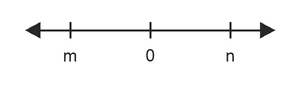
Statement 2 : When integers are marked on a number line, the integer on the left of the other is smaller.
Which of the following options is correct?
Solve with AIAnswer
- Correct
(A) Both the statements are true.
(B) Both the statements are false.
(C) Statement 1 is true, and statement 2 is false.
(D) Statement 1 is false, and statement 2 is true.
Answer: (A) Both the statements are true.
Concept: We judge each statement separately, true or false, and then choose the option that matches both verdicts. On a number line the numbers increase from left to right. So of two integers, the one on the right is greater and the one on the left is smaller. Every positive integer is greater than 0, and 0 is greater than every negative integer.
Step 1 — Judge Statement 2.
Numbers on a number line increase from left to right, so the integer on the left of another is the smaller one. Statement 2 is true.
Step 2 — Judge Statement 1.
In the figure lies on the left of . By the same rule, . Statement 1 is true.
Why the other options are wrong:
- (B): Both statements are true, so 'both false' is wrong.
- (C): Statement 2 is also true.
- (D): Statement 1 is also true.
Therefore, both the statements are true, option (A).
- 281 mark
Question 28
Choose your answer based on the codes given below :
(1) A is true, R is false. (2) A is false, R is true. (3) Both A and R are true. (4) Both A and R are false.
Assertion (A) : , , and .
, , and .
Reason (R) : On changing the signs of both the sides of an inequation, the sign of inequality reverses.
Solve with AIAnswer
(A) (1) A is true, R is false.
(B) (2) A is false, R is true.
- Correct
(C) (3) Both A and R are true.
(D) (4) Both A and R are false.
Answer: (C) (3) Both A and R are true.
Concept: In an Assertion–Reason item we judge the Assertion (A) and the Reason (R) separately, as true or false, and then choose the code that matches both verdicts. On a number line the numbers increase from left to right. So of two integers, the one on the right is greater and the one on the left is smaller. Every positive integer is greater than 0, and 0 is greater than every negative integer.
Step 1 — Judge the Reason.
If , then ; for example, gives . So changing the signs of both sides reverses the sign of inequality, and R is true.
Step 2 — Judge the Assertion.
Each of the four first statements is true. Changing both signs in each and reversing the inequality gives the second list, in the same order:
These are exactly the results in A, and each is true, so A is true.
Step 3 — Choose the code.
Both A and R are true, which is code (3).
Watch out: When both signs change, the inequality sign must turn round.
Why the other options are wrong:
- (A): R is also true: changing both signs reverses the inequality.
- (B): A is also true: every inequality in it is correct.
- (D): Both A and R are true, so 'both false' is wrong.
Therefore, both A and R are true, option (C).
What Class 6 Maths Ch 4 covers
The sections of the chapter, in the order the book takes them. Every question above comes from one of these.
- 01Need for Negative Numbers
- 02Integers
- 03Application of Negative Numbers in Our Daily Life
- 04Ordering (Comparing) of Integers
- 05Operations on Integers Using a Number Line
More ways to study this chapter
The same chapter asked three other ways. Practise it, revise it, and see what the board has set on Ch 4 before.
Class 6 Maths Ch 4 questions students ask
How many questions are there in Class 6 Maths Ch 4?
28 questions. Every one is solved step by step on this page.
Are these Class 6 Maths solutions free?
Yes. Every question and its full working is free to read, with no account needed.
Can I download the Class 6 Maths Ch 4 solutions as a PDF?
There is no PDF to download. Every solution is on this page instead, which means it is searchable, always the current syllabus, and readable on a phone. Use your browser's print option if you want it on paper.