
Opening your dashboard
Class 6 Maths Chapter 4 Negative Numbers and Integers: Competency-Based Questions (CBQ)
40 questions on Chapter 4, each worked through on its own page with the AI tutor. Class 6 Maths, ICSE 2026-27.
40 questions
1–5 marks · Mixed difficulty
- 11 mark
Question 1
Competency: Application
Rohan's school canteen card has ₹ 40 in it. He takes a lunch that costs ₹ 65, and the canteen lets him pay the rest later.
Which integer shows the balance on his card now, in rupees?
- 21 mark
Question 2
Competency: Analysis
In a quiz with negative marking, the final scores of four teams are:
Team A: , Team B: , Team C: , Team D:
The teams are ranked from the highest score to the lowest. Which team gets the third rank?
- 31 mark
Question 3
Competency: Application
A freezer shows °C. During a power cut, its temperature rises by 2 °C every hour.
What will the freezer show after 5 hours?
- 41 mark
Question 4
Competency: Analysis
On a number line, an integer and its opposite are 14 units apart. The integer lies to the left of 0.
What is ?
- 51 mark
Question 5
Competency: Evaluation
Kavya says, "When we subtract an integer from a number, the answer is always smaller than the number we started with."
Which example shows that Kavya is wrong?
- 61 mark
Question 6
Competency: Understanding
Assertion (A): In a game, Anu's score changes by , then by and then by . After these three changes her score is 4 less than her score at the start.
Reason (R): The sum of an integer and its opposite is 0.
- 72 marks
Question 7
Competency: Application
In a quiz, a team gets 3 marks for every correct answer and loses 2 marks for every wrong answer. A question that is not answered gets 0.
Sara's team answers 4 questions correctly and 8 questions wrongly. Tina's team does not answer any question.
Find the score of each team as an integer. Which team has the higher score?
- 82 marks
Question 8
Competency: Application
Before a rocket is launched, a clock counts down. The launch moment is taken as 0 seconds. A time before the launch is written with a negative sign and a time after the launch with a positive sign.
The tower lights come on at seconds. The engines start at seconds. The booster drops off at seconds.
(a) How many seconds pass between the lights coming on and the engines starting?
(b) How many seconds pass between the engines starting and the booster dropping off?
- 92 marks
Question 9
Competency: Evaluation
Farhan says, "The sum of two integers is always greater than each of the two integers."
Test his statement with these three sums: , and .
Is Farhan's statement always true, sometimes true or never true?
- 102 marks
Question 10
Competency: Analysis
Dev plays three rounds of a mobile game. His total score can go below zero.
In Round 2 he gained 7 points. In Round 3 he lost 12 points. After Round 3 his total score was .
What was Dev's score at the end of Round 1? Check your answer.
- 113 marks
Question 11
Competency: Analysis & Evaluation
In a football league, teams with equal points are ranked by goal difference.
Goal difference goals scored goals let in
Team Goals scored Goals let in X 7 12 Y 4 6 Z 9 9 (a) Find the goal difference of each team as an integer.
(b) Rank the three teams from the highest goal difference to the lowest.
(c) A fan says, "Team X must be ranked above Team Y, because X has scored more goals." Is the fan right by the league rule? Give a reason.
- 123 marks
Question 12
Competency: Creativity
Design a set of moves for a board game played on a number line from to . Your token starts at 0.
Your design must follow all these rules:
- There are exactly four moves: two forward (positive) and two backward (negative).
- All four moves have different numbers of steps.
- The token never goes beyond or .
- After the fourth move, the token is at .
Write your four moves as integers in order, show the position of the token after each move, and write one number statement for the whole game.
- 133 marks
Question 13
Competency: Analysis
A snail falls to the bottom of a dry well that is 9 m deep. Take the top of the well as 0, so the snail starts at .
Every day the snail climbs up 4 m. Every night it slips down 2 m.
(a) Write a number statement for the snail's position after the first day and the first night.
(b) Make a table of the snail's position at the end of each day and each night, until it reaches the top.
(c) On which day does the snail reach the top? Rina says, "It gains 2 m in a full day, so it needs 5 days." What did Rina miss?
- 145 marks
Question 14
Competency: Application & Analysis
Case study — Water level in the village tank
A village tank has a "normal mark" painted on its wall. The water level is measured from this mark: above the mark is positive and below the mark is negative.
On Sunday evening the level was cm above the normal mark. The table shows how the level changed on the next five days. A rise is positive and a fall is negative.
Day Monday Tuesday Wednesday Thursday Friday Change in water level (cm) (a) Write the five changes in ascending order. On which day did the water level fall the most?
(b) Find the water level at the end of each day. On which day was the water exactly at the normal mark?
(c) A warning is given when the level is below cm. Is a warning given on Friday? By how many centimetres must the level rise from Friday's level to come back to the normal mark?
- 154 marks
Question 15
Competency: Analysis & Evaluation
Case study — The old stepwell
Riya's class visits an old stepwell. The guide shows a chart of the levels. The ground level is 0, levels above the ground are positive and levels below the ground are negative. Each level is one flight of steps.
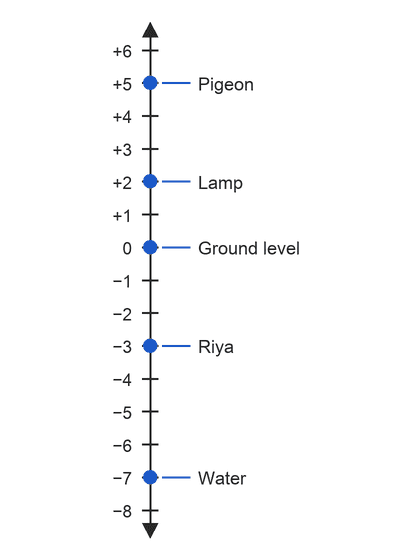
(a) Write the integers for the positions of the pigeon, Riya and the water.
(b) Riya walks down to the water. Then she climbs up to the lamp. How many flights of steps does she cover in all?
(c) The guide's helper says, "The pigeon is only 2 levels away from the water, because ." Is the helper right? Find the correct number of levels between the pigeon and the water.
- 161 mark
Question 16
Competency: Application
A school library keeps a daily register of the change in the number of books on its shelves. Books that are returned are written as positive integers and books that are issued are written as negative integers.
On Monday, 18 books were issued and 11 books were returned. Which integer shows the net change in the number of books on the shelves on Monday?
- 171 mark
Question 17
Competency: Analysis
Kabir marks a point X on a number line, as shown. Only some marks of the line are labelled, and the marks are 1 unit apart.

The integer for the point X has an opposite, which we call Y. Which integer is Y?
- 181 mark
Question 18
Competency: Understanding & Analysis
Assertion (A): If the temperature is °C in the morning and it rises by 8 °C, the temperature becomes °C.
Reason (R): When a positive integer is added to a number, we move to the left on the number line, so the result is smaller than the number we started with.
- 191 mark
Question 19
Competency: Analysis
Four stations of a metro line are at the heights given below. The ground level is 0 m. A height above the ground is positive and a height below the ground is negative. (Hypothetical data.)
Station Airport Market Park Fort Height (m) Which of the following pairs of stations has the greatest difference in height?
- 201 mark
Question 20
Competency: Application
The dial of a deep-freezer can be set to any integer temperature from °C up to °C. Both °C and °C are included.
How many different settings are possible?
- 211 mark
Question 21
Competency: Understanding
Rina stands at on a number line. She moves 7 units to the right.
Which subtraction gives the integer where she lands?
- 221 mark
Question 22
Competency: Analysis & Evaluation
Assertion (A): On the number line, the integers and are at the same distance from 0, so .
Reason (R): The distance of an integer from 0 is the same as the distance of its opposite from 0.
- 231 mark
Question 23
Competency: Evaluation
Nina draws a number line for the integers from to , as shown.

Which statement about her number line is correct?
- 241 mark
Question 24
Competency: Analysis
In a golf game, a player's score is the number of strokes above (positive) or below (negative) a fixed number called par. The player with the lowest score wins. (Hypothetical data.)
Player Ishaan Jaya Kabir Leela Score Who finishes second?
- 251 mark
Question 25
Competency: Application & Analysis
A group climbs a hill. At the base camp the temperature is °C. For every 500 m climbed, the temperature falls by 3 °C. The group will stop climbing as soon as the temperature is below °C. (Hypothetical data.)
After climbing how many metres is the temperature first below °C?
- 262 marks
Question 26
Competency: Analysis
Rohan's kitchen scale shows g when nothing is placed on it. So every reading of this scale is 20 g less than the true mass.
He puts a packet of rice on the scale and it shows g. Find the true mass of the packet. Then check your answer by working forward from it.
- 272 marks
Question 27
Competency: Analysis
A number line is drawn on the floor of a school hall. A toy robot stands at . It makes one move of exactly 5 units, either to the right or to the left.
(a) Write the two integers where the robot can land.
(b) Which of the two is greater? How many units apart are the two landing points?
- 282 marks
Question 28
Competency: Evaluation
A school science club will record the temperature in Leh in winter. They expect it to go as low as °C at night and as high as °C in the afternoon. (Hypothetical data.)
Thermometer P can show temperatures from °C to °C. Thermometer Q can show temperatures from °C to °C.
Which thermometer should the club use? Give a reason by comparing integers.
- 292 marks
Question 29
Competency: Application
The table shows how many minutes each train arrived earlier or later than its timetable. A positive number means later than the timetable and a negative number means earlier. (Hypothetical data.)
Train Express Mail Local Difference from timetable (minutes) (a) Write the three numbers in ascending order. Which train arrived earlier than its timetable by the greatest number of minutes?
(b) Which train arrived closest to its timetable?
- 302 marks
Question 30
Competency: Understanding
Solve this riddle.
I am an integer. I am greater than and less than . My opposite is an odd integer.
(a) List all the integers that fit the first two clues.
(b) Which integer am I? Which integer is 5 units to the right of me on the number line?
- 312 marks
Question 31
Competency: Understanding & Analysis
Without finding the exact value, decide whether each sum is positive, negative or zero. Give a reason for each. Then find the exact value to check.
(a)
(b)
- 323 marks
Question 32
Competency: Creativity
Invent your own example of using positive and negative integers.
Choose a situation from school, sport or home. Do not use temperature, money or height.
(a) Say what a positive number means and what a negative number means in your situation.
(b) Write three changes in your situation as integers. At least one must be negative.
(c) Starting from 0, find the total after the three changes. Write it as a number statement.
- 333 marks
Question 33
Competency: Analysis
A hot-air balloon takes off from a field. Take the field as 0 m. Heights above the field are positive and heights below the field are negative. (Hypothetical data.)
The balloon rises 150 m. Then it comes down 220 m to fly over a valley. Then it rises 90 m.
(a) Find the height of the balloon at the end of each stage.
(b) What is the lowest height the balloon reaches?
(c) Find the total distance the balloon travels up and down. Is it equal to its final height? Why or why not?
- 343 marks
Question 34
Competency: Analysis & Evaluation
In a board game, Anu's token is at on a number line. She must pick one of two cards.
Card 1: move , then , then .
Card 2: move , then , then .
The rule of the game: if the token is ever below after a move, the player is out.
(a) Find the position of the token after each move, for both cards.
(b) Which card keeps Anu in the game? Give the reason.
(c) If the rule did not exist, which card would end higher and by how many units?
- 353 marks
Question 35
Competency: Analysis
In a PE class a long rope is laid on the ground. It is marked like a number line, with 0 in the middle. Four children stand on it.
Asha stands at . Bela stands 12 units to the right of Asha. Chirag stands 9 units to the left of Bela. Dev stands at the opposite of Chirag's integer.
(a) Find the integers where Bela, Chirag and Dev stand.
(b) Write the names of the four children from the left end to the right end of the rope.
(c) How many units is Asha from Dev?
- 363 marks
Question 36
Competency: Application & Analysis
A school cricket team plays five practice matches. The target in every match is 150 runs. The table shows how many runs the team scored above the target (positive) or below the target (negative). (Hypothetical data.)
Match 1 2 3 4 5 Runs compared with the target (a) How many runs did the team score in Match 4?
(b) In which match was the team farthest from the target? How far?
(c) Write the matches from the best to the worst result compared with the target.
- 375 marks
Question 37
Competency: Application & Analysis
Case study — A trek in the hills
Sana's group trekked from a village to a temple. They took the height of the village as 0 m. Heights above the village are positive and heights below the village are negative. The table gives the height of each stop. The group visited the stops in the order Village, Lake, Pass, Valley, Temple. (Hypothetical data.)
Stop Village Lake Pass Valley Temple Height (m) (a) Write the stops in order from the highest to the lowest.
(b) For each leg of the trek, find the change in height and say whether the group climbed up or went down.
(c) Find the total height the group climbed and the total height they went down. Sana says, "We finished 95 m higher than the village, so we climbed only 95 m in all." Is Sana right? Explain.
- 384 marks
Question 38
Competency: Analysis & Evaluation
Case study — Night temperatures at a hill station
The bar chart shows the lowest temperature recorded each night at a hill station from Monday to Saturday. Bars above the line 0 show temperatures above 0 °C and bars below the line 0 show temperatures below 0 °C. (Hypothetical data.)
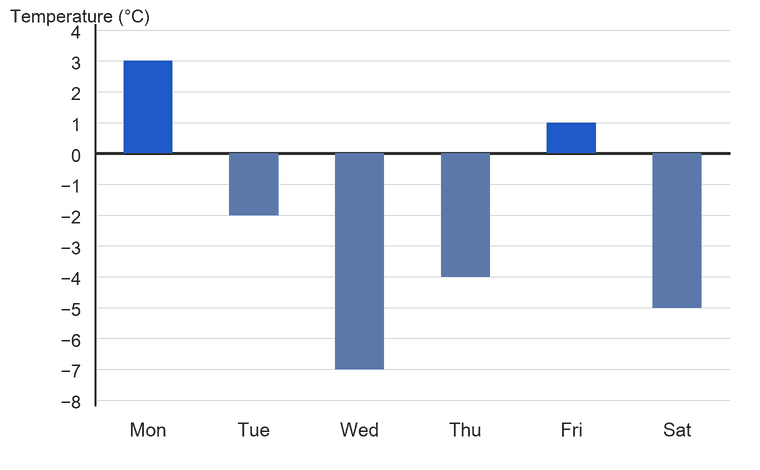
(a) Read the six temperatures from the chart and write them in ascending order.
(b) Find the change in temperature from each night to the next. Between which two nights was the fall in temperature the greatest?
(c) A frost warning is issued after any night when the temperature is below °C on that night and on the night before it. After which night is a warning issued? Give a reason.
- 395 marks
Question 39
Competency: Evaluation
Case study — Weighing packets of rice
A packing unit fills packets labelled 500 g. A checker weighs five packets and writes how much each packet is above (positive) or below (negative) 500 g. A packet passes the check if its difference is from g to g, both included. (Hypothetical data.)
Packet P1 P2 P3 P4 P5 Difference from 500 g (a) Find the actual mass of each packet.
(b) Which packets pass the check?
(c) The manager says, "The five differences add up to a small number, so all the packets are acceptable." Find the sum of the five differences and say whether the manager is right.
- 404 marks
Question 40
Competency: Analysis & Evaluation
Case study — The frog game
A frog game is played on a number line from to . The frog starts at . There are two traps on the line, as shown. A frog that lands exactly on a trap is out.

The frog must make four jumps, using each of these cards once, in any order: , , , .
(a) Write the integers at which the two traps are placed.
(b) The frog uses the cards in the order , , , . Find where it lands after each jump. Is it out?
(c) Write an order of the four cards for which the frog never lands on a trap. Give the landing points. Does the order change where the frog ends? Why?