
Opening your dashboard
Class 6 Maths Chapter 4 Negative Numbers and Integers: Practice Questions
41 questions on Chapter 4, each worked through on its own page with the AI tutor. Class 6 Maths, ICSE 2026-27.
41 questions
1–4 marks · Mixed difficulty
- 11 mark
Question 1
Bloom's level: Remember
Which integer is neither positive nor negative?
- 21 mark
Question 2
Bloom's level: Remember
If a rise in temperature of 6 °C is written as , then a fall in temperature of 4 °C is written as
- 31 mark
Question 3
Bloom's level: Understand
Which of the following statements is true?
- 41 mark
Question 4
Bloom's level: Apply
- 51 mark
Question 5
Bloom's level: Apply
- 61 mark
Question 6
Bloom's level: Apply
A diver is 12 m below sea level. She rises 5 m. Taking sea level as and heights above it as positive, her new position is
- 71 mark
Question 7
Bloom's level: Analyse
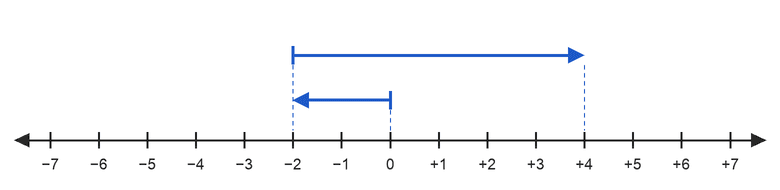
Which addition is shown on the number line below?
- 81 mark
Question 8
Bloom's level: Analyse
Points P, Q, R and S on the number line below stand for integers.

How many integers lie between P and S (not counting P and S)?
- 91 mark
Question 9
Bloom's level: Understand
Which subtraction cannot be done within whole numbers, so that negative numbers are needed?
- 101 mark
Question 10
Bloom's level: Understand
Assertion (A): and are opposites of each other.
Reason (R): Two integers are opposites of each other when their sum is .
- 111 mark
Question 11
Bloom's level: Evaluate
Assertion (A): , because .
Reason (R): On a number line, an integer is greater than every integer on its left.
- 121 mark
Question 12
Bloom's level: Analyse
Assertion (A): If moving 30 m due north is written as , then moving 30 m due south is written as .
Reason (R): is neither positive nor negative.
- 131 mark
Question 13
Bloom's level: Remember
On a number line for integers, where are the positive integers and the negative integers marked?
- 141 mark
Question 14
Bloom's level: Remember
Integers are of three kinds. Name them and give one example of each.
- 152 marks
Question 15
Bloom's level: Understand
Using , explain why we need negative numbers.
- 162 marks
Question 16
Bloom's level: Understand
Explain why , even though .
- 172 marks
Question 17
Bloom's level: Apply
Write an integer for each situation:
(a) a deposit of ₹ 2,500 in a bank
(b) 140 m below sea level
(c) 3 steps backward
(d) a temperature 8 °C below zero
- 182 marks
Question 18
Bloom's level: Apply
Write in ascending order: . Then name the greatest negative integer in the list.
- 192 marks
Question 19
Bloom's level: Apply
Evaluate:
(a)
(b)
- 202 marks
Question 20
Bloom's level: Apply
At 6 a.m. the temperature in a hill town was °C. By noon it rose by 11 °C, and by night it fell by 9 °C from the noon temperature. Find the temperature at noon and at night.
- 212 marks
Question 21
Bloom's level: Analyse
List all the integers between and , and find their sum. Explain why the sum comes out this way without adding them one by one.
- 222 marks
Question 22
Bloom's level: Understand
Copy and complete the table.
Integer Its opposite Position on the number line (left of 0, right of 0, or at 0) Positive, negative or neither - 234 marks
Question 23
Bloom's level: Apply
Case study — The lift in a mall
A mall has floors numbered to above the ground floor, the ground floor as , and three basements , and .
(a) A lift starts at floor and goes down 6 floors. At which floor does it stop?
(b) From there it goes up 3 floors. Where is it now?
(c) How many floors does the lift travel from the top floor to the lowest basement?
- 244 marks
Question 24
Bloom's level: Analyse
Case study — A cold morning
The table shows the temperatures of five places at 6 a.m. on a winter day.
Place Srinagar Leh Shimla Delhi Manali Temperature (°C) (a) Arrange the places from the coldest to the warmest.
(b) What is the difference between the warmest and the coldest temperature?
(c) Find two pairs of places whose temperatures differ by exactly 8 °C.
- 253 marks
Question 25
Bloom's level: Evaluate
Aditi wrote:
, "because when we subtract two negative numbers, we add them."
(a) Is Aditi's answer correct? Check it by the number line method of the chapter.
(b) Explain her mistake and write the correct rule.
- 263 marks
Question 26
Bloom's level: Evaluate
A shopkeeper made a profit of ₹ 350 on Monday, a loss of ₹ 520 on Tuesday and a profit of ₹ 240 on Wednesday. He says, "Over the three days I made a profit."
(a) Write each day's result as an integer.
(b) Find the overall result.
(c) Is the shopkeeper right? Justify your answer.
- 274 marks
Question 27
Bloom's level: Create
Make up a real-life story (not about money) that is solved by
Solve your problem, show the steps on a number line in words, and write the answer in a sentence.
- 284 marks
Question 28
Bloom's level: Create
Make a set of five different integers that meets all these conditions:
- exactly two of them are negative;
- the greatest is and the smallest is ;
- their sum is .
Arrange your integers in ascending order and show that every condition is met.
- 293 marks
Question 29
Bloom's level: Understand
(a) Write the integers from to .
(b) Explain how natural numbers, whole numbers and integers are related, using your list.
(c) Why does the number line for integers have arrowheads at both ends?
- 304 marks
Question 30
Bloom's level: Apply
Case study — The submarine
Take sea level as , heights above it as positive and depths below it as negative. A submarine is at m. It rises 120 m, and then dives 75 m. A seagull is flying at m right above it.
(a) Where is the submarine after rising?
(b) Where is it after diving?
(c) How far is the seagull above the submarine at the end?
- 312 marks
Question 31
Subtract from the sum of , and .
- 321 mark
Question 32
All the integers between and (not counting and ) are added. The sum is :
- 331 mark
Question 33
The integers written in ascending order (from the smallest to the greatest) are :
- 341 mark
Question 34
At midnight the temperature of a hill town was °C. By morning it had risen by 9 °C. The temperature in the morning was :
- 352 marks
Question 35
(a) Why can not be worked out within the whole numbers ? Find its value by using a number line.
(b) Write the opposite of the answer.
- 362 marks
Question 36
(a) Write the three integers that come just before on the number line, starting with the nearest to .
(b) Write the opposite of each of , and .
- 372 marks
Question 37
Meena walks along a straight road from her house. Distances to the east are written as positive integers and distances to the west as negative integers. She walks 450 m east, then 700 m west, and then 300 m east.
(a) Write her three walks as integers.
(b) Find her position from the house at the end of each walk. Where is she at the end ?
- 382 marks
Question 38
The curved arrow on the number line shows a jump from the point A to the point B.

(a) Write the integers at A and B.
(b) Write the addition fact shown by the jump, starting from A. Then write the subtraction fact and find its value.
- 393 marks
Question 39
The table shows the positions of some things with respect to sea level. A height above sea level is positive and a depth below sea level is negative.
Thing Bird Boat Dolphin Shark Whale Position (m) (a) Write the positions in ascending order.
(b) Which animal is the deepest, and which animal is the nearest to sea level among those below the sea level ?
(c) How many metres higher is the dolphin than the whale ?
- 404 marks
Question 40
Use number lines (or the rules of the chapter) to find :
(a)
(b) the integer that is 9 less than
(c) the integer that must be added to to get
(d)
- 413 marks
Question 41
Ravi's bank account has ₹ 0 in it. The bank lets him take out more money than he has; the account then shows a negative balance, which means he owes that money to the bank. His four transactions are : deposit ₹ 1,500, withdrawal ₹ 2,100, deposit ₹ 900 and withdrawal ₹ 700.
(a) Write the four transactions as integers.
(b) Find the balance after each transaction.
(c) What does the final balance mean ? How much must he deposit to make the balance 0 ?