
Opening your dashboard
Class 6 Chemistry Chapter 7: Water Solutions
59 textbook questions with step-by-step answers, free to read, for ICSE 2026-27.
Get talked through Ch 7, not just shown the answer
Reading a finished solution is not the same as being able to do it. The AI tutor takes one question at a time and works it with you, in your own words, until you can.
- Ask it out loud, in your own words
- It gives you the next step, not the answer
- Stuck on part (ii)? Start there
59 questions with solutions
1–5 marks · Mixed difficulty
- 11 mark
Question 1
The water content in human body is :
Solve with AIAnswer
- Correct
(A) 70%
(B) 75%
(C) 80%
(D) 90%
Answer: (A) 70%
Concept: All living things contain a large amount of water. The chapter gives about 70% as the water content of the human body as a whole.
Step 1 — Recall the figure for the whole body.
Water is present in our blood, muscles, organs and every cell. Taken over the whole body, it makes up about 70% of the body's mass in the chapter's figures.
Step 2 — Match with the options.
Of the four choices, 70% is the figure for the human body as a whole.
Watch out: The question asks about the whole body, not about one part of it such as blood.
Note: Measurements today give about 55% to 65% for most adults (more in babies and lean people); 70% is the round figure used in this chapter and is the closest option.
Why the other options are wrong:
- (B) 75%: This is close to the water content of a newborn baby, but not the figure for the human body as a whole.
- (C) 80%: This is higher than the water content of the human body as a whole.
- (D) 90%: This is about the water content of blood plasma (the liquid part of blood), not of the whole body.
Therefore, the water content of the human body is about 70%, option (A).
- 21 mark
Question 2
The purest form of natural water is :
Solve with AIAnswer
(A) sea water
(B) river water
- Correct
(C) rain water
(D) lake water
Answer: (C) rain water
Concept: Rain water forms when water evaporates from seas, rivers and lakes and its vapour condenses in the clouds. Evaporation leaves the dissolved salts and the mud behind.
Step 1 — Think about how rain water is formed.
Only the water turns into vapour; salts, clay and germs stay behind in the sea or river. So the drops that fall as rain are almost pure water.
Step 2 — Note its few impurities.
Rain picks up only some dust and some gases of the air (oxygen, nitrogen and carbon dioxide) as it falls. After a few showers even these are washed out of the air.
Watch out: Near factories and busy roads rain can also dissolve polluting gases (acid rain), so 'purest' means purest among natural waters, not completely pure.
Why the other options are wrong:
- (A) sea water: This contains a large amount of dissolved salts, mostly common salt, so it is the least pure.
- (B) river water: This carries dissolved mineral salts as well as suspended clay, sand and germs.
- (D) lake water: This, like river water, holds many dissolved and suspended impurities.
Therefore, the purest form of natural water is rain water, option (C).
- 31 mark
Question 3
When the water vapour changes into tiny droplets of water near the ground, it is called :
Solve with AIAnswer
(A) mist
(B) dew
- Correct
(C) fog
(D) frost
Answer: (C) fog
Concept: When moist air cools, its water vapour condenses into tiny droplets. The name depends on where the droplets form.
Step 1 — Find where the droplets form.
The stem says the vapour changes into tiny droplets near the ground, hanging in the air.
Step 2 — Name it.
A cloud of tiny water droplets in the air near the ground is called fog. Thick fog makes it hard to see far ahead.
Watch out: Dew also forms near the ground, but dew forms ON cold surfaces such as grass, not as droplets floating in the air.
Why the other options are wrong:
- (A) mist: This also means tiny droplets floating in the air, but it is thinner than fog; the term this chapter gives for droplets formed near the ground is fog.
- (B) dew: This is water that condenses on cold surfaces such as grass and leaves, not droplets in the air.
- (D) frost: This is a layer of ice crystals on surfaces colder than 0 °C, not liquid droplets.
Therefore, water vapour changing into tiny droplets near the ground is called fog, option (C).
- 41 mark
Question 4
Water is a :
Solve with AIAnswer
- Correct
(A) compound
(B) element
(C) mixture
(D) none of the above
Answer: (A) compound
Concept: A compound is formed when two or more elements combine chemically in a fixed proportion. In 1781 Henry Cavendish showed that water forms when hydrogen burns in oxygen.
Step 1 — See what water is made of.
Every molecule of water has two atoms of hydrogen joined to one atom of oxygen, so its formula is . Hydrogen burns in oxygen to give water:
Step 2 — Decide what kind of substance it is.
Two different elements are joined in a fixed proportion, so water is a compound.
Watch out: Water was once thought to be an element, because it cannot be split by ordinary heating; it can be split into hydrogen and oxygen by electricity.
Why the other options are wrong:
- (B) element: This cannot be right, because water can be broken down into two simpler substances, hydrogen and oxygen.
- (C) mixture: This cannot be right, because in a mixture the parts can be in any proportion, while in water hydrogen and oxygen are always in the same proportion.
- (D) none of the above: This cannot be right, because option (A) describes water correctly.
Therefore, water is a compound, option (A).
- 51 mark
Question 5
Which of the following is a source of underground water ?
Solve with AIAnswer
(A) Rivers
(B) Lakes
(C) Ponds
- Correct
(D) Springs
Answer: (D) Springs
Concept: Rain water seeps through porous soil and rocks and collects above non-porous rock as underground water. In some places this water comes out of the ground by itself as a spring.
Step 1 — Sort the options.
Rivers, lakes and ponds hold water on the surface of the earth, so they are surface water.
Step 2 — Pick the underground source.
A spring brings underground water up to the surface, so it is a source of underground water. Wells, tube wells and hand pumps also draw underground water.
Why the other options are wrong:
- (A) Rivers: This is water flowing on the surface of the earth, so it is surface water.
- (B) Lakes: This is water standing on the surface of the earth, so it is surface water.
- (C) Ponds: This is also water on the surface of the earth, so it is surface water.
Therefore, springs are a source of underground water, option (D).
- 61 mark
Question 6
Under normal conditions, water exists as a :
Solve with AIAnswer
(A) solid
- Correct
(B) liquid
(C) gas
(D) all of the above
Answer: (B) liquid
Concept: Water can exist as a solid (ice), a liquid (water) and a gas (water vapour or steam). Its state depends on the temperature.
Step 1 — Recall the temperatures that change its state.
Pure water freezes at 0 °C and boils at 100 °C.
Step 2 — Apply this to normal conditions.
Ordinary room and outdoor temperatures lie between 0 °C and 100 °C, so under normal conditions water is a liquid.
Watch out: Some water evaporates even at room temperature, but the water itself stays a liquid; only the small part that evaporates becomes vapour.
Why the other options are wrong:
- (A) solid: This is the state of water only at or below 0 °C (ice).
- (C) gas: This is the state of water only when it evaporates or boils (water vapour or steam).
- (D) all of the above: This is true of water in nature as a whole, but under normal conditions water itself is found as a liquid, so it does not answer the question.
Therefore, under normal conditions water exists as a liquid, option (B).
- 71 mark
Question 7
The most suitable source of water for domestic and industrial uses is :
Solve with AIAnswer
(A) sea water
- Correct
(B) river water
(C) spring water
(D) rain water
Answer: (B) river water
Concept: A source for homes and industries must give a large amount of water all through the year, and the water must be easy to purify.
Step 1 — Check each source for amount and supply.
Rivers carry large amounts of water throughout the year, and towns can store it behind dams.
Step 2 — Check purity.
River water has impurities, but after purification at the water works it is fit for homes and industries. So river water is the most suitable source.
Watch out: The purest source (rain water) is not the most suitable one, because it is not available all the year.
Why the other options are wrong:
- (A) sea water: This is saline, so it cannot be used directly for drinking, irrigation or most industries.
- (C) spring water: This is fairly pure, but it is found only in a few places and in small amounts.
- (D) rain water: This is the purest natural water, but it falls only in the rainy season and cannot meet daily needs.
Therefore, the most suitable source of water for domestic and industrial uses is river water, option (B).
- 81 mark
Question 8
What are the three states of water ?
Solve with AIWritten solution
Solution:
Concept: Water is found in all three states of matter, and it changes from one state to another on heating or cooling.
Step 1 — Name the three states.
The three states of water are:
- Solid – ice
- Liquid – water
- Gas – water vapour (steam)
Step 2 — Link them.
Ice melts to water at 0 °C, and water changes to steam when it boils at 100 °C; cooling reverses each change.
Therefore, the three states of water are solid (ice), liquid (water) and gas (water vapour or steam).
- 95 marks
Question 9
Name :
(a) Two major sources of natural water
(b) Two sources of surface water
(c) Two underground sources of water.
Solve with AIWritten solution
Solution:
Concept: Natural water is found on the surface of the earth (seas, rivers, lakes) and below it (underground water). Water above the surface, in the air, is atmospheric water.
Step 1 — (a) Two major sources of natural water.
Most of the water we use comes from the surface and from under the ground, so the two major sources are surface water and underground water.
Step 2 — (b) Two sources of surface water.
Water that flows or stands on the earth's surface includes rivers and lakes and seas and oceans.
Step 3 — (c) Two underground sources of water.
Underground water reaches us through wells (including tube wells and hand pumps) and natural springs.
Therefore, (a) surface water and underground water, (b) rivers and lakes, and seas and oceans, (c) wells and springs.
- 102 marks
Question 10
List three major impurities present in river water.
Solve with AIWritten solution
Solution:
Concept: River water comes from rain and melting snow and flows over hills and plains, picking up substances on its way.
Step 1 — Dissolved impurities.
As the water flows over rocks and soil, mineral salts dissolve in it.
Step 2 — Suspended impurities.
The flowing water carries clay, sand and bits of organic matter, which do not dissolve but float in it.
Step 3 — Living impurities.
Sewage and waste reaching the river add harmful bacteria (germs), which cause diseases.
Therefore, three major impurities in river water are dissolved mineral salts, suspended impurities such as clay and sand, and harmful bacteria.
- 115 marks
Question 11
Answer the following questions in brief :
(a) In which form is water present in the atmosphere ?
(b) Which source of water contains the highest concentration of salt in it ?
(c) What possible impurities does rain water contain ?
(d) What is water table ?
Solve with AIWritten solution
Solution:
Concept: Water is found in the atmosphere, on the surface of the earth and below it; each source carries its own impurities.
Step 1 — (a) Water in the atmosphere.
Water is present in the air as water vapour, and as tiny droplets in mist and clouds.
Step 2 — (b) Highest concentration of salt.
Sea (ocean) water has the highest concentration of dissolved salts, mostly common salt.
Step 3 — (c) Impurities in rain water.
Rain water picks up dust and the gases of the air (oxygen, nitrogen and carbon dioxide) as it falls. Near factories and busy roads it can also dissolve polluting gases such as sulphur dioxide, making acid rain. The first showers wash most of these out of the air.
Step 4 — (d) Water table.
Rain water seeps down through porous soil and rocks and collects above non-porous rock as ground water. The level of this ground water below the surface of the earth is called the water table.
Therefore, (a) water vapour, mist and clouds, (b) sea water, (c) dust and dissolved gases of the air, (d) the level of ground water below the earth's surface.
- 125 marks
Question 12
Find the percentage of water in the following:
(a) Rice and wheat grains
(b) Eggs
(c) Tomatoes
(d) Bread
(e) Watermelon
Solve with AIWritten solution
Solution:
Concept: Almost all foods contain water. Fresh fruits and vegetables contain the most; dry grains contain the least, so they keep for a long time without spoiling.
Step 1 — List the water content of each food.
The table gives typical values for the water content of each food:
Food Water (approximate) (a) Rice and wheat grains (dry) about 10% to 14% (b) Eggs about 75% (c) Tomatoes about 95% (d) Bread about 35% to 40% (e) Watermelon about 92% Step 2 — Compare them.
Watermelon and tomatoes are mostly water, eggs are three-quarters water, bread has about a third, and dry grains have very little, which is why grains can be stored for months.
Watch out: Values change a little from one sample to another, so they are given as approximate percentages.
Note: Some tables print 3% to 4% for grains, 25% for bread and 97% for watermelon; the values above are typical measured values.
Therefore, the water content is about 10% to 14% in dry rice and wheat grains, 75% in eggs, 95% in tomatoes, 35% to 40% in bread and 92% in watermelon.
- 133 marks
Question 13
What is water cycle ? State two important roles of water cycle in nature.
Solve with AIWritten solution
Solution:
Concept: The water cycle is the natural change of water from one state to another, which keeps water moving from the earth's surface to the atmosphere and back again.
Step 1 — Define the water cycle.
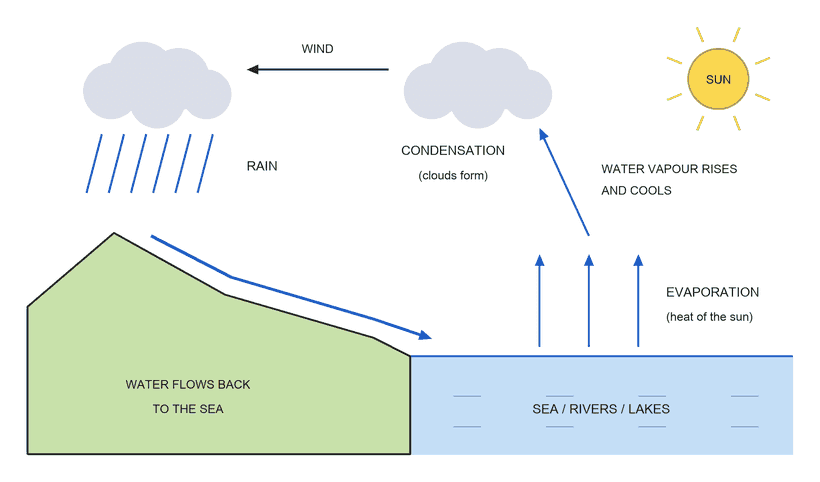
The change of water from one form to another in nature, which results in its continuous circulation from the earth's surface to the atmosphere and from the atmosphere back to the earth's surface, is called the water cycle.
Step 2 — Describe how it works.
The heat of the sun evaporates water from seas, rivers, lakes, the soil and plants. The water vapour rises, cools high up in the air and condenses into tiny droplets that form clouds. When the droplets join into larger drops, they fall back to the earth as rain (or as snow in cold places), and the water flows back to the sea.
Step 3 — State two roles of the water cycle.
The water cycle is important because:
- It restores the water lost from the earth's surface and keeps up the store of underground water.
- It helps to control the climate all over the world; its rain also supports farming in many parts of the world.
Watch out: The water is not used up in the cycle; the same water keeps going round again and again.
Therefore, the water cycle is the continuous circulation of water between the earth's surface and the atmosphere; it restores the water lost from the earth's surface and helps control the climate.
- 145 marks
Question 14
Give reasons :
(a) Rain water is considered the purest form of natural water.
(b) Spring water is pure enough for drinking but unsuitable for laboratory use.
(c) The taste of spring water differs at different places.
(d) Ice, water and steam are considered to have the same chemical composition.
Solve with AIWritten solution
Solution:
Concept: The purity and taste of natural water depend on the impurities it picks up on its way; its chemical make-up is always the same, .
Step 1 — (a) Rain water is the purest natural water.
Rain water is formed by the evaporation of water followed by the condensation of its vapour. Evaporation leaves the dissolved and suspended impurities behind, so rain water carries only some dust and dissolved gases of the air. That is why it is the purest form of natural water.
Step 2 — (b) Spring water is fit to drink but not for the laboratory.
Spring water has been filtered through many layers of soil and rock, so it usually has no suspended impurities or germs and is safe to drink. But it still contains dissolved mineral salts. Laboratory work needs water free from all impurities (distilled water), because dissolved salts can spoil experiments, so spring water is unsuitable for laboratory use.
Step 3 — (c) The taste of spring water differs from place to place.
The salts dissolved in spring water depend on the soil and rocks through which it passes. Different places have different soils and rocks, so different minerals dissolve and the taste differs.
Step 4 — (d) Ice, water and steam have the same chemical composition.
Ice, water and steam differ only in their physical state. All three are made of the same molecules, , two atoms of hydrogen joined to one atom of oxygen, so they have the same chemical composition.
Therefore, (a) rain water forms by evaporation and condensation, (b) spring water is germ-free but has dissolved salts, (c) the soil and rocks differ from place to place, (d) all three are the same substance, H₂O, in different states.
- 155 marks
Question 15
How are the following formed ?
(a) fog
(b) mist
(c) dew
(d) frost.
Solve with AIWritten solution
Solution:
Concept: Fog, mist, dew and frost all form when moist air cools, so that its water vapour turns into tiny drops of water or crystals of ice.
Step 1 — (a) Fog.
When the water vapour in the air near the ground cools and changes into tiny droplets of water that hang in the air, fog is formed. Thick fog makes it hard to see far.
Step 2 — (b) Mist.
When water vapour condenses into tiny droplets that stay suspended in the air, but fewer than in fog, it is called mist; we can see farther through mist than through fog.
Step 3 — (c) Dew.
On cool nights, water vapour in the air condenses on cold surfaces such as grass, leaves and flowers. The tiny drops formed, often seen on winter mornings, are called dew.
Step 4 — (d) Frost.
When the ground and objects on it are colder than 0 °C, the water vapour in the air turns directly into tiny crystals of ice on them, and dew that freezes also turns to ice. This white layer of ice is called frost.
Watch out: Dew and frost form on surfaces; fog and mist are droplets floating in the air.
Note: Frost is often described simply as frozen dew; most frost in fact forms when water vapour changes straight into ice on very cold surfaces.
Therefore, fog and mist are tiny droplets of condensed water vapour in the air, dew is water vapour condensed on cold surfaces, and frost is ice formed on surfaces colder than 0 °C.
- 161 mark
Question 16
Common salt is obtained from sea water by :
Solve with AIAnswer
(A) distillation
(B) crystallisation
- Correct
(C) evaporation
(D) sublimation
Answer: (C) evaporation
Concept: When a solution is left in the sun or heated, the solvent evaporates and the solute is left behind. Sea water is a solution of common salt in water.
Step 1 — See how salt is made in salt pans.
Sea water is let into shallow pans. The heat of the sun and the wind evaporate the water, and common salt is left behind as a solid.
Step 2 — Name the method.
The salt is recovered by evaporation of the water.
Watch out: Cooling hot sea water gives hardly any salt, because the solubility of common salt changes very little with temperature (about 36 g per 100 g of water at 20 °C and 39 g at 100 °C).
Why the other options are wrong:
- (A) distillation: This is used to collect the pure solvent (water) by condensing its vapour, not to obtain the salt.
- (B) crystallisation: This means getting crystals from a hot saturated solution as it cools; it does not work well for common salt, whose solubility hardly changes with temperature.
- (D) sublimation: This is the change of a solid straight into vapour on heating; common salt does not sublime.
Therefore, common salt is obtained from sea water by evaporation, option (C).
- 171 mark
Question 17
The substance which is insoluble in water is :
Solve with AIAnswer
(A) sugar
(B) salt
- Correct
(C) chalk
(D) sodium carbonate
Answer: (C) chalk
Concept: Substances that dissolve in water are water soluble; substances that do not dissolve, such as sand, chalk, plastic and wood, are water insoluble.
Step 1 — Test each option in your mind.
Sugar, common salt and sodium carbonate all disappear when stirred into water, giving a clear solution.
Step 2 — Pick the insoluble one.
Chalk powder does not dissolve; it makes the water milky and then settles at the bottom. So chalk is insoluble in water.
Watch out: A milky liquid is not a solution; the chalk particles only float for a while and then settle.
Why the other options are wrong:
- (A) sugar: This dissolves readily in water, so it is water soluble.
- (B) salt: This (common salt) dissolves readily in water, so it is water soluble.
- (D) sodium carbonate: This dissolves in water to give a clear solution, so it is water soluble.
Therefore, the substance which is insoluble in water is chalk, option (C).
- 181 mark
Question 18
A substance in which another substance is dissolved to form a solution is called :
Solve with AIAnswer
(A) solute
- Correct
(B) solvent
(C) precipitate
(D) none of the above
Answer: (B) solvent
Concept: A solution has two parts: the solute, which dissolves, and the solvent, the medium in which it dissolves.
Step 1 — Read what the stem describes.
The stem asks for the substance in which another substance is dissolved, that is, the dissolving medium.
Step 2 — Name it.
The medium is the solvent. It is usually a liquid and is present in the larger amount; in sugar solution, water is the solvent.
Watch out: The solute is the substance that dissolves; the solvent is the one that does the dissolving.
Why the other options are wrong:
- (A) solute: This is the substance that gets dissolved, not the medium in which it dissolves.
- (C) precipitate: This is an insoluble solid that separates out of a solution, not a dissolving medium.
- (D) none of the above: This cannot be right, because option (B) names the medium correctly.
Therefore, a substance in which another substance is dissolved to form a solution is called a solvent, option (B).
- 191 mark
Question 19
The most frequently used solvent is :
Solve with AIAnswer
- Correct
(A) water
(B) alcohol
(C) vinegar
(D) carbon disulphide
Answer: (A) water
Concept: Water dissolves a very large number of solids, liquids and gases, so it is called the universal solvent.
Step 1 — Think of everyday solutions.
Sugar in tea, salt in cooking, medicines in syrups and the oxygen used by fish are all dissolved in water.
Step 2 — Pick the most used solvent.
Water is cheap, safe and found everywhere, and it dissolves so many substances, so it is the most frequently used solvent.
Why the other options are wrong:
- (B) alcohol: This is a useful solvent (for iodine, for example), but it is used far less often than water.
- (C) vinegar: This is itself a solution of acetic acid in water, not a common solvent.
- (D) carbon disulphide: This is a special solvent used only for a few substances such as sulphur; it is poisonous and catches fire easily.
Therefore, the most frequently used solvent is water, option (A).
- 201 mark
Question 20
The substance which gets dissolved in a solvent to form a solution is called :
Solve with AIAnswer
- Correct
(A) solute
(B) residue
(C) sediment
(D) sublimate
Answer: (A) solute
Concept: In a solution the substance that dissolves is the solute; it is usually present in the smaller amount.
Step 1 — Read what the stem describes.
The stem asks for the substance that gets dissolved in a solvent.
Step 2 — Name it.
That substance is the solute; for example, sugar is the solute in sugar solution.
Why the other options are wrong:
- (B) residue: This is the solid left behind after evaporation or filtration, not a substance in solution.
- (C) sediment: This is insoluble matter that settles at the bottom of a liquid.
- (D) sublimate: This is the solid that collects when the vapour of a subliming substance cools.
Therefore, the substance which gets dissolved in a solvent to form a solution is called a solute, option (A).
- 211 mark
Question 21
The solubility of a solute in a solvent :
Solve with AIAnswer
(A) increases by stirring
- Correct
(B) increases by heating
(C) depends upon the size of the solute particles
(D) all of the above
Answer: (B) increases by heating
Concept: Solubility is the amount of solute that dissolves in a given amount of solvent at a given temperature to form a saturated solution. It tells how much can dissolve, not how fast it dissolves.
Step 1 — Check heating.
When a saturated sugar solution is heated, the undissolved sugar at the bottom dissolves. So for most solids (sugar, common salt, potassium nitrate) heating increases the solubility.
Step 2 — Check stirring and particle size.
Stirring and using smaller particles make a solute dissolve faster. But once the solution is saturated, no amount of stirring or powdering makes any more solute dissolve at that temperature.
Step 3 — Choose the option.
Only heating changes how much solute can dissolve, so the answer is (B).
Watch out: Do not mix up the rate of dissolving (faster) with solubility (how much).
Note: 'All of the above' is sometimes given as the answer, but by the definition of solubility only heating changes how much solute dissolves; stirring and smaller particles only help in quick dissolution.
Why the other options are wrong:
- (A) increases by stirring: This only makes the solute dissolve faster; it does not change the amount that can dissolve.
- (C) depends upon the size of the solute particles: This changes only how fast the solute dissolves; the amount that finally dissolves at a given temperature is the same.
- (D) all of the above: This cannot be right, because options (A) and (C) affect only the rate of dissolving.
Therefore, the solubility of a solute in a solvent increases by heating, option (B).
- 225 marks
Question 22
Identify the solute and solvent in the following solutions :
(a) Salt and water
(b) Iodine and alcohol
(c) Air and water
Solve with AIWritten solution
Solution:
Concept: In a solution the substance that dissolves is the solute; the medium in which it dissolves, usually present in the larger amount, is the solvent.
Step 1 — (a) Salt and water.
Salt dissolves in water, so the solute is salt and the solvent is water.
Step 2 — (b) Iodine and alcohol.
Iodine dissolves in alcohol (tincture of iodine), so the solute is iodine and the solvent is alcohol.
Step 3 — (c) Air and water.
The gases of air (oxygen, nitrogen and carbon dioxide) dissolve in water, so the solute is air and the solvent is water.
Watch out: A solute need not be a solid; in (c) the solute is a mixture of gases.
Therefore, the solutes are (a) salt, (b) iodine, (c) air, and the solvents are (a) water, (b) alcohol, (c) water.
- 235 marks
Question 23
Define :
(a) Solute
(b) Solvent
(c) Solution
(d) Saturated solution
(e) Unsaturated solution
Solve with AIWritten solution
Solution:
Concept: A solution is made by dissolving a solute in a solvent; whether it can take more solute decides whether it is saturated or unsaturated.
Step 1 — (a) Solute.
A solute is a substance that dissolves in a solvent to form a solution. It is present in the smaller quantity; for example, sugar in sugar solution.
Step 2 — (b) Solvent.
A solvent is the medium in which a substance is dissolved to form a solution. It is usually a liquid and is present in the larger quantity; for example, water.
Step 3 — (c) Solution.
A solution is a uniform (homogeneous) mixture formed by dissolving a solute in a solvent.
Step 4 — (d) Saturated solution.
A solution is saturated when it cannot dissolve any more of the solute at a given temperature.
Step 5 — (e) Unsaturated solution.
A solution that can still dissolve more of the solute at a given temperature is an unsaturated solution.
Watch out: Always say 'at a given temperature' for saturated and unsaturated solutions, because heating lets most solutions take more solute.
Therefore, the solute dissolves, the solvent dissolves it, the solution is their uniform mixture, a saturated solution can take no more solute and an unsaturated one can take more, at a given temperature.
- 242 marks
Question 24
Why is water called a universal solvent ?
Solve with AIWritten solution
Solution:
Concept: A universal solvent is one that dissolves a very wide range of substances.
Step 1 — Look at what water dissolves.
Water dissolves most solids (common salt, sugar, copper sulphate), many liquids (alcohol) and gases (oxygen and carbon dioxide of the air).
Step 2 — Note how strong this property is.
Water kept for a long time in containers of copper, iron or brass even dissolves tiny traces of the metal of the container.
Step 3 — Draw the conclusion.
Because water dissolves so many solid, liquid and gaseous substances, it is called a universal solvent.
Watch out: The word universal does not mean water dissolves everything; sand, chalk, oil and plastic do not dissolve in it.
Therefore, water is called a universal solvent because it can dissolve most solid, liquid and gaseous substances.
- 255 marks
Question 25
(a) Define solubility
(b) State two factors by which the solubility of a solute in a solvent can be increased.
Solve with AIWritten solution
Solution:
Concept: Solubility tells how much solute a given amount of solvent can hold at a given temperature; it is different from how fast the solute dissolves.
Step 1 — (a) Define solubility.
The amount of solute that dissolves in a given quantity of solvent at a given temperature to form a saturated solution is called the solubility of the solute.
Step 2 — (b) Factor 1: heating (raising the temperature).
For most solids the solubility increases as the temperature rises. Sugar left undissolved at the bottom of a saturated solution dissolves when the solution is heated; common salt, sugar and potassium nitrate all dissolve in larger amounts on heating.
Step 3 — (b) Factor 2: pressure, for gases.
A gas dissolves in larger amounts when it is pressed into the liquid under higher pressure. Soda water is made by dissolving carbon dioxide in water under pressure; when the bottle is opened, the pressure falls and the extra gas bubbles out.
Step 4 — Separate rate from solubility.
Stirring and powdering the solute (using smaller particles) make it dissolve faster, but they do not increase the amount that can finally dissolve.
Watch out: Heating does not help a gas: gases are less soluble in warm water, so for gases it is pressure that helps.
Note: The kind of solvent also decides how much dissolves (iodine dissolves only slightly in water but readily in alcohol); stirring and powdering are often listed too, but they only speed up dissolving.
Therefore, solubility is the amount of solute that makes a saturated solution with a given quantity of solvent at a given temperature, and it can be increased by heating (for most solids) and by raising the pressure (for gases).
- 261 mark
Question 26
Chlorination of water is done to :
Solve with AIAnswer
- Correct
(A) kill germs
(B) remove the suspended impurities
(C) remove the dissolved impurities
(D) none of the above
Answer: (A) kill germs
Concept: Chlorination means adding chlorine, or bleaching powder as a source of chlorine, to water. Chlorine kills germs.
Step 1 — Recall the purpose of each step of purification.
Suspended impurities are removed earlier, by loading, sedimentation and filtration.
Step 2 — Name the purpose of chlorination.
Chlorine is added at the end to kill the germs left in the water, so that it is safe to drink.
Why the other options are wrong:
- (B) remove the suspended impurities: This is done by loading, sedimentation and filtration, not by chlorine.
- (C) remove the dissolved impurities: This is not done by chlorine; chlorinated tap water still contains dissolved salts.
- (D) none of the above: This cannot be right, because option (A) gives the purpose correctly.
Therefore, chlorination of water is done to kill germs, option (A).
- 271 mark
Question 27
A method used to kill harmful germs present in water is :
Solve with AIAnswer
(A) sedimentation
(B) decantation
- Correct
(C) boiling
(D) filtration
Answer: (C) boiling
Concept: Germs cannot survive at the temperature of boiling water. Boiling water well is the simplest home method of killing them.
Step 1 — Ask which option acts on germs.
Sedimentation, decantation and filtration only separate solid particles from the water.
Step 2 — Pick the method that kills germs.
Boiling the water for several minutes kills harmful germs, so it is the method asked for.
Watch out: Clear-looking water can still contain germs; only boiling (or chlorine, or a proper purifier) makes it safe.
Why the other options are wrong:
- (A) sedimentation: This only lets suspended solid particles settle at the bottom; the germs are not killed.
- (B) decantation: This only pours off the clear liquid above a sediment; the germs remain in the water.
- (D) filtration: This through sand or cloth removes suspended particles, but the filtered water may still contain germs.
Therefore, a method used to kill harmful germs present in water is boiling, option (C).
- 281 mark
Question 28
Sea water is not fit for drinking because it contains a large amount of :
Solve with AIAnswer
(A) suspended impurities
(B) sugar
- Correct
(C) dissolved salts
(D) none of the above
Answer: (C) dissolved salts
Concept: Sea water is saline: it holds a large amount of dissolved salts, mostly common salt.
Step 1 — Recall what is in sea water.
About 3.5% of sea water by mass is dissolved salts, far more than in river or tap water.
Step 2 — See why this makes it unfit to drink.
Our kidneys cannot remove so much salt, so drinking sea water makes the body lose even more water. So sea water is not fit for drinking because of its dissolved salts.
Why the other options are wrong:
- (A) suspended impurities: These can be removed by settling and filtering; they are not what makes sea water unfit to drink.
- (B) sugar: This is not present in sea water.
- (D) none of the above: This cannot be right, because option (C) gives the reason correctly.
Therefore, sea water is not fit for drinking because it contains a large amount of dissolved salts, option (C).
- 291 mark
Question 29
The gas which adds taste to water is :
Solve with AIAnswer
(A) oxygen
(B) nitrogen
(C) hydrogen
- Correct
(D) carbon dioxide
Answer: (D) carbon dioxide
Concept: Drinking water should contain some dissolved gases and minerals to give it taste. Water that has lost them, such as boiled or distilled water, tastes flat.
Step 1 — Recall the gas named for taste.
Dissolved carbon dioxide gives water a fresh, slightly sharp taste; soda water tastes sharp because a lot of it is dissolved under pressure.
Step 2 — Choose the option.
So the gas which adds taste to water is carbon dioxide.
Why the other options are wrong:
- (A) oxygen: This dissolved gas is needed by fish and water plants and also makes water taste fresher, but the gas named for giving water its taste is carbon dioxide.
- (B) nitrogen: This dissolves only slightly in water and does not give it any taste.
- (C) hydrogen: This is not a dissolved gas of natural water; it is one of the elements of which water is made.
Therefore, the gas which adds taste to water is carbon dioxide, option (D).
- 301 mark
Question 30
Distilled water is :
Solve with AIAnswer
(A) salty
(B) sweet
(C) sour
- Correct
(D) tasteless
Answer: (D) tasteless
Concept: Distilled water is made by boiling water and condensing the steam. The dissolved salts stay behind and the dissolved gases escape, so distilled water is almost pure water.
Step 1 — See where taste comes from.
The taste of drinking water comes from the salts, minerals and gases dissolved in it.
Step 2 — Apply this to distilled water.
Distilled water has none of these, so it is tasteless.
Watch out: Never taste anything in the laboratory; this property is learnt from the chapter, not by testing.
Why the other options are wrong:
- (A) salty: This taste comes from dissolved salts, which distilled water does not contain.
- (B) sweet: This taste would need a dissolved substance such as sugar; distilled water has none.
- (C) sour: This taste comes from dissolved acids; distilled water contains none.
Therefore, distilled water is tasteless, option (D).
- 311 mark
Question 31
Which of the following is a water-borne disease ?
Solve with AIAnswer
(A) Influenza
- Correct
(B) Typhoid
(C) COVID-19
(D) Malaria
Answer: (B) Typhoid
Concept: Water-borne diseases are caused by germs in impure drinking water, for example cholera, typhoid, dysentery and jaundice (hepatitis A).
Step 1 — Check how each disease spreads.
Influenza and COVID-19 spread through droplets in the air, and malaria through the bite of a mosquito.
Step 2 — Pick the water-borne one.
Typhoid is caught by drinking water or eating food that has the typhoid germ in it, so it is water-borne.
Watch out: Malaria needs water for mosquitoes to breed, but it is spread by the mosquito bite, not by drinking water.
Why the other options are wrong:
- (A) Influenza: This spreads through droplets in the air when an infected person coughs or sneezes.
- (C) COVID-19: This spreads mainly through droplets and tiny particles in the air from infected people.
- (D) Malaria: This spreads through the bite of an infected female Anopheles mosquito.
Therefore, typhoid is a water-borne disease, option (B).
- 325 marks
Question 32
Name :
(a) Two chemicals used to destroy germs present in water.
(b) Two diseases which spread through impure water.
(c) A chemical used for loading.
(d) Two substances which add taste to water.
(e) Two household methods to get safe drinking water.
Solve with AIWritten solution
Solution:
Concept: These names come from the purification of water and from what makes water potable (fit to drink).
Step 1 — (a) Two chemicals that destroy germs.
Chlorine (often added as bleaching powder) and ozone both kill germs in water.
Step 2 — (b) Two diseases spread by impure water.
Cholera and typhoid are spread by germs in impure water (dysentery and jaundice are others).
Step 3 — (c) A chemical used for loading.
Potash alum is added to muddy water so that the suspended particles settle quickly.
Step 4 — (d) Two substances that add taste to water.
Dissolved minerals (salts) and dissolved gases, especially carbon dioxide, give drinking water its taste.
Step 5 — (e) Two household methods for safe drinking water.
Boiling the water well, and filtering it through a household water purifier (candle filter, U.V. or R.O. purifier); chlorine tablets are also used.
Watch out: Filtering through a cloth removes only suspended dirt, not germs; a proper purifier or boiling is needed.
Therefore, (a) chlorine and ozone, (b) cholera and typhoid, (c) potash alum, (d) dissolved minerals and dissolved carbon dioxide, (e) boiling and filtering through a water purifier.
- 335 marks
Question 33
Define :
(a) Sterilisation
(b) Sedimentation
(c) Loading
(d) Aeration
Solve with AIWritten solution
Solution:
Concept: These are steps used to make water clean and safe: some remove solid particles, others deal with germs.
Step 1 — (a) Sterilisation.
The process of removing or killing the germs in water, so that it does not spread water-borne diseases, is called sterilisation.
Step 2 — (b) Sedimentation.
The settling of suspended solid matter at the bottom of a liquid when it is left undisturbed is called sedimentation.
Step 3 — (c) Loading.
The process of adding a chemical such as potash alum to an impure liquid to make the suspended particles settle faster is called loading.
Step 4 — (d) Aeration.
The process of blowing air under pressure into water is called aeration. It adds oxygen to the water, removes bad smells and some dissolved gases, and helps destroy some harmful micro-organisms; the remaining germs are killed by chlorination.
Watch out: Loading does not kill germs; it only speeds up sedimentation.
Therefore, sterilisation removes germs, sedimentation is the settling of suspended matter, loading speeds up settling with alum, and aeration blows air into the water.
- 342 marks
Question 34
What is the taste of distilled water ? Why is it not potable ?
Solve with AIWritten solution
Solution:
Concept: Distilled water is made by boiling water and condensing the steam, so it has no dissolved salts and no dissolved gases. Potable water is water fit and pleasant for drinking.
Step 1 — Give the taste.
With no dissolved salts or gases, distilled water is tasteless (flat).
Step 2 — Explain why it is not used as drinking water.
Drinking water should contain small amounts of dissolved minerals and salts, which supply some of the minerals our body needs, and dissolved gases such as carbon dioxide and oxygen, which give it a fresh taste. Distilled water has none of these, so it is not considered potable.
Watch out: Distilled water is very pure; it is not poisonous, it simply lacks the minerals and gases good drinking water should have.
Therefore, distilled water is tasteless, and it is not potable because it has no dissolved minerals or gases.
- 355 marks
Question 35
Answer in brief :
(a) Why is river water unfit for drinking ?
(b) Why is tap water a mixture ?
(c) What is mineral water ?
(d) What is the purpose of adding bleaching powder to water supplied to the town ?
(e) How is chemically pure water obtained in the laboratory ?
(f) How is water in a swimming pool kept free from germs ?
(g) Why is water important for plants and animals?
Solve with AIWritten solution
Solution:
Concept: Each answer depends on which impurities the water contains and on how they are removed.
Step 1 — (a) River water is unfit for drinking.
River water contains dissolved mineral salts, suspended impurities such as clay, sand and organic matter, and harmful bacteria, so it is unfit to drink without purification.
Step 2 — (b) Tap water is a mixture.
Tap water is free from suspended impurities and germs, but it still contains dissolved salts and gases in varying amounts. Water with other substances present in no fixed proportion is a mixture; evaporating tap water on a watch glass leaves rings of solid residue.
Step 3 — (c) Mineral water.
Mineral water is water, usually from springs or wells, that contains useful minerals and salts dissolved in it; it is free from germs and suspended impurities and is safe to drink.
Step 4 — (d) Bleaching powder in town water.
Bleaching powder is a source of chlorine, which kills the germs in the water and makes it safe to drink.
Step 5 — (e) Chemically pure water in the laboratory.
Chemically pure water is obtained by distillation: the water is boiled and its vapour is cooled in a condenser, so pure water (the distillate) collects while the dissolved impurities stay behind in the flask.
Step 6 — (f) Swimming pool water.
The water is kept free from germs by chlorination: chlorine is added regularly to kill germs and reduce the danger of infection.
Step 7 — (g) Importance of water for plants and animals.
Plants need water to make their food by photosynthesis and to carry minerals; seeds need it to germinate. Animals need water for digestion, blood circulation and removing wastes, and to control body temperature by sweating. Many plants and animals also live in water and use the oxygen dissolved in it.
Therefore, (a) it has dissolved, suspended and living impurities, (b) it contains dissolved substances in no fixed proportion, (c) it is safe water with useful dissolved minerals, (d) to kill germs, (e) by distillation, (f) by chlorination, (g) water is needed for food making, digestion, circulation, body temperature and as a home.
- 363 marks
Question 36
Name the steps involved in the purification of drinking water supplied in cities and towns.
Solve with AIWritten solution
Solution:
Concept: River or lake water is purified at the water works in a fixed order: first the solid impurities are removed, then the germs are killed.
Step 1 — Loading and sedimentation.
The water is collected in large tanks and potash alum is added (loading), so that the suspended mud settles quickly at the bottom (sedimentation).
Step 2 — Filtration.
The clear water is passed through beds of sand and gravel, which hold back the lighter suspended particles.
Step 3 — Aeration.
Air is blown into the filtered water; this adds oxygen, removes bad smells and helps destroy some micro-organisms.
Step 4 — Chlorination (or ozonisation).
Chlorine (or ozone) is added to kill the remaining germs, making the water potable.
Step 5 — Storage and supply.
The potable water is stored in a storage tank and supplied to homes through pipes.
Watch out: The steps that remove solids come before the steps that kill germs, because germs hide in mud.
Therefore, the steps are loading and sedimentation, filtration, aeration, chlorination and storage for supply.
- 375 marks
Question 37
Give reasons :
(a) Ice floats on water.
(b) Marine life is able to survive in colder regions.
(c) Water droplets can be seen outside a chilled water bottle.
Solve with AIWritten solution
Solution:
Concept: Water behaves unusually (anomalously): it is densest at 4 °C, and it expands by about 9% when it freezes, so ice is lighter than the same volume of water.
Step 1 — (a) Ice floats on water.
Most liquids shrink when they freeze, but water expands by about 9%. So a given mass of ice takes up more space than the water it came from, and ice (density about 0.92 g/cm³) is lighter than liquid water (about 1 g/cm³). Hence ice floats on water.
Step 2 — (b) Marine life survives in cold regions.
In winter the top water of a lake or sea cools first. Water at 4 °C is the heaviest, so it sinks to the bottom, while colder, lighter water stays on top and freezes there. The floating ice covers the water like a lid, and the water below stays liquid, at about 4 °C near the bottom, so fish and water plants survive.
Step 3 — (c) Droplets outside a chilled bottle.
The air around us contains water vapour. When this air touches the cold surface of the bottle, it cools and the water vapour condenses into tiny drops of water on the outside of the bottle, just as dew forms on cold grass.
Watch out: The drops in (c) do not leak out of the bottle; they come from the water vapour in the air.
Therefore, (a) ice is lighter than water, (b) ice forms on top and the water below stays liquid, (c) water vapour in the air condenses on the cold surface.
- 383 marks
Question 38
What is potable water ? List four characteristics of potable water.
Solve with AIWritten solution
Solution:
Concept: Potable water is water that is fit and safe for drinking.
Step 1 — Define potable water.
Water fit for drinking purposes is called potable water.
Step 2 — List four characteristics.
Potable water should have these properties:
- It is colourless and odourless.
- It is clear (transparent).
- It is free from harmful micro-organisms (germs) that cause diseases.
- It is free from suspended impurities and other harmful substances.
Step 3 — Add what it should contain.
It should also contain small amounts of useful dissolved minerals and salts and some dissolved gases, which give it a pleasant taste.
Watch out: Clear water is not always potable; it may still contain germs.
Therefore, potable water is water fit for drinking; it is colourless and odourless, clear, free from germs and free from suspended impurities.
- 393 marks
Question 39
What are the three methods of removing germs from natural water? Explain.
Solve with AIWritten solution
Solution:
Concept: Removing or killing the germs in water is called sterilisation. It can be done by heat, by sunlight and air, or by chemicals.
Step 1 — Method 1: boiling.
Germs cannot survive at the temperature of boiling water, so boiling water for several minutes destroys them. This is the simplest method at home.
Step 2 — Method 2: exposure to air and sunlight.
The ultraviolet rays of sunlight, helped by the oxygen of the air, kill many germs. Clear water kept in clean, transparent bottles in strong sunlight for several hours becomes much safer to drink.
Step 3 — Method 3: chemical treatment.
Chemicals such as chlorine and ozone kill germs. Bleaching powder, a source of chlorine, is added to town water tanks, and swimming pools are chlorinated. Using ozone to sterilise water is called ozonisation.
Note: The ozone layer is high up in the atmosphere; it is the ultraviolet rays of sunlight, not ozone in the air around us, that kill germs in water left in the sun.
Therefore, germs are removed from natural water by boiling, by exposure to air and sunlight, and by chemical treatment with chlorine or ozone.
- 401 mark
Question 40
Water pollution is caused due to the addition of :
Solve with AIAnswer
(A) domestic sewage
(B) pesticides
(C) effluents
- Correct
(D) all of the above
Answer: (D) all of the above
Concept: Water is polluted mainly by three kinds of waste: domestic sewage, agricultural waste (pesticides, insecticides, fungicides) and industrial waste (effluents).
Step 1 — Check each option.
Sewage from homes, pesticides washed off fields and effluents from factories all reach rivers and lakes and pollute them.
Step 2 — Choose the option.
All three cause water pollution, so the answer is all of the above.
Why the other options are wrong:
- (A) domestic sewage: This does pollute water, but it is not the only cause listed.
- (B) pesticides: This does pollute water, but on its own it leaves out the other two causes.
- (C) effluents: This (waste chemicals from industries) does pollute water, but on its own it is also incomplete.
Therefore, water pollution is caused by the addition of all of the above, option (D).
- 411 mark
Question 41
One of the methods to control water pollution is :
Solve with AIAnswer
(A) using synthetic detergents
- Correct
(B) passing wastewater through effluent and sewage treatment plants
(C) washing clothes and utensils near water bodies
(D) using more fertilizers, pesticides, etc.
Answer: (B) passing wastewater through effluent and sewage treatment plants
Concept: Water pollution is controlled by stopping harmful substances from reaching rivers, lakes and the sea.
Step 1 — Ask what each option does.
Effluent treatment plants remove harmful chemicals from factory waste water, and sewage treatment plants remove dirt and germs from sewage.
Step 2 — Pick the method of control.
Passing waste water through these plants before it is released reduces pollution, so (B) is a method of control.
Why the other options are wrong:
- (A): This adds to pollution; synthetic detergents should be used less, and biodegradable ones preferred.
- (C): This puts soap, dirt and germs straight into the water, so it should be avoided.
- (D): This increases the farm chemicals washed into rivers by rain; their use should be reduced.
Therefore, one of the methods to control water pollution is passing wastewater through effluent and sewage treatment plants, option (B).
- 421 mark
Question 42
Excess rainfall may cause :
Solve with AIAnswer
(A) floods
(B) droughts
(C) soil erosion
- Correct
(D) both (A) and (C)
Answer: (D) both (A) and (C)
Concept: Too much rain and too little rain both cause harm. Excess rain overfills rivers and washes away soil; too little rain for a long time causes drought.
Step 1 — Find the effects of excess rain.
Heavy rain raises the water level in rivers, lakes and dams until they overflow, causing floods.
Step 2 — Find the second effect.
Running rain water and flood water also carry away the top layer of soil, causing soil erosion. So both (A) and (C) are effects of excess rain.
Why the other options are wrong:
- (A) floods: This is caused by excess rainfall, but so is soil erosion, so this alone is incomplete.
- (B) droughts: This is caused by no rain or very little rain over a long period, not by excess rain.
- (C) soil erosion: This is caused by heavy rainfall, but on its own it leaves out floods.
Therefore, excess rainfall may cause both floods and soil erosion, option (D).
- 431 mark
Question 43
Conservation of water can be done by :
Solve with AIAnswer
(A) rainwater harvesting
(B) planting trees and plants
(C) avoiding misuse of water
- Correct
(D) all of the above
Answer: (D) all of the above
Concept: Conservation of water means using water wisely and saving it, so that enough is left for the future.
Step 1 — Check each option.
Rainwater harvesting stores rain for later use; trees and plants help rain water soak into the ground and reduce run-off; avoiding misuse stops waste.
Step 2 — Choose the option.
Each of these saves water, so the answer is all of the above.
Why the other options are wrong:
- (A) rainwater harvesting: This conserves water, but it is only one of the correct ways listed.
- (B) planting trees and plants: This helps conserve water, but on its own it leaves out the other two ways.
- (C) avoiding misuse of water: This conserves water, but on its own it is also incomplete.
Therefore, conservation of water can be done by all of the above, option (D).
- 441 mark
Question 44
Assertion (A): The sea water is saline. Reason (R): The sea water contains many dissolved salts and minerals.
Solve with AIAnswer
- Correct
(A) Both A and R are true and R is the correct explanation of A.
(B) Both A and R are true but R is not the correct explanation of A.
(C) A is true but R is false.
(D) A is false but R is true.
Answer: (A) Both A and R are true and R is the correct explanation of A.
Concept: Judge the Assertion (A) first, then the Reason (R), and only then decide whether R explains A. Saline means salty.
Step 1 — Judge the Assertion.
Sea water tastes salty and cannot be used directly for drinking or irrigation, so A is true.
Step 2 — Judge the Reason.
Sea water contains a large amount of dissolved salts, mostly common salt, and other minerals, so R is true.
Step 3 — Decide whether R explains A.
Sea water is salty because of these dissolved salts, so R correctly explains A.
Why the other options are wrong:
- (B): This says R does not explain A, but the dissolved salts are exactly why sea water is saline.
- (C): This says R is false, but sea water really does contain many dissolved salts and minerals.
- (D): This says A is false, but sea water really is saline.
Therefore, both A and R are true and R is the correct explanation of A, option (A).
- 451 mark
Question 45
Assertion (A): Water is a universal solvent. Reason (R): Water has the ability to dissolve most of the solid, liquid and gaseous substances in it.
Solve with AIAnswer
- Correct
(A) Both A and R are true and R is the correct explanation of A.
(B) Both A and R are true but R is not the correct explanation of A.
(C) A is true but R is false.
(D) A is false but R is true.
Answer: (A) Both A and R are true and R is the correct explanation of A.
Concept: Judge the Assertion (A) first, then the Reason (R), and only then decide whether R explains A. A universal solvent is one that dissolves a very wide range of substances.
Step 1 — Judge the Assertion.
Water is called the universal solvent, so A is true.
Step 2 — Judge the Reason.
Water dissolves most solids (salt, sugar), many liquids (alcohol) and gases (oxygen, carbon dioxide), so R is true.
Step 3 — Decide whether R explains A.
This wide dissolving power is exactly why water is called the universal solvent, so R correctly explains A.
Why the other options are wrong:
- (B): This says R does not explain A, but R gives the very reason for the name.
- (C): This says R is false, but water really does dissolve most solids, liquids and gases.
- (D): This says A is false, but water really is called a universal solvent.
Therefore, both A and R are true and R is the correct explanation of A, option (A).
- 461 mark
Question 46
Assertion (A): Water is a mixture. Reason (R): Water is made up of hydrogen and oxygen combined together in a 2 : 1 ratio by volume.
Solve with AIAnswer
(A) Both A and R are true and R is the correct explanation of A.
(B) Both A and R are true but R is not the correct explanation of A.
(C) A is true but R is false.
- Correct
(D) A is false but R is true.
Answer: (D) A is false but R is true.
Concept: Judge the Assertion (A) first, then the Reason (R), and only then decide whether R explains A. A compound has its elements joined in a fixed proportion; a mixture does not.
Step 1 — Judge the Reason.
Two volumes of hydrogen combine with one volume of oxygen to form water, so the ratio is a fixed 2 : 1 by volume:
So R is true.
Step 2 — Judge the Assertion.
Because its elements are combined in a fixed proportion, water is a compound, not a mixture. So A is false.
Step 3 — Put the two together.
A is false and R is true; in fact R shows that water is a compound.
Why the other options are wrong:
- (A): This needs A to be true, but water is a compound, not a mixture.
- (B): This also needs A to be true, which it is not.
- (C): This has it the wrong way round: A is false and R is true.
Therefore, A is false but R is true, option (D).
- 471 mark
Question 47
Assertion (A): Seeds need water to germinate and grow into plants. Reason (R): Ice, liquid water and steam have different physical and chemical properties.
Solve with AIAnswer
(A) Both A and R are true and R is the correct explanation of A.
(B) Both A and R are true but R is not the correct explanation of A.
- Correct
(C) A is true but R is false.
(D) A is false but R is true.
Answer: (C) A is true but R is false.
Concept: Judge the Assertion (A) first, then the Reason (R), and only then decide whether R explains A. Ice, water and steam are the same chemical substance, , in different physical states.
Step 1 — Judge the Assertion.
Seeds soaked in water germinate, while dry seeds do not, so A is true.
Step 2 — Judge the Reason.
Ice, water and steam have different physical properties (state, shape, volume), but they have the same chemical properties, because all three are made of molecules. R says their chemical properties differ, so R is false.
Step 3 — Put the two together.
A is true and R is false.
Why the other options are wrong:
- (A): This needs R to be true, but ice, water and steam have the same chemical properties.
- (B): This also needs R to be true, which it is not.
- (D): This has it the wrong way round: A is true and R is false.
Therefore, A is true but R is false, option (C).
- 485 marks
Question 48
Fill in the blanks :
(a) Water is a ________ solvent.
(b) ________ is the purest form of natural water.
(c) Sand and dust are ________ impurities in water.
(d) Sea water has a high concentration of ________
(e) Water covers nearly ________ of the surface of the earth.
(f) Evaporation of rain water leaves ________ residue.
(g) ________ is the chemical added to water to remove the tiny suspended particles.
(h) A ________ is a uniform mixture of a solute and a solvent.
(i) Ice, water and steam have different physical states but are chemically ________ .
(j) Boiling kills most of the ________ in water.
(k) The elements present in the molecules of water are ________ and ________ .
Solve with AIWritten solution
Solution:
Concept: Each blank is a key term of the chapter: water as a solvent, sources and impurities of water, purification and the composition of water.
Step 1 — Fill the blanks on water as a solvent.
Water dissolves most substances, and a solution is a uniform mixture:
- (a) Water is a universal solvent.
- (h) A solution is a uniform mixture of a solute and a solvent.
Step 2 — Fill the blanks on sources and impurities.
These come from the sections on sources of water:
- (b) Rain water is the purest form of natural water.
- (c) Sand and dust are suspended impurities in water.
- (d) Sea water has a high concentration of salts (mostly common salt).
- (e) Water covers nearly 70% (about 71%) of the surface of the earth.
- (f) Evaporation of rain water leaves no residue.
Step 3 — Fill the blanks on purification.
Alum makes fine particles settle, and boiling destroys germs:
- (g) Potash alum is the chemical added to water to remove the tiny suspended particles.
- (j) Boiling kills most of the germs (bacteria) in water.
Step 4 — Fill the blanks on what water is.
Water is one substance in three states, made of two elements:
- (i) Ice, water and steam have different physical states but are chemically identical (the same).
- (k) The elements present in the molecules of water are hydrogen and oxygen.
Watch out: In (c), sand and dust do not dissolve; they float or settle, so they are suspended, not dissolved, impurities.
Therefore, the blanks are (a) universal, (b) rain water, (c) suspended, (d) salts, (e) 70%, (f) no, (g) potash alum, (h) solution, (i) identical, (j) germs, (k) hydrogen and oxygen.
- 494 marks
Question 49
Write 'true' or 'false' for the following statements:
(a) Water is an element.
(b) Alum is commonly used for removing suspended impurities.
(c) Tap water does not contain dissolved impurities.
(d) Distillation is a good method for purifying water for town supply.
Solve with AIWritten solution
Solution:
Concept: Check each statement against the facts of the chapter; a statement that is not fully correct is false.
Step 1 — (a) Water is an element.
Water can be split into hydrogen and oxygen, so it is a compound of two elements. The statement is false.
Step 2 — (b) Alum removes suspended impurities.
Potash alum is added to muddy water (loading) so that the suspended particles stick together and settle quickly. The statement is true.
Step 3 — (c) Tap water has no dissolved impurities.
Tap water is free from suspended impurities and germs, but it still contains dissolved salts and gases; evaporating it leaves a residue. The statement is false.
Step 4 — (d) Distillation for town supply.
Distillation needs a great deal of fuel for the huge amount of water a town uses, and distilled water lacks the dissolved minerals and gases that give drinking water its taste. Town water is purified by sedimentation, filtration, aeration and chlorination instead. The statement is false.
Therefore, (a) false, (b) true, (c) false, (d) false.
- 503 marks
Question 50
Match the following :
Match each description in Column A with the correct term in Column B.
Column A Column B (a) A solution in which more solute can be dissolved. (1) Solution (b) A medium in which a substance dissolves. (2) Unsaturated solution (c) A homogeneous mixture. (3) Solvent Solve with AIWritten solution
Solution:
Concept: A solution is a uniform (homogeneous) mixture of a solute in a solvent; the solvent is the medium in which the solute dissolves; an unsaturated solution can still dissolve more solute at that temperature.
Step 1 — Match description (a).
A solution in which more solute can still be dissolved is not yet saturated, so (a) matches (2), unsaturated solution.
Step 2 — Match description (b).
The medium in which a substance dissolves is the solvent, so (b) matches (3), solvent.
Step 3 — Match description (c).
A homogeneous mixture of solute and solvent is a solution, so (c) matches (1), solution.
Therefore, (a) matches (2) unsaturated solution, (b) matches (3) solvent, and (c) matches (1) solution.
- 512 marks
Question 51
Name two water-borne diseases.
Solve with AIWritten solution
Solution:
Concept: Water-borne diseases are caused by germs present in impure drinking water.
Step 1 — Name two diseases.
Drinking water that has these germs in it can cause cholera and typhoid; dysentery and jaundice (hepatitis A) are others.
Therefore, two water-borne diseases are cholera and typhoid.
- 522 marks
Question 52
What are effluents ?
Solve with AIWritten solution
Solution:
Concept: Effluents are a kind of industrial waste that pollutes water.
Step 1 — Define effluents.
The waste chemicals and waste water from industries that are let out into rivers, lakes and the sea are called effluents.
Step 2 — State why they are harmful.
They are often toxic to water plants and animals, and they make the water unfit for people to use.
Therefore, effluents are the waste chemicals from industries that get into water bodies and pollute them.
- 532 marks
Question 53
What is rainwater harvesting ?
Solve with AIWritten solution
Solution:
Concept: Rainwater harvesting is a way of conserving water by collecting rain instead of letting it run off.
Step 1 — Describe the method.
Rainwater falling on the roofs of buildings is collected and carried through pipes to underground tanks, or into pits, where it is stored.
Step 2 — State its use.
The stored water is used later, and water led into pits also soaks into the ground and raises the water table.
Therefore, rainwater harvesting is collecting rainwater from roofs and storing it in tanks or the ground for later use.
- 545 marks
Question 54
What causes
(a) floods
(b) soil erosion
(c) droughts ?
Solve with AIWritten solution
Solution:
Concept: Too much rain and too little rain both harm people and land.
Step 1 — (a) Floods.
Heavy rain raises the water level in rivers, lakes and dams until they overflow; the overflow of a huge amount of water onto land is a flood.
Step 2 — (b) Soil erosion.
Heavy rainfall and flood water wash away the top layer of soil, especially where there are no plants to hold it.
Step 3 — (c) Droughts.
A drought happens when a region gets no rain, or very little rain, for a long time.
Therefore, floods and soil erosion are caused by heavy rainfall, and droughts by little or no rain for a long time.
- 553 marks
Question 55
What are the three main causes of water pollution?
Solve with AIWritten solution
Solution:
Concept: Water is polluted by waste that comes from homes, farms and factories.
Step 1 — Domestic sewage.
Water from our homes carries dirt from toilets, from washing clothes and utensils, and food waste. This sewage drains into lakes, rivers and seas and carries germs that spread cholera, typhoid and jaundice.
Step 2 — Agricultural waste.
Pesticides, insecticides, fungicides and fertilisers used in fields are washed by rain into rivers and ponds; they harm water life and can enter our food.
Step 3 — Industrial waste.
Waste chemicals from industries, called effluents, are let into water bodies. They are toxic to water plants and animals and make the water unfit for people to use.
Therefore, the three main causes of water pollution are domestic sewage, agricultural waste and industrial waste (effluents).
- 563 marks
Question 56
State four steps to be taken to prevent water pollution.
Solve with AIWritten solution
Solution:
Concept: Water pollution is prevented by stopping wastes from reaching rivers, lakes and the sea.
Step 1 — Treat factory waste.
Waste water from industries should be passed through effluent treatment plants, so that harmful chemicals are removed before it is released.
Step 2 — Treat sewage.
Sewage should first be passed through a sewage treatment plant; the treated water can then be used for irrigation.
Step 3 — Keep water bodies clean.
Washing clothes and utensils and bathing animals should not be done in or near rivers, lakes and ponds.
Step 4 — Use fewer harmful chemicals.
The use of pesticides, insecticides, fungicides and synthetic detergents should be reduced; biodegradable detergents should be used instead.
Therefore, four steps are treating factory waste, treating sewage, not washing or bathing animals in water bodies, and using fewer farm chemicals and synthetic detergents.
- 575 marks
Question 57
(a) State three reasons to conserve water.
(b) State four ways in which you as an individual can conserve water.
Solve with AIWritten solution
Solution:
Concept: Usable fresh water is limited, while our needs keep growing, so every one of us must save water.
Step 1 — (a) Three reasons to conserve water.
We must conserve water because:
- Water fit for use is not available in plenty: only about 1% of the earth's water is fresh water that living beings can use.
- Agriculture needs water in very large quantities.
- Industries also need a large amount of water.
Step 2 — (b) Four ways an individual can conserve water.
Each of us can save water at home:
- Use a bucket instead of a shower for bathing.
- Close the tap while brushing the teeth, and get dripping taps repaired.
- Make sure water does not overflow from the overhead tank.
- Wash fruits and vegetables in a bowl of water rather than under a running tap, and use that water for the plants.
Therefore, water must be conserved because usable water is scarce and farming and industry need a lot of it, and we can save it by using a bucket, closing taps, stopping tank overflow and reusing washing water.
- 585 marks
Question 58
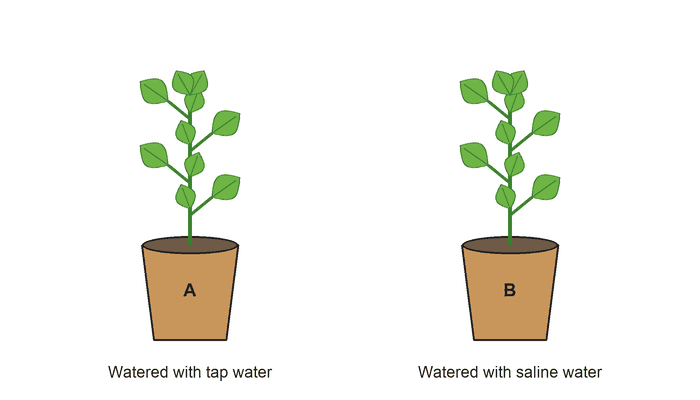
Siya kept two healthy potted plants A and B in sunlight. She watered plant A with tap water and plant B with saline water for a few days regularly. She observed that one of the plants grew well, the other could not.
(a) Which potted plant did not grow well ? Why ?
(b) What is saline water ?
(c) What conclusion can you draw from Siya's experiment ?
Solve with AIWritten solution
Solution:
Concept: Plants take in water through their roots. Water with a high concentration of salts draws water out of the roots instead, so the plant cannot get the water it needs.
Step 1 — (a) The plant that did not grow well.
Plant B, which was watered with saline water, did not grow well. The large amount of dissolved salts in the saline water stops the roots from taking in water and harms the plant.
Step 2 — (b) Saline water.
Saline water is water with a high concentration of dissolved salts, mostly common salt; sea water is an example.
Step 3 — (c) Conclusion.
Plant A, given tap water, grew well, while plant B did not, and only the water was different. So plants cannot tolerate saline water; this is why sea water cannot be used directly for irrigation.
Watch out: The experiment is a fair test only because both plants were kept alike (both healthy, both in sunlight) and only the kind of water was changed.
Therefore, (a) plant B did not grow well because of the dissolved salts, (b) saline water is water with a high concentration of salts, (c) plants cannot tolerate saline water.
- 595 marks
Question 59
During summer, Radha noticed that the ponds near her house became dry. But in the rainy season, those same ponds overflow with water. Curious, she asked her teacher why this happens. Her teacher explained that heat from the sun changes water from rivers, lakes and ponds into water vapour. Water vapour then rises up and forms clouds. When clouds become heavy, they release water back to the earth as rain. This natural process keeps water circulating on the earth.
(a) What is this continuous circulation of water called?
(b) What is the process by which water vapour turns back into tiny droplets of water?
(c) In which season is the evaporation of water the fastest?
(d) Write two uses of water in your daily life, apart from drinking.
Solve with AIWritten solution
Solution:
Concept: The story describes the water cycle: evaporation by the sun's heat, condensation into clouds and rain falling back to the earth.
Step 1 — (a) Name the circulation.
The continuous circulation of water between the earth and the atmosphere is called the water cycle.
Step 2 — (b) Name the process.
Water vapour cools high up in the atmosphere and turns back into tiny droplets of water; this is condensation.
Step 3 — (c) Find the season of fastest evaporation.
Evaporation is fastest when it is hottest, so it is fastest in summer; that is why the ponds dried up then.
Step 4 — (d) Two uses of water apart from drinking.
Water is used for bathing and for cooking food; washing clothes and utensils and watering plants are other uses.
Therefore, (a) the water cycle, (b) condensation, (c) summer, (d) bathing and cooking food.
What Class 6 Chemistry Ch 7 covers
The sections of the chapter, in the order the book takes them. Every question above comes from one of these.
- 01Occurrence of Water
- 02Sources of Water
- 03The Three States of Water
- 04Physical Properties of Water
- 05Water – A Universal Solvent
- 06Importance of Water
More ways to study this chapter
The same chapter asked three other ways. Practise it, revise it, and see what the board has set on Ch 7 before.
Class 6 Chemistry Ch 7 questions students ask
How many questions are there in Class 6 Chemistry Ch 7?
59 questions. Every one is solved step by step on this page.
Are these Class 6 Chemistry solutions free?
Yes. Every question and its full working is free to read, with no account needed.
Can I download the Class 6 Chemistry Ch 7 solutions as a PDF?
There is no PDF to download. Every solution is on this page instead, which means it is searchable, always the current syllabus, and readable on a phone. Use your browser's print option if you want it on paper.