
Opening your dashboard
Class 6 Chemistry Chapter 7 Water: Competency-Based Questions (CBQ)
40 questions on Chapter 7, each worked through on its own page with the AI tutor. Class 6 Chemistry, ICSE 2026-27.
40 questions
1–5 marks · Mixed difficulty
- 11 mark
Question 1
Cognitive domain: Application
The water from a village hand pump looks perfectly clear. It has no mud in it and no smell. But this month, many children who drink it have fallen ill with typhoid. A health worker visits the village.
Which advice should she give the families so that this water becomes safe to drink?
- 21 mark
Question 2
Cognitive domain: Analysis
Asha's grandmother spreads 500 g of fresh red chillies on a mat on the terrace to dry. The sun is bright. Every evening Asha weighs all the chillies together. Her readings are in the table.
Day 0 (fresh) 1 2 3 4 5 Mass of chillies 500 g 340 g 210 g 130 g 100 g 100 g Which conclusion can Asha draw from the table?
- 31 mark
Question 3
Cognitive domain: Understanding
While cleaning the school laboratory, Mr Das finds a bottle of liquid without a label. He does some tests and writes down what he finds.
Test Result Look and smell Clear, colourless, no smell Heated in a beaker Boils at 100 °C Cooled in a freezer Freezes at 0 °C A little heated in a dish until dry Nothing is left in the dish What is the liquid most likely to be?
- 41 mark
Question 4
Cognitive domain: Application
Guests have just arrived at Zoya's home. She wants to make nimbu pani quickly. She drops big lumps of sugar (mishri) into a jug of cold water. The lumps lie at the bottom and dissolve very slowly.
Which of these will not help the sugar to dissolve faster?
- 51 mark
Question 5
Cognitive domain: Analysis
Assertion (A): The first shower of the rainy season is less pure than the rain that falls after several showers.
Reason (R): Rain water is formed when water from the earth's surface evaporates and its vapour condenses.
- 61 mark
Question 6
Cognitive domain: Understanding
Assertion (A): Farmers whose fields lie next to a river are advised to use as little pesticide as they can.
Reason (R): Rain washes pesticides from the fields into the river, where they harm the plants and animals living in the water.
- 71 mark
Question 7
Cognitive domain: Understanding
Papa is boiling water in a pan to make tea. He covers the pan with a cold steel plate. When he lifts the plate, drops of water fall from its lower side.
Complete the sentences.
The water in the pan boils at ________ °C and changes into ________. When this touches the cold plate, it changes back into liquid water. This change is called ________.
- 81 mark
Question 8
Cognitive domain: Application
After heavy rain, the well water in Dadi's village has turned muddy. Dadi fills a bucket and stirs a small lump of a white chemical in it. She leaves the bucket still. In a short time the mud collects at the bottom, and she pours off the clear water from the top.
Name the chemical that Dadi used. What is this way of making the mud settle faster called?
- 91 mark
Question 9
Cognitive domain: Understanding
Anu is making sugar syrup for gulab jamun. She adds many spoons of sugar to a pan of cold water and stirs for a long time. Some sugar still lies at the bottom and will not dissolve. Now she puts the pan on the stove and warms it.
Predict what will happen to the sugar lying at the bottom. Give a reason.
- 102 marks
Question 10
Cognitive domain: Application
Ten years ago, farmer Harpreet found water in his well at a depth of 8 metres. Since then, many tube wells have been dug in his village. Their pumps run for hours every day. Today Harpreet's well is dry, and he has to dig down to 20 metres to find water.
(a) What is the level of underground water called? What has happened to this level in the village?
(b) Underground water comes from rain water that seeps down through the soil. Use this fact to explain why the well went dry. Suggest one thing the villagers can do to bring the level up again.
- 112 marks
Question 11
Cognitive domain: Analysis
In a cold hill village, the pond freezes at the top every winter. Some students lower a thermometer through a hole in the ice and note the temperature of the water at different depths.
Where the reading was taken Temperature Ice layer at the top 0 °C Water just below the ice 1 °C Water half-way down 2 °C to 3 °C Water at the bottom 4 °C (a) At which place in the pond is the water the heaviest? Use a property of water to explain why the water at that temperature is found there.
(b) Most substances are heavier as solids than as liquids. Imagine that ice were also heavier than water. What would happen to the pond, and to the fish in it, during a long winter?
- 122 marks
Question 12
Cognitive domain: Evaluation
Tanvi wants to find out what moong seeds need to sprout. She sets up two bowls.
Bowl A Bowl B Seeds Dry seeds in a dry cloth Seeds soaked for 6 hours, in a wet cloth Kept On a sunny window sill In a dark cupboard After 2 days No change Seeds have sprouted Tanvi says, "My experiment proves that seeds need darkness to sprout."
(a) Is Tanvi's conclusion a fair one? Give a reason from her table.
(b) What one change should she make so that the experiment shows clearly what the seeds need? What result do you expect then?
- 134 marks
Question 13
Cognitive domain: Application
Class 6 of a village school went to study the village pond. Long ago people used to drink its water. Now the water is dull green and smells bad. A few families still drink it after pouring it through a cloth. Last month some of their children fell ill. The students walked around the pond and wrote down what they saw.
Spot What happens there What the students saw 1 An open drain from the houses empties into the pond Grey, smelly water 2 Clothes are washed on the steps with detergent Foam floating on the water 3 Rain runs into the pond from fields sprayed with pesticide Dead fish after heavy rain (a) What are substances that pollute water called? Which spot shows pollution by domestic sewage, and which shows pollution by agricultural waste?
(b) Explain why pouring the pond water through a cloth does not make it safe to drink. Name two diseases the children may have caught from this water.
(c) Suggest one step for each of spots 1, 2 and 3 that will help to make the pond clean again.
- 144 marks
Question 14
Cognitive domain: Evaluation
A school with 400 students often runs short of water. So the school starts harvesting rain water. Rain falling on the flat roof runs down pipes into a covered underground tank. The roof has an area of 200 square metres. An engineer tells the students a simple rule: 1 mm of rain falling on 1 square metre of roof gives 1 litre of water. Each student needs about 5 litres of water on a school day for drinking and washing hands. The students note the rainfall for four months.
Month June July August September Rainfall 60 mm 200 mm 180 mm 90 mm (a) How many litres of water does the roof collect in July? In which of the four months does it collect the least?
(b) The tank is built under the ground and is kept covered. Give two reasons why this is a good idea.
(c) The Principal says, "The rain we collect in July is enough for all our students for the 25 school days of that month." Is she right? Show your working. Suggest two ways in which the students can make the collected water last longer.
- 155 marks
Question 15
Cognitive domain: Creativity
Meenal lives in a fishing village by the sea. Her science teacher gives each group these things and asks them to design a way of getting a little drinking water from sea water, using only the heat of the sun.
- a wide, deep bowl
- a small steel cup, shorter than the bowl
- a sheet of clear, thin plastic that can cover the bowl
- a small pebble
- a jug of sea water
(a) Design the set-up. Say where Meenal should put the sea water, the cup, the plastic sheet and the pebble, and where the set-up should be kept.
(b) Explain how water gets from the bowl into the cup. Name the two changes of state that take place.
(c) Why is the water in the cup not salty? Describe a test, without tasting, that shows it has no salt in it.
(d) Give one reason why this method is not suitable for supplying drinking water to the whole village.
- 161 mark
Question 16
Cognitive domain: Application
Shanti runs a small shop in a hill town and wants to know which foods will spoil quickly. The chapter tells us that foods that have less than 14 % of water are called non-perishable foods, and foods that have more than 14 % of water are called perishable foods. She finds the water content of four foods from a food chart. (Hypothetical data.)
Food Water in the food Dry wheat flour 12 % Spinach leaves 91 % Roasted groundnuts 2 % Bread 38 % Which choice names the perishable foods?
- 171 mark
Question 17
Cognitive domain: Analysis
In a village, two families dig wells of different depths. The figure shows a cross-section of the ground. It shows how deep each well is and how deep the water table lies in the wet season and in the dry season. A well gives water only when its bottom is below the water table.
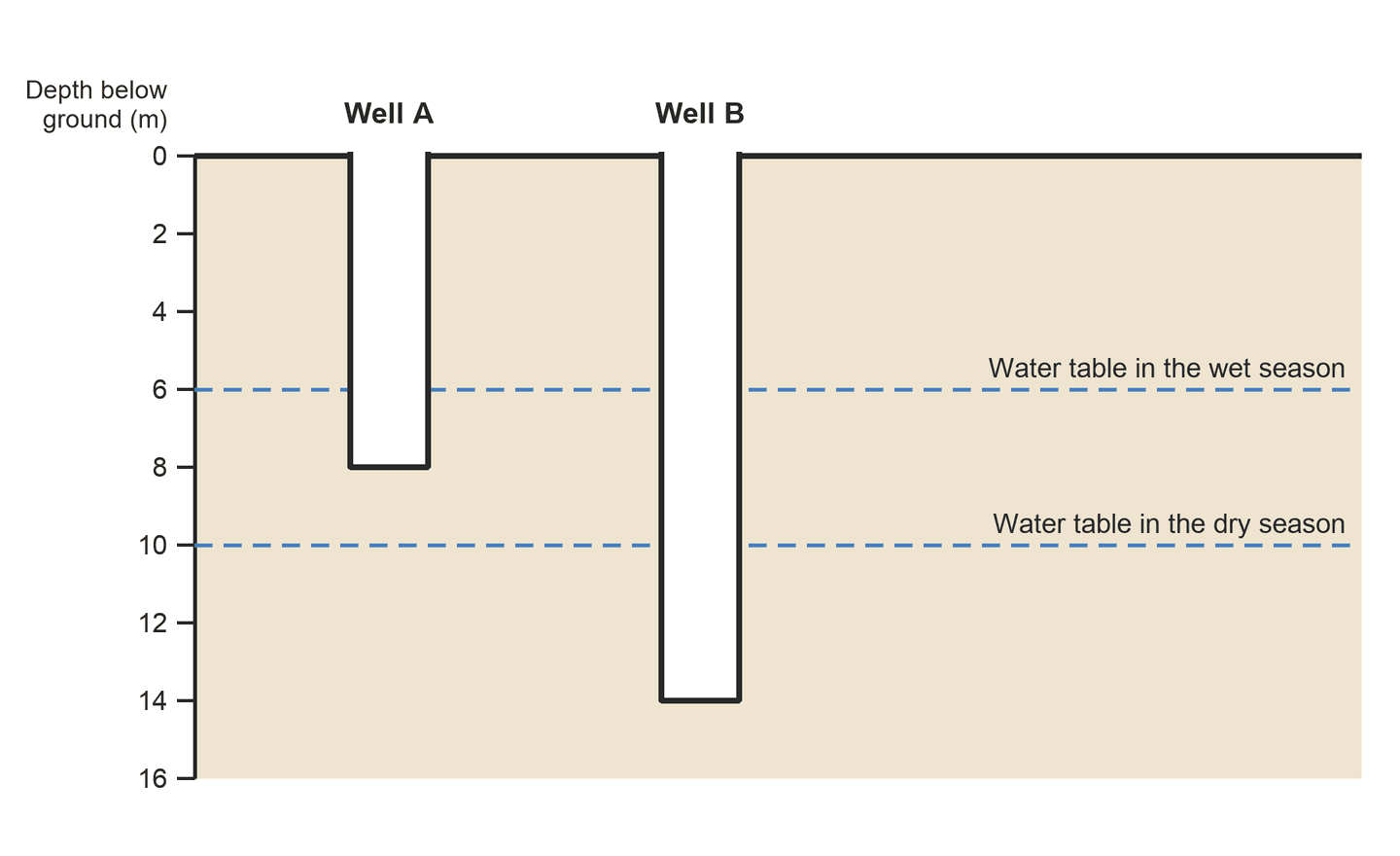
Which statement about the two wells is correct?
- 181 mark
Question 18
Cognitive domain: Analysis
Assertion (A): Hailstones are formed high up in the clouds and not near the ground.
Reason (R): Hail is formed when dew freezes on cold objects such as grass and leaves.
- 191 mark
Question 19
Cognitive domain: Analysis
Assertion (A): Filtering sea water through a fine muslin cloth does not make it fit for drinking.
Reason (R): Sea water is the chief source of common salt.
- 201 mark
Question 20
Cognitive domain: Analysis
The figure shows the path of water in nature on a rainy day. Arrow 1 goes from the sea surface into the air. Arrow 2 goes from the air into the cloud. Arrow 3 goes from the cloud to the hill, as rain. Arrow 4 goes along the river back to the sea.
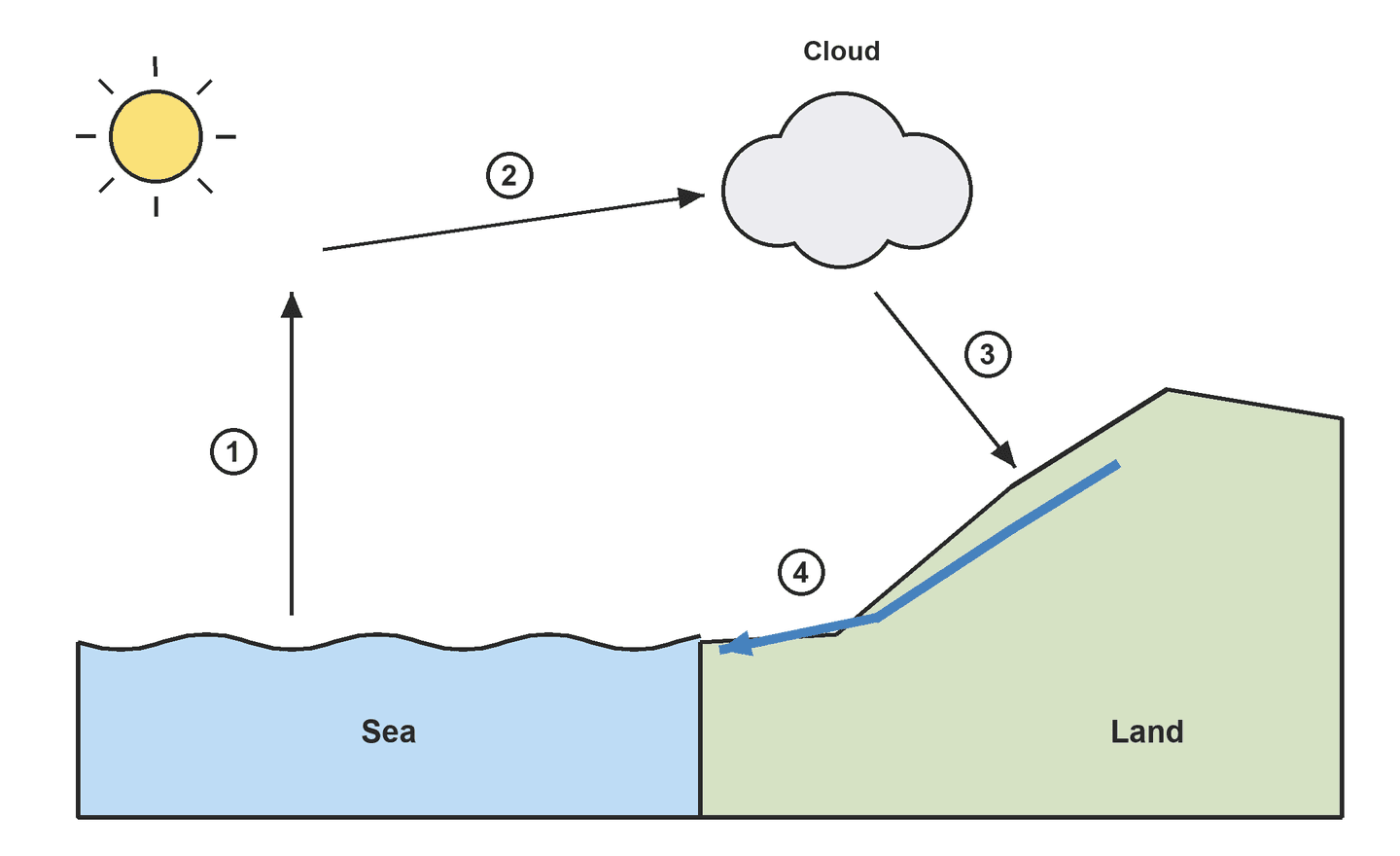
At which arrows does the water change its state?
- 211 mark
Question 21
Cognitive domain: Application
(Hypothetical data.) Meera fills an empty bucket with 8 litres of water at the hand pump and carries it home. The empty bucket has a mass of 1.5 kg. The chapter tells us that the density of water is 1 g per cc (cubic centimetre) at 4 °C, and Meera takes this value for the water in the bucket. She also knows that 1 litre is 1000 cc.
What is the mass of the bucket with the water in it?
- 221 mark
Question 22
Cognitive domain: Analysis
Four students stir different things into 200 mL of water, one thing in each glass. They look at the glasses after 10 minutes.
Glass What was stirred in What the students saw after 10 minutes P Copper sulphate crystals Clear blue liquid, nothing left at the bottom Q Chalk powder Milky water, with white powder slowly settling at the bottom R Sugar Clear liquid, nothing left at the bottom S Sand Sand at the bottom, and clear water above it In which glasses has a solution been formed?
- 231 mark
Question 23
Cognitive domain: Application
(Hypothetical situation.) Kabir fills a glass fish bowl with tap water that he has just boiled for ten minutes and then cooled to room temperature. He puts two goldfish into it. Within an hour the fish keep coming up to the surface and opening and closing their mouths. His teacher tells him that boiling drives the gases dissolved in water out of it, and that fish use the oxygen dissolved in water.
Why are the fish in trouble?
- 241 mark
Question 24
Cognitive domain: Application
(Hypothetical data.) A tap in Ravi's kitchen drips day and night. Ravi holds a measuring cylinder under it and finds that 20 drops of water make 1 mL. The tap drips 1 drop every second.
About how much water does the tap waste in one day?
- 251 mark
Question 25
Cognitive domain: Evaluation
(Hypothetical data.) A town council surveys what pollutes the water of the town lake and shows the result in a bar chart.
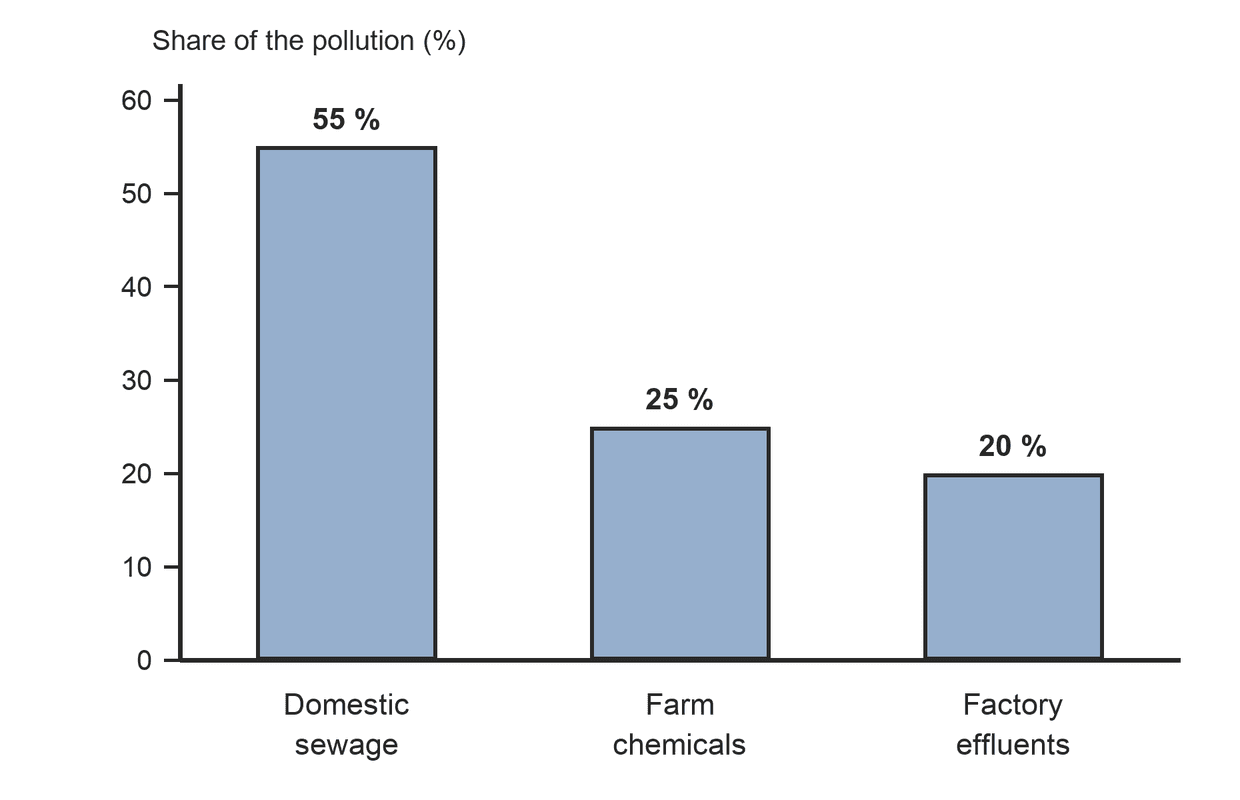
The council has money for one new project only. Each project would stop all the pollution that comes from the source it deals with, and none from the other sources. Which project will cut the pollution of the lake the most?
- 262 marks
Question 26
Cognitive domain: Application
A teacher asks four students to make models of a molecule of water with coloured balls. The figure shows their models P, Q, R and S. Each large grey ball stands for an atom of oxygen and each small pink ball stands for an atom of hydrogen.
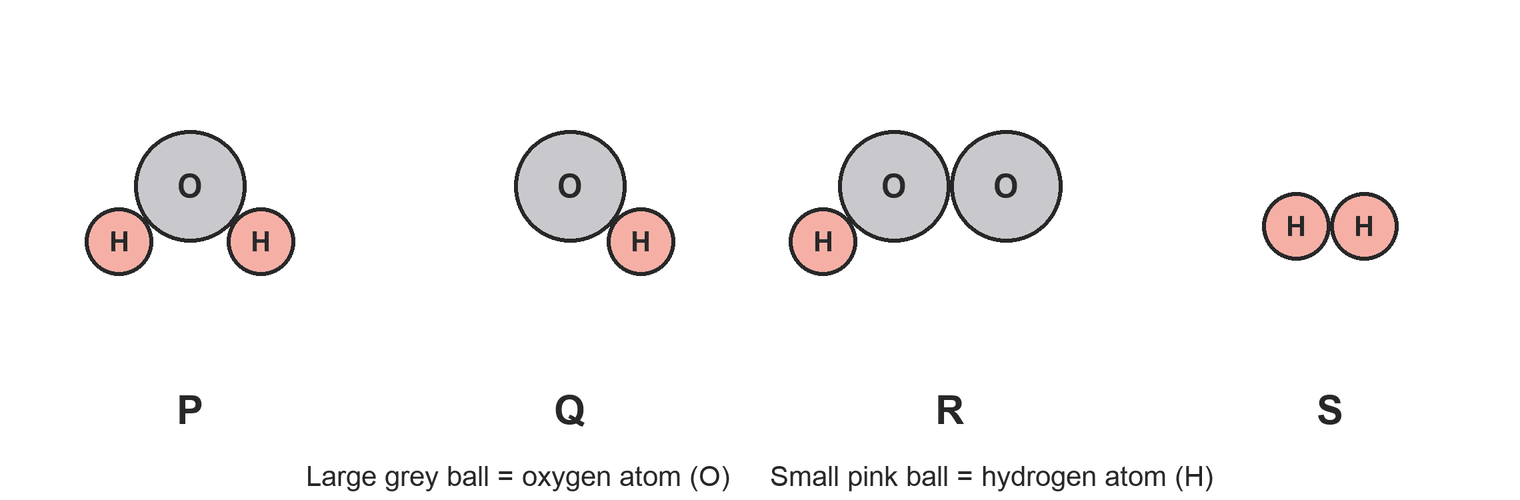
(a) Which model shows one molecule of water? Give a reason, using what the chapter tells us about the atoms in a molecule of water.
(b) How many atoms of hydrogen and how many atoms of oxygen are there in 3 molecules of water?
- 272 marks
Question 27
Cognitive domain: Analysis
Shrey fills a glass bottle right up to the brim with water, screws the cap on tightly and forgets it in the freezer overnight. Next morning he finds the bottle cracked, with a block of ice inside it.
(a) Using the unusual property of water that the chapter describes, explain why the bottle cracked.
(b) How should Shrey fill the bottle next time so that it does not crack when the water freezes?
- 282 marks
Question 28
Cognitive domain: Understanding
At a school, the Eco Club tells the students that the motto for saving water is reduce, reuse and recycle. It explains that to reduce is to use less water for a job, to reuse is to use the same water once more for another job, and to recycle is to treat used water so that it becomes fit for use again.
Write whether each of these actions is an example of reduce, reuse or recycle, and give a short reason for each.
(a) Taking a bath with a bucket and a mug instead of standing under a shower.
(b) Watering the garden with the water in which vegetables were washed.
(c) Closing the tap while brushing the teeth.
(d) Passing sewage water through a sewage treatment plant and then using it to irrigate fields.
- 292 marks
Question 29
Cognitive domain: Analysis
Neha stirs two spoons of copper sulphate into a glass of water (glass P) and two spoons of chalk powder into another glass of water (glass Q). She stirs both glasses well and then leaves them undisturbed for 10 minutes. From each glass she then takes one spoonful of liquid from the top and one spoonful from the bottom. She heats each of the four spoonfuls on its own dish until all the water has evaporated.
(a) In which glass will the top spoonful and the bottom spoonful leave the same amount of solid? Give the reason.
(b) In the other glass the amounts will be different. Which spoonful will leave more solid, and why?
- 302 marks
Question 30
Cognitive domain: Understanding
The table shows, in round figures, how the surface of the earth is shared between its oceans and the land.
Part of the earth's surface Share of the surface Pacific Ocean 32 % Atlantic Ocean 17 % Indian Ocean 14 % Arctic and Antarctic Oceans 8 % Land 29 % (a) What percentage of the earth's surface is covered by the four oceans taken together?
(b) Aman says, "The Pacific Ocean alone covers more of the earth than all the land put together." Is he right? Use the table to explain.
- 312 marks
Question 31
Cognitive domain: Understanding
Water has several properties that make it useful to us. Four uses of water are listed. For each use, choose the property of water that makes it possible. Choose from: it flows easily, it is a good solvent, it does not support burning.
(a) Fire fighters spray water on a burning godown.
(b) The food we eat is absorbed into our body in the form of a solution.
(c) A flour mill in a hill village is turned by water running down a stream.
(d) Fish in a pond take in the oxygen that is dissolved in the water.
- 323 marks
Question 32
Cognitive domain: Analysis
(Hypothetical data.) Aman wants to find out what makes copper sulphate dissolve faster in water. He takes 100 mL of water in each of four glasses and adds 5 g of copper sulphate to each. He changes only the things shown in the table, and notes the time that all the copper sulphate takes to dissolve.
Glass Copper sulphate Water Stirred? Time to dissolve 1 Big crystals Cold No 14 minutes 2 Fine powder Cold No 6 minutes 3 Big crystals Cold Yes 5 minutes 4 Big crystals Warm No 4 minutes (a) Which two glasses should he compare to find the effect of the size of the particles? Which size dissolves faster?
(b) Which two glasses show the effect of stirring? What do they show?
(c) Which glass shows the effect of warming the water? If he used fine powder, stirred it and used warm water, would it take more or less than 4 minutes? Give a reason.
- 333 marks
Question 33
Cognitive domain: Evaluation
A dye factory near a village wants to get rid of its coloured waste water. The manager has two plans.
Plan 1: Pass the waste water through an effluent treatment plant, which removes the harmful chemicals, and then let the water flow into the river.
Plan 2: Dig a deep pit in the factory yard and let the waste water soak into the ground, so that it cannot be seen.
The village gets its drinking water from hand pumps and wells.
(a) Which plan is better? Give one reason.
(b) Explain how Plan 2 could harm the village, using the fact that underground water is formed from water that seeps down through the soil.
(c) Give one more step that the village can take to keep its wells clean.
- 343 marks
Question 34
Cognitive domain: Evaluation
Rohit says, "Rain comes only from the sea. Planting trees has nothing to do with rain, so cutting a few trees does no harm to the water cycle." His sister Pooja reminds him of the water cycle in the chapter. In it, water vapour enters the air from the sea, rivers and soil, and also from plants. The sea, rivers and soil lose water by evaporation, and plants lose water through the process called transpiration.
(a) Name the two processes by which water vapour enters the air in the water cycle, as described above.
(b) Is Rohit right? Give a reason from the water cycle.
(c) The chapter lists more plantations among the ways of conserving water. Why?
- 353 marks
Question 35
Cognitive domain: Creativity
Sunita grows tomato plants in pots on her terrace. When she waters them with a mug, much of the water runs out of the pots. Her teacher tells her that farmers save water by drip irrigation, in which water reaches the plant one drop at a time. Sunita has a used 2-litre plastic bottle with its cap, and a needle that she can use with an elder's help.
(a) Design a simple drip system for one pot with these things. Say how the holes are made, how the bottle is placed and how the water comes out.
(b) Explain why this system saves more water than pouring a mugful of water on the soil at one time.
(c) State one thing that Sunita must do to keep the system working through the summer.
- 363 marks
Question 36
Cognitive domain: Application
(Hypothetical data.) Sea water is the chief source of common salt. In a school experiment, Tanvi weighs out 200 g of a salt solution made to be like sea water and pours it into an evaporating dish. She heats it gently until all the water has gone. She finds 7 g of white solid left in the dish.
(a) Name the process that separates the salt from the water in this way, and explain why the salt stays behind in the dish.
(b) Find the mass of the water that evaporated.
(c) A salt-maker lets 4000 kg of sea water of the same kind dry in shallow pans in the sun. Find the mass of salt that he can obtain, if all of it is collected.
- 374 marks
Question 37
Cognitive domain: Analysis
(Hypothetical data.) The water works of a small town purifies river water by loading with alum, sedimentation, filtration and chlorination. After heavy floods the stock of chlorine at the plant ran out, and the plant could not use chlorine for three days. The health centre of the town noted the number of new patients with stomach illnesses, such as diarrhoea and dysentery, each day. The water of the town looked clear on every day, because loading, sedimentation and filtration went on as usual.
Day 1 2 3 4 5 6 7 8 Chlorine used at the plant? Yes Yes No No No Yes Yes Yes New patients 5 6 18 41 63 38 17 7 (a) On which days was chlorine not used? How many new patients came on those days altogether?
(b) The water looked clear, so why did so many people fall ill? Name the step that kills the germs in the water.
(c) The plant needs one more day to get chlorine. Suggest one thing a family can do at home that day to make the water safe, and say why the same method is not suitable for the whole town.
- 384 marks
Question 38
Cognitive domain: Analysis
(Hypothetical data.) The science club of a school studies how much of a salt, potassium nitrate, dissolves in 100 g of water at different temperatures. Ananya plots the results in the graph below. She remembers that a solution is saturated when it cannot dissolve any more solute at that temperature. When a saturated solution is cooled, the solvent can no longer hold all of the solute, and the extra solute settles at the bottom.
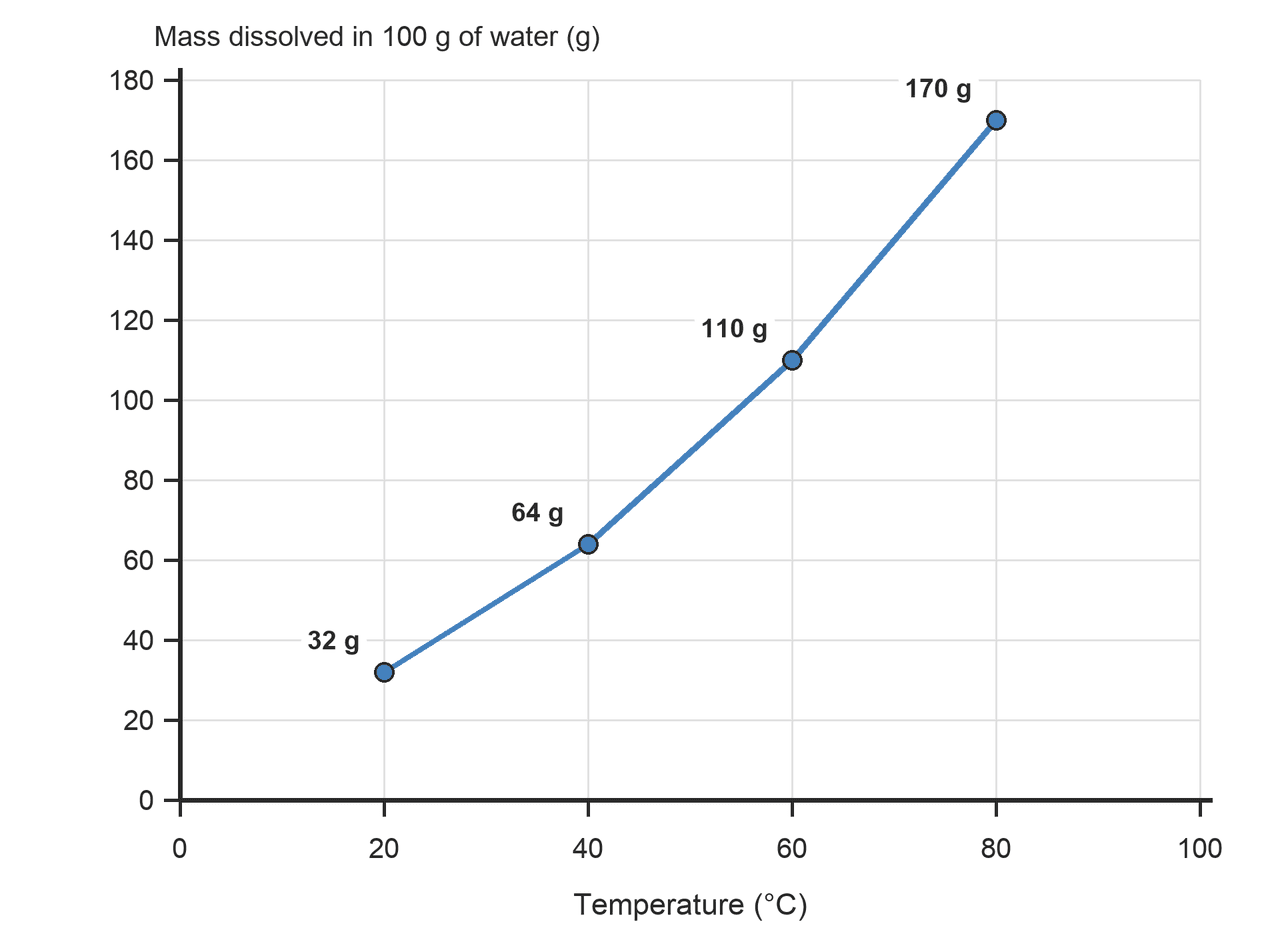
(a) How many grams of the salt dissolve in 100 g of water at 40 °C to make a saturated solution?
(b) How many grams more of the salt dissolve in 100 g of water at 60 °C than at 20 °C? What does the graph say about the effect of heating on the solubility of the salt?
(c) A saturated solution is made at 40 °C with 50 g of water. It is then cooled to 20 °C. How many grams of the salt settle at the bottom? Show your working.
- 395 marks
Question 39
Cognitive domain: Evaluation
(Hypothetical data.) A coastal town of 20 000 people is building a plant that removes the dissolved salts from sea water. For every 1000 litres of sea water that the plant takes in, it gives 400 litres of fresh water, and the rest goes back to the sea as very salty water. The town wants to supply every person with 50 litres of water a day, which is the minimum amount that the United Nations recommends for drinking, washing and cooking. A councillor says, "With the huge sea next to us, we need not save water any more."
(a) What is the process of removing the dissolved salts from sea water called?
(b) How many litres of fresh water does the town need in a day? How many litres of sea water must the plant take in each day to make it?
(c) Suppose the people waste 10 litres of their 50 litres a day through dripping taps. How many litres of sea water does the plant take in every day just to replace the wasted water? Does this support the councillor? Give a reason.
- 404 marks
Question 40
Cognitive domain: Application
(Hypothetical data.) Ria, who is 12 years old, wrote down everything she drank or ate on a hot day. Much of the water that our body gets comes from the food we eat. The chapter says that we need a minimum of one and a half litres of water every day to stay alive. The table shows the amount of each item and the part of it that is water. Ria knows that the density of water is 1 g per cc, so 1 g of water has a volume of 1 mL.
What Ria took Amount Water in it Plain drinking water 1000 mL All of it Nimbu pani 250 mL 90 % Watermelon 300 g 90 % Rice and dal 400 g 70 % (a) How many millilitres of water did Ria get from the nimbu pani, the watermelon and the rice and dal together?
(b) Find the total volume of water that Ria took in the day, in millilitres and in litres.
(c) Ria says, "I drank only one litre of plain water, so I did not get my minimum of one and a half litres." Is she right? Give a reason.