Solution:
Concept: Plants take in water through their roots. Water with a high concentration of salts draws water out of the roots instead, so the plant cannot get the water it needs.
Step 1 — (a) The plant that did not grow well.
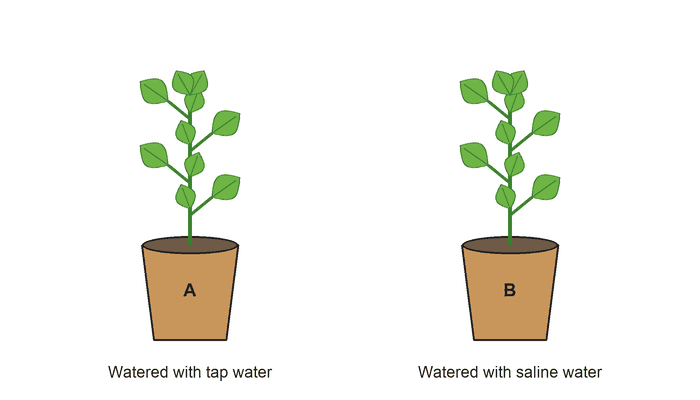
Plant B, which was watered with saline water, did not grow well. The large amount of dissolved salts in the saline water stops the roots from taking in water and harms the plant.
Step 2 — (b) Saline water.
Saline water is water with a high concentration of dissolved salts, mostly common salt; sea water is an example.
Step 3 — (c) Conclusion.
Plant A, given tap water, grew well, while plant B did not, and only the water was different. So plants cannot tolerate saline water; this is why sea water cannot be used directly for irrigation.
Watch out: The experiment is a fair test only because both plants were kept alike (both healthy, both in sunlight) and only the kind of water was changed.
Therefore, (a) plant B did not grow well because of the dissolved salts, (b) saline water is water with a high concentration of salts, (c) plants cannot tolerate saline water.