
Opening your dashboard
Class 6 Chemistry Chapter 3: Matter Solutions
51 textbook questions with step-by-step answers, free to read, for ICSE 2026-27.
Get talked through Ch 3, not just shown the answer
Reading a finished solution is not the same as being able to do it. The AI tutor takes one question at a time and works it with you, in your own words, until you can.
- Ask it out loud, in your own words
- It gives you the next step, not the answer
- Stuck on part (ii)? Start there
51 questions with solutions
1–5 marks · Mixed difficulty
- 11 mark
Question 1
Which one is a kind of matter ?
Solve with AIAnswer
(A) Light
- Correct
(B) Petroleum
(C) Sound
(D) Heat
Answer: (B) Petroleum
Concept: Matter is anything that has mass and occupies space (has volume). Light, sound and heat are forms of energy, not matter.
Step 1 — Test each option for mass and volume.
Light, sound and heat cannot be weighed and do not take up space. Petroleum is a liquid that can be poured into a container and weighed.
Step 2 — Pick the kind of matter.
Only petroleum has mass and occupies space, so it is matter.
Watch out: We can feel heat and see light, but being sensed is not enough; matter must also have mass and take up space.
Why the other options are wrong:
- (A) Light: Light is a form of energy; it has no mass and takes up no space.
- (C) Sound: Sound is a form of energy carried by vibrations; it is not itself matter.
- (D) Heat: Heat is a form of energy that flows from hot things to cold things; it is not matter.
Therefore, petroleum is a kind of matter, option (B).
- 21 mark
Question 2
All kinds of matter :
Solve with AIAnswer
- Correct
(A) occupy space and have a definite mass
(B) have mass and a definite shape
(C) can change their states
(D) have a definite volume
Answer: (A) occupy space and have a definite mass
Concept: Matter is anything that has mass and occupies space (has volume). This is true of every kind of matter, whether solid, liquid or gas.
Step 1 — Check each statement against every state.
A statement about all kinds of matter must hold for solids, liquids and gases alike.
Step 2 — Find the statement that always holds.
Every solid, liquid and gas takes up space and has a definite mass, so option (A) is true of all matter.
Watch out: A gas still has mass even though it has no definite shape or volume; a balloon full of air is heavier than an empty one.
Why the other options are wrong:
- (B) have mass and a definite shape: Liquids and gases have mass but no definite shape; they take the shape of their container.
- (C) can change their states: Not all matter changes its state on heating; wood and paper burn instead of melting.
- (D) have a definite volume: Gases have no definite volume; they spread to fill the whole container.
Therefore, all kinds of matter occupy space and have a definite mass, option (A).
- 31 mark
Question 3
The space occupied by matter is called :
Solve with AIAnswer
(A) mass
(B) area
- Correct
(C) volume
(D) weight
Answer: (C) volume
Concept: The space that a piece of matter takes up is called its volume.
Step 1 — Recall the meaning of each word.
Mass is the amount of matter, area is the size of a flat surface, weight is a pull, and volume is the space taken up.
Step 2 — Match with the question.
The question asks for the space occupied, so the answer is volume.
Why the other options are wrong:
- (A) mass: Mass is the quantity of matter in an object, not the space it takes up.
- (B) area: Area measures only a flat surface (length times breadth), not the whole space an object fills.
- (D) weight: Weight is the force with which the earth pulls an object, not the space it occupies.
Therefore, the space occupied by matter is called volume, option (C).
- 41 mark
Question 4
The quantity of matter in an object is called as :
Solve with AIAnswer
- Correct
(A) mass
(B) volume
(C) density
(D) weight
Answer: (A) mass
Concept: The quantity (amount) of matter in an object is called its mass. It is measured in grams or kilograms.
Step 1 — Recall the meaning of each word.
Volume is the space taken up, density is the mass packed into each unit of volume, weight is the earth's pull, and mass is the amount of matter.
Step 2 — Match with the question.
The question asks for the quantity of matter, so the answer is mass.
Watch out: Mass and weight are different: mass stays the same everywhere, while weight would be less on the moon.
Why the other options are wrong:
- (B) volume: Volume is the space occupied by the matter, not its quantity.
- (C) density: Density tells how much mass is packed into a given volume; it is not the quantity of matter itself.
- (D) weight: Weight is the force with which the earth pulls the object.
Therefore, the quantity of matter in an object is called its mass, option (A).
- 51 mark
Question 5
Which of the following is a kind of man-made matter ?
Solve with AIAnswer
(A) Coal
(B) Cotton
- Correct
(C) Plastic
(D) Silk
Answer: (C) Plastic
Concept: Natural matter is found in nature (from plants, animals or the earth). Man-made matter is made by people from natural materials, for example plastics, glass, soap and nylon.
Step 1 — Find where each substance comes from.
Coal is dug out of the earth, cotton comes from the cotton plant, and silk comes from the silkworm. Plastic is made in factories from chemicals obtained from petroleum.
Step 2 — Pick the man-made one.
Only plastic is made by people, so it is man-made matter.
Why the other options are wrong:
- (A) Coal: Coal is formed naturally inside the earth, so it is natural matter.
- (B) Cotton: Cotton grows on the cotton plant, so it is natural matter.
- (D) Silk: Silk is spun by the silkworm, so it is natural matter.
Therefore, plastic is a kind of man-made matter, option (C).
- 61 mark
Question 6
An object which is not made up of wood is:
Solve with AIAnswer
(A) Desk
- Correct
(B) Soap
(C) Chair
(D) Handle
Answer: (B) Soap
Concept: Many everyday objects are made of wood, but some are made from other materials.
Step 1 — Think about what each object is made of.
Desks, chairs and the handles of tools and brooms are commonly made of wood. Soap is made by boiling oils or fats with an alkali.
Step 2 — Pick the object not made of wood.
Soap contains no wood, so it is the answer.
Why the other options are wrong:
- (A) Desk: It is usually made of wood, though some are made of metal or plastic.
- (C) Chair: It is commonly made of wood.
- (D) Handle: Handles of tools, doors and brooms are commonly made of wood.
Therefore, soap is not made up of wood, option (B).
- 75 marks
Question 7
Select natural and man-made matter from the following list :
Wood, plastic, silk, medicines, detergents, coal, water, ceramic, cotton, glass, nylon, fruits.
Solve with AIWritten solution
Solution:
Concept: Natural matter is found in nature (from plants, animals or the earth). Man-made matter is made by people, usually in factories, from natural materials.
Step 1 — Find the natural substances.
Wood (from trees), silk (from silkworms), coal (from the earth), water, cotton (from the cotton plant) and fruits (from plants) all occur in nature.
Step 2 — Find the man-made substances.
Plastic, medicines, detergents, ceramic, glass and nylon are made by people in factories from natural raw materials.
Step 3 — Sort them into a table.
The table shows the two groups side by side.
Natural matter Man-made matter Wood Plastic Silk Medicines Coal Detergents Water Ceramic Cotton Glass Fruits Nylon Watch out: Glass and ceramic are made from natural sand and clay, but they are man-made because people heat and shape these raw materials to make something new.
Therefore, natural: wood, silk, coal, water, cotton, fruits; man-made: plastic, medicines, detergents, ceramic, glass, nylon.
- 82 marks
Question 8
Define matter.
Solve with AIWritten solution
Solution:
Concept: Matter is anything that has mass and occupies space.
Step 1 — State the definition.
Anything that has mass and occupies space is called matter. Matter can usually also be detected by our senses.
Step 2 — Give examples.
Water, air, wood and stone are all matter, because each of them has mass and takes up space.
Watch out: Air is matter even though we cannot see it, because it has mass and fills space (it blows up a balloon).
Therefore, matter is anything that has mass and occupies space.
- 92 marks
Question 9
What are the two main types of matter ? Give two examples for each type.
Solve with AIWritten solution
Solution:
Concept: Matter around us is grouped as living or non-living, depending on whether it shows signs of life such as growth, breathing and reproduction.
Step 1 — Describe living matter.
Living matter grows, breathes, needs food and reproduces. Examples: plants such as the banyan tree, and animals such as the dog.
Step 2 — Describe non-living matter.
Non-living matter does not grow, breathe or reproduce. Examples: air and stone.
Note: Matter can also be grouped as natural (wood, cotton) and man-made (plastic, nylon), as in Q2 of the objective questions; both groupings are correct ways of sorting matter.
Therefore, the two main types of matter are living matter (plants, animals) and non-living matter (air, stone).
- 102 marks
Question 10
Why are plants and animals considered as matter ?
Solve with AIWritten solution
Solution:
Concept: Matter is anything that has mass and occupies space. This is true whether the thing is living or non-living.
Step 1 — Check for mass.
Plants and animals can be weighed on a balance, so they have mass.
Step 2 — Check for space.
Plants and animals have a size and take up room, so they occupy space (they have volume).
Step 3 — Draw the conclusion.
Since they have mass and occupy space, plants and animals are matter. They are living matter.
Therefore, plants and animals are considered matter because they have mass and occupy space.
- 111 mark
Question 11
The state of matter which has no definite shape or volume is called :
Solve with AIAnswer
(A) solid
(B) liquid
- Correct
(C) gas
(D) none of these
Answer: (C) gas
Concept: A solid has a definite shape and volume, a liquid has a definite volume but no definite shape, and a gas has neither.
Step 1 — Read the condition.
The state asked for has no definite shape and no definite volume.
Step 2 — Match with the states.
A gas spreads out to fill the whole of any container, so its shape and volume are those of the container. So the answer is gas.
Why the other options are wrong:
- (A) solid: A solid has both a definite shape and a definite volume.
- (B) liquid: A liquid has a definite volume, even though it takes the shape of its container.
- (D) none of these: A gas fits the description exactly, so "none of these" is wrong.
Therefore, the state with no definite shape or volume is the gas, option (C).
- 121 mark
Question 12
The largest intermolecular gaps occur in :
Solve with AIAnswer
(A) water
(B) iron ball
(C) common salt
- Correct
(D) air
Answer: (D) air
Concept: In solids the particles are packed closest, with the strongest force of attraction between them; in liquids the force is weaker and the gaps are larger; in gases the force is very weak and the gaps are the largest.
Step 1 — Find the state of each substance.
Water is a liquid, an iron ball and common salt are solids, and air is a mixture of gases.
Step 2 — Pick the state with the largest gaps.
The intermolecular gaps are largest in gases, so they are largest in air.
Why the other options are wrong:
- (A) water: Water is a liquid; its gaps are larger than in solids but much smaller than in gases.
- (B) iron ball: An iron ball is a solid, with its particles very closely packed.
- (C) common salt: Common salt is a solid, so its gaps are very small.
Therefore, the largest intermolecular gaps occur in air, option (D).
- 131 mark
Question 13
A solid :
Solve with AIAnswer
(A) has a definite shape
(B) cannot flow
(C) cannot be compressed easily
- Correct
(D) all of the above
Answer: (D) all of the above
Concept: In a solid the particles are closely packed and held by a strong force of attraction, so they can only vibrate about fixed positions.
Step 1 — Check statement (A).
Because the particles stay in fixed positions, a solid keeps its own shape, so (A) is true.
Step 2 — Check statements (B) and (C).
The particles cannot move from place to place, so a solid cannot flow, and there is very little space between them, so a solid can hardly be compressed. Both (B) and (C) are true.
Step 3 — Choose the best option.
Since (A), (B) and (C) are all true, the best answer is all of the above.
Why the other options are wrong:
- (A) has a definite shape: This statement is true, but it is only one of the three true properties.
- (B) cannot flow: This statement is true, but it is only one of the three true properties.
- (C) cannot be compressed easily: This statement is true, but it is only one of the three true properties.
Therefore, a solid has a definite shape, cannot flow and cannot be compressed easily, so the answer is all of the above, option (D).
- 141 mark
Question 14
Which of the following diffuses very fast?
Solve with AIAnswer
(A) Water
(B) Gold
(C) Milk
- Correct
(D) Nitrogen
Answer: (D) Nitrogen
Concept: Diffusion is the intermixing of the particles of one substance with another because of their motion. It is fastest in gases, slower in liquids and extremely slow in solids.
Step 1 — Find the state of each substance.
Water and milk are liquids, gold is a solid, and nitrogen is a gas.
Step 2 — Pick the fastest.
Gas particles move fast and have large gaps between them, so gases diffuse very fast. So nitrogen diffuses very fast.
Why the other options are wrong:
- (A) Water: Water is a liquid; liquids diffuse much more slowly than gases.
- (B) Gold: Gold is a solid; its particles are held in fixed positions, so it diffuses extremely slowly, if at all.
- (C) Milk: Milk is a liquid, so it diffuses slowly compared with a gas.
Therefore, nitrogen diffuses very fast, option (D).
- 151 mark
Question 15
Which of the following shows the strongest cohesive force ?
Solve with AIAnswer
(A) Petrol
(B) Oxygen
- Correct
(C) Mercury
(D) Hydrogen
Answer: (C) Mercury
Concept: Cohesive force is the force of attraction between particles of the same kind. It is strong in solids, weaker in liquids and very weak in gases. Mercury is a liquid metal whose particles attract each other very strongly.
Step 1 — Find the state of each substance.
Petrol and mercury are liquids, while oxygen and hydrogen are gases.
Step 2 — Compare the two liquids.
Mercury's particles hold together so strongly that spilt mercury forms round beads instead of spreading out. Petrol spreads out easily. So mercury shows the strongest cohesive force.
Why the other options are wrong:
- (A) Petrol: Petrol is a liquid whose cohesive force is much weaker than that of mercury; it spreads out easily.
- (B) Oxygen: Oxygen is a gas, and gases have the weakest cohesive force.
- (D) Hydrogen: Hydrogen is a gas, so its cohesive force is very weak.
Therefore, mercury shows the strongest cohesive force, option (C).
- 165 marks
Question 16
Classify the following into solids, liquids and gases.
Oxygen, milk, common salt, wax, stone, L.P.G., carbon dioxide, sugar, mercury, coal, blood, butter, copper, coconut oil, kerosene.
Solve with AIWritten solution
Solution:
Concept: Sort each substance by its state at room temperature and normal pressure: a solid keeps its shape, a liquid flows but keeps its volume, and a gas spreads to fill its container.
Step 1 — Pick out the solids.
Common salt, wax, stone, sugar, coal, butter and copper keep their own shape, so they are solids.
Step 2 — Pick out the liquids.
Milk, mercury, blood, coconut oil and kerosene flow and take the shape of their container, so they are liquids.
Step 3 — Pick out the gases.
Oxygen, L.P.G. and carbon dioxide spread out to fill any space, so they are gases.
Step 4 — Put them in a table.
The table shows the three groups.
Solids Liquids Gases Common salt Milk Oxygen Wax Mercury L.P.G. Stone Blood Carbon dioxide Sugar Coconut oil Coal Kerosene Butter Copper Watch out: L.P.G. is kept as a liquid inside the cylinder because it is under high pressure, but at normal pressure it is a gas. Coconut oil turns solid in cold weather (below about 24 °C), and butter is a soft solid.
Therefore, solids: common salt, wax, stone, sugar, coal, butter, copper; liquids: milk, mercury, blood, coconut oil, kerosene; gases: oxygen, L.P.G., carbon dioxide.
- 171 mark
Question 17
Name the smallest particle from which matter is made of.
Solve with AIWritten solution
Solution:
Concept: All matter is made of extremely small particles.
Step 1 — Name the particle.
The smallest particle of matter that keeps the identity of an element is the atom. Atoms join together to form molecules.
Note: Atoms themselves are made of even smaller particles (protons, neutrons and electrons), which you will study in higher classes.
Therefore, matter is made of atoms.
- 182 marks
Question 18
What are molecules ?
Solve with AIWritten solution
Solution:
Concept: Atoms of most elements cannot exist on their own, so they join together to form molecules.
Step 1 — Describe how a molecule forms.
When two or more atoms join together, they form a tiny particle called a molecule.
Step 2 — Define a molecule.
A molecule is the smallest particle of a substance that can exist independently and shows the chemical properties of that substance.
Step 3 — Give examples.
A molecule of oxygen has two oxygen atoms joined together. A molecule of water has two hydrogen atoms joined to one oxygen atom.
Watch out: A single molecule does not have bulk properties such as colour or melting point; those belong to a large collection of molecules.
Note: In the noble gases, such as helium and neon, a single atom exists on its own, so the molecule has just one atom.
Therefore, molecules are the smallest particles of a substance, made of atoms joined together, that can exist independently.
- 195 marks
Question 19
Define :
(a) Intermolecular force of attraction.
(b) Intermolecular space.
(c) Cohesive force
(d) Diffusion
(e) Brownian movement
Solve with AIWritten solution
Solution:
Concept: Matter is made of tiny particles that are always moving. There are gaps between them (intermolecular spaces) and a pull between them (intermolecular force of attraction). Solids have the strongest pull and smallest gaps; gases have the weakest pull and largest gaps.
Step 1 — (a) Define the intermolecular force of attraction.
The force of attraction between the particles (molecules) of matter, which holds them together, is called the intermolecular force of attraction.
Step 2 — (b) Define intermolecular space.
The space or gap between the particles (molecules) of matter is called intermolecular space.
Step 3 — (c) Define cohesive force.
The force of attraction between particles of the same kind is called cohesive force.
Step 4 — (d) Define diffusion.
The intermixing of the particles of one substance with those of another, because the particles are moving, is called diffusion.
Step 5 — (e) Define Brownian movement.
The continuous zig-zag movement of tiny particles suspended in a liquid or a gas, caused by the moving particles of the liquid or gas knocking into them, is called Brownian movement. It is named after Robert Brown, who saw it in 1827 in tiny particles released from pollen grains in water.
Watch out: Brown saw the tiny particles from inside the pollen grains moving, not the pollen grains themselves.
Therefore, the intermolecular force holds particles together, intermolecular space is the gap between them, cohesive force is attraction between like particles, diffusion is intermixing of particles, and Brownian movement is the zig-zag motion of suspended particles.
- 202 marks
Question 20
Give one difference between atoms and molecules.
Solve with AIWritten solution
Solution:
Concept: Atoms and molecules are both tiny particles of matter, and molecules are made of atoms.
Step 1 — State the difference.
An atom usually cannot exist on its own, whereas a molecule can exist independently.
Step 2 — Add the link between them.
A molecule is formed when two or more atoms join together, so an atom is smaller than a molecule.
Watch out: Atoms of the noble gases, such as helium, are an exception: they exist on their own.
Therefore, an atom usually cannot exist independently, but a molecule can.
- 212 marks
Question 21
What are fluids ? Give two examples.
Solve with AIWritten solution
Solution:
Concept: In liquids and gases the particles are free to move past one another, so these substances can flow.
Step 1 — Define fluids.
All substances that can flow are called fluids. Liquids and gases are both fluids.
Step 2 — Give examples.
Water (a liquid) and air (a gas) are fluids.
Therefore, fluids are substances that can flow, for example water and air.
- 223 marks
Question 22
Name the three states of matter and define them.
Solve with AIWritten solution
Solution:
Concept: The three states of matter differ in whether they have a definite shape and a definite volume.
Step 1 — Name the three states.
Matter exists in three states: solid, liquid and gas.
Step 2 — Define a solid.
A solid has a definite shape and a definite volume, because its particles are packed very closely. Examples: wood, stone, iron.
Step 3 — Define a liquid.
A liquid has a definite volume but no definite shape; it takes the shape of its container. Examples: water, milk, kerosene.
Step 4 — Define a gas.
A gas has neither a definite shape nor a definite volume; it fills all the space available to it. Examples: oxygen, nitrogen, carbon dioxide.
Therefore, the three states are solid (definite shape and volume), liquid (definite volume only) and gas (neither).
- 235 marks
Question 23
Give reasons :
(a) Liquids and gases flow but solids do not.
(b) A gas fills up the space available to it.
(c) The odour of scent spreads in a room.
(d) We can walk through air.
(e) Liquids have a definite volume but no definite shape.
(f) When a teaspoon of sugar is added to half a glass of water and stirred, the water level in the glass remains unchanged.
(g) When an empty gas jar is inverted over a gas jar containing a coloured gas, the gas also spreads into the empty jar.
(h) A red ink drop added to a small amount of water in a glass turns the water red in some time.
(i) Solids usually have higher density than liquids and gases.
(j) An egg is kicked out of a bottle when air is blown inside the bottle.
Solve with AIWritten solution
Solution:
Concept: Matter is made of tiny particles that are always moving. There are gaps between them (intermolecular spaces) and a pull between them (intermolecular force of attraction). Solids have the strongest pull and smallest gaps; gases have the weakest pull and largest gaps.
Step 1 — (a) Explain why liquids and gases flow but solids do not.
In liquids and gases the force of attraction is weak and the gaps are large, so the particles can move from place to place, and the substance flows. In solids the particles are closely packed and strongly held; they only vibrate about fixed positions, so solids do not flow.
Step 2 — (b) Explain why a gas fills the space available.
Gas particles hardly attract each other and move very fast in all directions, so they spread out until they fill all the space available.
Step 3 — (c) Explain why the odour of scent spreads.
This happens by diffusion. The particles of scent vapour move fast and intermix with the particles of air, so the smell spreads through the room.
Step 4 — (d) Explain why we can walk through air.
Air is a mixture of gases whose particles are far apart and very weakly attracted, so they easily move aside and offer very little resistance.
Step 5 — (e) Explain why liquids have a definite volume but no definite shape.
The particles of a liquid attract one another enough to stay together, so the volume is fixed. But they can slide past one another, so the liquid flows and takes the shape of its container.
Step 6 — (f) Explain why the water level does not change with sugar.
There are gaps between water molecules. When the sugar dissolves, its particles fit into these gaps, so the water level shows no noticeable rise.
Step 7 — (g) Explain why the coloured gas spreads into the empty jar.
This happens by diffusion. The particles of the coloured gas move freely in all directions and mix with the air in the empty jar, until the colour is the same in both jars.
Step 8 — (h) Explain why the red ink colours all the water.
This is diffusion in a liquid. The particles of red ink slowly intermix with the moving water particles, so after some time all the water turns red.
Step 9 — (i) Explain why solids are usually denser.
In solids the particles are packed very closely with very small gaps, so more mass is packed into the same volume. In liquids and gases the particles are farther apart, so the same volume has less mass.
Step 10 — (j) Explain why the egg is pushed out of the bottle.
Gases can be compressed. Blowing into the bottle pushes more air into the same space, so the air pressure inside becomes greater than the pressure outside, and this extra pressure pushes the egg out.
Watch out: Ice is an exception to (i): it is less dense than liquid water, which is why ice floats.
Note: In (f), a very careful measurement shows a slight rise in level, but it is far less than the volume of the sugar added, because most of the sugar particles fit into the gaps.
Therefore, each observation follows from the size of the gaps, the strength of the attraction and the motion of the particles in that state of matter.
- 241 mark
Question 24
A kind of matter which can sublime is :
Solve with AIAnswer
(A) water
(B) plastic
(C) milk
- Correct
(D) iodine
Answer: (D) iodine
Concept: Sublimation is the change of a solid directly into vapour on heating, without becoming a liquid. Camphor, iodine, naphthalene and dry ice sublime.
Step 1 — Check each substance.
Water and milk are liquids, so they cannot sublime (only a solid can). Plastic softens, melts or burns on heating.
Step 2 — Pick the substance that sublimes.
On gentle heating, solid iodine turns straight into violet vapour, so iodine sublimes.
Why the other options are wrong:
- (A) water: Water is a liquid; on heating it boils into steam, which is vaporisation, not sublimation.
- (B) plastic: Plastic softens, melts or burns on heating; it does not sublime.
- (C) milk: Milk is a liquid; on heating it boils, it does not sublime.
Therefore, iodine can sublime, option (D).
- 251 mark
Question 25
A substance which can change its state is :
Solve with AIAnswer
(A) wood
- Correct
(B) oxygen
(C) paper
(D) cloth
Answer: (B) oxygen
Concept: A substance changes its state when it changes from solid to liquid to gas or back, without becoming a new substance. Wood, paper and cloth burn (a chemical change) before they could melt.
Step 1 — Check the three plant materials.
Wood, paper and cloth char and burn when heated strongly, forming ash, smoke and gases. They do not melt or boil.
Step 2 — Check oxygen.
Oxygen gas turns into a pale blue liquid when it is cooled strongly (below about at normal pressure). So oxygen can change its state.
Watch out: Oxygen cannot be turned into a liquid by pressure alone at room temperature; it must be cooled below about first.
Why the other options are wrong:
- (A) wood: Wood burns and turns into ash on heating; it does not melt.
- (C) paper: Paper burns on heating instead of melting.
- (D) cloth: Cloth also chars and burns on heating instead of melting.
Therefore, oxygen is the substance which can change its state, option (B).
- 261 mark
Question 26
The process by which a solid changes into a liquid is called :
Solve with AIAnswer
(A) freezing
- Correct
(B) melting
(C) condensation
(D) evaporation
Answer: (B) melting
Concept: Each change of state has its own name: solid to liquid is melting, liquid to solid is freezing, gas to liquid is condensation, and liquid to vapour below the boiling point is evaporation.
Step 1 — Read the change.
The change asked for is from solid to liquid.
Step 2 — Name it.
This change is called melting (or fusion), as when ice turns into water.
Why the other options are wrong:
- (A) freezing: Freezing is the change of a liquid into a solid, the reverse of melting.
- (C) condensation: Condensation is the change of a gas or vapour into a liquid.
- (D) evaporation: Evaporation is the change of a liquid into vapour below its boiling point.
Therefore, the change of a solid into a liquid is called melting, option (B).
- 271 mark
Question 27
The change of state of liquid into vapour below its boiling points is called :
Solve with AIAnswer
(A) melting
(B) freezing
(C) boiling
- Correct
(D) evaporation
Answer: (D) evaporation
Concept: A liquid can change into vapour in two ways: slowly from its surface at any temperature below its boiling point (evaporation), or quickly throughout the liquid at its boiling point (boiling).
Step 1 — Read the condition.
The change is from liquid to vapour, and it happens below the boiling point.
Step 2 — Name it.
This is evaporation, as when wet clothes dry at room temperature.
Why the other options are wrong:
- (A) melting: Melting is the change of a solid into a liquid.
- (B) freezing: Freezing is the change of a liquid into a solid.
- (C) boiling: Boiling happens at the boiling point, not below it.
Therefore, the change of a liquid into vapour below its boiling point is evaporation, option (D).
- 281 mark
Question 28
When a substance is heated, it can :
Solve with AIAnswer
(A) undergo a chemical change
(B) change its state
(C) show expansion
- Correct
(D) all of the above
Answer: (D) all of the above
Concept: Heat can have three effects on a substance: it can change its state, make it expand, or bring about a chemical change.
Step 1 — Find an example of each effect.
Ice melts into water (change of state), a metal ball becomes larger (expansion), and paper burns to ash (chemical change).
Step 2 — Choose the best option.
All three effects can happen, so the best answer is all of the above.
Why the other options are wrong:
- (A) undergo a chemical change: This is true (paper burns to ash), but it is only one of the three effects.
- (B) change its state: This is true (ice melts), but it is only one of the three effects.
- (C) show expansion: This is true (a metal ball expands), but it is only one of the three effects.
Therefore, a heated substance can undergo a chemical change, change its state or expand, so the answer is all of the above, option (D).
- 291 mark
Question 29
Assertion (A): A chair is made up of wood, which is a kind of matter. Reason (R): Wood has mass and occupies space.
Solve with AIAnswer
- Correct
(A) Both A and R are true and R is the correct explanation of A.
(B) Both A and R are true but R is not the correct explanation of A.
(C) A is true but R is false.
(D) A is false but R is true.
Answer: (A) Both A and R are true and R is the correct explanation of A.
Concept: Judge the Assertion (A) first, then the Reason (R), and only then decide whether R explains A. Matter is anything that has mass and occupies space (has volume).
Step 1 — Judge the Assertion.
A chair is made of wood, and wood is a kind of matter, so A is true.
Step 2 — Judge the Reason.
Wood can be weighed and it takes up space, so R is true.
Step 3 — Decide whether R explains A.
Having mass and occupying space is exactly what makes something matter, so R is the correct explanation of A.
Why the other options are wrong:
- (B): R gives the very reason why wood is matter, so it does explain A.
- (C): R is true, because wood has mass and occupies space.
- (D): A is true, because a chair is made of wood, which is matter.
Therefore, both A and R are true and R is the correct explanation of A, option (A).
- 301 mark
Question 30
Assertion (A): Particles of matter are held together by intermolecular forces of attraction. Reason (R): Particles of matter possess kinetic energy.
Solve with AIAnswer
(A) Both A and R are true and R is the correct explanation of A.
- Correct
(B) Both A and R are true but R is not the correct explanation of A.
(C) A is true but R is false.
(D) A is false but R is true.
Answer: (B) Both A and R are true but R is not the correct explanation of A.
Concept: Judge the Assertion (A) first, then the Reason (R), and only then decide whether R explains A. The particles of matter attract one another, and they are always moving, so they have kinetic energy (energy of motion).
Step 1 — Judge the Assertion.
The particles of matter are held together by the intermolecular force of attraction, so A is true.
Step 2 — Judge the Reason.
The particles are always moving, so they possess kinetic energy. R is true.
Step 3 — Decide whether R explains A.
Kinetic energy makes the particles move about and tends to pull them apart; it is the force of attraction, not the motion, that holds them together. So R does not explain A.
Why the other options are wrong:
- (A): R does not explain A; motion works against the holding-together, it does not cause it.
- (C): R is true, because particles of matter are always moving and so have kinetic energy.
- (D): A is true, because intermolecular forces hold the particles together.
Therefore, both A and R are true but R is not the correct explanation of A, option (B).
- 311 mark
Question 31
Assertion (A): There is no change in the level of water in a glass when a teaspoon of sugar is added to it. Reason (R): There are intermolecular gaps between water molecules.
Solve with AIAnswer
- Correct
(A) Both A and R are true and R is the correct explanation of A.
(B) Both A and R are true but R is not the correct explanation of A.
(C) A is true but R is false.
(D) A is false but R is true.
Answer: (A) Both A and R are true and R is the correct explanation of A.
Concept: Judge the Assertion (A) first, then the Reason (R), and only then decide whether R explains A. There are small gaps (intermolecular spaces) between the molecules of a liquid such as water.
Step 1 — Judge the Assertion.
When a teaspoon of sugar is stirred into a glass of water, the water level does not rise noticeably, so A is taken as true.
Step 2 — Judge the Reason.
Water molecules have gaps between them, so R is true.
Step 3 — Decide whether R explains A.
The sugar dissolves and its particles fit into the gaps between the water molecules, so the volume hardly changes. R is the correct explanation of A.
Note: A very careful measurement shows that the level does rise slightly, but by far less than the volume of the sugar added; the change is too small to see in a glass, so A is accepted as true here.
Why the other options are wrong:
- (B): R gives the very reason why the level does not rise, so it does explain A.
- (C): R is true, because water molecules do have gaps between them.
- (D): A is taken as true, because the level shows no noticeable change.
Therefore, both A and R are true and R is the correct explanation of A, option (A).
- 321 mark
Question 32
Assertion (A): A molecule is capable of independent existence. Reason (R): An atom is a bigger particle than a molecule.
Solve with AIAnswer
(A) Both A and R are true and R is the correct explanation of A.
(B) Both A and R are true but R is not the correct explanation of A.
- Correct
(C) A is true but R is false.
(D) A is false but R is true.
Answer: (C) A is true but R is false.
Concept: Judge the Assertion (A) first, then the Reason (R), and only then decide whether R explains A. A molecule is made of two or more atoms joined together (or, for noble gases, one atom).
Step 1 — Judge the Assertion.
A molecule can exist on its own, so A is true.
Step 2 — Judge the Reason.
A molecule is made up of atoms, so an atom is smaller than the molecule it is part of. R says the opposite, so R is false.
Step 3 — Choose the option.
A is true and R is false, so option (C) fits.
Why the other options are wrong:
- (A): R is false, so it cannot be a correct explanation of A.
- (B): Both are not true, because R is false.
- (D): A is true, not false.
Therefore, A is true but R is false, option (C).
- 335 marks
Question 33
Fill in the blanks :
(a) Water is matter because it has ________ and occupies ________
(b) Any matter which has a definite ________ but no definite shape is called a ________
(c) ________ and ________ can flow.
(d) The molecules are at a greater distance in ________ as compared to liquids.
(e) Water boils at ________ °C.
(f) The physical state of a substance, which has neither fixed volume nor fixed shape is a ________
Solve with AIWritten solution
Solution:
Concept: Matter is anything that has mass and occupies space. The three states differ in shape, volume and the distance between particles.
Step 1 — (a) Complete the reason water is matter.
Water is matter because it has mass and occupies space.
Step 2 — (b) Name the state with definite volume only.
Any matter which has a definite volume but no definite shape is called a liquid.
Step 3 — (c) Name the states that flow.
Liquids and gases can flow.
Step 4 — (d) Name the state with the most widely spaced molecules.
The molecules are at a greater distance in gases as compared to liquids.
Step 5 — (e) State the boiling point of water.
Water boils at 100 °C at normal atmospheric pressure.
Step 6 — (f) Name the state with no fixed shape or volume.
The physical state with neither fixed volume nor fixed shape is a gas.
Watch out: Water boils below 100 °C on high mountains, where the air pressure is lower.
Therefore, (a) mass, space; (b) volume, liquid; (c) liquids, gases; (d) gases; (e) 100; (f) gas.
- 345 marks
Question 34
Write whether the following statements are true or false.
(a) Only water can exist in three different states.
(b) If the container in which a gas is collected has an opening, the gas will flow out and spread itself indefinitely.
(c) Solids have the largest intermolecular space.
(d) There is no difference between evaporation and boiling.
(e) All solids, on heating, first change to liquid and then to the gaseous state.
(f) The intermolecular force of attraction is the weakest in gases.
(g) A gas has no free surface.
Solve with AIWritten solution
Solution:
Concept: Matter is made of tiny particles that are always moving. There are gaps between them (intermolecular spaces) and a pull between them (intermolecular force of attraction). Solids have the strongest pull and smallest gaps; gases have the weakest pull and largest gaps.
Step 1 — (a) Judge the claim about water.
False. Many substances, such as wax, iron and oxygen, can exist as a solid, a liquid and a gas when the temperature (or pressure) is changed.
Step 2 — (b) Judge the claim about a gas in an open container.
True. Gas particles move freely in all directions, so the gas flows out of the opening and spreads into the air around.
Step 3 — (c) Judge the claim about intermolecular space in solids.
False. Solids have the smallest intermolecular space; gases have the largest.
Step 4 — (d) Judge the claim about evaporation and boiling.
False. Evaporation happens slowly, from the surface, at any temperature below the boiling point. Boiling happens quickly, throughout the liquid, at the boiling point.
Step 5 — (e) Judge the claim about all solids melting first.
False. Some solids, such as camphor, iodine and naphthalene, change directly into vapour (sublimation) without becoming a liquid.
Step 6 — (f) Judge the claim about the weakest force.
True. The intermolecular force of attraction is the weakest in gases.
Step 7 — (g) Judge the claim about the free surface of a gas.
True. A gas fills its whole container, so it has no free surface of its own.
Watch out: Some substances, such as wood and paper, burn or break down on heating before they can melt, so not every substance shows all three states.
Therefore, (a) false, (b) true, (c) false, (d) false, (e) false, (f) true, (g) true.
- 355 marks
Question 35
Match the following :
Column A Column B (a) Solids (i) Can flow in all directions. (b) Sublimation (ii) The temperature at which a liquid changes into its gaseous state. (c) Boiling point (iii) Can have any number of free surfaces. (d) Gases (iv) Gaps between molecules. (e) Intermolecular space (v) Change of state directly from solid to gas. Solve with AIWritten solution
Solution:
Concept: Match each term in column A with the property or meaning in column B that describes it.
Step 1 — (a) Match solids.
A solid keeps its own shape, so it can be cut or shaped to have any number of free surfaces: (a) matches (iii).
Step 2 — (b) Match sublimation.
Sublimation is the change of state directly from solid to gas: (b) matches (v).
Step 3 — (c) Match boiling point.
The boiling point is the temperature at which a liquid changes into its gaseous state: (c) matches (ii).
Step 4 — (d) Match gases.
Gases can flow in all directions: (d) matches (i).
Step 5 — (e) Match intermolecular space.
Intermolecular space means the gaps between molecules: (e) matches (iv).
Therefore, (a) matches (iii), (b) matches (v), (c) matches (ii), (d) matches (i) and (e) matches (iv).
- 364 marks
Question 36
Select the odd one out from the following :
(a) solid, liquid, gas, volume
(b) water, fruit juice, air, stone, milk
(c) Iron, aluminium, wood, gold
(d) Freezing, condensation, melting point, evaporation
Solve with AIWritten solution
Solution:
Concept: In each group, find what the other members have in common; the odd one is the word that does not share it.
Step 1 — (a) Find the odd one in group (a).
Solid, liquid and gas are states of matter; volume is a measured quantity, not a state.
Step 2 — (b) Find the odd one in group (b).
Water, fruit juice, air and milk are fluids (they can flow); stone is a solid.
Step 3 — (c) Find the odd one in group (c).
Iron, aluminium and gold are metals; wood is not a metal.
Step 4 — (d) Find the odd one in group (d).
Freezing, condensation and evaporation are processes (changes of state); melting point is a temperature, not a process.
Therefore, the odd ones out are (a) volume, (b) stone, (c) wood, (d) melting point.
- 373 marks
Question 37
For each of the following statements, say whether it describes a solid, a liquid or a gas.
(a) Particles move about very quickly but do not leave the surface.
(b) Particles are quite close together.
(c) Particles are far apart and move in all directions.
Solve with AIWritten solution
Solution:
Concept: Matter is made of tiny particles that are always moving. There are gaps between them (intermolecular spaces) and a pull between them (intermolecular force of attraction). Solids have the strongest pull and smallest gaps; gases have the weakest pull and largest gaps.
Step 1 — (a) Identify the state in statement (a).
Particles that move about quickly but stay together, keeping a surface, belong to a liquid.
Step 2 — (b) Identify the state in statement (b).
Particles packed close together belong to a solid.
Step 3 — (c) Identify the state in statement (c).
Particles far apart and moving in all directions belong to a gas.
Watch out: The particles of a liquid are also fairly close together, but in a solid they are packed closest and held in fixed positions; since (a) already describes the liquid, (b) is the solid.
Therefore, (a) liquid, (b) solid, (c) gas.
- 385 marks
Question 38
Name the phenomenon which causes the following changes :
(a) Formation of water vapour from water.
(b) Disappearance of camphor when exposed to air.
(c) Conversion of ice into water.
(d) Conversion of water into steam.
Solve with AIWritten solution
Solution:
Concept: Each change in the question is a change of state; name the process that causes it.
Step 1 — (a) Name the change from water to water vapour.
Water slowly turns into vapour from its surface at room temperature, so this is evaporation.
Step 2 — (b) Name the change in camphor.
Camphor changes directly from a solid into vapour, without melting, so this is sublimation.
Step 3 — (c) Name the change from ice to water.
A solid changing into a liquid is melting (fusion).
Step 4 — (d) Name the change from water to steam.
When water is heated to its boiling point it changes into steam, so this is vaporisation (boiling).
Watch out: Both (a) and (d) turn water into vapour; evaporation happens below the boiling point, boiling happens at it.
Therefore, (a) evaporation, (b) sublimation, (c) melting, (d) vaporisation (boiling).
- 395 marks
Question 39
Give two examples for each of the following:-
(a) Substances which sublime.
(b) Substances which do not change their state.
(c) Substances which are rigid and not compressible.
Solve with AIWritten solution
Solution:
Concept: Some solids change straight into vapour, some substances burn instead of changing state, and some solids are hard and keep their shape under pressure.
Step 1 — (a) Give substances that sublime.
Camphor and naphthalene change directly into vapour (iodine and dry ice are other examples).
Step 2 — (b) Give substances that do not change their state.
Paper and wood burn on heating (a chemical change) instead of melting or boiling.
Step 3 — (c) Give rigid, incompressible substances.
Iron and stone are hard solids that keep their shape and can hardly be compressed.
Therefore, (a) camphor and naphthalene, (b) paper and wood, (c) iron and stone.
- 405 marks
Question 40
Define the following terms :
(a) Fusion
(b) Vaporisation
(c) Condensation
(d) Sublimation
(e) Diffusion
(f) Melting point
(g) Boiling point
(h) Liquefaction
(e) Evaporation
Solve with AIWritten solution
Solution:
Concept: Each term names a change of state, the temperature at which a change happens, or the mixing of particles.
Step 1 — (a) Define fusion.
Fusion (melting) is the change of a substance from the solid state to the liquid state on heating.
Step 2 — (b) Define vaporisation.
Vaporisation is the change of a substance from the liquid state to the vapour state on heating.
Step 3 — (c) Define condensation.
Condensation is the change of a substance from the gaseous state to the liquid state on cooling.
Step 4 — (d) Define sublimation.
Sublimation is the change of a solid directly into vapour on heating, without passing through the liquid state.
Step 5 — (e) Define diffusion.
Diffusion is the intermixing of the particles of one substance with those of another, because the particles are moving.
Step 6 — (f) Define melting point.
The melting point is the fixed temperature at which a solid changes into a liquid at normal pressure. For ice it is 0 °C.
Step 7 — (g) Define boiling point.
The boiling point is the fixed temperature at which a liquid boils, changing into its gaseous state throughout the liquid, at normal pressure. For water it is 100 °C.
Step 8 — (h) Define liquefaction.
Liquefaction is the change of a gas into a liquid, by cooling it, by increasing the pressure, or both.
Step 9 — (e) Define evaporation (the last part, also numbered (e)).
Evaporation is the slow change of a liquid into vapour, from its surface, at any temperature below its boiling point.
Watch out: Condensation and liquefaction both turn a gas into a liquid; liquefaction is the word used when a gas is turned into a liquid deliberately, often with high pressure.
Therefore, the nine terms are defined as above: fusion, vaporisation, condensation, sublimation, diffusion, melting point, boiling point, liquefaction and evaporation.
- 415 marks
Question 41
(a) Define : interconversion of states of matter.
(b) What are the two conditions for the interconversion of states of matter ?
Solve with AIWritten solution
Solution:
Concept: A change of state is a physical change: the substance stays the same substance, only its state changes.
Step 1 — (a) Define interconversion of states.
The change of matter from one state to another, and back to the original state, without any change in its chemical composition, is called interconversion of states of matter. For example, on heating ice becomes water and water becomes steam; on cooling, steam becomes water and water becomes ice.
Step 2 — (b) State the first condition.
A change in temperature: heating or cooling the substance.
Step 3 — (b) State the second condition.
A change in pressure: increasing the pressure (together with cooling, if needed) can turn a gas into a liquid. For example, L.P.G. is kept as a liquid inside a cylinder under high pressure.
Watch out: Some gases, such as oxygen, cannot be liquefied by pressure alone at room temperature; they must also be cooled strongly.
Therefore, interconversion of states is the change of matter from one state to another and back without any change in composition, and its two conditions are a change in temperature and a change in pressure.
- 425 marks
Question 42
Differentiate between :
(a) Solidification and condensation
(b) Melting and boiling
(c) Gas and vapour
(d) Miscible and immiscible liquids
(e) Vaporisation and evaporation
Solve with AIWritten solution
Solution:
Concept: Each pair is told apart by the change of state involved, the temperature at which it happens, or the kind of substance.
Step 1 — (a) Differentiate solidification and condensation.
Both happen on cooling, but they start from different states.
Solidification Condensation A liquid changes into a solid. A gas or vapour changes into a liquid. Example: water freezes into ice at 0 °C. Example: steam condenses into water (at 100 °C at normal pressure). Step 2 — (b) Differentiate melting and boiling.
Both happen on heating, but they start from different states.
Melting Boiling A solid changes into a liquid. A liquid changes into its gaseous state. Takes place at the melting point, e.g. ice melts at 0 °C. Takes place at the boiling point, e.g. water boils at 100 °C. Step 3 — (c) Differentiate gas and vapour.
Both are in the gaseous state; the difference is the substance's normal state.
Gas Vapour A substance that is a gas at room temperature. The gaseous form of a substance that is a liquid or solid at room temperature. Examples: oxygen, nitrogen, carbon dioxide. Examples: water vapour, iodine vapour. Step 4 — (d) Differentiate miscible and immiscible liquids.
The difference is whether the two liquids mix.
Miscible liquids Immiscible liquids Liquids that mix completely with each other. Liquids that do not mix and form separate layers. Example: water and alcohol. Example: water and oil. Step 5 — (e) Differentiate vaporisation and evaporation.
Both turn a liquid into vapour, but at different temperatures and speeds.
Vaporisation (boiling) Evaporation Takes place at the boiling point, on heating. Takes place below the boiling point, even at room temperature. Happens throughout the liquid, quickly. Happens only from the surface, slowly. Watch out: Water vapour in the air also condenses at temperatures far below 100 °C, for example on a cold glass of water.
Therefore, the pairs differ as shown in the five tables.
- 433 marks
Question 43
State the three effects of heat on matter.
Solve with AIWritten solution
Solution:
Concept: Heating a substance can change its state, its size or its composition.
Step 1 — State the first effect.
Change of state: heat can turn a solid into a liquid or a liquid into a gas; for example, ice melts into water.
Step 2 — State the second effect.
Thermal expansion: most substances get bigger when heated; for example, a metal ball expands.
Step 3 — State the third effect.
Chemical change: heat can produce new substances; for example, paper burns to form ash and smoke.
Therefore, the three effects of heat on matter are a change of state, thermal expansion and a chemical change.
- 443 marks
Question 44
How is interconversion of states of matter different from a chemical reaction ?
Solve with AIWritten solution
Solution:
Concept: A change of state is a physical change; a chemical reaction is a chemical change that forms new substances.
Step 1 — Compare the two side by side.
The table lists the main differences.
Interconversion of states of matter Chemical reaction No new substance is formed; the composition stays the same. New substances are formed, with properties different from the starting substances. It is reversible: ice melts into water and water freezes back into ice. It usually cannot be reversed easily: ash cannot be turned back into paper. It is a physical change. It is a chemical change. Therefore, interconversion of states forms no new substance and is reversible, while a chemical reaction forms new substances and usually cannot be reversed easily.
- 453 marks
Question 45
How does a liquid change into its gaseous state ? Explain in brief.
Solve with AIWritten solution
Solution:
Concept: Heating gives the particles of a liquid more energy, which loosens their hold on one another.
Step 1 — Describe the effect of heating.
When a liquid is heated, its particles gain energy and move faster. The gaps between them increase and the force of attraction between them becomes weaker.
Step 2 — Describe boiling.
At the boiling point, particles throughout the liquid have enough energy to break away, so bubbles of vapour form and the liquid turns into a gas. This is vaporisation; water does this at 100 °C.
Step 3 — Describe evaporation.
Even below the boiling point, the fastest particles at the surface escape slowly into the air. This is evaporation.
Therefore, a liquid changes into a gas when its particles gain enough energy, by boiling at the boiling point or by evaporation from the surface below it.
- 463 marks
Question 46
What happens to a metal ball when it is heated? What does this show ?
Solve with AIWritten solution
Solution:
Concept: Most solids get bigger when they are heated and smaller when they are cooled. This is called thermal expansion.
Step 1 — Describe what happens to the ball.
A cold metal ball passes easily through a metal ring. When the ball is heated, it expands, so it no longer passes through the ring. On cooling it contracts and passes through again.
Step 2 — State what this shows.
This shows that solids expand on heating and contract on cooling.
Therefore, a heated metal ball expands, which shows that solids expand on heating (thermal expansion).
- 473 marks
Question 47
Why does a candle become smaller on burning with time ?
Solve with AIWritten solution
Solution:
Concept: A burning candle shows both a physical change (melting of wax) and a chemical change (burning of wax vapour).
Step 1 — Describe the physical change.
The heat of the flame melts the wax near the wick, and the liquid wax rises up the wick and turns into vapour.
Step 2 — Describe the chemical change.
The wax vapour burns in the oxygen of the air to form carbon dioxide and water vapour (with a little soot), which escape into the air.
Step 3 — Explain why the candle gets smaller.
The wax that has burnt has become new substances that leave as gases, so it cannot be recovered. As more wax burns, the candle becomes smaller and smaller.
Watch out: The melted wax that drips down is not lost; it can set again. Only the wax that burns is used up.
Therefore, a candle becomes smaller because its wax burns to form carbon dioxide and water vapour, which escape into the air.
- 483 marks
Question 48
State the two characteristics of a chemical change.
Solve with AIWritten solution
Solution:
Concept: A chemical change makes something new, and it usually cannot easily be undone.
Step 1 — State the first characteristic.
New substances are formed, with properties different from the original substances; for example, paper on burning forms ash and smoke.
Step 2 — State the second characteristic.
A chemical change is usually permanent: the original substance cannot easily be got back; ash cannot be turned back into paper.
Therefore, a chemical change forms new substances and is usually permanent (irreversible).
- 495 marks
Question 49
Look at the diagram given alongside and answer the questions that follow :
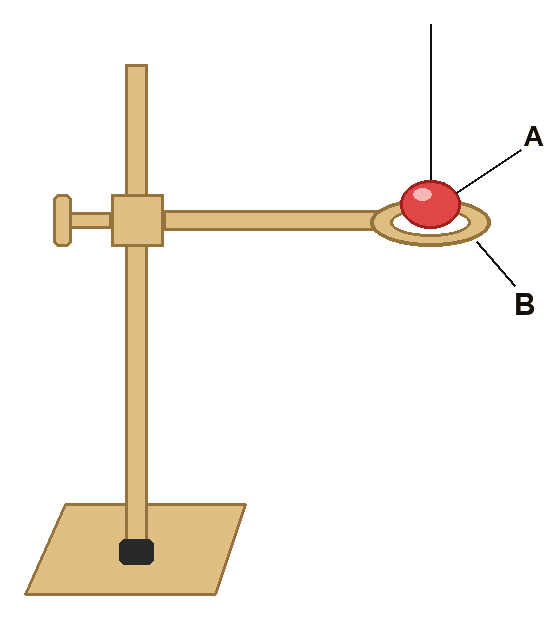
(a) Label A and B.
(b) What is the purpose of this experiment?
Solve with AIWritten solution
Solution:
Concept: The ball and ring experiment shows the expansion of a solid on heating.
Step 1 — (a) Label the parts.
A is the metal ball, hanging from a string. B is the metal ring, held by a clamp on the stand.
Step 2 — (b) Describe the experiment.
When cold, the ball passes easily through the ring. After the ball is heated, it expands and rests on the ring without passing through. When it cools, it contracts and passes through again.
Step 3 — (b) State the purpose.
The purpose is to show that a solid expands on heating and contracts on cooling.
Therefore, A is the metal ball and B is the metal ring, and the experiment shows that solids expand on heating and contract on cooling.
- 505 marks
Question 50
Given below is a crossword puzzle based on this lesson. Read the clues across and clues downwards and fill up the blank squares.
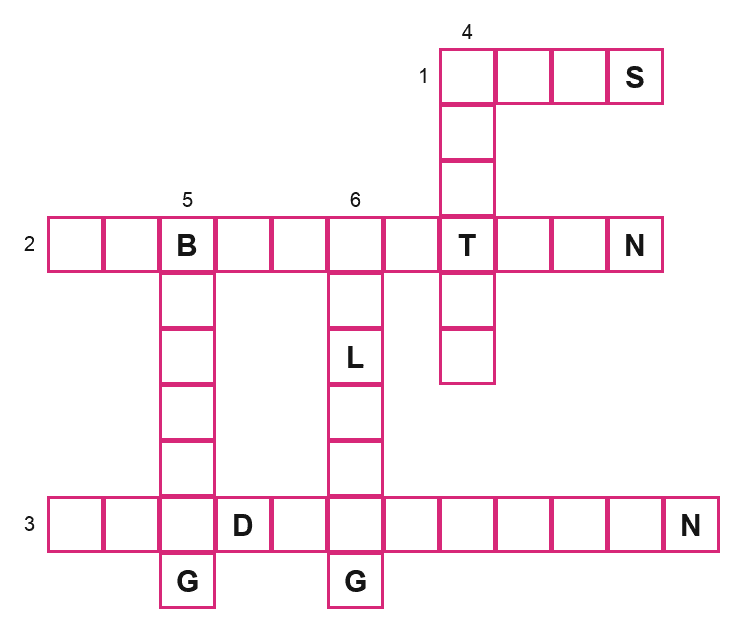
Across :
- Quantity of matter
- Solid changes directly into vapour
- Gas changes into liquid
Down :
- Occupies space and has mass
- Liquid is heated to change into vapour
- Solid changes into liquid.
Solve with AIWritten solution
Solution:
Concept: Answer each clue with a term from this chapter, then check that the letters already printed in the grid fit every crossing.
Step 1 — Answer the across clues.
The three across words are given below.
- Quantity of matter: MASS
- Solid changes directly into vapour: SUBLIMATION
- Gas changes into liquid: CONDENSATION
Step 2 — Answer the down clues.
The three down words are given below; the numbering continues from the across clues.
-
- Occupies space and has mass: MATTER
-
- Liquid is heated to change into vapour: BOILING
-
- Solid changes into liquid: MELTING
Step 3 — Check the crossings.
MATTER starts on the M of MASS and crosses SUBLIMATION at its T. BOILING starts on the B of SUBLIMATION and crosses CONDENSATION at its first N. MELTING starts on the M of SUBLIMATION and crosses CONDENSATION at its second N. Every printed letter (S, B, T, N, L, D, N, G, G) fits.
Step 4 — See the completed puzzle.
The filled grid is shown below.

Therefore, across: 1 MASS, 2 SUBLIMATION, 3 CONDENSATION; down: 4 MATTER, 5 BOILING, 6 MELTING.
- 515 marks
Question 51
Anshul visited the beach and collected a handful of small pebbles to play with later at home. Once home, he carefully stacked them into a tall tower. Then he decided to pour water over the tower. He observed that water flowed through the gaps between the pebbles and spread everywhere on the floor.
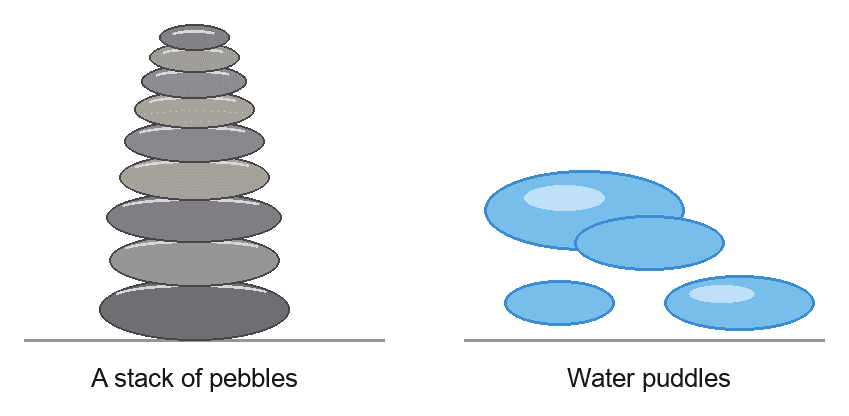
(a) Why was it possible to stack pebbles ?
(b) Why did the water spread on the floor ?
(c) What happens to the water after it spreads across the floor ?
(d) Which other state of matter can flow in all directions ?
Solve with AIWritten solution
Solution:
Concept: Pebbles are solids and water is a liquid; their behaviour follows from how closely their particles are packed and how strongly they attract one another.
Step 1 — (a) Explain why the pebbles could be stacked.
Pebbles are solids. Their particles are closely packed and strongly held, so each pebble is rigid and keeps a definite shape and volume. It does not flow or squash under the weight of the pebbles above, so the pebbles can be piled up.
Step 2 — (b) Explain why the water spread.
Water is a liquid. Its particles can slide past one another, so water has no definite shape and flows from a higher level to a lower level. It ran through the gaps between the pebbles and spread over the floor.
Step 3 — (c) Describe what happens to the water later.
The water slowly evaporates: its particles escape into the air as water vapour at room temperature, so the puddles dry up after some time.
Step 4 — (d) Name the other state that flows in all directions.
Gases can flow in all directions.
Therefore, (a) pebbles are rigid solids, (b) water is a liquid that flows, (c) the water evaporates, (d) gases.
What Class 6 Chemistry Ch 3 covers
The sections of the chapter, in the order the book takes them. Every question above comes from one of these.
- 01Nature of Matter
- 02Composition of Matter (Atoms and Molecules)
- 03Characteristics of Particles of Matter
- 04States of Matter
- 05Explanation of the Three States of Matter
- 06Effect of Heat on Matter
- 07Cause of Change of State of Matter
More ways to study this chapter
The same chapter asked three other ways. Practise it, revise it, and see what the board has set on Ch 3 before.
Class 6 Chemistry Ch 3 questions students ask
How many questions are there in Class 6 Chemistry Ch 3?
51 questions. Every one is solved step by step on this page.
Are these Class 6 Chemistry solutions free?
Yes. Every question and its full working is free to read, with no account needed.
Can I download the Class 6 Chemistry Ch 3 solutions as a PDF?
There is no PDF to download. Every solution is on this page instead, which means it is searchable, always the current syllabus, and readable on a phone. Use your browser's print option if you want it on paper.