
Opening your dashboard
Class 6 Chemistry Chapter 3 Matter: Competency-Based Questions (CBQ)
40 questions on Chapter 3, each worked through on its own page with the AI tutor. Class 6 Chemistry, ICSE 2026-27.
40 questions
1–5 marks · Mixed difficulty
- 11 mark
Question 1
Cognitive domain: Application
Rekha has a plastic syringe without a needle. She pulls the plunger back to fill the syringe with air. She closes the nozzle with her thumb and pushes the plunger. It goes in easily up to the half-way mark.
Next she fills the syringe with water, closes the nozzle and pushes again. This time the plunger hardly moves.
Which statement explains what Rekha saw?
- 21 mark
Question 2
Cognitive domain: Analysis
A teacher writes the melting points and boiling points of four substances on the board. The temperature of the classroom is 30 °C.
Substance Melting point Boiling point P 45 °C 250 °C Q 63 °C 360 °C R 18 °C 118 °C S 2 °C 25 °C Which substance is a liquid in the classroom?
- 31 mark
Question 3
Cognitive domain: Understanding
Tanvi puts a flat football on a kitchen weighing scale. It reads 410 g. She pumps air into the football till it is hard and round, and weighs it again. Now the scale reads 415 g.
What does the extra 5 g show?
- 41 mark
Question 4
Cognitive domain: Application
Dadi is making a sweet. She heats a spoonful of white sugar in a pan and forgets it on the flame. The sugar turns dark brown and then black, and it gives off a burnt smell. She lets the pan cool. The black mass does not turn back into white sugar.
What has heating done to the sugar?
- 51 mark
Question 5
Cognitive domain: Understanding
Assertion (A): A drop of blue ink spreads through a glass of warm water faster than through a glass of cold water.
Reason (R): The particles of matter move faster when the temperature rises.
- 61 mark
Question 6
Cognitive domain: Analysis
Assertion (A): When naphthalene balls kept with woollen clothes become smaller, they leave a wet patch of liquid on the clothes.
Reason (R): Naphthalene changes directly from the solid state into the vapour state.
- 71 mark
Question 7
Cognitive domain: Understanding
Savita tilts a jar of honey over a plate. The honey flows out slowly and spreads on the plate.
Complete the sentences about the honey.
Honey can flow because the molecules of a liquid are ________ closely packed than the molecules of a solid. On the plate, the honey takes the ________ of the plate. But its ________ stays the same as it was in the jar.
- 81 mark
Question 8
Cognitive domain: Application
Riya makes a model with clay balls and matchsticks. She joins two small red balls to one big blue ball. Each red ball stands for an atom of hydrogen. The blue ball stands for an atom of oxygen.
Name the substance whose smallest particle Riya has made. Is her model an atom or a molecule of that substance?
- 91 mark
Question 9
Cognitive domain: Application
Water is boiling in an open pan on a gas stove. A thermometer dipped in the water reads 100 °C. Kabir turns the flame up to full and lets the water go on boiling for five more minutes. Some water is still left in the pan.
Predict the reading of the thermometer at the end of the five minutes. Give a reason.
- 102 marks
Question 10
Cognitive domain: Understanding
Pooja can snap a stick of chalk with her fingers. But she cannot break an iron nail of the same thickness, however hard she tries.
(a) What does this tell you about the force of attraction between the particles of chalk and between the particles of iron?
(b) What is the force of attraction between particles of the same kind called? In which state of matter is this force the weakest?
- 112 marks
Question 11
Cognitive domain: Evaluation
Manu pours dry sand from a mug into a bucket. He says, "Sand can be poured, and it takes the shape of the bucket. So sand is a liquid."
Is Manu right? Give two reasons to support your answer.
- 122 marks
Question 12
Cognitive domain: Evaluation
Cooking gas (LPG) comes to our homes in strong steel cylinders. A label on each cylinder says: Liquefied petroleum gas – liquid, under pressure. Raju, a new helper at the gas agency, says, "LPG burns as a gas. Why change it into a liquid? A cylinder filled with the gas would hold just as much."
Do you agree with Raju? Explain your answer by thinking about the molecules of a gas and of a liquid. Also write the two things that are done to a gas to change it into a liquid.
- 134 marks
Question 13
Cognitive domain: Application
Salim Chacha runs a cycle repair shop near Nisha's school. Nisha's cycle has a flat tyre. Salim Chacha takes out the rubber tube and pumps air into it with a hand pump. The tube swells up and looks full, yet he goes on pumping more and more air into it. Then he dips the tube into a tub of water. A line of bubbles rises from one spot. "That is the hole," he says. He dries the tube and sticks a patch over the hole. Then he tightens the wheel nuts with a steel spanner.
(a) From the passage, name one solid, one liquid and one gas. Which of the three has neither a definite shape nor a definite volume?
(b) The tube already looks full. How can Salim Chacha still pump more air into it? Explain by thinking about the molecules of a gas.
(c) Nobody pushes the air out, yet it leaves the tube through the tiny hole. Which property of gases does this show? Nisha asks, "Why not fill the tube with water in place of air?" Using one property of liquids, explain why a tube filled with water would not make a soft cushion for the wheel.
- 144 marks
Question 14
Cognitive domain: Analysis
Electricity reaches our homes through long metal wires fixed on tall poles. Most of these wires are made of aluminium. On a hot May afternoon the wires hang loose between the poles. On a cold January morning the same wires look tighter and straighter. To explain this, an engineer shows a table to a class. It tells how much longer a 100-metre wire becomes when it warms up from 5 °C to 45 °C.
Metal of the wire Length at 5 °C Increase in length at 45 °C (about) Aluminium 100 m 92 mm Copper 100 m 68 mm Iron 100 m 48 mm (a) Name the effect of heat that makes the wires longer. What happens to the length of a wire when the weather turns cold again? Is this a physical change or a chemical change?
(b) Which wire becomes longer by the largest amount? Work out the length of this wire at 45 °C in millimetres. What does the table tell you about different substances?
(c) On a very hot day, some workers fix a new aluminium wire between two poles. They pull it as tight as they can. What may happen to this wire in winter? What should the workers have done?
- 155 marks
Question 15
Cognitive domain: Creativity
Anaya wants to show her class that air expands on heating and contracts on cooling. She has an empty glass bottle, a balloon, a bowl of hot water and a bowl of ice-cold water.
(a) Design her experiment. Write the steps she should follow.
(b) Predict what the class will see in each bowl.
(c) Explain what they see by thinking about the molecules of air in the bottle.
(d) A classmate says, "The balloon became bigger because the hot water made new air inside the bottle." Is the classmate right? Which part of Anaya's experiment helps you to answer?
- 161 mark
Question 16
Cognitive domain: Application
Meera pushes an empty glass tumbler, mouth downwards, straight into a bucket of water. A crumpled piece of tissue paper is stuck to the inside bottom of the tumbler. When she lifts the tumbler out, the tissue paper is still dry. She then pushes the tumbler in again, this time tilting it a little, and bubbles rise out of it.
What do these observations show?
- 171 mark
Question 17
Cognitive domain: Evaluation
Ravi puts a drop of pond water under the ordinary microscope of his school laboratory. He looks at it for some time and says, "I can see the water molecules and the atoms inside them moving about."
Which statement about Ravi's claim is correct?
- 181 mark
Question 18
Cognitive domain: Analysis
In a science lesson, a student adds one drop of milk to a beaker of water and stirs it. She pours this very dilute milk into two identical beakers, A and B. One beaker is kept at room temperature and the other is warmed. Looking through a microscope, she marks the position of one tiny fat droplet of the milk in each beaker after every equal gap of time. The figure shows the zig-zag paths that she got. (Hypothetical data.)
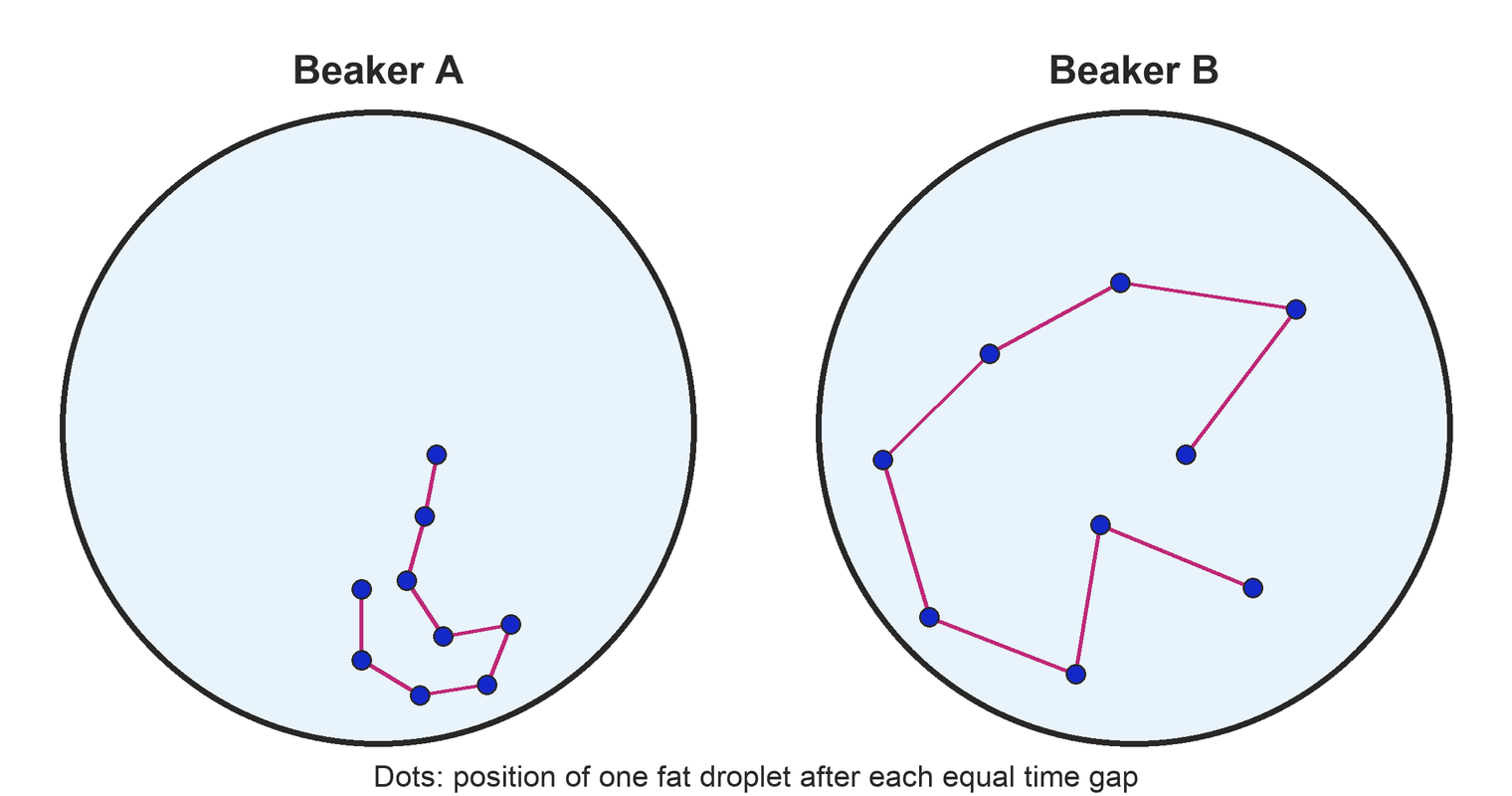
Which statement is correct?
- 191 mark
Question 19
Cognitive domain: Analysis
A student tests three samples, P, Q and R, at room temperature and writes her observations in a table.
Sample Fixed shape Fixed volume Can be compressed easily Free surfaces in an open container P No Yes No One Q Yes Yes No Any number R No No Yes None Which option names the states of P, Q and R correctly?
- 201 mark
Question 20
Cognitive domain: Application
On a hot afternoon in May, an attendant at a petrol pump asks a lorry driver not to fill the petrol tank right up to the brim, even though the tank has no leak. He says that petrol may spill out of the tank in the heat.
Which statement explains the attendant's advice?
- 211 mark
Question 21
Cognitive domain: Understanding
In Delhi, Anjali's mother keeps a bottle of coconut oil on a kitchen shelf. In January the oil in the bottle turns into a white solid, and she has to stand the closed bottle in warm water before she can pour the oil. In May the same oil stays a clear liquid all the time. Coconut oil melts at about 24 °C.
Which statement explains these observations?
- 221 mark
Question 22
Cognitive domain: Analysis
Seema pours some melted wax into a beaker and lets it cool in the room. She notes the temperature of the wax every 2 minutes. (Hypothetical data.)
Time (minutes) 0 2 4 6 8 10 12 Temperature (°C) 75 65 55 55 55 47 41 She sees that the wax has started to form a solid at 4 minutes, and that all of it has become solid by 8 minutes.
Which option gives the freezing point of the wax and what is happening between 4 and 8 minutes?
- 231 mark
Question 23
Cognitive domain: Analysis
Three observations are noted by a student on a school day.
- P: The smell of food being cooked in the canteen reaches the classroom at the other end of the corridor within a few minutes.
- Q: A drop of blue ink put into a glass of water, without stirring, slowly colours all the water over a long time.
- R: A copper coin and an iron nail are kept touching each other in a drawer for a week, and no mixing of the two can be seen.
Which option correctly gives the state of matter in which P, Q and R take place?
- 241 mark
Question 24
Cognitive domain: Analysis
Assertion (A): Mercury is a liquid at room temperature, but it shows a strong cohesive force.
Reason (R): A liquid has a definite volume but no definite shape of its own.
- 251 mark
Question 25
Cognitive domain: Understanding
Assertion (A): A gas kept in a closed bottle fills the whole bottle.
Reason (R): The molecules of a gas attract one another very strongly, and so they stay close together.
- 262 marks
Question 26
Cognitive domain: Understanding
Tina's mother stores water in a steel bucket in the kitchen. Tina notices that the plate, the tumbler (drinking glass) and the spoon in the kitchen are also made of steel. The bucket in the bathroom is made of plastic.
(a) Is steel a natural matter or a man-made matter? Give a reason.
(b) What do the two buckets, and the plate, tumbler and spoon, tell us about materials and the objects that are made from them?
- 272 marks
Question 27
Cognitive domain: Application
Imran makes models of molecules with coloured clay balls. He uses a red ball for an atom of hydrogen and a blue ball for an atom of oxygen. He makes 4 models of a water molecule and 3 models of an oxygen molecule.
(a) How many red balls and how many blue balls does he use in all?
(b) How many balls does he use altogether?
- 282 marks
Question 28
Cognitive domain: Understanding
In the school laboratory, Pooja pours a little mustard oil into a glass of water and stirs it well. After a few minutes the oil floats on the water as a separate layer. Her teacher then pours some alcohol into another glass of water and stirs it. This time Pooja sees only one clear liquid, with no layer in it.
(a) Name each pair of liquids as miscible or immiscible.
(b) In which glass have the particles of one liquid intermixed with the particles of the other liquid? What is this phenomenon called?
- 292 marks
Question 29
Cognitive domain: Evaluation
Amit's teacher says that both water and air are fluids. Amit says, "Air cannot be a fluid, because we cannot pour it from a glass the way we pour water."
Do you agree with Amit? Give two reasons for your answer.
- 302 marks
Question 30
Cognitive domain: Application
Kavya squeezes a rubber eraser between her fingers, and it gets slightly squashed. She pulls a rubber balloon that is not blown up, and it stretches. She then squeezes a steel coin and a glass marble just as hard, but she cannot see any change in their shape or size.
(a) Is the rubber eraser a solid? Give a reason.
(b) What does this activity show about the difference between a soft solid and a hard solid?
- 312 marks
Question 31
Cognitive domain: Application
An ice-cream seller keeps his ice-cream cold in a box with pieces of dry ice, which is solid carbon dioxide. At the end of the day, he finds that the pieces of dry ice have vanished, and the box is dry. There is no liquid in it.
(a) Name the change of state that has taken place.
(b) Why is no liquid seen in the box? Name one more substance that behaves in the same way.
- 323 marks
Question 32
Cognitive domain: Application
On a windy afternoon Sana finds that it is very hard to pedal her cycle when she rides against the wind, and it is easy when the wind blows from behind her. She cannot see anything pushing her.
(a) Name the property of matter that makes it hard to pedal against the wind.
(b) Name the matter that Sana pushes against, and say whether it is a solid, a liquid or a gas.
(c) Why does pedalling become easy when the wind blows from behind her?
- 333 marks
Question 33
Cognitive domain: Analysis
A student weighs three samples, P, Q and R, of the same volume (100 mL) at room temperature. Her notes are shown in the table. (Hypothetical data.)
Sample Mass of 100 mL What she observed P 790 g It does not flow and keeps its shape when it is put in a bowl. Q 100 g It flows, takes the shape of the bowl and has one free surface. R 0.12 g It spreads and fills the whole of a closed jar. (a) Name the state of matter of P, Q and R.
(b) Arrange P, Q and R in the order of decreasing density.
(c) The mass of R is much smaller than the mass of P for the same volume. Explain why, using the particles of R.
- 343 marks
Question 34
Cognitive domain: Analysis
A village blacksmith makes an iron ring, called a rim, for a wooden bullock-cart wheel. He makes the ring a little smaller than the wheel, so that it cannot be slipped over the wheel when it is cold. He heats the ring in a wood fire until it is red hot, slips it over the wheel and pours water on it. When the ring cools, it grips the wheel tightly.
(a) Why can the hot ring be slipped over the wheel, but the cold ring cannot?
(b) Why does the ring grip the wheel tightly after the water is poured on it?
(c) Is the expansion and contraction of the iron ring a physical change or a chemical change? Give a reason.
- 353 marks
Question 35
Cognitive domain: Understanding
Anu helps at a balloon stall. She sees that a balloon swells evenly in all directions when it is filled with air. A bucket of water stands near the stall, and the water has a flat top. A wooden block can be kept on the table in any position.
(a) How many free surfaces are there in the wooden block, the water in the bucket and the air in the balloon?
(b) Use a property of gases to explain why the balloon swells evenly in all directions.
(c) The water from the bucket can be poured into a mug, but the block cannot be. Name the property of liquids that makes this possible.
- 363 marks
Question 36
Cognitive domain: Evaluation
Naina leaves 100 mL of water in a wide plate on a sunny terrace. By the evening the plate is dry. She measured the temperature of the water at noon and found it to be 38 °C. Her friend says, "Water can change into vapour only at 100 °C. So your thermometer must have been wrong."
(a) Is her friend right? Give a reason.
(b) Name the process that dried the plate, and give one difference between this process and boiling.
- 374 marks
Question 37
Cognitive domain: Analysis
In the school laboratory, Priya's group heats a pure solid substance, Z, steadily with a burner. They read the temperature with a thermometer and plot the graph shown below. Z is a solid at the start. It does not burn, and it does not change into any other substance on heating. The experiment is done at normal atmospheric pressure, and they stop heating at 28 minutes. (Hypothetical data.)
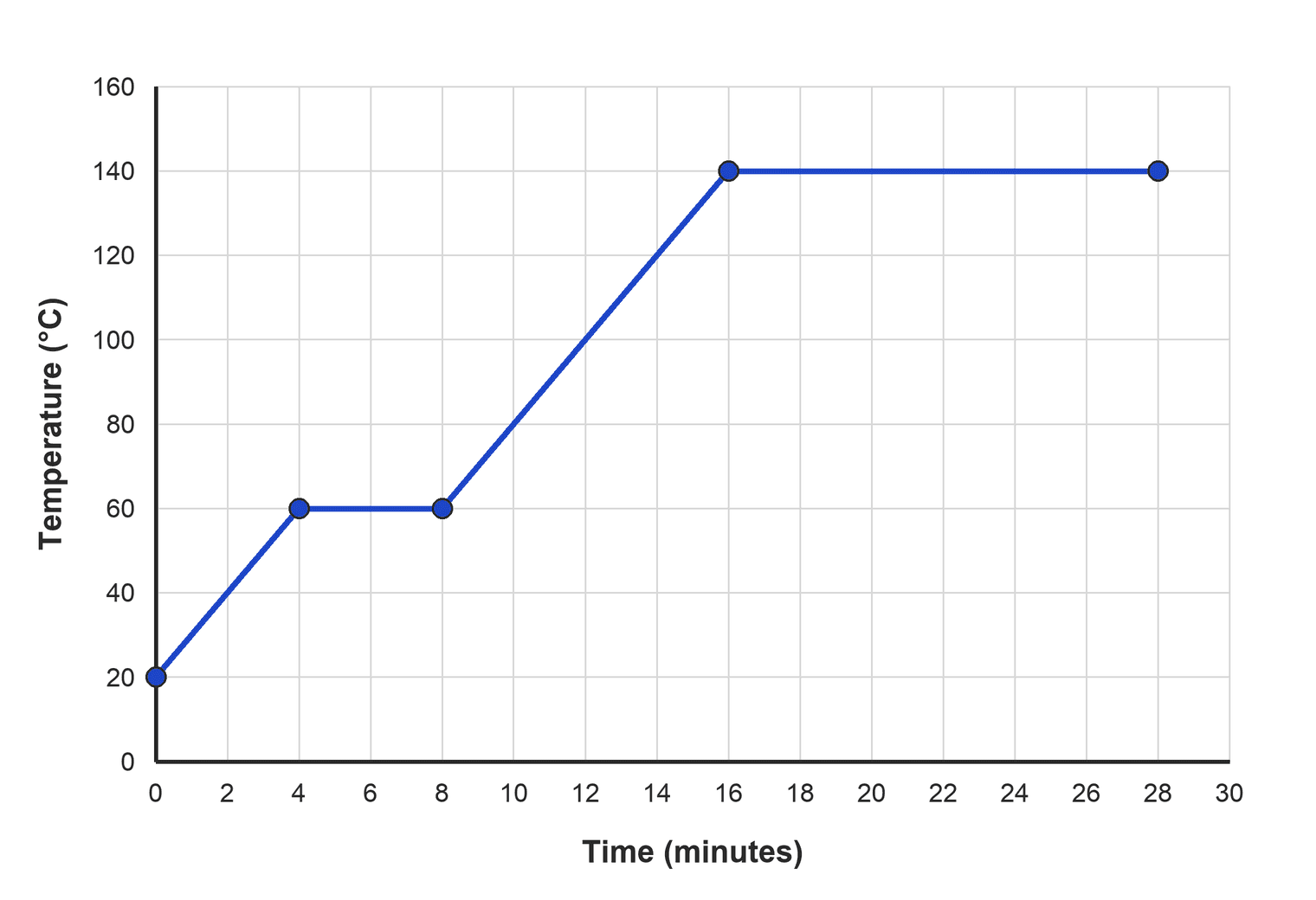
(a) Read the melting point and the boiling point of Z from the graph.
(b) State what Z is, in terms of solid, liquid and gas, at 2 minutes, at 6 minutes and at 22 minutes.
(c) The burner goes on supplying heat between 4 and 8 minutes, but the temperature does not rise. Explain why, using the particles of Z.
- 384 marks
Question 38
Cognitive domain: Application
Rahul's grandfather lives in a hill village near the sea. In summer the small pond of the village shrinks, but in the rainy season it fills up again. Rahul's teacher draws a figure of the water cycle for the class. She tells the class that water from the sea rises as an invisible gas at A, that it forms a cloud high up at B, and that it falls back to the earth at C. "This goes on for ever," says the teacher, "but the water does not turn into a different substance."
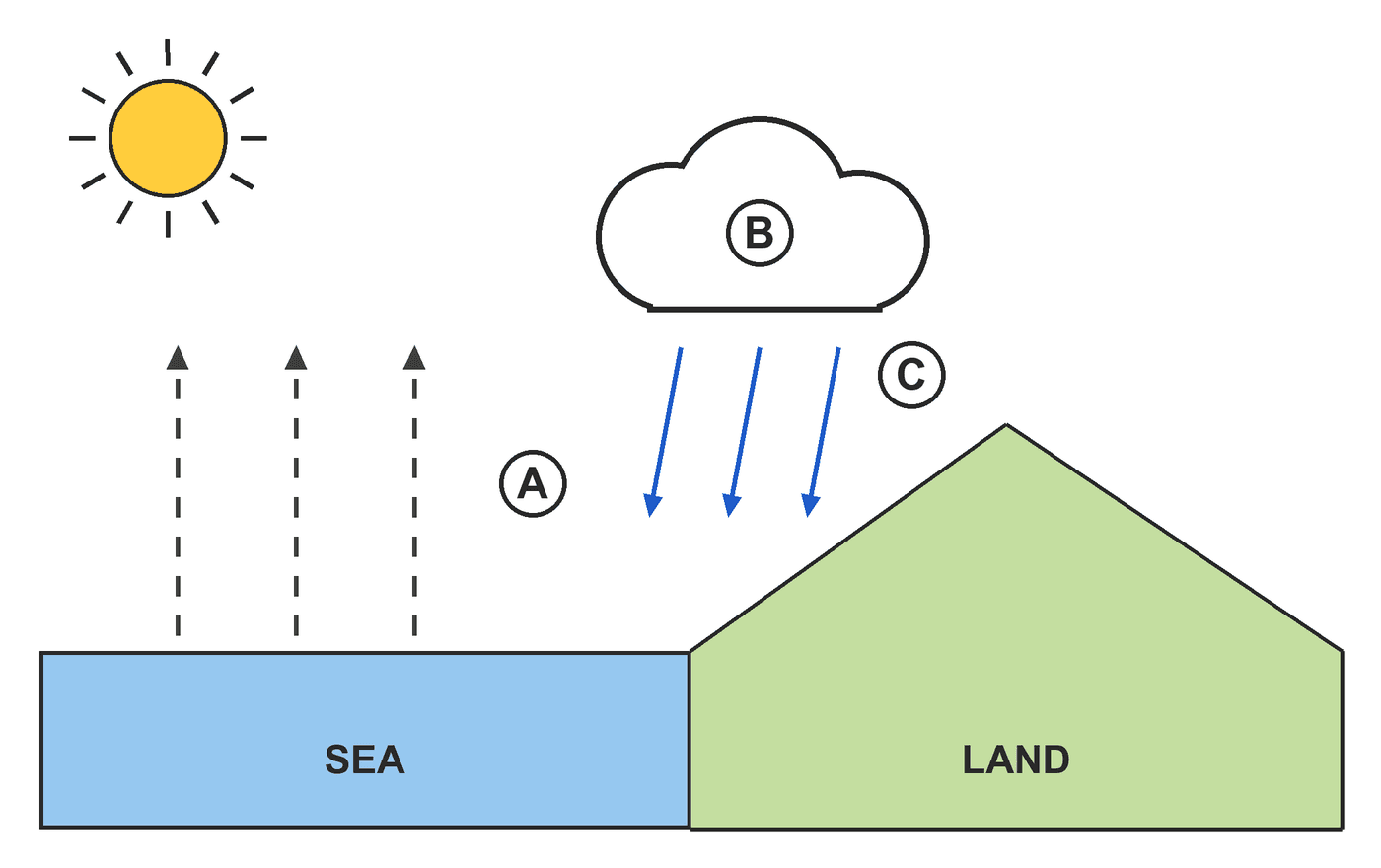
(a) Name the change of state at A and the change of state at B. Which of the two needs heat to be given to the water?
(b) What happens to the gaps between the particles of water at A and at B?
(c) Name the process of changing from one state to another and back to the original state, with no change in composition. Is it a physical or a chemical change? Give a reason.
- 395 marks
Question 39
Cognitive domain: Creativity
A class is asked to write "A day in the life of a water particle". The story of one group follows the same particle through four stages. It starts as a piece of ice in a freezer. It is then taken out and the ice becomes water on the kitchen counter. The water is boiled in a kettle. At last, the steam from the kettle touches a cold window glass and forms drops of water on it.
Stage Where the particle is State of water How the particles are arranged 1 Ice in the freezer ? ? 2 Water on the kitchen counter ? ? 3 Steam from the kettle ? ? 4 Drops on the cold window glass ? ? (a) Copy the table and fill in the state of water and the arrangement of the particles for each stage. Use these three words for the arrangement: closely packed, less closely packed, far apart.
(b) Name the change of state from stage 1 to stage 2, from stage 2 to stage 3 and from stage 3 to stage 4. Say whether heat is given to the water or taken from it in each change.
(c) Write a diary entry of 4 to 5 lines in the voice of the water particle at stage 3. Tell how it moves, how far it is from the other particles and how strongly the other particles attract it.
- 404 marks
Question 40
Cognitive domain: Analysis
Kabir takes a plastic syringe with its nozzle closed and 50 mL of air at 20 °C in it. The plunger of the syringe can move freely. He dips the syringe in a water bath, raises the temperature of the bath slowly, and reads the volume of the air at each temperature. At the end, he cools the bath back to 20 °C. (Hypothetical data.)
Temperature of the bath (°C) 20 40 60 80 20 (after cooling) Volume of the air (mL) 50 53 57 60 50 (a) What do the readings from 20 °C to 80 °C show about the effect of heat on air? By how many mL has the volume increased from 20 °C to 80 °C?
(b) What does the last reading tell Kabir? Is the change in the air a physical change or a chemical change? Give a reason from the table.
(c) Kabir did not note the volume at 50 °C. Between which two readings does it lie, and about how many mL would it be?