
Opening your dashboard
Class 6 Chemistry Chapter 3 Matter: Practice Questions
45 questions on Chapter 3, each worked through on its own page with the AI tutor. Class 6 Chemistry, ICSE 2026-27.
45 questions
1–5 marks · Mixed difficulty
- 11 mark
Question 1
Bloom's level: Remember
Which Indian philosopher proposed, long before John Dalton, that all forms of matter are made of atoms?
- 21 mark
Question 2
Bloom's level: Remember
The condensation point of steam is:
- 31 mark
Question 3
Bloom's level: Remember
Most scientists believe that all the matter in the Universe was created in an explosion called the:
- 41 mark
Question 4
Bloom's level: Understand
When air is pumped into a football, it takes the shape of the football. This shows that gases:
- 51 mark
Question 5
Bloom's level: Understand
The particles of a substance move faster when:
- 61 mark
Question 6
Bloom's level: Apply
An L.P.G. cylinder contains cooking gas in the liquid state, but it comes out of the burner as a gas. This is because, when it leaves the cylinder:
- 71 mark
Question 7
Bloom's level: Apply
Wet clothes spread in the sun dry faster than wet clothes kept indoors. The main reason is that:
- 81 mark
Question 8
Bloom's level: Apply
The metal lid of a glass jar is stuck tightly. Holding the lid under hot running water for a minute helps to open it because:
- 91 mark
Question 9
Bloom's level: Analyse
A substance keeps the same volume when it is poured from a tall jar into a flat dish, but its shape changes, and it has only one free surface. The substance could be:
- 101 mark
Question 10
Bloom's level: Understand
Assertion (A): Gases can be compressed easily.
Reason (R): In gases the molecules lie far apart, so the intermolecular spaces are very large.
- 111 mark
Question 11
Bloom's level: Analyse
Assertion (A): Melting of ice is an interconversion of states of matter.
Reason (R): Ice melts when heat is supplied to it.
- 121 mark
Question 12
Bloom's level: Evaluate
Assertion (A): Atoms of oxygen usually exist on their own, independently.
Reason (R): A molecule of oxygen is made up of two atoms of oxygen.
- 131 mark
Question 13
Bloom's level: Remember
Define freezing point.
- 142 marks
Question 14
Bloom's level: Understand
Explain, with one everyday example each, that matter (a) has mass and (b) occupies space.
- 152 marks
Question 15
Bloom's level: Understand
Rahul says, "Air is not matter because we cannot see it." Explain why he is wrong.
- 162 marks
Question 16
Bloom's level: Understand
Explain why gases diffuse very fast while liquids diffuse slowly.
- 172 marks
Question 17
Bloom's level: Apply
Sort these into living matter, natural non-living matter and man-made matter:
lotus, nylon, sand, dog, cement, stars, soap, banyan tree
- 182 marks
Question 18
Bloom's level: Apply
A jar is filled to the top with marbles. Shanu says it is full, but her friend pours in two cups of fine sand, and the sand disappears into the jar without spilling. Explain what happened, and what this models about particles of matter.
- 192 marks
Question 19
Bloom's level: Apply
Name the change of state taking place in each case.
(a) Drops of water form on the outside of a glass of iced water.
(b) Moth balls (naphthalene) in a cupboard become smaller and disappear.
(c) Molten wax from a candle becomes hard on the table.
(d) A puddle of rain water dries up on a sunny afternoon.
- 202 marks
Question 20
Bloom's level: Apply
A thermometer is put into a cup of hot tea, and the silver thread of mercury in it rises. Explain why, and state the principle on which the thermometer is built.
- 212 marks
Question 21
Bloom's level: Analyse
Butter is heated in a pan till it melts; a piece of paper is held over a flame till it burns. By comparing the two, decide which is a physical change and which is a chemical change. Give two points of difference to support your answer.
- 222 marks
Question 22
Bloom's level: Evaluate
A student says, "Every substance changes its state when it is heated." Is this correct? Justify your answer with examples.
- 234 marks
Question 23
Bloom's level: Apply
Meena is making tea in her kitchen. She notices water drops on the inside of the lid of the boiling pan. Her mother takes an ice tray out of the freezer, and the ice cubes slowly turn into water on the counter. The tea is cooked on gas from an L.P.G. cylinder.
(a) Name the change of state when water in the pan turns into steam, and when the ice cubes turn into water.
(b) Explain why water drops form on the inside of the lid.
(c) The gas is stored in the cylinder as a liquid. Name the two conditions that cause a change of state, and say which one keeps L.P.G. liquid in the cylinder.
- 244 marks
Question 24
Bloom's level: Analyse
The figure shows the arrangement of molecules in three substances X, Y and Z.
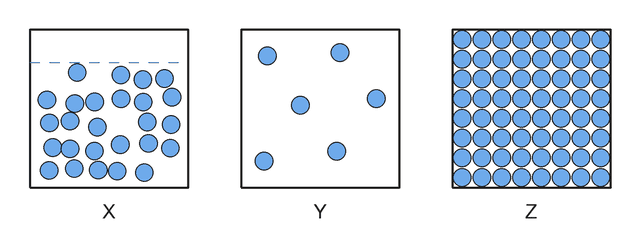
(a) Identify the state of matter of X, Y and Z.
(b) Arrange X, Y and Z in increasing order of the cohesive force between their molecules.
(c) Which of them would diffuse fastest, and which can be compressed most easily? Give reasons.
- 253 marks
Question 25
Bloom's level: Understand
Complete a comparison of solids, liquids and gases for: shape, volume, number of free surfaces, compressibility and diffusion. Present it as a table.
- 264 marks
Question 26
Bloom's level: Evaluate
One evening Rohan smells cooking gas in the kitchen and, a minute later, his sister notices the smell in the next room as well.
(a) Name the property of gases that carried the smell into the next room.
(b) L.P.G. itself has no smell. What makes a leak detectable?
(c) Rohan says, "Let's shut every window and door so that the gas stays in the kitchen." Judge whether this is a good idea, using what you know about how gases behave.
- 274 marks
Question 27
Bloom's level: Analyse
A student records what happened to six things when they were heated and then left to cool.
The observations are given below.
Substance On heating On cooling Wood Burns, leaves ash Ash stays ash Wax Melts Becomes solid wax again Iron rail Becomes slightly longer Returns to its old length Rice Gets cooked Stays cooked Camphor Turns directly into vapour Vapour forms solid camphor again Air in a test tube Pushes a water drop up The drop comes down again (a) Sort the six into: change of state, thermal expansion, and chemical change.
(b) What single test did you use to separate the chemical changes from the others?
(c) Explain why both a change of state and thermal expansion are called physical changes.
- 283 marks
Question 28
Bloom's level: Apply
Priya fills a glass to the brim with water and keeps it in an empty trough. She ties a stone to a thread and slowly lowers it fully into the water. The water that overflows into the trough measures 24 mL.
(a) What does the 24 mL of overflowing water tell her about the stone?
(b) She now lowers the same stone into a cup filled to the brim. How much water will overflow? Explain.
(c) A second stone alone makes 36 mL of water overflow. If both stones are lowered together into a full container, how much water will overflow? Which property of matter does this activity show?
- 295 marks
Question 29
Bloom's level: Create
Plan a playground game in which your classmates act as molecules to show the three states of matter. Describe how the 'molecules' should stand and move for a solid, a liquid and a gas, and what happens when the teacher calls out "Heat!". Link each part to a property of that state.
- 304 marks
Question 30
Bloom's level: Create
Construct a labelled flow diagram (or table) that shows all the changes between the solid, liquid and gaseous states. For each change, name the process, say whether heat is given or taken away, and give one everyday example that is not about water.
- 311 mark
Question 31
Cooking gas is stored in a steel cylinder. Which set of properties correctly describes a gas?
- 321 mark
Question 32
Steam from a kettle touches a cold steel plate, and tiny drops of water appear on the plate. What is this change of a gas into a liquid called?
- 331 mark
Question 33
A wooden block keeps its shape, but air does not. Compared with solids and liquids, gases are the least:
- 341 mark
Question 34
Fill in the blank.
In a solid, the molecules are very ________ packed, so there is almost no empty space between them.
- 352 marks
Question 35
State whether each statement is true or false. Correct the false ones.
(a) Solidification and condensation are two names for one and the same change of state.
(b) When a solid such as camphor sublimes, it first melts into a liquid.
- 361 mark
Question 36
The force of attraction between like particles, which holds the molecules of a substance together, is known as :
- 371 mark
Question 37
Which one of the following is a property of liquids but not of gases ?
- 381 mark
Question 38
At normal atmospheric pressure, water that is being heated stays at 100 °C until the whole of it has changed into steam. This fixed temperature is called the :
- 391 mark
Question 39
Fill in the blank :
Particles of matter are always in random motion because they possess .............. energy.
- 401 mark
Question 40
Write true or false :
A gas changes into a liquid when the pressure on it is decreased and its temperature is increased.
- 412 marks
Question 41
State the two properties which every kind of matter has. Use them to explain why a brick is matter but the heat given out by a fire is not.
- 422 marks
Question 42
Give a reason for each of the following.
(a) A solid is hard and has a fixed shape.
(b) A gas can be compressed easily.
- 435 marks
Question 43
(a) What is meant by thermal expansion ?
(b) Heat can cause a change of state, thermal expansion or a chemical change. Draw a table to show which of these three effects is seen in each of the following :
- butter melts in a hot pan
- a piece of paper burns to ash
- the mercury rises in a thermometer dipped in warm water
- raw rice is cooked
- water boils in a kettle
- a heated metal ball no longer passes through its ring
(c) Which two of the three effects are physical changes ? Give a reason.
- 444 marks
Question 44
Some crushed ice at 0 °C is taken in a beaker and heated steadily. The ice changes into water, and after some time the water starts boiling. The pressure is the normal atmospheric pressure.
(a) Name, in order, the two changes of state that take place.
(b) At what temperature does each change take place ? What happens to the temperature while each change is going on ?
(c) Explain, in terms of its particles, how the ice changes into water.
- 454 marks
Question 45
(a) Why do atoms usually combine with one another ? What is formed when they combine ?
(b) Copy and complete the table given below.
Molecule Kinds of atoms in it Number of atoms in one molecule Oxygen ........ ........ Water ........ ........ (c) Calculate the total number of atoms present in 6 molecules of water. How many of them are atoms of hydrogen ?