
Opening your dashboard
Class 5 Science Chapter 12: Cleanliness and Hygiene Solutions
34 textbook questions with step-by-step answers, free to read, for ICSE 2026-27.
Get talked through Ch 12, not just shown the answer
Reading a finished solution is not the same as being able to do it. The AI tutor takes one question at a time and works it with you, in your own words, until you can.
- Ask it out loud, in your own words
- It gives you the next step, not the answer
- Stuck on part (ii)? Start there
34 questions with solutions
1–5 marks · Mixed difficulty
- 11 mark
Question 1
Give two examples of the following.
Places where germs are found: ________ and ________
Solve with AIWritten solution
Solution:
Concept: Germs are tiny living things that can cause illness. They are too small to be seen with our eyes, and they are found almost everywhere around us.
Step 1 — What is asked.
We need to name two places where germs are found.
Step 2 — Recall where germs live.
Germs are present in the air, soil, water and food, on plants and animals, and even on and inside our own body.
Step 3 — Pick two places.
Two such places are the air and water.
Note: Soil, food and our own skin are also correct examples.
Therefore, two places where germs are found are air and water.
- 21 mark
Question 2
Give two examples of the following.
Result of unclean hair: ________ and ________
Solve with AIWritten solution
Solution:
Concept: When we play outside, dust sticks to our hair and mixes with sweat and the natural oil of the scalp. If we do not wash it off, the hair becomes dirty.
Step 1 — What is asked.
We need two things that can happen when hair is not kept clean.
Step 2 — Think about dirt, sweat and oil.
Dirt, sweat and oil that stay on the scalp make the hair smell bad.
Step 3 — Think about the scalp.
Oil and dead skin that build up on the scalp can make dandruff (white flakes and an itchy scalp) worse.
Note: Head lice can live in clean hair as well as dirty hair. They spread when heads touch or when combs and caps are shared, so keeping hair clean alone does not stop them.
Therefore, two results of unclean hair are bad smell and dandruff.
- 31 mark
Question 3
Give two examples of the following.
Disease-causing germs: ________ and ________
Solve with AIWritten solution
Solution:
Concept: Germs are of different kinds. The main kinds of disease-causing germs are bacteria, viruses, fungi and protozoa.
Step 1 — What is asked.
We need two kinds of germs that cause disease.
Step 2 — Recall the kinds of germs.
Bacteria cause diseases such as typhoid and cholera. Viruses cause diseases such as the common cold and dengue.
Note: Fungi and protozoa are also correct examples. The malaria germ is a protozoan.
Therefore, two kinds of disease-causing germs are bacteria and viruses.
- 41 mark
Question 4
Give two examples of the following.
Diseases caused by contaminated food and water
________ and ________
Solve with AIWritten solution
Solution:
Concept: Food and water that have germs in them are called contaminated. Eating such food or drinking such water can make us ill.
Step 1 — What is asked.
We need two diseases that spread through contaminated food and water.
Step 2 — Recall the diseases.
Typhoid, cholera, diarrhoea and jaundice (often caused by the liver infection hepatitis A) spread through dirty food and water.
Note: Diarrhoea and jaundice are also correct examples.
Therefore, two diseases caused by contaminated food and water are typhoid and cholera.
- 51 mark
Question 5
Give two examples of the following.
Diseases caused by mosquitoes
________ and ________
Solve with AIWritten solution
Solution:
Concept: Some mosquitoes carry germs. When an infected mosquito bites a healthy person, it passes the germs into that person's blood.
Step 1 — What is asked.
We need two diseases that spread through mosquito bites.
Step 2 — Recall the diseases.
The female Anopheles mosquito spreads malaria. The Aedes mosquito spreads dengue and chikungunya.
Note: Chikungunya is also a correct example.
Therefore, two diseases caused by mosquitoes are malaria and dengue.
- 61 mark
Question 6
Give two examples of the following.
Biodegradable waste: ________ and ________
Solve with AIWritten solution
Solution:
Concept: Biodegradable waste is waste that tiny living things (microorganisms) can break down into the soil in a few weeks or months.
Step 1 — What is asked.
We need two examples of waste that rots and becomes part of the soil.
Step 2 — Recall such waste.
Fruit and vegetable peels, left-over food, leaves, flowers and paper are broken down by microorganisms.
Note: Vegetable peels, left-over food, leaves and flowers are also correct examples.
Therefore, two examples of biodegradable waste are fruit peels and paper.
- 71 mark
Question 7
Give two examples of the following.
Non-biodegradable waste: ________ and ________
Solve with AIWritten solution
Solution:
Concept: Non-biodegradable waste is waste that microorganisms cannot break down. It stays almost unchanged for hundreds of years.
Step 1 — What is asked.
We need two examples of waste that does not rot.
Step 2 — Recall such waste.
Plastic, glass, metal, rubber and paint do not rot. Most of them are man-made materials.
Note: Metal cans, rubber and old electronic items (e-waste) are also correct examples.
Therefore, two examples of non-biodegradable waste are plastic and glass.
- 81 mark
Question 8
Choose the correct option.
Which are the places where germs can be found?
Solve with AIAnswer
(A) Air
(B) Water
(C) Our body
- Correct
(D) All of these
Answer: (D) All of these
Concept: Germs are tiny living things that are present almost everywhere: in air, water, soil and food, and on and inside our body.
Step 1 — What is asked.
We must find the places where germs can be found.
Step 2 — Check each place.
Germs float in the air. They are found in water. They also live on our skin and inside our mouth, nose and stomach.
Step 3 — Choose the answer.
Since germs are found in all three places, the correct choice is 'All of these'.
Step 4 — Check the other options.
Each of the other options is wrong for the reason given below.
- (A): Germs are found in air, but also in water and on our body. So air alone is not the full answer.
- (B): Germs are found in water, but also in air and on our body. So water alone is not the full answer.
- (C): Germs live on and inside our body, but also in air and water. So our body alone is not the full answer.
Therefore, germs can be found in air, in water and in our body: option (D).
- 91 mark
Question 9
Choose the correct option.
Which of the following helps in keeping good personal hygiene?
Solve with AIAnswer
(A) Brushing teeth twice a day
(B) Bathing once in a week
(C) Always wear clean clothes
- Correct
(D) Both a and c
Answer: (D) Both a and c
Concept: Personal hygiene means keeping our body and our clothes clean. Good habits include bathing every day, brushing teeth twice a day and wearing clean clothes.
Step 1 — What is asked.
We must find the habit (or habits) that help us keep good personal hygiene.
Step 2 — Check option (A).
Brushing teeth twice a day, in the morning and at night, keeps teeth clean. It is a good habit.
Step 3 — Check option (C).
Wearing clean clothes keeps dirt, sweat and germs away from our skin. It is a good habit.
Step 4 — Choose the answer.
Both (A) and (C) are good habits, so the answer is 'Both a and c'.
Step 5 — Check the other options.
Each of the other options is wrong for the reason given below.
- (A): Brushing twice a day is a good habit, but wearing clean clothes is a good habit too. So (A) alone is not the full answer.
- (B): We should bathe every day. Once a week lets sweat, dirt and germs collect on the skin.
- (C): Wearing clean clothes is a good habit, but brushing twice a day is a good habit too. So (C) alone is not the full answer.
Therefore, brushing teeth twice a day and always wearing clean clothes both help: option (D).
- 101 mark
Question 10
Choose the correct option.
Which of the following we should not repeat wearing the next day without washing it first?
Solve with AIAnswer
(A) Comb
- Correct
(B) Undergarment
(C) Uniform
(D) Hair Clip
Answer: (B) Undergarment
Concept: Undergarments are worn next to the skin. They collect sweat and dead skin cells all day, so they must be washed after every wear.
Step 1 — What is asked.
We must find the item that must be washed before it is worn again.
Step 2 — Think about each item.
Undergarments touch our skin directly and soak up sweat, so germs can grow in them.
Step 3 — Choose the answer.
So an undergarment should never be worn again the next day without washing it.
Step 4 — Check the other options.
Each of the other options is wrong for the reason given below.
- (A): A comb is not worn at all. It should be washed often and not shared, but it is not a piece of clothing.
- (C): A uniform is worn over other clothes. If it is not dirty, it can be taken off, hung up to air and worn the next day.
- (D): A hair clip is not clothing. It does not soak up sweat from the skin as an undergarment does.
Therefore, an undergarment should not be worn again without washing it first: option (B).
- 111 mark
Question 11
Choose the correct option.
Which of the following is associated with clean surroundings?
Solve with AIAnswer
(A) Germs
(B) Mosquitoes
- Correct
(C) Clean air
(D) Houseflies
Answer: (C) Clean air
Concept: Clean surroundings have no heaps of garbage, no open drains and no stagnant water. So there are fewer germs, flies and mosquitoes, and the air is fresh and clean.
Step 1 — What is asked.
We must find the thing that goes with clean surroundings.
Step 2 — Think about clean surroundings.
When garbage is kept in closed dustbins and drains are covered, there is no bad smell and the air stays clean.
Step 3 — Choose the answer.
Clean air is the only option that comes with clean surroundings.
Step 4 — Check the other options.
Each of the other options is wrong for the reason given below.
- (A): Germs grow in large numbers in garbage and dirty water, so they go with dirty surroundings.
- (B): Mosquitoes breed in stagnant water, so they go with dirty surroundings.
- (D): Houseflies breed and feed on garbage, so they go with dirty surroundings.
Therefore, clean air is associated with clean surroundings: option (C).
- 121 mark
Question 12
Choose the correct option.
Which of the following disease is caused by mosquito bite?
Solve with AIAnswer
- Correct
(A) Dengue
(B) Diarrhoea
(C) Cholera
(D) Typhoid
Answer: (A) Dengue
Concept: Dengue is spread by the bite of an infected Aedes mosquito. This mosquito breeds in clean water that is left standing, for example in coolers, pots and old tyres.
Step 1 — What is asked.
We must find the disease that spreads through a mosquito bite.
Step 2 — Recall how each disease spreads.
Dengue spreads through mosquito bites. Diarrhoea, cholera and typhoid spread through contaminated food and water.
Step 3 — Choose the answer.
So dengue is the disease caused by a mosquito bite.
Step 4 — Check the other options.
Each of the other options is wrong for the reason given below.
- (B): Diarrhoea spreads through contaminated food and water, not through mosquito bites.
- (C): Cholera is caused by bacteria in contaminated food and water, not through mosquito bites.
- (D): Typhoid is caused by bacteria in contaminated food and water, not through mosquito bites.
Therefore, dengue is caused by a mosquito bite: option (A).
- 131 mark
Question 13
Fill in the blanks.
Illnesses are results of infection caused by ___________________________.
Solve with AIWritten solution
Solution:
Concept: Many illnesses happen when tiny living things called germs enter the body and multiply there. This is called an infection.
Step 1 — What is asked.
We need the name of the tiny living things that cause infections.
Step 2 — Recall the word.
The tiny, invisible living things that cause infections are called germs.
Note: Not every illness is an infection. Diseases such as scurvy come from a poor diet, not from germs.
Therefore, the answer is: Illnesses are results of infection caused by germs.
- 141 mark
Question 14
Fill in the blanks.
We should take bath ___________________________.
Solve with AIWritten solution
Solution:
Concept: Bathing with soap and water washes away dirt and sweat, which may carry germs.
Step 1 — What is asked.
We need to say how often we should take a bath.
Step 2 — Recall the habit.
Sweat and dirt collect on our skin every day, so we should bathe every day.
Note: The word 'daily' means the same thing and is also correct.
Therefore, the answer is: We should take bath every day.
- 151 mark
Question 15
Fill in the blanks.
The food and water with germs are said to be ________________________.
Solve with AIWritten solution
Solution:
Concept: Houseflies and cockroaches carry germs from garbage. When they sit on food or water, the germs pass onto it.
Step 1 — What is asked.
We need the word for food and water that have germs in them.
Step 2 — Recall the word.
Food and water with germs in them are said to be contaminated. They can cause diseases such as typhoid and cholera.
Therefore, the answer is: The food and water with germs are said to be contaminated.
- 161 mark
Question 16
Fill in the blanks.
___________________________ waste can be decomposed by microorganisms.
Solve with AIWritten solution
Solution:
Concept: To decompose means to rot and break down. Microorganisms such as bacteria and fungi break down some kinds of waste into the soil.
Step 1 — What is asked.
We need the type of waste that microorganisms can break down.
Step 2 — Recall the term.
Waste that microorganisms can decompose in a few weeks or months is called biodegradable waste.
Therefore, the answer is: Biodegradable waste can be decomposed by microorganisms.
- 171 mark
Question 17
Fill in the blanks.
Used paper and metal can be ________________________ to reduce waste.
Solve with AIWritten solution
Solution:
Concept: To recycle means to collect used things and send them to factories, where they are made into new things.
Step 1 — What is asked.
We need the word for what is done to used paper and metal so that they do not end up as waste.
Step 2 — Recall what happens to them.
Old newspapers and notebooks go to paper mills to be made into new paper. Old metal goes to factories to be made into new metal objects.
Step 3 — Choose the word.
Making new things out of used materials is called recycling.
Note: Some paper and metal things can also be reused (used again as they are), for example an envelope turned inside out. But 'recycled' fits best, because paper and metal are usually sent to mills and factories to be made into new things.
Therefore, the answer is: Used paper and metal can be recycled to reduce waste.
- 181 mark
Question 18
Write T for True statements or F for False statements.
We should wash our hands before and after eating food.
Solve with AIWritten solution
Solution:
Concept: Our hands pick up germs from almost everything we touch. Washing hands with soap and water removes these germs.
Step 1 — Read the statement.
It says that we should wash our hands both before and after eating.
Step 2 — Check it.
Washing before eating stops germs on our hands from entering our mouth with the food. Washing after eating removes food and oil from our hands. So the statement is correct.
Watch out: Wash with soap and water for at least 20 seconds, rubbing the palms, the backs of the hands, between the fingers and under the nails. Then rinse and dry with a clean towel.
Therefore, the statement is True (T).
- 191 mark
Question 19
Write T for True statements or F for False statements.
Head lice spread through water.
Solve with AIWritten solution
Solution:
Concept: Head lice are tiny, wingless insects that live on the scalp and suck blood. They cannot fly or jump, and they cannot live in water.
Step 1 — Read the statement.
It says that head lice spread through water.
Step 2 — Check it.
Head lice crawl from one head to another when heads touch, for example while children play together. They can also spread when combs, caps or scarves are shared. They do not spread through water. So the statement is wrong.
Step 3 — Write the correct statement.
Head lice spread through head-to-head contact and by sharing combs, caps and scarves.
Therefore, the statement is False (F).
- 201 mark
Question 20
Write T for True statements or F for False statements.
We should clean ears with soft earbuds.
Solve with AIWritten solution
Solution:
Concept: Our ears clean themselves. The wax inside the ear traps dust and slowly moves out of the ear on its own.
Step 1 — Read the statement.
It says that we should clean our ears with soft earbuds.
Step 2 — Check it with today's advice.
Doctors now advise us not to push earbuds (cotton buds) or anything else into the ear. A bud can push the wax deeper, block the ear or even hurt the eardrum.
Step 3 — Write the correct statement.
We should clean only the outer part of the ear, with a soft, damp cloth. If an ear feels blocked or hurts, an elder should take us to a doctor.
Note: Earbuds were once thought safe to use inside the ear. Doctors today advise against putting earbuds into the ear at all.
Therefore, the statement is False (F).
- 211 mark
Question 21
Write T for True statements or F for False statements.
We should wear clean undergarments every time.
Solve with AIWritten solution
Solution:
Concept: Undergarments touch our skin directly and collect sweat and dead skin cells.
Step 1 — Read the statement.
It says that the undergarments we wear should always be clean.
Step 2 — Check it.
Worn undergarments hold sweat in which germs grow, so they must be washed after every wear and a clean pair worn each time. So the statement is correct.
Therefore, the statement is True (T).
- 221 mark
Question 22
Write T for True statements or F for False statements.
Peels of fruits are useful part of the waste.
Solve with AIWritten solution
Solution:
Concept: Garbage has useful parts and useless parts. Useful parts can be turned into compost, recycled or reused.
Step 1 — Read the statement.
It says that fruit peels are a useful part of the waste.
Step 2 — Check it.
Fruit peels are kitchen waste. They rot easily and can be turned into compost, which is a natural manure for plants. So the statement is correct.
Therefore, the statement is True (T).
- 235 marks
Question 23
Match the following.
Column A Column B 1. Hair a. Paper 2. Cockroach b. Shampoo 3. Stagnant water c. Paint 4. Biodegradable d. Garbage 5. Non-biodegradable e. Dengue Solve with AIWritten solution
Solution:
Concept: Each item in column A is linked to one item in column B. Use each item of column B only once.
Step 1 — Match 1 (Hair).
We wash our hair with shampoo to keep it clean. So 1 matches b.
Step 2 — Match 2 (Cockroach).
Cockroaches roam in garbage and carry germs from it to our food. So 2 matches d.
Step 3 — Match 3 (Stagnant water).
Mosquitoes breed in stagnant water, and the Aedes mosquito spreads dengue. So 3 matches e.
Step 4 — Match 4 (Biodegradable).
Paper is broken down by microorganisms, so it is biodegradable. So 4 matches a.
Step 5 — Match 5 (Non-biodegradable).
Paint does not rot and stays in the soil and water for a very long time, so it is non-biodegradable. So 5 matches c.
Step 6 — Write the matched pairs.
The table below shows each item with its match.
Column A Column B 1. Hair b. Shampoo 2. Cockroach d. Garbage 3. Stagnant water e. Dengue 4. Biodegradable a. Paper 5. Non-biodegradable c. Paint Therefore, 1 matches b, 2 matches d, 3 matches e, 4 matches a and 5 matches c.
- 242 marks
Question 24
Where do germs exist?
Solve with AIWritten solution
Solution:
Concept: Germs are tiny living things that can cause illness. We cannot see them with our eyes.
Step 1 — Name the places around us.
Germs exist almost everywhere: in the air, soil and water, in food, and on plants and animals.
Step 2 — Name the places on our body.
Germs also live on our skin and in and around the openings of the body, such as the mouth, nose, eyes and ears. They get onto our hands and under our nails as we work and play.
Note: Not all tiny living things are harmful. Many that live in our stomach and intestines are helpful.
Therefore, germs exist everywhere: in air, soil, water and food, on plants and animals, and on and inside our own body.
- 252 marks
Question 25
Whom should we visit if we have problem in teeth?
Solve with AIWritten solution
Solution:
Concept: A dentist is a doctor who takes care of our teeth and gums.
Step 1 — Name the doctor.
If we have a toothache, a cavity or bleeding gums, we should visit a dentist.
Step 2 — Say what the dentist does.
The dentist checks the teeth, finds problems such as cavities early, treats them and cleans the teeth. We should visit the dentist regularly, even when the teeth do not hurt.
Therefore, we should visit a dentist if we have a problem in our teeth.
- 262 marks
Question 26
Which insect can make its home in our scalp if we do not keep our hair clean?
Solve with AIWritten solution
Solution:
Concept: Head lice (singular: louse) are tiny, wingless insects that live on the scalp and suck blood from it.
Step 1 — Name the insect.
The insect that makes its home in our scalp is the head louse.
Step 2 — Say what it does.
Lice suck blood from the scalp, which makes it itch. The female lays eggs called nits, which stick to the hair. Lice spread quickly among children when heads touch or when combs and caps are shared.
Note: Lice can live in clean hair too. Washing hair keeps it healthy, but lice are removed with a special lice shampoo or lotion and a fine-toothed comb, as a doctor or chemist advises. Not sharing combs and caps helps to stop them spreading.
Therefore, the insect is the head louse.
- 272 marks
Question 27
What are the types of waste? Give two examples.
Solve with AIWritten solution
Solution:
Concept: Things that are of no use to us are called waste or garbage. Waste is divided into two types, depending on whether it rots or not.
Step 1 — Name the first type.
Biodegradable waste can be broken down by microorganisms into the soil. Two examples are vegetable peels and paper.
Step 2 — Name the second type.
Non-biodegradable waste cannot be broken down by microorganisms and stays for hundreds of years. Two examples are plastic bottles and glass.
Therefore, the two types of waste are biodegradable waste (for example, vegetable peels and paper) and non-biodegradable waste (for example, plastic bottles and glass).
- 282 marks
Question 28
Which is the most effective method to manage non-biodegradable waste?
Solve with AIWritten solution
Solution:
Concept: Non-biodegradable waste does not rot when it is buried, and some of it, like plastic, gives out poisonous gases when it is burnt. So it is hard to get rid of.
Step 1 — Name the method.
The most effective method is the 3R method: Reduce, Reuse and Recycle.
Step 2 — Explain the three Rs.
Reduce means using fewer non-biodegradable things, for example carrying a cloth bag instead of taking plastic bags. Reuse means using things again, for example a jam jar for storing spices. Recycle means sending used plastic, glass and metal to factories to be made into new things.
Note: Reducing comes first, because waste that is never made does not have to be managed at all.
Therefore, the most effective method to manage non-biodegradable waste is the 3R method: Reduce, Reuse and Recycle.
- 293 marks
Question 29
How do diseases spread through air?
Solve with AIWritten solution
Solution:
Concept: Some germs travel through the air in tiny droplets. When we breathe in air with these germs, we can fall ill.
Step 1 — Say how germs get into the air.
When a person with an infection coughs or sneezes without covering the nose and mouth, tiny droplets carrying germs spread into the air around them.
Step 2 — Say how others get infected.
A healthy person nearby breathes in this air, and the germs enter the body through the nose or mouth. Germs from the droplets can also settle on hands and things we touch.
Step 3 — Give examples.
The common cold and whooping cough spread in this way.
Step 4 — Say how to stop the spread.
We should cover the nose and mouth with a tissue or our elbow when we cough or sneeze, throw the tissue into a dustbin, and wash our hands with soap. A sick person can wear a mask.
Therefore, diseases spread through air when an infected person coughs or sneezes germs into the air and healthy people breathe them in; the common cold and whooping cough spread this way.
- 304 marks
Question 30
What are the differences between biodegradable and non-biodegradable wastes?
Solve with AIWritten solution
Solution:
Concept: Waste is sorted into two types by whether microorganisms can break it down.
Step 1 — Compare how they break down.
Biodegradable waste is broken down by microorganisms, such as bacteria and fungi. Non-biodegradable waste is not broken down by them.
Step 2 — Compare the time taken.
Biodegradable waste rots in a few weeks or months. Non-biodegradable waste stays almost unchanged for hundreds of years.
Step 3 — Compare the effect on the environment.
Biodegradable waste becomes part of the soil and is fairly safe for the environment. Non-biodegradable waste pollutes the land and water and harms living things.
Step 4 — Compare where they come from.
Biodegradable waste comes mostly from plants and animals, for example peels, leaves and paper. Non-biodegradable waste is mostly man-made, for example plastic, glass, metal and rubber.
Step 5 — Put the differences in a table.
The table below sums up the differences.
Biodegradable waste Non-biodegradable waste Broken down by microorganisms Not broken down by microorganisms Rots in a few weeks or months Stays for hundreds of years Becomes part of the soil; fairly safe Pollutes land and water; harms living things Mostly from plants and animals: peels, leaves, paper Mostly man-made: plastic, glass, metal, rubber Therefore, biodegradable waste is broken down by microorganisms in a short time and becomes part of the soil, while non-biodegradable waste is not broken down, stays for hundreds of years and pollutes the environment.
- 314 marks
Question 31
How can we keep our surroundings clean?
Solve with AIWritten solution
Solution:
Concept: Garbage, open drains and stagnant water let germs, flies and mosquitoes grow, and these spread diseases. Keeping our surroundings clean keeps us healthy.
Step 1 — Keep garbage in closed dustbins.
Garbage should never be thrown in the open. It should be kept in closed dustbins so that flies, cockroaches and stray animals cannot reach it.
Step 2 — Do not litter in public places.
We should not leave bottles, plates, cups and wrappers in parks, stadiums, railway stations or markets. We should put them in the dustbins kept there.
Step 3 — Cover and clean the drains.
Drains that carry dirty water should be covered and cleaned from time to time.
Step 4 — Do not let water collect.
We should not let water stand in pots, coolers, old tyres or ditches, because mosquitoes breed in it. Coolers should be emptied and dried every week.
Step 5 — Sort the waste.
We should put kitchen waste in the green dustbin and dry waste such as plastic, glass and metal in the blue dustbin, so that it can be composted or recycled.
Therefore, we can keep our surroundings clean by keeping garbage in closed dustbins, not littering, covering and cleaning drains, not letting water collect and sorting our waste.
- 325 marks
Question 32
Take the waste to the correct dustbin.
The picture shows a blue dustbin, a green dustbin and 18 waste items, numbered 1 to 18. Sort the items into biodegradable waste and non-biodegradable waste. Write the numbers of the items in each group.
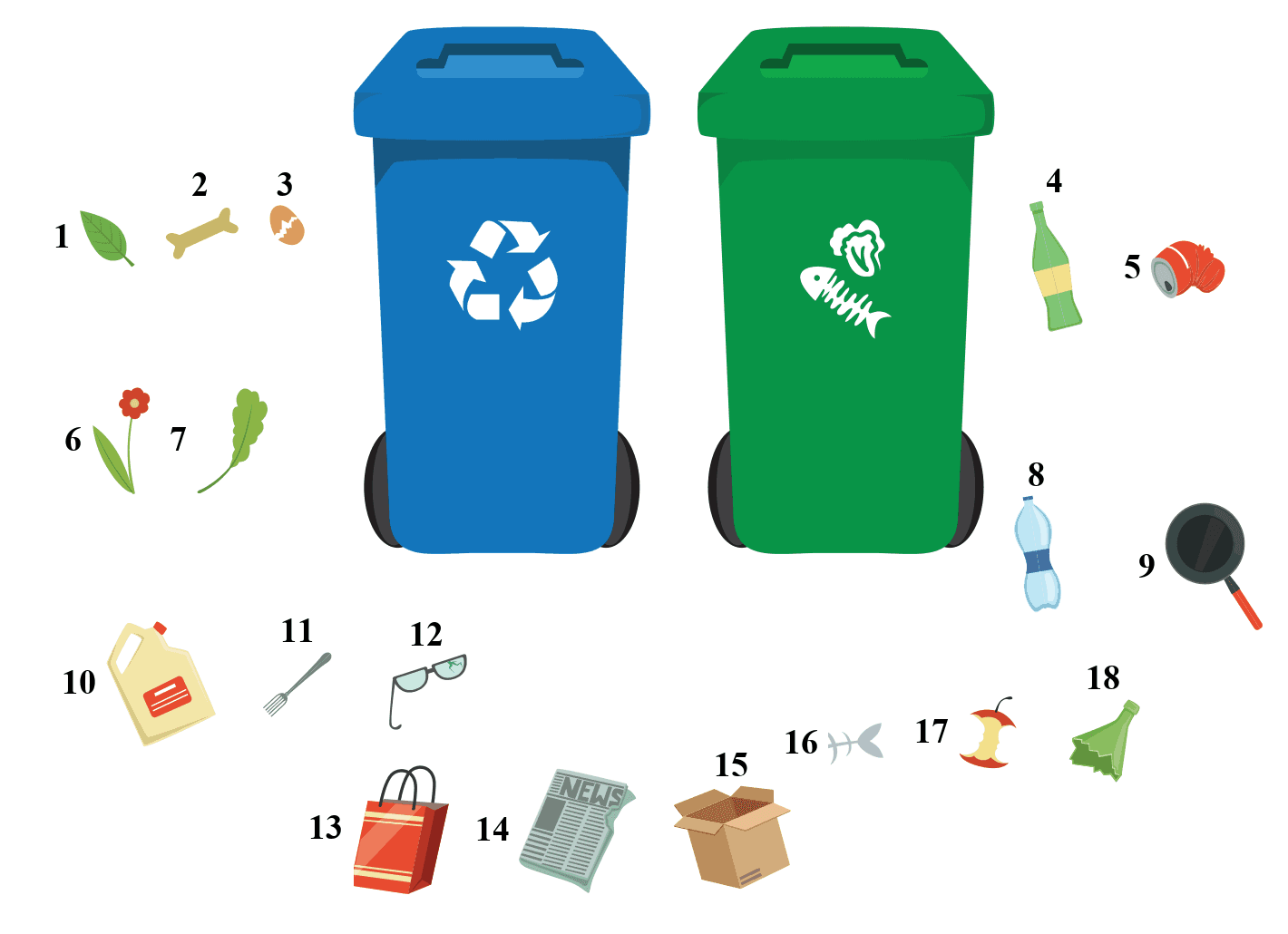
The items are: 1: a leaf; 2: a bone; 3: an eggshell; 4: a glass bottle; 5: a crushed drink can; 6: a flower; 7: a leafy vegetable leaf; 8: a plastic bottle; 9: a frying pan; 10: a plastic can; 11: a fork; 12: a pair of spectacles; 13: a paper shopping bag; 14: a newspaper; 15: a cardboard box; 16: fish bones; 17: an apple core; 18: a broken glass bottle.
Solve with AIWritten solution
Solution:
Concept: Biodegradable waste (food, plant and animal waste, paper) is broken down by microorganisms. Non-biodegradable waste (plastic, glass, metal) is not broken down and stays for hundreds of years.
Step 1 — Find the biodegradable items.
The leaf (1), bone (2), eggshell (3), flower (6), vegetable leaf (7), fish bones (16) and apple core (17) come from plants and animals. The paper bag (13), newspaper (14) and cardboard box (15) are made of paper, which comes from wood. Microorganisms break all of these down, so they are biodegradable.
Step 2 — Find the non-biodegradable items.
The glass bottles (4, 18) are glass. The drink can (5), frying pan (9) and fork (11) are metal. The plastic bottle (8) and plastic can (10) are plastic. The spectacles (12) are made of plastic, metal and glass. Microorganisms cannot break these down, so they are non-biodegradable.
Step 3 — Say which dustbin to use.
Kitchen, plant and animal waste (1, 2, 3, 6, 7, 16, 17) goes into the green dustbin. Plastic, glass and metal (4, 5, 8, 9, 10, 11, 12, 18) goes into the blue dustbin to be recycled. Clean, dry paper and cardboard (13, 14, 15) are also put in the blue dustbin in most towns, because they are sent for recycling.
Note: Paper and cardboard are biodegradable, but they are worth more when they are recycled into new paper, so they go with the dry waste.
Therefore, items 1, 2, 3, 6, 7, 13, 14, 15, 16 and 17 are biodegradable, and items 4, 5, 8, 9, 10, 11, 12 and 18 are non-biodegradable.
- 333 marks
Question 33
Why is plastic used so much even though it is the most harmful waste for our environment?
Solve with AIWritten solution
Solution:
Concept: Plastic is non-biodegradable. It does not rot, and it gives out poisonous gases when it is burnt. Even so, people use a lot of it because it has many useful properties.
Step 1 — It is cheap and light.
Plastic costs little to make and is very light, so plastic bags, bottles and boxes are cheap and easy to carry.
Step 2 — It is strong and waterproof.
Plastic does not break easily and does not let water through, so it is good for packing food, oil and medicines and for storing water.
Step 3 — It lasts long and is easy to shape.
Plastic does not rust or rot, and it can be moulded into almost any shape and colour. So it is used for toys, buckets, pipes, chairs and many other things.
Step 4 — Link this to the harm.
The same property that makes plastic last long, that it does not rot, is what makes plastic waste so harmful. It stays in the soil and water for hundreds of years.
Note: Plastic is one of the most harmful kinds of waste, but not the only harmful one. Old batteries and electronic waste (e-waste) are harmful too.
Therefore, plastic is used so much because it is cheap, light, strong, waterproof, long-lasting and easy to shape, even though it is very harmful as waste.
- 343 marks
Question 34
Why should we not immerse painted idols of Gods in rivers and oceans? What can we do as an alternative?
Solve with AIWritten solution
Solution:
Concept: Many idols are made of plaster of Paris and painted with bright paints. Plaster of Paris does not dissolve easily, and some paints contain harmful chemicals, such as metals like lead and chromium.
Step 1 — Say what happens to the water.
When such idols are immersed, the paints and plaster mix with the river or sea water. The water becomes polluted and unsafe for drinking and bathing.
Step 2 — Say what happens to living things.
The harmful chemicals can kill fish and other water animals, and they can reach us through fish and water. The plaster settles at the bottom and makes the river bed shallow and muddy.
Step 3 — Give alternatives.
We can use idols made of natural clay coloured with natural, plant-based colours, which dissolve safely. We can immerse idols in a tank or a bucket of water at home or in special ponds made by the town, instead of in rivers and the sea. Flowers and other offerings can be turned into compost.
Therefore, we should not immerse painted idols in rivers and oceans because their paints and plaster pollute the water and harm water animals; instead we can use clay idols with natural colours and immerse them in a tank, a bucket or a special pond.
What Class 5 Science Ch 12 covers
The sections of the chapter, in the order the book takes them. Every question above comes from one of these.
- 01Personal hygiene
- 02Cleanliness of clothes, food and water
- 03Diseases due to lack of cleanliness
- 04Biodegradable and non-biodegradable waste
- 05Managing waste – 3R
More ways to study this chapter
The same chapter asked three other ways. Practise it, revise it, and see what the board has set on Ch 12 before.
Class 5 Science Ch 12 questions students ask
How many questions are there in Class 5 Science Ch 12?
34 questions. Every one is solved step by step on this page.
Are these Class 5 Science solutions free?
Yes. Every question and its full working is free to read, with no account needed.
Can I download the Class 5 Science Ch 12 solutions as a PDF?
There is no PDF to download. Every solution is on this page instead, which means it is searchable, always the current syllabus, and readable on a phone. Use your browser's print option if you want it on paper.