Solution:
Concept: Biodegradable waste (food, plant and animal waste, paper) is broken down by microorganisms. Non-biodegradable waste (plastic, glass, metal) is not broken down and stays for hundreds of years.
Step 1 — Find the biodegradable items.
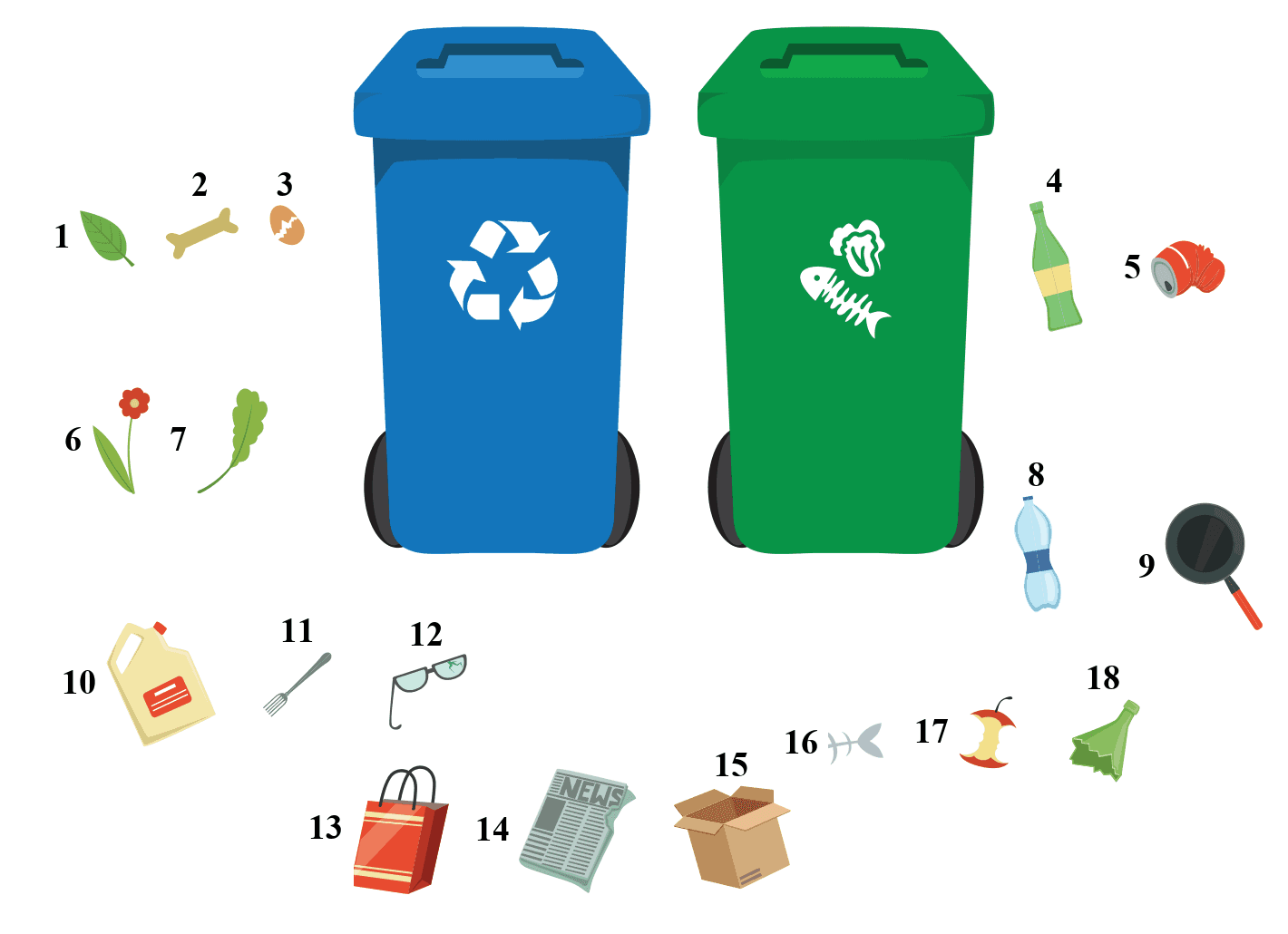
The leaf (1), bone (2), eggshell (3), flower (6), vegetable leaf (7), fish bones (16) and apple core (17) come from plants and animals. The paper bag (13), newspaper (14) and cardboard box (15) are made of paper, which comes from wood. Microorganisms break all of these down, so they are biodegradable.
Step 2 — Find the non-biodegradable items.
The glass bottles (4, 18) are glass. The drink can (5), frying pan (9) and fork (11) are metal. The plastic bottle (8) and plastic can (10) are plastic. The spectacles (12) are made of plastic, metal and glass. Microorganisms cannot break these down, so they are non-biodegradable.
Step 3 — Say which dustbin to use.
Kitchen, plant and animal waste (1, 2, 3, 6, 7, 16, 17) goes into the green dustbin. Plastic, glass and metal (4, 5, 8, 9, 10, 11, 12, 18) goes into the blue dustbin to be recycled. Clean, dry paper and cardboard (13, 14, 15) are also put in the blue dustbin in most towns, because they are sent for recycling.
Note: Paper and cardboard are biodegradable, but they are worth more when they are recycled into new paper, so they go with the dry waste.
Therefore, items 1, 2, 3, 6, 7, 13, 14, 15, 16 and 17 are biodegradable, and items 4, 5, 8, 9, 10, 11, 12 and 18 are non-biodegradable.