
Opening your dashboard
Class 5 Science Chapter 12 Cleanliness and Hygiene: Competency-Based Questions (CBQ)
40 questions on Chapter 12, each worked through on its own page with the AI tutor. Class 5 Science, ICSE 2026-27.
40 questions
1–5 marks · Mixed difficulty
- 11 mark
Question 1
Cognitive domain: Application
In July, Riya's family stops using their desert cooler because the weather has turned cool. There is still some water standing in it. A week later, many mosquitoes are seen in the house. What is the best thing the family should do with the cooler?
- 21 mark
Question 2
Cognitive domain: Analysis
After playing football, Arjun holds his hands under the tap for about five seconds and then eats his lunch. His friend says this does not make his hands clean. Which advice is best for Arjun?
- 31 mark
Question 3
Cognitive domain: Analysis
Meena's mother always hangs the washed clothes out in the sunshine instead of drying them in a dark corner of the room.
Assertion (A): Washed clothes should be dried in sunlight.
Reason (R): Sunlight dries clothes fully and helps to kill many germs on them.
- 41 mark
Question 4
Cognitive domain: Application
Some people in Kabir's colony have fallen ill with cholera. The tap water in his home looks clear and has no smell. What should his family do with the water before drinking it?
- 51 mark
Question 5
Cognitive domain: Analysis
The children of Class 5 collect fruit and vegetable peels from the school kitchen and put them into a pit in the school garden.
Assertion (A): Fruit and vegetable peels in the pit can be turned into compost.
Reason (R): Fruit and vegetable peels are non-biodegradable waste.
- 61 mark
Question 6
Cognitive domain: Analysis
Four children each picked up four things from the school ground for a cleanliness drive. Whose collection is made up only of biodegradable waste?
- 71 mark
Question 7
Cognitive domain: Application
Rohan, aged 9, has had loose, watery motions (diarrhoea) three times since the morning, and he feels weak. His mother wants to stop him from losing too much water. What should she give him to drink at once?
- 81 mark
Question 8
Cognitive domain: Understanding
After a birthday party, Sana has eaten cake, toffees and a cold drink. It is not yet time to brush her teeth. Give one thing she should do at once, and say why.
- 91 mark
Question 9
Cognitive domain: Application
Anya's younger brother has a habit of biting his nails, even after playing in the park. Give one reason why this habit can make him ill.
- 102 marks
Question 10
Cognitive domain: Understanding & Application
Read the passage and answer the questions.
Tara's head has been itching for a week. Her mother looks closely and finds tiny greyish insects moving in her hair, and small white eggs stuck firmly near the roots. "These are head lice and their eggs, called nits," she says. Tara is upset. "But I wash my hair every other day!" she cries. Two of her classmates also have itchy heads. Tara often shares her comb and her cap with her best friend.
(a) Does having lice mean that Tara's hair is dirty? Give a reason. (1 mark)
(b) Write two things Tara and her family should do now. (1 mark)
- 112 marks
Question 11
Cognitive domain: Application
Write whether each action below is an example of Reduce, Reuse or Recycle.
(i) Saying "No, thank you" to a plastic straw with a fresh lime drink
(ii) Making a pen stand out of an empty tin
(iii) Sending empty glass bottles to a factory where new bottles are made from them
(iv) Carrying a steel water bottle from home instead of buying bottled water
- 122 marks
Question 12
Cognitive domain: Analysis
The cleanliness club of a school weighed the waste collected in one day. (Hypothetical data.)
Kind of waste Mass (kg) Kitchen waste (peels, left-over food) 12 Paper and cardboard 8 Plastic wrappers and bottles 5 Glass 2 Metal cans 1 (a) How many kilograms of biodegradable waste were collected? (1 mark)
(b) How many kilograms of non-biodegradable waste were collected? (1 mark)
- 133 marks
Question 13
Cognitive domain: Application & Analysis
At a fair, a stall sells cut fruit and chaat. The fruit is kept on an open plate, and houseflies keep sitting on it. A heap of garbage lies just behind the stall, and the seller does not wash his hands between serving customers.
(a) Explain how the houseflies can make the fruit unsafe to eat. (1 mark)
(b) Name two diseases a person may get from eating this fruit. (1 mark)
(c) Suggest two changes the seller should make. (1 mark)
- 144 marks
Question 14
Cognitive domain: Evaluation
After a class picnic in a park, four friends suggest what to do with the waste: paper plates, banana peels, plastic wrappers and empty glass bottles.
- Ishaan: "Let's burn all of it here. Then nothing will be left."
- Kavya: "Let's bury the plastic wrappers and glass bottles in the soil. They will rot like the peels."
- Zoya: "Let's put the peels and paper plates in one bag and the wrappers and bottles in another, and drop them in the park's green and blue bins."
- Neel: "Let's leave it all under the tree. The park cleaners will pick it up."
(a) Whose idea is the best? Give a reason. (2 marks)
(b) Explain what is wrong with Ishaan's idea and with Kavya's idea. (2 marks)
- 155 marks
Question 15
Cognitive domain: Evaluation & Creativity
Many people in Priya's colony have fallen ill with dengue during the rainy season. The Residents' Club asks the children to run a "No Mosquito, No Dengue" week.
(a) Name two places in or near a home where the dengue mosquito may breed. (1 mark)
(b) Suggest two things every family can do to stop mosquitoes from breeding. (2 marks)
(c) Suggest one way people can protect themselves from mosquito bites. (1 mark)
(d) Write a short slogan for the week that gives a true fact. (1 mark)
- 161 mark
Question 16
Cognitive domain: Application
Four classmates describe how they brush their teeth. Whose method follows the rules for keeping teeth clean and healthy?
- 171 mark
Question 17
Cognitive domain: Application
Neel comes home from the park after a windy afternoon. His eyes feel itchy because of dust. Which step is best for him?
- 181 mark
Question 18
Cognitive domain: Analysis
At Sunita's house, the cooked food and the drinking water are always kept covered with lids.
Assertion (A): Cooked food and drinking water in the kitchen should be kept covered.
Reason (R): The Sun's rays help to kill disease-causing germs on washed clothes that are hung out to dry.
- 191 mark
Question 19
Cognitive domain: Analysis
Manav is ill with malaria. His friend Imran sits next to him at school all day long.
Assertion (A): Imran can catch malaria directly from Manav just by sitting next to him.
Reason (R): Malaria spreads when a female Anopheles mosquito bites a person who has malaria and then bites a healthy person.
- 201 mark
Question 20
Cognitive domain: Evaluation
Four students share their views about undergarments. Whose view is correct?
- 211 mark
Question 21
Cognitive domain: Analysis
A health teacher recorded the habits of three classes for four weeks and counted the children who had stomach upsets. (Hypothetical data.)
Class Washes hands before lunch Drinking-water jug Children with stomach upsets 5A Every day, with soap Covered 2 5B Some days, with water only Covered 6 5C Never Open, water taken out with a dipped glass 11 Which conclusion is best supported by the table?
- 221 mark
Question 22
Cognitive domain: Application
A school has a green dustbin for kitchen waste and other plant and animal waste, and a blue dustbin for plastic, glass and metal articles that can be recycled. In which pair has each item been put in the correct dustbin?
- 231 mark
Question 23
Cognitive domain: Understanding
Mohit takes a bath every day, but he only rinses the front of his body quickly with water. His grandmother says that some places need extra care while bathing, because dirt and sweat collect there. Which places does she mean?
- 241 mark
Question 24
Cognitive domain: Analysis
At a small railway station, passengers drop tea cups, food wrappers and left-over food on the platform all day. By evening the platform smells bad and houseflies swarm over it, although a few dustbins stand at fixed places on the platform. Which action would remove the cause of the problem?
- 251 mark
Question 25
Cognitive domain: Evaluation
A school expects 500 guests at its annual day. The committee compares four plans for serving snacks and cold drinks. (Hypothetical data.) Which plan will leave the least waste?
- 262 marks
Question 26
Cognitive domain: Application
Kabir plays football every evening. He wears the same sweaty socks and T-shirt for three days in a row without washing them, and he does not bathe after playing. After a week, the skin on his feet and back starts to itch and gets red patches. (Hypothetical situation.)
Explain the likely cause of the problem, and write one habit that would prevent it.
- 272 marks
Question 27
Cognitive domain: Analysis
A caterer empties the garbage bin of his kitchen, wipes his hands on his apron and then, without washing them, makes sandwiches for a party. Explain how this can make some guests ill, and say what he should have done.
- 282 marks
Question 28
Cognitive domain: Application
Roughly 80 out of every 100 items buried in landfills could be recycled. A town's landfill pit holds 500 buried items. (Hypothetical data.)
(i) About how many of these 500 items could have been recycled?
(ii) Name the one 'R' that would have kept these items out of the pit, and say what must be done to them.
- 292 marks
Question 29
Cognitive domain: Understanding
The kitchen of a village school sends its vegetable peels and left-over food to a small biogas plant. The plant gives gas for cooking and a manure for the school garden.
(i) Is this kitchen waste biodegradable? Give a reason.
(ii) Write one way in which the plant helps the school.
- 302 marks
Question 30
Cognitive domain: Understanding
Reena brushes her teeth twice a day, but she never cleans her tongue. Explain why this is not enough, and name what she can use.
- 312 marks
Question 31
Cognitive domain: Analysis
Dev wrote three notes in his notebook.
(i) Cholera spreads through the air.
(ii) The common cold spreads through contaminated water.
(iii) Stagnant water and garbage let mosquitoes, flies and bugs grow.
Two of the notes are wrong. Find them and write each one correctly.
- 323 marks
Question 32
Cognitive domain: Application
Sheela's mother puts peels, plastic bottles, newspapers and tin cans together in one polythene bag. A rag picker has to open the bag and sort the waste with her hands. Give three reasons why it is better to separate the waste at home.
- 333 marks
Question 33
Cognitive domain: Evaluation
Two families counted the items they threw away in one week. (Hypothetical data.)
Item thrown away Family Rao Family Singh Plastic carry bags 14 4 Plastic water bottles 10 0 Empty jam and pickle jars 3 0 (a) Find the total number of items thrown away by each family. (1 mark)
(b) Which family follows the ideas of 'Reduce' and 'Reuse' better? Give two points from the table to support your answer. (2 marks)
- 343 marks
Question 34
Cognitive domain: Analysis
An average plastic water bottle takes about 500 years to fully decompose. In the year 2026, Rhea throws an empty bottle in a park.
(a) In about which year will the bottle have fully decomposed? (1 mark)
(b) Why does the bottle stay for so long? (1 mark)
(c) What should Rhea do with the bottle instead? (1 mark)
- 353 marks
Question 35
Cognitive domain: Creativity
You have to speak at the school assembly about how to stop the common cold from spreading. Write a message of three sentences. Each sentence must give a different true step, and say why it helps.
- 363 marks
Question 36
Cognitive domain: Analysis
Say whether each situation in a kitchen is safe or unsafe for health, and give a reason.
(i) Meera pours drinking water into a clean steel bottle and closes its lid. (1 mark)
(ii) Cooked rice is left uncovered on the kitchen platform overnight, and cockroaches are seen crawling on the platform. (1 mark)
(iii) Sumit comes in from the playground and picks up a roti with his unwashed hands. (1 mark)
- 374 marks
Question 37
Cognitive domain: Analysis
The health teacher of a school noted how many children were absent each month because of fever or stomach upsets. The graph shows her record. (Hypothetical data.)
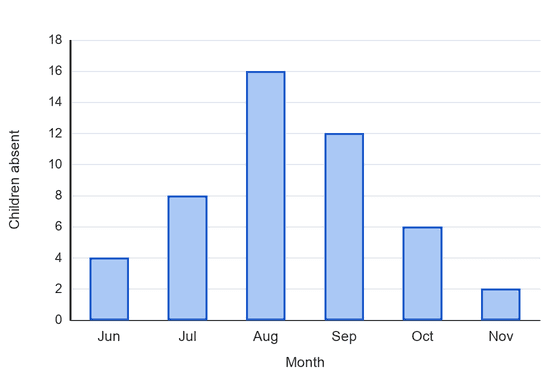
(a) In which month were the most children absent? (1 mark)
(b) How many more children were absent in August than in November? (1 mark)
(c) Give two reasons why more children fall ill in the rainy months. (2 marks)
- 385 marks
Question 38
Cognitive domain: Creativity
The canteen of Class 5 serves fruit juice in single-use plastic cups. The table shows the cups thrown away in one week. The peels of the fruit are also thrown into the same drum as the cups. (Hypothetical data.)
Day Mon Tue Wed Thu Fri Plastic cups thrown away 60 55 65 50 70 (a) How many plastic cups were thrown away in the week? (1 mark)
(b) Suggest two ideas to cut down the cup waste. One must use 'Reduce' and the other 'Reuse'. (2 marks)
(c) Design a plan for the fruit peels, and name the dustbin or pit you would use. (2 marks)
- 394 marks
Question 39
Cognitive domain: Analysis
A nurse checked 40 children of a school. She noted the problems below. (Hypothetical data.)
Problem found Number of children Cavities in the teeth 12 Long and dirty nails 8 Dandruff in the hair 6 (a) Which problem was the most common? How many more children had it than had dandruff? (1 mark)
(b) Name one habit that will help the children with long and dirty nails. (1 mark)
(c) Write two habits that will help to prevent cavities. (2 marks)
- 405 marks
Question 40
Cognitive domain: Evaluation
The residents' committee of Shanti Nagar finds three problems in the colony.
- Problem 1: A heap of garbage lies in the open at the corner of the lane, and houseflies swarm over it.
- Problem 2: A drain carrying dirty water is open right beside the public tap.
- Problem 3: Many families store water in open drums that stand unused for weeks.
The volunteers have time to tackle only one problem this week.
(a) For Problem 1 and Problem 2, explain how germs can reach people. (2 marks)
(b) Which problem should the volunteers tackle first? Give a reason. (2 marks)
(c) Write one thing every family can do at home to help. (1 mark)