
Opening your dashboard
Class 5 Maths Chapter 22: Patterns Solutions
3 textbook questions with step-by-step answers, free to read, for ICSE 2026-27.
Get talked through Ch 22, not just shown the answer
Reading a finished solution is not the same as being able to do it. The AI tutor takes one question at a time and works it with you, in your own words, until you can.
- Ask it out loud, in your own words
- It gives you the next step, not the answer
- Stuck on part (ii)? Start there
3 questions with solutions
3 marks · Easy difficulty
- 13 marks
Question 1
Draw one more figure at the end in each of the following geometrical patterns.
(a)

(b)
(c)
(d)

(e)
 Solve with AI
Written solution
Solution:
Concept: In a growing or turning pattern, the same change happens from one figure to the next. We find that change and make it once more to draw the next figure.
Step 1 — Part (a).
Look at which quarter of the circle is shaded. It is top-left, then top-right, then bottom-right, so the shading moves one quarter clockwise (the way a clock's hands move) each time. Next comes the bottom-left quarter.

Step 2 — Part (b).
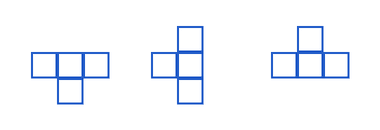
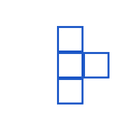
Look at where the single square sticks out. It is below, then on the left, then above, so the shape turns a quarter turn clockwise each time. Next the single square is on the right.
Step 3 — Part (c).
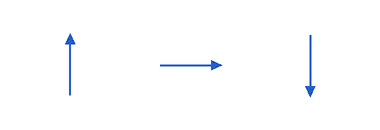
The arrow points up, then right, then down, so it turns a quarter turn clockwise each time. Next it points left.

Step 4 — Part (d).
Count the small circles. The first figure has 1 circle on top. The second has 2 on top and 2 on the right, and the third has 3 on top and 3 on the right. So each side gets one more circle each time, and the next figure has 4 circles on top and 4 on the right.

Step 5 — Part (e).
Look at the cut corner. It is top-right, then bottom-right, then bottom-left, so it moves one corner clockwise each time. Next the top-left corner is cut.

Watch out: Compare each figure with the one just before it; the change must be the same every time.
Therefore, the next figures are: (a) the bottom-left quarter shaded; (b) the single square on the right; (c) the arrow pointing left; (d) 4 circles on top and 4 on the right; (e) the top-left corner cut.
- 23 marks
Question 2
Observe the pattern and fill the next number.
(a) 1, 6, 11, 16, 21, .........
(b) 1, 2, 4, 8, 16, .........
(c) 1, 3, 7, 13, 21, .........
(d) 1, 6, 12, 19, 27, .........
(e) 35, 29, 24, 20, 17, .........
(f) 76, 71, 66, 61, 56, .........
(g) 48, 47, 45, 42, 38, .........
Solve with AIWritten solution
Solution:
Concept: To continue a number pattern, we look at how each number changes from the one before it (what is added, taken away or multiplied) and use the same rule once more.
Step 1 — Part (a).
Each number is 5 more than the one before it (6 − 1 = 5, 11 − 6 = 5, and so on). So we add 5 to 21.
Step 2 — Part (b).
Each number is 2 times the one before it (1, 2, 4, 8, 16 keep doubling). So we multiply 16 by 2.
Step 3 — Part (c).
The numbers added are 2, 4, 6, 8: each time 2 more than before. So next we add 10.
Step 4 — Part (d).
The numbers added are 5, 6, 7, 8: each time 1 more than before. So next we add 9.
Step 5 — Part (e).
The numbers taken away are 6, 5, 4, 3: each time 1 less than before. So next we take away 2.
Step 6 — Part (f).
Each number is 5 less than the one before it. So we take 5 away from 56.
Step 7 — Part (g).
The numbers taken away are 1, 2, 3, 4: each time 1 more than before. So next we take away 5.
Watch out: The change itself can grow or shrink (as in (c), (d), (e) and (g)); check the differences, not just the first one.
Therefore, the next numbers are (a) 26; (b) 32; (c) 31; (d) 36; (e) 15; (f) 51; (g) 33.
- 33 marks
Question 3
Observe the pattern and fill in the blanks.
(a)
1 × 1 = 1
11 × 11 = 1 2 1
111 × 111 = 1 2 3 2 1
1111 × 1111 = 1 2 3 4 3 2 1
11111 × 11111 = .........
111111 × 111111 = .........
(b)
9 × 9 = 8 1
99 × 9 = 8 9 1
999 × 9 = 8 9 9 1
9999 × 9 = .........
99999 × 9 = .........
(c)
2 × 2 − 1 × 1 = 2 + 1 = 3
3 × 3 − 2 × 2 = 3 + 2 = 5
4 × 4 − 3 × 3 = 4 + 3 = 7
5 × 5 − 4 × 4 = ......... = .........
6 × 6 − 5 × 5 = ......... = .........
7 × 7 − 6 × 6 = ......... = .........
(d) 2 + 4 + 6 + 8 + 10 + 12 + 14 + 16 + 18 + 20 = 2 × 55 = 110
3 + 6 + 9 + 12 + 15 + 18 + 21 + 24 + 27 + 30 = 3 × 55 = 165
4 + 8 + 12 + 16 + 20 + 24 + 28 + 32 + 36 + 40 = ......... = .........
5 + 10 + 15 + 20 + 25 + 30 + 35 + 40 + 45 + 50 = ......... = .........
7 + 14 + 21 + 28 + 35 + 42 + 49 + 56 + 63 + 70 = ......... = .........
Solve with AIWritten solution
Solution:
Concept: In these patterns we find the rule from the lines that are filled in, use it for the blank lines, and then check by working them out.
Step 1 — Part (a): find the rule.
In each answer the digits count up from 1 to the number of 1s, and then count back down to 1. For example, 1111 has four 1s, and its answer is 1 2 3 4 3 2 1.
Step 2 — Part (a): use the rule.
11111 has five 1s, so its answer counts up to 5 and back. 111111 has six 1s, so its answer counts up to 6 and back.
Step 3 — Part (b): find the rule.
Each answer starts with 8 and ends with 1. In between there is one 9 fewer than the number of 9s being multiplied: 999 × 9 gives 8 9 9 1, with two 9s in the middle.
Step 4 — Part (b): use the rule.
9999 has four 9s, so three 9s go in the middle; 99999 has five 9s, so four 9s go in the middle.
Step 5 — Part (c): find the rule.
Each line takes the square of a number away from the square of the next number. The answer is always the two numbers added together, for example 4 × 4 − 3 × 3 = 4 + 3.
Step 6 — Part (c): use the rule.
We write each blank line in the same way and check it by working out the squares.
Step 7 — Check part (c).
Working out the squares gives the same answers.
Step 8 — Part (d): find the rule.
Each line adds the first ten multiples of one number. Since 1 + 2 + 3 + … + 10 = 55, the sum is that number times 55. For example, 2 + 4 + … + 20 is 2 × 55.
Step 9 — Part (d): use the rule.
The first numbers of the blank lines are 4, 5 and 7, so we multiply each by 55.
Watch out: In part (a) the pattern only works up to nine 1s; after that, carrying spoils it.
Therefore, (a) 123454321 and 12345654321; (b) 89991 and 899991; (c) 5 + 4 = 9, 6 + 5 = 11 and 7 + 6 = 13; (d) 4 × 55 = 220, 5 × 55 = 275 and 7 × 55 = 385.
What Class 5 Maths Ch 22 covers
The sections of the chapter, in the order the book takes them. Every question above comes from one of these.
- 01More About Number Patterns
- 02Growing and Reducing Patterns
More ways to study this chapter
The same chapter asked three other ways. Practise it, revise it, and see what the board has set on Ch 22 before.
Class 5 Maths Ch 22 questions students ask
How many questions are there in Class 5 Maths Ch 22?
3 questions. Every one is solved step by step on this page.
Are these Class 5 Maths solutions free?
Yes. Every question and its full working is free to read, with no account needed.
Can I download the Class 5 Maths Ch 22 solutions as a PDF?
There is no PDF to download. Every solution is on this page instead, which means it is searchable, always the current syllabus, and readable on a phone. Use your browser's print option if you want it on paper.