
Opening your dashboard
Class 5 Maths Chapter 22 Patterns: Practice Questions
40 questions on Chapter 22, each worked through on its own page with the AI tutor. Class 5 Maths, ICSE 2026-27.
40 questions
1–4 marks · Mixed difficulty
- 11 mark
Question 1
Bloom's level: Remember
An arrangement of letters of the English alphabet according to some rule is called a
- 21 mark
Question 2
Bloom's level: Remember
The numbers 1, 4, 9, 16, 25, … form the
- 31 mark
Question 3
Bloom's level: Understand
Which of these is a reducing pattern?
- 41 mark
Question 4
Bloom's level: Understand
The first four figures of the triangular number pattern are shown below.
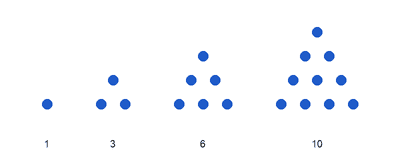
The 5th figure of this pattern will have
- 51 mark
Question 5
Bloom's level: Apply
What is the next number in the pattern 7, 15, 23, 31, ___ ?
- 61 mark
Question 6
Bloom's level: Apply
What is the 9th unit of the square number pattern 1, 4, 9, 16, …?
- 71 mark
Question 7
Bloom's level: Apply
Using the rule , the 10th unit of the triangular number pattern is
- 81 mark
Question 8
Bloom's level: Analyse
The shapes below repeat in the same order again and again.

What will the 20th shape be?
- 91 mark
Question 9
Bloom's level: Analyse
Look at the two patterns:
Pattern P: 3, 6, 12, 24, …
Pattern Q: 3, 6, 9, 12, …
Which statement is correct?
- 101 mark
Question 10
Bloom's level: Understand
Assertion (A): 36 is a square number.
Reason (R): 36 dots can be arranged in 6 rows of 6 dots each.
- 111 mark
Question 11
Bloom's level: Evaluate
Assertion (A): 50 is a unit of the triangular number pattern.
Reason (R): The units of the triangular number pattern are given by the rule .
- 121 mark
Question 12
Bloom's level: Understand
Assertion (A): 100, 90, 80, 70, … is a reducing pattern.
Reason (R): In the chart of numbers 1 to 100, the numbers in each column increase by 10 from top to bottom.
- 131 mark
Question 13
Bloom's level: Remember
What is a pattern? Name the three kinds of patterns given in the chapter.
- 141 mark
Question 14
Bloom's level: Remember
Write the rule for finding the th unit of the triangular number pattern. What does stand for?
- 152 marks
Question 15
Bloom's level: Understand
How is a growing pattern different from a reducing pattern? Give one example of each, with its rule.
- 162 marks
Question 16
Bloom's level: Apply
Write the next two terms of each letter pattern:
(a) AZ, BY, CX, ___, ___
(b) A, C, F, J, ___, ___
- 172 marks
Question 17
Bloom's level: Apply
Extend the pattern backwards: write the two numbers that come before 41.
___, ___, 41, 52, 63, 74
- 182 marks
Question 18
Bloom's level: Apply
Find:
(a) the 15th unit of the triangular number pattern
(b) the 15th unit of the square number pattern
- 192 marks
Question 19
Bloom's level: Apply
Find the rule and write the next two numbers:
(a) 81, 72, 64, 57, 51, ___, ___
(b) 2, 5, 11, 23, 47, ___, ___
- 202 marks
Question 20
Bloom's level: Understand
In the triangular number pattern, explain why the 8th figure has 8 rows. Then find the number of dots in the 8th figure by adding the rows.
- 212 marks
Question 21
Bloom's level: Analyse
In the chart of numbers 1 to 100 (10 numbers in each row):
(a) Start at 7 and move diagonally down to the right three times. Which numbers do you land on?
(b) Start at 10 and move diagonally down to the left three times. Which numbers do you land on?
Why does one diagonal go up by 11 and the other by 9?
- 222 marks
Question 22
Bloom's level: Evaluate
Tara says:
(1) "210 is the 20th unit of the triangular number pattern."
(2) "400 is the 21st unit of the square number pattern."
Check each statement and say whether it is right. Correct any wrong statement.
- 234 marks
Question 23
Bloom's level: Apply
Squares are made in a row with matchsticks, as shown.
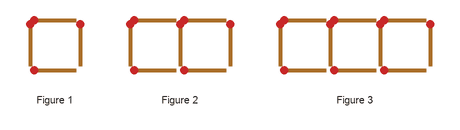
(a) Write the number of matchsticks in Figures 1, 2 and 3. What is the rule?
(b) How many matchsticks are needed for 10 squares in a row?
(c) How many squares in a row can be made with exactly 40 matchsticks?
- 244 marks
Question 24
Bloom's level: Apply
Case study — The PT display
For a PT display, the students of a school stand in a square: the same number of rows and columns.
(a) If there are 7 rows, how many students are there?
(b) 100 students want to stand in a square. How many students will be in each row?
(c) On the day of the display 130 students come. What is the biggest square they can make, and how many students are left out? How many more students would be needed to make the next bigger square?
- 254 marks
Question 25
Bloom's level: Analyse
Case study — Meera's piggy bank
Meera puts ₹ 5 into her piggy bank in week 1, ₹ 8 in week 2, ₹ 11 in week 3, and so on, following the same rule.
(a) What is the rule of this growing pattern?
(b) How much does she put in during week 8?
(c) How much has she saved in all after 6 weeks? In which week will she put in ₹ 41?
- 263 marks
Question 26
Bloom's level: Analyse
Add each pair of neighbouring triangular numbers:
(a) What kind of numbers are the answers?
(b) Use what you notice to find the sum of the 10th and 11th triangular numbers without adding them. Then check by adding.
- 273 marks
Question 27
Bloom's level: Understand
Look at this pattern of symbols:
▲ ● ● ▲ ● ● ▲ ● ● …
(a) What is a geometrical pattern? Is this one?
(b) What is the repeating unit of this pattern? How many symbols does it have?
(c) Explain how the repeating unit helps you find the 30th symbol without drawing all of them. What is the 30th symbol?
- 284 marks
Question 28
Bloom's level: Evaluate
Case study — Who is right?
The teacher writes: 1, 2, 4, ___
Ravi says the next number is 8. Priya says the next number is 7.
(a) What rule could Ravi be using?
(b) What rule could Priya be using?
(c) Who is right? Write the next three numbers in each of their patterns, and say what the teacher should do so that only one answer is correct.
- 293 marks
Question 29
Bloom's level: Create
(a) Make your own growing pattern that starts at 4, so that its 6th number lies between 50 and 70. Write the rule and the first six numbers.
(b) Make your own reducing pattern that starts at 100 and reaches exactly 0. Write the rule and all its numbers.
- 304 marks
Question 30
Bloom's level: Create
Design a growing geometrical pattern using small squares.
(a) Draw the first three figures of your pattern.
(b) Write the number of squares in each figure as a number pattern, and its rule.
(c) Use your rule to find the number of squares in the 10th figure.
- 311 mark
Question 31
The next number in the pattern 2, 6, 12, 20, 30, ___ is :
- 321 mark
Question 32
In the reducing pattern 160, 80, 40, 20, ___, each number is half of the number before it. The next number is :
- 331 mark
Question 33
The triangular number pattern is 1, 3, 6, 10, 15, ___ . The number that comes after 15 is :
- 342 marks
Question 34
Look at the growing pattern 3, 6, 12, 24, ___, ___ .
(a) Write the rule of the pattern.
(b) Write the next two numbers.
- 352 marks
Question 35
(a) Write the next two letters of the pattern A, E, I, M, ___, ___ .
(b) Write the first six numbers of the triangular number pattern.
- 362 marks
Question 36
A packet has 120 sheets of paper. A teacher uses 8 sheets every day.
(a) Write the number of sheets left at the end of each of the first 5 days.
(b) At the end of which day will 40 sheets be left ?
- 372 marks
Question 37
In the chart of the numbers 1 to 100, there are 10 numbers in each row.
(a) Which number is just below 37 and which number is just above 37 ?
(b) The numbers 6, 16, 26 are in the same column. Write the next two numbers of the pattern.
- 383 marks
Question 38
Rohan saves ₹ 15 in the first week, ₹ 20 in the second week, ₹ 25 in the third week, and so on, in the same way.
(a) How much does he save in the 5th week ?
(b) How much does he save in the first 5 weeks in all ?
(c) In which week does he save ₹ 50 ?
- 394 marks
Question 39
The figure shows the first three figures of a growing pattern of dots.
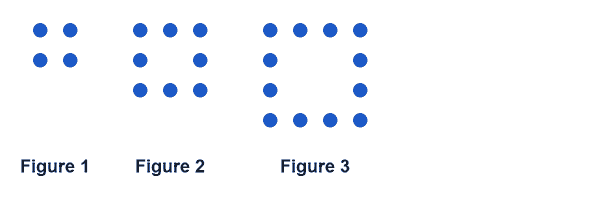
(a) Write the number of dots in Figures 1, 2 and 3.
(b) How many dots will Figure 4 have ?
(c) How many dots will Figure 6 have ?
(d) Which figure will have 40 dots ?
- 404 marks
Question 40
Observe the pattern.
Use the pattern to write the answers of :
(a)
(b)
(c)
(d) By what number must 37 be multiplied to get 777 ?