
Opening your dashboard
Class 5 Maths Chapter 22 Patterns: Competency-Based Questions (CBQ)
40 questions on Chapter 22, each worked through on its own page with the AI tutor. Class 5 Maths, ICSE 2026-27.
40 questions
1–5 marks · Mixed difficulty
- 11 mark
Question 1
Competency: Understanding
A pattern is an arrangement that follows some rule.
Which of these is not a pattern?
- 21 mark
Question 2
Competency: Application
A shopkeeper stacks tins in a triangle. The top row has 1 tin, the next row has 2 tins, and so on. A small display with 4 rows is shown.

For a festival, he makes a big display in the same way with 12 tins in the bottom row. How many tins does he need in all?
- 31 mark
Question 3
Competency: Application
The seats in a school hall are numbered 1 to 100, with 10 seats in each row, just like the chart of numbers 1 to 100. Row 1 (seats 1 to 10) is at the front.
Meena sits on seat 36. Her friend sits exactly two rows behind her, in the same column. What is her friend's seat number?
- 41 mark
Question 4
Competency: Analysis
A water tank has 500 litres of water on the morning of Day 1. The family uses 35 litres every day, and no water is added.
The morning readings make the pattern 500, 465, 430, …
On the morning of which day will the reading be less than 300 litres for the first time?
- 51 mark
Question 5
Competency: Analysis
Ria has 45 marbles. She wants to use all of them to make one dot pattern, with no marble left over.
Which pattern can she make?
- 61 mark
Question 6
Competency: Understanding
Assertion (A): The amounts of juice left in a jug, 96 mL, 48 mL, 24 mL, 12 mL, make a reducing pattern.
Reason (R): A pattern is a reducing pattern only when the same number is subtracted each time.
- 72 marks
Question 7
Competency: Application
The morning bus timetable at a bus stop follows a pattern. Rain has washed away the first two timings.
___, ___, 7:10 a.m., 7:35 a.m., 8:00 a.m., 8:25 a.m.
Find the rule and write the two missing timings.
- 82 marks
Question 8
Competency: Application
In a school hall, some rows are left empty for walking. The rows that have chairs are labelled
B, E, H, K, …
(a) Write the rule of this letter pattern and the next two labels.
(b) Will there be a row labelled T? Show how you know.
- 92 marks
Question 9
Competency: Evaluation
For a puja, laddoos are arranged on a tray in a triangle: 1 in the first row, 2 in the second row, and so on. The last row has 16 laddoos.
Kabir finds the total number of laddoos like this:
Is Kabir's answer correct? If not, explain his mistake and find the correct total.
- 102 marks
Question 10
Competency: Analysis
On Diwali, Asha arranges diyas in a triangle on the floor: 1 diya in the first row, 2 in the second row, 3 in the third row, and so on.
She uses exactly 55 diyas. How many rows does her triangle have? Show how you found it.
- 113 marks
Question 11
Competency: Analysis
In a school kho-kho league, every team plays one match against every other team. The sports teacher makes this table.
Number of teams 2 3 4 5 Number of matches 1 3 6 10 (a) How does the number of matches grow each time one more team joins?
(b) Extend the pattern to find the number of matches when 8 teams play.
(c) Which number pattern of the chapter do these numbers make? Check your answer to part (b) with its rule.
- 123 marks
Question 12
Competency: Analysis & Evaluation
Grandfather will give Anu some money every day for 6 days. She must choose one plan.
Plan A: ₹ 50 on day 1, and then ₹ 10 more each day than the day before.
Plan B: ₹ 5 on day 1, and then double the amount of the day before.
Anu says, "Plan B is better, because on day 6 it gives more money than Plan A."
Write the six amounts for each plan. Is Anu's reason correct? Which plan should she choose, and by how much is it better?
- 133 marks
Question 13
Competency: Creativity
Design a border for a greeting card using only the two shapes ▲ and ●. Your border must be a geometrical pattern that obeys both these conditions:
- the repeating unit has exactly 4 shapes, and it uses both ▲ and ●;
- the 10th shape of the border is ▲.
Write your repeating unit and the first 12 shapes of the border. Show that the 10th shape is ▲.
- 145 marks
Question 14
Competency: Analysis & Evaluation
Case study — The calendar page
The calendar page for October 2026 hangs in Sana's classroom. A calendar is a chart of numbers with 7 numbers in each row.
Sun Mon Tue Wed Thu Fri Sat 1 2 3 4 5 6 7 8 9 10 11 12 13 14 15 16 17 18 19 20 21 22 23 24 25 26 27 28 29 30 31 (a) Write the dates of all the Mondays. What is the rule of this pattern? Why does a calendar follow this rule?
(b) Start at 6 and move diagonally down to the right three times. Then start at 10 and move diagonally down to the left three times. Write the dates you land on and the rule of each pattern. Explain why the two rules are different.
(c) Sana has a dance class every Friday. The last Friday of October is the 30th. Sana says, "My first dance class in November is on the 7th." Is she right? Without looking at the next page, find the dates of all her dance classes in November. (November has 30 days.)
- 154 marks
Question 15
Competency: Application & Analysis
Case study — Saplings along the school road
On Van Mahotsav, the students plant saplings in a line along a straight road that is 400 m long. The first sapling is at the school gate (0 m). After that, there is a sapling every 40 m, up to the 400 m mark. The number line shows the first few saplings.
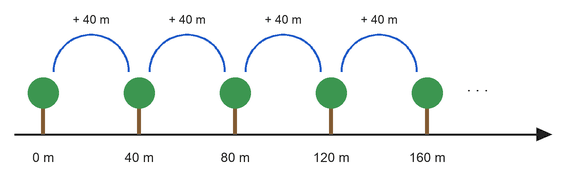
(a) Write the rule of the pattern made by the sapling positions. At what distances are the 5th, 6th and 7th saplings?
(b) How many saplings are planted in all, from 0 m to 400 m?
(c) Every evening the gardener starts at the 400 m sapling and walks back towards the gate. He waters that sapling and then every third sapling after it. Write the positions of the saplings he waters and the rule of this pattern. Does the sapling at the gate get water?
- 161 mark
Question 16
Competency: Analysis
(Hypothetical data.) For Independence Day, a string of 100 flags is hung in a repeating order: saffron, white, green, saffron, white, green, and so on. The first flag is saffron.
How many of the 100 flags are green?
- 171 mark
Question 17
Competency: Analysis
Two frogs start at 0 on a number line. Frog A jumps 4 steps each time and Frog B jumps 6 steps each time, both in the forward direction.
What is the first number, other than 0, on which both frogs land?
- 181 mark
Question 18
Competency: Analysis
Hema studies the square number pattern made with dots and notices that
She uses this pattern to add the first nine odd numbers, . What is the sum?
- 191 mark
Question 19
Competency: Analysis
The figure shows a triangle of dots with 4 rows (dark dots). A copy of it, turned upside down (light dots), is fitted next to it. Together they make a rectangle of 4 rows with 5 dots in each row.
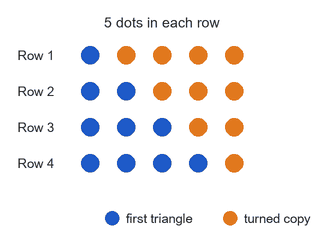
Dev uses the same idea for a triangle of dots with 14 rows, where row 1 has 1 dot, row 2 has 2 dots, and so on. How many dots are there in this triangle?
- 201 mark
Question 20
Competency: Application
Observe the pattern.
Following the same pattern, what is ?
- 211 mark
Question 21
Competency: Evaluation
Assertion (A): The pattern 7, 7, 7, 7, … is a growing pattern.
Reason (R): Each number in this pattern is the same as the number before it.
- 221 mark
Question 22
Competency: Evaluation
Assertion (A): The 1st unit of the triangular number pattern and the 1st unit of the square number pattern are both 1.
Reason (R): Every unit of the square number pattern is greater than the unit in the same place of the triangular number pattern.
- 231 mark
Question 23
Competency: Application
(Hypothetical data.) A taxi charges ₹ 40 for the first kilometre and ₹ 12 for every extra kilometre. The fares for 1 km, 2 km and 3 km are ₹ 40, ₹ 52 and ₹ 64.
Rishi pays ₹ 124. How many kilometres did he travel?
- 241 mark
Question 24
Competency: Analysis
Which of these numbers is not a unit of the square number pattern 1, 4, 9, 16, 25, …?
- 251 mark
Question 25
Competency: Application
(Hypothetical data.) In a secret code, every letter is written as the letter that is 3 places after it in the English alphabet: A is written as D, B as E, C as F, and so on.
How is the word MAP written in this code?
- 262 marks
Question 26
Competency: Application
(Hypothetical data.) A toy bowling set has pins set up in a triangle: 1 pin in the front row, 2 in the next row, and so on. A small set has 5 rows, with 15 pins. A bigger set has 8 rows.
How many more pins does the bigger set need? Find the answer by adding only the new rows.
- 272 marks
Question 27
Competency: Analysis
(Hypothetical data.) The buses of a school are given codes in this order:
A1, C2, E3, G4, …
(a) Write the next two codes.
(b) What is the code of the 10th bus?
- 282 marks
Question 28
Competency: Application
(Hypothetical data.) A monkey climbs a greasy pole that is 11 m tall. In every minute it first climbs up 3 m and then slips back 1 m. In the first minute the highest point it reaches is 3 m. In the second minute the highest point is 5 m, and in the third minute it is 7 m.
(a) Write the rule of the pattern of highest points, and the highest points in the 4th and 5th minutes.
(b) In which minute does the monkey first reach the top of the pole?
- 292 marks
Question 29
Competency: Evaluation
Ria looks at the square number pattern 1, 4, 9, 16, 25, … and says, "It is a growing pattern in which 3 is added each time, so the next number is 28."
(a) Is Ria right? Find what is added each time to check.
(b) Write the correct next two numbers.
- 302 marks
Question 30
Competency: Analysis
(Hypothetical data.) For a school function, flower pots are placed in a square, with the same number of rows and columns. The figure shows 6 rows and 6 columns, where each dot is one flower pot. The pots on the outer edge are red (dark dots).

(a) How many red pots are there in this square? Find the answer without counting the dark dots one by one.
(b) Using the same idea, how many red pots are there in a square of 9 rows and 9 columns?
- 312 marks
Question 31
Competency: Creativity
The sports teacher wants a number pattern for lucky coupons. It must be a growing pattern in which the same whole number is added each time, and the 4th number must be 30.
Make your own pattern. Write its first six numbers and its rule, and show that the 4th number is 30.
- 323 marks
Question 32
Competency: Analysis
(Hypothetical data.) In a pond, a water plant spreads so that the area it covers doubles every day. On day 12 the whole pond is covered.
(a) What fraction of the pond is covered on day 11?
(b) What fraction of the pond is covered on day 9?
(c) On which day is exactly of the pond covered?
- 333 marks
Question 33
Competency: Analysis
The figure shows the first four figures of the square number pattern made with dots. In each figure, the orange dots are the dots added to the figure before it.
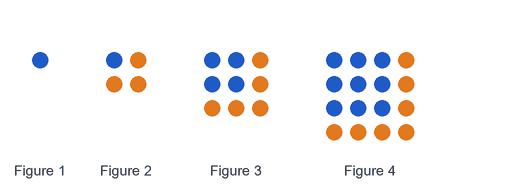
(a) How many dots must be added to Figure 4 to make Figure 5?
(b) How many dots must be added to Figure 7 to make Figure 8?
(c) Figure 9 has 81 dots. Without counting rows, find the number of dots in Figure 10.
- 343 marks
Question 34
Competency: Analysis & Evaluation
Look at the 9 times table.
(a) What happens to the tens digit and to the ones digit as we go from one number to the next in 9, 18, 27, 36, 45?
(b) Use this digit pattern to fill the four blanks.
(c) Rohan says, "The same digit pattern will give the number after 90." Is he right? Find the number after 90 and explain.
- 353 marks
Question 35
Competency: Application & Analysis
(Hypothetical data.) Meena draws a kolam of dots on the floor. It has 7 rows, as shown in the figure.
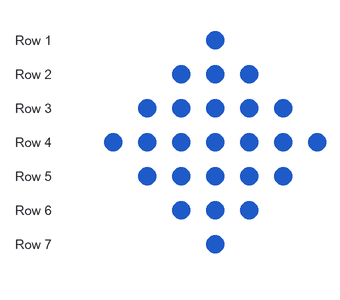
(a) Write the number of dots in each row from Row 1 to Row 7. Which rows form a growing pattern, and which rows form a reducing pattern?
(b) How many dots are there in the whole kolam?
(c) Meena draws a bigger kolam in the same way. Its middle row has 9 dots. How many dots are there in the whole kolam?
- 363 marks
Question 36
Competency: Analysis & Evaluation
(Hypothetical data.) Two fruit sellers stack oranges. Seller A stacks them in a triangle of 13 rows: 1 orange in the top row, 2 in the next row, and so on. Seller B stacks them in a square of 10 rows with 10 oranges in each row.
Seller A says, "My stack has more rows than yours, so I have more oranges."
(a) How many oranges does each seller have?
(b) Who has more oranges, and by how many?
(c) Is Seller A's reason correct? Explain.
- 375 marks
Question 37
Competency: Application & Evaluation
Case study — The picnic news
(Hypothetical data.) A school with 500 students plans a picnic. In the morning of Day 1, 2 students hear the news. Every day, each student who knows the news tells 2 new students, so the number of students who know the news becomes 3 times the number of the day before. The table shows the first four days.
Day 1 2 3 4 Students who know the news 2 6 18 54 (a) Write the rule of the pattern. How many students know the news on Day 5 and on Day 6?
(b) Do all 500 students know the news on Day 6? How many do not?
(c) Arjun says, "On Day 7 the pattern gives 1,458, so 1,458 students will know the news." Is Arjun right? On which day does the whole school first know the news?
- 384 marks
Question 38
Competency: Application & Analysis
Case study — The tile designs
(Hypothetical data.) A mason makes plus-shaped designs with square tiles for a garden path. The figure shows the first three designs.
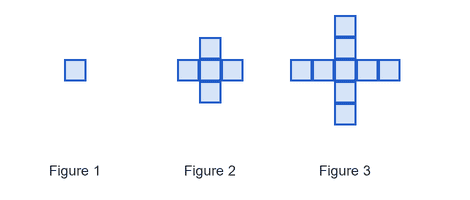
Every tile costs ₹ 12.
(a) Write the number of tiles in Figures 1, 2 and 3 as a number pattern. What is its rule?
(b) How many tiles are needed for Figure 10, and what do they cost?
(c) The mason has ₹ 1,000. What is the biggest figure he can make, and how much money is left?
- 394 marks
Question 39
Competency: Analysis & Evaluation
Case study — Skip counting by 4
Rohan skip counts by 4 starting from 4 and writes the list. The table shows the first ten numbers and their ones digits.
Number of the term 1 2 3 4 5 6 7 8 9 10 The number 4 8 12 16 20 24 28 32 36 40 Ones digit 4 8 2 6 0 4 8 2 6 0 (a) Which group of ones digits repeats again and again? How many digits does it have?
(b) What is the ones digit of the 23rd number in Rohan's list?
(c) Rohan says, "150 ends in 0, so 150 is in my list." Is he right? Explain.
- 405 marks
Question 40
Competency: Analysis
Case study — Two water tanks
(Hypothetical data.) Water is taken out of two tanks, A and B, by pumps. The levels are noted every 10 minutes.
Time (minutes) 0 10 20 30 Tank A (litres) 9000 8250 7500 6750 Tank B (litres) 6000 5700 5400 5100 (a) Write the rule of the pattern for each tank.
(b) How many litres are left in each tank after 60 minutes?
(c) At the first reading when Tank A has less water than Tank B, what are the two levels? At which time is that?