
Question 432 marksMedium
Symbolically represent a -- transistor. Show the biasing of -- transistor and explain the transistor action.
Confirming your payment
Sign up now and get 250 free tokens.
Junction Transistor · Question 43 of 62
Symbolically represent a -- transistor. Show the biasing of -- transistor and explain the transistor action.
Solution:
Concept: For transistor action the emitter–base junction is forward biased and the collector–base junction is reverse biased. In a -- transistor the current is carried mainly by holes.
Step 1 — Symbol. In the -- symbol the arrow on the emitter points towards the base, in the direction of conventional current.
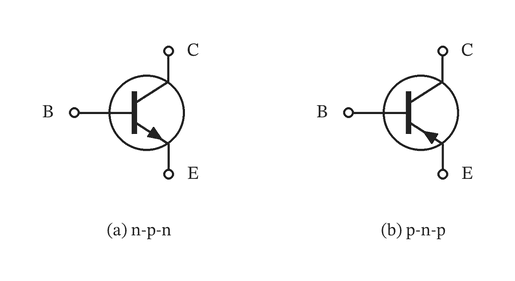
Step 2 — Biasing. The battery makes the emitter positive with respect to the base (forward bias), and the battery makes the collector negative with respect to the base (reverse bias).

Step 3 — Transistor action. The positive terminal of drives a large number of holes from the heavily doped emitter into the base; this is the emitter current . Only about 2 % of them recombine with electrons in the thin, lightly doped base, giving the small base current . The rest are swept across the reverse-biased collector junction and taken up by electrons from the negative terminal of , giving the collector current .

Step 4 — Relate the currents. As in any transistor, the currents obey
Therefore, the -- symbol is drawn with its emitter arrow pointing towards the base (figure (b) above); with the emitter junction forward biased and the collector junction reverse biased, holes flow from the emitter through the thin base to the collector, so that .