
Question 442 marksMedium
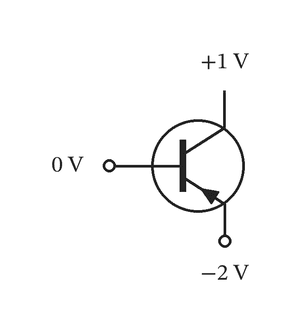
In the given figure, is (i) the emitter and (ii) the collector forward or reverse biased? With the help of a circuit diagram, explain the action of a -- transistor.
Confirming your payment
Sign up now and get 250 free tokens.
Junction Transistor · Question 44 of 62
In the given figure, is (i) the emitter and (ii) the collector forward or reverse biased? With the help of a circuit diagram, explain the action of a -- transistor.
Solution:
Concept: A junction is forward biased when its side is at the higher potential. The arrow on the emitter in the figure points towards the base, so the transistor shown is a -- transistor: emitter and collector -type, base -type.
Step 1 — Judge the emitter junction. The emitter is at and the base at . The side is lower, so the emitter junction is reverse biased.
Step 2 — Judge the collector junction. The collector is at and the base at . The side is higher, so the collector junction is forward biased. (This is the opposite of the normal working condition.)
Step 3 — Draw the working circuit of an -- transistor. For transistor action the emitter–base junction must be forward biased by and the collector–base junction reverse biased by .
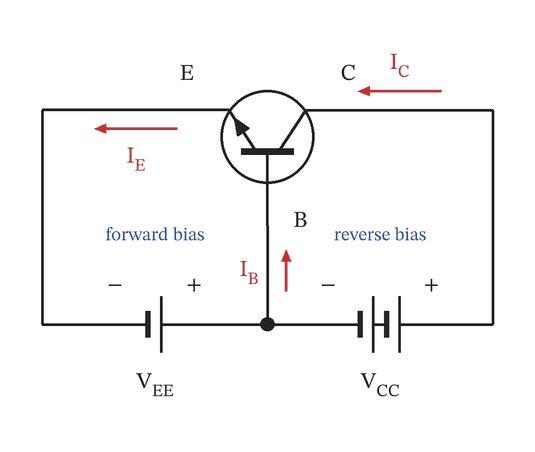
Step 4 — Explain the action. Electrons from the heavily doped emitter are driven into the base, forming . Only about 2 % recombine with holes in the thin, lightly doped base, forming the small base current ; the rest cross the reverse-biased collector junction and are attracted by the positive terminal of , forming . So , and the small base current controls the large collector current.
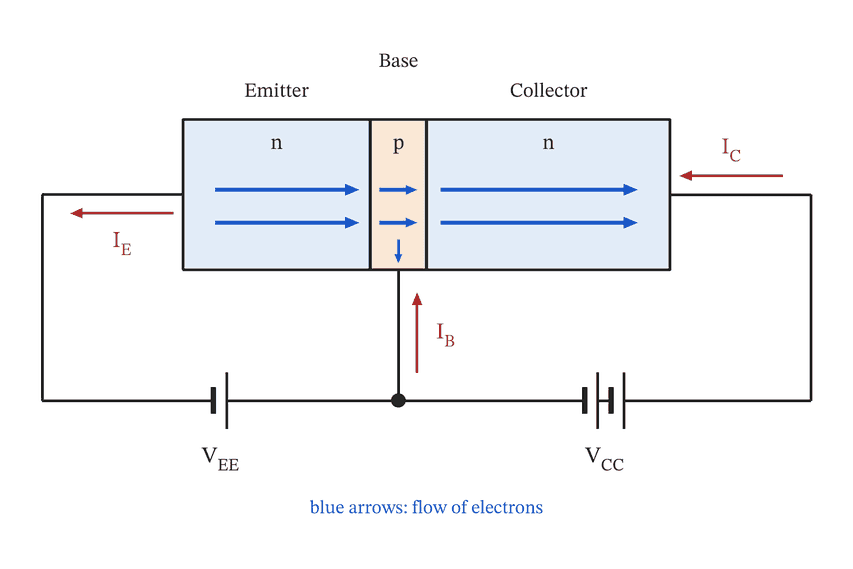
Therefore, in the given -- transistor (i) the emitter is reverse biased and (ii) the collector is forward biased; in a working -- transistor the emitter junction is forward biased and the collector junction reverse biased, and electrons flow from emitter to collector with .