
Question 422 marksMedium
Give the symbol of an -- transistor. Show the biasing of an -- transistor and explain the transistor action.
Confirming your payment
Sign up now and get 250 free tokens.
Junction Transistor · Question 42 of 62
Give the symbol of an -- transistor. Show the biasing of an -- transistor and explain the transistor action.
Solution:
Concept: For transistor action the emitter–base junction is forward biased and the collector–base junction is reverse biased. In an -- transistor the current is carried mainly by electrons.
Step 1 — Symbol. In the -- symbol the arrow on the emitter points away from the base, in the direction of conventional current.

Step 2 — Biasing. The battery makes the emitter negative with respect to the base (forward bias), and the battery makes the collector positive with respect to the base (reverse bias).
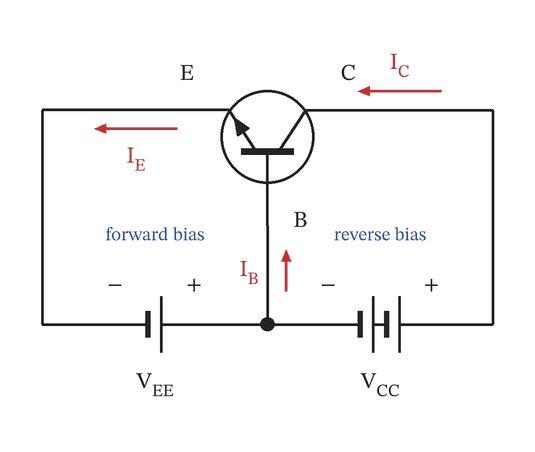
Step 3 — Transistor action. The forward bias drives a large number of electrons from the heavily doped emitter into the base; this is the emitter current . The base is thin and lightly doped, so only about 2 % of them recombine with holes there, giving the small base current . The other 98 % are swept across the reverse-biased collector junction and attracted by the positive terminal of , giving the collector current .
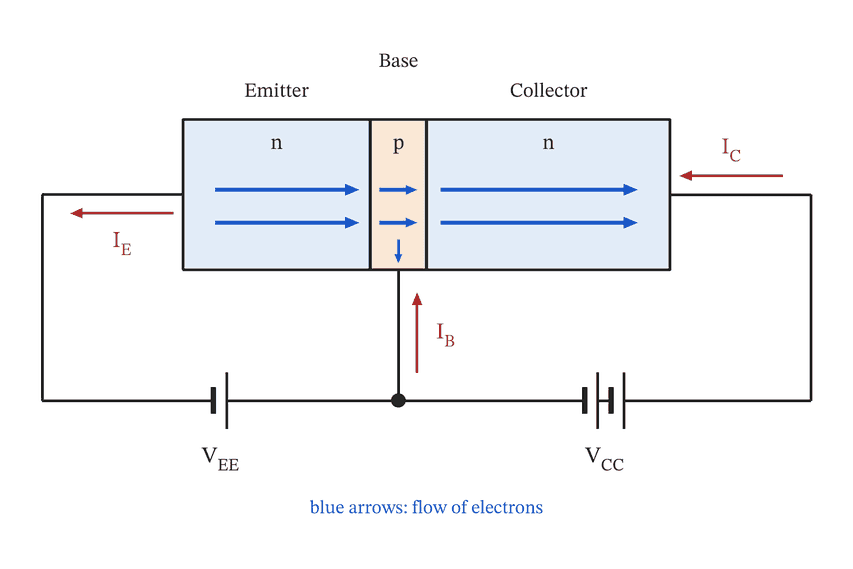
Step 4 — Relate the currents. The emitter current divides into the base and collector currents:
A small change in (or ) therefore controls a much larger change in .
Therefore, the -- symbol has its emitter arrow pointing away from the base; with the emitter junction forward biased and the collector junction reverse biased, electrons flow from the emitter through the thin base to the collector, so that with very small.