
Opening your dashboard
Class 12 Maths Chapter 22: Three-Dimensional Geometry - 3: The Plane Solutions
98 textbook questions with step-by-step answers, free to read, for ISC 2026-27.
Get talked through Ch 22, not just shown the answer
Reading a finished solution is not the same as being able to do it. The AI tutor takes one question at a time and works it with you, in your own words, until you can.
- Ask it out loud, in your own words
- It gives you the next step, not the answer
- Stuck on part (ii)? Start there
98 questions with solutions
1–3 marks · Mixed difficulty
The first 10 solutions are on this page. This chapter is a long one, so the rest open on their own page to keep this one quick to load.
- 13 marks
Question 1
Find the direction cosines of the normal to the plane
(i)
(ii)
Solve with AIWritten solution
Solution:
Key idea: For the plane , the normal has direction ratios . Dividing each of them by gives the direction cosines of the normal.
Step 1 — Part (i): read the direction ratios.
The coefficients of , and in give the direction ratios of the normal, namely .
Step 2 — Part (i): find the divisor.
We square the three direction ratios, add them and take the square root.
Step 3 — Part (i): divide each ratio by 7.
Each direction cosine is the matching direction ratio divided by 7, keeping its sign.
Step 4 — Part (ii): read the direction ratios.
The coefficients of , and in are , so these are the direction ratios of the normal.
Step 5 — Part (ii): find the divisor.
We again square, add and take the square root.
Step 6 — Part (ii): divide each ratio by 3.
Each direction cosine is the matching direction ratio divided by 3.
Watch out: A normal can be taken in either sense, so changing all three signs (for example in part (i)) also gives direction cosines of the normal. In each part the squares add up to 1, which is a quick check.
Therefore, the direction cosines of the normal are (i) and (ii) .
- 23 marks
Question 2
Show that the normals to the planes , are inclined to each other at an angle of .
Solve with AIWritten solution
Solution:
Key idea: The normal to the plane has direction ratios . Two lines with direction ratios and are perpendicular exactly when .
Step 1 — Read the direction ratios of the first normal.
The coefficients of , , in give the direction ratios .
Step 2 — Read the direction ratios of the second normal.
The coefficients of , , in give the direction ratios .
Step 3 — Test the perpendicularity condition.
We multiply matching direction ratios and add the products.
Step 4 — Draw the conclusion.
Since the sum of the products is zero, the cosine of the angle between the normals is zero, so the angle is .
Hence, the normals to the two planes are inclined to each other at .
- 31 mark
Question 3
Find the intercepts of the plane on the coordinate axes.
Solve with AIWritten solution
Solution:
Key idea: A plane written as (the intercept form) cuts the -, - and -axes at distances , and from the origin. So we divide the equation by its constant term to make the right side 1.
Step 1 — Divide both sides by 12.
The constant term is 12, so dividing every term by 12 makes the right side equal to 1.
Step 2 — Write each term as a variable over a number.
We simplify each fraction so that , and each stand alone over a number; the minus sign goes into the denominator of the -term.
Step 3 — Read off the intercepts.
Comparing with the intercept form, the intercepts are , and . As a check, putting and equal to zero in the original equation leaves , so the -intercept is indeed 6.
Therefore, the intercepts on the -, - and -axes are , and .
- 43 marks
Question 4
Write the equation of each of the following planes in the intercept form:
(i)
(ii)
(iii)
Solve with AIWritten solution
Solution:
Key idea: The intercept form of a plane is , where , , are its intercepts on the axes. To reach it, we divide the equation by its constant term so that the right side becomes 1.
Step 1 — Part (i): divide by 12.
The constant term of is 12, so we divide every term by 12.
Step 2 — Part (ii): divide by 15.
The constant term of is 15, so we divide every term by 15.
Here is written as , so the -intercept is .
Step 3 — Part (iii): divide by 12.
The constant term of is 12, so we divide every term by 12.
Therefore, the intercept forms are (i) , (ii) and (iii) .
- 53 marks
Question 5
Find the equation of the plane
(i) which cuts the axes of , and at , , respectively.
(ii) which cuts the axes of and at and and does not cut the -axis.
(iii) which cuts the -axis at and does not cut the -axis and the -axis.
(iv) passing through the point and making equal intercepts on the coordinate axes.
Solve with AIWritten solution
Solution:
Key idea: A plane with intercepts , , on the axes is . If the plane never meets an axis, it is parallel to that axis and the matching variable is missing from the equation.
Step 1 — Part (i): use the three intercepts.
The plane meets the axes at , and , so its intercepts are , , .
Step 2 — Part (ii): drop the -term.
A plane that does not cut the -axis is parallel to it, so does not appear in its equation. The intercepts on the other two axes are and .
Step 3 — Part (iii): drop the - and -terms.
A plane that cuts neither the -axis nor the -axis is parallel to both of them, so it is parallel to the -plane and only appears. Its -intercept is 4.
Step 4 — Part (iv): set up equal intercepts.
Let each intercept be (with ). The intercept form then has the same denominator in every term, so we multiply through by .
Step 5 — Part (iv): use the point .
The point lies on the plane, so its coordinates satisfy the equation; this fixes .
Therefore, the planes are (i) , (ii) , (iii) and (iv) .
- 63 marks
Question 6
Find the equations of the two planes passing through the points and if the sum of their intercepts on the three axes is zero.
Solve with AIWritten solution
Solution:
Key idea: Take the plane in intercept form . Each given point gives one equation, and the condition on the intercepts gives a third, so we can find , and .
Step 1 — Write the three conditions.
Putting and then in the intercept form, and using the zero sum of intercepts, we get three equations.
Step 2 — Add (1) and (2) to find .
The terms in and cancel when the two equations are added, which leaves an equation in alone.
Step 3 — Express in terms of .
Equation (3) with gives in terms of .
Step 4 — Clear the fractions in (1).
We multiply (1) by so that it contains no fractions.
Step 5 — Substitute for and form a quadratic.
We put into the last equation and collect all the terms on one side.
Step 6 — Find the two sets of intercepts.
Each root of the quadratic gives a value of , and then gives .
Step 7 — Check both planes.
We put into the first plane, with intercepts .
We put the same point into the second plane, with intercepts .
The point satisfies both planes in the same way, and in each case the three intercepts add up to zero.
Step 8 — Clear the fractions.
Multiplying the first plane by 18 and the second by 6 gives equations with whole-number coefficients.
Therefore, the two planes are and (or and ).
- 73 marks
Question 7
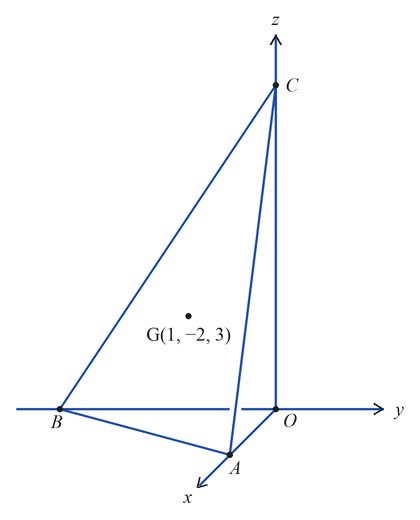
A plane meets the coordinate axes at , , respectively such that the centroid of the triangle is . Find the equation of the plane.
 Solve with AI
Written solution
Solution:
Key idea: If the plane is , it meets the axes at , and . The centroid of a triangle is the average of its three vertices, so the centroid of is .
Step 1 — Match the centroid with .
We equate each coordinate of the centroid to the given value.
Step 2 — Solve for the intercepts.
Multiplying each equation by 3 gives the intercepts.
Step 3 — Write the plane in intercept form.
We put these intercepts into the intercept form.
Step 4 — Clear the fractions.
The LCM of 3, 6 and 9 is 18, so we multiply every term by 18.
As a check, , and all satisfy this equation.
Therefore, the equation of the plane is .
- 83 marks
Question 8
(i) Find the equation of the plane the normal to which from the origin is of length and which makes angles, with the axes of , and , equal to , and respectively.
(ii) Find the equation of the plane the normal to which from the origin is of length and which makes angles with the axes of , , equal to , , respectively.
(iii) Find the equation of the plane such that the foot of the normal to which from the origin is the point .
(iv) Find the equation of the plane such that the length of the perpendicular to which from the origin is equal to units and the angles , , that this perpendicular makes with the axes of , , are connected by the relation .
Solve with AIWritten solution
Solution:
Key idea: If the perpendicular from the origin to a plane has length (with ) and direction cosines , the plane is . This is the normal form of the plane.
Step 1 — Part (i): find .
The normal makes angles , and with the axes, so its direction cosines are the cosines of these angles.
Step 2 — Part (i): write the normal form and simplify.
With , we put these values in and then multiply by to clear the fractions.
Step 3 — Part (ii): find .
The angles are now , and .
Step 4 — Part (ii): write the normal form and simplify.
With , we use the normal form and multiply by .
Step 5 — Part (iii): use the foot of the normal.
The normal from the origin to the plane is the segment , where is its foot. Subtracting the coordinates of from those of gives the direction ratios of the normal, and the plane passes through .
Step 6 — Part (iv): express the cosines through one constant.
Let each of the equal ratios be , so each direction cosine is a multiple of .
Step 7 — Part (iv): find .
The squares of the direction cosines always add up to 1, which gives an equation for .
Step 8 — Part (iv): write the two planes.
The positive value of gives the direction cosines , and the negative value reverses every sign. With the normal form, multiplied by 9, gives one plane for each value of .
Both can be written together as .
Therefore, the planes are (i) , (ii) , (iii) and (iv) .
- 93 marks
Question 9
Reduce each of the following equations to the normal form and then determine the direction cosines and the length of the normal from the origin:
(i)
(ii)
Solve with AIWritten solution
Solution:
Key idea: The normal form of a plane is , where are the direction cosines of the normal and . To reduce to this form, take the constant to the right side and make it positive (multiply by if needed). Then divide by . The coefficients are then the direction cosines of the normal, and the right side is the length of the normal from the origin.
Step 1 — Part (i): move the constant to the right.
Taking 12 to the right side gives a positive constant, so no sign change is needed.
Step 2 — Part (i): find the divisor.
We find the length of the vector of coefficients.
Step 3 — Part (i): divide by 3.
Dividing every term by 3 gives the normal form.
So the direction cosines of the normal are and the length of the normal is .
Step 4 — Part (ii): make the constant positive.
Taking 7 to the right gives , so we multiply the whole equation by .
Step 5 — Part (ii): find the divisor.
We find the length of the vector of coefficients.
Step 6 — Part (ii): divide by 11.
Dividing every term by 11 gives the normal form.
So the direction cosines of the normal are and the length of the normal is .
Watch out: The length must come out positive. That is why the constant is made positive before dividing.
Therefore, (i) the normal form is , with direction cosines and ; (ii) the normal form is , with direction cosines and .
- 103 marks
Question 10
For each of the following planes, find the direction ratios and the direction cosines of the normal from the origin.
(i)
(ii)
(iii)
Solve with AIWritten solution
Solution:
Key idea: The coefficients of , , are direction ratios of the normal. For the normal drawn from the origin towards the plane, first write the equation with a positive constant on the right; the direction cosines are the coefficients of that form divided by .
Step 1 — Part (i): direction ratios and sign.
The direction ratios are . Moving 22 to the right gives , so we multiply by to make the constant positive.
Step 2 — Part (i): direction cosines.
We divide each coefficient by the length of the coefficient vector.
Step 3 — Part (ii): direction ratios and sign.
The direction ratios are . Moving to the right gives , which is already positive.
Step 4 — Part (ii): direction cosines.
We find the length of the coefficient vector and divide by it, then rationalise the denominators.
Step 5 — Part (iii): direction ratios and sign.
There is no -term, so the direction ratios are . Moving 20 to the right gives , so we multiply by .
Step 6 — Part (iii): direction cosines.
We divide each coefficient by the length of the coefficient vector.
Therefore, (i) d.r. and d.c. ; (ii) d.r. and d.c. ; (iii) d.r. and d.c. .
- 113 marks
Question 11
(i) Find the coordinates of the point, where the line meets the plane .
(ii) Find the coordinates of the point where the line joining the points and cuts the plane . Hence, find the distance of this point from the point .
(iii) Find the coordinates of the point where the line through the points and crosses the plane. Also find the angle which the line makes with the plane.
- 123 marks
Question 12
Foot of the perpendicular from the origin to the plane is . Find the equation of the plane.
- 133 marks
Question 13
Find the distance of the point from the plane , measured parallel to the line .
- 143 marks
Question 14
Find the equation in Cartesian form of the plane passing through the point and normal to the line joining the points and .
- 153 marks
Question 15
Find the image of the point
(i) in the plane
(ii) in the plane
- 163 marks
Question 16
Find the reflection of the point in the plane .
- 173 marks
Question 17
From the point , a perpendicular is drawn on the plane . Find the equation, the length and the coordinates of the foot of the perpendicular.
- 183 marks
Question 18
Find the distance of the point from the plane measured along a line parallel to .
- 193 marks
Question 19
Prove that a variable plane which moves so that the sum of reciprocals of its intercepts on the three coordinate axes is constant, passes through a fixed point.
- 203 marks
Question 20
(i) A variable plane is at a constant distance from the origin and meets the axes in , , .
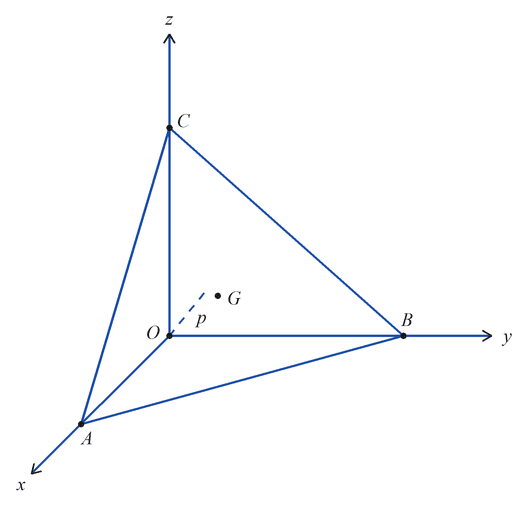
Show that the locus of the centroid of triangle is .
(ii) A variable plane, which remains at a constant distance of units from the origin, cuts the coordinate axes at the points , and . Show that the locus of the centroid of is .
- 213 marks
Question 21
Find the equation of the plane passing through the following points:
(i) , ,
(ii) , ,
- 223 marks
Question 22
Show that the following points are coplanar: , , and .
- 233 marks
Question 23
Show that the line joining the points and is coplanar with the line joining the points and .
- 241 mark
Question 24
Find the vector equation of a plane at a distance of units from the origin and has as the unit vector normal to it.
- 253 marks
Question 25
Find the vector equation of a plane which is at a distance of
(i) units from the origin and which is normal to the vector .
(ii) units from the origin and which is normal to the vector .
- 263 marks
Question 26
Find the Cartesian equation of the following planes
(i)
(ii)
(iii)
- 273 marks
Question 27
Find the vector equation of the following planes
(i)
(ii)
- 283 marks
Question 28
Find the direction cosines of the perpendicular from the origin to the plane
(i)
(ii)
- 293 marks
Question 29
Reduce the equation to normal form and hence find length of perpendicular from the origin to the plane.
(i)
(ii)
- 301 mark
Question 30
The vector equation of a plane is , where is normal to the plane. Find the length of perpendicular from the origin to the plane.
- 313 marks
Question 31
Find the vector equation of a plane which is at a distance of units from the origin and has as the direction ratios of a normal to it.
- 321 mark
Question 32
Find a unit normal vector to the plane,
- 333 marks
Question 33
Find the vector equation of a plane passing through a point having position vector and perpendicular to the vector . Also reduce it to Cartesian form.
- 343 marks
Question 34
Find the equation of the plane through the point and perpendicular to the vector . Determine the perpendicular distance of this plane from the origin.
- 353 marks
Question 35
Find the equation of the plane through the point and perpendicular to the vector . Put the above equation in normal form.
- 361 mark
Question 36
Find the vector equations of the coordinate planes.
- 373 marks
Question 37
Show that the normals to the following pairs of planes are perpendicular to each other.
(i) and
(ii) and
- 383 marks
Question 38
Show that the normal vector to the plane is equally inclined with the coordinate axes.
- 393 marks
Question 39
Find the angle between the planes
(i) and
(ii) and
(iii) and
(iv) and
- 403 marks
Question 40
Show that the following planes are at right angles
(i) and
(ii) and
- 411 mark
Question 41
If the planes and are perpendicular, find the value of .
- 423 marks
Question 42
The planes and are parallel. Determine and .
- 433 marks
Question 43
Find the angle between
(i) the line and the plane
(ii) the line and the plane
- 443 marks
Question 44
Find the angle between the line and the plane .
- 453 marks
Question 45
Find the angle between the line and the plane .
- 461 mark
Question 46
If the line is parallel to the plane , find the value of .
- 473 marks
Question 47
Find the equation of the line passing through the point and parallel to the planes and .
- 483 marks
Question 48
Find the vector equation of the line passing through the point with position vector and perpendicular to the plane
- 493 marks
Question 49
Find the equation of the plane
(i) through the points , and parallel to the line .
(ii) through the points and and parallel to the line whose direction ratios are .
- 503 marks
Question 50
Find the vector equation of the line through the origin which is perpendicular to the plane .
- 513 marks
Question 51
Find the equation of the plane through and and parallel to -axis.
- 523 marks
Question 52
Find the vector equation of the line passing through the point and perpendicular to the plane .
- 533 marks
Question 53
Find the equation of the plane passing through the points and and perpendicular to the plane .
- 543 marks
Question 54
Find the equation of the plane passing through the point and perpendicular to each of the planes and .
- 553 marks
Question 55
Find the vector equation in the scalar product form of the plane through the point and perpendicular to the planes and .
- 563 marks
Question 56
Find the vector equation of the plane through the point and plane parallel to the plane .
- 573 marks
Question 57
Find the equation of the planes through the intersection of the planes , and the point .
- 583 marks
Question 58
Find the equation of the plane containing the line of intersection of the plane and and passing through the point .
- 593 marks
Question 59
Find the direction ratios of the normal to the plane passing through the point and the line of intersection of the planes and .
- 603 marks
Question 60
Find the equation of the plane passing through the intersection of the planes and and the point .
- 613 marks
Question 61
Find the equation of the plane passing through the intersection of the planes , and perpendicular to the plane .
- 623 marks
Question 62
Find the equation of the plane through the point and passing through the line of intersection of the planes and .
- 633 marks
Question 63
Find the vector equation of the plane through the point and perpendicular to the line of intersection of the planes , .
- 643 marks
Question 64
Find the equation of the plane through the intersection of the planes and and whose perpendicular distance from the origin is unity.
- 653 marks
Question 65
Find the equation of the plane passing through the intersection of the planes and and parallel to the line with direction ratios . Also, find the perpendicular distance of from this plane.
- 663 marks
Question 66
Find the equation of the plane which passes through the line of intersection of the planes and and parallel to the line joining the points and .
- 673 marks
Question 67
Find the equation to the plane through the line of intersection of the planes , and
(a) parallel to the -axis,
(b) perpendicular to -plane.
- 683 marks
Question 68
Find the equation of the plane which passes through the -axis and the point .
- 693 marks
Question 69
Find the equation of the plane passing through the line of intersection of the planes and and cutting off equal intercepts on -axis and -axis.
- 703 marks
Question 70
Find the vector equation of the plane containing the line of intersection of the planes and and passing through the point .
- 713 marks
Question 71
Find the equation of the plane passing through the line of intersection of the planes and and parallel to the line .
- 723 marks
Question 72
Show that the lines and intersect. Find the equation of the plane in which they lie and also their point of intersection.
- 733 marks
Question 73
Find the Cartesian equation of the plane through the line of intersection of the planes and and intersecting at .
- 743 marks
Question 74
Find the distance from the point.
(i) to the plane
(ii) to the plane .
(iii) from the plane
- 753 marks
Question 75
Find the distance of the point
(i) from the plane
(ii) from the plane
- 763 marks
Question 76
Find the equation of the planes parallel to the plane which is at a unit distance from the points .
- 773 marks
Question 77
Find the distance between the parallel planes and .
- 783 marks
Question 78
Find the shortest distance between the planes and .
- 793 marks
Question 79
Show that the two points and are equidistant from the plane and lie on opposite side of the plane.
- 803 marks
Question 80
Find the equation of the plane through the point which is parallel to the plane . Also, find the distance between the two planes.
- 813 marks
Question 81
A plane is at a constant distance from the origin and meets the coordinate axes in , , .
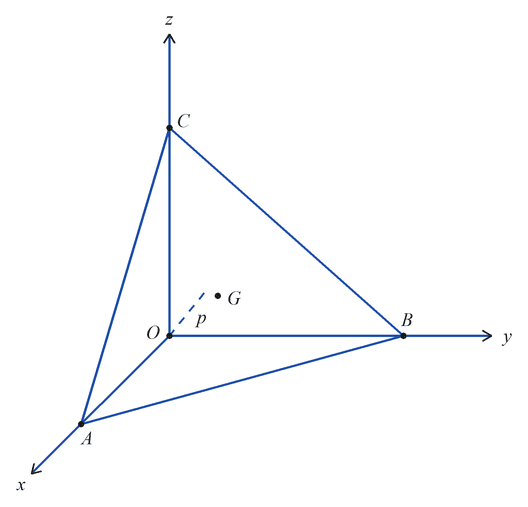
Show that the locus of the centroid of triangle is .
- 823 marks
Question 82
Find the distance of the point from the -plane.
- 833 marks
Question 83
Find the equation of the plane mid-parallel to the planes
(i) and .
(ii) and .
- 843 marks
Question 84
Show that the line whose vector equation is is parallel to the plane whose vector equation is . Also, find the distance between them.
- 853 marks
Question 85
From the point a perpendicular is drawn on the plane . Find the equation, the length and the coordinates of the foot of the perpendicular.
- 863 marks
Question 86
Find the image of the point in the plane .
Vector form. Find the image of the point having position vector in the plane .
- 873 marks
Question 87
Find the equation of the planes which are perpendicular to each of the planes and and at a distance of units from the origin.
- 883 marks
Question 88
Find the locus of a point whose distance from the origin is three times its distance from the plane .
- 893 marks
Question 89
Find the equation of the plane which
(i) passes through and is perpendicular to a line whose direction ratios are ;
(ii) passes through and has the line joining and as a normal;
(iii) bisects the line joining and at right angles;
(iv) passes through and is parallel to the plane ;
(v) passes through the points , and ;
(vi) passes through the points , , ;
(vii) passes through the -axis and the point ;
- 903 marks
Question 90
Find the equation of the plane
(i) parallel to the plane and distant 4 units from the point ;
(ii) which passes through the point and is perpendicular to each of the planes and ;
(iii) perpendicular to each of the planes and and is at a distance of from the origin;
(iv) through and and perpendicular to the plane ;
- 913 marks
Question 91
(i) Find the equation of the plane which contains the line of intersection of the planes and and is perpendicular to the plane .
(ii) Find the equation of the plane which contains the line and is perpendicular to the plane .
- 923 marks
Question 92
Find the equation of the plane through the intersection of the planes and and parallel to the -axis.
- 933 marks
Question 93
(i) Find the equation of the plane through and and parallel to the -axis.
(ii) Find the equation of the plane passing through the points and and parallel to the -axis.
- 943 marks
Question 94
Find the equation of a plane which is perpendicular to the plane and passes through the intersection of the planes and .
- 953 marks
Question 95
(i) Find the equation of the plane passing through and and perpendicular to the plane .
(ii) Also, find the distance of the point from the plane .
- 963 marks
Question 96
A plane meets the plane , where , , and the plane where , . Find the equation to the plane.
- 973 marks
Question 97
Prove that the plane , , and have a line in common.
- 983 marks
Question 98
Find the equation of the plane passing through the intersection of the plane and and parallel to -axis.
What Class 12 Maths Ch 22 covers
The sections of the chapter, in the order the book takes them. Every question above comes from one of these.
- 01General, One-Point and Normal Forms of a Plane
- 02Intercept Form of a Plane
- 03Vector Equation of a Plane
- 04Angle Between Two Planes and Between a Line and a Plane
- 05Plane Through the Intersection of Two Planes
- 06Distance of a Point from a Plane
More ways to study this chapter
The same chapter asked three other ways. Practise it, revise it, and see what the board has set on Ch 22 before.
- Competency-Based Questions (CBQ)Case study questions: a situation, and the part of the chapter that answers it.42questionsOpen
- Previous Year QuestionsQuestions that have actually appeared in board papers, each tagged with its year.18questionsOpen
- Practice QuestionsExtra questions per chapter, for when one attempt at a method is not enough.133questionsOpen
Ch 22 in past ISC papers
The same chapter as the board has actually asked it. These are worded differently from the textbook exercise, which is the point of reading them.
- 15 marks
Board paper question 1
Find the equation of the plane passing through the intersection of the planes:
and and the point .
Solve with AIWritten solution
Solution:
Key idea: If and are two planes that meet in a line, then every plane through that line (other than the second plane itself) can be written as for some number . A point the plane must pass through fixes .
Step 1 — Write the family of planes through the line of intersection.
Let and . Every plane through their line of intersection has the form below.
Step 2 — Use the point (−1, 2, 1) to find k.
The plane passes through , so these coordinates satisfy its equation. First we work out each bracket at this point.
So the equation of Step 1 becomes an equation in alone.
Step 3 — Substitute k and simplify.
We put back and multiply the whole equation by to clear the fraction.
Step 4 — Check with the given point.
We substitute to be sure the plane passes through it.
Therefore, the required plane is .
- 25 marks
Board paper question 2
Find the Cartesian equation of the plane, passing through the line of intersection of the planes: and and intersecting -axis at .
Solve with AIWritten solution
Solution:
Key idea: If and are two planes that meet in a line, then every plane through that line (other than the second plane itself) can be written as for some number . A point the plane must pass through fixes .
Step 1 — Write the two planes in Cartesian form.
With , a dot product equals . So the two given planes are as follows.
Step 2 — Write the family of planes through their line of intersection.
Every plane through the common line has the form below.
Step 3 — Find the point on the y-axis.
Every point of the -axis has and . So the point written in the question is the point in space.
Note: The paper prints the point as ; we take it as because a point on the -axis has - and -coordinates zero.
Step 4 — Use the point (0, 3, 0) to find k.
We substitute , , into each bracket.
So the family equation gives an equation in .
Step 5 — Substitute k and simplify.
We put back and multiply by to clear the fraction.
Step 6 — Check with the point (0, 3, 0).
We substitute the point to confirm.
Therefore, the required Cartesian equation is .
- 35 marks
Board paper question 3
Find the equation of the plane passing through the point and perpendicular to the line joining the points and .
Solve with AIWritten solution
Solution:
Key idea: The plane through with normal direction ratios is . A plane perpendicular to a line has that line as its normal.
Step 1 — Find the direction ratios of AB.
The plane is perpendicular to , so is its normal. We subtract the coordinates of from those of .
Step 2 — Write the plane through (1, −2, 1).
We use the one-point form with normal .
Multiplying by gives a neater form of the same plane.
Step 3 — Check with the given point.
We substitute .
Therefore, the required plane is , that is, .
- 42 marks
Board paper question 4
Find the equation of the plane through the intersection of the planes and and passing through the origin.
Solve with AIWritten solution
Solution:
Key idea: If and are two planes that meet in a line, then every plane through that line (other than the second plane itself) can be written as for some number . A point the plane must pass through fixes .
Step 1 — Write the planes in Cartesian form and form the family.
With , the planes are and . Every plane through their line of intersection is of the form below.
Step 2 — Make the plane pass through the origin.
We substitute the origin ; only the constant terms remain.
Step 3 — Substitute k and simplify.
We put back into the family.
The constant term is , so the plane does pass through the origin.
Therefore, the required plane is , that is, .
- 56 marks
Board paper question 5
Find the image of a point having position vector : in the plane .
Solve with AIWritten solution
Solution:
Key idea: The image of a point in a plane lies on the normal to the plane through , on the other side, at the same distance. So we go along the normal from to the plane to reach the foot , and then the same distance again: is the mid-point of .
Step 1 — Write the plane and the point in Cartesian form.
With , the plane is , and its normal has direction ratios . The given point is .
Step 2 — Write the normal line through P.
The line through along the normal is made of the points below, where is a parameter.
Step 3 — Find where this line meets the plane.
The foot is the point of the line that satisfies the plane's equation, so we substitute.
Step 4 — Find the foot of the perpendicular.
We put into the line.
Step 5 — Go the same distance beyond the plane.
The image is twice as far along the normal, so it corresponds to double the value of found for the foot.
Putting into the line gives the image.
Step 6 — Check with the mid-point.
The mid-point of and must be , and must lie on the plane.
Both checks work.
Therefore, the image of the point is , that is, the point with position vector .
- 62 marks
Board paper question 6
Find the length of the perpendicular from origin to the plane .
Solve with AIWritten solution
Solution:
Key idea: The perpendicular distance of the origin from the plane is .
In Cartesian form this is for the plane .
Step 1 — Read off the normal and the constant.
Comparing with , we read off the normal vector and the constant term.
Step 2 — Find the length of the normal.
We take the square root of the sum of the squares of the components.
Step 3 — Divide.
The distance is divided by .
Therefore, the length of the perpendicular from the origin to the plane is units.
All 18 board paper questions for this chapter, solved the same way.
Class 12 Maths Ch 22 questions students ask
How many questions are there in Class 12 Maths Ch 22?
98 questions. Every one is solved step by step on this page.
Are these Class 12 Maths solutions free?
Yes. Every question and its full working is free to read, with no account needed.
Can I download the Class 12 Maths Ch 22 solutions as a PDF?
There is no PDF to download. Every solution is on this page instead, which means it is searchable, always the current syllabus, and readable on a phone. Use your browser's print option if you want it on paper.