
Opening your dashboard
Class 12 Maths Chapter 22 Three-Dimensional Geometry - 3: The Plane: Competency-Based Questions (CBQ)
42 questions on Chapter 22, each worked through on its own page with the AI tutor. Class 12 Maths, ICSE 2026-27.
42 questions
1–5 marks · Mixed difficulty
- 13 marks
Question 1
Competency: Application
The glass front of a new office building leans outwards. An architect places the origin at a ground-level corner, with the -axis east, the -axis north and the -axis vertically up (in metres). Three fixing points on the glass are and at ground level and higher up. Treat the glass front as a plane. (Hypothetical data.)
(a) Find the equation of the plane of the glass front.
(b) A steel bracket is to be bolted at . Check whether lies on the glass front.
(c) A cleaning robot's arm must meet the glass at right angles at . Write the Cartesian equations of the line of the arm.
- 21 mark
Question 2
Competency: Application
A geologist models a flat coal seam as a plane. The origin is a point on level ground, the -axis points east, the -axis north and the -axis vertically up (in metres). The seam meets the -axis at 300, the -axis at 200, and the vertical line through at 60 m below . (Hypothetical data.)
A vertical borehole is drilled at the ground point . At what level does the borehole meet the seam?
- 31 mark
Question 3
Competency: Analysis & Evaluation
A rotating grade laser stands at the origin of a building site (metres, -axis vertically up). Its beam sweeps out the gently sloping plane , which the workers use to set a drainage slope of about 4.5 %. (Hypothetical data.)
Assertion (A): The laser plane cannot be written in the intercept form .
Reason (R): The intercept form can describe only a plane that does not pass through the origin.
- 44 marks
Question 4
Competency: Application
A survey drone flies over a hillside. Take the -axis east, the -axis north and the -axis vertically up (in metres). The hillside is modelled as the plane , and the drone hovers at . A safety rule says the drone must stay at least 15 m from the hillside, measured perpendicular to the slope. (Hypothetical data.)
(a) Find how high the drone is above the point of the hillside vertically below it. (1 mark)
(b) Find the perpendicular distance of the drone from the hillside, and state whether the drone obeys the safety rule. (2 marks)
(c) The drone climbs straight up, keeping and . Find the least height (correct to two decimal places) at which it obeys the rule. (1 mark)
- 51 mark
Question 5
Competency: Analysis & Evaluation
A wheelchair ramp at a school entrance rises 1 m for every 12 m of horizontal run. With the floor as the plane and the ramp rising in the direction of the -axis, the ramp surface is the plane (in metres). (Hypothetical data.)
Assertion (A): The ramp surface makes an angle with the floor, where .
Reason (R): The angle between two planes is the angle between any line drawn in one plane and any line drawn in the other.
- 61 mark
Question 6
Competency: Application
In a parcel depot, the flat bed of a tilted conveyor is set out from its corner with position vector . One edge of the bed runs along and the other edge along (in metres, -axis vertically up), so the bed is the plane . (Hypothetical data.)
The control software needs the bed in scalar product (normal) form. Which equation should be entered?
- 73 marks
Question 7
Competency: Application
In a steel sculpture, two flat sheets lie in the planes and and meet along a straight welded seam. The artist wants a third flat sheet that is welded along the same seam and also passes through the tip of a rod. Coordinates are in metres with the -axis vertically up. (Hypothetical data.)
(a) Write the equation of any plane that contains the seam.
(b) Find the equation of the third sheet.
(c) Show that the third sheet stands vertically.
- 81 mark
Question 8
Competency: Analysis & Evaluation
In a recording studio, a tilted acoustic panel is fixed in front of a sloping wall with an air gap between them. In centimetres, the wall lies in the plane and the panel in the parallel plane . (Hypothetical data.)
Assertion (A): The air gap between the wall and the panel is 10 cm wide.
Reason (R): The distance between the parallel planes and is .
- 91 mark
Question 9
Competency: Application
A mason checks a sloping (battered) stone retaining wall with a plumb line, which hangs vertically. With the -axis vertically up and units in metres, the face of the wall is the plane , so it leans back 1 m for every 5 m of height. (Hypothetical data.)
The angle between the plumb line and the face of the wall is
- 103 marks
Question 10
Competency: Application
A triangular shade sail over a school's sandpit is tied to the tops of three poles at , , with position vectors , and (in metres, ground ). A triangle of cloth stretched between three points is flat. (Hypothetical data.)
(a) Write the vector equation of the plane of the sail in parametric form.
(b) Write its vector equation in scalar product form.
(c) For rain to run off, the designer wants the sail tilted at least to the ground. Check whether this sail meets the requirement.
- 111 mark
Question 11
Competency: Analysis & Evaluation
An underwater robot is taken as the origin , with the -axis vertically up (in metres). The sloping seabed near it is the plane . The seabed directly below the robot is at . (Hypothetical data.)
Assertion (A): The shortest distance from the robot to the seabed is m, the depth of the seabed directly below it.
Reason (R): When the equation of a plane is written in normal form , where are the direction cosines of the normal and , is the length of the perpendicular from the origin to the plane.
- 121 mark
Question 12
Competency: Application
On a theatre stage, two flat scenery panels lie in the planes and and meet along a straight edge. A spotlight hangs at the origin . The designer wants a third flat panel that contains the same edge and passes through the spotlight. (Hypothetical data.)
The equation of the third panel is
- 133 marks
Question 13
Competency: Application
A stone monument in a park is a square pyramid. With the ground as (in metres), the corners of its base are , , , , and its apex is . Each sloping face is flat. (Hypothetical data.)
(a) Find the equation of the plane of the face .
(b) Find the angle between the face and the ground.
(c) The face lies in the plane . Find the acute angle between the planes of the faces and .
- 141 mark
Question 14
Competency: Application
A dance studio has a flat vertical mirror wall in the plane (in metres, -axis vertically up). A lamp hangs at . A dancer sees the image of the lamp behind the mirror, at the point where the image of in the plane of the mirror lies. (Hypothetical data.)
The image of the lamp is at
- 151 mark
Question 15
Competency: Analysis & Evaluation
Two security cameras are mounted at and near a sloping wall that lies in the plane (in metres). Each camera is exactly 2 m from the wall, measured perpendicular to it. (Hypothetical data.)
Assertion (A): Since and are equally far from the wall, the mid-point of must lie on the wall.
Reason (R): The distance of the point from the plane is .
- 163 marks
Question 16
Competency: Application
A flat triangular plywood sheet is wedged into the corner of a storeroom. The corner is the origin , the floor is the -plane and the two walls are the - and -planes (in centimetres). The sheet touches the edges of the room at and on the floor and at on the vertical corner edge. (Hypothetical data.)
(a) Write the equation of the plane of the sheet in intercept form and in the form with integer coefficients.
(b) Find the height of the sheet above the floor point .
(c) A cubical carton of side 30 cm is pushed fully into the corner, with three of its faces against the floor and the two walls. Show that the carton fits under the sheet.
- 171 mark
Question 17
Competency: Analysis & Evaluation
A designer tries to define a flat panel in a CAD program by entering the point and two edge vectors and , hoping for the plane . (Hypothetical data.)
Assertion (A): These entries do not fix a single plane through .
Reason (R): A plane is fixed by one point on it and any two non-zero vectors parallel to it.
- 181 mark
Question 18
Competency: Application
Two identical Wi-Fi routers in a library are placed at and (in metres). Assume that the signal strength from a router depends only on the distance from it. The points where both signals are equally strong are the points equidistant from and , and they form a plane. (Hypothetical data.)
The equation of this plane is
- 193 marks
Question 19
Competency: Application
A tunnel boring machine digs a level tunnel 20 m underground. Its flat cutting face is always perpendicular to its direction of travel, . Take the ground surface as (in metres). One morning the centre of the cutting face is at . (Hypothetical data.)
(a) Find the equation of the plane of the cutting face that morning.
(b) During the day the machine moves 15 m forward along . Find the equation of the plane of the cutting face in the evening.
(c) A survey marker is fixed at on the centre line of the tunnel, ahead of the machine. How far ahead of the evening cutting face is the marker, measured along the tunnel?
- 201 mark
Question 20
Competency: Analysis & Evaluation
An irrigation channel has a V-shaped cross-section. Its two flat side walls lie in the planes and (in metres, -axis vertically up), and they meet along the bottom edge of the channel. (Hypothetical data.)
Assertion (A): The vertical plane contains the bottom edge of the channel.
Reason (R): The two side walls of the channel are perpendicular to each other.
- 211 mark
Question 21
Competency: Application
The hopper of a grain mill has two flat sloping walls that meet along a horizontal slot at the bottom. With the slot along the -axis and the -axis vertically up (in metres), the walls lie in the planes (for ) and (for ), and the grain is held above the slot. (Hypothetical data.)
The angle between the two walls, measured inside the hopper where the grain lies, is
- 223 marks
Question 22
Competency: Application
In a site model of a hill road, the flat face of a rock cutting is a plane whose intercepts on the -, - and -axes are in the ratio (all positive). The -axis is vertically up and the units are metres. A survey peg on the face is at . (Hypothetical data.)
(a) Taking the intercepts as , and , find .
(b) Write the equation of the face in intercept form and in the form .
(c) Road engineers expect a rock cutting face to be steep, at more than to the horizontal. Find the angle this face makes with the horizontal plane and comment.
- 231 mark
Question 23
Competency: Analysis & Evaluation
The gripper of a factory robot moves only in a flat work plane given by , where and are real numbers and the -axis is vertically up (in metres). (Hypothetical data.)
Assertion (A): The gripper can reach the point without leaving its work plane.
Reason (R): The work plane is vertical (parallel to the -axis).
- 243 marks
Question 24
Competency: Application
A door is hinged along a vertical line. In a plan of the room (in metres, -axis vertically up), the wall containing the door lies in the plane , and the vertical plane through the hinge at right angles to the wall is . So the hinge is the line in which these two planes meet. The door is 0.8 m wide. (Hypothetical data.)
(a) Explain why, in every position, the door lies in a plane of the form (or in ).
(b) The door is opened until its free edge touches a door-stop at . Find the equation of the plane of the door in this position.
(c) When closed, the door lies in the plane of the wall. Find the angle through which the door has been turned.
- 253 marks
Question 25
Competency: Application
A mountain rescue team stands at in front of a flat cliff face (in metres, -axis vertically up). Its laser rangefinder is aimed at right angles to the face, and the beam hits the face at . (Hypothetical data.)
(a) Find the equation of the plane of the cliff face.
(b) Find the perpendicular distance of the team from the cliff face.
(c) A climber waits at , on the same side of the face as the team. How far is the climber from the cliff face?
- 264 marks
Question 26
A plane makes equal intercepts on the -axis and the -axis, makes an intercept on the -axis, and is at a distance of units from the origin. Find the equations of all such planes.
- 274 marks
Question 27
A plane passes through the point and makes positive intercepts on the coordinate axes. Find the equation of the plane for which the tetrahedron formed by the plane and the three coordinate planes has the least volume, and find this least volume.
- 284 marks
Question 28
, , are non-collinear points with position vectors , , .
(i) Prove that the vector equation of the plane through , and is .
(ii) Use it to find the Cartesian equation of the plane through the points with position vectors , and .
- 293 marks
Question 29
A straight line passes through and is perpendicular to the plane .
Based on the above, answer the following questions:
(i) What are the direction ratios of normal to the plane?
(ii) Where does the line meet the plane?
(iii) What is the image of the point in the plane?
- 303 marks
Question 30
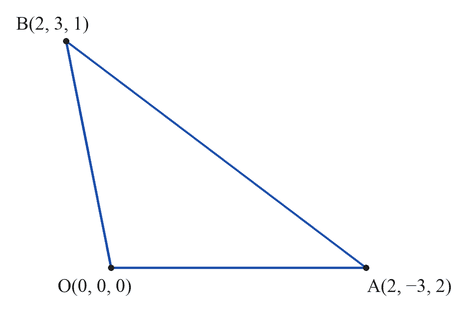
The position vectors of the points and are and , respectively. Find the area of .
- 313 marks
Question 31
A line with positive vector direction cosines passes through the point and makes equal angles with the coordinate axes. The line passes through the plane at point . Find the length of the line segment .
- 323 marks
Question 32
Shown below is a cube.
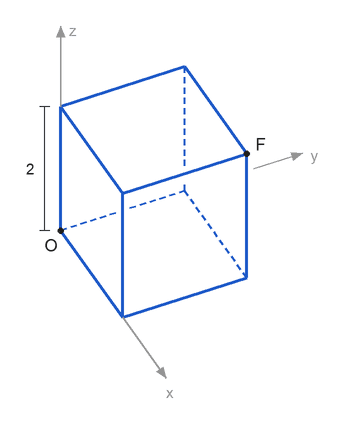
Find the equation of its diagonal which passes through the centre of the cube and also the origin.
- 333 marks
Question 33
A triangular plane with centroid cuts the coordinate axes at , , respectively.
(i) What are the intercepts made by the plane on the axes?
(ii) What is the equation of the plane ?
- 343 marks
Question 34
Given equation of two planes are
Plane 1: and plane 2: .
Is the point closer to plane 1 or plane 2? Find the angle between the planes.
- 353 marks
Question 35
Match correctly statements given in column I with those given in column II.
Column I Column II 1. If the line lies on the plane , then what is the value of ? (a) 1 2. If a line has direction ratios , then what is the sum of squares of its direction cosines? (b) 3. Find the direction ratios of a line parallel to the line whose equations are . (c) unit 4. Find the angle made by the vector with -axis. (d) 5. Find the shortest distance between the pair of lines and ; . (e) 7 - 363 marks
Question 36
A mobile tower is situated at the top of a hill. Consider the surface on which the tower stands as a plane having points , and on it. The mobile tower is tied with three cables from the points , and such that it stands vertically on the ground. The top of the tower is at point as shown in the figure given. The foot of the perpendicular from the point on the plane is at the point .
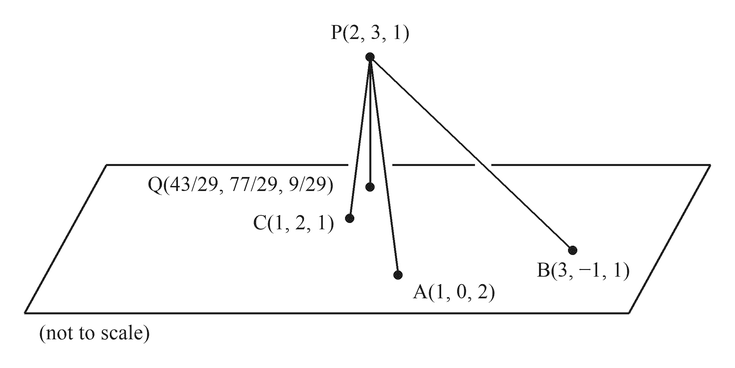
Based on the above information, answer the following questions:
(i) Find the equation of the plane containing the points , and .
(ii) Find the equation of the line .
(iii) Calculate the height of the tower.
- 375 marks
Question 37
Two motorcycles and are running at the speed more than allowed speed on the roads represented by the lines and , respectively.
Based on the above information, answer the following questions:
(i) Write the Cartesian equation of the line along which motorcycle is running.
(ii) Find the direction cosines of the line along which motorcycle is running.
(iii) Find the direction ratios of the line along which motorcycle is running.
(iv) Find the shortest distance between the given lines.
(v) Find the point at which the motorcycles may collide.
(A) (B) (C) (D) Does not exist
- 384 marks
Question 38
Air traffic control – Avoiding collision: At an international airport, two airplanes take off from different runways at the same time. Their flight paths are represented by the following lines in vector form:
Plane :
Plane :
The air traffic controllers want to ensure that the planes do not collide or come too close.
Based on the above information, answer the following questions:
(i) Which of the planes best describes the relative position of the flight paths of plane and plane ?
(A) Intersecting lines (B) Parallel lines (C) Skew lines (D) Coincident lines
(ii) What is the angle between the direction vectors of the two planes?
(A) (B) (C) (D)
(iii) What is the shortest distance between the skew lines?
(A) 2 units (B) units (C) units (D) units
(iv) Condition for parallelism: If the direction vectors of two lines are proportional, what can be said about the lines?
(A) They are intersecting (B) They are parallel or coincident (C) They are skew (D) They must be perpendicular
- 394 marks
Question 39
Missile strike trajectory in wartime: A missile is launched from a submarine at point in the direction . An enemy radar tower is aligned along a line from in the direction .
Based on the above information, answer the following question:
(i) Do missile's path and radar line intersect?
(A) Yes (B) No (C) Parallel (D) Coincident
(ii) Are they perpendicular?
(iii) Importance of distance: Why calculate the shortest distance between missile's path and radar?
(A) To check, if missile will hit target (B) To determine signal coverage (C) To check trajectory avoidance (D) All of these
(iv) If the shortest distance is under 5 units, what does it imply?
(A) Missile is safe (B) Missile is visible to radar (C) Missile hits the tower (D) Radar is out of range
- 403 marks
Question 40
Solar panel on inclined roof: A solar panel is mounted on an inclined roof, which lies in a plane given by . Sunlight comes in along a line .
Based on the above information, answer the following questions:
(i) Find the angle between the sunlight and the roof plane.
(A) (B) (C) (D)
(ii) Is the sunlight perpendicular to the plane?
(A) Yes (B) No (C) Only during noon (D) Cannot say
(iii) The normal vector to the plane is
(A) (B) (C) (D)
- 414 marks
Question 41
Medical scanners – (X-ray beam and tumour location): An X-ray beam in a CT scanner was along . The suspected tumour lies along a blood vessel modelled as .
Based on the above information, answer the following questions:
(i) Do the beam and vessel intersect?
(A) Yes (B) No (C) Only for certain wavelengths (D) Always intersect
(ii) Are they perpendicular?
(A) Yes (B) No (C) Cannot tell (D) Only if scanner rotates
(iii) Find the angle between them
(A) (B) (C) (D)
(iv) What is the relevance of shortest distance in this context?
(A) Maximize image contrast (B) Estimate beam scatter (C) Confirm tumour accessibility (D) Calibrate scanner brightness
- 424 marks
Question 42
Weather science (aircraft flight and storm front): An aircraft is flying along the line . A storm lies in the plane .
Based on the above information, answer the following questions:
(i) Is this flight path parallel to the storm front?
(A) Yes (B) No (C) Intersecting (D) Skew
(ii) Does the line lie on the plane?
(A) Yes (B) No (C) Partially (D) Cannot tell
(iii) Find the shortest distance from aircraft to storm plane.
(A) (B) Use dot product (C) Use cross product (D) Zero
(iv) If angle between line and plane is , then
(A) Aircraft dives into storm (B) Aircraft is perpendicular to storm (C) Aircraft moves along the plane (D) Data insufficient