
Opening your dashboard
Class 12 Maths Chapter 22 Three-Dimensional Geometry - 3: The Plane: Previous Year Questions
18 questions on Chapter 22, each solved step by step. Class 12 Maths, ICSE 2026-27.
18 questions with solutions
1–6 marks · Mixed difficulty
The first 13 solutions are on this page. This chapter is a long one, so the rest open on their own page to keep this one quick to load.
- 15 marks
Question 1
Find the equation of the plane passing through the intersection of the planes:
and and the point .
Solve with AIWritten solution
Solution:
Key idea: If and are two planes that meet in a line, then every plane through that line (other than the second plane itself) can be written as for some number . A point the plane must pass through fixes .
Step 1 — Write the family of planes through the line of intersection.
Let and . Every plane through their line of intersection has the form below.
Step 2 — Use the point (−1, 2, 1) to find k.
The plane passes through , so these coordinates satisfy its equation. First we work out each bracket at this point.
So the equation of Step 1 becomes an equation in alone.
Step 3 — Substitute k and simplify.
We put back and multiply the whole equation by to clear the fraction.
Step 4 — Check with the given point.
We substitute to be sure the plane passes through it.
Therefore, the required plane is .
- 25 marks
Question 2
Find the Cartesian equation of the plane, passing through the line of intersection of the planes: and and intersecting -axis at .
Solve with AIWritten solution
Solution:
Key idea: If and are two planes that meet in a line, then every plane through that line (other than the second plane itself) can be written as for some number . A point the plane must pass through fixes .
Step 1 — Write the two planes in Cartesian form.
With , a dot product equals . So the two given planes are as follows.
Step 2 — Write the family of planes through their line of intersection.
Every plane through the common line has the form below.
Step 3 — Find the point on the y-axis.
Every point of the -axis has and . So the point written in the question is the point in space.
Note: The paper prints the point as ; we take it as because a point on the -axis has - and -coordinates zero.
Step 4 — Use the point (0, 3, 0) to find k.
We substitute , , into each bracket.
So the family equation gives an equation in .
Step 5 — Substitute k and simplify.
We put back and multiply by to clear the fraction.
Step 6 — Check with the point (0, 3, 0).
We substitute the point to confirm.
Therefore, the required Cartesian equation is .
- 35 marks
Question 3
Find the equation of the plane passing through the point and perpendicular to the line joining the points and .
Solve with AIWritten solution
Solution:
Key idea: The plane through with normal direction ratios is . A plane perpendicular to a line has that line as its normal.
Step 1 — Find the direction ratios of AB.
The plane is perpendicular to , so is its normal. We subtract the coordinates of from those of .
Step 2 — Write the plane through (1, −2, 1).
We use the one-point form with normal .
Multiplying by gives a neater form of the same plane.
Step 3 — Check with the given point.
We substitute .
Therefore, the required plane is , that is, .
- 42 marks
Question 4
Find the equation of the plane through the intersection of the planes and and passing through the origin.
Solve with AIWritten solution
Solution:
Key idea: If and are two planes that meet in a line, then every plane through that line (other than the second plane itself) can be written as for some number . A point the plane must pass through fixes .
Step 1 — Write the planes in Cartesian form and form the family.
With , the planes are and . Every plane through their line of intersection is of the form below.
Step 2 — Make the plane pass through the origin.
We substitute the origin ; only the constant terms remain.
Step 3 — Substitute k and simplify.
We put back into the family.
The constant term is , so the plane does pass through the origin.
Therefore, the required plane is , that is, .
- 56 marks
Question 5
Find the image of a point having position vector : in the plane .
Solve with AIWritten solution
Solution:
Key idea: The image of a point in a plane lies on the normal to the plane through , on the other side, at the same distance. So we go along the normal from to the plane to reach the foot , and then the same distance again: is the mid-point of .
Step 1 — Write the plane and the point in Cartesian form.
With , the plane is , and its normal has direction ratios . The given point is .
Step 2 — Write the normal line through P.
The line through along the normal is made of the points below, where is a parameter.
Step 3 — Find where this line meets the plane.
The foot is the point of the line that satisfies the plane's equation, so we substitute.
Step 4 — Find the foot of the perpendicular.
We put into the line.
Step 5 — Go the same distance beyond the plane.
The image is twice as far along the normal, so it corresponds to double the value of found for the foot.
Putting into the line gives the image.
Step 6 — Check with the mid-point.
The mid-point of and must be , and must lie on the plane.
Both checks work.
Therefore, the image of the point is , that is, the point with position vector .
- 62 marks
Question 6
Find the length of the perpendicular from origin to the plane .
Solve with AIWritten solution
Solution:
Key idea: The perpendicular distance of the origin from the plane is .
In Cartesian form this is for the plane .
Step 1 — Read off the normal and the constant.
Comparing with , we read off the normal vector and the constant term.
Step 2 — Find the length of the normal.
We take the square root of the sum of the squares of the components.
Step 3 — Divide.
The distance is divided by .
Therefore, the length of the perpendicular from the origin to the plane is units.
- 74 marks
Question 7
Find the equation of the plane through the intersection of the planes and such that the intercepts made by the resulting plane on the x –axis and the z-axis are equal.
Solve with AIWritten solution
Solution:
Key idea: If and are two planes that meet in a line, then every plane through that line (other than the second plane itself) can be written as for some number . A point the plane must pass through fixes .
Also, a plane (with ) cuts the -axis at and the -axis at .
Step 1 — Tidy the second plane.
The second plane is printed as . Taking to the left side gives its standard form.
Step 2 — Write the family of planes through the line of intersection.
Every plane through the common line of the two planes has the form below.
We collect the terms in , and .
Step 3 — Write the two intercepts.
Putting and equal to gives the -intercept; putting and equal to gives the -intercept.
Step 4 — Make the intercepts equal.
The numerators are the same, so (for a non-zero numerator) the intercepts are equal exactly when the denominators are equal.
Step 5 — Write the plane.
We put into the collected form.
Dividing by gives the simplest form.
Step 6 — Check the intercepts.
The -intercept is and the -intercept is also , so they are equal.
Watch out: If (the value that makes zero), the plane is . It passes through the origin, so it meets both axes only at the origin and has no proper intercepts; it is not the plane the question wants.
Note: The paper prints the second plane as , and we have solved it as printed. If the intended plane was , the same method again gives and the plane .
Therefore, the required plane is .
- 82 marks
Question 8
Find the equation of the plane passing through the point (2, -3, 1) and perpendicular to the line joining the points (4, 5, 0) and (1, -2, 4)
Solve with AIWritten solution
Solution:
Key idea: The plane through with normal direction ratios is . A plane perpendicular to a line has that line as its normal.
Step 1 — Find the direction ratios of the joining line.
We subtract the coordinates of from those of .
So the normal to the plane has direction ratios .
Step 2 — Write the plane through (2, −3, 1).
We use the one-point form.
Multiplying by gives the same plane in a neater form.
Step 3 — Check with the given point.
We substitute .
Therefore, the required plane is .
- 94 marks
Question 9
Find the image of the point (3, -2, 1) in the plane
Solve with AIWritten solution
Solution:
Key idea: The image of a point in a plane lies on the normal to the plane through , on the other side, at the same distance. So we go along the normal from to the plane to reach the foot , and then the same distance again: is the mid-point of .
Step 1 — Read off the normal.
The plane is , so its normal has direction ratios . Call the given point .
Step 2 — Write the normal line through P.
The line through along the normal is made of the points below, where is a parameter.
Step 3 — Find where this line meets the plane.
The foot satisfies the equation of the plane, so we substitute.
Step 4 — Find the foot of the perpendicular.
We put into the line.
Step 5 — Use the mid-point to find the image.
Let the image be . Since is the mid-point of , each coordinate of is the average of the matching coordinates of and .
Step 6 — Check.
The image should be on the other side of the plane at the same distance. Putting into gives , and putting gives : equal size, opposite sign, as expected.
Therefore, the image of in the plane is .
- 101 mark
Question 10
The distance of the point from the plane will be:
Solve with AIAnswer
(A)
- Correct
(B)
(C)
(D)
Answer: (B)
Key idea: The distance of the point with position vector from the plane is .
Step 1 — Read off the data.
The point has , and the plane has normal and .
Step 2 — Find the numerator.
We take the dot product of and and subtract .
Step 3 — Find the length of the normal.
We take the square root of the sum of the squares of the components of .
Step 4 — Divide.
The distance is the numerator divided by .
Why the others are wrong:
- (A) This is only the numerator ; it has not been divided by .
- (C) This is , the square of the length of the normal, not a distance.
- (D) This swaps the roles of and : the numerator should be and the root in the denominator should be .
Therefore, the distance is units, option (B).
- 111 mark
Question 11
Write the equation of the plane passing through the point and making equal intercepts on the coordinate axes.
Solve with AIWritten solution
Solution:
Key idea: A plane with intercepts on the -, - and -axes is . Equal intercepts mean the three intercepts are the same number , so the plane is .
Step 1 — Write the plane with equal intercepts.
Let each intercept be (not zero). The intercept form becomes the equation below.
Step 2 — Use the point (2, 4, 6).
The point lies on the plane, so its coordinates satisfy the equation.
Therefore, the required plane is .
- 124 marks
Question 12
Find the equation of the plane passing through the point and perpendicular to the planes
Solve with AIWritten solution
Solution:
Key idea: A plane perpendicular to two given planes has its normal perpendicular to both of their normals, so its normal is parallel to . Then the one-point form gives the plane.
Step 1 — Read off the normals of the given planes.
The coefficients of , and in each equation give its normal.
Step 2 — Find a normal for the required plane.
We take the cross product of the two normals by the determinant.
Step 3 — Write the plane through (1, 1, −1).
We use the one-point form with normal .
Step 4 — Check.
The point fits: gives . The new normal is perpendicular to both given normals, because the products of matching components add up to each time.
Therefore, the required plane is .
- 134 marks
Question 13
A mobile tower is situated at the top of a hill. Consider the surface on which the tower stands as a plane having points , and on it. The mobile tower is tied with three cables from the points A, B and C such that it stands vertically on the ground. The top of the tower is at point as shown in the figure below. The foot of the perpendicular from the point P on the plane is at the point
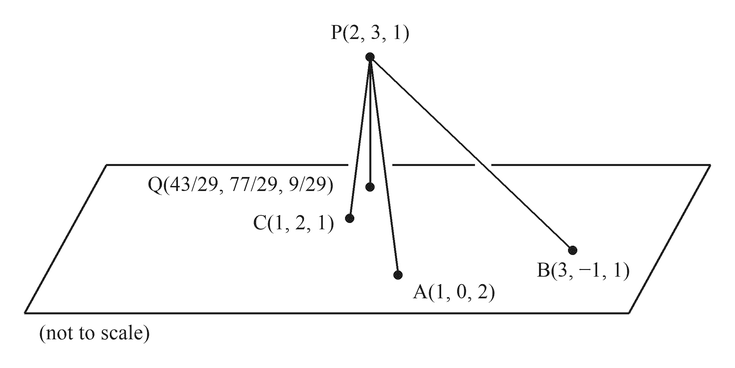
Answer the following questions.
(i) Find the equation of the plane containing the points A, B and C.
(ii) Find the equation of the line PQ.
(iii) Calculate the height of the tower.
Solve with AIWritten solution
Solution:
Key idea: The plane through three points has as its normal the cross product . The tower is perpendicular to the plane, so it runs along that normal, and its height is the perpendicular distance of from the plane, .
Step 1 — (i) Find two vectors in the plane.
We subtract the coordinates of from those of and .
Step 2 — (i) Find the normal.
We take the cross product of the two vectors by the determinant.
Step 3 — (i) Write the plane through A.
We use the one-point form with normal and the point .
As a check, we substitute and ; both must give .
Step 4 — (ii) Find the direction of PQ.
The tower is perpendicular to the plane, so it is parallel to the normal . We can confirm this from the coordinates by subtracting from .
These are times , so the direction ratios of are .
Step 5 — (ii) Write the line PQ.
The line passes through with direction ratios .
In vector form this is .
Step 6 — (iii) Find the height of the tower.
The height is the perpendicular distance of from the plane .
The same value comes from the coordinates of .
Therefore, (i) the plane is ; (ii) the line PQ is ; (iii) the height of the tower is units.
- 141 mark
Question 14
The angle between the two planes and is:
- 152 marks
Question 15
Find the equation of the plane passing through the points , and .
- 162 marks
Question 16
Find the equation of the plane passing through the points , and parallel to -axis.
- 171 mark
Question 17
Find the equation of the plane with intercepts 3, and 2 on and axes respectively.
- 184 marks
Question 18
A school is preparing the stage for its annual day function. They want to place a hanging mic and a hanging light on the stage.
- They decide to position the mic at the point such that it is equidistant from a plain backdrop and the hanging light as shown below.

- The equation of the surface of the plain backdrop is
(a) Find the distance between the mic and the plain backdrop. [1]
(b) Calculate the coordinates of the position of the hanging light. [3]