
Opening your dashboard
Class 12 Chemistry Chapter 14: Biomolecules Solutions
86 textbook questions with step-by-step answers, free to read, for ISC 2026-27.
Get talked through Ch 14, not just shown the answer
Reading a finished solution is not the same as being able to do it. The AI tutor takes one question at a time and works it with you, in your own words, until you can.
- Ask it out loud, in your own words
- It gives you the next step, not the answer
- Stuck on part (ii)? Start there
86 questions with solutions
1–5 marks · Mixed difficulty
- 11 mark
Question 1
α-D-glucose and β-D-glucose are ..... of each other.
Solve with AIAnswer
(A) epimers
(B) tautomers
- Correct
(C) anomers
(D) enantiomers
Answer: (C) anomers
Key idea: when a sugar closes into a ring, its carbonyl carbon becomes a new chiral centre called the anomeric carbon. Two ring forms that differ only in the arrangement of groups on this carbon are called anomers.
Step 1 — Find where the two forms differ. In the ring (pyranose) form of glucose, C1 is the hemiacetal carbon. In α-D-glucose the –OH on C1 lies on one side (below the ring in the Haworth form); in β-D-glucose it lies on the other side (above the ring). All other carbons, C2 to C5, are the same in both.
Step 2 — Name the relationship. C1 is the anomeric carbon, so isomers that differ only at C1 are anomers. They can be told apart by their specific rotations: α-D-glucose +112°, β-D-glucose +19°.
Why the other options are wrong:
- (A) "Epimers" is the general name for sugars that differ in configuration at one chiral carbon, such as D-glucose and D-mannose (at C2). The special name for a difference at the anomeric carbon C1 is anomers, which is the exact answer here.
- (B) Tautomers differ in the position of a hydrogen atom and a double bond (for example keto and enol forms); α- and β-glucose have the same bonds and differ only in the arrangement of groups in space.
- (D) Enantiomers are non-superimposable mirror images, like D-glucose and L-glucose; α-D- and β-D-glucose are not mirror images of each other.
So α-D-glucose and β-D-glucose are anomers, option (C).
- 21 mark
Question 2
The pairs of sugars which give the same product with excess of phenylhydrazine are:
Solve with AIAnswer
(A) Starch and cellulose
(B) Cellulose and sucrose
(C) Sucrose and glucose
- Correct
(D) Glucose and fructose
Answer: (D) Glucose and fructose
Key idea: with excess phenylhydrazine, only a reducing sugar (one with a free aldehyde or keto group) forms a yellow crystalline osazone. The reaction changes only carbon atoms C1 and C2 of the sugar.
Step 1 — See what happens in osazone formation. Phenylhydrazine reacts at the carbonyl carbon and at the carbon next to it. In the osazone, both C1 and C2 carry a C=N–NH– group.
Step 2 — Compare glucose and fructose. Glucose has its carbonyl group at C1; fructose has its carbonyl group at C2. Carbons C3, C4, C5 and C6 have the same arrangement in both sugars.
Step 3 — Conclude. Since the only differences (at C1 and C2) are removed when the osazone forms, both sugars give the same osazone (glucosazone).
Why the other options are wrong:
- (A) Starch and cellulose are polysaccharides with no free aldehyde or keto group, so they do not form osazones.
- (B) Neither cellulose nor sucrose is a reducing sugar, so neither forms an osazone.
- (C) Sucrose is a non-reducing sugar (its C1 of glucose and C2 of fructose are tied up in the glycosidic bond), so it gives no osazone, while glucose does.
So glucose and fructose give the same product, option (D).
- 31 mark
Question 3
In polysaccharides the linkage containing monosaccharide units is called
Solve with AIAnswer
- Correct
(A) glycoside linkage
(B) nucleoside linkage
(C) glycogen linkage
(D) peptide linkage
Answer: (A) glycoside linkage
Key idea: two sugar units join through an oxygen bridge (C–O–C) when water is removed between them. This bond is called a glycosidic (glycoside) linkage.
Step 1 — See how two sugar units join. The hemiacetal –OH on the anomeric carbon of one monosaccharide reacts with an –OH group of the next monosaccharide, and a molecule of water is lost.
Step 2 — Name the bond. The two units are now held together by an oxygen atom, C–O–C. This is the glycosidic linkage; it joins the units in disaccharides (such as maltose) and in polysaccharides (such as starch and cellulose).
Why the other options are wrong:
- (B) In a nucleoside the bond joins a nitrogen base to the sugar (through a nitrogen atom of the base); it does not join one monosaccharide to another.
- (C) Glycogen is a polysaccharide (animal starch), not the name of a linkage.
- (D) A peptide linkage, –CO–NH–, joins amino acids in proteins.
So the linkage is the glycoside linkage, option (A).
- 41 mark
Question 4
Which of the following cannot distinguish between glucose and fructose?
Solve with AIAnswer
(A) Tollens' reagent
(B) Fehling solution
(C) Benedict's solution
- Correct
(D) All of these
Answer: (D) All of these
Key idea: a reagent can distinguish two sugars only if it gives a result with one of them and not with the other. Tollens', Fehling's and Benedict's reagents are all alkaline mild oxidising agents.
Step 1 — Glucose with these reagents. Glucose is an aldose. Its –CHO group is easily oxidised, so it reduces all three reagents.
Step 2 — Fructose with these reagents. Fructose is a ketose, but in an alkaline medium it changes partly into glucose and mannose (through an enediol form). So fructose also reduces all three reagents.
Step 3 — Compare the results. Both sugars give a silver mirror with Tollens' reagent and a red precipitate of with Fehling's and Benedict's solutions. Since the results are the same, none of these reagents can tell them apart.
Watch out: bromine water, a mild oxidising agent that is not alkaline, oxidises glucose (an aldose) but not fructose, so it can distinguish them.
Why the other options are wrong:
- (A) Tollens' reagent is reduced by both glucose and fructose, so it cannot distinguish them on its own.
- (B) Fehling's solution gives a red precipitate with both sugars, so it cannot distinguish them on its own.
- (C) Benedict's solution is also reduced by both sugars, so it cannot distinguish them on its own.
So none of the three reagents can distinguish them: option (D), all of these.
- 51 mark
Question 5
Which is correct statement?
(a) Starch is a polymer of α-glucose.
(b) Amylose is a component of cellulose.
(c) Proteins are composed of only one type of amino acids.
(d) In cyclic structure of furanose there are four carbons and one oxygen atom.
Solve with AIWritten solution
Solution:
Key idea: check each statement one by one against what we know about starch, cellulose, proteins and sugar rings.
Step 1 — Statement (a): true. Starch is made of two parts, amylose and amylopectin. Both are chains of α-D-glucose units joined by α-glycosidic links, so starch is a polymer of α-glucose.
Step 2 — Statement (b): false. Amylose is a component of starch (about 15–20% of it), not of cellulose. Cellulose is a straight chain of β-D-glucose units.
Step 3 — Statement (c): false. Proteins are built from about 20 different α-amino acids, joined by peptide bonds, not from one type only.
Step 4 — Statement (d): true. A furanose ring is a five-membered ring, like the ring of furan. It contains four carbon atoms and one oxygen atom. (A pyranose ring is six-membered: five carbons and one oxygen.)
Correct statements: (a) and (d).
Note: the book's key gives only (a), but statement (d) is also true, so this item is answered as a subjective question naming both correct statements.
- 61 mark
Question 6
The sugar which is not a disaccharide in the following is:
Solve with AIAnswer
(A) Lactose
- Correct
(B) Galactose
(C) Sucrose
(D) Maltose
Answer: (B) Galactose
Key idea: a disaccharide gives two monosaccharide units on hydrolysis; a monosaccharide cannot be hydrolysed into simpler sugars.
Step 1 — Look at galactose. Galactose, , is an aldohexose. It is a single sugar unit and cannot be broken into simpler sugars, so it is a monosaccharide.
Step 2 — Look at the other three. Lactose, sucrose and maltose are all and each hydrolyses into two monosaccharide units, so they are disaccharides.
Why the other options are wrong:
- (A) Lactose (milk sugar) is a disaccharide; it hydrolyses to β-D-galactose and β-D-glucose.
- (C) Sucrose (cane sugar) is a disaccharide; it hydrolyses to D-glucose and D-fructose.
- (D) Maltose (malt sugar) is a disaccharide; it hydrolyses to two molecules of α-D-glucose.
So the sugar that is not a disaccharide is galactose, option (B).
- 71 mark
Question 7
Complete hydrolysis of cellulose gives,
Solve with AIAnswer
(A) L-glucose
- Correct
(B) D-glucose
(C) D-ribose
(D) D-fructose
Answer: (B) D-glucose
Key idea: hydrolysis breaks each glycosidic link of a polysaccharide with a molecule of water, giving back the monosaccharide units it is made of.
Step 1 — Recall the structure of cellulose. Cellulose is a long straight chain of β-D-glucose units joined by β(1→4) glycosidic links.
Step 2 — Hydrolyse it completely. Every link takes up one water molecule and breaks, so only D-glucose is left:
Why the other options are wrong:
- (A) Natural sugars, including the glucose in cellulose, belong to the D-series; L-glucose is not present.
- (C) D-ribose is a pentose found in RNA, not in cellulose.
- (D) D-fructose is a ketohexose present in sucrose and inulin, not in cellulose.
So complete hydrolysis of cellulose gives D-glucose, option (B).
- 81 mark
Question 8
The number of chiral carbons in β-D (+) glucose is:
Solve with AIAnswer
- Correct
(A) Five
(B) Six
(C) Three
(D) Four
Answer: (A) Five
Key idea: a chiral carbon is a carbon atom joined to four different atoms or groups.
Step 1 — Note which form is meant. The name β-D-(+)-glucose refers to the cyclic (pyranose) form, because the α/β labels exist only for the ring.
Step 2 — Check each carbon of the ring. C2, C3, C4 and C5 each carry four different groups. When the ring closes, C1 also gets four different groups (–OH, –H, the ring oxygen and C2), so it becomes a new chiral centre.
Step 3 — Check C6. C6 is a – group. It has two hydrogens on it, so it is not chiral.
Step 4 — Count. C1, C2, C3, C4 and C5 give five chiral carbons.
Why the other options are wrong:
- (B) C6 is a group with two hydrogens on it, so it is not chiral; six would count it.
- (C) Three is too few: C2, C3, C4 and C5 are chiral even in the open chain, and C1 is chiral in the ring.
- (D) Four is the number for the open-chain form (C2 to C5), where C1 is a –CHO group and is not chiral.
So β-D-(+)-glucose has five chiral carbons, option (A).
- 91 mark
Question 9
Which of the following pairs gives the same osazone?
Solve with AIAnswer
- Correct
(A) Glucose, Fructose
(B) Glucose, Galactose
(C) Maltose, Lactose
(D) Sucrose, Fructose
Answer: (A) Glucose, Fructose
Key idea: osazone formation changes only C1 and C2 of a reducing sugar. Two sugars give the same osazone when the rest of their chain (C3 onwards) is the same.
Step 1 — Compare glucose and fructose. They differ only at C1 and C2 (glucose has –CHO at C1; fructose has C=O at C2). Their configurations at C3, C4 and C5 are the same.
Step 2 — Conclude. The C1 and C2 differences disappear in the osazone, so glucose and fructose give the same osazone.
Why the other options are wrong:
- (B) Glucose and galactose differ in configuration at C4, which is not touched in osazone formation, so their osazones are different.
- (C) Maltose and lactose are different disaccharides (glucose + glucose; galactose + glucose), so they give different osazones.
- (D) Sucrose is a non-reducing sugar and gives no osazone at all.
So glucose and fructose give the same osazone, option (A).
- 101 mark
Question 10
Which of the following is a vitamin?
Solve with AIAnswer
(A) Benzoic acid
- Correct
(B) Ascorbic acid
(C) Oxalic acid
(D) Formic acid
Answer: (B) Ascorbic acid
Key idea: vitamins are organic compounds needed in small amounts in the diet for normal health; the body cannot make enough of them, and their lack causes deficiency diseases.
Step 1 — Identify ascorbic acid. Ascorbic acid is vitamin C, a water-soluble vitamin found in citrus fruits and amla.
Step 2 — Link it to a deficiency disease. Lack of vitamin C causes scurvy, so ascorbic acid is a vitamin.
Why the other options are wrong:
- (A) Benzoic acid () is an aromatic acid; its sodium salt is used as a food preservative.
- (C) Oxalic acid () is a dicarboxylic acid; it is not needed in the diet.
- (D) Formic acid () is the simplest carboxylic acid (found in ant stings), not a vitamin.
So the vitamin is ascorbic acid, option (B).
- 111 mark
Question 11
Which one of the following structures represents the peptide chain?
Solve with AIAnswer
(A)
(B)
- Correct
(C)
(D)
Answer: (C)
Key idea: a peptide chain is built from α-amino acid units joined by peptide bonds (–CO–NH–). Every unit has the pattern –NH–C–CO–: a nitrogen, then the α-carbon (carrying H and the side group R), then the carbonyl carbon, which is joined to the N of the next unit:
Step 1 — Know what to look for. Read along each chain and check for the repeating order: N, then one saturated carbon, then a carbon with =O, then N again.
Step 2 — Check structure (C). Reading from the left: N, a carbon with two single bonds above and below (the α-carbon), a carbon double-bonded to O (the carbonyl carbon), then N–H of the next unit. This –N–C–CO– unit repeats three times, so (C) is a peptide chain.
Step 3 — Check the others. None of (A), (B) or (D) has this regular repeating unit (see below).
Why the other options are wrong:
- (A) Here a carbonyl group sits between two NH groups (–NH–CO–NH–, a urea-type link), and there is no α-carbon between N and the carbonyl carbon, so it is not a chain of α-amino acid units.
- (B) This chain has only one –CO–NH– group, and three carbon atoms lie between that carbonyl carbon and the next nitrogen; in a peptide only one carbon (the α-carbon) lies between the N and the C=O of each unit.
- (D) This chain has an –NH– joined to two saturated carbons (an amine link, not an amide link), and two carbons lie between some N and C=O groups, so it does not have the regular –NH–C–CO– pattern of a peptide.
So the structure that represents a peptide chain is (C).
Note: the structures are shown as printed; a few printed bonds are stray (for example the =O drawn under the first N of (C), and N=H in (D)). They do not change the answer: only (C) has the repeating –NH–C–CO– unit.
- 121 mark
Question 12
A Zwitter ion is
Solve with AIAnswer
(A) a negatively charged ion without metal atom
(B) a heavy ion with a small charge on it
- Correct
(C) an ion with positive and negative charge at different points on it
(D) a positively charged ion without a metal atom
Answer: (C) an ion with positive and negative charge at different points on it
Key idea: a zwitter ion (dipolar ion) carries a positive charge on one part of the molecule and a negative charge on another part, so it is neutral overall.
Step 1 — See how it forms in an amino acid. An amino acid has an acidic –COOH group and a basic – group in the same molecule. The –COOH group gives its proton () to the – group.
Step 2 — Write the result. The –COOH becomes – and the – becomes –:
The two opposite charges sit at different points of one molecule, which is option (C).
Why the other options are wrong:
- (A) A zwitter ion is not negatively charged overall; its positive and negative charges balance.
- (B) Its defining feature is two opposite charges on one molecule, not its mass or the size of a single charge.
- (D) A zwitter ion is not positively charged overall; it also carries a negative – group.
So a zwitter ion is an ion with positive and negative charges at different points on it, option (C).
- 131 mark
Question 13
The monosaccharides having anomeric carbon atom are
Solve with AIAnswer
(A) geometrical isomers
- Correct
(B) α- and β-optical isomers
(C) having symmetrical carbon atoms
(D) None of the above
Answer: (B) α- and β-optical isomers
Key idea: the anomeric carbon is the carbonyl carbon of a sugar (C1 in glucose) that becomes a new chiral centre when the chain closes into a ring.
Step 1 — See what ring closure does. When glucose forms its ring, the –OH formed on C1 can lie on either side of the ring.
Step 2 — Name the two forms. This gives two optical isomers, the α-form and the β-form (anomers). They differ only at the anomeric carbon and have different specific rotations (glucose: +112° for α and +19° for β).
Why the other options are wrong:
- (A) Geometrical (cis–trans) isomers arise from restricted rotation about a C=C double bond; the α and β forms come from the two possible arrangements at the chiral anomeric carbon, so they are described as optical isomers.
- (C) The anomeric carbon carries four different groups, so it is an asymmetric (chiral) carbon, not a symmetrical one.
- (D) Option (B) is correct, so "none of the above" is wrong.
So monosaccharides with an anomeric carbon exist as α- and β-optical isomers, option (B).
- 141 mark
Question 14
Which one of the following is an amine hormone?
Solve with AIAnswer
- Correct
(A) Thyroxine
(B) Oxypurin
(C) Insulin
(D) Progesterone
Answer: (A) Thyroxine
Key idea: hormones are grouped by their chemical nature into amine (amino-acid derived) hormones, peptide/protein hormones and steroid hormones.
Step 1 — Look at thyroxine. Thyroxine is made in the thyroid gland from the amino acid tyrosine.
Step 2 — Classify it. A hormone made from an amino acid is an amine hormone, so thyroxine is an amine hormone (adrenaline is another).
Why the other options are wrong:
- (B) An oxypurine (such as xanthine or hypoxanthine) is a purine derivative formed in the breakdown of nucleic acids; it is not a hormone.
- (C) Insulin is a protein (peptide) hormone made of two polypeptide chains (51 amino acid residues).
- (D) Progesterone is a steroid hormone (a female sex hormone).
So the amine hormone is thyroxine, option (A).
- 151 mark
Question 15
Which of the following hormones contains iodine?
Solve with AIAnswer
(A) Insulin
(B) Testosterone
(C) Adrenaline
- Correct
(D) Thyroxine
Answer: (D) Thyroxine
Key idea: the thyroid gland uses iodine from food to make its hormone, thyroxine.
Step 1 — Recall the composition of thyroxine. Thyroxine is made from the amino acid tyrosine and has four iodine atoms in each molecule.
Step 2 — Link it to health. Too little iodine in the diet lowers thyroxine production and causes goitre (swelling of the thyroid gland). This is why iodised salt is used.
Why the other options are wrong:
- (A) Insulin is a protein hormone of the pancreas made of C, H, O, N and S; it has no iodine.
- (B) Testosterone is a steroid hormone made of C, H and O only.
- (C) Adrenaline is an amine hormone of the adrenal glands made of C, H, O and N; it has no iodine.
So the hormone that contains iodine is thyroxine, option (D).
- 161 mark
Question 16
The nitrogenous base not found in RNA is
Solve with AIAnswer
(A) adenine
(B) guanine
- Correct
(C) thymine
(D) cytosine
Answer: (C) thymine
Key idea: DNA and RNA share three bases (adenine, guanine, cytosine); the fourth base is thymine in DNA but uracil in RNA.
Step 1 — List the bases of RNA. RNA contains adenine, guanine, cytosine and uracil.
Step 2 — Find the missing one. Thymine is not in this list; in RNA its place is taken by uracil.
Why the other options are wrong:
- (A) Adenine, a purine, is present in both DNA and RNA.
- (B) Guanine, a purine, is present in both DNA and RNA.
- (D) Cytosine, a pyrimidine, is present in both DNA and RNA.
So the base not found in RNA is thymine, option (C).
- 171 mark
Question 17
Which of the following classes of compounds do glucose and fructose represent ?
(a) Aldoses and ketoses, respectively
(b) Polyols
(c) Monosaccharides
(d) Aldoses
Solve with AIWritten solution
Solution:
Key idea: glucose is a polyhydroxy aldehyde and fructose a polyhydroxy ketone, each . Check each class against these two structures.
Step 1 — Option (a): correct. Glucose has an aldehyde group (–CHO), so it is an aldose (an aldohexose). Fructose has a keto group (>C=O), so it is a ketose (a ketohexose).
Step 2 — Option (b): correct. Both molecules carry five –OH groups (they are polyhydroxy compounds), which is why they are described as polyols here.
Step 3 — Option (c): correct. Neither sugar can be hydrolysed into simpler sugars, so both are monosaccharides.
Step 4 — Option (d): not correct. Only glucose is an aldose; fructose is a ketose, so "aldoses" does not describe both.
Correct options: (a), (b) and (c).
Note: the book's key gives three options, (a), (b) and (c), so this item is answered as a subjective question. Strictly, "polyol" is the name for sugar alcohols such as sorbitol; glucose and fructose are polyhydroxy carbonyl compounds.
- 181 mark
Question 18
Which one of the following sets of monosaccharides forms sucrose ?
Solve with AIAnswer
(A) α-D-galactopyranose and α-D-glucopyranose
- Correct
(B) α-D-glucopyranose and β-D-fructofuranose
(C) β-D-glucopyranose and α-D-fructofuranose
(D) α-D-glucopyranose and β-D-fructopyranose
Answer: (B) α-D-glucopyranose and β-D-fructofuranose
Key idea: sucrose (cane sugar) is a disaccharide of one glucose unit and one fructose unit. To name the set correctly we need the sugars, their ring sizes (a pyranose ring is six-membered, a furanose ring five-membered) and their α/β forms.
Step 1 — The glucose unit. In sucrose, glucose is present as α-D-glucopyranose (a six-membered ring, α-form).
Step 2 — The fructose unit. Fructose is present as β-D-fructofuranose (a five-membered ring, β-form).
Step 3 — The link. C1 of the glucose unit joins C2 of the fructose unit through an oxygen atom. Both anomeric carbons are used in this C1–C2 link, which is why sucrose is a non-reducing sugar.
Why the other options are wrong:
- (A) Galactose is a unit of lactose (milk sugar), not of sucrose.
- (C) The anomers are the wrong way round: in sucrose glucose is the α-form and fructose the β-form.
- (D) In sucrose fructose is present as a five-membered furanose ring, not a six-membered pyranose ring.
So sucrose is formed from α-D-glucopyranose and β-D-fructofuranose, option (B).
- 191 mark
Question 19
The anticodon transfer RNA for the messenger RNA codon GCA is:
Solve with AIAnswer
(A) TGA
(B) GUT
(C) AGT
- Correct
(D) CGU
Answer: (D) CGU
Key idea: the tRNA anticodon pairs base by base with the mRNA codon (G–C, A–U); RNA has U, never T.
Step 1 — Pair the first base. The codon starts with G, and G pairs with C.
Step 2 — Pair the second base. The second base is C, and C pairs with G.
Step 3 — Pair the third base. The third base is A, and in RNA A pairs with U (not T, because RNA has no thymine).
Step 4 — Put the bases together. The anticodon is C, G, U, that is CGU.
Why the other options are wrong:
- (A) TGA contains thymine, which is not found in RNA; also its first base T does not pair with G.
- (B) GUT contains thymine, which is not found in RNA; also G does not pair with G.
- (C) AGT contains thymine, which is not found in RNA; also A does not pair with G.
So the anticodon for the codon GCA is CGU, option (D).
- 201 mark
Question 20
Which of the following bases is not present in DNA?
Solve with AIAnswer
(A) Thymine
- Correct
(B) Quinoline
(C) Adenine
(D) Cytosine
Answer: (B) Quinoline
Key idea: DNA contains exactly four nitrogen bases: two purines (adenine, guanine) and two pyrimidines (cytosine, thymine).
Step 1 — Check each option against the list. Thymine, adenine and cytosine are all in the list of DNA bases.
Step 2 — Identify the odd one. Quinoline is a fused benzene–pyridine ring compound. It is not a purine or pyrimidine base of nucleic acids, so it is not present in DNA.
Why the other options are wrong:
- (A) Thymine is a pyrimidine base present in DNA (in RNA it is replaced by uracil).
- (C) Adenine is a purine base present in DNA; it pairs with thymine.
- (D) Cytosine is a pyrimidine base present in DNA; it pairs with guanine.
So the base not present in DNA is quinoline, option (B).
- 211 mark
Question 21
Invert sugar is obtained by hydrolysis of …… and contains equimolar amounts of …… and …… .
Solve with AIWritten solution
Solution:
Key idea: hydrolysis of a disaccharide splits it into its two monosaccharide units; "invert" refers to the change in the sign of optical rotation.
Step 1 — Hydrolyse sucrose. Sucrose is hydrolysed by dilute acid or by the enzyme invertase into equal amounts of glucose and fructose:
Step 2 — Compare the rotations. Sucrose is dextrorotatory (+66.5°). In the product, glucose turns light to the right (+52.5°) and fructose turns it more strongly to the left (−92.4°).
Step 3 — Find the overall sign. For an equimolar mixture the average rotation is negative:
The sign changes from + to −, so the mixture is called invert sugar.
So the blanks are: sucrose; D(+)-glucose; D(−)-fructose.
- 221 mark
Question 22
Most of the α-amino acids exist as …… .
Solve with AIWritten solution
Solution:
Key idea: an α-amino acid has an acidic –COOH group and a basic – group on the same molecule.
Step 1 — Internal proton transfer. The –COOH group gives its proton to the – group of the same molecule.
Step 2 — Write the result. The amino acid becomes a dipolar ion with a positive and a negative charge:
Step 3 — Link to properties. Because they are ionic, amino acids are crystalline solids with high melting points and dissolve in water.
So the blank is: zwitter ions (dipolar ions).
- 231 mark
Question 23
Quaternary structure of haemoglobin consists of …… subunits; two of the subunits are identical …… and contain …… amino acid residues and the other two subunits are also identical and contain …… amino acid residues.
Solve with AIWritten solution
Solution:
Key idea: the quaternary structure of a protein is the way two or more separate polypeptide chains (subunits) are packed together.
Step 1 — Count the subunits. Haemoglobin is made of four polypeptide subunits.
Step 2 — Describe the first pair. Two of them are identical β-chains, each with 146 amino acid residues.
Step 3 — Describe the second pair. The other two are identical α-chains, each with 141 amino acid residues.
So the blanks are: four; β-chains; 146; 141.
Note: the book's answer fills three blanks (four, 146, 141); the blank after "identical" is filled with the chain name, β-chains.
- 241 mark
Question 24
Deficiency of …… causes scurvy.
Solve with AIWritten solution
Solution:
Key idea: each vitamin has a typical deficiency disease.
Step 1 — Recall the symptoms of scurvy. Scurvy causes bleeding gums and slow healing of wounds.
Step 2 — Name the vitamin. It is caused by lack of vitamin C (ascorbic acid), which is found in citrus fruits, amla and green vegetables.
So the blank is: vitamin C.
- 251 mark
Question 25
The acidic character of glycine is due to …… group and the basic character is due to …… group.
Solve with AIWritten solution
Solution:
Key idea: glycine exists as the zwitter ion . An acid gives a proton; a base takes a proton.
Step 1 — Acidic character. With a base such as , glycine gives a proton from its – group:
Step 2 — Basic character. With an acid, glycine takes a proton on its – group:
So the blanks are: –; –.
- 261 mark
Question 26
Exposure of body to sun rays produces …… .
Solve with AIWritten solution
Solution:
Key idea: one vitamin can be made by the body itself in the skin.
Step 1 — What sunlight does. When the skin is exposed to sunlight, its ultraviolet rays convert a compound in the skin into vitamin D.
Step 2 — Why it matters. Vitamin D is needed for strong bones; its deficiency causes rickets in children and osteomalacia in adults.
So the blank is: vitamin D.
- 271 mark
Question 27
Starch is …… saccharide.
Solve with AIWritten solution
Solution:
Key idea: carbohydrates are classed by how many sugar units they give on hydrolysis: one (mono-), two to ten (oligo-), or very many (poly-).
Step 1 — Look at starch. Starch (amylose and amylopectin) is a polymer of a very large number of α-D-glucose units.
Step 2 — Classify it. A carbohydrate made of very many sugar units is a polysaccharide.
So the blank is: poly (starch is a polysaccharide).
- 281 mark
Question 28
DNA undergoes …… but …… usually does not.
Solve with AIWritten solution
Solution:
Key idea: replication means a molecule making an exact copy of itself.
Step 1 — DNA. In replication the two strands of DNA separate, and each strand acts as a template for a new strand. So each daughter cell gets the same genetic information.
Step 2 — RNA. RNA usually does not replicate; it is made from DNA (transcription) and directs protein synthesis.
So the blanks are: replication; RNA.
- 291 mark
Question 29
…… shows mutarotation but …… does not.
Solve with AIWritten solution
Solution:
Key idea: mutarotation is the slow change in specific rotation of a freshly made sugar solution as the α- and β-forms change into each other through the open-chain form.
Step 1 — Glucose. In water, α-glucose (+112°) and β-glucose (+19°) change into each other until an equilibrium mixture with specific rotation +52.5° is reached. So glucose shows mutarotation.
Step 2 — Sucrose. In sucrose, C1 of glucose and C2 of fructose are both used in the glycosidic link, so there is no free hemiacetal group. The ring cannot open, so sucrose does not show mutarotation.
So the blanks are: Glucose; sucrose.
- 301 mark
Question 30
A nucleotide consists of three parts: a phosphate unit, a sugar and a …… or …… .
Solve with AIWritten solution
Solution:
Key idea: a nucleotide is made of a nitrogen base, a pentose sugar and a phosphate group.
Step 1 — Identify the third part. The third part is the nitrogen base.
Step 2 — Name the two kinds of base. The base is either a purine (adenine, guanine) or a pyrimidine (cytosine, thymine, uracil).
So the blanks are: purine; pyrimidine (base).
- 311 mark
Question 31
Glucose and sucrose can be distinguished by …… or …… solution.
Solve with AIWritten solution
Solution:
Key idea: a reducing sugar has a free aldehyde (or hemiacetal) group and reduces mild oxidising agents; a non-reducing sugar does not.
Step 1 — Glucose. Glucose is a reducing sugar: it gives a silver mirror with Tollens' reagent and a red precipitate of with Fehling's solution.
Step 2 — Sucrose. Sucrose is a non-reducing sugar (both anomeric carbons are used in its glycosidic link), so it gives neither test.
So the blanks are: Tollens' reagent; Fehling's (solution).
- 321 mark
Question 32
Adrenaline is an …… hormone while testosterone is a …… hormone.
Solve with AIWritten solution
Solution:
Key idea: hormones are classed by chemical nature as amine, peptide/protein or steroid hormones.
Step 1 — Adrenaline. Adrenaline is made from the amino acid tyrosine, so it is an amine hormone.
Step 2 — Testosterone. Testosterone, the male sex hormone, has the four-ring steroid skeleton, so it is a steroid hormone.
So the blanks are: amine; steroid.
- 331 mark
Question 33
The monosaccharide units in oligosaccharides and polysaccharides are connected through …… linkages.
Solve with AIWritten solution
Solution:
Key idea: sugar units join through an oxygen bridge formed when water is removed between them.
Step 1 — How the bond forms. The –OH on the anomeric carbon of one unit reacts with an –OH of the next unit, and a water molecule is lost.
Step 2 — Name the bond. The units are now joined by C–O–C, the glycosidic linkage.
So the blank is: glycosidic.
- 341 mark
Question 34
Hormone secretion in mammals is under the control of …… .
Solve with AIWritten solution
Solution:
Key idea: hormones are chemical messengers made in one part of the body and carried by the blood to act elsewhere.
Step 1 — Where they are made. Hormones are produced by ductless glands, which release them straight into the blood. These are the endocrine glands, such as the thyroid, pituitary and adrenal glands and the pancreas.
Step 2 — Where they go. The blood carries each hormone to the organs it acts on.
So the blank is: endocrine glands.
- 351 mark
Question 35
The presence of …… in the body induces the formation of antibodies.
Solve with AIWritten solution
Solution:
Key idea: antibodies are proteins made by the body to defend it against foreign substances.
Step 1 — The trigger. A foreign substance, such as a protein on a virus or bacterium, is called an antigen.
Step 2 — The response. The antigen makes the body produce antibodies, which bind to the antigen and help destroy it.
So the blank is: antigens.
- 361 mark
Question 36
Carbohydrates containing an aldehydic group are called …… and those containing a keto group are called …… .
Solve with AIWritten solution
Solution:
Key idea: monosaccharides are classed by the kind of carbonyl group they contain.
Step 1 — Aldehyde group. A sugar with an aldehyde group (–CHO) is an aldose; for example, glucose is an aldohexose.
Step 2 — Keto group. A sugar with a keto group (>C=O) is a ketose; for example, fructose is a ketohexose.
So the blanks are: aldoses; ketoses.
- 371 mark
Question 37
The prosthetic group of nucleoproteins are …… while those of glycoproteins are …… .
Solve with AIWritten solution
Solution:
Key idea: a conjugated protein has a non-protein part joined to it, called the prosthetic group.
Step 1 — Nucleoproteins. In nucleoproteins the prosthetic group is a nucleic acid.
Step 2 — Glycoproteins. In glycoproteins the prosthetic group is a carbohydrate.
So the blanks are: nucleic acids; carbohydrates.
- 381 mark
Question 38
Out of alanine and phenylalanine, …… is an essential amino acid.
Solve with AIWritten solution
Solution:
Key idea: essential amino acids cannot be made by the body and must come from the diet; non-essential ones can be made in the body.
Step 1 — Alanine. Alanine can be made in the body, so it is non-essential.
Step 2 — Phenylalanine. Phenylalanine cannot be made in the body, so it must be taken in food; it is essential.
So the blank is: phenylalanine.
- 391 mark
Question 39
Denaturation involves conversion of …… proteins to …… proteins.
Solve with AIWritten solution
Solution:
Key idea: denaturation is the loss of a protein's natural shape, and with it its biological activity, on heating or on a change of pH.
Step 1 — What breaks. The hydrogen bonds that hold the folded (globular) shape break.
Step 2 — What happens to the shape. The globules unfold and the helices uncoil, so the protein loses its activity. The primary structure (the order of amino acids) stays the same.
Step 3 — Example. Egg white coagulates on boiling because its globular protein is denatured.
So the blanks are: globular; fibrous.
Note: more exactly, the unfolded chain is a random, uncoiled chain rather than a true fibrous protein; the book's answer is kept.
- 401 mark
Question 40
In RNA, the sugar is …… but in DNA, it is …… .
Solve with AIWritten solution
Solution:
Key idea: both nucleic acids contain a five-carbon (pentose) sugar, but the two sugars differ at one carbon.
Step 1 — RNA. RNA contains β-D-ribose, which has an –OH group at C2.
Step 2 — DNA. DNA contains β-D-2-deoxyribose, which has H in place of the –OH at C2 ("deoxy" means one oxygen less).
So the blanks are: ribose; 2-deoxyribose.
- 411 mark
Question 41
Name the sugar present in milk. How many monosaccharide units are present in it? What are such oligosaccharides called?
Solve with AIWritten solution
Solution:
Key idea: oligosaccharides are named by the number of monosaccharide units they give on hydrolysis – two units make a disaccharide, three a trisaccharide, and so on.
Step 1 — Name the sugar in milk. The sugar present in milk is lactose, molecular formula .
Step 2 — Count its units. On hydrolysis (by acid or the enzyme lactase), lactose gives one molecule of β-D-galactose and one molecule of β-D-glucose, so it contains two monosaccharide units:
Step 3 — Name the class. An oligosaccharide made of two monosaccharide units is a disaccharide.
Therefore, milk sugar is lactose; it has 2 monosaccharide units, and such oligosaccharides are called disaccharides.
- 421 mark
Question 42
How do you explain the presence of all the six carbon atoms in glucose in a straight chain?
Solve with AIWritten solution
Solution:
Key idea: if a reaction removes all the oxygen atoms but does not break or rearrange the carbon skeleton, the product shows how the carbon atoms were joined in the starting compound.
Step 1 — The reaction. On prolonged heating with hydriodic acid (HI), glucose is fully reduced: all its –OH and –CHO oxygens are removed.
Step 2 — Identify the product. The product is n-hexane, in which six carbon atoms are joined one after another with no branch.
Step 3 — Conclude. Since the carbon skeleton is not changed in this reduction, the six carbon atoms of glucose must also be joined in an unbranched chain.
Therefore, formation of n-hexane with HI shows that all six carbon atoms of glucose are in a straight chain.
- 431 mark
Question 43
Name the linkage connecting monosaccharide units in polysaccharides.
Solve with AIWritten solution
Solution:
Key idea: when two monosaccharide units join, the –OH on the anomeric carbon of one unit condenses with an –OH of the next unit, and a molecule of water is lost; the C–O–C bridge left behind is called a glycosidic linkage.
Step 1 — How the units join. In polysaccharides such as starch and cellulose, hundreds of glucose units are joined one after another by this condensation.
Step 2 — Name the bond formed. Each join is an oxide (ether-type) bridge C–O–C between C1 of one unit and C4 (or C6) of the next. This bridge is the glycosidic linkage.
Therefore, the monosaccharide units in polysaccharides are connected by glycosidic linkages.
- 441 mark
Question 44
Monosaccharides contain carbonyl group hence are classified, as aldose or ketose. The number of carbon atoms present in the monosaccharide molecule are also considered for classification. In which class of monosaccharide will you place fructose?
Solve with AIWritten solution
Solution:
Key idea: a monosaccharide is named by its carbonyl group (aldehyde → "aldo-", ketone → "keto-") and its number of carbon atoms (5 → "-pentose", 6 → "-hexose").
Step 1 — Find the carbonyl group. Fructose, , has its C=O at C2, inside the chain. This is a ketone group, so fructose is a ketose.
Step 2 — Count the carbon atoms. Its formula is , so it has six carbon atoms – a hexose.
Step 3 — Combine the two. Keto + hexose gives ketohexose.
Therefore, fructose is a ketohexose.
- 451 mark
Question 45
Amino acids can be classified as α-, β-, γ-, δ- and so on depending upon the relative position of amino group with respect to carboxyl group. Which type of amino acids form polypeptide chain in proteins?
Solve with AIWritten solution
Solution:
Key idea: the carbon next to the –COOH group is called the α-carbon, the next one the β-carbon, and so on. The Greek letter tells which carbon carries the –NH₂ group.
Step 1 — What proteins give on hydrolysis. When proteins are hydrolysed completely, they give only amino acids in which the –NH₂ group is on the α-carbon.
Step 2 — General formula. These are α-amino acids, , where R is the side chain.
Step 3 — How they form the chain. The –COOH of one α-amino acid joins the –NH₂ of the next through a peptide bond, building the polypeptide chain.
Therefore, α-amino acids form the polypeptide chains of proteins.
- 461 mark
Question 46
Some enzymes are named after the reaction, where they are used. What name is given to the class of enzymes which catalyse the oxidation of one substrate with simultaneous reduction of another substrate.
Solve with AIWritten solution
Solution:
Key idea: enzymes are often named after the type of reaction they catalyse, with the ending "-ase".
Step 1 — Identify the reaction type. One substrate is oxidised while, at the same time, another substrate is reduced. This is an oxidation–reduction (redox) reaction.
Step 2 — Name the enzyme class. Enzymes that catalyse redox reactions are named "oxido" + "reductase".
Therefore, this class of enzymes is called oxidoreductases.
- 471 mark
Question 47
During curdling of milk, what happens to sugar present in it?
Solve with AIWritten solution
Solution:
Key idea: curd is made when bacteria ferment the sugar in milk to an acid, and that acid makes the milk protein coagulate.
Step 1 — The sugar in milk. Milk contains the disaccharide lactose.
Step 2 — What the bacteria do. Lactic acid bacteria (lactobacilli) ferment the lactose and convert it into lactic acid, .
Step 3 — Effect of the acid. The lactic acid lowers the pH of the milk, so the milk protein casein coagulates and the milk sets into curd.
Therefore, during curdling the lactose in milk is converted into lactic acid.
- 481 mark
Question 48
Name the enzyme which converts glucose into alcohol?
Solve with AIWritten solution
Solution:
Key idea: fermentation is the breakdown of a sugar by enzymes from micro-organisms; yeast ferments glucose into ethanol and carbon dioxide.
Step 1 — The reaction. Glucose is converted into ethyl alcohol and carbon dioxide:
Step 2 — The enzyme. The enzyme that brings about this change is zymase, which is present in yeast. (Invertase, also from yeast, only splits sucrose into glucose and fructose; it does not make alcohol.)
Therefore, the enzyme that converts glucose into alcohol is zymase.
- 491 mark
Question 49
Certain diseases are caused by enzyme deficiencies. Explain giving one example.
Solve with AIWritten solution
Solution:
Key idea: each enzyme is highly specific – it catalyses only one particular reaction in the body. If that enzyme is missing, the reaction stops and a disease results.
Step 1 — Cause. A person may be born without a working enzyme (a congenital defect). The reaction that the enzyme catalyses then cannot take place.
Step 2 — Example. The enzyme tyrosinase is needed to make the dark pigment melanin. When tyrosinase is deficient, no melanin is formed, so the skin and hair remain very pale. This disease is albinism.
Step 3 — Another example. Deficiency of phenylalanine hydroxylase stops the normal conversion of phenylalanine; phenylalanine builds up and causes phenylketonuria.
Therefore, an enzyme deficiency blocks one reaction and causes a disease – for example, lack of tyrosinase causes albinism.
- 501 mark
Question 50
What is a peptide bond?
Solve with AIWritten solution
Solution:
Key idea: an α-amino acid has an acidic –COOH group and a basic –NH₂ group, so two amino acids can join by an amide link with the loss of water.
Step 1 — How it forms. The –COOH group of one α-amino acid reacts with the –NH₂ group of another, and a molecule of water is eliminated.
Step 2 — The link formed. The new group that joins the two units is the amide group –CO–NH–.
Step 3 — Example. Glycine + alanine → glycylalanine, .
Therefore, a peptide bond is the –CO–NH– (amide) bond formed between the –COOH of one α-amino acid and the –NH₂ of another, with loss of water.
- 511 mark
Question 51
What is a polypeptide? Give one example.
Solve with AIWritten solution
Solution:
Key idea: peptides are named by the number of α-amino acid units joined by peptide bonds – two units make a dipeptide, three a tripeptide, and a large number a polypeptide.
Step 1 — Definition. A polypeptide is a peptide in which a large number (more than ten) of α-amino acid units are joined by peptide (–CO–NH–) bonds.
Step 2 — Example. Insulin is a polypeptide hormone: it has 51 amino acid units in two polypeptide chains, joined by disulphide links.
Therefore, a polypeptide is a chain of many α-amino acids joined by peptide bonds; example – insulin.
- 521 mark
Question 52
What type of bonding occurs in globular proteins?
Solve with AIWritten solution
Solution:
Key idea: in a globular protein the polypeptide chain is folded around itself into a compact, roughly spherical shape, and this fold is held in place by attractions between different parts of the chain.
Step 1 — Covalent cross-links. Disulphide (–S–S–) bridges form between cysteine units of the chain.
Step 2 — Weak attractions. Intramolecular hydrogen bonds, van der Waals forces and dipolar (ionic) interactions between side chains also hold the folded shape.
Therefore, globular proteins are held by disulphide bridges, hydrogen bonds, van der Waals forces and dipolar (ionic) interactions.
- 531 mark
Question 53
What is the secondary structure of proteins?
Solve with AIWritten solution
Solution:
Key idea: the primary structure is the sequence of amino acids; the secondary structure is the regular shape that this chain takes up because of hydrogen bonding.
Step 1 — Cause. Hydrogen bonds form between the C=O group of one peptide bond and the N–H group of another.
Step 2 — Two types. If the H-bonds are within the same chain, the chain coils into a right-handed α-helix (e.g. keratin in hair). If they are between neighbouring chains, the chains lie side by side as a β-pleated sheet (e.g. silk fibroin).
Therefore, the secondary structure of a protein is the α-helix or β-pleated sheet shape of its polypeptide chain, produced by hydrogen bonds between C=O and N–H groups.
- 541 mark
Question 54
What are glycosidic linkages? In which type of biomolecules are they present?
Solve with AIWritten solution
Solution:
Key idea: two monosaccharide units join when the –OH on the anomeric carbon of one condenses with an –OH of the other, losing a molecule of water.
Step 1 — Definition. The oxide (C–O–C) bridge formed in this way between two monosaccharide units is called a glycosidic linkage. In sucrose, for example, C1 of glucose is joined through oxygen to C2 of fructose.
Step 2 — Where it is found. Such linkages join the units of all disaccharides, oligosaccharides and polysaccharides.
Therefore, glycosidic linkages are C–O–C bridges between monosaccharide units, and they are present in carbohydrates (disaccharides, oligosaccharides and polysaccharides).
- 551 mark
Question 55
Which monosaccharide units are present in starch, cellulose and glycogen and which linkages link these units?
Solve with AIWritten solution
Solution:
Key idea: all three are polymers of D-glucose. They differ in the form of glucose used (α or β) and in which carbons the glycosidic links join.
Step 1 — Starch. Starch is made of α-D-glucose. Its amylose part has C1–C4 α-glycosidic links in a straight chain; its amylopectin part has C1–C4 links in the chains and C1–C6 links at the branch points.
Step 2 — Cellulose. Cellulose is made of β-D-glucose joined by C1–C4 β-glycosidic links in long straight chains.
Step 3 — Glycogen. Glycogen is made of α-D-glucose with C1–C4 α-links in the chains and C1–C6 links at the branches; it is more highly branched than amylopectin.
Polysaccharide Monosaccharide unit Linkage Starch α-D-glucose C1–C4 α-glycosidic (amylose); C1–C4 plus C1–C6 at branches (amylopectin) Cellulose β-D-glucose C1–C4 β-glycosidic Glycogen α-D-glucose C1–C4 α-glycosidic, with C1–C6 at the (more frequent) branches Therefore, starch and glycogen contain α-D-glucose units with α-glycosidic links, and cellulose contains β-D-glucose units with β-glycosidic links.
- 561 mark
Question 56
How do enzymes help a substrate to be attacked by the reagent effectively?
Solve with AIWritten solution
Solution:
Key idea: an enzyme acts by the lock-and-key mechanism – the substrate fits into a specially shaped region of the enzyme called the active site.
Step 1 — Binding. The substrate binds to the active site and forms an enzyme–substrate complex.
Step 2 — Positioning. The enzyme holds the substrate in the correct position and orientation, so the reagent can attack the right bond.
Step 3 — Weakening the bond. The binding strains the bond to be broken, so the reaction follows a path of lower activation energy.
Step 4 — Release. The products leave the active site, and the enzyme is free to act again.
Therefore, enzymes hold the substrate in the right position at their active site and lower the activation energy, so the reagent attacks it quickly.
- 571 mark
Question 57
Amino acids behave like salts rather than simple amines or carboxylic acids. Explain.
Solve with AIWritten solution
Solution:
Key idea: an α-amino acid has an acidic group (–COOH) and a basic group (–NH₂) in the same molecule, so it can undergo an internal acid–base reaction.
Step 1 — Internal proton transfer. The –COOH group gives its proton () to the –NH₂ group of the same molecule.
Step 2 — The ion formed. The product carries a positive charge on N and a negative charge on O. Such a dipolar ion is called a zwitterion (shown above for glycine).
Step 3 — Salt-like properties. Like ionic salts, the zwitterions are held together by strong electrostatic attractions. So amino acids are crystalline solids with high melting points, are soluble in water and are insoluble in non-polar solvents – unlike simple amines or carboxylic acids.
Therefore, amino acids behave like salts because they exist as dipolar ions (zwitterions).
- 582 marks
Question 58
What is the structural feature characterising reducing sugars?
Solve with AIWritten solution
Solution:
Key idea: a sugar is called reducing if it reduces Fehling's solution or Tollens' reagent. To do this it must be able to supply a free aldehyde or ketone group.
Step 1 — The feature. A reducing sugar has a free aldehyde (–CHO) or ketone (>C=O) group. In the ring form, this means a free hemiacetal or hemiketal –OH on its anomeric carbon.
Step 2 — Why it matters. Because the anomeric –OH is free, the ring can open in solution to give the open-chain carbonyl form, which reduces the reagent.
Step 3 — Examples. All monosaccharides (glucose, fructose) and the disaccharides maltose and lactose are reducing sugars. In sucrose, the anomeric carbons of both glucose (C1) and fructose (C2) are used in the glycosidic link, so no free carbonyl group is possible and sucrose is non-reducing.
Therefore, reducing sugars are characterised by a free aldehyde or ketone group (a free –OH on the anomeric carbon).
- 592 marks
Question 59
The letters 'D' or 'L' before the name of a stereoisomer of a compound indicates the correlation of configuration of that particular stereoisomer. This refers to their relation with one of the isomers of glyceraldehyde. Predict whether the following compound has 'D' or 'L' configuration.
 Solve with AI
Written solution
Solution:
Key idea: D or L is decided by the –OH on the lowest chiral carbon (the chiral carbon farthest from the C=O group) in the Fischer projection. If that –OH is on the right, as in D-glyceraldehyde, the sugar is D; if it is on the left, as in L-glyceraldehyde, the sugar is L.
Step 1 — Find the chiral carbons. C2, C3, C4 and C5 each carry four different groups, so they are chiral. C6 () has two H atoms, so it is not chiral.
Step 2 — Pick the lowest chiral carbon. The chiral carbon farthest from the –CHO group (C1) is C5.
Step 3 — Read its –OH. At C5 the –OH is written on the left and H on the right. This matches L-glyceraldehyde.
Step 4 — Check. In D-glucose the –OH groups at C2, C3, C4, C5 are right, left, right, right. Here they are left, right, left, left – every one is reversed, so this compound is the mirror image of D-glucose, i.e. L-glucose.
Therefore, the compound has the L-configuration.
- 602 marks
Question 60
How do you explain the presence of five –OH groups in glucose molecule?
Solve with AIWritten solution
Solution:
Key idea: acetic anhydride converts each –OH group into an acetate (–OCOCH₃) group, so counting the acetyl groups taken up counts the –OH groups.
Step 1 — The reaction. Glucose reacts with acetic anhydride to form glucose pentaacetate:
Step 2 — Count. One glucose molecule takes up five acetyl groups, so it must contain five –OH groups.
Step 3 — Where they are. The pentaacetate is a stable compound. Two –OH groups on the same carbon would be unstable and would lose water, so the five –OH groups must be on five different carbon atoms.
Therefore, formation of a pentaacetate shows that glucose has five –OH groups, each on a different carbon atom.
- 612 marks
Question 61
What are oligosaccharides?
Solve with AIWritten solution
Solution:
Key idea: carbohydrates are classified by how many monosaccharide units they give on hydrolysis: one (monosaccharide), a few (oligosaccharide) or very many (polysaccharide).
Step 1 — Definition. Oligosaccharides are carbohydrates that give a small number – two to nine – of monosaccharide molecules on hydrolysis.
Step 2 — Sub-classes. They are called disaccharides, trisaccharides, tetrasaccharides … according as they give 2, 3, 4 … units.
Step 3 — Examples. Sucrose and maltose (disaccharides), raffinose (trisaccharide) and stachyose (tetrasaccharide).
Therefore, oligosaccharides are carbohydrates that give 2 to 9 monosaccharide units on hydrolysis, e.g. sucrose.
- 622 marks
Question 62
What are disaccharides? Give one example.
Solve with AIWritten solution
Solution:
Key idea: a disaccharide is made of two monosaccharide units joined by one glycosidic linkage; hydrolysis breaks this link.
Step 1 — Definition. Disaccharides are carbohydrates that give two monosaccharide molecules (same or different) on hydrolysis with dilute acid or an enzyme. Their formula is .
Step 2 — Example. Sucrose (cane sugar) is hydrolysed to D-(+)-glucose and D-(–)-fructose:
Step 3 — Other examples. Maltose gives two glucose units; lactose gives glucose and galactose.
Therefore, disaccharides are carbohydrates that give two monosaccharide units on hydrolysis; example – sucrose.
- 632 marks
Question 63
What are tetrasaccharides? Give an example.
Solve with AIWritten solution
Solution:
Key idea: the prefix "tetra-" means four, so a tetrasaccharide is the oligosaccharide built from four monosaccharide units.
Step 1 — Definition. Tetrasaccharides are oligosaccharides that give four monosaccharide molecules on hydrolysis. Their general formula is .
Step 2 — Example. Stachyose is a tetrasaccharide. On hydrolysis it gives one glucose, one fructose and two galactose units (all ):
Step 3 — Check the water. Four units are joined by three glycosidic links, so three molecules of water are needed to break them.
Therefore, tetrasaccharides give four monosaccharide units on hydrolysis; example – stachyose.
- 642 marks
Question 64
What are polysaccharides? Give one example.
Solve with AIWritten solution
Solution:
Key idea: polysaccharides are natural polymers in which a very large number of monosaccharide units are joined by glycosidic linkages.
Step 1 — Definition. Polysaccharides are carbohydrates that give a very large number (hundreds to thousands) of monosaccharide units on hydrolysis.
Step 2 — Properties. They are not sweet and are usually insoluble in water, so they are called non-sugars.
Step 3 — Example. Starch, , gives glucose on hydrolysis:
Therefore, polysaccharides are carbohydrates that give a very large number of monosaccharide units on hydrolysis; example – starch (also cellulose, glycogen).
- 652 marks
Question 65
Name one reducing and one non-reducing disaccharide.
Solve with AIWritten solution
Solution:
Key idea: a disaccharide is reducing if at least one of its units still has a free anomeric –OH (so it can open to a free carbonyl group); it is non-reducing if both anomeric carbons are used in the glycosidic link.
Step 1 — Reducing disaccharide. In maltose, C1 of one glucose unit is joined to C4 of the other. The second unit keeps a free –OH at its C1, so maltose reduces Fehling's solution and Tollens' reagent. (Lactose is also reducing.)
Step 2 — Non-reducing disaccharide. In sucrose, C1 of glucose is joined to C2 of fructose – both anomeric carbons are used. Neither unit can open to a free carbonyl group, so sucrose does not reduce these reagents.
Therefore, maltose is a reducing disaccharide and sucrose is a non-reducing disaccharide.
- 662 marks
Question 66
What is mutarotation?
Solve with AIWritten solution
Solution:
Key idea: glucose exists as two cyclic forms (anomers), α and β, which differ only in the position of the –OH at C1 and have different specific rotations.
Step 1 — Definition. The spontaneous change in the specific rotation of a freshly prepared solution of an optically active sugar with time, until it reaches a constant equilibrium value, is called mutarotation.
Step 2 — Example. A fresh solution of α-D-glucose has specific rotation +112°, which slowly falls to +52.7°. A fresh solution of β-D-glucose has +19°, which slowly rises to the same +52.7°.
Step 3 — Reason. In water, each anomer opens to the open-chain form, which can close again as either anomer:
α-D-glucose ⇌ open-chain form ⇌ β-D-glucose
The change stops when an equilibrium mixture (about 36% α, 64% β) is reached.
Therefore, mutarotation is the change of specific rotation of a sugar solution with time to an equilibrium value (+52.7° for D-glucose), caused by interconversion of the α- and β-forms.
- 672 marks
Question 67
What is invert sugar?
Solve with AIWritten solution
Solution:
Key idea: the sign of optical rotation of a sugar solution changes ("inverts") when sucrose is hydrolysed.
Step 1 — The hydrolysis. Sucrose is hydrolysed by dilute acid or the enzyme invertase into equal amounts of glucose and fructose:
Step 2 — Rotation before. Sucrose is dextrorotatory (+66.5°).
Step 3 — Rotation after. Glucose is dextrorotatory (+52.5°) but fructose is more strongly laevorotatory (–92.4°). So the equimolar mixture is laevorotatory.
Step 4 — Name. Since the sign of rotation changes from + to –, the process is called inversion, and the product mixture is called invert sugar.
Therefore, invert sugar is the equimolar mixture of D-(+)-glucose and D-(–)-fructose obtained by hydrolysis of sucrose.
- 682 marks
Question 68
What are biomolecules?
Solve with AIWritten solution
Solution:
Key idea: living things are built from non-living molecules; the organic molecules that do this work in living cells are called biomolecules.
Step 1 — Definition. Biomolecules are the organic compounds that form the basis of life. They build up the bodies of living organisms and take part in life processes such as growth, maintenance and reproduction.
Step 2 — Examples. Carbohydrates, proteins, enzymes, nucleic acids, lipids, vitamins and hormones.
Step 3 — Their roles. Carbohydrates supply energy, proteins build tissues and act as enzymes, and nucleic acids carry hereditary information.
Therefore, biomolecules are the organic compounds of living systems, e.g. carbohydrates, proteins and nucleic acids.
- 692 marks
Question 69
How is oxygen replenished in our atmosphere?
Solve with AIWritten solution
Solution:
Key idea: respiration and burning use up oxygen; green plants put it back by making carbohydrates in the process called photosynthesis.
Step 1 — What plants take in. Green plants take in carbon dioxide from the air and water from the soil.
Step 2 — Energy source. Chlorophyll in the leaves absorbs sunlight and uses this energy to combine and into glucose.
Step 3 — Oxygen released. Oxygen is given out as a product:
Therefore, oxygen in the atmosphere is replenished by photosynthesis in green plants.
- 702 marks
Question 70
Why are carbohydrates generally optically active?
Solve with AIWritten solution
Solution:
Key idea: a molecule is optically active (rotates the plane of plane-polarised light) when it is not superimposable on its mirror image; this usually happens when it has a chiral carbon – a carbon joined to four different groups.
Step 1 — Chiral carbons. Carbohydrate molecules contain one or more chiral (asymmetric) carbon atoms. For example, open-chain glucose has four chiral carbons (C2, C3, C4 and C5).
Step 2 — No symmetry. These molecules have no plane of symmetry, so each molecule is not superimposable on its mirror image.
Step 3 — Result. Such molecules rotate the plane of polarised light. (Dihydroxyacetone, a ketotriose with no chiral carbon, is the one common exception.)
Therefore, carbohydrates are generally optically active because their molecules contain chiral carbon atoms and are not superimposable on their mirror images.
- 712 marks
Question 71
Glucose on reaction with HI gives n-hexane. What does it suggest about the structure of glucose?
Solve with AIWritten solution
Solution:
Key idea: hydriodic acid (HI) on prolonged heating is a very strong reducing agent. It removes all the oxygen of glucose and replaces it by hydrogen, but it does not break or rearrange the carbon–carbon bonds, so the product keeps the carbon skeleton of glucose.
Step 1 — Write the reaction. On prolonged heating with HI, glucose gives n-hexane:
Step 2 — Look at the product. n-Hexane has six carbon atoms joined one after another in an unbranched chain ("n" = normal, straight chain).
Step 3 — Compare the carbon count. Glucose () has six carbon atoms, and n-hexane () also has six, so no carbon is lost.
Step 4 — Conclude. Since the carbon skeleton is not changed, the six carbon atoms of glucose must be arranged in the same straight chain.
Watch out: this reaction tells only about the carbon chain; it does not show where the –CHO and –OH groups are.
Therefore, the reaction suggests that all six carbon atoms in glucose are linked in a straight (unbranched) chain.
- 722 marks
Question 72
What is isoelectric point?
Solve with AIWritten solution
Solution:
Key idea: an amino acid can exist as a cation, a zwitterion or an anion, depending on the pH of the solution.
Step 1 — In acid. In acidic solution the –COO⁻ group takes up a proton, so the amino acid exists as a cation and moves to the cathode in an electric field.
Step 2 — In alkali. In alkaline solution the –NH₃⁺ group loses a proton, so the amino acid exists as an anion and moves to the anode.
Step 3 — In between. At one particular pH, the amino acid exists mainly as the dipolar zwitterion, with no net charge, so it does not move towards either electrode.
Step 4 — Definition. This pH is called the isoelectric point. At this pH the amino acid also has its minimum solubility. Example: glycine, about pH 6.
Therefore, the isoelectric point is the pH at which an amino acid exists mainly as a zwitterion and shows no net migration in an electric field.
- 732 marks
Question 73
Give one example each of essential and non-essential amino acids.
Solve with AIWritten solution
Solution:
Key idea: the human body can make some α-amino acids itself (non-essential), but others it cannot make and must get from food (essential).
Step 1 — Essential amino acid. An amino acid that the body cannot synthesise, so it must come from the diet. Example: valine (others: leucine, lysine, phenylalanine).
Step 2 — Non-essential amino acid. An amino acid that the body can synthesise. Example: glycine (others: alanine, glutamic acid).
Therefore, valine is an essential amino acid and glycine is a non-essential amino acid.
- 742 marks
Question 74
What are the ultimate products of digestion of proteins?
Solve with AIWritten solution
Solution:
Key idea: proteins are long chains of α-amino acids joined by peptide bonds; digestion is the hydrolysis of these peptide bonds by enzymes.
Step 1 — Enzymes. Digestive enzymes such as pepsin (in the stomach) and trypsin (in the intestine) hydrolyse the peptide bonds step by step.
Step 2 — Stages. The large protein molecules are broken into smaller and smaller pieces:
proteins proteoses peptones polypeptides α-amino acids
Step 3 — End point. When every peptide bond has been hydrolysed, only the individual α-amino acids remain; these are absorbed into the blood.
Therefore, the ultimate products of digestion of proteins are α-amino acids.
- 752 marks
Question 75
What is a prosthetic group?
Solve with AIWritten solution
Solution:
Key idea: simple proteins give only α-amino acids on hydrolysis, while conjugated proteins also contain a non-protein part.
Step 1 — Definition. The non-protein part of a conjugated protein is called its prosthetic group. In enzymes, a non-protein group tightly (covalently) bound to the protein is also called a prosthetic group.
Step 2 — How it is found. On hydrolysis, a conjugated protein gives α-amino acids and the prosthetic group.
Step 3 — Examples. Haem in haemoglobin; nucleic acid in nucleoproteins; carbohydrate in glycoproteins.
Therefore, a prosthetic group is the non-protein part of a conjugated protein, e.g. haem in haemoglobin.
- 762 marks
Question 76
Write the name of the linkage joining two amino acids.
Solve with AIWritten solution
Solution:
Key idea: an amino acid has a –COOH group and an –NH₂ group, so two amino acids can join by forming an amide link with the loss of water.
Step 1 — How the link forms. The –COOH group of one amino acid condenses with the –NH₂ group of the other, and a water molecule is eliminated.
Step 2 — The linkage. The –CO–NH– group formed is called the peptide linkage (an amide linkage).
Step 3 — Example. Glycine + alanine → glycylalanine, .
Therefore, two amino acids are joined by a peptide linkage, –CO–NH–.
- 775 marks
Question 77
Glucose does not give 2,4-DNP test, Schiff's test or does not give sodium bisulphite adduct. Give reasons, or Despite having an aldehyde group, glucose not give 2,4-DNP test? What does this indicate?
Solve with AIWritten solution
Solution:
Key idea: the 2,4-DNP test, Schiff's test and the bisulphite addition all need a free –CHO group. Glucose has almost no free –CHO, because it exists mainly as a ring.
Step 1 — Glucose forms a ring. In the solid state and in solution, glucose exists almost entirely as cyclic hemiacetal (pyranose) forms. The –OH at C5 adds to the –CHO group at C1, forming a six-membered ring that contains one oxygen atom.
Step 2 — The equilibrium in water. The two ring forms are in equilibrium through a tiny amount of the open-chain form:
α-D-glucose (about 36%) ⇌ open-chain form (about 0.02%) ⇌ β-D-glucose (about 64%)
Step 3 — Effect on the tests. The concentration of free –CHO is too small, so glucose does not give the 2,4-DNP test, does not restore the pink colour of Schiff's reagent and does not form a bisulphite addition product.
Step 4 — What it indicates. The open-chain structure cannot be the complete structure. Glucose has a cyclic structure, in which C1 is a hemiacetal (anomeric) carbon.
Step 5 — Supporting facts. The ring explains why glucose shows mutarotation and exists as α- and β-anomers, and why glucose pentaacetate does not react with hydroxylamine.
Watch out: glucose still forms an oxime and reduces Tollens' reagent, because these reagents pull the equilibrium towards the open chain.
Therefore, these negative tests show that glucose has no free –CHO group in its main form, which indicates a cyclic (pyranose) structure.
- 785 marks
Question 78
In nucleoside, a base is attached at 1′ position of sugar moiety. Nucleotide is formed by linking of phosphoric acid unit to the sugar unit of nucleoside. At which position of sugar unit is the phosphoric acid linked in a nucleoside to give a nucleotide?
Solve with AIWritten solution
Solution:
Key idea: the primes (1′, 2′ … 5′) number the carbon atoms of the sugar, so that they are not confused with the numbered atoms of the base.
Step 1 — Nucleoside. A nucleoside = pentose sugar (ribose or 2-deoxyribose, in the furanose form) + nitrogenous base. The base is joined to C1′ of the sugar.
Step 2 — Which –OH is used. The sugar of a nucleoside has a free group at C5′. Phosphoric acid forms a phosphate ester with this C5′–OH group, with loss of water.
Step 3 — Answer the position. So in a nucleotide the phosphoric acid unit is linked at the 5′-position of the sugar.
Step 4 — Linking nucleotides. In a nucleic acid chain, the 5′-phosphate of one nucleotide is joined to the 3′-OH of the next, giving 3′,5′-phosphodiester linkages.
Step 5 — Result. These linkages form the sugar–phosphate backbone, with the bases sticking out from C1′ of each sugar.
Therefore, the phosphoric acid is linked at the 5′-position (the C5′–OH) of the sugar unit.
- 795 marks
Question 79
Structures of glycine and alanine are given below. Show the peptide linkage in glycylalanine.
(Glycine); (Alanine)
Solve with AIWritten solution
Solution:
Key idea: in a peptide name, the amino acid ending in "-yl" (glycyl) uses its –COOH group, and the amino acid named last (alanine) uses its –NH₂ group and keeps its free –COOH.
Step 1 — Choose the reacting groups. For glycylalanine, the –COOH of glycine reacts with the –NH₂ of alanine.
Step 2 — Condensation. The –OH of glycine's –COOH and one H of alanine's –NH₂ are lost as a water molecule:
Step 3 — Structure of glycylalanine (peptide linkage boxed):
Step 4 — The peptide linkage. The –CO–NH– (amide) group joining the two amino acid units is the peptide linkage.
Step 5 — Describe the product. Glycylalanine is a dipeptide (). It has a free –NH₂ end (N-terminal, glycine) and a free –COOH end (C-terminal, alanine).
Watch out: alanylglycine is a different dipeptide, in which alanine's –COOH joins glycine's –NH₂.
Therefore, in glycylalanine the two units are joined by the –CO–NH– peptide linkage: H₂N–CH₂–CO–NH–CH(CH₃)–COOH.
- 805 marks
Question 80
Why does compound (A) given below not form an oxime?
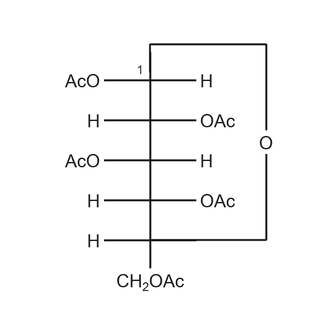 Solve with AI
Written solution
Solution:
Key idea: hydroxylamine () forms an oxime only with a free –CHO (or >C=O) group. Ring glucose has no free –CHO unless the ring can open.
Step 1 — Identify (A). (A) is glucose pentaacetate (β-D-glucose pentaacetate). It is a cyclic (pyranose) structure in which C1 is joined to C5 through the ring oxygen. All five –OH groups (at C1, C2, C3, C4 and C6) are acetylated (–OAc = ).
Step 2 — No free –CHO. In (A), C1 carries an –OAc group and is bonded to the ring oxygen. It is an acetal-type carbon, not a hemiacetal, so there is no free aldehyde group.
Step 3 — The ring cannot open. In glucose itself, the C1–OH is free, and the ring opens in solution to give a small amount of the open-chain –CHO form, which reacts with . In (A) the C1–OH is acetylated, so the ring cannot open to the open-chain aldehyde form.
Step 4 — Conclusion. Hence (A) does not react with hydroxylamine.
Step 5 — What it indicates. This is evidence that glucose has a cyclic hemiacetal structure, with the –CHO group at C1 tied up in the ring.
Therefore, compound (A), glucose pentaacetate, does not form an oxime because it has no free –CHO group and its ring cannot open to give one.
- 815 marks
Question 81
Coagulation of egg white on boiling is an example of denaturation of protein. Explain it in terms of structural changes.
Solve with AIWritten solution
Solution:
Key idea: denaturation destroys the folded shape (secondary and tertiary structure) of a protein, but not its sequence of amino acids (primary structure).
Step 1 — Native egg white. Egg white contains the globular protein albumin. Its polypeptide chains are coiled (secondary structure, α-helix) and folded into a compact, water-soluble spherical shape (tertiary structure). This shape is held by hydrogen bonds, disulphide bridges, van der Waals forces and ionic (dipolar) interactions.
Step 2 — Effect of boiling. Heat makes the chains vibrate strongly and breaks these weak hydrogen bonds and other attractions.
Step 3 — Structural change. The helices and folds uncoil, so the secondary and tertiary structures are destroyed. The uncoiled chains tangle and stick to one another, so the soluble globular protein changes into an insoluble, fibrous-like mass. The egg white coagulates and turns white and solid.
Step 4 — What does not change. The primary structure (the sequence of amino acids joined by peptide bonds) remains intact, because boiling does not break peptide bonds.
Step 5 — Result. The protein loses its biological activity, and the change is not reversed on cooling. (Curdling of milk by lemon juice is another example of denaturation.)
Therefore, on boiling, the hydrogen bonds and other forces holding albumin's folded shape break, its secondary and tertiary structures are lost, and the uncoiled chains coagulate into an insoluble mass, while the primary structure stays the same.
- 825 marks
Question 82
How will you distinguish 1° and 2° hydroxyl groups present in glucose? Explain with reactions.
Solve with AIWritten solution
Solution:
Key idea: on oxidation, a primary –CH₂OH group gives –COOH, whereas the secondary >CHOH groups are left unchanged by these reagents. Comparing a mild and a strong oxidising agent shows which –OH is primary.
Step 1 — Glucose has five –OH groups. Acetylation gives glucose pentaacetate. One –OH is at C6 (, 1°) and four are at C2–C5 (>CHOH, 2°).
Step 2 — Mild oxidation with bromine water. Only the –CHO group is oxidised; the –CH₂OH group is untouched:
glucose gluconic acid
Step 3 — Strong oxidation with nitric acid. Both end groups are oxidised to –COOH:
glucose saccharic (glucaric) acid
Step 4 — The primary –OH. The extra –COOH in saccharic acid comes from C6, which therefore carries a primary alcoholic group (–CH₂OH). A 1° alcohol is oxidised to a carboxylic acid with the same number of carbon atoms.
Step 5 — The secondary –OH groups. The four >CHOH groups at C2–C5 remain as (CHOH)₄ in both acids. They are secondary alcoholic groups: a 2° –OH would give a ketone, not an acid, on oxidation.
Therefore, glucose has one 1° –OH (at C6), shown by its oxidation to –COOH with nitric acid, and four 2° –OH groups (at C2–C5).
- 835 marks
Question 83
Describe the term D- and L-configuration used for amino acids with examples.
Solve with AIWritten solution
Solution:
Key idea: D and L give the configuration of the chiral α-carbon by comparison with glyceraldehyde; they do not tell the direction of optical rotation.
Step 1 — Reference compound. D-(+)-glyceraldehyde has the –OH on the right of its chiral carbon in the Fischer projection (–CHO at the top); L-(–)-glyceraldehyde has it on the left.
Step 2 — Rule for amino acids. Draw the Fischer projection with –COOH at the top and the side chain R at the bottom. If the –NH₂ group is on the right, the amino acid is D; if it is on the left, it is L.
Step 3 — Examples. In L-alanine the –NH₂ is on the left and H on the right of the α-carbon, with COOH above and below. D-alanine is its mirror image, with –NH₂ on the right. Likewise L-serine and L-valine.
Step 4 — Natural amino acids. All the α-amino acids obtained from proteins, except glycine, are chiral, and almost all of them belong to the L-series.
Step 5 — Glycine. Glycine, , has two H atoms on the α-carbon, so it is not chiral and has no D/L form.
Watch out: D/L is a configuration label only; the sign (+) or (–) of rotation must be found by experiment.
Therefore, an α-amino acid is D if its –NH₂ is on the right and L if it is on the left in the Fischer projection (COOH at top); natural amino acids such as L-alanine are of the L-series.
- 845 marks
Question 84
Activation energy for the acid catalysed hydrolysis of sucrose is 6.22 kJ mol⁻¹, while the activation energy is only 2.15 kJ mol⁻¹ when hydrolysis is catalysed by the enzyme sucrase. Explain.
Solve with AIWritten solution
Solution:
Key idea: a catalyst speeds up a reaction by giving it a path of lower activation energy; an enzyme lowers it far more than an acid does.
Step 1 — Acid catalysis. ions catalyse the hydrolysis of sucrose to glucose and fructose. The activation energy of this path is 6.22 kJ mol⁻¹.
Step 2 — Enzyme catalysis. The enzyme sucrase (invertase) is a biological catalyst. Sucrose fits into its active site (lock and key) and forms an enzyme–substrate complex. The enzyme holds the molecule in the right position and strains the glycosidic bond, so the reaction follows a different path with a lower activation energy, 2.15 kJ mol⁻¹.
Step 3 — Effect on rate. By the Arrhenius equation, , a lower gives a larger rate constant.
Taking the same A at 298 K, with R as 8.314 J K⁻¹ mol⁻¹:
Step 4 — Explanation of the data. So the enzyme lowers the energy barrier more than the acid does, and the enzyme-catalysed hydrolysis is faster, even at body temperature.
Step 5 — Features of enzymes shown. Enzymes are very efficient and highly specific catalysts (sucrase acts only on sucrose), and they work under mild conditions (about pH 7, 37 °C).
Therefore, sucrase provides a reaction path of much lower activation energy than the acid, so the enzyme-catalysed hydrolysis of sucrose is faster.
- 855 marks
Question 85
What are zwitterions? Give one example.
Or Write the zwitterion structure of glycine.
Solve with AIWritten solution
Solution:
Key idea: an α-amino acid carries an acidic group (–COOH) and a basic group (–NH₂) in the same molecule, so it can neutralise itself.
Step 1 — Definition. A zwitterion (dipolar ion) is a neutral molecule that carries both a positive and a negative charge on different atoms.
Step 2 — How it forms. In an α-amino acid, the –COOH group gives a proton to the –NH₂ group of the same molecule:
Step 3 — Example: zwitterion of glycine.
Step 4 — Properties explained. Because of this dipolar (salt-like) structure, amino acids are crystalline solids with high melting points, soluble in water and insoluble in non-polar solvents.
Step 5 — Amphoteric nature. The zwitterion reacts with both acids and bases. In acid, the takes up to give the cation . In alkali, the loses to give the anion .
Therefore, a zwitterion is a dipolar ion with both + and – charges; for glycine it is H₃N⁺–CH₂–COO⁻.
- 865 marks
Question 86
Give the biological functions of the following proteins:
(i) Haemoglobin
(ii) Collagen
Solve with AIWritten solution
Solution:
Key idea: globular proteins usually do a chemical job (transport, catalysis); fibrous proteins give strength and structure.
(i) Haemoglobin
Step 1 — Type. Haemoglobin is a globular, conjugated protein in red blood cells; its prosthetic group is haem, which contains iron.
Step 2 — Main function. It is a transport protein: it carries oxygen from the lungs to all parts of the body. The of haem binds reversibly – it picks oxygen up in the lungs and releases it in the tissues.
Step 3 — Second function. It also helps carry some carbon dioxide back from the tissues to the lungs.
(ii) Collagen
Step 4 — Type. Collagen is a fibrous protein, the most abundant protein in the body.
Step 5 — Function. It is a structural protein: it forms the strong fibres of tendons, ligaments, cartilage, bones, teeth and skin, giving them strength and holding tissues together.
Therefore, (i) haemoglobin transports oxygen (and some CO₂) in the blood, and (ii) collagen is a structural protein that gives strength to tendons, bones, cartilage and skin.
What Class 12 Chemistry Ch 14 covers
The sections of the chapter, in the order the book takes them. Every question above comes from one of these.
- 01Carbohydrates and Their Classification
- 02Monosaccharides and the Structure of Glucose
- 03Structure of Fructose
- 04Disaccharides
- 05Polysaccharides
- 06Amino Acids
More ways to study this chapter
The same chapter asked three other ways. Practise it, revise it, and see what the board has set on Ch 14 before.
- Competency-Based Questions (CBQ)Case study questions: a situation, and the part of the chapter that answers it.40questionsOpen
- Previous Year QuestionsQuestions that have actually appeared in board papers, each tagged with its year.13questionsOpen
- Practice QuestionsExtra questions per chapter, for when one attempt at a method is not enough.98questionsOpen
Ch 14 in past ISC papers
The same chapter as the board has actually asked it. These are worded differently from the textbook exercise, which is the point of reading them.
- 15 marks
Board paper question 1
Match the following:
(i) Disaccharide (a) Lucas reagent (ii) Carbylamine (b) Condensation polymer (iii) Dacron (c) Obnoxious smell (iv) Low spin complex, (d) Sucrose (v) Anhydrous + conc. (e) Hexaamminecobalt(III) ion Solve with AIWritten solution
Solution:
Key idea: Each item on the left comes from a different chapter (biomolecules, amines, polymers, coordination compounds, alcohols). We match each one with the item on the right that it is, gives or is made of.
Step 1 — Match (i) Disaccharide.
A disaccharide gives two monosaccharide units on hydrolysis. Sucrose is a disaccharide: it is hydrolysed to glucose and fructose. So (i) matches (d).
Step 2 — Match (ii) Carbylamine.
In the carbylamine reaction, a primary amine is warmed with chloroform and alcoholic potassium hydroxide. It gives an isocyanide (carbylamine), which has a very unpleasant (obnoxious) smell. For ethylamine:
So (ii) matches (c).
Step 3 — Match (iii) Dacron.
Dacron (terylene) is a polyester made from ethylene glycol and terephthalic acid. Each ester link forms with the loss of a water molecule, so it is a condensation polymer. So (iii) matches (b).
Step 4 — Match (iv) Low spin complex, d²sp³.
In the hexaamminecobalt(III) ion, , cobalt is in the +3 state with the configuration 3d⁶. Ammonia is a strong field ligand, so the six d electrons pair up in three d orbitals and two inner 3d orbitals stay empty. These two 3d orbitals, one 4s and three 4p orbitals give d²sp³ hybridisation, and the complex is low spin (diamagnetic). So (iv) matches (e).
Step 5 — Match (v) Anhydrous ZnCl₂ + conc. HCl.
A solution of anhydrous zinc chloride in concentrated hydrochloric acid is called Lucas reagent. It is used to tell primary, secondary and tertiary alcohols apart by how quickly turbidity appears. So (v) matches (a).
Therefore, (i) matches (d), (ii) matches (c), (iii) matches (b), (iv) matches (e) and (v) matches (a).
- 24 marks
Board paper question 2
Give balanced equations for the following reactions:
(i) How will you convert ethyl amine to methyl amine?
(ii) What is the effect of denaturation on the structure of proteins?
(iii) Name the nitrogen base residues present in DNA.
Solve with AIWritten solution
Solution:
Key idea: Part (i) is a "stepping down" conversion (one carbon fewer), done through acetamide and the Hofmann bromamide reaction. Parts (ii) and (iii) are short theory answers about proteins and nucleic acids.
Step 1 — Part (i): plan the route.
Ethylamine has two carbon atoms and methylamine has one. The Hofmann bromamide reaction turns an amide into an amine with one carbon atom fewer, so we first convert ethylamine into acetamide, .
Step 2 — Part (i): ethylamine to ethanol.
Ethylamine reacts with nitrous acid (from sodium nitrite and dilute HCl, kept cold) to give ethanol and nitrogen gas.
This is the simplified equation used at this level; in practice primary aliphatic amines also give some other products (such as alkenes) with nitrous acid.
Step 3 — Part (i): ethanol to acetic acid.
Ethanol is oxidised by acidified potassium dichromate, which supplies oxygen, written as [O].
Step 4 — Part (i): acetic acid to acetamide.
Acetic acid reacts with ammonia to form ammonium acetate, which loses water on heating to give acetamide.
Step 5 — Part (i): acetamide to methylamine.
In the Hofmann bromamide reaction, acetamide is warmed with bromine and sodium hydroxide. The carbonyl carbon is lost as sodium carbonate, so the amine has one carbon fewer.
Step 6 — Part (ii): effect of denaturation.
When a protein is heated, or its pH is changed, the hydrogen bonds and other weak forces that hold its folded shape are broken. The helices and sheets unfold (secondary structure lost) and the folded three-dimensional shape is lost (tertiary structure lost). The peptide bonds are not broken, so the primary structure (the order of amino acids) stays the same. The protein loses its biological activity; for example, egg white coagulates on boiling.
Step 7 — Part (iii): nitrogen bases in DNA.
DNA contains four nitrogen bases: the purines adenine (A) and guanine (G), and the pyrimidines cytosine (C) and thymine (T).
Therefore, (i) ethylamine is converted to methylamine by the sequence ethylamine → ethanol → acetic acid → acetamide → methylamine (Hofmann bromamide reaction in the last step), (ii) denaturation destroys the secondary and tertiary structure of a protein but leaves its primary structure intact, so it loses its biological activity, and (iii) DNA contains adenine, guanine, cytosine and thymine.
- 31 mark
Board paper question 3
Fill in the blanks by choosing the appropriate word/words from those given in the brackets:
(iodoform, acetaldehyde, positive, greater, acidic, acetone, disaccharide, negative, increases, glucose, decreases, chloroform, polysaccharide, lactose, lesser, basic, cationic hydrolysis, anionic hydrolysis)
Sucrose is a ______ and yields upon hydrolysis, a mixture of ______ and fructose.
Solve with AIWritten solution
Solution:
Key idea: A disaccharide is a carbohydrate that gives two monosaccharide molecules on hydrolysis.
Step 1 — Fill the first blank.
One molecule of sucrose is hydrolysed to two monosaccharide molecules, so sucrose is a disaccharide.
Step 2 — Fill the second blank.
Hydrolysis by dilute acid (or the enzyme invertase) splits sucrose into glucose and fructose, both with the formula .
Here the first product is glucose and the second is fructose.
Therefore, the completed statement reads: sucrose is a disaccharide and yields upon hydrolysis, a mixture of glucose and fructose.
- 44 marks
Board paper question 4
(i) Deficiency of which vitamin causes the following diseases:
(1) Scurvy
(2) Night blindness
(ii) Write two differences between globular and fibrous proteins.
Solve with AIWritten solution
Solution:
Key idea: Vitamins are needed in small amounts, and the lack of each one causes a particular deficiency disease. Proteins are grouped by the shape of their molecules into fibrous and globular proteins.
Step 1 — Part (i): scurvy.
Scurvy (bleeding gums, poor wound healing) is caused by a lack of vitamin C (ascorbic acid), which the body needs to make collagen.
Step 2 — Part (i): night blindness.
Night blindness is caused by a lack of vitamin A (retinol), which the eye needs to make the light-sensitive pigment of the rod cells.
Step 3 — Part (ii): differences between globular and fibrous proteins.
The table compares the two kinds of protein.
Globular proteins Fibrous proteins The polypeptide chains fold into a compact, roughly spherical shape. The polypeptide chains lie side by side as long threads (fibres). They are usually soluble in water. They are insoluble in water. They do functional work, as enzymes, hormones and carriers. They do structural work, in hair, skin, muscle and tendons. Examples: insulin, albumin. Examples: keratin, myosin, collagen. Therefore, (i) scurvy is caused by lack of vitamin C and night blindness by lack of vitamin A, and (ii) globular proteins are compact and water-soluble, while fibrous proteins are thread-like and insoluble in water (any two differences from the table).
- 52 marks
Board paper question 5
Name the purine bases and pyrimidine bases present in RNA and DNA.
Solve with AIWritten solution
Solution:
Key idea: The nitrogen bases of nucleic acids are of two kinds: purines (two fused rings) and pyrimidines (one ring). DNA and RNA share three bases and differ in one pyrimidine.
Step 1 — Name the purine bases.
Both DNA and RNA contain the same two purines: adenine (A) and guanine (G).
Step 2 — Name the pyrimidine bases of DNA.
DNA contains the pyrimidines cytosine (C) and thymine (T).
Step 3 — Name the pyrimidine bases of RNA.
RNA contains cytosine (C) and uracil (U); uracil takes the place of thymine.
Therefore, the purines in both DNA and RNA are adenine and guanine; the pyrimidines are cytosine and thymine in DNA, and cytosine and uracil in RNA.
- 62 marks
Board paper question 6
Name two water soluble vitamins and the diseases caused by their deficiency in the diet of an individual.
Solve with AIWritten solution
Solution:
Key idea: Water-soluble vitamins (the B group and vitamin C) dissolve in water and are readily excreted in urine. Apart from vitamin B₁₂, the body stores very little of them, so they must be taken in the diet regularly.
Step 1 — First vitamin and its deficiency disease.
Vitamin B₁ (thiamine) is water soluble. Its deficiency causes beriberi, which affects the nerves and the heart.
Step 2 — Second vitamin and its deficiency disease.
Vitamin C (ascorbic acid) is water soluble. Its deficiency causes scurvy, with bleeding gums and slow healing of wounds.
Therefore, two water-soluble vitamins are vitamin B₁ (deficiency causes beriberi) and vitamin C (deficiency causes scurvy).
All 13 board paper questions for this chapter, solved the same way.
Class 12 Chemistry Ch 14 questions students ask
How many questions are there in Class 12 Chemistry Ch 14?
86 questions. Every one is solved step by step on this page.
Are these Class 12 Chemistry solutions free?
Yes. Every question and its full working is free to read, with no account needed.
Can I download the Class 12 Chemistry Ch 14 solutions as a PDF?
There is no PDF to download. Every solution is on this page instead, which means it is searchable, always the current syllabus, and readable on a phone. Use your browser's print option if you want it on paper.