
Question 805 marksMedium
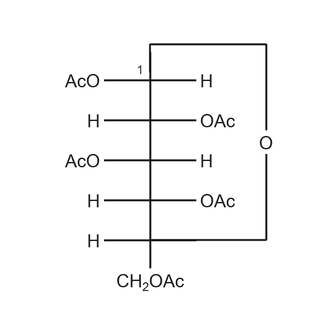
Why does compound (A) given below not form an oxime?
Confirming your payment
Sign up now and get 250 free tokens.
Biomolecules · Question 80 of 86
Why does compound (A) given below not form an oxime?
Solution:
Key idea: hydroxylamine () forms an oxime only with a free –CHO (or >C=O) group. Ring glucose has no free –CHO unless the ring can open.
Step 1 — Identify (A). (A) is glucose pentaacetate (β-D-glucose pentaacetate). It is a cyclic (pyranose) structure in which C1 is joined to C5 through the ring oxygen. All five –OH groups (at C1, C2, C3, C4 and C6) are acetylated (–OAc = ).
Step 2 — No free –CHO. In (A), C1 carries an –OAc group and is bonded to the ring oxygen. It is an acetal-type carbon, not a hemiacetal, so there is no free aldehyde group.
Step 3 — The ring cannot open. In glucose itself, the C1–OH is free, and the ring opens in solution to give a small amount of the open-chain –CHO form, which reacts with . In (A) the C1–OH is acetylated, so the ring cannot open to the open-chain aldehyde form.
Step 4 — Conclusion. Hence (A) does not react with hydroxylamine.
Step 5 — What it indicates. This is evidence that glucose has a cyclic hemiacetal structure, with the –CHO group at C1 tied up in the ring.
Therefore, compound (A), glucose pentaacetate, does not form an oxime because it has no free –CHO group and its ring cannot open to give one.