
Opening your dashboard
Class 12 Chemistry Chapter 11: Alcohols, Phenols and Ethers Solutions
84 textbook questions with step-by-step answers, free to read, for ISC 2026-27.
Get talked through Ch 11, not just shown the answer
Reading a finished solution is not the same as being able to do it. The AI tutor takes one question at a time and works it with you, in your own words, until you can.
- Ask it out loud, in your own words
- It gives you the next step, not the answer
- Stuck on part (ii)? Start there
84 questions with solutions
1–5 marks · Mixed difficulty
The first 66 solutions are on this page. This chapter is a long one, so the rest open on their own page to keep this one quick to load.
- 11 mark
Question 1
Ethylene may be obtained by the treatment of concentrated and X at 160-170°C. X is
Solve with AIAnswer
- Correct
(A)
(B)
(C)
(D)
Answer: (A)
Key idea: Heating an alcohol with excess concentrated sulphuric acid at about 443 K (170 °C) removes a water molecule (the –OH from one carbon and an H from the next carbon) and gives an alkene with the same number of carbon atoms as the alcohol.
Step 1 — Count the carbon atoms needed.
Ethylene, , has two carbon atoms, so X must be an alcohol with two carbon atoms and a hydrogen on the carbon next to the –OH carbon.
Step 2 — Write the reaction.
Ethanol fits these conditions and loses one water molecule to give ethylene.
Why the other options are wrong:
- (B) is wrong: A one-carbon alcohol has no neighbouring carbon to form a C=C bond, so methanol cannot give an alkene; with concentrated sulphuric acid it gives dimethyl ether (or methyl hydrogen sulphate).
- (C) is wrong: A three-carbon alcohol (propan-1-ol or propan-2-ol) dehydrates to the three-carbon alkene propene, , not ethylene.
- (D) is wrong: A four-carbon alcohol (2-methylpropan-1-ol, isobutyl alcohol) dehydrates to four-carbon alkenes, mainly 2-methylpropene.
Therefore, X is ethanol, C₂H₅OH: option (A).
- 21 mark
Question 2
Order of esterification of alcohols is:
Solve with AIAnswer
(A) 3° > 2° > 1°
(B) 2° > 3° > 1°
- Correct
(C) 1° > 2° > 3°
(D) None of these.
Answer: (C) 1° > 2° > 3°
Key idea: In acid-catalysed esterification the alcohol keeps its C–O bond: its O–H bond breaks, and the alcohol oxygen attacks the carbonyl carbon of the acid. The more crowded the carbon carrying –OH, the harder this attack becomes.
Step 1 — Find the bond that breaks.
Experiments with alcohols labelled with oxygen-18 show that the labelled oxygen ends up in the ester, not in the water. So the alcohol acts as a nucleophile through its oxygen, and its C–O bond is not broken.
Step 2 — Compare the crowding.
A primary alcohol has one alkyl group on the –OH carbon, a secondary alcohol has two and a tertiary alcohol has three. Each extra alkyl group crowds the oxygen (steric hindrance) and slows its attack on the acid. Tertiary alcohols also tend to lose water and form alkenes under these acidic conditions.
Step 3 — Write the order.
The rate of esterification therefore falls from primary to tertiary alcohols, giving 1° > 2° > 3°.
Why the other options are wrong:
- (A) is wrong: This is the order for reactions that break the C–O bond of the alcohol through a carbocation (reaction with halogen acids, dehydration); esterification breaks the O–H bond instead.
- (B) is wrong: Tertiary alcohols are the most crowded and esterify most slowly, so they cannot come above primary alcohols, and secondary alcohols do not react faster than primary ones.
- (D) is wrong: Option (C) gives the correct order, so "none of these" does not apply.
Therefore, the order of esterification of alcohols is 1° > 2° > 3°: option (C).
- 31 mark
Question 3
Absolute alcohol (100% alcohol) is prepared by distilling rectified spirit over
Solve with AIAnswer
(A) Na
(B)
(C) Mg
- Correct
(D)
Answer: (D)
Key idea: Rectified spirit is about 95.6% ethanol by mass. It boils as a constant-boiling mixture (an azeotrope) with water at about 351 K (78.2 °C), so ordinary distillation cannot remove the last water. A substance is needed that reacts with the water and gives back ethanol.
Step 1 — Prepare magnesium ethoxide in the flask.
Magnesium (activated with a little iodine) is warmed with some of the alcohol and forms magnesium ethoxide, with the release of hydrogen.
Step 2 — Let the ethoxide remove the water.
Magnesium ethoxide reacts with the remaining water. The water is used up as insoluble magnesium hydroxide, and ethanol is given back.
Step 3 — Distil the dry alcohol.
The ethanol is then distilled away from the solid magnesium hydroxide, which gives absolute (100%) alcohol.
Why the other options are wrong:
- (A) is wrong: Sodium reacts with the ethanol itself to give sodium ethoxide, and sodium ethoxide reacts with water only in an equilibrium (), so some water always remains.
- (B) is wrong: Calcium chloride combines with ethanol to form an addition compound, , so it cannot be used to dry ethanol.
- (C) is wrong: The metal is only the starting material; the substance that actually takes up the water is the magnesium ethoxide formed from it.
Note: Some texts name magnesium as the reagent, because the metal is what is added to the flask; the key here names the ethoxide that does the drying.
Therefore, absolute alcohol is obtained by distilling rectified spirit over magnesium ethoxide, Mg(OC₂H₅)₂: option (D).
- 41 mark
Question 4
3 moles of ethanol react with one mole of phosphorus tribromide to form 3 moles of bromoethane and one mole of X. Which of the following is X?
Solve with AIAnswer
(A)
(B)
(C)
- Correct
(D)
Answer: (D)
Key idea: Phosphorus tribromide replaces the –OH group of an alcohol by –Br. The three –OH groups taken from three alcohol molecules end up on phosphorus as , and phosphorus keeps its oxidation state of +3.
Step 1 — Write the balanced equation.
Three molecules of ethanol exchange their –OH groups with the three Br atoms of .
Step 2 — Check the oxidation state of phosphorus in X.
The formula is written , phosphorous acid. We let the oxidation state of phosphorus in it be .
This matches +3 in , so no redox change has taken place, as expected for a substitution.
Step 3 — Check the atoms.
Each side has 6 C, 18 H, 3 O, 3 Br and 1 P, so the equation balances with as X.
Why the other options are wrong:
- (A) is wrong: Phosphorus in is +5, but nothing in the reaction oxidises phosphorus, and the extra oxygen atom would leave the equation unbalanced.
- (B) is wrong: Phosphorus in is +1 and the formula has only two oxygen atoms, so it cannot hold the three –OH groups taken from the alcohol.
- (C) is wrong: Phosphorus in is +5 and the formula has only one hydrogen, so neither the hydrogen atoms nor the oxidation state balance.
Therefore, X is phosphorous acid, H₃PO₃: option (D).
- 51 mark
Question 5
A fruity smell is obtained by the reaction of ethanol with
Solve with AIAnswer
(A)
(B)
- Correct
(C)
(D) None of these.
Answer: (C)
Key idea: An alcohol and a carboxylic acid, warmed with a little concentrated sulphuric acid, form an ester and water. Esters of low molar mass have pleasant fruity smells, which is the basis of the ester test.
Step 1 — Write the reaction.
Ethanol and acetic (ethanoic) acid form ethyl acetate (ethyl ethanoate).
Step 2 — Link the product to the smell.
Ethyl acetate is an ester with a sweet, fruity smell, so acetic acid is the reagent that gives the fruity smell.
Why the other options are wrong:
- (A) is wrong: Phosphorus pentachloride replaces –OH by –Cl and gives ethyl chloride, and steamy fumes of HCl, not a fruity ester.
- (B) is wrong: A ketone has no –COOH group, so acetone cannot form an ester with ethanol.
- (D) is wrong: Option (C) does give the fruity smell, so "none of these" does not apply.
Note: The smell of an ester is tested by wafting the vapour gently towards the nose, never by sniffing straight from the tube.
Therefore, ethanol gives a fruity smell with acetic acid, CH₃COOH: option (C).
- 61 mark
Question 6
Which of the following compound is obtained on passing ethanol vapours on heated ?
Solve with AIAnswer
- Correct
(A) Ethyl ether
(B) Acetone
(C) Ethane
(D) Ethanol
Answer: (A) Ethyl ether
Key idea: Heated alumina, , is a dehydrating catalyst. At a moderate temperature (about 513 K) two ethanol molecules lose one water molecule between them and give an ether; at a higher temperature (about 630 K) each molecule loses water and gives ethene.
Step 1 — Write the reaction at the moderate temperature.
Ethanol vapour passed over alumina at about 513 K (240 °C) gives diethyl ether (ethyl ether).
Step 2 — Compare with the higher temperature.
At about 630 K (360 °C) the same catalyst removes water from single molecules and gives ethene. Ethene is not among the options, so the dehydration product asked for is the ether.
Why the other options are wrong:
- (B) is wrong: A three-carbon ketone cannot come from removing water from a two-carbon alcohol; acetone is made by oxidising propan-2-ol.
- (C) is wrong: An alkane can be made from ethanol only by reduction (for example with HI and red phosphorus); alumina only removes water, which gives ethene or the ether.
- (D) is wrong: The starting material cannot also be the product, and ethanol is the compound being passed over the catalyst.
Therefore, ethanol vapour passed over heated alumina gives ethyl ether: option (A).
- 71 mark
Question 7
n-propyl alcohol and isopropyl alcohol can be chemically distinguished by which reagent
Solve with AIAnswer
(A)
(B) Reduction
- Correct
(C) Oxidation with potassium dichromate
(D) Ozonolysis.
Answer: (C) Oxidation with potassium dichromate
Key idea: Primary and secondary alcohols give different oxidation products: a primary alcohol gives an aldehyde and then a carboxylic acid, while a secondary alcohol gives a ketone. The products can then be told apart.
Step 1 — Classify the two alcohols.
The first alcohol, n-propyl alcohol (), has –OH on a carbon joined to one other carbon, so it is primary. Isopropyl alcohol, , has –OH on a carbon joined to two other carbons, so it is secondary.
Step 2 — Oxidise each alcohol with acidified potassium dichromate.
The primary alcohol gives propanal and then propanoic acid.
The secondary alcohol gives acetone (propanone), a ketone.
Step 3 — Tell the products apart.
Both alcohols turn the orange dichromate solution green, so the colour change alone does not distinguish them. The aldehyde from n-propyl alcohol gives a silver mirror with Tollens' reagent, while acetone does not, and this tells the two alcohols apart.
Why the other options are wrong:
- (A) is wrong: Both compounds have an –OH group, so both react with and give steamy fumes of HCl; the test cannot tell them apart.
- (B) is wrong: Alcohols are not reduced by ordinary reducing agents, and with HI and red phosphorus both give the same alkane, propane, so nothing distinguishes them.
- (D) is wrong: Neither saturated alcohol has a C=C double bond for ozone to break, so ozone has nothing to attack and the test cannot tell them apart.
Therefore, n-propyl alcohol and isopropyl alcohol are distinguished by oxidation with potassium dichromate: option (C).
- 81 mark
Question 8
Ethanol when reacted with gives A, and HCl. A reacts with silver nitrite to form B (major product) and AgCl. A and B respectively are
Solve with AIAnswer
(A) and
(B) and
- Correct
(C) and
(D) and
Answer: (C) and
Key idea: Phosphorus pentachloride replaces the –OH of an alcohol by –Cl. An alkyl halide reacts with silver nitrite mainly through the nitrogen atom of the nitrite group, so the main product is a nitroalkane.
Step 1 — Identify A.
The –OH group of ethanol is replaced by –Cl, and and HCl are formed, exactly as the stem says. So A is chloroethane (ethyl chloride).
Step 2 — Identify B.
In silver nitrite the silver is held to oxygen by a largely covalent bond, so the free lone pair on nitrogen attacks the carbon of ethyl chloride, and silver chloride is precipitated. The main product B is nitroethane.
Why the other options are wrong:
- (A) is wrong: The first compound is right, but silver nitrite gives a nitro compound, not an ether; diethyl ether forms from ethyl chloride with dry silver oxide or sodium ethoxide.
- (B) is wrong: Phosphorus pentachloride substitutes –Cl for –OH and does not reduce ethanol to ethane, and B is a nitro compound, not an ether.
- (D) is wrong: The second compound is right, but A cannot be ethane, because gives ethyl chloride; ethane also has no halogen to react with silver nitrite.
Therefore, A is C₂H₅Cl and B is C₂H₅NO₂: option (C).
- 91 mark
Question 9
The wrong statement about glycerol is
Solve with AIAnswer
(A) It is a trihydric alcohol
(B) It is generally obtained by hydrolysis of oils/fats
(C) Acidified converts it to oxalic acid
- Correct
(D) It is a tertiary alcohol
Answer: (D) It is a tertiary alcohol
Key idea: An –OH group is primary, secondary or tertiary when the carbon carrying it is joined to one, two or three other carbon atoms. The question asks for the one false statement, so the other three must all be true.
Step 1 — Write the structure of glycerol.
Glycerol is propane-1,2,3-triol, .
Step 2 — Classify each –OH group.
The two end –OH groups are on carbons joined to one other carbon, so they are primary. The middle –OH group is on a CH carbon joined to two other carbons, so it is secondary. No –OH group is on a carbon joined to three carbons, so glycerol is not a tertiary alcohol, and statement (D) is the false one.
Why the other options are not the answer:
- (A) is not the answer: Glycerol has three –OH groups, so it is indeed a trihydric alcohol; this statement is true.
- (B) is not the answer: Glycerol is obtained as a by-product when oils and fats are hydrolysed (as in soap making), so this statement is true.
- (C) is not the answer: Acidified potassium permanganate, a strong oxidising agent, oxidises glycerol to oxalic acid (and carbon dioxide), so this statement is true.
Therefore, the wrong statement about glycerol is that it is a tertiary alcohol: option (D).
- 101 mark
Question 10
In the synthesis of glycerol from propene, the steps involved are
Solve with AIAnswer
(A) Glycerol β-chlorohydrin and allyl chloride
(B) Glyceryl trichloride and glycerol α-chlorohydrin
- Correct
(C) Allyl alcohol and glycerol β-chlorohydrin
(D) Allyl alcohol and monosodium glycerolate
Answer: (C) Allyl alcohol and glycerol β-chlorohydrin
Key idea: Glycerol is made from propene by putting an –OH group on each of the three carbon atoms in turn: first by substitution at the group, and then by adding across the C=C bond.
Step 1 — Chlorinate propene at the methyl group.
At about 773 K chlorine substitutes a hydrogen of the group (allylic substitution) instead of adding to the double bond, giving allyl chloride.
Step 2 — Hydrolyse allyl chloride.
Aqueous sodium hydroxide replaces –Cl by –OH, giving allyl alcohol.
Step 3 — Add hypochlorous acid.
HOCl adds across the C=C bond of allyl alcohol, putting –Cl on one carbon and –OH on the other, which gives a glycerol monochlorohydrin.
Step 4 — Hydrolyse the chlorohydrin.
Aqueous alkali replaces the last –Cl by –OH, giving glycerol.
Step 5 — Match the intermediates.
The two intermediates that lead directly to glycerol are allyl alcohol and the glycerol chlorohydrin, which is the pair named in option (C).
Why the other options are wrong:
- (A) is wrong: Both compounds in this pair do occur on the route, so it is partly right; but it leaves out allyl alcohol, without which the chlorohydrin cannot form, while the key names the two consecutive intermediates just before glycerol.
- (B) is wrong: The trichloride (glyceryl trichloride) is not formed on this route, so the pair fails even though a monochlorohydrin does form in Step 3.
- (D) is wrong: The first compound is right, but monosodium glycerolate is made from glycerol and sodium; it comes after glycerol, not before it.
Note: HOCl adds to allyl alcohol to give a mixture of the two monochlorohydrins, α () and β (), and both give glycerol on hydrolysis; the key names the β-isomer. Today most glycerol is obtained as a by-product of soap and biodiesel making, and the synthesis from propene is little used.
Therefore, the intermediates in the synthesis of glycerol from propene are allyl alcohol and glycerol β-chlorohydrin: option (C).
- 111 mark
Question 11
Which of the following alcohol is used as a beverage ?
Solve with AIAnswer
(A) Propanol
(B) 2-Butanol
(C) Methanol
- Correct
(D) Ethanol
Answer: (D) Ethanol
Key idea: The alcohol in alcoholic drinks is ethanol (ethyl alcohol), made by fermenting sugars with yeast. The other simple alcohols are poisonous when drunk.
Step 1 — Identify the beverage alcohol.
Beer, wine and spirits are dilute solutions of ethanol, , produced by fermentation. Ethanol is the alcohol that drinks are made to contain; it is a depressant of the nervous system and is harmful in excess.
Step 2 — Rule out the other alcohols.
Propanol, butan-2-ol and methanol are all toxic when drunk, so none of them is used as a beverage.
Why the other options are wrong:
- (A) is wrong: As an industrial solvent that is more toxic than ethanol, propanol is not used in drinks.
- (B) is wrong: As a four-carbon solvent that is toxic when drunk, butan-2-ol is not used in beverages.
- (C) is wrong: Even small amounts of methanol can cause permanent blindness, and larger amounts can cause death, so it is a poison, not a beverage.
Note: The book's answer names propanol here, which is a misprint; alcoholic beverages contain ethanol.
Therefore, the alcohol used as a beverage is ethanol: option (D).
- 121 mark
Question 12
The compound 'A' when treated with methyl alcohol and few drops of gave smell of wintergreen. The compound 'A' is
Solve with AIAnswer
(A) Succinic acid
- Correct
(B) Salicylic acid
(C) Tartaric acid
(D) Oxalic acid.
Answer: (B) Salicylic acid
Key idea: A carboxylic acid warmed with an alcohol and a few drops of concentrated sulphuric acid forms an ester. The ester of salicylic acid with methanol, methyl salicylate, is oil of wintergreen, which has a strong, characteristic smell.
Step 1 — Write the esterification.
Salicylic acid (2-hydroxybenzoic acid) reacts with methanol to give methyl salicylate and water.
Step 2 — Link the product to the smell.
Methyl salicylate smells of wintergreen, so A is salicylic acid. The same reaction is used as a test for methanol.
Why the other options are wrong:
- (A) is wrong: The methyl ester of succinic acid, dimethyl succinate, has no benzene ring or phenolic –OH and does not smell of wintergreen.
- (C) is wrong: The methyl ester of tartaric acid, dimethyl tartrate, is not methyl salicylate and has no wintergreen smell.
- (D) is wrong: The methyl ester of oxalic acid, dimethyl oxalate, is a crystalline solid without the smell of wintergreen.
Therefore, compound A is salicylic acid: option (B).
- 131 mark
Question 13
Which is used in alcoholic beverages?
Solve with AIAnswer
(A) Methanol
- Correct
(B) Ethanol
(C) Phenol
(D) Glycerol
Answer: (B) Ethanol
Key idea: Alcoholic beverages are made by fermenting sugars with yeast, which produces ethanol. Their strength is given as the percentage of ethanol by volume.
Step 1 — Identify the alcohol in beverages.
Beer contains about 4–6%, wine about 9–15% and spirits about 40% ethanol by volume, so the substance used in alcoholic beverages is ethanol.
Step 2 — Check the other substances.
Methanol and phenol are poisonous, and glycerol is not intoxicating, so none of them is the active substance in drinks.
Why the other options are wrong:
- (A) is wrong: Small amounts of methanol can cause blindness and larger amounts death, so it is never used in drinks.
- (C) is wrong: A toxic, corrosive solid that causes chemical burns on the skin, phenol is not an ingredient of drinks.
- (D) is wrong: A sweet, viscous liquid used in cosmetics, medicines and foods, glycerol is not intoxicating and is not the alcohol of beverages.
Therefore, the alcohol used in alcoholic beverages is ethanol: option (B).
- 141 mark
Question 14
Methyl alcohol when reacted with carbon monoxide using cobalt or rhodium as catalyst, compound 'A' is formed. On heating 'A' with HI in the presence of red phosphorus as catalyst 'B' is formed. Identify 'B'.
Solve with AIAnswer
(A)
(B)
(C)
- Correct
(D)
Answer: (D)
Key idea: Methanol combines with carbon monoxide over a metal catalyst (carbonylation) to give acetic acid. Hydriodic acid with red phosphorus is a very strong reducing agent that can remove all the oxygen from a carboxylic acid and leave an alkane.
Step 1 — Identify A.
Carbon monoxide is inserted between the methyl group and the –OH group of methanol, so A is acetic (ethanoic) acid.
Step 2 — Identify B.
HI and red phosphorus reduce the –COOH group fully to , so B is ethane. Iodine is set free, and the red phosphorus turns it back into HI.
Why the other options are wrong:
- (A) is wrong: Acetic acid is compound A, the product of the first step; B is what is left after the reduction.
- (B) is wrong: HI with red phosphorus does not stop at the aldehyde stage; it removes all the oxygen and leaves an alkane.
- (C) is wrong: Ethyl iodide forms when ethanol (not acetic acid) reacts with HI; acetic acid has no group for iodide to replace.
Note: Industrial methanol carbonylation also needs an iodide promoter (methyl iodide) and today uses rhodium or, mainly, iridium catalysts.
Therefore, B is ethane, CH₃CH₃: option (D).
- 151 mark
Question 15
Which is the strongest acid?
Solve with AIAnswer
(A)
(B)
(C)
- Correct
(D)
Answer: (D)
Key idea: An acid is stronger when its conjugate base is more stable. A negative charge is held best by a more electronegative atom, so an O–H hydrogen is far more acidic than any C–H hydrogen. A lower means a stronger acid.
Step 1 — Compare the atoms that hold the charge.
When methanol loses , the charge of sits on oxygen, which is much more electronegative than carbon. The three hydrocarbons would have to put the charge on carbon.
Step 2 — Compare the hydrocarbons.
Among C–H acids, the more s character the carbon has, the closer it holds the charge, so the order of acidity is ethyne () > benzene () > ethane ().
Step 3 — Compare the approximate pKa values.
Methanol has about 15.5, ethyne about 25, benzene about 43 and ethane about 50. The lowest value belongs to methanol, so methanol is the strongest acid.
Step 4 — Find how much stronger methanol is than ethyne.
Each unit of is a factor of 10, so we raise 10 to the difference between the two values.
Why the other options are wrong:
- (A) is wrong: The C–H bonds of ethane are on carbon, which holds a negative charge worst; ethane ( about 50) is the weakest acid of the four.
- (B) is wrong: The C–H bonds of benzene are on carbon, so benzene ( about 43) is a very weak acid.
- (C) is wrong: The carbon of ethyne makes it the most acidic of the three hydrocarbons, but with about 25 it is still about times weaker than methanol.
Therefore, the strongest acid is methanol, CH₃OH: option (D).
- 161 mark
Question 16
Dehydration of methyl alcohol with concentrated yields
Solve with AIAnswer
(A) methane
(B) ethane
- Correct
(C) dimethyl ether
(D) acetone
Answer: (C) dimethyl ether
Key idea: Concentrated sulphuric acid removes water from alcohols. A single alcohol molecule gives an alkene only if there is a hydrogen on a carbon next to the –OH carbon; otherwise two molecules lose one water molecule between them and form an ether.
Step 1 — Check whether an alkene is possible.
Methanol, , has only one carbon atom, so there is no neighbouring carbon to form a C=C bond.
Step 2 — Write the ether formation.
On warming with concentrated sulphuric acid (about 413 K), a protonated methanol molecule is attacked by a second methanol molecule, and dimethyl ether is formed.
Why the other options are wrong:
- (A) is wrong: The one-carbon alkane forms only when methanol is reduced (for example by hot HI with red phosphorus); dehydration removes water and does not add hydrogen.
- (B) is wrong: A C–C bond would be needed for ethane, but in ether formation the two methyl groups are joined through oxygen, not to each other.
- (D) is wrong: A three-carbon ketone cannot come from two one-carbon molecules losing water, so acetone cannot form.
Therefore, dehydration of methyl alcohol with concentrated H₂SO₄ gives dimethyl ether: option (C).
- 171 mark
Question 17
Ethyl alcohol is used as a preservative for chloroform because it:
Solve with AIAnswer
(A) prevents aerial oxidation of chloroform
(B) prevents decomposition of chloroform
(C) decomposes phosgene to CO and
- Correct
(D) removes phosgene by converting it to ethyl carbonate
Answer: (D) removes phosgene by converting it to ethyl carbonate
Key idea: In light and air chloroform is slowly oxidised to phosgene, , a very poisonous gas. A little ethanol (about 1%) is added to stored chloroform so that any phosgene formed is turned into harmless diethyl carbonate.
Step 1 — Write the oxidation of chloroform.
Oxygen of the air, helped by light, oxidises chloroform to phosgene and hydrogen chloride.
Step 2 — Write the reaction of ethanol with phosgene.
Each chlorine atom of phosgene is replaced by an ethoxy group from ethanol, giving diethyl carbonate (often called ethyl carbonate).
Step 3 — State the purpose of the ethanol.
The ethanol destroys the poisonous phosgene as it forms. Chloroform is also stored in dark, completely filled bottles, which limits the oxidation itself.
Why the other options are wrong:
- (A) is wrong: Air oxidation is limited by storing chloroform in dark, full bottles; the role of the added ethanol is to remove the phosgene that still forms.
- (B) is wrong: Some chloroform still breaks down slowly; the ethanol removes the poisonous product of this breakdown rather than preventing it.
- (C) is wrong: Ethanol combines with phosgene to form diethyl carbonate; it does not split phosgene into carbon monoxide and chlorine.
Therefore, ethanol is used as a preservative for chloroform because it removes phosgene by converting it to ethyl carbonate: option (D).
- 181 mark
Question 18
Alcoholic beverages contain :
Solve with AIAnswer
(A) isopropyl alcohol
(B) n-propyl alcohol
- Correct
(C) ethyl alcohol
(D) methyl alcohol
Answer: (C) ethyl alcohol
Key idea: The intoxicating substance in alcoholic beverages is ethyl alcohol (ethanol), made by yeast fermentation of sugars and starches.
Step 1 — Recall how beverages are made.
Yeast ferments the sugars in fruit juice or grain to ethanol and carbon dioxide, so the alcohol in beer, wine and spirits is ethanol.
Step 2 — Check the other alcohols.
Isopropyl, n-propyl and methyl alcohol are all toxic when drunk, so none of them is the beverage alcohol.
Why the other options are wrong:
- (A) is wrong: Known as "rubbing alcohol", used as an antiseptic and solvent, isopropyl alcohol is poisonous to drink.
- (B) is wrong: An industrial solvent more toxic than ethanol, n-propyl alcohol is not used in drinks.
- (D) is wrong: As a poison, methyl alcohol can cause blindness and death, which is why drinks contaminated with it are so dangerous.
Therefore, alcoholic beverages contain ethyl alcohol: option (C).
- 191 mark
Question 19
In the reaction:
A is
Solve with AIAnswer
(A) 1-propanol
(B) 2-butanol
- Correct
(C) 2-propanol
(D) ethanol
Answer: (C) 2-propanol
Key idea: Acidified potassium dichromate oxidises a secondary alcohol to a ketone with the same carbon skeleton. Ketones resist mild oxidation, but strong oxidation breaks them into acids with fewer carbon atoms.
Step 1 — Work back from acetone.
Acetone, , has three carbon atoms with the C=O group on the middle carbon. The alcohol that gives it must have –OH on the middle carbon of a three-carbon chain, so it is propan-2-ol (2-propanol).
Step 2 — Check the second step.
On strong oxidation, acetone is broken next to the C=O group into acetic acid (two carbons) and carbon dioxide, as the stem shows.
Why the other options are wrong:
- (A) is wrong: A primary alcohol such as 1-propanol is oxidised to propanal and then propanoic acid, not to a ketone.
- (B) is wrong: A four-carbon secondary alcohol such as 2-butanol gives butanone (ethyl methyl ketone), not acetone.
- (D) is wrong: A two-carbon primary alcohol such as ethanol gives acetaldehyde and then acetic acid directly, never acetone.
Therefore, A is 2-propanol (propan-2-ol): option (C).
- 201 mark
Question 20
The enzymes which are used to convert starch into ethyl alcohol are :
Solve with AIAnswer
(A) maltase, diastase
- Correct
(B) diastase, maltase, zymase
(C) invertase, zymase
(D) invertase, diastase, maltase
Answer: (B) diastase, maltase, zymase
Key idea: Starch is turned into ethanol in three enzyme-controlled steps: starch to maltose, maltose to glucose, and glucose to ethanol. Each step needs its own enzyme.
Step 1 — Hydrolyse starch with diastase.
Diastase, from malt (germinated barley), breaks starch down to maltose.
Step 2 — Hydrolyse maltose with maltase.
Maltase, from yeast, splits each maltose molecule into two glucose molecules.
Step 3 — Ferment glucose with zymase.
Zymase, a group of enzymes in yeast, converts glucose into ethanol and carbon dioxide.
Why the other options are wrong:
- (A) is wrong: Diastase and maltase take starch only as far as glucose; without zymase no ethanol is formed.
- (C) is wrong: Invertase hydrolyses cane sugar (sucrose), not starch, and with no diastase the starch is never broken down.
- (D) is wrong: This set breaks starch down to glucose but has no zymase, so the glucose is not fermented to ethanol.
Therefore, the enzymes that convert starch into ethyl alcohol are diastase, maltase and zymase: option (B).
- 211 mark
Question 21
In the following sequence of reactions,
the compound 'D' is
Solve with AIAnswer
(A) butanal
(B) n-butyl alcohol
- Correct
(C) n-propyl alcohol
(D) propanal
Answer: (C) n-propyl alcohol
Key idea: A Grignard reagent adds to the C=O group of an aldehyde or ketone, and hydrolysis then gives an alcohol. With formaldehyde (HCHO) the product is a primary alcohol with one more carbon atom than the alkyl group of the Grignard reagent.
Step 1 — Identify A.
Red phosphorus and iodine form phosphorus triiodide, which replaces the –OH of ethanol by –I, so A is ethyl iodide.
Step 2 — Identify B.
Ethyl iodide reacts with magnesium in dry ether to give the Grignard reagent, ethylmagnesium iodide.
Step 3 — Identify C.
The ethyl group of the Grignard reagent attacks the carbonyl carbon of formaldehyde, giving a magnesium alkoxide with three carbon atoms.
Step 4 — Identify D.
Hydrolysis replaces the –OMgI group by –OH, giving propan-1-ol (n-propyl alcohol).
Why the other options are wrong:
- (A) is wrong: Hydrolysis of the magnesium alkoxide gives an alcohol, not an aldehyde, and the chain has three carbon atoms, not four.
- (B) is wrong: Formaldehyde adds only one carbon atom to the two of the ethyl group, so the alcohol has three carbon atoms, not four.
- (D) is wrong: The carbon count of three is right, but the Grignard–formaldehyde route ends in an alcohol after hydrolysis, not an aldehyde.
Therefore, D is n-propyl alcohol, CH₃CH₂CH₂OH: option (C).
- 221 mark
Question 22
Friedel-Crafts reaction is not given by
Solve with AIAnswer
(A) benzene
(B) xylene
- Correct
(C) nitrobenzene
(D) phenol
Answer: (C) nitrobenzene
Key idea: A Friedel–Crafts reaction needs a ring rich enough in electrons to be attacked by the carbocation or acylium ion formed with anhydrous . A strongly electron-withdrawing group makes the ring too poor in electrons to react.
Step 1 — Look at the effect of the nitro group.
The nitro group withdraws electrons from the ring by both its and effects, so the ring of nitrobenzene is strongly deactivated.
Step 2 — Decide whether the reaction can occur.
The weak electrophile of a Friedel–Crafts reaction cannot attack such an electron-poor ring, so nitrobenzene does not undergo the reaction. It is so unreactive that it has been used as a solvent for Friedel–Crafts reactions.
Why the other options are wrong:
- (A) is wrong: The benzene ring carries no deactivating group, so it readily undergoes Friedel–Crafts alkylation and acylation with anhydrous .
- (B) is wrong: Two electron-releasing methyl groups make the ring of xylene even more reactive than benzene.
- (D) is wrong: The ring of phenol does react (with methyl chloride and anhydrous it gives o- and p-cresol), although the yields are poor because the oxygen of –OH ties up part of the .
Therefore, the Friedel–Crafts reaction is not given by nitrobenzene: option (C).
- 231 mark
Question 23
Consider the following carbocations
I.
II.
III.
IV.
The correct order of increasing stability is
Solve with AIAnswer
(A) II < III < I < IV
- Correct
(B) II < I < III < IV
(C) III < I < II < IV
(D) IV < III < I < II
Answer: (B) II < I < III < IV
Key idea: A carbocation is stabilised when its positive charge is spread out: alkyl groups do this by their +I effect and hyperconjugation, and a benzene ring does it by resonance. The more the charge is spread, the more stable the cation.
Step 1 — Classify each cation.
Cation II, , is primary (ethyl); cation I, , is secondary (isopropyl); cation III, , is benzyl; and cation IV, , is tertiary (tert-butyl).
Step 2 — Compare the alkyl cations.
Stability rises with the number of alkyl groups on the positive carbon, which give 3 C–H bonds for hyperconjugation in ethyl, 6 in isopropyl and 9 in tert-butyl. So among these, II < I < IV.
Step 3 — Place the benzyl cation.
In the benzyl cation the positive charge is spread by resonance over the ortho and para carbons of the ring, which makes it more stable than the secondary isopropyl cation. Measured gas-phase data show it is slightly less stable than the tert-butyl cation, so it lies between I and IV.
Step 4 — Write the order.
Putting the four together, the order of increasing stability is II < I < III < IV.
Why the other options are wrong:
- (A) is wrong: It places the benzyl cation below the secondary isopropyl cation, but resonance with the ring makes benzyl the more stable of the two.
- (C) is wrong: It makes the benzyl cation the least stable of all, ignoring its resonance, and it also puts the primary ethyl cation above the secondary isopropyl cation.
- (D) is wrong: It lists the cations from most to least stable, which is the order of decreasing, not increasing, stability.
Therefore, the correct order of increasing stability is II < I < III < IV: option (B).
- 241 mark
Question 24
Which one is the correct IUPAC name of the following compound?
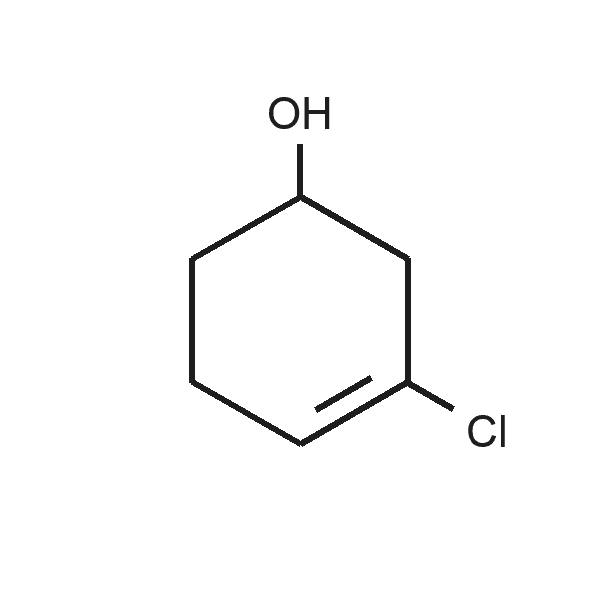 Solve with AI
Answer
(A) 1-chloro-5-hydroxycyclohexane
(B) 2-chloro-4-hydroxycyclohexane
- Correct
(C) 3-chloro-3-cyclohexenol
(D) 5-hydroxycyclohexenyl chloride
Answer: (C) 3-chloro-3-cyclohexenol
Key idea: In an IUPAC name the principal characteristic group takes the suffix and the lowest possible locant. Here –OH is the principal group (suffix "-ol"), so its carbon is C-1; next the C=C bond gets the lowest locant, and then the substituent –Cl.
Step 1 — Choose the parent.
The six-membered ring contains one C=C bond, so the parent is cyclohexene, and with the –OH group it is named as a cyclohexenol.
Step 2 — Number the ring.
C-1 is the carbon carrying –OH. Numbering towards the chlorine puts Cl on C-3 and the double bond between C-3 and C-4, so the double bond gets locant 3. Numbering the other way puts the double bond between C-4 and C-5 (locant 4) and Cl on C-5, which is higher, so the first direction is correct.
Step 3 — Write the name.
The compound is 3-chloro-3-cyclohexenol, written in current IUPAC style as 3-chlorocyclohex-3-en-1-ol.
Why the other options are wrong:
- (A) is wrong: The ending "cyclohexane" ignores the ring double bond, and –OH, the principal group, must be the suffix "-ol", not the prefix "hydroxy".
- (B) is wrong: It also ignores the double bond and treats –OH as a prefix, and its locants 2 and 4 are not the lowest possible set, because –OH takes locant 1.
- (D) is wrong: A name ending "…enyl chloride" makes the halogen the main group, but –OH outranks a halogen, so the compound must be named as an alcohol.
Note: The book prints this option as "3-chloro-3-cyclohexanol", without the ring double bond; with that wording no option names the compound exactly, and the intended answer is 3-chlorocyclohex-3-en-1-ol.
Therefore, the IUPAC name of the compound is 3-chloro-3-cyclohexenol (3-chlorocyclohex-3-en-1-ol): option (C).
- 251 mark
Question 25
Which one of the following is most reactive towards electrophilic reagent?
Solve with AIAnswer
- Correct
(A) -
(B) -
(C) -
(D) -
Answer: (A) -
Key idea: A group with a lone pair on the atom joined to the ring releases electrons into the ring by resonance (+R effect) and activates it towards electrophiles. The more freely that lone pair is given to the ring, the more reactive the ring.
Step 1 — Compare the second groups.
All four compounds carry the same ortho methyl group, so only the second group decides the reactivity: –OH, , or .
Step 2 — Rank the groups.
The oxygen of –OH gives its lone pair to the ring most strongly, so –OH is the strongest activator here. The group is slightly weaker, the group is weaker still because its nitrogen lone pair is also shared with the C=O group, and cannot activate by resonance at all.
Step 3 — Pick the most reactive compound.
The compound with –OH, o-cresol, has the most electron-rich ring and so reacts fastest with electrophiles.
Why the other options are wrong:
- (B) is wrong: In the acetamido group the nitrogen lone pair is partly drawn into the C=O group, so less electron density reaches the ring than from –OH.
- (C) is wrong: The atom joined to the ring in is carbon, which has no lone pair, so this group cannot activate the ring by resonance and has very little effect on it.
- (D) is wrong: The methoxy group is a strong activator, but slightly weaker than –OH, so this ether reacts a little more slowly than o-cresol.
Therefore, o-cresol (o-CH₃C₆H₄–OH) is the most reactive towards electrophilic reagents: option (A).
- 261 mark
Question 26
On commercial scale, phenol is obtained from chlorobenzene by Raschig's process. Which one of the following is Raschig's process?
Solve with AIAnswer
(A)
(B)
(C)
- Correct
(D)
Answer: (D) benzene + HCl + air over at about 500 K
Key idea: In Raschig's process chlorobenzene is made not with chlorine gas but by oxidative chlorination: benzene, hydrogen chloride and air are passed over a copper(II) chloride catalyst. The chlorobenzene is then hydrolysed by steam to phenol, and the HCl given off is used again.
Step 1 — Write the chlorination step.
Benzene, hydrogen chloride and oxygen from the air react over copper(II) chloride at about 500 K.
Step 2 — Write the hydrolysis step.
Chlorobenzene vapour and steam are passed over a calcium phosphate (with silica) catalyst at about 700–770 K, giving phenol and hydrogen chloride, which goes back to Step 1.
Step 3 — Match the option.
Only option (D) shows benzene reacting with HCl and air over , which is the Raschig chlorination.
Why the other options are wrong:
- (A) is wrong: Benzene with chlorine and anhydrous is ordinary electrophilic chlorination, which uses chlorine gas instead of recycled HCl and air.
- (B) is wrong: Benzenediazonium chloride with CuCl/HCl is the Sandmeyer reaction, a laboratory method that starts from aniline, not a commercial route from benzene.
- (C) is wrong: Benzenediazonium chloride with copper powder and HCl is the Gattermann reaction, also a laboratory method that starts from aniline.
Note: The equation printed in option (D) is not balanced (two O atoms on the left, one on the right); the balanced form is given in Step 1. Raschig's process is now of historical interest: almost all phenol today is made by the cumene process, which also gives acetone.
Therefore, Raschig's process is the reaction of benzene with HCl and air over CuCl₂ at about 500 K: option (D).
- 271 mark
Question 27
Which among the following compounds will give a secondary alcohol on reacting with Grignard reagent followed by acid hydrolysis?
I.
II.
III.
IV.
Select the correct answer using the codes given below:
Solve with AIAnswer
- Correct
(A) only II
(B) only III
(C) II and IV
(D) III and IV
Answer: (A) only II
Key idea: A Grignard reagent R′MgX adds to a carbonyl group, and acid hydrolysis then gives an alcohol. Formaldehyde gives a primary alcohol, any other aldehyde gives a secondary alcohol, a ketone gives a tertiary alcohol, and an ester takes two molecules of R′MgX and gives a tertiary alcohol (only a formate ester gives a secondary one).
Step 1 — Look at formaldehyde (I).
HCHO has two H atoms on the carbonyl carbon, so after R′ adds, that carbon carries –OH, R′ and two H atoms. The product is a primary alcohol, .
Step 2 — Look at propanal (II).
Propanal, , has one H and one ethyl group on the carbonyl carbon, so after R′ adds, that carbon carries two alkyl groups. The product is a secondary alcohol, .
Step 3 — Look at acetone (III).
Acetone, , already has two methyl groups on the carbonyl carbon, so adding R′ gives three alkyl groups. The product is a tertiary alcohol, .
Step 4 — Look at the ester (IV).
The first R′MgX replaces the group and gives a ketone, , and a second R′MgX adds to that ketone. The –OH carbon then carries three alkyl groups, so the product is a tertiary alcohol, .
Step 5 — Collect the answer.
Only compound II gives a secondary alcohol.
Why the other options are wrong:
- (B) is wrong: Acetone is a ketone, so it gives a tertiary alcohol, not a secondary one.
- (C) is wrong: Compound II is right, but the ester IV takes two Grignard molecules and gives a tertiary alcohol (only an ester of formic acid would give a secondary one).
- (D) is wrong: The ketone III and the ester IV both give tertiary alcohols, so neither gives a secondary alcohol.
Therefore, only compound II (propanal) gives a secondary alcohol: option (A).
- 281 mark
Question 28
Reaction of phenol with chloroform in presence of dilute sodium hydroxide finally introduces which one of the following functional group?
Solve with AIAnswer
(A) –COOH
(B) –
- Correct
(C) –CHO
(D) –
Answer: (C) –CHO
Key idea: Phenol heated with chloroform and sodium hydroxide undergoes the Reimer–Tiemann reaction. Chloroform and alkali form dichlorocarbene, , which attacks the phenoxide ring at the ortho position; the group formed is then hydrolysed to –CHO.
Step 1 — Form the electrophile.
Hydroxide ion removes from chloroform, and the ion then loses to give dichlorocarbene.
Step 2 — Let the carbene attack the ring.
The phenoxide ion is very electron-rich at the ortho and para positions, and dichlorocarbene substitutes mainly at the ortho position, giving a group on the ring.
Step 3 — Hydrolyse the dichloromethyl group.
The alkali replaces both chlorine atoms of by –OH, and the gem-diol formed loses water to give –CHO. The overall reaction is shown below.
Step 4 — Acidify the product.
Acidifying the sodium salt gives salicylaldehyde (2-hydroxybenzaldehyde), so the group introduced is –CHO.
Why the other options are wrong:
- (A) is wrong: A –COOH group is introduced when carbon tetrachloride is used in place of chloroform, which gives salicylic acid.
- (B) is wrong: The group is only an intermediate; the alkali hydrolyses it, so it is not the group finally introduced.
- (D) is wrong: No group forms at any stage; the carbon from chloroform keeps two chlorine atoms until hydrolysis turns it into –CHO.
Note: Chloroform is toxic and a suspected carcinogen, so this reaction is carried out in a fume cupboard.
Therefore, the reaction of phenol with chloroform and sodium hydroxide finally introduces a –CHO group: option (C).
- 291 mark
Question 29
…… is widely used as a solvent for the preparation of Grignard reagents.
Solve with AIWritten solution
Solution:
Key idea: A Grignard reagent, RMgX, is made by reacting an alkyl or aryl halide with magnesium. It reacts at once with water, alcohols and other compounds that have an acidic hydrogen, so the solvent must be dry and have no acidic hydrogen.
Step 1 — Find a solvent with the right properties.
Dry diethyl ether, , has no O–H group, so it does not destroy the reagent.
Step 2 — Explain how the ether helps.
The lone pairs on the ether oxygen coordinate to magnesium, which stabilises the Grignard reagent and keeps it in solution.
Note: Tetrahydrofuran (THF), another ether, is also widely used today. Diethyl ether is extremely flammable, so no flame is used nearby.
Therefore, dry diethyl ether is widely used as a solvent for the preparation of Grignard reagents.
- 301 mark
Question 30
Absolute alcohol can be prepared from rectified spirit by …… distillation.
Solve with AIWritten solution
Solution:
Key idea: Rectified spirit is about 95.6% ethanol by mass. It forms a constant-boiling mixture (an azeotrope) with water that boils at about 351 K, so simple distillation cannot remove the last water.
Step 1 — Explain why simple distillation fails.
At the azeotropic composition the vapour has the same composition as the liquid, so distilling does not change the ratio of ethanol to water.
Step 2 — Explain azeotropic distillation.
A third liquid (an entrainer) is added that forms a new, lower-boiling azeotrope containing the water. This azeotrope distils first and carries the water away, and water-free (absolute) ethanol is left to distil last.
Note: Benzene was the entrainer in the older textbook method; because benzene causes cancer, cyclohexane is used instead today, and much absolute alcohol is now dried with molecular sieves.
Therefore, absolute alcohol can be prepared from rectified spirit by azeotropic distillation.
- 311 mark
Question 31
A mixture of phenol and phthalic anhydride when heated with conc. forms …… which is used as an …… in acid-base titrations.
Solve with AIWritten solution
Solution:
Key idea: Concentrated sulphuric acid is a dehydrating agent. It makes phthalic anhydride condense with two molecules of phenol at their para positions, with the loss of water.
Step 1 — Write the condensation.
One molecule of phthalic anhydride and two molecules of phenol lose one molecule of water and form phenolphthalein.
Step 2 — State its use.
Phenolphthalein is colourless in acidic and neutral solutions and turns pink from about pH 8.2 upwards. This sharp colour change makes it an indicator in acid–base titrations, especially of weak acids with strong bases.
Therefore, the blanks are filled by phenolphthalein and indicator.
- 321 mark
Question 32
Lower alcohols are highly soluble in water due to …… .
Solve with AIWritten solution
Solution:
Key idea: A substance dissolves well in water when its molecules can form attractions with water molecules about as strong as the ones that must be broken.
Step 1 — Identify the bonding with water.
The –OH group of an alcohol forms hydrogen bonds with water molecules, both by giving its H to a water oxygen and by accepting an H from water.
Step 2 — Link it to chain length.
In the lower alcohols the hydrocarbon part is small, so hydrogen bonding wins: methanol, ethanol and the propanols mix with water in all proportions. As the chain gets longer the water-repelling part grows and the solubility falls.
Therefore, lower alcohols are highly soluble in water due to H-bonding (hydrogen bonding with water molecules).
- 331 mark
Question 33
A primary alcohol on oxidation gives an …… which on further oxidation gives a …… both containing the same number of carbon atoms.
Solve with AIWritten solution
Solution:
Key idea: A primary alcohol has –OH on a carbon carrying two hydrogens, . Oxidation removes hydrogen to give an aldehyde, and further oxidation adds oxygen to give a carboxylic acid; the carbon chain is not broken.
Step 1 — Oxidise the alcohol to an aldehyde.
Removing two hydrogen atoms from the alcohol (as water with the oxidant) gives an aldehyde.
Step 2 — Oxidise the aldehyde to an acid.
Adding one oxygen atom to the aldehyde gives a carboxylic acid.
Step 3 — Check the carbon count.
For example, ethanol gives acetaldehyde () and then acetic acid (), all with two carbon atoms. To stop at the aldehyde, a mild reagent such as PCC is used, or the aldehyde is distilled off as it forms.
Therefore, a primary alcohol on oxidation gives an aldehyde, which on further oxidation gives a carboxylic acid, both containing the same number of carbon atoms.
- 341 mark
Question 34
Phenol is acidic because of resonance stabilization of its conjugate base, namely ……
Solve with AIWritten solution
Solution:
Key idea: An acid is stronger when the anion left after losing (its conjugate base) is more stable. For this reason phenol ( about 10) is much more acidic than ethanol ( about 16).
Step 1 — Write the ionisation.
Phenol gives up the H of its –OH group to water.
Step 2 — Explain the stabilisation.
In the phenoxide ion, , the negative charge on oxygen is delocalised by resonance onto the two ortho carbons and the para carbon of the ring. Spreading the charge stabilises the ion, so phenol ionises more readily than an alcohol, whose alkoxide ion holds its charge on oxygen alone.
Therefore, the conjugate base of phenol is the phenoxide ion, C₆H₅O⁻.
- 351 mark
Question 35
When an organic acid reacts with …… in presence of a few drops of conc. , an ester is formed and the process is called …… .
Solve with AIWritten solution
Solution:
Key idea: A carboxylic acid and an alcohol, warmed with a few drops of concentrated sulphuric acid, form an ester and water. The acid speeds up the reaction and takes up the water formed, and the reaction is reversible.
Step 1 — Write the general reaction.
The –OH of the acid and the H of the alcohol's –OH leave as water, and the two parts join through oxygen.
Step 2 — Give an example and name the process.
Acetic acid and ethanol give ethyl acetate, which has a fruity smell. Forming an ester in this way is called esterification.
Therefore, an organic acid reacts with an alcohol in the presence of a few drops of conc. H₂SO₄ to form an ester, and the process is called esterification.
- 361 mark
Question 36
Dehydration of alcohols with conc. at 413 K gives …… .
Solve with AIWritten solution
Solution:
Key idea: When a primary alcohol such as ethanol is heated with concentrated sulphuric acid, the temperature decides the product. At 413 K, with the alcohol in excess, two molecules join and form an ether; at 443 K one molecule loses water and forms an alkene.
Step 1 — Write what happens at 413 K.
At 413 K the acid protonates one alcohol molecule, and a second alcohol molecule attacks it and pushes out water (). So one water molecule is lost from two alcohol molecules together.
Step 2 — Say why the ether is symmetrical.
Both alkyl groups come from the same alcohol, so the two groups on the oxygen atom are identical. For example, ethanol gives diethyl ether (ethoxyethane).
Watch out: This method works well only for primary alcohols. Secondary and tertiary alcohols lose water much more easily and give alkenes instead, and at 443 K even ethanol gives ethene.
Therefore, dehydration of alcohols with conc. at 413 K gives symmetrical ethers.
- 371 mark
Question 37
Phenol forms coloured complexes with neutral …… .
Solve with AIWritten solution
Solution:
Key idea: Phenols (and other compounds with an –OH group on a C=C carbon, called enols) form coloured complexes with iron(III) ions. This colour is used as a test for phenols.
Step 1 — Name the reagent.
A few drops of neutral ferric chloride (iron(III) chloride, ) solution are added to a solution of phenol. The solution must be neutral, because in acid the complex does not form: it needs phenoxide groups to bind to the iron(III) ion.
Step 2 — Describe the colour.
Phenol gives a violet colour, because phenoxide groups bind to and form a coloured iron(III)–phenoxide complex. Other phenols give blue, green or red-violet colours.
Therefore, phenol forms coloured complexes with neutral ferric chloride () solution.
- 381 mark
Question 38
Ethers behave as weakly …… substances due to the presence of two lone pairs of electrons on the oxygen atom.
Solve with AIWritten solution
Solution:
Key idea: A base accepts a proton (or, in the Lewis sense, donates an electron pair). The oxygen atom of an ether has two lone pairs, so an ether can act as a base, though only a weak one.
Step 1 — Show how a lone pair accepts a proton.
With a strong acid such as cold concentrated HCl or , the ether oxygen takes up a proton and forms an oxonium salt, which dissolves in the acid.
Step 2 — Explain why the basic character is weak.
Ethers are protonated only by strong acids, and the oxonium salt gives back the ether when the solution is diluted with water. The lone pairs can also be donated to Lewis acids such as , which form complexes like .
Therefore, ethers behave as weakly basic substances due to the two lone pairs of electrons on the oxygen atom.
- 391 mark
Question 39
has …… metamers. One of them is diethyl ether while the others are …… and …… .
Solve with AIWritten solution
Solution:
Key idea: Metamers are compounds with the same molecular formula and the same functional group, but with different alkyl groups on the two sides of the functional group (here, the ether oxygen).
Step 1 — List the ethers of formula .
The four carbon atoms are shared between the two alkyl groups on the oxygen. They can be shared as 2 + 2 or as 1 + 3, and the three-carbon group can be straight (n-propyl) or branched (isopropyl).
- : diethyl ether (ethoxyethane)
- : methyl n-propyl ether (1-methoxypropane)
- : isopropyl methyl ether (2-methoxypropane)
Step 2 — Count the ethers and fill the blanks.
There are three such ethers. Diethyl ether is one of them, and the other two are methyl n-propyl ether and isopropyl methyl ether.
Note: Each methyl propyl ether is a metamer of diethyl ether, because the groups on the oxygen are different (1 + 3 carbons instead of 2 + 2). The two methyl propyl ethers carry the same kinds of group on the oxygen and differ only in where the oxygen joins the propyl chain, so they are position isomers of each other.
Therefore, has three metamers: one is diethyl ether, and the others are methyl n-propyl ether and isopropyl methyl ether.
- 401 mark
Question 40
Amongst the three isomers of nitrophenols, the one that is least soluble in water is …… .
Solve with AIWritten solution
Solution:
Key idea: A compound dissolves well in water when it can form hydrogen bonds with water molecules. If its –OH group is already hydrogen-bonded inside the same molecule, it bonds much less with water.
Step 1 — Look at the groups in o-nitrophenol.
In o-nitrophenol the –OH and groups are on neighbouring carbons. The hydrogen of –OH forms a hydrogen bond with an oxygen of the nitro group in the same molecule and closes a six-membered ring (chelation, or intramolecular hydrogen bonding).
Step 2 — Compare with the m- and p-isomers.
In m- and p-nitrophenol the two groups are too far apart to bond inside the molecule. Their –OH and groups form hydrogen bonds with water molecules instead.
Step 3 — Decide which isomer is least soluble.
Because the –OH of o-nitrophenol is tied up inside the molecule, it forms few hydrogen bonds with water, so o-nitrophenol is the least soluble of the three isomers. The same effect makes it the most volatile, so it can be separated from p-nitrophenol by steam distillation.
Therefore, amongst the three nitrophenols, the one least soluble in water is o-nitrophenol (2-nitrophenol), because of chelation (intramolecular hydrogen bonding).
- 411 mark
Question 41
Aliphatic ethers are purified by shaking them with a solution of ferrous salt to remove …… which are formed on prolonged standing in contact with air.
Solve with AIWritten solution
Solution:
Key idea: Ethers kept in contact with air and light for a long time slowly react with oxygen and form organic peroxides, which are explosive.
Step 1 — Name the impurity.
On prolonged standing in air, diethyl ether forms peroxides, mainly hydroperoxides such as . They are less volatile than the ether, so they collect in the residue when the ether is distilled, and there they can explode.
Step 2 — Explain how a ferrous salt removes them.
Shaking the ether with an acidified solution of a ferrous salt, such as iron(II) sulphate, reduces the peroxides, while the ions are oxidised to . The peroxide-free ether is then separated, dried and distilled.
Watch out: An old sample of ether is never distilled to dryness before it has been tested for peroxides, because the peroxide residue can explode.
Therefore, aliphatic ethers are shaken with a ferrous salt solution to remove peroxides, which are formed on prolonged standing in contact with air.
- 421 mark
Question 42
The acidity of phenol is due to the …… of its anion.
Solve with AIWritten solution
Solution:
Key idea: An acid is stronger when the anion left behind after it loses is more stable.
Step 1 — Write the ionisation of phenol.
Phenol loses a proton from its –OH group and forms the phenoxide ion.
Step 2 — Explain why the phenoxide ion is stable.
The negative charge on the oxygen of the phenoxide ion is delocalised into the benzene ring by resonance, so it is spread over the oxygen and the ortho and para carbons. An alkoxide ion such as has no such resonance, and its charge stays on the oxygen.
Step 3 — Link the stability to the acidity.
Because its anion is stabilised by resonance, phenol ( about 10.0) is a much stronger acid than ethanol ( about 15.9).
Note: Phenol itself also has resonance structures, but they separate positive and negative charge, so they stabilise phenol much less than the phenoxide ion is stabilised.
Therefore, the acidity of phenol is due to the resonance stabilisation of its anion (the phenoxide ion).
- 431 mark
Question 43
The reaction of phenol with a diazonium salt in weakly alkaline medium is called …… .
Solve with AIWritten solution
Solution:
Key idea: A diazonium ion is a weak electrophile. It attacks very reactive aromatic rings, such as the phenoxide ion, and joins the two rings through an –N=N– (azo) link. This is called a coupling reaction.
Step 1 — Explain why a weakly alkaline medium is used.
In weakly alkaline solution, phenol is partly converted into the phenoxide ion, which activates the ring much more strongly than –OH does. The medium is kept only weakly alkaline, because strong alkali turns the diazonium ion into species that do not couple, and the mixture is kept cold (about 273–278 K) so that the diazonium salt does not decompose.
Step 2 — Write the coupling reaction.
The diazonium ion attacks the para position of phenol and gives p-hydroxyazobenzene, an orange dye. The HCl formed is taken up by the alkali.
Therefore, the reaction of phenol with a diazonium salt in a weakly alkaline medium is called a coupling reaction (azo coupling).
- 441 mark
Question 44
A …… diol has two hydroxyl groups on …… .
Solve with AIWritten solution
Solution:
Key idea: Diols are described by where their two –OH groups sit: on the same carbon (geminal) or on adjacent carbons (vicinal).
Step 1 — Recall the meaning of "vicinal".
"Vicinal" comes from the Latin word for "neighbouring". A vicinal diol has its two –OH groups on two carbon atoms that are bonded directly to each other.
Step 2 — Give an example.
Ethane-1,2-diol (ethylene glycol) is the simplest vicinal diol.
Note: Two –OH groups on the same carbon (a geminal diol) are usually unstable, and such a compound loses water to form a carbonyl compound.
Therefore, a vicinal diol has two hydroxyl groups on adjacent carbon atoms.
- 451 mark
Question 45
The reaction of sulphur powder with phenylmagnesium bromide followed by hydrolysis gives …… .
Solve with AIWritten solution
Solution:
Key idea: In a Grignard reagent the carbon bonded to magnesium is strongly nucleophilic. Sulphur, like oxygen, can insert into the C–Mg bond, and hydrolysis of the product gives a thiol.
Step 1 — Write the reaction with sulphur.
Phenylmagnesium bromide reacts with powdered sulphur and forms a magnesium thiolate.
Step 2 — Hydrolyse the product.
Water (or dilute acid) replaces the MgBr group by hydrogen and gives thiophenol.
Note: In the same way, oxygen reacts with phenylmagnesium bromide to give , which is hydrolysed to phenol. Thiophenol is the sulphur analogue of phenol.
Therefore, sulphur powder with phenylmagnesium bromide, followed by hydrolysis, gives thiophenol (benzenethiol), .
- 461 mark
Question 46
Reaction of phenol with …… in the presence of aq. NaOH is called Schotten–Baumann reaction.
Solve with AIWritten solution
Solution:
Key idea: Benzoylation replaces the hydrogen of an –OH (or ) group by a benzoyl group, . When it is carried out with benzoyl chloride in aqueous sodium hydroxide, it is called the Schotten–Baumann reaction.
Step 1 — Explain the role of the alkali.
Sodium hydroxide converts phenol into the phenoxide ion, which is a better nucleophile. It also neutralises the HCl formed, so the reaction goes to completion.
Step 2 — Write the reaction.
The phenoxide ion attacks the carbonyl carbon of benzoyl chloride and replaces the chlorine, giving the ester phenyl benzoate.
Therefore, the reaction of phenol with benzoyl chloride in the presence of aq. NaOH is called the Schotten–Baumann reaction.
- 471 mark
Question 47
Presence of electron donating groups at o- and p-positions …… while that of electron-withdrawing groups …… the acidity of phenols.
Solve with AIWritten solution
Solution:
Key idea: The acidity of a phenol depends on how stable its phenoxide ion is. Groups that spread out the negative charge stabilise the ion, and groups that add to it destabilise the ion.
Step 1 — Consider electron-donating groups.
Groups such as push electron density into the ring (+I effect and hyperconjugation). This increases the negative charge on the phenoxide oxygen and destabilises the ion, so the acidity decreases. For example, o-cresol and p-cresol ( about 10.3) are weaker acids than phenol ( about 10.0).
Step 2 — Consider electron-withdrawing groups.
Groups such as pull electron density away (–I effect, and from the o- and p-positions also the –R effect). They spread the negative charge further and stabilise the ion, so the acidity increases. For example, p-nitrophenol ( about 7.1) is a much stronger acid than phenol.
Watch out: The effect of a nitro group is largest at the o- and p-positions, where resonance carries the charge onto the nitro group. At the m-position only the –I effect acts, so m-nitrophenol ( about 8.4) is less acidic than the o- and p-isomers.
Therefore, electron-donating groups at o- and p-positions decrease, while electron-withdrawing groups increase, the acidity of phenols.
- 481 mark
Question 48
Sodium metal can be used for …… ethers but not for alcohols.
Solve with AIWritten solution
Solution:
Key idea: Sodium reacts with compounds that have a hydrogen on oxygen (water, alcohols, acids), but not with ethers, which have no O–H bond.
Step 1 — Explain why sodium can dry an ether.
An ether has no hydrogen attached to oxygen, so sodium does not react with the ether itself. It reacts only with the traces of water present and removes them as sodium hydroxide and hydrogen.
Step 2 — Explain why sodium cannot dry an alcohol.
An alcohol has an O–H bond, so sodium reacts with the alcohol itself and forms a sodium alkoxide and hydrogen. The alcohol would be used up instead of being dried.
Watch out: Sodium (often pressed into wire) is added only to ether that has already been mostly dried, because sodium reacts violently with larger amounts of water and the hydrogen given off is flammable.
Therefore, sodium metal can be used for drying ethers but not for alcohols.
- 491 mark
Question 49
3,3-Dimethylbutan-2-ol loses a molecule of water in the presence of concentrated sulphuric acid to give tetramethylethylene as the major product. Suggest a suitable mechanism.
Solve with AIWritten solution
Solution:
Key idea: Acid-catalysed dehydration of an alcohol goes through a carbocation. A less stable carbocation can rearrange, by a 1,2-shift of a neighbouring group, into a more stable one before it loses a proton.
Step 1 — Protonate the –OH group.
The acid gives a proton to the oxygen of the alcohol. This turns the poor leaving group –OH into a good leaving group, .
Step 2 — Lose water to form a secondary carbocation.
The C–O bond breaks and water leaves, so a secondary (2°) carbocation forms on C-2.
Step 3 — Rearrange by a 1,2-methyl shift.
A methyl group on C-3 moves, with its pair of bonding electrons, to the positive C-2. The positive charge moves to C-3, which now carries two methyl groups and an isopropyl group, so it is a more stable tertiary (3°) carbocation.
Step 4 — Lose a proton to form the alkene.
A base (water or ) removes a proton from a carbon next to the positive carbon. Removing the H of the neighbouring CH group gives a C=C bond carrying four methyl groups.
Step 5 — Explain why this alkene is the major product.
2,3-Dimethylbut-2-ene has four alkyl groups on its double bond, so it is the most substituted and most stable alkene that can form (Saytzeff, or Zaitsev, rule). Loss of a proton from a methyl group of the same cation gives only the minor product 2,3-dimethylbut-1-ene.
Therefore, the mechanism is protonation, loss of water to a 2° carbocation, a 1,2-methyl shift to a 3° carbocation and loss of a proton, giving 2,3-dimethylbut-2-ene (tetramethylethylene) as the major product.
- 501 mark
Question 50
Write the IUPAC name of the compound given below.
Solve with AIWritten solution
Solution:
Key idea: For an alcohol with a double bond, the main chain must contain the carbons that carry the –OH groups and the C=C bond. It is numbered so that the –OH groups (the suffix "-ol") get the lowest locants.
Step 1 — Choose the main chain.
The –OH groups are on the carbon and on the carbon next to it. The longest chain that runs through both of them and through the C=C bond has five carbons.
Step 2 — Number the chain.
Numbering from the end gives the –OH groups the locants 1 and 2; from the other end they would be 4 and 5. So C-1 is the carbon, C-2 carries –OH, C-3 carries the methyl group, and C-4 and C-5 complete the chain.
Step 3 — Put the name together.
The double bond starts at C-2, so the parent is pent-2-ene. The two –OH groups at C-1 and C-2 give the suffix "-1,2-diol", and the methyl group at C-3 is written as a prefix.
Note: A compound with an –OH group on a C=C carbon is an enol. Such enols are usually unstable and change into the keto form (here 1-hydroxy-3-methylpentan-2-one), but the name asked for is that of the structure as drawn.
Therefore, the IUPAC name of the compound is 3-methylpent-2-ene-1,2-diol.
- 511 mark
Question 51
Write the IUPAC name of the following compounds.
(A)
(B)
Solve with AIWritten solution
Solution:
Key idea: The main chain is the longest chain that contains the greatest number of –OH groups. It is numbered to give the –OH groups the lowest locants, and substituent prefixes are written in alphabetical order. Aryl ethers are named as alkoxybenzenes.
Step 1 — Choose the main chain of (A).
The –OH groups are on the third and fifth carbons from the left. The longest chain containing both has six carbons, so the parent is a hexanediol. The ethyl group sits on a middle carbon of this chain, so it cannot make a longer chain that still holds both –OH groups.
Step 2 — Number the chain of (A).
Numbering from the right-hand end gives the –OH groups the locants 2 and 4, while numbering from the left would give 3 and 5. So we number from the right; the ethyl group is then on C-3 and the methyl group on C-5.
Step 3 — Name compound (A).
Ethyl is cited before methyl in alphabetical order, and the "e" of hexane is kept because the suffix "-diol" begins with a consonant. The name is 3-ethyl-5-methylhexane-2,4-diol.
Step 4 — Name compound (B).
In an aryl ether neither the alkoxy group nor the nitro group is used as a suffix, so both are prefixes on benzene. The groups are meta to each other, so the locants are 1 and 3 whichever group is chosen first; the rule then gives locant 1 to the group cited first in alphabetical order, and methoxy comes before nitro.
Therefore, (A) is 3-ethyl-5-methylhexane-2,4-diol and (B) is 1-methoxy-3-nitrobenzene (3-nitroanisole).
- 521 mark
Question 52
What is the structure and IUPAC name of glycerol?
Solve with AIWritten solution
Solution:
Key idea: Glycerol is a trihydric alcohol: a three-carbon chain with one –OH group on each carbon.
Step 1 — Write the structure.
Each of the three carbons of a propane chain carries one –OH group.
Step 2 — Build the IUPAC name.
The parent chain is propane, and the three –OH groups at C-1, C-2 and C-3 give the suffix "-1,2,3-triol". The "e" of propane is kept because the suffix begins with the consonant "t".
Therefore, glycerol is , and its IUPAC name is propane-1,2,3-triol.
- 531 mark
Question 53
How do you account for the fact that unlike phenol, 2,4-dinitrophenol and 2,4,6-trinitrophenol are soluble in aqueous sodium carbonate solution?
Solve with AIWritten solution
Solution:
Key idea: An acid releases from sodium carbonate, and dissolves as its sodium salt, only if it is a stronger acid than carbonic acid ( about 6.4).
Step 1 — Explain the effect of the nitro groups.
The groups at the ortho and para positions withdraw electrons by –I and –R effects. In the phenoxide ion, the negative charge is delocalised through the ring onto the oxygen atoms of the nitro groups, so the anion is strongly stabilised.
Step 2 — Compare the acid strengths.
Each extra o- or p-nitro group makes the phenol much more acidic. 2,4-Dinitrophenol has about 4.1 and 2,4,6-trinitrophenol (picric acid) about 0.4, so both are stronger acids than carbonic acid. Phenol ( about 10.0) is a far weaker acid than carbonic acid.
Step 3 — Write the reactions of the nitrophenols.
The two nitrophenols decompose sodium carbonate with effervescence of carbon dioxide and dissolve as their sodium salts.
Step 4 — Explain why phenol behaves differently.
Phenol is too weak an acid to set free carbonic acid from sodium carbonate, so it gives no effervescence and does not dissolve in this way.
Note: The of phenol (about 10.0) is close to that of the hydrogencarbonate ion (about 10.3), so phenol can turn a little carbonate into hydrogencarbonate, but it can never release .
Therefore, 2,4-dinitrophenol and 2,4,6-trinitrophenol dissolve in aqueous sodium carbonate because their nitro groups make them stronger acids than carbonic acid, while phenol is a weaker acid than carbonic acid and cannot decompose sodium carbonate.
- 541 mark
Question 54
Which is a stronger acid, phenol or cresol? Explain.
Solve with AIWritten solution
Solution:
Key idea: The more stable the phenoxide ion formed, the stronger the phenol is as an acid. Electron-releasing groups destabilise the phenoxide ion.
Step 1 — Look at the methyl group of cresol.
Cresol, , has a methyl group on the ring. The methyl group releases electrons by the +I effect and, from the o- and p-positions, by hyperconjugation.
Step 2 — See its effect on the anion.
The extra electron density increases the negative charge on the oxygen of the cresoxide ion. This ion is therefore less stable than the phenoxide ion, so cresol gives up less readily.
Step 3 — Compare with measured values.
The values agree with this: phenol about 10.0, o-cresol and p-cresol about 10.3, and m-cresol about 10.1. The m-isomer is only slightly weaker than phenol, because hyperconjugation does not act from the m-position.
Therefore, phenol is a stronger acid than cresol.
- 551 mark
Question 55
What is denatured alcohol?
Solve with AIWritten solution
Solution:
Key idea: Ethanol for industrial use carries far less duty than drinking alcohol, so it is made unfit to drink ("denatured") before it is sold.
Step 1 — Define denatured alcohol.
Denatured alcohol is ethanol to which small amounts of poisonous, foul-smelling or bad-tasting substances have been added, so that it cannot be drunk.
Step 2 — Name the usual additives.
Common denaturants are methanol (which is poisonous and can cause blindness and death), pyridine (a foul-smelling liquid) and a little copper sulphate (which colours it). Very bitter substances such as denatonium benzoate are also used today. Ethanol denatured mainly with methanol is called methylated spirit.
Step 3 — State why it is made.
Denatured alcohol is sold cheaply, without the duty charged on drinking alcohol, for use as a solvent, a fuel and a raw material in industry.
Therefore, denatured alcohol is ethanol made unfit for drinking by adding substances such as methanol, pyridine or copper sulphate.
- 561 mark
Question 56
What happens when benzenediazonium chloride is heated with water?
Solve with AIWritten solution
Solution:
Key idea: Diazonium salts are unstable above about 278 K. When an aqueous solution is warmed, the group leaves as nitrogen gas and is replaced by –OH.
Step 1 — Write the reaction.
When benzenediazonium chloride is warmed with water, nitrogen gas is evolved and phenol is formed.
Step 2 — Say why the reaction is useful.
Benzenediazonium chloride is made from aniline with and HCl at 273–278 K. So this reaction is a laboratory method of making phenol from aniline.
Therefore, when benzenediazonium chloride is heated with water, it is hydrolysed to phenol, with nitrogen gas and HCl given off.
- 571 mark
Question 57
What are primary alcohols?
Solve with AIWritten solution
Solution:
Key idea: Alcohols are classified by the carbon atom that carries the –OH group: a primary carbon is bonded to one other carbon, a secondary carbon to two and a tertiary carbon to three.
Step 1 — Define a primary alcohol.
A primary (1°) alcohol has its –OH group on a primary carbon, that is, a carbon bonded to only one other carbon atom. It contains the group and has the general formula .
Step 2 — Give examples.
Ethanol, , and propan-1-ol, , are primary alcohols. Methanol, , has no other carbon on its –OH carbon, but it is grouped with the primary alcohols because it also contains the group and reacts like them (for example, it is oxidised to an aldehyde).
Therefore, primary alcohols are alcohols in which the –OH group is attached to a primary carbon atom, , for example ethanol.
- 581 mark
Question 58
What is the IUPAC name of the alcohol: ?
Solve with AIWritten solution
Solution:
Key idea: In an alcohol with a multiple bond, the chain is numbered to give the –OH group the lowest locant, and a triple bond is shown by the infix "-yn-".
Step 1 — Number the chain.
The chain has three carbons. Numbering from the carbon gives –OH the locant 1, and the triple bond then lies between C-2 and C-3.
Step 2 — Build the name.
The parent is propyne with the triple bond starting at C-2 (prop-2-yne). The –OH group at C-1 gives the suffix "-1-ol", and the final "e" of the alkyne is dropped before the vowel "o".
Therefore, the IUPAC name of is prop-2-yn-1-ol (propargyl alcohol).
- 591 mark
Question 59
Draw the structure of
(i) hex-1-en-3-ol
(ii) 3-aminopentan-2-ol
Solve with AIWritten solution
Solution:
Key idea: To draw a structure from a name, write the parent chain given by the root (hex = 6 carbons, pent = 5 carbons), place each group at its locant, and then add hydrogens so that every carbon has four bonds.
Step 1 — Draw hex-1-en-3-ol.
The chain has six carbons, a double bond between C-1 and C-2, and an –OH group on C-3.
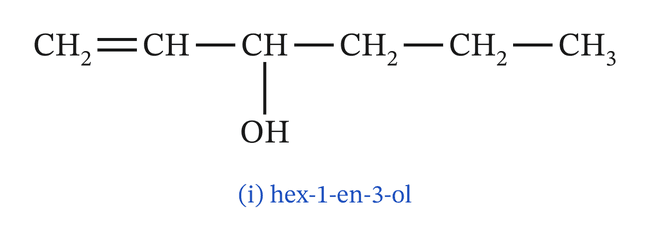
Step 2 — Draw 3-aminopentan-2-ol.
The chain has five carbons, an –OH group on C-2 and an group on C-3. The –OH group is the principal group (suffix "-ol"), so the amino group appears as a prefix.
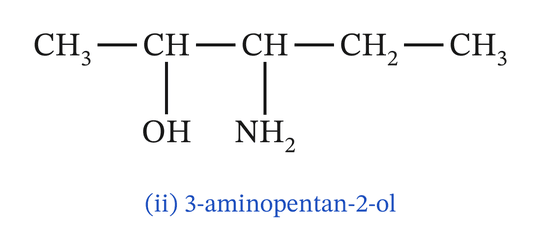
Therefore, (i) hex-1-en-3-ol is and (ii) 3-aminopentan-2-ol is .
- 601 mark
Question 60
How is ethyl methanoate converted into propan-2-ol?
Solve with AIWritten solution
Solution:
Key idea: An ester reacts with two moles of a Grignard reagent. The first mole replaces the –OR group and gives a carbonyl compound, and the second mole adds to that carbonyl compound. A methanoate (formate) ester gives an aldehyde first, so the final product is a secondary alcohol.
Step 1 — Add the first mole of Grignard reagent.
Methylmagnesium bromide in dry ether adds to the C=O group of ethyl methanoate, and the intermediate loses to give ethanal.
Step 2 — Add the second mole of Grignard reagent.
Ethanal is more reactive than the ester, so a second mole of methylmagnesium bromide adds to it at once.
Step 3 — Hydrolyse with dilute acid.
Dilute acid converts the magnesium alkoxide into the alcohol (the from Step 1 gives ethanol in the same way).
Step 4 — Write the overall change.
Adding the three steps (with ethanol as the second alcohol formed) gives the overall equation.
Therefore, ethyl methanoate is converted into propan-2-ol, , by treating it with two moles of methylmagnesium bromide in dry ether and then hydrolysing with dilute acid.
- 612 marks
Question 61
Arrange the following in increasing order of basicity:
Solve with AIWritten solution
Solution:
Key idea: A base accepts a proton with a lone pair. An anion carries a full negative charge, so it is a far stronger base than a neutral molecule. Within each pair, this chapter compares the species by the electron-releasing (+I) effect of the methyl group.
Step 1 — Compare the neutral molecules.
In the methyl group releases electrons (+I effect) towards the oxygen, so its lone pairs accept a proton more readily than those of water. So water is the weaker base of the two.
Step 2 — Compare the anions.
A stronger base is the conjugate base of a weaker acid. On the same +I argument methanol is a weaker acid than water, so methoxide is a stronger base than hydroxide.
Step 3 — Place the anions above the neutral molecules.
The anions carry a full negative charge, so both are much stronger bases than either neutral molecule. Their conjugate acids (water and methanol) have about 15–16, while the protonated neutral molecules (, ) have about −2.
Note: The two members of each pair are very close in strength, and their order can change with the medium; for example, in water, methanol ( about 15.5) and water (about 15.7) are nearly equal acids. The order asked for follows the +I argument of this chapter; the large gap between the anions and the neutral molecules holds in every medium.
Therefore, the increasing order of basicity is .
- 622 marks
Question 62
Acid-catalysed dehydration of t-butanol is faster than that of n-butanol. Give reasons in one or two sentences.
Solve with AIWritten solution
Solution:
Key idea: Acid-catalysed dehydration is fastest for alcohols that form stable carbocations. Carbocation stability is 3° > 2° > 1°.
Step 1 — Look at t-butanol.
After protonation, t-butanol loses water and forms the tertiary carbocation . Its three methyl groups stabilise the positive charge by the +I effect and hyperconjugation, so this step is fast and the alcohol is dehydrated under mild conditions (for example, 20% phosphoric acid at about 358 K).
Step 2 — Look at n-butanol.
To dehydrate in the same way, n-butanol would have to form a primary carbocation, which is very unstable. So its slow step is much slower, and hot concentrated sulphuric acid (about 443 K) is needed.
Therefore, the acid-catalysed dehydration of t-butanol is faster than that of n-butanol, because t-butanol forms a stable tertiary carbocation, while n-butanol would have to form an unstable primary carbocation.
- 632 marks
Question 63
Which of the following is the correct method for synthesising methyl tert-butyl ether and why?
(i)
(ii) -tert-Bu
Solve with AIWritten solution
Solution:
Key idea: The Williamson synthesis is an reaction of an alkoxide ion with an alkyl halide, so the alkyl halide must be primary (methyl is best). With a tertiary halide, the alkoxide acts as a base instead and elimination takes place.
Step 1 — Examine method (ii).
In method (ii) the halide is methyl bromide, which is unhindered. The tert-butoxide ion attacks its carbon from the back and displaces the bromide ion, giving the ether.
Step 2 — Examine method (i).
In method (i) the halide is tert-butyl bromide, whose carbon is too crowded for back-side attack. The strongly basic methoxide ion removes a β-hydrogen instead, so elimination gives 2-methylpropene and no ether.
Therefore, method (ii), sodium tert-butoxide with methyl bromide, is the correct way to make methyl tert-butyl ether, because the tertiary halide in method (i) undergoes elimination instead of substitution.
- 642 marks
Question 64
Unlike phenols, alcohols are easily protonated.
or Alcohols are easily protonated in comparison to phenols.
or Why do phenols not give protonation reactions readily?
Solve with AIWritten solution
Solution:
Key idea: Protonation needs a lone pair on the oxygen atom that is free to accept a proton. The more available the lone pair, the more easily the compound is protonated.
Step 1 — Look at the oxygen of an alcohol.
In an alcohol both lone pairs stay on the oxygen, and the alkyl group (+I effect) slightly increases the electron density there. So the oxygen readily accepts a proton from a strong acid.
Step 2 — Look at the oxygen of a phenol.
In phenol one lone pair of the oxygen is delocalised into the benzene ring by resonance. In the resonance structures the oxygen carries a positive charge, so its lone pair is much less available for a proton.
Step 3 — Compare the two.
Protonating phenol would use the lone pair that takes part in resonance, so it would destroy this stabilisation. Phenol is therefore a much weaker base than an alcohol and is protonated only with difficulty.
Therefore, alcohols are protonated easily because their oxygen lone pairs are fully available, while phenols are not, because a lone pair of the phenolic oxygen is delocalised into the ring.
- 652 marks
Question 65
Out of 2-chloroethanol and ethanol which is more acidic and why?
Solve with AIWritten solution
Solution:
Key idea: An alcohol is a stronger acid when its alkoxide ion is more stable. Electron-withdrawing groups near the oxygen spread out the negative charge and stabilise the ion.
Step 1 — Look at the effect of chlorine.
Chlorine is more electronegative than carbon and withdraws electrons through the σ bonds (–I effect). This makes the O–H bond more polar, so is lost more easily.
Step 2 — Compare the anions.
The –I effect of chlorine also spreads out the negative charge of , making it more stable than . The ethoxide ion has no electron-withdrawing group; its ethyl group releases electrons slightly.
Step 3 — Check with measured values.
The measured values agree: 2-chloroethanol has about 14.3 and ethanol about 15.9. The difference of 1.6 units means that 2-chloroethanol is about 40 times stronger as an acid.
Therefore, 2-chloroethanol is more acidic than ethanol, because the –I effect of chlorine stabilises its alkoxide ion.
- 662 marks
Question 66
Predict the major product of the following reaction:
Solve with AIWritten solution
Solution:
Key idea: In strong acid an alcohol forms a carbocation, which can alkylate benzene by electrophilic substitution (Friedel–Crafts type alkylation). A primary carbocation rearranges into a more stable one before it attacks.
Step 1 — Form the carbocation.
The acid protonates the –OH group of 2-methylpropan-1-ol (isobutyl alcohol), and water leaves. As water leaves, a hydride ion shifts from C-2 to C-1 (a 1,2-hydride shift), so the stable tertiary tert-butyl cation forms instead of the unstable primary isobutyl cation.
Step 2 — Let the cation attack benzene.
The tert-butyl cation is the electrophile. It attacks the benzene ring, and loss of from the intermediate restores the aromatic ring.
Step 3 — Write the overall reaction.
Adding the two steps, the proton is given back, so the acid acts as a catalyst.
Watch out: The product is not isobutylbenzene, because the primary isobutyl cation rearranges before it can attack the ring.
Therefore, the major product is tert-butylbenzene (2-methyl-2-phenylpropane), .
- 672 marks
Question 67
Suggest a reagent for the following conversion.
- 682 marks
Question 68
Give one reaction to show that phenol is acidic in character.
- 692 marks
Question 69
How will you know whether a given OH group is alcoholic or phenolic in nature?
- 702 marks
Question 70
Phenol is an acid but does not react with sodium bicarbonate solution. Explain.
- 712 marks
Question 71
Name the products when anisole is heated with HI.
- 722 marks
Question 72
A little water is there on the inner surface of a conical flask. Can this water be removed by shaking with ether? Answer with reason.
- 735 marks
Question 73
Arrange the following compounds in increasing order of acidity and give a suitable explanation. Phenol, o-nitrophenol, o-cresol.
- 745 marks
Question 74
Write steps to carry out the conversion of phenol to aspirin.
- 755 marks
Question 75
Out of o-nitrophenol and o-cresol which is more acidic?
- 765 marks
Question 76
How can propan-2-one be converted into tert-butyl alcohol?
- 775 marks
Question 77
Name the enzymes and write the reactions involved in the preparation of ethanol from sucrose by fermentation.
- 785 marks
Question 78
Explain why phenols do not undergo substitution of the –OH group like alcohols.
- 795 marks
Question 79
Arrange the following in order of decreasing acid strength:
- 805 marks
Question 80
Explain why p-nitrophenol is more acidic than phenol.
- 815 marks
Question 81
Give the IUPAC names of the following:
(i)
(ii)
(iii)
(iv)
(v)
(vi)
(vii)
(viii)
(ix)
(x)
(xi)
(xii)
- 825 marks
Question 82
How will you convert ethanol into ethene?
- 835 marks
Question 83
The relative ease of dehydration of alcohols is: tertiary > secondary > primary.
- 845 marks
Question 84
Although both allyl alcohol and 1-propanol are primary alcohols, they can still be distinguished by Lucas reagent. Explain how?
What Class 12 Chemistry Ch 11 covers
The sections of the chapter, in the order the book takes them. Every question above comes from one of these.
- 01Classification and Nomenclature of Alcohols, Phenols and Ethers
- 02Preparation of Alcohols
- 03Properties and Reactions of Alcohols
- 04Methanol and Ethanol
- 05Interconversion and Distinction of Primary, Secondary and Tertiary Alcohols
- 06Phenols: Preparation and Acidity
More ways to study this chapter
The same chapter asked three other ways. Practise it, revise it, and see what the board has set on Ch 11 before.
- Competency-Based Questions (CBQ)Case study questions: a situation, and the part of the chapter that answers it.40questionsOpen
- Previous Year QuestionsQuestions that have actually appeared in board papers, each tagged with its year.39questionsOpen
- Practice QuestionsExtra questions per chapter, for when one attempt at a method is not enough.111questionsOpen
Ch 11 in past ISC papers
The same chapter as the board has actually asked it. These are worded differently from the textbook exercise, which is the point of reading them.
- 11 mark
Board paper question 1
How can the following conversions be brought about:
Chlorobenzene to phenol
Solve with AIWritten solution
Solution:
Key idea: The C–Cl bond in chlorobenzene is very strong, because the lone pair of chlorine is partly shared with the ring (resonance gives the bond some double-bond character). So the chlorine can be replaced by –OH only under harsh conditions: heating with concentrated aqueous sodium hydroxide at about 623 K and 300 atm. This is Dow's process.
Step 1 — Heat chlorobenzene with sodium hydroxide under pressure.
Chlorobenzene is heated with a concentrated solution of sodium hydroxide at about 623 K and 300 atm. The chlorine is replaced and, because the medium is alkaline, the phenol formed is obtained as sodium phenoxide.
Step 2 — Acidify to free phenol.
Sodium phenoxide is the salt of the weak acid phenol. Adding dilute hydrochloric acid gives back phenol.
Watch out: Chlorobenzene does not give phenol with aqueous NaOH under ordinary conditions, unlike an alkyl chloride; the high temperature and pressure are essential.
Note: Dow's process is now mainly of historical interest; today most phenol is made from cumene (isopropylbenzene), a process that also gives acetone.
Therefore, chlorobenzene is converted to phenol by heating it with sodium hydroxide at about 623 K and 300 atm (Dow's process) and then acidifying the sodium phenoxide formed with dilute HCl.
- 21 mark
Board paper question 2
How can the following conversions be brought about:
Diethyl ether to ethanol
Solve with AIWritten solution
Solution:
Key idea: Ethers are generally unreactive, but the C–O–C link is broken (hydrolysed) when an ether is heated with dilute sulphuric acid under pressure. A symmetrical ether such as diethyl ether gives two molecules of the same alcohol.
Step 1 — Choose the reaction.
Diethyl ether, , has two ethyl groups on the oxygen. Breaking the ether link with water puts an –OH on each ethyl group, so both halves become ethanol.
Step 2 — Write the equation.
Diethyl ether is boiled with dilute sulphuric acid under pressure.
Therefore, diethyl ether is converted to ethanol by heating it with dilute sulphuric acid under pressure, which hydrolyses one molecule of the ether into two molecules of ethanol.
- 31 mark
Board paper question 3
Glycerol (propane 1, 2, 3 triol) is more viscous than ethylene glycol (ethane 1, 2, diol). Explain.
Solve with AIWritten solution
Solution:
Key idea: Viscosity (resistance to flow) of a liquid rises with the strength of the forces between its molecules. In alcohols the main force is hydrogen bonding through the –OH groups, so more –OH groups per molecule means a more viscous liquid.
Step 1 — Count the –OH groups.
Glycerol, , has three –OH groups in each molecule. Ethylene glycol, , has only two.
Step 2 — Relate the –OH groups to hydrogen bonding.
Each –OH group can form hydrogen bonds with neighbouring molecules. With three –OH groups, each glycerol molecule is held by more hydrogen bonds, which link the molecules into a more extensive three-dimensional network. Glycerol is also a larger molecule.
Step 3 — Relate hydrogen bonding to viscosity.
For the liquid to flow, molecules must slide past one another, which means breaking and re-forming these hydrogen bonds. The more extensive network in glycerol resists this more strongly, so glycerol flows less easily.
Therefore, glycerol is more viscous than ethylene glycol because its three –OH groups per molecule form more extensive intermolecular hydrogen bonding than the two –OH groups of ethylene glycol.
- 44 marks
Board paper question 4
(i) Write the structure of three ethers with molecular formula .
(ii) Starting with Grignard's reagent, how will you prepare propanoic acid?
Solve with AIWritten solution
Solution:
Key idea: An ether has the general formula R–O–R′. For the four carbon atoms must be shared between the two groups on the oxygen, either 1 + 3 or 2 + 2. A carboxylic acid is made from a Grignard reagent by adding carbon dioxide (one carbon more), then hydrolysing.
Step 1 — Part (i): list the ways to share four carbons.
The groups on the two sides of the oxygen can be methyl and a three-carbon group, or ethyl and ethyl. A three-carbon group can be straight (n-propyl) or branched (isopropyl). So there are exactly three ethers.
Step 2 — Part (i): write the three structures.
The three ethers are:
-
, 1-methoxypropane (methyl n-propyl ether)
-
, 2-methoxypropane (methyl isopropyl ether)
-
, ethoxyethane (diethyl ether)
Each has 4 C, 10 H and 1 O, so each fits .
Step 3 — Part (ii): choose the Grignard reagent.
Propanoic acid, , has three carbon atoms. Carbon dioxide supplies the –COOH carbon, so the Grignard reagent must carry a two-carbon group: ethylmagnesium bromide, . It is made from ethyl bromide and magnesium in dry ether.
Step 4 — Part (ii): add carbon dioxide.
The ethyl group of the Grignard reagent attacks the carbon of carbon dioxide (dry ice), giving a magnesium salt of the acid.
Step 5 — Part (ii): hydrolyse the adduct.
Hydrolysis with dilute acid releases propanoic acid.
Therefore, (i) the three ethers of formula C₄H₁₀O are CH₃–O–CH₂CH₂CH₃ (1-methoxypropane), CH₃–O–CH(CH₃)₂ (2-methoxypropane) and C₂H₅–O–C₂H₅ (ethoxyethane), and (ii) propanoic acid is prepared by treating ethylmagnesium bromide with carbon dioxide (dry ice) and hydrolysing the product with dilute acid.
-
- 51 mark
Board paper question 5
Answer the following questions:
What are the products formed when phenol and nitrobenzene are treated separately with a mixture of concentrated sulphuric acid and concentrated nitric acid?
Solve with AIWritten solution
Solution:
Key idea: A mixture of concentrated nitric and sulphuric acids (nitrating mixture) supplies the nitronium ion, , which attacks the benzene ring. The –OH group of phenol strongly activates the ring and directs to the ortho and para positions, while the –NO₂ group of nitrobenzene deactivates the ring and directs to the meta position.
Step 1 — Nitrate phenol.
Because –OH activates the ring so strongly, all three ortho and para positions (2, 4 and 6) are nitrated, giving 2,4,6-trinitrophenol, called picric acid.
Step 2 — Nitrate nitrobenzene.
The –NO₂ group already present makes the ring less reactive, so further nitration needs heating, and only one more nitro group enters, at the meta position. The product is m-dinitrobenzene (1,3-dinitrobenzene).
Note: Concentrated nitric acid also oxidises part of the phenol, so in practice picric acid is made in better yield by first sulphonating phenol and then nitrating it.
Therefore, phenol gives 2,4,6-trinitrophenol (picric acid) and nitrobenzene gives m-dinitrobenzene with the nitrating mixture.
- 61 mark
Board paper question 6
How can the following conversions be brought about:
Acetaldehyde to propan-2-ol.
Solve with AIWritten solution
Solution:
Key idea: A Grignard reagent adds to the C=O group of an aldehyde. After hydrolysis, an aldehyde other than formaldehyde gives a secondary alcohol whose carbon count is the sum of the two parts.
Step 1 — Plan the route.
Propan-2-ol, , has three carbon atoms with the –OH on the middle one. Acetaldehyde, , has two, so one more carbon (a methyl group) must be joined to its carbonyl carbon. Methylmagnesium bromide, , does this.
Step 2 — Add the Grignard reagent.
The methyl group of attacks the carbonyl carbon of acetaldehyde in dry ether, giving an addition product (a magnesium alkoxide).
Step 3 — Hydrolyse the addition product.
Dilute acid hydrolyses the addition product to propan-2-ol.
Therefore, acetaldehyde is converted to propan-2-ol by treating it with methylmagnesium bromide in dry ether and then hydrolysing the addition product with dilute acid.
All 39 board paper questions for this chapter, solved the same way.
Class 12 Chemistry Ch 11 questions students ask
How many questions are there in Class 12 Chemistry Ch 11?
84 questions. Every one is solved step by step on this page.
Are these Class 12 Chemistry solutions free?
Yes. Every question and its full working is free to read, with no account needed.
Can I download the Class 12 Chemistry Ch 11 solutions as a PDF?
There is no PDF to download. Every solution is on this page instead, which means it is searchable, always the current syllabus, and readable on a phone. Use your browser's print option if you want it on paper.