
Question 241 markMCQEasy
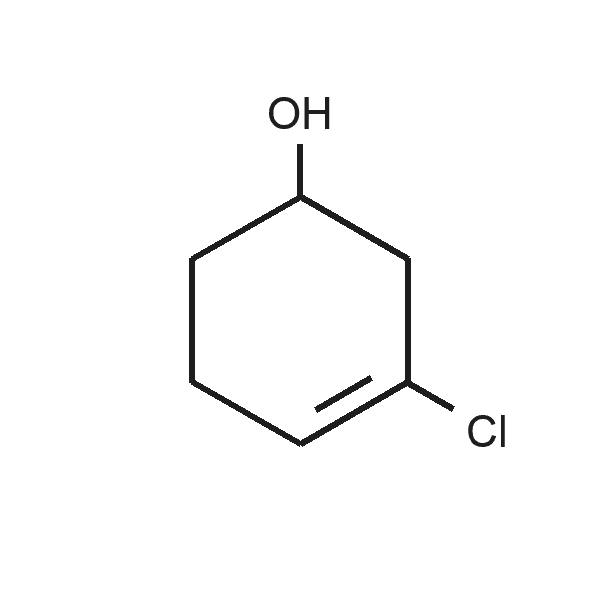
Which one is the correct IUPAC name of the following compound?
Confirming your payment
Sign up now and get 250 free tokens.
Alcohols, Phenols and Ethers · Question 24 of 84
Which one is the correct IUPAC name of the following compound?
(A) 1-chloro-5-hydroxycyclohexane
(B) 2-chloro-4-hydroxycyclohexane
(C) 3-chloro-3-cyclohexenol
(D) 5-hydroxycyclohexenyl chloride
Answer: (C) 3-chloro-3-cyclohexenol
Key idea: In an IUPAC name the principal characteristic group takes the suffix and the lowest possible locant. Here –OH is the principal group (suffix "-ol"), so its carbon is C-1; next the C=C bond gets the lowest locant, and then the substituent –Cl.
Step 1 — Choose the parent.
The six-membered ring contains one C=C bond, so the parent is cyclohexene, and with the –OH group it is named as a cyclohexenol.
Step 2 — Number the ring.
C-1 is the carbon carrying –OH. Numbering towards the chlorine puts Cl on C-3 and the double bond between C-3 and C-4, so the double bond gets locant 3. Numbering the other way puts the double bond between C-4 and C-5 (locant 4) and Cl on C-5, which is higher, so the first direction is correct.
Step 3 — Write the name.
The compound is 3-chloro-3-cyclohexenol, written in current IUPAC style as 3-chlorocyclohex-3-en-1-ol.
Why the other options are wrong:
Note: The book prints this option as "3-chloro-3-cyclohexanol", without the ring double bond; with that wording no option names the compound exactly, and the intended answer is 3-chlorocyclohex-3-en-1-ol.
Therefore, the IUPAC name of the compound is 3-chloro-3-cyclohexenol (3-chlorocyclohex-3-en-1-ol): option (C).