
Opening your dashboard
Class 12 Chemistry Chapter 11 Alcohols, Phenols and Ethers: Previous Year Questions
39 questions on Chapter 11, each solved step by step. Class 12 Chemistry, ICSE 2026-27.
39 questions with solutions
1–5 marks · Mixed difficulty
- 11 mark
Question 1
How can the following conversions be brought about:
Chlorobenzene to phenol
Solve with AIWritten solution
Solution:
Key idea: The C–Cl bond in chlorobenzene is very strong, because the lone pair of chlorine is partly shared with the ring (resonance gives the bond some double-bond character). So the chlorine can be replaced by –OH only under harsh conditions: heating with concentrated aqueous sodium hydroxide at about 623 K and 300 atm. This is Dow's process.
Step 1 — Heat chlorobenzene with sodium hydroxide under pressure.
Chlorobenzene is heated with a concentrated solution of sodium hydroxide at about 623 K and 300 atm. The chlorine is replaced and, because the medium is alkaline, the phenol formed is obtained as sodium phenoxide.
Step 2 — Acidify to free phenol.
Sodium phenoxide is the salt of the weak acid phenol. Adding dilute hydrochloric acid gives back phenol.
Watch out: Chlorobenzene does not give phenol with aqueous NaOH under ordinary conditions, unlike an alkyl chloride; the high temperature and pressure are essential.
Note: Dow's process is now mainly of historical interest; today most phenol is made from cumene (isopropylbenzene), a process that also gives acetone.
Therefore, chlorobenzene is converted to phenol by heating it with sodium hydroxide at about 623 K and 300 atm (Dow's process) and then acidifying the sodium phenoxide formed with dilute HCl.
- 21 mark
Question 2
How can the following conversions be brought about:
Diethyl ether to ethanol
Solve with AIWritten solution
Solution:
Key idea: Ethers are generally unreactive, but the C–O–C link is broken (hydrolysed) when an ether is heated with dilute sulphuric acid under pressure. A symmetrical ether such as diethyl ether gives two molecules of the same alcohol.
Step 1 — Choose the reaction.
Diethyl ether, , has two ethyl groups on the oxygen. Breaking the ether link with water puts an –OH on each ethyl group, so both halves become ethanol.
Step 2 — Write the equation.
Diethyl ether is boiled with dilute sulphuric acid under pressure.
Therefore, diethyl ether is converted to ethanol by heating it with dilute sulphuric acid under pressure, which hydrolyses one molecule of the ether into two molecules of ethanol.
- 31 mark
Question 3
Glycerol (propane 1, 2, 3 triol) is more viscous than ethylene glycol (ethane 1, 2, diol). Explain.
Solve with AIWritten solution
Solution:
Key idea: Viscosity (resistance to flow) of a liquid rises with the strength of the forces between its molecules. In alcohols the main force is hydrogen bonding through the –OH groups, so more –OH groups per molecule means a more viscous liquid.
Step 1 — Count the –OH groups.
Glycerol, , has three –OH groups in each molecule. Ethylene glycol, , has only two.
Step 2 — Relate the –OH groups to hydrogen bonding.
Each –OH group can form hydrogen bonds with neighbouring molecules. With three –OH groups, each glycerol molecule is held by more hydrogen bonds, which link the molecules into a more extensive three-dimensional network. Glycerol is also a larger molecule.
Step 3 — Relate hydrogen bonding to viscosity.
For the liquid to flow, molecules must slide past one another, which means breaking and re-forming these hydrogen bonds. The more extensive network in glycerol resists this more strongly, so glycerol flows less easily.
Therefore, glycerol is more viscous than ethylene glycol because its three –OH groups per molecule form more extensive intermolecular hydrogen bonding than the two –OH groups of ethylene glycol.
- 44 marks
Question 4
(i) Write the structure of three ethers with molecular formula .
(ii) Starting with Grignard's reagent, how will you prepare propanoic acid?
Solve with AIWritten solution
Solution:
Key idea: An ether has the general formula R–O–R′. For the four carbon atoms must be shared between the two groups on the oxygen, either 1 + 3 or 2 + 2. A carboxylic acid is made from a Grignard reagent by adding carbon dioxide (one carbon more), then hydrolysing.
Step 1 — Part (i): list the ways to share four carbons.
The groups on the two sides of the oxygen can be methyl and a three-carbon group, or ethyl and ethyl. A three-carbon group can be straight (n-propyl) or branched (isopropyl). So there are exactly three ethers.
Step 2 — Part (i): write the three structures.
The three ethers are:
-
, 1-methoxypropane (methyl n-propyl ether)
-
, 2-methoxypropane (methyl isopropyl ether)
-
, ethoxyethane (diethyl ether)
Each has 4 C, 10 H and 1 O, so each fits .
Step 3 — Part (ii): choose the Grignard reagent.
Propanoic acid, , has three carbon atoms. Carbon dioxide supplies the –COOH carbon, so the Grignard reagent must carry a two-carbon group: ethylmagnesium bromide, . It is made from ethyl bromide and magnesium in dry ether.
Step 4 — Part (ii): add carbon dioxide.
The ethyl group of the Grignard reagent attacks the carbon of carbon dioxide (dry ice), giving a magnesium salt of the acid.
Step 5 — Part (ii): hydrolyse the adduct.
Hydrolysis with dilute acid releases propanoic acid.
Therefore, (i) the three ethers of formula C₄H₁₀O are CH₃–O–CH₂CH₂CH₃ (1-methoxypropane), CH₃–O–CH(CH₃)₂ (2-methoxypropane) and C₂H₅–O–C₂H₅ (ethoxyethane), and (ii) propanoic acid is prepared by treating ethylmagnesium bromide with carbon dioxide (dry ice) and hydrolysing the product with dilute acid.
-
- 51 mark
Question 5
Answer the following questions:
What are the products formed when phenol and nitrobenzene are treated separately with a mixture of concentrated sulphuric acid and concentrated nitric acid?
Solve with AIWritten solution
Solution:
Key idea: A mixture of concentrated nitric and sulphuric acids (nitrating mixture) supplies the nitronium ion, , which attacks the benzene ring. The –OH group of phenol strongly activates the ring and directs to the ortho and para positions, while the –NO₂ group of nitrobenzene deactivates the ring and directs to the meta position.
Step 1 — Nitrate phenol.
Because –OH activates the ring so strongly, all three ortho and para positions (2, 4 and 6) are nitrated, giving 2,4,6-trinitrophenol, called picric acid.
Step 2 — Nitrate nitrobenzene.
The –NO₂ group already present makes the ring less reactive, so further nitration needs heating, and only one more nitro group enters, at the meta position. The product is m-dinitrobenzene (1,3-dinitrobenzene).
Note: Concentrated nitric acid also oxidises part of the phenol, so in practice picric acid is made in better yield by first sulphonating phenol and then nitrating it.
Therefore, phenol gives 2,4,6-trinitrophenol (picric acid) and nitrobenzene gives m-dinitrobenzene with the nitrating mixture.
- 61 mark
Question 6
How can the following conversions be brought about:
Acetaldehyde to propan-2-ol.
Solve with AIWritten solution
Solution:
Key idea: A Grignard reagent adds to the C=O group of an aldehyde. After hydrolysis, an aldehyde other than formaldehyde gives a secondary alcohol whose carbon count is the sum of the two parts.
Step 1 — Plan the route.
Propan-2-ol, , has three carbon atoms with the –OH on the middle one. Acetaldehyde, , has two, so one more carbon (a methyl group) must be joined to its carbonyl carbon. Methylmagnesium bromide, , does this.
Step 2 — Add the Grignard reagent.
The methyl group of attacks the carbonyl carbon of acetaldehyde in dry ether, giving an addition product (a magnesium alkoxide).
Step 3 — Hydrolyse the addition product.
Dilute acid hydrolyses the addition product to propan-2-ol.
Therefore, acetaldehyde is converted to propan-2-ol by treating it with methylmagnesium bromide in dry ether and then hydrolysing the addition product with dilute acid.
- 71 mark
Question 7
Why do alcohols possess higher boiling points as compared to those of corresponding alkanes?
Solve with AIWritten solution
Solution:
Key idea: The boiling point of a liquid depends on how strongly its molecules attract one another. Alcohols contain an –OH group, which forms hydrogen bonds; alkanes have only weak van der Waals forces.
Step 1 — Identify the forces in alcohols.
In an alcohol, the O–H bond is strongly polar. The hydrogen of one molecule is attracted to the lone pair on the oxygen of a neighbouring molecule, so the molecules are linked by intermolecular hydrogen bonds.
Step 2 — Identify the forces in alkanes.
Alkanes contain only C–C and C–H bonds, which are almost non-polar. Their molecules are held only by weak van der Waals (dispersion) forces.
Step 3 — Compare the energy needed to boil.
To boil an alcohol, the hydrogen bonds must be broken as well as the van der Waals forces, which needs much more energy. For example, ethanol (molar mass 46 g mol⁻¹) boils at about 78 °C, while propane (molar mass 44 g mol⁻¹) boils at about −42 °C.
Therefore, alcohols have higher boiling points than the corresponding alkanes because their molecules are associated by intermolecular hydrogen bonding through the –OH group, which needs extra energy to break.
- 83 marks
Question 8
Give balanced equations for the following name reactions:
(i) Friedel-Crafts reaction (alkylation)
(ii) Williamson's synthesis
(iii) Aldol condensation
Solve with AIWritten solution
Solution:
Key idea: A name reaction is best shown with one simple, balanced example. Friedel–Crafts alkylation joins an alkyl group to a benzene ring, Williamson's synthesis makes an ether from an alkyl halide and an alkoxide, and aldol condensation joins two aldehyde molecules that carry an α-hydrogen.
Step 1 — Part (i): Friedel–Crafts alkylation.
Benzene reacts with an alkyl halide in the presence of anhydrous aluminium chloride, which helps form the attacking carbocation. With methyl chloride, toluene is formed.
Step 2 — Part (ii): Williamson's synthesis.
An alkyl halide is heated with a sodium alkoxide; the alkoxide ion replaces the halogen (an reaction) and an ether forms. Sodium ethoxide and methyl iodide give ethyl methyl ether (methoxyethane).
A primary alkyl halide is used, because a tertiary one would mainly give an alkene by elimination.
Step 3 — Part (iii): aldol condensation.
Two molecules of an aldehyde with an α-hydrogen combine in the presence of dilute alkali to give a β-hydroxy aldehyde (an aldol). Acetaldehyde gives 3-hydroxybutanal.
On warming, the aldol loses water to give but-2-enal, .
Therefore, (i) benzene and methyl chloride with anhydrous AlCl₃ give toluene, (ii) sodium ethoxide and methyl iodide give methoxyethane, and (iii) acetaldehyde with dilute NaOH gives 3-hydroxybutanal (aldol).
- 93 marks
Question 9
Give the chemical test to distinguish:
(i) Ethyl alcohol and sec-propyl alcohol
(ii) Acetaldehyde and acetic acid
Solve with AIWritten solution
Solution:
Key idea: A distinguishing test must give a clear, visible result with one compound and not with the other. The Lucas test separates primary, secondary and tertiary alcohols by the speed of turbidity; sodium hydrogencarbonate gives effervescence only with a carboxylic acid.
Step 1 — Part (i): choose a test that works.
Ethyl alcohol is a primary alcohol and sec-propyl alcohol (propan-2-ol) is a secondary alcohol. Both contain the group, so both give the iodoform test; that test cannot tell them apart. The Lucas test can.
Step 2 — Part (i): the Lucas test.
Each alcohol is shaken with Lucas reagent (anhydrous zinc chloride in concentrated HCl) at room temperature. Propan-2-ol forms an insoluble alkyl chloride, so the solution turns cloudy (turbid) within about five minutes.
Ethyl alcohol, being primary, gives no turbidity at room temperature.
Step 3 — Part (ii): the sodium hydrogencarbonate test.
Each compound is added to sodium hydrogencarbonate solution. Acetic acid is a carboxylic acid, strong enough to release carbon dioxide, so brisk effervescence is seen.
Acetaldehyde is not acidic, so there is no effervescence. (Acetaldehyde also gives a silver mirror with Tollens' reagent, which acetic acid does not.)
Watch out: In part (i), do not use the iodoform test: ethanol and propan-2-ol both give the yellow iodoform precipitate.
Therefore, (i) propan-2-ol turns Lucas reagent turbid within about five minutes while ethyl alcohol does not, and (ii) acetic acid gives brisk effervescence of CO₂ with sodium hydrogencarbonate while acetaldehyde does not.
- 103 marks
Question 10
Answer the following:
(i) What is the common name of the polymer obtained by the polymerisation of caprolactam? Is it addition polymer or condensation polymer?
(ii) Name the two organic compounds which have the same molecular formula . Will they react with ? If they react, what are the products formed?
Solve with AIWritten solution
Solution:
Key idea: Caprolactam is a cyclic amide; on heating with a little water its ring opens and the units join by amide (–CO–NH–) links. Two compounds with the same molecular formula but different structures are isomers; can be an alcohol or an ether, and both react with phosphorus pentachloride in different ways.
Step 1 — Part (i): name the polymer.
Caprolactam has six carbon atoms in its ring. Heating it with a little water opens the ring to 6-aminohexanoic acid units, which join through amide links. The polymer is nylon-6.
Step 2 — Part (i): classify the polymer.
Nylon-6 is classed as a condensation polymer (a polyamide), because its repeating units are joined by amide links of the kind that form when an –NH₂ group condenses with a –COOH group.
Note: Much of the chain growth from caprolactam is actually ring opening, with no small molecule lost, so some books call it a ring-opening polymerisation; it is still grouped with the condensation polyamides.
Step 3 — Part (ii): name the two compounds.
The formula fits ethanol (ethyl alcohol), , and dimethyl ether (methoxymethane), . They are functional isomers.
Step 4 — Part (ii): reaction of ethanol with PCl₅.
Yes, both react. Ethanol reacts readily at room temperature; its –OH group is replaced by –Cl, and steamy fumes of HCl are given off.
The products are ethyl chloride (chloroethane), phosphorus oxychloride and hydrogen chloride.
Step 5 — Part (ii): reaction of dimethyl ether with PCl₅.
Dimethyl ether has no –OH group, so it gives no HCl. On heating, PCl₅ breaks the C–O–C link and each methyl group becomes methyl chloride.
The products are methyl chloride (chloromethane) and phosphorus oxychloride.
Therefore, (i) caprolactam gives nylon-6, a condensation polymer, and (ii) the two compounds are ethanol and dimethyl ether; both react with PCl₅, ethanol giving C₂H₅Cl, POCl₃ and HCl, and dimethyl ether (on heating) giving CH₃Cl and POCl₃.
- 111 mark
Question 11
Fill in the blanks by choosing the appropriate word/words from those given in the brackets:
(square pyramidal, electrical, 74; 26, , , chemical, 68, 32, tetrahedral, yellow, white, iodoform, Lucas)
Propan-2-ol on reaction with iodine and sodium hydroxide gives ______ precipitate and the reaction is called ______ test.
Solve with AIWritten solution
Solution:
Key idea: Compounds that contain the group or give the iodoform test: with iodine and sodium hydroxide they form iodoform, , a yellow solid with a typical smell.
Step 1 — Check the structure of propan-2-ol.
Propan-2-ol is . It contains the group, so it gives the test.
Step 2 — Write the reaction.
Iodine first oxidises propan-2-ol to acetone, which is then iodinated and split by the alkali.
Step 3 — Fill the blanks.
Iodoform separates as a yellow precipitate, and the test is named after this product: the iodoform test.
Therefore, propan-2-ol on reaction with iodine and sodium hydroxide gives yellow precipitate and the reaction is called iodoform test.
- 121 mark
Question 12
Complete the following statements by selecting the correct alternative from the choices given:
In the dehydration of alcohols to alkenes by heating with concentrated sulphuric acid, the initiation step is:
Solve with AIAnswer
(A) formation of carbocation
(B) formation of an ester
- Correct
(C) protonation of alcohol molecule
(D) elimination of water
Answer: (C) protonation of alcohol molecule
Key idea: The –OH group is a poor leaving group (hydroxide ion is a strong base). Concentrated sulphuric acid first gives a proton to the oxygen of the alcohol, turning –OH into –OH₂⁺, which can leave as a neutral water molecule.
Step 1 — Write the first step.
The alcohol accepts a proton from the acid on the lone pair of its oxygen. For ethanol, (a protonated alcohol, an oxonium ion).
Step 2 — Follow the later steps.
In the second step the protonated alcohol loses a water molecule to form a carbocation. In the third step a proton is lost from the carbon next to the positive carbon, giving the alkene and regenerating the acid catalyst.
Step 3 — Pick the initiation step.
The step that starts the whole sequence is the first one, protonation of the alcohol molecule.
Why the others are wrong:
- (A) The carbocation forms only in the second step, after the protonated alcohol loses water; it cannot form directly from the neutral alcohol.
- (B) An ester (ethyl hydrogen sulphate) can form from ethanol and sulphuric acid as a side product, but its formation is not the first step of the dehydration mechanism.
- (D) Water leaves in the second step, and only from the protonated alcohol; the neutral –OH group would have to leave as hydroxide ion, which does not happen.
Note: For a primary alcohol such as ethanol the loss of water and of the proton happen together in one step, but this still begins with protonation of the alcohol.
Therefore, the initiation step in the acid-catalysed dehydration of an alcohol is protonation of the alcohol molecule, option (C).
- 132 marks
Question 13
How will you obtain the following? (Give balanced equation.)
(i) Picric acid from phenol
(ii) Ethyl chloride from diethyl ether.
Solve with AIWritten solution
Solution:
Key idea: Picric acid is 2,4,6-trinitrophenol, made by nitrating phenol. Ethers are split by phosphorus pentachloride on heating, each alkyl group becoming an alkyl chloride.
Step 1 — Part (i): sulphonate phenol.
Direct nitration of phenol with concentrated nitric acid oxidises much of it, so phenol is first heated with concentrated sulphuric acid to give phenol-2,4-disulphonic acid.
Step 2 — Part (i): nitrate the disulphonic acid.
Heating with concentrated nitric acid replaces both –SO₃H groups by –NO₂ groups and adds a third –NO₂ group, giving 2,4,6-trinitrophenol (picric acid).
Overall, phenol is nitrated at positions 2, 4 and 6.
Step 3 — Part (ii): heat diethyl ether with PCl₅.
Phosphorus pentachloride breaks the C–O–C link on heating. Each ethyl group takes a chlorine atom, and the oxygen goes into phosphorus oxychloride.
Therefore, (i) picric acid is obtained by sulphonating phenol with concentrated H₂SO₄ and then nitrating with concentrated HNO₃, and (ii) ethyl chloride is obtained by heating diethyl ether with phosphorus pentachloride.
- 142 marks
Question 14
How will you obtain the following? (Give balanced equation.)
(i) Anisole from phenol
(ii) Ethyl acetate from ethanol.
Solve with AIWritten solution
Solution:
Key idea: Anisole (methoxybenzene) is an aryl alkyl ether, made by Williamson's synthesis from sodium phenoxide and a methyl halide. Ethyl acetate is an ester, made by heating ethanol with acetic acid and a little concentrated sulphuric acid (esterification).
Step 1 — Part (i): make sodium phenoxide.
Phenol is acidic enough to react with sodium hydroxide, forming sodium phenoxide.
Step 2 — Part (i): Williamson's synthesis.
The phenoxide ion replaces the iodine of methyl iodide, giving anisole.
Step 3 — Part (ii): esterification.
Ethanol is heated with acetic acid in the presence of a little concentrated sulphuric acid, which acts as a catalyst and absorbs the water formed. The reaction is reversible.
Therefore, (i) anisole is obtained by converting phenol into sodium phenoxide and heating it with methyl iodide, and (ii) ethyl acetate is obtained by heating ethanol with acetic acid and a little concentrated sulphuric acid.
- 151 mark
Question 15
Fill in the blanks by choosing the appropriate words from those given in the brackets.
(More than, primary, cathode, Lucas, regent, two, four, less than, Grignard's reagent, tertiary, anode, zero, equal to, three)
A mixture of conc. HCl and anhydrous is called ______ which shows maximum reactivity with ______ alcohol.
Solve with AIWritten solution
Solution:
Key idea: Alcohols react with HCl in the presence of anhydrous to form alkyl chlorides, which are insoluble and make the mixture cloudy. The reaction goes through a carbocation, so it is fastest for alcohols that give the most stable carbocation.
Step 1 — Name the mixture.
A solution of anhydrous zinc chloride in concentrated hydrochloric acid is called Lucas reagent.
Step 2 — Decide which alcohol reacts fastest.
A tertiary carbocation is the most stable, because three alkyl groups push electrons towards the positive carbon. So a tertiary alcohol reacts at once and the solution turns turbid immediately; a secondary alcohol takes about five minutes, and a primary alcohol gives no turbidity at room temperature.
Therefore, a mixture of conc. HCl and anhydrous ZnCl₂ is called Lucas reagent which shows maximum reactivity with tertiary alcohol.
- 162 marks
Question 16
How will you obtain the following (give balanced chemical equations)?
(i) Benzene from phenol.
(ii) Iodoform from ethanol.
Solve with AIWritten solution
Solution:
Key idea: (i) Heating phenol with zinc dust removes its –OH group: zinc takes the oxygen and becomes zinc oxide. (ii) Ethanol contains the group , so it gives the iodoform reaction. Iodine in alkali first oxidises ethanol to acetaldehyde, which is then tri-iodinated at the methyl group and split by the alkali into iodoform and a formate.
Step 1 — (i) State the conditions.
Phenol is distilled with zinc dust, or its vapour is passed over heated zinc dust.
Step 2 — (i) Write the equation.
Zinc removes the oxygen atom of the –OH group, and the hydrogen stays on the ring.
Step 3 — (ii) State the conditions.
Ethanol is warmed with iodine and sodium hydroxide solution (or with sodium hypoiodite).
Step 4 — (ii) Write the overall equation.
Four molecules of iodine are used: one oxidises ethanol to acetaldehyde and three replace the hydrogens of the methyl group.
Step 5 — (ii) Observe the product.
Iodoform, , separates as a yellow solid with a characteristic smell.
Therefore, (i) benzene is obtained by heating phenol with zinc dust, and (ii) iodoform is obtained by warming ethanol with iodine and sodium hydroxide solution, which gives yellow CHI₃ together with sodium formate and sodium iodide.
- 172 marks
Question 17
How will you obtain the following? (give balanced chemical equations)?
(i) Salicylaldehyde from phenol.
(ii) Propan-2-ol from Grignard's reagent
Solve with AIWritten solution
Solution:
Key idea: Salicylaldehyde (2-hydroxybenzaldehyde) is made by the Reimer–Tiemann reaction, in which phenol is heated with chloroform and sodium hydroxide and a –CHO group enters the ortho position. A secondary alcohol such as propan-2-ol is made from a Grignard reagent and an aldehyde other than formaldehyde.
Step 1 — Part (i): the Reimer–Tiemann reaction.
Phenol is heated with chloroform and aqueous sodium hydroxide at about 340 K. Dichlorocarbene, formed from chloroform and alkali, attacks the ring at the ortho position, and the intermediate is hydrolysed to give the sodium salt of salicylaldehyde.
Step 2 — Part (i): acidify.
Dilute hydrochloric acid frees salicylaldehyde from its sodium salt.
Step 3 — Part (ii): add the Grignard reagent to acetaldehyde.
Methylmagnesium bromide adds to the carbonyl group of acetaldehyde in dry ether.
Step 4 — Part (ii): hydrolyse.
Dilute acid hydrolyses the addition product to propan-2-ol.
Therefore, (i) salicylaldehyde is obtained from phenol by the Reimer–Tiemann reaction (CHCl₃ and NaOH, then acid), and (ii) propan-2-ol is obtained by adding methylmagnesium bromide to acetaldehyde and hydrolysing the product.
- 181 mark
Question 18
Select the correct alternative from the choices given:
When acetone is treated with Grignard's reagent, followed by hydrolysis, the product formed is:
Solve with AIAnswer
(A) Secondary alcohol
- Correct
(B) Tertiary alcohol
(C) Primary alcohol
(D) Aldehyde
Answer: (B) Tertiary alcohol
Key idea: A Grignard reagent, R–MgX, adds its alkyl group to the carbon of a C=O group; hydrolysis then turns the O–MgX into O–H. The class of alcohol formed depends on how many alkyl groups end up on the carbinol carbon (the carbon carrying –OH).
Step 1 — Look at the carbonyl carbon of acetone.
Acetone, , is a ketone: its carbonyl carbon already carries two methyl groups.
Step 2 — Add the Grignard reagent and hydrolyse.
The R group of the Grignard reagent becomes the third group on that carbon. With methylmagnesium bromide:
Step 3 — Classify the alcohol.
The carbinol carbon of (2-methylpropan-2-ol) is joined to three carbon atoms, so the product is a tertiary alcohol. Any ketone gives a tertiary alcohol in this way.
Why the others are wrong:
- (A) A secondary alcohol is formed when the Grignard reagent adds to an aldehyde other than formaldehyde, whose carbonyl carbon carries only one alkyl group. The carbonyl carbon of acetone already carries two, so after the addition it carries three and cannot be secondary.
- (C) Among aldehydes and ketones, only formaldehyde, HCHO, gives a primary alcohol, because its carbonyl carbon carries no alkyl group. Acetone is a ketone, so it cannot give a primary alcohol.
- (D) The Grignard reagent adds to the C=O group and hydrolysis gives an –OH group, so the product is an alcohol, not an aldehyde.
Therefore, acetone with a Grignard reagent followed by hydrolysis gives a tertiary alcohol, option (B).
- 195 marks
Question 19
(i) Give balanced chemical equations for the following reactions:
(1) Phenol is treated with ice cold alkaline solution of benzene diazonium chloride.
(2) Diethyl ether is treated with phosphorus pentachloride.
(3) Ethyl alcohol is treated with thionyl chloride.
(ii) Give one chemical test each to distinguish between the following pairs of compounds:
(1) Ethanol and dimethyl ether
(2) Propan-1-ol and propan-2-ol
Solve with AIWritten solution
Solution:
Key idea: Part (i) uses three reactions of the –OH group and the ether link: phenol couples with a diazonium salt at its para position, PCl₅ splits an ether, and thionyl chloride replaces the –OH of an alcohol by –Cl. Part (ii) needs tests that give a visible result with only one compound of each pair.
Step 1 — Part (i)(1): coupling of phenol with benzene diazonium chloride.
In ice-cold alkaline solution, the benzene diazonium ion attacks the activated ring of phenol at the para position. An orange dye, p-hydroxyazobenzene (4-hydroxyazobenzene), is formed.
Step 2 — Part (i)(2): diethyl ether with phosphorus pentachloride.
On heating, PCl₅ breaks the C–O–C link, giving two molecules of ethyl chloride.
Step 3 — Part (i)(3): ethyl alcohol with thionyl chloride.
Thionyl chloride replaces the –OH group by –Cl. Both by-products are gases, so pure ethyl chloride is left.
Step 4 — Part (ii)(1): ethanol and dimethyl ether.
A small piece of sodium metal is added to each dry liquid. Ethanol has an O–H bond, so it reacts and bubbles of hydrogen gas are given off.
Dimethyl ether has no –OH group, so no gas is given off.
Step 5 — Part (ii)(2): propan-1-ol and propan-2-ol.
Each alcohol is warmed with iodine and sodium hydroxide solution (iodoform test). Propan-2-ol contains the group, so it gives a yellow precipitate of iodoform.
Propan-1-ol, , does not contain this group, so no yellow precipitate forms. (The Lucas test also works: propan-2-ol gives turbidity within about five minutes, propan-1-ol none at room temperature.)
Therefore, (i) phenol couples with benzene diazonium chloride to give orange p-hydroxyazobenzene, diethyl ether with PCl₅ gives ethyl chloride and POCl₃, and ethyl alcohol with SOCl₂ gives ethyl chloride, SO₂ and HCl, and (ii) ethanol (not dimethyl ether) gives hydrogen gas with sodium, and propan-2-ol (not propan-1-ol) gives a yellow iodoform precipitate.
- 205 marks
Question 20
(i) Write chemical equations to illustrate the following name reactions:
(1) Williamson's synthesis
(2) Esterification reaction
(3) Reimer-Tiemann reaction
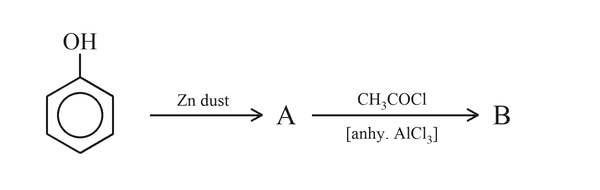
(ii) Identify the compounds A and B in the given reactions:
(1)
(2)
 Solve with AI
Written solution
Solution:
Key idea: Williamson's synthesis makes ethers from an alkoxide and an alkyl halide; esterification joins an alcohol and a carboxylic acid; the Reimer–Tiemann reaction puts a –CHO group ortho to the –OH of phenol. In part (ii) each arrow is a known reaction, so we follow the chains one step at a time.
Step 1 — Part (i)(1): Williamson's synthesis.
Sodium ethoxide is heated with ethyl bromide; the ethoxide ion replaces the bromine and diethyl ether forms.
Step 2 — Part (i)(2): esterification.
Ethanol is heated with acetic acid and a little concentrated sulphuric acid; ethyl acetate and water form in a reversible reaction.
Step 3 — Part (i)(3): Reimer–Tiemann reaction.
Phenol is heated with chloroform and sodium hydroxide at about 340 K, and the product is acidified, giving salicylaldehyde.
Step 4 — Part (ii)(1): identify A.
Vapours of ethanol passed over hot copper (about 573 K) lose hydrogen; a primary alcohol is dehydrogenated to an aldehyde. So A is acetaldehyde (ethanal).
Step 5 — Part (ii)(1): identify B.
Acetaldehyde has α-hydrogens, so with dilute sodium hydroxide two molecules combine by aldol condensation. B is 3-hydroxybutanal (aldol).
Step 6 — Part (ii)(2): identify A.
When phenol is distilled with zinc dust, the zinc removes the oxygen of the –OH group, leaving benzene. So A is benzene.
Step 7 — Part (ii)(2): identify B.
Benzene reacts with acetyl chloride in the presence of anhydrous aluminium chloride (Friedel–Crafts acylation). An acetyl group replaces a ring hydrogen, so B is acetophenone (methyl phenyl ketone).
Therefore, (i) the equations above illustrate Williamson's synthesis, esterification and the Reimer–Tiemann reaction, and (ii) in (1) A is acetaldehyde (CH₃CHO) and B is 3-hydroxybutanal (CH₃CH(OH)CH₂CHO), and in (2) A is benzene (C₆H₆) and B is acetophenone (C₆H₅COCH₃).
- 211 mark
Question 21
Fill in the blanks by choosing the appropriate word(s) from those given in the brackets:
[stable, low, aldehyde, unstable, 6, 4, ethane, Clemmensen's, 2, 3, carboxylic acid, high, propane, Rosenmund's]
The primary alcohols are easily oxidized first into ______ and then into ________.
Solve with AIWritten solution
Solution:
Key idea: Oxidation of a primary alcohol, , removes hydrogen from the carbinol carbon in two stages: first to an aldehyde, then, by adding oxygen, to a carboxylic acid with the same number of carbon atoms.
Step 1 — Fill the first blank.
A primary alcohol is first oxidised (for example by acidified potassium dichromate) to an aldehyde. Ethanol gives acetaldehyde.
Step 2 — Fill the second blank.
The aldehyde is oxidised further to a carboxylic acid. Acetaldehyde gives acetic acid.
Therefore, the primary alcohols are easily oxidized first into aldehyde and then into carboxylic acid.
- 222 marks
Question 22
How will the following be obtained? (Give chemical equation)
a) Ethanol from Grignard's reagent.
b) Diethyl ether from sodium ethoxide.
Solve with AIWritten solution
Solution:
Key idea: A Grignard reagent adds to formaldehyde to give a primary alcohol with one carbon more than the Grignard reagent's alkyl group. Williamson's synthesis makes an ether from a sodium alkoxide and an alkyl halide.
Step 1 — Part a): choose the reagents.
Ethanol, , is a primary alcohol with two carbon atoms. Formaldehyde supplies the carbon, so the Grignard reagent must carry a methyl group: methylmagnesium bromide.
Step 2 — Part a): add and hydrolyse.
Methylmagnesium bromide adds to formaldehyde in dry ether, and the addition product is hydrolysed with dilute acid.
Step 3 — Part b): Williamson's synthesis.
Sodium ethoxide is heated with ethyl bromide. The ethoxide ion replaces the bromine atom (), giving diethyl ether.
Therefore, a) ethanol is obtained by adding methylmagnesium bromide to formaldehyde and hydrolysing the product, and b) diethyl ether is obtained by heating sodium ethoxide with ethyl bromide (Williamson's synthesis).
- 232 marks
Question 23
An organic compound [A] , on heating with conc. at 413 K gives a neutral compound [B] . Compound [B] on treatment with gives a product, which on subsequent treatment with KCN yields compound [C] . [A]. [B] [C] and [D] on hydrolysis gives an acid [D] . Identify the compounds [A], [B], [C] and [D].
Solve with AIWritten solution
Solution:
Key idea: Each clue fixes one compound: the formula with conc. H₂SO₄ at 413 K points to an alcohol forming an ether; PCl₅ splits an ether into alkyl chlorides; KCN turns an alkyl chloride into a nitrile with one carbon more; and a nitrile is hydrolysed to a carboxylic acid.
Note: The paper's sentence "[A]. [B] [C] and [D] on hydrolysis gives an acid [D]" is garbled; we read it as "[C] on hydrolysis gives an acid [D]", the only reading that fits the formulae.
Step 1 — Identify A and B.
Compound A, , heated with concentrated sulphuric acid at 413 K gives a neutral compound with formula , made of two units minus water. This is how ethanol gives diethyl ether. So A is ethanol and B is diethyl ether (ethoxyethane).
Step 2 — Treat B with PCl₅.
Phosphorus pentachloride splits the ether into ethyl chloride.
Step 3 — Identify C.
Ethyl chloride heated with alcoholic potassium cyanide gives ethyl cyanide (propanenitrile), , which has the formula . So C is propanenitrile.
Step 4 — Identify D.
Acid hydrolysis converts the –CN group into –COOH, giving propanoic acid, , formula . So D is propanoic acid.
Step 5 — Check every formula.
Ethanol is , diethyl ether is , propanenitrile is and propanoic acid is , matching all four formulae in the question.
Therefore, A is ethanol (C₂H₅OH), B is diethyl ether (C₂H₅OC₂H₅), C is propanenitrile (C₂H₅CN) and D is propanoic acid (C₂H₅COOH).
- 243 marks
Question 24
Account for the following:
(i) Phenol is a stronger acid than aliphatic alcohols.
(ii) Ethanol gives iodoform reaction whereas methanol does not give iodoform reaction.
(iii) Ethers should not be distilled to dryness.
Solve with AIWritten solution
Solution:
Key idea: The acidity of an –OH compound depends on how stable its anion is; the iodoform reaction needs a or group; and ethers slowly form explosive peroxides when they stand in air and light.
Step 1 — Part (i): compare the anions.
When phenol loses a proton, the negative charge on the phenoxide ion, , is spread over the ring (to the ortho and para carbons) by resonance. This delocalisation stabilises the phenoxide ion. In an alkoxide ion, such as , the charge stays on the oxygen, and the alkyl group pushes more electron density towards it, which destabilises the ion further.
Step 2 — Part (i): link stability to acidity.
The more stable the anion, the more easily the proton is lost. Phenol (pKa about 10) therefore ionises far more than ethanol (pKa about 16), and phenol even reacts with aqueous NaOH, which aliphatic alcohols do not.
Step 3 — Part (ii): check the structures.
The iodoform reaction is given by compounds containing , which iodine first oxidises to . Ethanol, , contains this group (its R group is H). Methanol, , has no carbon next to the carbinol carbon, so it cannot form a group.
Step 4 — Part (ii): write the reaction for ethanol.
Iodine in sodium hydroxide converts ethanol into iodoform and sodium formate.
Methanol gives no yellow iodoform precipitate.
Step 5 — Part (iii): explain the danger.
On standing in air and light, ethers react slowly with oxygen to form ether peroxides. These are less volatile than the ether, so during distillation they collect in the residue in the flask. If the ether is distilled to dryness, the concentrated peroxides can explode on heating.
Therefore, (i) phenol is more acidic because the phenoxide ion is stabilised by resonance while the alkoxide ion is not, (ii) ethanol has the CH₃CH(OH)– group needed for the iodoform reaction while methanol does not, and (iii) ethers are not distilled to dryness because peroxides formed in air concentrate in the residue and may explode.
- 251 mark
Question 25
Fill in the blanks by choosing the appropriate words(s) from those given below in the options:
- lead poisoning
- zero
- phosgene
- dependent
- cancer
- independent
- diethyl ether
- first
- ethyl carbonate
- ethene
The dehydration of ethyl alcohol with conc. at mainly yields ______ while at the main product formed is ______.
Solve with AIWritten solution
Solution:
Key idea: Ethanol heated with concentrated sulphuric acid can lose water in two ways. At the lower temperature, two molecules lose one water molecule between them (intermolecular dehydration, giving an ether); at the higher temperature, each molecule loses water by itself (intramolecular dehydration, giving an alkene).
Step 1 — Fill the first blank (140 °C, 413 K).
With excess ethanol at 140 °C, the main product is diethyl ether.
Step 2 — Fill the second blank (170 °C, 443 K).
With excess acid at 170 °C, each ethanol molecule loses water and the main product is ethene.
Therefore, the dehydration of ethyl alcohol with conc. H₂SO₄ at 140 °C mainly yields diethyl ether while at 170 °C the main product formed is ethene.
- 262 marks
Question 26
(a) Write a chemical test to distinguish between ethanol and phenol.
(b) Give a chemical reaction to convert acetaldehyde into secondary propyl alcohol.
Solve with AIWritten solution
Solution:
Key idea: Phenol differs from ethanol because its –OH group is joined to a benzene ring; such enols give a coloured complex with neutral iron(III) chloride. A secondary alcohol is made by adding a Grignard reagent to an aldehyde other than formaldehyde.
Step 1 — Part (a): the neutral ferric chloride test.
A few drops of neutral iron(III) chloride solution are added to each compound. Phenol gives a violet colour, because it forms a coloured iron(III) phenoxide complex. Ethanol gives no such colour.
Step 2 — Part (a): a second check.
Bromine water confirms the result: phenol decolourises it at once and gives a white precipitate of 2,4,6-tribromophenol, while ethanol does not.
Step 3 — Part (b): add methylmagnesium bromide to acetaldehyde.
Secondary propyl alcohol is propan-2-ol, . Acetaldehyde supplies two carbons, and methylmagnesium bromide adds the third to the carbonyl carbon.
Step 4 — Part (b): hydrolyse.
Dilute acid hydrolyses the addition product to propan-2-ol.
Therefore, (a) phenol gives a violet colour with neutral FeCl₃ solution while ethanol does not, and (b) acetaldehyde is converted to secondary propyl alcohol by adding methylmagnesium bromide and hydrolysing the product.
- 272 marks
Question 27
Convert the following by giving chemical equations for each.
(a) Ethyl bromide to diethyl ether.
(b) Phenol to salicylaldehyde.
Solve with AIWritten solution
Solution:
Key idea: An ether is made from an alkyl halide by Williamson's synthesis (with a sodium alkoxide). Salicylaldehyde is made from phenol by the Reimer–Tiemann reaction (chloroform and sodium hydroxide).
Step 1 — Part (a): Williamson's synthesis.
Ethyl bromide is heated with sodium ethoxide. The ethoxide ion replaces the bromine atom by an reaction, giving diethyl ether.
Heating ethyl bromide with dry silver oxide also gives diethyl ether.
Step 2 — Part (b): Reimer–Tiemann reaction.
Phenol is heated with chloroform and aqueous sodium hydroxide at about 340 K. A –CHO group enters ortho to the –OH group, and the sodium salt of salicylaldehyde forms.
Step 3 — Part (b): acidify.
Dilute hydrochloric acid releases salicylaldehyde (2-hydroxybenzaldehyde).
Therefore, (a) ethyl bromide gives diethyl ether when heated with sodium ethoxide (Williamson's synthesis), and (b) phenol gives salicylaldehyde by the Reimer–Tiemann reaction with chloroform and NaOH followed by acidification.
- 282 marks
Question 28
Give a reason for each of the following.
(i) Ethoxy ethane does not react with sodium, but ethanol does.
(ii) Ethoxy ethane with conc. HI at 373 K gives and but not and .
Solve with AIWritten solution
Solution:
Key idea: Sodium reacts only with compounds that have a hydrogen joined to oxygen (an acidic O–H). Ethers are cleaved by HI: the ether oxygen is protonated, and the iodide ion then attacks the less hindered alkyl carbon by an reaction.
Step 1 — Part (i): compare the structures.
Ethanol, , has a hydrogen on oxygen, which sodium can replace. Ethoxyethane, , has both oxygen bonds joined to carbon, so it has no replaceable hydrogen.
Step 2 — Part (i): write the reaction of ethanol.
Ethanol gives sodium ethoxide and hydrogen gas.
Ethoxyethane does not react; in fact dry ether is used as a solvent for reactions with sodium.
Note: The paper prints "ethoxy ethane" in part (ii), but the products named there, and , come from methoxyethane, , so we explain part (ii) for that ether. Ethoxyethane itself would give and .
Step 3 — Part (ii): protonate the ether.
The lone pair on the oxygen of methoxyethane accepts a proton from HI, giving a protonated ether, .
Step 4 — Part (ii): decide which carbon the iodide ion attacks.
At 373 K the iodide ion attacks by an mechanism, which is fastest at the least hindered carbon. The methyl carbon carries no alkyl groups and is less crowded than the ethyl carbon, so attacks the methyl group. Methyl iodide forms, and the ethyl group leaves with the oxygen as ethanol.
Therefore, (i) ethanol has a replaceable O–H hydrogen and so reacts with sodium, while ethoxyethane has none, and (ii) the iodide ion attacks the less hindered methyl carbon of the protonated ether by an Sɴ2 mechanism, so CH₃I and C₂H₅OH are formed rather than CH₃OH and C₂H₅I.
- 292 marks
Question 29
An organic compound [A] having the molecular formula forms a compound [B] with the molecular formula on oxidation. Compound [B] gives a positive iodoform test. The reaction of compound [B] with followed by hydrolysis, gives compound [C] with the molecular formula . Identify the compounds [A], [B] and [C]. Write the reaction for the conversion of compound [A] to compound [B].
Solve with AIWritten solution
Solution:
Key idea: Oxidation that removes two hydrogen atoms () turns an alcohol into an aldehyde or a ketone. A positive iodoform test shows a group, so B is a methyl ketone; a Grignard reagent adds to a ketone to give a tertiary alcohol.
Step 1 — List the possible alcohols A.
The formula also fits three ethers (1-methoxypropane, 2-methoxypropane and ethoxyethane), but ethers are not oxidised to a carbonyl compound, so A must be an alcohol. The alcohols are butan-1-ol, 2-methylpropan-1-ol (both primary), butan-2-ol (secondary) and 2-methylpropan-2-ol (tertiary). The tertiary alcohol is not oxidised easily, and the two primary alcohols give aldehydes (butanal and 2-methylpropanal), which do not contain .
Step 2 — Identify A and B.
Only butan-2-ol gives a methyl ketone: butanone, , formula , which gives the iodoform test. So A is butan-2-ol and B is butanone.
Step 3 — Write the conversion of A into B.
Butan-2-ol is oxidised by acidified potassium dichromate, written as [O].
(Passing its vapour over hot copper at 573 K also gives butanone, with loss of .)
Step 4 — Identify C.
Methylmagnesium bromide adds a methyl group to the carbonyl carbon of butanone, and hydrolysis gives a tertiary alcohol, 2-methylbutan-2-ol, formula .
Therefore, A is butan-2-ol (CH₃CH(OH)CH₂CH₃), B is butanone (CH₃COCH₂CH₃) and C is 2-methylbutan-2-ol ((CH₃)₂C(OH)CH₂CH₃), and A is converted to B by oxidation with acidified potassium dichromate.
- 303 marks
Question 30
Give a chemical test to distinguish between the following pair of compound:
(i) Ethanol and methanol
(ii) Ethanol and Ethanal
(iii) Propan-2-ol and 2-methyl propan-2-ol
Solve with AIWritten solution
Solution:
Key idea: Each test must give a visible result with only one member of the pair. The iodoform test needs a or group; Tollens' reagent is reduced only by aldehydes; the Lucas test separates secondary and tertiary alcohols by the speed of turbidity.
Step 1 — Part (i): ethanol and methanol.
Each alcohol is warmed with iodine and sodium hydroxide solution. Ethanol contains , so it gives a yellow precipitate of iodoform.
Methanol has no such group, so no yellow precipitate forms.
Step 2 — Part (ii): ethanol and ethanal.
Each compound is warmed with Tollens' reagent (ammoniacal silver nitrate). Ethanal, an aldehyde, reduces the silver ions and a silver mirror forms on the tube.
Ethanol does not reduce Tollens' reagent, so no mirror forms.
Step 3 — Part (iii): propan-2-ol and 2-methylpropan-2-ol.
Each alcohol is shaken with Lucas reagent (anhydrous ZnCl₂ in conc. HCl) at room temperature. 2-Methylpropan-2-ol is tertiary and turns the solution turbid at once.
Propan-2-ol is secondary and gives turbidity only after about five minutes. (The iodoform test also separates them: propan-2-ol gives the yellow precipitate, the tertiary alcohol does not.)
Therefore, (i) ethanol gives a yellow iodoform precipitate and methanol does not, (ii) ethanal gives a silver mirror with Tollens' reagent and ethanol does not, and (iii) 2-methylpropan-2-ol turns Lucas reagent turbid at once while propan-2-ol takes about five minutes.
- 311 mark
Question 31
Select and write the correct alternative from the choices given below.
Which one of the following alcohols is the strongest acid?
Solve with AIAnswer
- Correct
(A) Phenol
(B) Methanol
(C) Ethanol
(D) -butyl alcohol
Answer: (A) Phenol
Key idea: An –OH compound is more acidic when the anion left after losing is more stable. Resonance stabilises the phenoxide ion, while alkoxide ions have no resonance stabilisation.
Step 1 — Compare phenol with the alcohols.
In the phenoxide ion, , the negative charge is spread over the benzene ring by resonance. No such spreading is possible in methoxide, ethoxide or tert-butoxide ions, so phenol (pKa about 10) is a much stronger acid than all three alcohols (pKa about 15.5 to 18).
Step 2 — Note the order among the alcohols.
Among the aliphatic alcohols in water, acidity falls as more alkyl groups surround the carbinol carbon: methanol > ethanol > t-butyl alcohol. Even the strongest of them, methanol, is a far weaker acid than phenol.
Note: Textbooks explain this order by the electron-releasing (+I) effect of alkyl groups. The main cause in water is that larger alkoxide ions are less well solvated (less hydrogen bonded by water); in the gas phase the order of these three alcohols is actually reversed. Either way, all three are far weaker acids than phenol.
Note: Phenol is not strictly an alcohol (its –OH is on a ring carbon); the question groups it with the alcohols as a hydroxy compound.
Why the others are wrong:
- (B) Methanol is the most acidic of the three aliphatic alcohols, but its methoxide ion has no resonance stabilisation, so it is a far weaker acid than phenol (pKa about 15.5 against about 10, a difference of more than 100 000 times in acid strength).
- (C) Ethanol (pKa about 15.9) is a slightly weaker acid than methanol in water, and its ethoxide ion has no resonance stabilisation, so it is far weaker than phenol.
- (D) The t-butyl alcohol (pKa about 18) is the weakest acid of all four in water: its bulky anion is the least well solvated and has no resonance stabilisation.
Therefore, the strongest acid among the given compounds is phenol, option (A).
- 322 marks
Question 32
(i) Arrange the following in the increasing order of their Acidic strength:
, ,
(ii) Arrange the following in the increasing order of their Boiling points:
, ,
Solve with AIWritten solution
Solution:
Key idea: An alcohol is more acidic when electron-withdrawing groups (–I effect) pull electron density away from the O–H bond and stabilise the alkoxide ion. Boiling point depends on intermolecular forces: more –OH groups mean more hydrogen bonding.
Step 1 — Part (i): compare the groups.
In and , three halogen atoms pull electron density away from the –OH group, stabilising the alkoxide ion; ethanol has no such group, so it is the weakest acid. Fluorine is more electronegative than chlorine, so the group has the stronger –I effect.
Step 2 — Part (i): write the order.
The increasing order of acidic strength is:
Note: The measured aqueous pKa values of the two halogenated alcohols are very close (about 12.2 for and 12.4 for ), so in water these two are nearly equal; the order above follows the –I effect that this question tests. Both are clearly stronger acids than ethanol (pKa about 16).
Step 3 — Part (ii): compare the forces.
Chloroethane, , has no –OH group and is held only by dipole–dipole and van der Waals forces. Ethanol has one –OH group per molecule and forms hydrogen bonds. Ethane-1,2-diol, , has two –OH groups per molecule and forms the most extensive hydrogen bonding.
Step 4 — Part (ii): write the order.
The increasing order of boiling points is:
This agrees with the measured boiling points of about 12 °C, 78 °C and 197 °C.
Therefore, (i) the increasing order of acidic strength is CH₃CH₂OH < CCl₃CH₂OH < CF₃CH₂OH, and (ii) the increasing order of boiling points is CH₃CH₂Cl < CH₃CH₂OH < HOCH₂CH₂OH (ethane-1,2-diol).
- 333 marks
Question 33
Write chemical equations to illustrate the following name reactions:
(i) Finkelstein reaction
(ii) Williamson's synthesis
(iii) Reimer–Tiemann reaction
Solve with AIWritten solution
Solution:
Key idea: The Finkelstein reaction exchanges one halogen for iodine using sodium iodide in dry acetone; Williamson's synthesis makes an ether from a sodium alkoxide and an alkyl halide; the Reimer–Tiemann reaction puts a –CHO group ortho to the –OH of phenol.
Step 1 — Part (i): Finkelstein reaction.
An alkyl bromide (or chloride) is heated with sodium iodide in dry acetone. Sodium bromide is insoluble in acetone and precipitates, which drives the exchange forward.
Step 2 — Part (ii): Williamson's synthesis.
Sodium ethoxide is heated with ethyl bromide; the ethoxide ion replaces the bromine (), giving diethyl ether.
Step 3 — Part (iii): Reimer–Tiemann reaction.
Phenol is heated with chloroform and aqueous sodium hydroxide at about 340 K, and the product is acidified, giving salicylaldehyde.
Therefore, (i) ethyl bromide with NaI in dry acetone gives ethyl iodide, (ii) sodium ethoxide with ethyl bromide gives diethyl ether, and (iii) phenol with chloroform and NaOH, then acid, gives salicylaldehyde.
- 345 marks
Question 34
Phenol is an aromatic alcohol that is used to prepare many important compounds such as picric acid. Phenol is widely used in household and industrial settings as a cleaner and disinfectant. It is also used as a primary chemical to make plastics. Phenol is less soluble in water as compared to aliphatic alcohol. Some aliphatic alcohols are toxic and can be addictive.
(i) How is the acid mentioned above prepared from phenol? Write the chemical reaction involved in this preparation.
(ii) 'Phenol is less soluble in water as compared to aliphatic alcohol'. Explain.
(iii) Write the chemical equation for the preparation of phenol from chlorobenzene.
(iv) An organic compound [A] having molecular formula gives positive Lucas test within five minutes at room temperature. Compound [A] upon oxidation with forms compound [B] which does not respond to Tollen's test.
Identify compounds [A] and [B].
(v) In the above reaction, compound [B] gets reduced with Zn/Hg and HCl and forms compound (C). Identify compound [C] and write the balanced reaction for the conversion of compound [B] to compound [C].
Solve with AIWritten solution
Solution:
Key idea: The acid named in the passage is picric acid (2,4,6-trinitrophenol). Solubility in water depends on hydrogen bonding against the size of the non-polar part. The Lucas test and an oxidation test together fix the class of an alcohol, and the Clemmensen reduction turns a C=O group into a group.
Note: Strictly, phenol is not an alcohol: its –OH group is joined directly to a carbon of the benzene ring, so phenols form a class of their own. Phenol itself is toxic and corrosive to skin; household disinfectants today use milder phenol derivatives such as chloroxylenol.
Step 1 — Part (i): sulphonate phenol.
Phenol is first heated with concentrated sulphuric acid, giving phenol-2,4-disulphonic acid (direct nitration with concentrated nitric acid oxidises much of the phenol).
Step 2 — Part (i): nitrate to picric acid.
Heating with concentrated nitric acid replaces the –SO₃H groups and nitrates the ring at positions 2, 4 and 6.
Step 3 — Part (ii): explain the lower solubility of phenol.
Both phenol and small aliphatic alcohols dissolve by forming hydrogen bonds with water through their –OH group. In phenol this –OH is joined to a large, non-polar (hydrophobic) phenyl group, , which cannot hydrogen bond and disrupts the hydrogen-bonded network of water. Ethanol has only a small ethyl group, so the –OH group dominates and ethanol mixes with water in all proportions, while only about 8 g of phenol dissolves in 100 g of water at room temperature.
Step 4 — Part (iii): Dow's process.
Chlorobenzene is heated with sodium hydroxide at about 623 K and 300 atm, and the sodium phenoxide formed is acidified.
Step 5 — Part (iv): identify A.
A positive Lucas test within five minutes (not at once) is typical of a secondary alcohol. The only secondary alcohol with formula is butan-2-ol, . So A is butan-2-ol.
Step 6 — Part (iv): identify B.
Oxidation of a secondary alcohol by acidified potassium dichromate gives a ketone. Ketones do not reduce Tollens' reagent, which fits B. So B is butanone (ethyl methyl ketone), .
Step 7 — Part (v): identify C.
In the Clemmensen reduction, zinc amalgam and concentrated HCl reduce the C=O group of a ketone to a group. Butanone gives butane, so C is n-butane, .
Therefore, (i) picric acid is made by sulphonating phenol and then nitrating it with concentrated HNO₃, (ii) phenol is less soluble because its large hydrophobic phenyl group outweighs the hydrogen bonding of its –OH group, (iii) chlorobenzene gives phenol by Dow's process, (iv) A is butan-2-ol and B is butanone, and (v) C is n-butane, formed by Clemmensen reduction of butanone.
- 351 mark
Question 35
Fill in the blanks by choosing the appropriate word(s) from those given in the brackets:
[first, alc. AgCN, primary, decrease, third, increase, zero, Lucas, alc. KCN, KOH, no change, two, Tollen's, AgOH, tertiary]
A mixture of anhydrous and conc. is called __________ reagent which shows maximum reactivity with __________ alcohol.
Solve with AIWritten solution
Solution:
Key idea: Alcohols react with concentrated HCl and anhydrous to give insoluble alkyl chlorides, which make the solution cloudy. The reaction goes through a carbocation, so it is fastest when the most stable carbocation forms.
Step 1 — Name the reagent.
A mixture of anhydrous zinc chloride and concentrated hydrochloric acid is called Lucas reagent.
Step 2 — Decide which alcohol reacts fastest.
Tertiary carbocations are the most stable, so tertiary alcohols react fastest: turbidity appears at once. Secondary alcohols take about five minutes, and primary alcohols give no turbidity at room temperature.
Therefore, a mixture of anhydrous ZnCl₂ and conc. HCl is called Lucas reagent which shows maximum reactivity with tertiary alcohol.
- 361 mark
Question 36
Select and write the correct alternative from the choices given below.
Given below are two statements marked Assertion and Reason. Read the two statements carefully and select the correct option.
Assertion: Phenols are more acidic than aliphatic alcohols.
Reason: Phenoxide ion is stabilised by resonance but alkoxide ion is not stabilised by resonance.
Solve with AIAnswer
- Correct
(A) Both Assertion and Reason are true and Reason is the correct explanation for Assertion.
(B) Both Assertion and Reason are true but Reason is not the correct explanation for Assertion.
(C) Assertion is true and Reason is false.
(D) Both Assertion and Reason are false.
Answer: (A) Both Assertion and Reason are true and Reason is the correct explanation for Assertion.
Key idea: An –OH compound is a stronger acid when its anion is more stable. Spreading a negative charge over several atoms by resonance stabilises an anion.
Step 1 — Judge the Assertion.
Phenol (pKa about 10) is a much stronger acid than aliphatic alcohols such as ethanol (pKa about 16); it even reacts with aqueous sodium hydroxide, which ethanol does not. The Assertion is true.
Step 2 — Judge the Reason.
In the phenoxide ion, the negative charge on oxygen is delocalised into the ring and appears on the ortho and para carbons in resonance structures. In an alkoxide ion such as there is no π system next to the oxygen, so the charge stays on the oxygen and no resonance stabilisation is possible. The Reason is true.
Step 3 — Decide whether the Reason explains the Assertion.
Because the phenoxide ion is stabilised and the alkoxide ion is not, phenol loses its proton more readily. This is exactly why phenol is the stronger acid, so the Reason correctly explains the Assertion.
Why the others are wrong:
- (B) The Reason is the cause of the higher acidity of phenol, so saying it is not the correct explanation is wrong.
- (C) The Reason is true: resonance stabilises the phenoxide ion, and the alkoxide ion has no resonance structures.
- (D) The Assertion is true, since phenol is a far stronger acid than aliphatic alcohols, and the Reason is also true.
Therefore, both Assertion and Reason are true and the Reason is the correct explanation for the Assertion, option (A).
- 372 marks
Question 37
Write chemical equations to convert each of the following:
(i) Methyl magnesium bromide to propan-2-ol
(ii) Phenol to benzene
Solve with AIWritten solution
Solution:
Key idea: Methylmagnesium bromide adds its methyl group to the carbonyl carbon of an aldehyde; with acetaldehyde, hydrolysis gives the secondary alcohol propan-2-ol. Phenol loses its oxygen when heated with zinc dust, giving benzene.
Step 1 — Part (i): choose the carbonyl compound.
Propan-2-ol, , has three carbons with –OH on the middle one. The Grignard reagent supplies one methyl group, so the carbonyl compound must be acetaldehyde, .
Step 2 — Part (i): add and hydrolyse.
Methylmagnesium bromide adds to acetaldehyde in dry ether, and dilute acid hydrolyses the addition product.
Step 3 — Part (ii): heat phenol with zinc dust.
When phenol is distilled with zinc dust, zinc takes the oxygen and benzene distils over.
Therefore, (i) methylmagnesium bromide gives propan-2-ol when it is added to acetaldehyde and the product is hydrolysed, and (ii) phenol gives benzene when it is heated with zinc dust.
- 382 marks
Question 38
An organic compound [A] having molecular formula gives turbidity with Lucas reagent within five minutes of mixing. On heating compound [A] with Cu at 573K, compound [B] is formed. Compound [B] does not reduce Fehling's solution but when heated with iodine and sodium hydroxide, it gives a yellow precipitate of compound [C]. Identify the compounds [A], [B] and [C].
Write the chemical reaction for the conversion of compound [B] to compound [C].
Solve with AIWritten solution
Solution:
Key idea: The Lucas test within five minutes marks a secondary alcohol; hot copper at 573 K dehydrogenates a secondary alcohol to a ketone; a ketone that does not reduce Fehling's solution but gives a yellow precipitate with iodine and NaOH must be a methyl ketone, and the yellow precipitate is iodoform.
Step 1 — Identify A.
The alcohols are propan-1-ol (primary) and propan-2-ol (secondary). Turbidity with Lucas reagent within five minutes shows a secondary alcohol, so A is propan-2-ol, .
Step 2 — Identify B.
Over copper at 573 K, propan-2-ol loses hydrogen and gives acetone (propanone).
Acetone is a ketone, so it does not reduce Fehling's solution, which fits. So B is acetone.
Step 3 — Identify C.
Acetone contains the group, so with iodine and sodium hydroxide it gives a yellow precipitate of iodoform, . So C is iodoform (triiodomethane).
Step 4 — Write the conversion of B into C.
Acetone is warmed with iodine and sodium hydroxide; the three hydrogens of its methyl group are replaced by iodine, and the alkali then splits off iodoform.
Therefore, A is propan-2-ol (CH₃CH(OH)CH₃), B is acetone (CH₃COCH₃) and C is iodoform (CHI₃), formed from acetone by the iodoform reaction shown above.
- 393 marks
Question 39
Write chemical equations to convert each of the following:
(i) Methanol to ethanol
(ii) Benzene diazonium chloride to phenol
(iii) Sodium ethoxide to ethoxyethane
Solve with AIWritten solution
Solution:
Key idea: Part (i) needs one more carbon atom (step-up), which a Grignard reagent and formaldehyde supply. Part (ii) is the hydrolysis of a diazonium salt on warming. Part (iii) is Williamson's synthesis.
Step 1 — Part (i): make methyl iodide and methylmagnesium iodide.
Methanol is converted to methyl iodide by heating with HI (or red phosphorus and iodine). Methyl iodide then reacts with magnesium in dry ether to give the Grignard reagent.
Step 2 — Part (i): make formaldehyde from methanol.
Vapours of methanol passed over copper at 573 K lose hydrogen and give formaldehyde.
Step 3 — Part (i): join the two and hydrolyse.
Methylmagnesium iodide adds to formaldehyde, and hydrolysis gives ethanol, a primary alcohol with one carbon more than methanol.
Step 4 — Part (ii): warm the diazonium salt with water.
When an aqueous solution of benzene diazonium chloride is warmed, nitrogen gas is given off and phenol forms.
Step 5 — Part (iii): Williamson's synthesis.
Sodium ethoxide is heated with ethyl bromide; the ethoxide ion replaces the bromine and ethoxyethane (diethyl ether) forms.
Therefore, (i) methanol is converted to ethanol through methylmagnesium iodide and formaldehyde (both made from methanol), (ii) benzene diazonium chloride gives phenol on warming with water, and (iii) sodium ethoxide gives ethoxyethane with ethyl bromide.