(i) Write chemical equations to illustrate the following name reactions
Question 205 marksAsked 2020Medium
(i) Write chemical equations to illustrate the following name reactions:
(1) Williamson's synthesis
(2) Esterification reaction
(3) Reimer-Tiemann reaction
(ii) Identify the compounds A and B in the given reactions:
(1) C2H5OHCuΔAdil.NaOHB
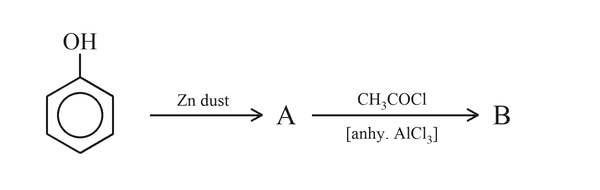
(2)
Solution:
Key idea: Williamson's synthesis makes ethers from an alkoxide and an alkyl halide; esterification joins an alcohol and a carboxylic acid; the Reimer–Tiemann reaction puts a –CHO group ortho to the –OH of phenol. In part (ii) each arrow is a known reaction, so we follow the chains one step at a time.
Step 1 — Part (i)(1): Williamson's synthesis.
Sodium ethoxide is heated with ethyl bromide; the ethoxide ion replaces the bromine and diethyl ether forms.
C2H5ONa+C2H5Br→C2H5OC2H5+NaBr
Step 2 — Part (i)(2): esterification.
Ethanol is heated with acetic acid and a little concentrated sulphuric acid; ethyl acetate and water form in a reversible reaction.
Vapours of ethanol passed over hot copper (about 573 K) lose hydrogen; a primary alcohol is dehydrogenated to an aldehyde. So A is acetaldehyde (ethanal).
C2H5OHCu,573KCH3CHO+H2
Step 5 — Part (ii)(1): identify B.
Acetaldehyde has α-hydrogens, so with dilute sodium hydroxide two molecules combine by aldol condensation. B is 3-hydroxybutanal (aldol).
2CH3CHOdil.NaOHCH3CH(OH)CH2CHO
Step 6 — Part (ii)(2): identify A.
When phenol is distilled with zinc dust, the zinc removes the oxygen of the –OH group, leaving benzene. So A is benzene.
C6H5OH+ZnheatC6H6+ZnO
Step 7 — Part (ii)(2): identify B.
Benzene reacts with acetyl chloride in the presence of anhydrous aluminium chloride (Friedel–Crafts acylation). An acetyl group replaces a ring hydrogen, so B is acetophenone (methyl phenyl ketone).
C6H6+CH3COClanhyd.AlCl3C6H5COCH3+HCl
Therefore, (i) the equations above illustrate Williamson's synthesis, esterification and the Reimer–Tiemann reaction, and (ii) in (1) A is acetaldehyde (CH₃CHO) and B is 3-hydroxybutanal (CH₃CH(OH)CH₂CHO), and in (2) A is benzene (C₆H₆) and B is acetophenone (C₆H₅COCH₃).