
Opening your dashboard
Class 12 Biology Chapter 17: Organisms and Populations Solutions
110 textbook questions with step-by-step answers, free to read, for ISC 2026-27.
Get talked through Ch 17, not just shown the answer
Reading a finished solution is not the same as being able to do it. The AI tutor takes one question at a time and works it with you, in your own words, until you can.
- Ask it out loud, in your own words
- It gives you the next step, not the answer
- Stuck on part (ii)? Start there
110 questions with solutions
1–5 marks · Mixed difficulty
- 11 mark
Question 1
What do you understand by the term ecology?
Solve with AIWritten solution
Solution:
Key idea: The word ecology comes from the Greek oikos (house, home) and logos (study), so it means the study of organisms in their "home", their surroundings.
Step 1 — State what ecology studies.
Ecology is the branch of biology that studies the interactions among organisms (plants, animals and microbes), and between organisms and their physical (abiotic) environment, such as light, temperature, water and soil.
Step 2 — Name the levels it covers.
Ecology deals with four main levels of biological organisation: organisms, populations, communities and biomes (with ecosystems and the whole biosphere).
Therefore, ecology is the study of the interactions of organisms with one another and with their abiotic environment.
- 21 mark
Question 2
Give higher levels of organisation beyond an organism.
Solve with AIWritten solution
Solution:
Key idea: Living things are organised in levels, each made of units of the level below it. Ecology studies the levels from the single organism upwards.
Step 1 — List the levels in order.
Organisms of one species living in an area form a population; populations of different species living together form a community; a community together with its non-living surroundings forms an ecosystem.
Step 2 — Add the largest levels.
Large regions with similar climate and vegetation form biomes, and all the ecosystems of the Earth together form the biosphere.
Therefore, the levels beyond an organism are population, community, ecosystem, biome and biosphere.
- 31 mark
Question 3
What is a biotic community?
Solve with AIWritten solution
Solution:
Key idea: A population is a group of individuals of one species living in an area. Several populations of different species living together make up a community.
Step 1 — Define a biotic community.
A biotic community is the assemblage of populations of different species (plants, animals, fungi and microbes) living together in a particular area at a particular time.
Step 2 — State what holds it together.
These populations interact with one another, for example as producers and consumers, predators and prey, or competitors, so the community works as a unit. A pond community is one example.
Therefore, a biotic community is a group of interacting populations of different species living in the same area.
- 41 mark
Question 4
Give important features of an ecosystem.
Solve with AIWritten solution
Solution:
Key idea: An ecosystem is the basic functional unit of ecology: a community of living things together with its non-living environment, working as one system.
Step 1 — Describe its structure.
An ecosystem has two linked parts: the biotic components (producers, consumers and decomposers) and the abiotic components (light, temperature, water, soil, air and minerals).
Step 2 — Describe how it works.
Energy from the Sun flows through it in one direction along food chains, nutrients are cycled again and again between the living and non-living parts, and it carries out productivity and decomposition. With a steady input of sunlight, it is a largely self-sustaining unit.
Therefore, an ecosystem is a largely self-sustaining unit in which a biotic community interacts with its abiotic environment through energy flow and nutrient cycling.
- 51 mark
Question 5
What is a biosphere?
Solve with AIWritten solution
Solution:
Key idea: The biosphere is the highest level of ecological organisation.
Step 1 — Define the biosphere.
The biosphere is the part of the Earth where life exists. It is a thin zone that includes the lower atmosphere, the waters (hydrosphere) and the upper layer of the land (lithosphere).
Step 2 — Relate it to ecosystems.
All the ecosystems of the Earth, small or large, together make up the biosphere, so it can be thought of as one global ecosystem.
Therefore, the biosphere is the life-supporting zone of the Earth, made up of all its ecosystems together.
- 61 mark
Question 6
Which are three important regions of a biosphere?
Solve with AIWritten solution
Solution:
Key idea: The biosphere is the part of the Earth where living things are found, and it spreads over air, water and land.
Step 1 — Name the three regions.
The three regions are the hydrosphere (water: oceans, seas, rivers and lakes), the lithosphere (the solid crust: rocks and soil) and the atmosphere (the layer of gases around the Earth).
Step 2 — Link them to life.
Life is found where these three regions meet, in the lower atmosphere, the waters and the upper layer of soil.
Therefore, the three regions of the biosphere are the hydrosphere, the lithosphere and the atmosphere.
- 71 mark
Question 7
What is a microhabitat?
Solve with AIWritten solution
Solution:
Key idea: A habitat is the place where an organism lives. Conditions inside one habitat are not the same everywhere.
Step 1 — Define a microhabitat.
A microhabitat is a small part of a habitat whose special local conditions (of light, moisture, temperature and so on) suit particular organisms.
Step 2 — Give an example.
Inside a forest, the damp, shaded space under a fallen log is a microhabitat where fungi, woodlice and earthworms live.
Therefore, a microhabitat is a small region within a habitat with special conditions suited to particular organisms.
- 81 mark
Question 8
What is an ecological niche?
Solve with AIWritten solution
Solution:
Key idea: The habitat is the address of an organism (where it lives), while its niche is its profession (what it does there).
Step 1 — Define the ecological niche.
The ecological niche of a species is its functional role in the community: what it feeds on, what feeds on it, its habits, and its relations with other organisms and with abiotic factors such as temperature and moisture.
Step 2 — State its importance.
It includes the full range of conditions a species can tolerate and the resources it uses. Each species has a distinct niche, so no two species in a community fill exactly the same niche for long.
Therefore, an ecological niche is the functional role of a species in its community, including the resources it uses and the conditions it tolerates.
- 91 mark
Question 9
What is a biome?
Solve with AIWritten solution
Solution:
Key idea: Climate, mainly temperature and rainfall, decides which plants can grow in a region, and the plants in turn decide which animals live there.
Step 1 — Define a biome.
A biome is a large regional community of plants and animals, mainly on land, with a distinct climate and a characteristic dominant type of vegetation.
Step 2 — Give examples.
Tropical rainforest, temperate forest, coniferous forest, grassland, desert and tundra are major biomes of the world.
Therefore, a biome is a large regional community with a distinct climate and characteristic dominant vegetation.
- 101 mark
Question 10
Where do the tropical rainforest biomes exist in India?
Solve with AIWritten solution
Solution:
Key idea: Tropical rainforests need high rainfall spread through much of the year and warm temperatures all year round.
Step 1 — Name the regions.
In India, tropical rainforests (tropical evergreen forests) grow along the Western Ghats and in north-eastern India (for example Assam and Meghalaya).
Step 2 — Add the island region.
They also cover large parts of the Andaman and Nicobar Islands, which are warm and receive heavy rainfall.
Therefore, in India tropical rainforests are found in the Western Ghats, north-eastern India and the Andaman and Nicobar Islands.
- 111 mark
Question 11
What are the climatic conditions in tropical deciduous rainforest biomes?
Solve with AIWritten solution
Solution:
Key idea: Tropical deciduous (monsoon) forests grow where it is warm all year but rain falls mainly in one season, so the trees shed their leaves in the dry season to save water.
Step 1 — State the rainfall.
These forests receive about 90–160 cm of rain a year, falling mostly in the monsoon months.
Step 2 — State the temperature and the dry season.
The temperature stays warm, about 22 °C to 32 °C, and the rainy season is followed by a long dry season lasting several months, when most trees become leafless.
Therefore, tropical deciduous forests have about 90–160 cm of seasonal rainfall, temperatures of about 22–32 °C and a long dry season.
- 121 mark
Question 12
Give two recognisable features of temperate broad-leaf forest biome.
Solve with AIWritten solution
Solution:
Key idea: Temperate broad-leaf forests grow in cooler regions with moderate rainfall. In India they are found in the Himalayas, at about 1,500–3,000 m.
Step 1 — Give the first feature.
The Himalayan temperate broad-leaf forests are dominated by several species of evergreen oak (Quercus), along with trees such as rhododendrons, maples and laurels.
Step 2 — Give the second feature.
The vegetation is clearly layered into strata (tall trees, smaller trees, shrubs and herbs), and the trees are often covered with mosses, ferns and lichens.
Note: Temperate broad-leaf forests of Europe, North America and East Asia are mostly deciduous (oak, maple, beech), shedding their leaves in winter. The evergreen oaks are a feature of the Himalayan forests.
Therefore, two features of the (Himalayan) temperate broad-leaf forest are dominance by evergreen oaks and clear layering of the vegetation into strata.
- 131 mark
Question 13
Name various layers that form stratification in a forest.
Solve with AIWritten solution
Solution:
Key idea: Stratification is the vertical layering of plants in a community, according to height. Each layer gets a different amount of light.
Step 1 — Name the tree layers from the top.
The highest layer is formed by a few tall emergent trees that rise above the rest. Below them is the dense canopy of tree crowns, and below that a layer of shorter trees (the understorey).
Step 2 — Name the lower layers.
Under the trees is the shrub layer, and at the bottom is the forest floor with herbs, grasses, mosses and fallen leaves.
Therefore, the layers of a forest are the emergent trees, the canopy, the short trees, the shrubs and the herbs of the forest floor.
- 141 mark
Question 14
Give the type of vegetation found in savannas.
Solve with AIWritten solution
Solution:
Key idea: A savanna is a tropical grassland with scattered trees. It has a long dry season and frequent fires, which stop a closed forest from forming.
Step 1 — Describe the ground cover.
The ground is covered by a well-developed layer of tall grasses.
Step 2 — Describe the woody plants.
Shrubs and small trees, often thorny (such as acacias), are scattered over the grassland; most are only a few metres tall, so they do not form a continuous canopy.
Therefore, the vegetation of a savanna is a continuous grass cover with scattered shrubs and small trees.
- 151 mark
Question 15
What are the climatic conditions in cold desert biomes?
Solve with AIWritten solution
Solution:
Key idea: A cold desert is dry like a hot desert, but it is cold for most of the year. Arctic tundra and high-altitude regions such as Ladakh are cold deserts.
Step 1 — Describe the temperature.
Temperatures are extremely low for most of the year, with long, freezing winters and cold winds. Summer is very short and cool.
Step 2 — Describe the water.
Rainfall and snowfall are very low (usually below about 25 cm a year). Much of the water stays locked as snow and ice, and in many places the ground stays frozen all year (permafrost).
Therefore, cold deserts have very low temperatures with a very short summer, very little rain or snow, cold winds and often frozen soil.
- 161 mark
Question 16
What are ectotherms?
Solve with AIWritten solution
Solution:
Key idea: Animals are grouped by where their body heat comes from. Endotherms make enough heat inside the body to keep a steady body temperature; ectotherms do not.
Step 1 — Define ectotherms.
Ectotherms are animals whose body heat comes mainly from their surroundings, so their body temperature changes with the temperature of the environment. They are often called cold-blooded.
Step 2 — Explain how they regulate.
Ectotherms cannot keep a constant body temperature by producing heat, but many regulate it by behaviour. A desert lizard basks in the sun when it is cold and moves into shade or a burrow when it is hot.
Therefore, ectotherms are animals that depend mainly on external heat, so their body temperature varies with the surroundings, although many adjust it by behaviour.
- 171 mark
Question 17
Give examples of ectotherms and endotherms.
Solve with AIWritten solution
Solution:
Key idea: Ectotherms get their body heat mainly from their surroundings, while endotherms produce heat inside the body and keep a fairly constant body temperature.
Step 1 — Give examples of ectotherms.
Most invertebrates (such as earthworms and insects), fishes, amphibians (frogs) and reptiles (lizards, snakes) are ectotherms.
Step 2 — Give examples of endotherms.
Birds (such as the sparrow) and mammals (such as humans and dogs) are endotherms.
Note: There are a few exceptions. Tuna and some sharks keep their swimming muscles warmer than the water, and bumble bees warm their flight muscles by shivering before they fly.
Therefore, frogs, fishes, lizards and most invertebrates are ectotherms, while birds and mammals are endotherms.
- 181 mark
Question 18
Name three important thermal zones in a lake during summers.
Solve with AIWritten solution
Solution:
Key idea: In summer, deep lakes of temperate regions form layers of different temperature (summer stratification), because warm water is lighter than cold water.
Step 1 — Name the top and bottom layers.
The warm, well-mixed upper layer is the epilimnion, and the cold, still bottom layer is the hypolimnion.
Step 2 — Name the middle layer.
Between them is the thermocline (metalimnion), a layer in which the temperature falls quickly with depth.
Therefore, the three thermal zones of a lake in summer are the epilimnion, the thermocline and the hypolimnion.
- 191 mark
Question 19
What is the meaning of photosynthetically active radiation (PAR)?
Solve with AIWritten solution
Solution:
Key idea: Chlorophyll and the other photosynthetic pigments absorb only part of the sunlight that reaches a plant.
Step 1 — Define PAR.
Photosynthetically active radiation (PAR) is the part of sunlight that plants can use for photosynthesis. It has wavelengths from about 400 nm to 700 nm, which is the visible light (violet to red, VIBGYOR).
Step 2 — State why it matters.
Light outside this range, such as ultraviolet and infrared, is not used for photosynthesis, so the amount of PAR reaching a plant sets how much photosynthesis it can carry out.
Therefore, PAR is the 400–700 nm (visible) part of sunlight that is used in photosynthesis.
- 201 mark
Question 20
What is an abyssal zone?
Solve with AIWritten solution
Solution:
Key idea: The ocean is divided into zones by depth. Sunlight enough for photosynthesis reaches only the top 200 m or so, and below about 1,000 m there is no sunlight at all.
Step 1 — Define the abyssal zone.
The abyssal zone is the deep, permanently dark, very cold zone of the open ocean over the abyssal plains of the sea floor, at depths of about 4,000–6,000 m.
Step 2 — Describe life there.
There is no light and so no photosynthesis; the pressure is very high and the temperature is only about 2–4 °C. Animals there feed on organic matter sinking from above or on chemosynthetic bacteria.
Note: Older ecology books place the abyssal zone below about 2,000 m. Oceanographers now call the 1,000–4,000 m region the bathyal zone and the trenches deeper than about 6,000 m the hadal zone.
Therefore, the abyssal zone is the deep, permanently dark zone of the ocean, at about 4,000–6,000 m, where no light reaches.
- 211 mark
Question 21
What is a limnetic zone in a lake? Name types of organisms present in this zone.
Solve with AIWritten solution
Solution:
Key idea: A lake has three main zones: the shallow littoral zone near the shore, the open-water limnetic zone, and the deep, dark profundal zone below it.
Step 1 — Define the limnetic zone.
The limnetic zone is the well-lit open water of a lake, away from the shore, down to the depth where light is just enough for photosynthesis to balance respiration.
Step 2 — Name its organisms.
It contains phytoplankton (floating algae and cyanobacteria) as producers, zooplankton that feed on them, and fishes and other free-swimming animals (nekton).
Therefore, the limnetic zone is the well-lit open water of a lake, with phytoplankton, zooplankton and fishes.
- 221 mark
Question 22
What type of soil do tropical rainforests have?
Solve with AIWritten solution
Solution:
Key idea: Heavy rain in a tropical rainforest washes (leaches) nutrients down out of the soil, and most nutrients are held in the living plants rather than the soil.
Step 1 — Describe the topsoil.
The topsoil is shallow and poor in nutrients, because dead matter decomposes and is reabsorbed by the plants very quickly, and the rain leaches the rest.
Step 2 — Describe the subsoil.
Below it lies a dense, clayey subsoil rich in iron and aluminium compounds (lateritic soil), which gives it a red or yellow colour.
Therefore, tropical rainforests have a shallow, nutrient-poor topsoil over a dense, red clay subsoil rich in iron and aluminium compounds.
- 231 mark
Question 23
Which type of soil is well suited for plants and why?
Solve with AIWritten solution
Solution:
Key idea: Soil type depends on the proportion of sand, silt and clay particles. A good soil holds enough water and air for roots, and enough nutrients.
Step 1 — Name the soil.
Loamy soil, a mixture of sand, silt and clay with plenty of humus, is the best suited for most plants.
Step 2 — Explain why.
The sand keeps it porous, so air reaches the roots and extra water drains away. The clay and humus hold enough water and minerals for the roots, and the humus also adds nutrients.
Therefore, loamy soil suits plants best, because it is rich in humus and has a good balance of aeration, drainage and water holding.
- 241 mark
Question 24
Where is tropopause present?
Solve with AIWritten solution
Solution:
Key idea: In the troposphere, the lowest layer of the atmosphere, the temperature falls with height. It stops falling at the top of the troposphere.
Step 1 — Locate the tropopause.
The tropopause is the boundary at the top of the troposphere, separating it from the stratosphere above. It lies about 16–18 km above the ground at the equator and only about 8–9 km above the poles.
Step 2 — Describe its temperature.
It is the coldest part of the lower atmosphere, at about −55 °C in middle latitudes and down to about −80 °C over the equator.
Therefore, the tropopause is the very cold boundary between the troposphere and the stratosphere, about 16 km above the equator.
- 251 mark
Question 25
Where is ozone layer present? What is its significance?
Solve with AIWritten solution
Solution:
Key idea: Ozone (O₃) is a form of oxygen that absorbs ultraviolet (UV) radiation. About 90 percent of the ozone in the atmosphere lies in the stratosphere.
Step 1 — Locate the ozone layer.
The ozone layer lies in the stratosphere, roughly 15–35 km above the Earth, with the most ozone at about 20–25 km.
Step 2 — State its significance.
It absorbs all of the Sun's UV-C and most of the UV-B radiation, while most UV-A passes through. UV-B damages DNA and causes skin cancer, cataracts and harm to crops and plankton, so the ozone layer protects life on Earth.
Therefore, the ozone layer lies in the stratosphere (about 15–35 km up) and protects life by absorbing most of the harmful UV radiation from the Sun.
- 261 mark
Question 26
Give two features of drought-enduring plants.
Solve with AIWritten solution
Solution:
Key idea: Drought-enduring plants (xerophytes) survive long dry periods by getting as much water as possible and losing as little as possible.
Step 1 — Give a feature for taking in water.
They have deep tap roots that reach water far below the surface, down towards the water table.
Step 2 — Give a feature for saving water.
They have small or reduced leaves (sometimes spines), often with a thick waxy cuticle and sunken stomata, so they lose less water by transpiration.
Therefore, two features of drought-enduring plants are deep tap roots and small leaves that cut down water loss.
- 271 mark
Question 27
What are chaperonins?
Solve with AIWritten solution
Solution:
Key idea: A protein works only when it is folded into its correct shape. High temperature makes proteins unfold (denature).
Step 1 — Define chaperonins.
Chaperonins are a family of large, barrel-shaped protein complexes (molecular chaperones, such as Hsp60) that help newly made or damaged proteins fold into their correct shape.
Step 2 — Link them to heat tolerance.
Chaperonins are heat shock proteins: cells make more of them when they are heated. By refolding proteins damaged by heat, they help organisms, including plants of hot deserts, to tolerate high temperatures.
Therefore, chaperonins are heat shock proteins that help other proteins fold correctly, and so help organisms survive high temperatures.
- 281 mark
Question 28
What are halophytes?
Solve with AIWritten solution
Solution:
Key idea: Salty water makes it hard for most plants to take in water by osmosis, so only specially adapted plants grow there.
Step 1 — Define halophytes.
Halophytes are plants adapted to grow in soil or water with a high concentration of salt.
Step 2 — Give examples and adaptations.
Mangroves of sea coasts (such as Rhizophora) and plants of salt marshes and salty lakes are halophytes. Many of them get rid of extra salt through salt glands or store it in their cells.
Therefore, halophytes are plants adapted to live in saline (salty) habitats, such as mangroves.
- 291 mark
Question 29
Why do mangrove plants have pneumatophores?
Solve with AIWritten solution
Solution:
Key idea: Root cells need oxygen for respiration. In waterlogged soil the spaces between soil particles are filled with water, so there is very little oxygen.
Step 1 — Describe the problem.
Mangroves grow in muddy, salty, waterlogged swamps where the soil has very little oxygen, so the underground roots cannot get enough oxygen.
Step 2 — Explain the pneumatophores.
Mangroves form pneumatophores, which are special roots that grow upwards out of the mud into the air (negatively geotropic). Small pores (lenticels) on them take in oxygen, which reaches the buried roots through air spaces.
Therefore, mangroves have pneumatophores so that their roots can get oxygen for respiration from the air above the waterlogged soil.
- 301 mark
Question 30
What are mycorrhizae?
Solve with AIWritten solution
Solution:
Key idea: Many plants depend on fungi in the soil to help their roots take up minerals.
Step 1 — Define mycorrhizae.
Mycorrhizae are mutualistic (symbiotic) associations between a fungus and the roots of a plant, for example the fungi on pine roots.
Step 2 — State the benefit to each partner.
The fungal threads (hyphae) spread through the soil and help the plant absorb water and minerals, especially phosphorus. In return, the plant gives the fungus sugars made in photosynthesis.
Therefore, mycorrhizae are mutually beneficial associations between fungi and plant roots.
- 311 mark
Question 31
What is Batesian mimicry?
Solve with AIWritten solution
Solution:
Key idea: In mimicry one species looks like another. Predators that have learnt to avoid the harmful species also avoid the look-alike.
Step 1 — Define Batesian mimicry.
Batesian mimicry is mimicry in which a harmless, palatable species (the mimic) copies the warning colours or shape of a harmful or distasteful species (the model).
Step 2 — Give an example.
Many harmless hoverflies have the black and yellow stripes of stinging wasps, so birds that have been stung by wasps leave the hoverflies alone too.
Note: The viceroy butterfly, long given as a mimic of the monarch, is now known to be distasteful itself, so that pair is better treated as Müllerian mimicry.
Therefore, Batesian mimicry is the copying of a harmful species by a harmless one, as in hoverflies that look like wasps.
- 321 mark
Question 32
What is Gause's 'Competitive Exclusion Principle'?
Solve with AIWritten solution
Solution:
Key idea: Competition is an interaction in which two species both lose (−/−) because they use the same limited resources.
Step 1 — State the principle.
Gause's competitive exclusion principle states that two closely related species competing for the same limiting resources cannot co-exist indefinitely; the competitively inferior species is eventually eliminated.
Step 2 — Give the evidence.
Gause grew two species of Paramecium together in a culture with limited food. P. aurelia survived, while P. caudatum died out, although each grew well when kept alone.
Therefore, according to Gause's principle, two species competing for the same limiting resource cannot live together indefinitely, and the weaker one is excluded.
- 331 mark
Question 33
Give two adaptations in parasites to live in or on host.
Solve with AIWritten solution
Solution:
Key idea: A parasite lives on or in another organism (the host) and gets food from it, so it is adapted to stay on the host and to use the host's food.
Step 1 — Give an adaptation for holding on.
Many parasites have adhesive organs such as suckers and hooks, which keep them attached to the host; a tapeworm has both.
Step 2 — Give an adaptation for feeding.
Gut parasites such as the tapeworm have lost their digestive system and absorb the host's digested food directly through their body surface.
Therefore, two adaptations of parasites are suckers or hooks for attachment and loss of the digestive system.
- 341 mark
Question 34
What is protocooperation? Give one example.
Solve with AIWritten solution
Solution:
Key idea: In mutualism both species benefit. When they benefit but do not depend on each other, the interaction is called protocooperation (facultative mutualism).
Step 1 — Define protocooperation.
Protocooperation is an interaction in which two species benefit by living together, but each can also live on its own.
Step 2 — Give an example.
A hermit crab often carries a sea anemone on its shell. The anemone's stinging tentacles protect the crab, and the anemone is carried to new feeding places and picks up scraps of the crab's food, but each can live without the other.
Therefore, protocooperation is a non-obligatory interaction that benefits both partners, as in the hermit crab and the sea anemone.
- 351 mark
Question 35
Give an example of co-evolution in mutualism.
Solve with AIWritten solution
Solution:
Key idea: In co-evolution two interacting species evolve together, so that a change in one partner is matched by a change in the other. Mutualisms between flowering plants and their pollinators show this most clearly.
Step 1 — Name the partners. A classic example is the fig tree (Ficus) and its pollinating fig wasp. Most fig species are pollinated by only one partner species of wasp, and that wasp can breed only inside the figs of its partner tree.
Step 2 — Say what each partner gains. The female wasp enters the young fig, which is a closed, hollow inflorescence, and pollinates its tiny flowers while she searches for places to lay her eggs. She lays eggs in some of the ovules, and her larvae feed on these developing ovules, while the other pollinated ovules grow into seeds. So the fig is pollinated, and the wasp gets a safe egg-laying site and food for its young.
Step 3 — Show why this is co-evolution. The size and shape of the wasp fit the narrow opening of its own fig species, and the flowering time of the fig matches the life cycle of the wasp. Neither partner can reproduce without the other, so each has evolved to suit the other.
Therefore, the fig tree and its fig wasp are an example of co-evolution in mutualism: the wasp pollinates the fig flowers, and the fig gives the wasp an egg-laying site and food for its larvae.
- 361 mark
Question 36
What are keystone species?
Solve with AIWritten solution
Solution:
Key idea: The species of a community differ in how strongly they affect one another. A dominant species is important because it is very common, but a keystone species is important out of all proportion to its numbers.
Step 1 — Define a keystone species. A keystone species is a species whose influence on the abundance of other species in its community is much greater than its own abundance (number or biomass) would suggest. The name comes from the keystone at the top of a stone arch: when it is pulled out, the whole arch falls.
Step 2 — Explain why it matters. When a keystone species is removed, many other species decline or disappear and the structure of the whole community changes.
Step 3 — Give examples. Fig trees are keystone species in tropical rainforests, because they bear fruit through the year and feed many birds, bats and monkeys when little other fruit is available. On rocky sea shores the starfish Pisaster is a keystone predator: when it was removed in an experiment, mussels took over the rocks and the number of other invertebrate species fell sharply.
Therefore, keystone species are species that have a much greater influence on the abundance of other species in their community than their own abundance would suggest, e.g., fig trees in tropical rainforests.
- 371 mark
Question 37
What is ecotone?
Solve with AIWritten solution
Solution:
Key idea: Neighbouring communities rarely end at a sharp line. Where they meet, their species mix over a strip of land or water.
Step 1 — Define an ecotone. An ecotone is the transition zone where two or more different communities meet and blend into each other, for example the strip between a forest and a grassland, or between a pond and the dry land around it.
Step 2 — State its main feature. An ecotone contains species from each neighbouring community and also some species found mainly in the ecotone itself. It therefore often has more species than either community; this is called the edge effect.
Therefore, an ecotone is the transition zone between two or more communities, such as the zone between a forest and a grassland.
- 381 mark
Question 38
What type of association exists between sharks and sucker fish, Echeneis?
Solve with AIWritten solution
Solution:
Key idea: Commensalism (+, 0) is an interaction between two species in which one species benefits and the other is neither benefited nor harmed.
Step 1 — See what the sucker fish gains. The sucker fish (remora, Echeneis) holds on to the shark with an oval sucking disc on top of its head, which is its modified first dorsal fin. It gets free transport, protection from predators and scraps of the shark's food.
Step 2 — See what happens to the shark. The shark gains nothing noticeable and is not harmed, because the small fish is carried along without damaging it or taking its food away.
Step 3 — Name the interaction. One partner benefits (+) and the other is unaffected (0), so the association is commensalism.
Note: Remoras sometimes also pick parasites off their host, but this gain to the shark is small, so the association is classed as commensalism.
Therefore, the association between the shark and the sucker fish is commensalism: the sucker fish benefits and the shark is unaffected.
- 391 mark
Question 39
How does less pre-reproductive population and large older population change the structure of a population?
Solve with AIWritten solution
Solution:
Key idea: The age structure of a population is shown by an age pyramid with three age groups: pre-reproductive (young), reproductive and post-reproductive (old). Its shape shows whether the population will grow, stay stable or decline.
Step 1 — Read the information. Few pre-reproductive individuals means that the base of the pyramid is narrow. A large older population means that the upper part of the pyramid is broad.
Step 2 — Predict the change in numbers. Few young individuals will enter the reproductive group in future, so births will fall, while the many old individuals will die over the coming years. Deaths will exceed births, so the population will shrink.
Step 3 — Name the shape. A pyramid with a narrow base and a broad upper part is urn-shaped, which is the pyramid of a declining population.
Therefore, such a population becomes a declining population, and its age pyramid is urn-shaped, with a narrow base and a broad upper part.
- 401 mark
Question 40
What are homoiothermic animals?
Solve with AIWritten solution
Solution:
Key idea: Animals are grouped by whether they keep their body temperature steady or let it follow the temperature of their surroundings.
Step 1 — Define homoiothermic animals. Homoiothermic animals keep their body temperature nearly constant over a wide range of outside temperatures, for example about 37 °C in humans and about 40–42 °C in many birds.
Step 2 — Explain how they do it. They produce heat mainly by their own metabolism, so they are also called endotherms. They keep the temperature steady by sweating or panting to lose heat, shivering to make heat, changing the blood flow to the skin, and insulation by fur, feathers or fat.
Step 3 — Give examples. Birds and mammals are homoiothermic animals.
Note: The everyday name for these animals is "warm-blooded". Some of them let their body temperature fall for a time, for example during hibernation.
Therefore, homoiothermic animals are animals that keep a nearly constant body temperature whatever the temperature of the surroundings, e.g., birds and mammals.
- 412 marks
Question 41
Define the term population. Name a few characteristics that affect density of a population.
Solve with AIWritten solution
Solution:
Key idea: Population density is the number of individuals per unit area or volume. It changes only through four basic processes: births, deaths, individuals arriving and individuals leaving.
Step 1 — Define a population (part i). A population is a group of individuals of the same species that live in a particular area at a particular time, share its resources and can interbreed, for example all the lotus plants in a pond.
Step 2 — Name the characteristics that change density (part ii). Natality (the birth rate) and immigration add individuals to the population. Mortality (the death rate) and emigration remove individuals from it.
Step 3 — Show how they combine. We write for the density at time , for births, for immigrants, for deaths and for emigrants over the next period.
The density rises when is greater than , and falls when it is smaller.
Step 4 — Add the other influences. The age distribution and sex ratio decide how many individuals can breed, and the available food, space, predators and diseases change the birth and death rates. So these also affect density, acting through natality and mortality.
Therefore, a population is a group of interbreeding individuals of one species living in an area at a given time, and its density is affected by natality, mortality, immigration and emigration, together with its age distribution and the resources available.
- 422 marks
Question 42
Name various components of an ecosystem. What is an ecological niche?
Solve with AIWritten solution
Solution:
Key idea: An ecosystem is a functional unit of nature in which living organisms interact with one another and with their non-living surroundings.
Step 1 — Name the biotic components (part i). The living part has producers, consumers and decomposers. Producers (green plants, algae and cyanobacteria) make food by photosynthesis, consumers (herbivores, carnivores and omnivores) feed on other organisms, and decomposers (bacteria and fungi) break down dead matter and return its nutrients to the soil or water.
Step 2 — Name the abiotic components. The non-living part includes light, temperature, water, air, soil and inorganic nutrients, together with dead organic matter (detritus).
Step 3 — Define an ecological niche (part ii). An ecological niche is the functional role of a species in its community. It includes the physical space the species occupies and also what it eats, what eats it, when it is active and the range of abiotic conditions it can tolerate. Two species living in the same habitat usually differ in their niches.
Therefore, an ecosystem has biotic components (producers, consumers and decomposers) and abiotic components (light, temperature, water, air, soil and nutrients), and an ecological niche is the space and functional role of a species in its community.
- 432 marks
Question 43
What is biotic potential? Why is the biotic potential not achieved in a population?
Solve with AIWritten solution
Solution:
Key idea: When resources are unlimited a population grows exponentially at its intrinsic rate of natural increase, . In nature, growth slows and stops near the carrying capacity, , of the habitat.
Step 1 — Define biotic potential (part i). Biotic potential is the maximum capacity of a population to reproduce and increase in number when conditions are ideal, with unlimited food and space and no predators or diseases. It is expressed by the intrinsic rate of natural increase, , under such conditions.
Step 2 — Write the growth under ideal conditions. With for the population size and for time, the population would grow at the rate
and its numbers would rise faster and faster (a J-shaped curve).
Step 3 — Explain why it is not reached (part ii). In nature the environment resists growth. Food and space are limited, individuals compete for them, and predators, parasites, diseases and bad weather kill many individuals before they breed. This environmental resistance lowers natality and raises mortality.
Step 4 — Show the effect on growth. With environmental resistance the growth follows the logistic equation
As comes close to , the factor approaches zero, so growth slows and the population levels off near instead of growing without limit.
Therefore, biotic potential is the maximum reproductive capacity of a population under ideal conditions, and it is never achieved because environmental resistance (limited food and space, competition, predation, disease and unfavourable weather) lowers births and raises deaths.
- 442 marks
Question 44
Name the vertical layers of atmosphere. What is the limit of stratosphere?
Solve with AIWritten solution
Solution:
Key idea: The atmosphere is divided into layers according to the way temperature changes with height.
Step 1 — Name the vertical layers (part i). From the ground upward the layers are the troposphere, the stratosphere, the mesosphere and the thermosphere, which contains the ionosphere. Thin boundary layers (tropopause, stratopause and mesopause) separate them, and the thin outermost exosphere merges into space.
Step 2 — Find the lower limit of the stratosphere (part ii). The stratosphere begins at the tropopause. Its height depends on latitude: it lies at about 16–18 km over the equator but only about 8 km over the poles. The value of 16 km often quoted is the figure for the tropics.
Step 3 — Find the upper limit. The stratosphere extends up to the stratopause at about 50 km. Temperature rises with height in this layer, because the ozone layer, mostly between about 15 and 35 km, absorbs ultraviolet rays and warms the air.
Therefore, the atmosphere has the troposphere, stratosphere, mesosphere and thermosphere, and the stratosphere extends from the tropopause (about 16 km over the tropics, about 8 km over the poles) up to about 50 km.
- 452 marks
Question 45
What does solar spectrum comprise of? What is PAR?
Solve with AIWritten solution
Solution:
Key idea: Sunlight is electromagnetic radiation spread over a range of wavelengths. The shorter the wavelength, the greater the energy carried by the radiation.
Step 1 — Describe the short-wave part (part i). Radiation shorter than 400 nm is mainly ultraviolet (UV) rays, with very small amounts of X-rays and gamma rays, given out mostly during solar flares. The X-rays, gamma rays and the shortest UV rays are absorbed high in the atmosphere.
Step 2 — Describe the visible part. Visible light has wavelengths from about 400 nm (violet) to 700 nm (red), seen together as white light (VIBGYOR).
Step 3 — Describe the long-wave part. Radiation longer than 700 nm is mainly infrared (heat) rays, with small amounts of microwaves and radio waves.
Step 4 — Compare the shares. Most of the Sun's energy arrives as visible light and infrared, and less than a tenth of it as ultraviolet.
Step 5 — Define PAR (part ii). Photosynthetically active radiation (PAR) is the part of sunlight that plants can use for photosynthesis: the visible light of 400–700 nm, which is absorbed by chlorophylls and carotenoids. It is a little under half of the solar radiation reaching the ground.
Note: Cosmic rays are sometimes listed with the short-wave radiations, but they are fast-moving charged particles, mostly from outside the solar system, and not part of the Sun's electromagnetic spectrum. Radar is a use of microwaves, not a separate kind of radiation.
Therefore, the solar spectrum comprises short-wave radiation (mainly ultraviolet, with traces of X-rays and gamma rays) below 400 nm, visible light of 400–700 nm and long-wave radiation (mainly infrared, with some microwaves and radio waves) above 700 nm, and PAR is the visible light of 400–700 nm used in photosynthesis.
- 462 marks
Question 46
Name various types of UV radiations depending upon their wavelength. What is their effect on humans?
Solve with AIWritten solution
Solution:
Key idea: Ultraviolet (UV) rays are invisible radiation with wavelengths from 100 to 400 nm, shorter than violet light. The shorter the wavelength, the more energy the rays carry and the more they can damage DNA in living cells.
Step 1 — Name the types of UV (part i). UV is divided by wavelength into UV-C (100–280 nm), UV-B (280–315 nm) and UV-A (315–400 nm). Some books put the boundary between UV-B and UV-A at 320 nm, but the international standard value is 315 nm.
Step 2 — Find which types reach us. The ozone layer and oxygen in the atmosphere absorb all the UV-C and most of the UV-B, while most UV-A reaches the ground. The effects on humans therefore come mainly from UV-B and UV-A.
Step 3 — State the effects on the skin (part ii). UV-B causes sunburn. Both UV-B and UV-A damage the DNA of skin cells, which can lead to skin cancers, including melanoma, and to early ageing and wrinkling of the skin.
Step 4 — State the effects on the eyes. UV rays can cause cataract (clouding of the eye lens) and, after strong exposure as on snowfields, snow blindness, a painful inflammation of the cornea.
Step 5 — State the effect on immunity. UV rays weaken (suppress) the immune response of the skin, so the body fights some infections and cancers less well.
Note: UV-B also helps the skin make vitamin D, so short exposure to sunlight is useful; the harm comes from too much exposure.
Therefore, UV rays are UV-C (100–280 nm), UV-B (280–315 nm) and UV-A (315–400 nm), and in humans they cause sunburn, skin cancer and skin ageing, cataract and snow blindness, and weakening of the immune system.
- 472 marks
Question 47
Name various zones in a lake. In which zone are phytoplanktons found in a lake?
Solve with AIWritten solution
Solution:
Key idea: A lake is divided into zones by depth and by distance from the shore, because the depth to which light reaches decides where photosynthesis can take place.
Step 1 — Describe the littoral zone (part i). The littoral zone is the shallow water near the shore, where light reaches the bottom, so rooted plants can grow there.
Step 2 — Describe the limnetic zone. The limnetic zone is the open, well-lit water away from the shore. It extends down to the depth at which the light is just enough for photosynthesis to balance respiration.
Step 3 — Describe the profundal zone. The profundal zone is the deep water below the limnetic zone, where too little light reaches for photosynthesis. The lake bottom under it is called the benthic region.
Step 4 — Locate the phytoplankton (part ii). Phytoplankton are microscopic floating algae and cyanobacteria that need light for photosynthesis. They therefore live mainly in the limnetic zone (also in the open water of the littoral zone) and cannot grow in the dark profundal zone.
Therefore, a lake has the littoral, limnetic and profundal zones (with the benthic region at the bottom), and phytoplankton are found mainly in the well-lit limnetic zone.
- 482 marks
Question 48
What is symbiosis? Give an example.
Solve with AIWritten solution
Solution:
Key idea: Interactions between two species are named by their effect on each partner: + for benefit, − for harm and 0 for no effect. Mutualism is a (+, +) interaction.
Step 1 — Define symbiosis (part i). In this chapter symbiosis means a close, long-lasting association between two different species in which both partners benefit and depend on each other; it is also called obligate mutualism.
Step 2 — Give an example (part ii). A lichen is a close association of a fungus with an alga or a cyanobacterium. The photosynthetic partner makes food for both, while the fungus absorbs water and minerals, shelters its partner from drying out and fixes the lichen to rock or bark.
Step 3 — Show that both depend on each other. The fungus of a lichen usually cannot live on its own in nature, and the pair together can grow on bare rock where neither partner could survive alone.
Note: In a broad sense ecologists use the word symbiosis for any close, long-term association of two species, which includes commensalism and parasitism as well as mutualism.
Therefore, symbiosis is a close association of two species in which both benefit and depend on each other, e.g., the fungus and the alga of a lichen.
- 492 marks
Question 49
What are ectoparasites? Give two adaptations in them for survival in host.
Solve with AIWritten solution
Solution:
Key idea: Parasitism is a (+, −) interaction: the parasite benefits and the host is harmed. Ectoparasites live on the outside of the host, while endoparasites live inside its body.
Step 1 — Define ectoparasites (part i). Ectoparasites are parasites that live on the outer surface of the host, on its skin, hair, feathers or scales, and feed on its blood, skin or tissue fluid. Examples are lice on humans, ticks on dogs, mites, copepods on marine fish and the plant Cuscuta on hedge plants.
Step 2 — Give the first adaptation (part ii). Ectoparasites have organs to hold on to the host so that they are not shaken or rubbed off. Lice grip hairs with strong claws, ticks anchor themselves with barbed mouthparts, and many parasites have hooks, clamps or suckers; lice are also flattened and wingless, which helps them stay close to the skin.
Step 3 — Give the second adaptation. Ectoparasites have special feeding organs to take food from the host. Lice and ticks have piercing and sucking mouthparts to draw blood, and Cuscuta sends root-like suckers called haustoria into the conducting tissues of the host plant.
Therefore, ectoparasites are parasites that live on the outer surface of the host, and two adaptations for survival are organs of attachment (claws, hooks, clamps or suckers) and piercing-sucking mouthparts or haustoria for feeding on the host.
- 502 marks
Question 50
What is commensalism? Give one example.
Solve with AIWritten solution
Solution:
Key idea: Interactions between two species are named by their effect on each partner. Commensalism is a (+, 0) interaction.
Step 1 — Define commensalism (part i). Commensalism is an interaction between two species in which one species benefits and the other is neither benefited nor harmed.
Step 2 — Give an example (part ii). An orchid growing as an epiphyte on a branch of a mango tree is an example. The orchid gets support and a place high up near the light, and it absorbs moisture from the air with its own aerial roots, so it takes no food from the tree.
Step 3 — Check the effect on the other partner. The mango tree is neither helped nor harmed by the orchid, so one partner gains (+) and the other is unaffected (0).
Therefore, commensalism is an interaction in which one species benefits while the other is neither benefited nor harmed, e.g., an orchid growing on a mango branch.
- 512 marks
Question 51
How do active ectotherms control their body temperature?
Solve with AIWritten solution
Solution:
Key idea: Ectotherms get their body heat mainly from their surroundings and make little heat of their own. Active ectotherms still keep their body temperature within a favourable range, mainly by their behaviour.
Step 1 — Use sun and shade. When the body temperature falls below the comfortable range, desert lizards bask in the sun to absorb heat. When the air becomes too hot, they move into shade or burrows. Frogs and snakes also move to shady or moist places on hot days and to warmer places on cold days.
Step 2 — Change posture and contact. Many lizards turn their body side-on to the sun in the morning to absorb more heat and face the sun at midday so that less of the body is exposed. They may press the body against warm rocks to gain heat or raise it off hot sand to lose heat.
Step 3 — Choose the time of activity. Many desert ectotherms stay in cool burrows during the day and are active at night or at dawn and dusk, when the temperature suits them.
Step 4 — Avoid extreme seasons. When conditions become too extreme, many ectotherms escape them: they hibernate in very cold seasons and aestivate in very hot, dry seasons.
Therefore, active ectotherms control their body temperature mainly by behaviour: basking in the sun or moving into shade, changing posture, being active at suitable times of day, and hibernating or aestivating in extreme seasons.
- 522 marks
Question 52
Why do endotherms have metabolic advantage over other animals?
Solve with AIWritten solution
Solution:
Key idea: Endotherms produce heat by their own metabolism and keep a nearly constant body temperature (about 37 °C in humans), whatever the temperature of the surroundings.
Step 1 — Keep enzymes working well. Since the body temperature stays steady near the best temperature for their enzymes, their metabolic reactions run fast and at a steady rate in any weather.
Step 2 — Stay active in the cold. Endotherms can stay active on cold nights, in winter and in the early morning, when ectotherms are slow and sluggish. They can also keep up long, fast activity such as running or flying.
Step 3 — Live in many habitats. Because they are not controlled by the outside temperature, endotherms can live in a very wide range of habitats, including polar regions and high mountains.
Step 4 — Note the cost. The price of this advantage is a high use of energy, so an endotherm needs several times as much food as an ectotherm of the same size.
Therefore, endotherms have a metabolic advantage because their constant body temperature keeps their enzymes working at a steady, efficient rate, so they stay active in cold conditions and can live in a wide range of habitats.
- 532 marks
Question 53
What is spring turnover? Why is the growth of phytoplanktons low during summer stratification?
Solve with AIWritten solution
Solution:
Key idea: Water is densest at about 4 °C. In lakes of cold temperate regions the water separates into layers in summer and winter and mixes completely in spring and autumn.
Step 1 — Describe the lake in winter. In winter the surface water cools below 4 °C, becomes lighter and freezes, while the water at the bottom stays at about 4 °C.
Step 2 — Explain the spring turnover (part i). In spring the ice melts and the surface water warms up to 4 °C. At this temperature it is at its densest, so it sinks, and with the help of wind the whole lake circulates. This spring turnover carries oxygen down to the deep water and brings nutrients up from the bottom, so the temperature, oxygen and nutrients become uniform throughout the lake.
Step 3 — Describe summer stratification (part ii). In summer the surface water becomes much warmer and lighter. The warm upper layer (epilimnion) floats on the cold, dense lower layer (hypolimnion), with a zone of rapid temperature change (thermocline) between them, and the two layers do not mix.
Step 4 — Explain the low growth of phytoplankton. Phytoplankton live in the lit epilimnion and soon use up its nitrates and phosphates. Dead organisms sink into the dark hypolimnion, where decomposition releases their nutrients, but the thermocline stops these nutrients from returning to the surface. The shortage of nutrients in the lit layer keeps phytoplankton growth low. The fall in oxygen during stratification happens in the hypolimnion and affects bottom-living organisms.
Therefore, spring turnover is the complete mixing of a lake when its surface water warms to 4 °C and sinks, spreading oxygen and nutrients evenly, and phytoplankton grow poorly during summer stratification because the thermocline stops nutrients in the deep water from reaching the lit upper layer.
- 542 marks
Question 54
How do ecotypes differ from each other?
Solve with AIWritten solution
Solution:
Key idea: A species spread over a wide area meets different local conditions. Its local populations become genetically adapted to them, and such populations are called ecotypes.
Step 1 — Define ecotypes. Ecotypes are genetically distinct populations (varieties) of the same species, each adapted to its own local habitat. They are interfertile, that is, they can interbreed, so they still belong to one species.
Step 2 — State the morphological differences. Ecotypes differ in form, such as plant height, size and shape of leaves, hairiness and growth habit. For example, a plant species may grow tall in a warm lowland valley but remain dwarf on a cold, windy mountain slope.
Step 3 — State the physiological differences. Ecotypes also differ in their working, such as the time of flowering and their tolerance of frost, drought or salt. Each ecotype has its own optimum and limits of tolerance for light, temperature and moisture.
Step 4 — Show that the differences are genetic. When ecotypes from different places are grown side by side in the same garden, they keep their differences. Transplant experiments with yarrow (Achillea) collected from different altitudes showed this clearly.
Therefore, ecotypes are interfertile, genetically different populations of one species that differ from each other in morphological and physiological characters, because each is adapted to its own local conditions.
- 552 marks
Question 55
How are ephemerals adapted to dry conditions?
Solve with AIWritten solution
Solution:
Key idea: Desert plants cope with drought in three ways: some escape it (ephemerals), some endure it and some resist it by storing water (succulents).
Step 1 — Identify ephemerals. Ephemerals are short-lived annual plants that escape drought instead of facing it, so they are called drought-escaping plants.
Step 2 — Explain their short life cycle. Their seeds germinate soon after rain, and the plants grow, flower and set seed within a few weeks (about 4–6 weeks), while the soil is still moist.
Step 3 — Explain how they survive the dry season. The dry season is passed as dormant seeds with tough coats, which can bear heat and dryness for a long time. Many such seeds germinate only after a good fall of rain, so the plants do not start growing after a light shower.
Step 4 — Note the result. Since no growing plant body is present during the drought, ephemerals need no special water-saving structures. The wild oat Avena barbata is an example of a drought-escaping annual.
Therefore, ephemerals are adapted to dry conditions by completing their whole life cycle in a few weeks of the brief rainy season and surviving the dry season as dormant seeds.
- 562 marks
Question 56
What are succulents? Which type of plants accumulate proline?
Solve with AIWritten solution
Solution:
Key idea: Xerophytes are plants of dry places. Some escape drought, some endure it and some resist it by storing water.
Step 1 — Define succulents (part i). Succulents are drought-resisting xerophytes with thick, fleshy stems or leaves that store a large amount of water in their parenchyma, often with mucilage that holds the water. They also have a thick cuticle and few or sunken stomata, and many of them carry out CAM photosynthesis, opening their stomata only at night to save water.
Step 2 — Give examples. Opuntia is a stem succulent, while Aloe and Agave are leaf succulents.
Step 3 — Name the plants that accumulate proline (part ii). Proline is accumulated by plants under water stress or salt stress, such as many xerophytes and halophytes.
Step 4 — Explain why proline helps. Proline collects in the cytoplasm as a harmless dissolved substance. It lowers the water potential of the cells, so they can still draw water from dry or salty soil, and it protects proteins and membranes without disturbing the enzymes.
Therefore, succulents are xerophytes with fleshy, water-storing stems or leaves (e.g., prickly pear, aloe and agave), and proline is accumulated by plants under water or salt stress, such as xerophytes and halophytes.
- 572 marks
Question 57
Name two emergent and rooted hydrophytes.
Solve with AIWritten solution
Solution:
Key idea: Hydrophytes are grouped by how they grow in water: submerged, free-floating, rooted with floating leaves, and emergent (amphibious) plants.
Step 1 — Describe an emergent rooted hydrophyte. An emergent rooted hydrophyte has its roots fixed in the mud at the bottom of shallow water, while its leaves and flowers rise above the water surface into the air.
Step 2 — Give examples. Typha (cattail) and Sagittaria (arrowhead) grow in this way. The lotus (Nelumbo), whose leaves and flowers are held above the water on long stalks, is another example.
Step 3 — Compare with a similar plant. The water lily (Nymphaea) is also rooted in the mud, but its leaves float flat on the water surface, so it is a rooted hydrophyte with floating leaves rather than an emergent one.
Therefore, two emergent and rooted hydrophytes are the cattail and the arrowhead; the lotus is another example.
- 582 marks
Question 58
Why do tropical rainforests have oligotrophic soil?
Solve with AIWritten solution
Solution:
Key idea: An oligotrophic soil is a nutrient-poor soil. Tropical rainforests are very rich in life, yet their soils are poor in nutrients.
Step 1 — Explain the effect of heavy rain. Tropical rainforests receive very heavy rainfall, often more than 2000 mm a year. Water draining through the soil washes the soluble minerals down below the reach of roots; this is called leaching.
Step 2 — Explain the effect of the soil's age. These regions have been geologically stable for a very long time, so their soils are deeply weathered and have lost most of their minerals. What remains is mostly iron and aluminium oxides, which give the soil its red colour.
Step 3 — Explain the fast recycling. The warm, humid climate makes fallen leaves decompose very quickly. The dense roots and their mycorrhizae take up the released nutrients almost at once, so very little is stored in the soil.
Step 4 — State where the nutrients are held. Most of the nutrients of the ecosystem are therefore held in the living plants (the biomass), not in the soil. This is why the soil quickly becomes infertile when the forest is cleared.
Therefore, tropical rainforests have oligotrophic soil because heavy rainfall leaches minerals from old, deeply weathered soils, and the nutrients released by fast decomposition are taken up at once and held in the plant biomass.
- 592 marks
Question 59
Give an example each of Batesian and Mullerian mimicry.
Solve with AIWritten solution
Solution:
Key idea: In mimicry one species, the mimic, resembles another species, the model, in colour, markings or shape. Predators then confuse the two and avoid both.
Step 1 — Give an example of Batesian mimicry (part i). In Batesian mimicry a harmless species copies a harmful or distasteful one. Hoverflies cannot sting, but they have the same yellow-and-black bands as stinging wasps, so birds that have learnt to avoid wasps also avoid hoverflies. The harmless scarlet kingsnake, with its red, black and yellow rings, similarly mimics the venomous coral snake.
Step 2 — Give an example of Müllerian mimicry (part ii). In Müllerian (Mullerian) mimicry two or more harmful or distasteful species share the same warning pattern. The monarch and queen butterflies are both distasteful, because their caterpillars feed on milkweed and store its bitter, toxic chemicals, and they look alike. Stinging wasps and bees with similar yellow-and-black bands are another example.
Step 3 — Show what each type gains. In Batesian mimicry only the harmless mimic gains. In Müllerian mimicry all the species gain, because predators have to learn only one warning pattern.
Note: The viceroy butterfly is often given as a harmless Batesian mimic of the monarch. Feeding tests have shown that the viceroy is also distasteful to birds, so the viceroy and the monarch are now treated as Müllerian mimics.
Therefore, an example of Batesian mimicry is the harmless hoverfly that looks like a stinging wasp, and an example of Müllerian mimicry is the distasteful monarch and queen butterflies, which share one warning pattern.
- 602 marks
Question 60
Name the interaction in the
(i) Orchid grows on mango tree,
(ii) Clown fish living among the tentacles of sea anemone.
Solve with AIWritten solution
Solution:
Key idea: Interactions between two species are named by their effect on each partner. Commensalism is a (+, 0) interaction, in which one species benefits and the other is neither benefited nor harmed.
Step 1 — Analyse the orchid on a mango tree (part i). The orchid grows as an epiphyte on the mango branch and gets support and a place near the light. It absorbs moisture from the air with its own aerial roots and takes no food from the tree, so the mango tree is neither helped nor harmed. This is commensalism.
Step 2 — Analyse the clown fish and the sea anemone (part ii). The clown fish lives among the stinging tentacles of the sea anemone, which keep its predators away. A coat of mucus on the clown fish stops the anemone from stinging it. The textbook treats the anemone as gaining nothing, so the interaction is classed as commensalism.
Note: Studies of reef fishes show that the sea anemone also gains: the clown fish chases away fish that bite the tentacles, and its wastes supply nutrients to the anemone. For this reason many ecologists now describe the pair as mutualism.
Therefore, (i) the orchid on a mango tree is commensalism, and (ii) the clown fish among the tentacles of a sea anemone is classed as commensalism in the textbook, although many ecologists now regard it as mutualism.
- 613 marks
Question 61
List two important features of
(i) an ecosystem,
(ii) biome,
(iii) biosphere.
Solve with AIWritten solution
Solution:
Key idea: Ecology studies life at increasing levels of organisation: organism, population, community, ecosystem, biome and biosphere.
Step 1 — State two features of an ecosystem (part i). First, in an ecosystem the living community interacts with the non-living (abiotic) factors of its habitat: energy flows through it in one direction, from the Sun through the food chains, and nutrients cycle between the living and non-living parts. Second, it is a self-sustaining functional unit of any size, such as a pond or a forest, but it is an open system that needs a constant input of solar energy.
Step 2 — State two features of a biome (part ii). First, a biome is a very large regional community recognised by its dominant vegetation and the animals that go with it, such as tropical rainforest, desert, grassland or tundra. Second, which biome develops in a region depends mainly on its annual temperature and rainfall.
Step 3 — State two features of the biosphere (part iii). First, the biosphere is the part of the Earth where life exists, covering the lower atmosphere, the hydrosphere and the upper lithosphere; it is the sum of all the ecosystems on Earth. Second, it is the highest level of ecological organisation and is open to energy (it receives sunlight and gives out heat) but nearly closed for matter, which is recycled within it.
Therefore, an ecosystem is a self-sustaining unit in which a community interacts with its abiotic environment through energy flow and nutrient cycling, a biome is a large regional community identified by its dominant vegetation and decided by temperature and rainfall, and the biosphere is the sum of all ecosystems, open to energy but nearly closed for matter.
- 623 marks
Question 62
What is the difference between habitat and microhabitat? Define an ecological niche.
Solve with AIWritten solution
Solution:
Key idea: A habitat tells us where an organism lives, while a niche tells us what it does there.
Step 1 — Define a habitat (part i). A habitat is the place or locality where an organism lives, such as a pond or a forest. It is a large area whose conditions allow the organism to survive, though they are not equally ideal everywhere in it.
Step 2 — Define a microhabitat. A microhabitat is a small part of a habitat with its own special conditions that suit a particular organism best. For example, in a pond the bottom mud, rich in organic matter but poor in oxygen, is the microhabitat of Tubifex worms, and in a forest the moist, shady space under a fallen log is the microhabitat of woodlice.
Step 3 — State the difference. A habitat is large and its conditions merely allow survival, while a microhabitat is small and has the particular conditions to which one kind of organism is best suited.
Step 4 — Define an ecological niche (part ii). An ecological niche is the functional role of an organism in its community. It includes the physical space it occupies and also its food, its enemies, its habits and the range of abiotic conditions it can tolerate.
Note: Tubifex is sometimes described as needing oxygen-rich flowing water. In fact it lives in organic-rich mud and tolerates very low oxygen with the help of its haemoglobin, so large numbers of Tubifex indicate organic pollution.
Therefore, a habitat is the large area where an organism lives, a microhabitat is a small part of it with the special conditions best suited to that organism, and an ecological niche is the space and functional role of an organism in its community.
- 633 marks
Question 63
List main climatic regions on the basis of mean temperature. What is the effect of altitude on biomes?
Solve with AIWritten solution
Solution:
Key idea: Mean temperature falls from the equator towards the poles and also falls as we climb higher, so the same sequence of climates and biomes appears with latitude and with altitude.
Step 1 — List the climatic regions (part i). By latitude, with mean temperature falling from the equator to the poles, the main regions are tropical (0°–20°), subtropical (20°–40°), temperate (40°–60°) and the arctic and antarctic (polar) regions, from 60° to the poles at 90°.
Step 2 — State how temperature changes with altitude (part ii). In the lower atmosphere the air temperature falls by about 6.5 °C for every 1000 m rise in height.
Step 3 — Work out an example. Suppose a valley at sea level has a temperature of 30 °C, and we want the temperature on a peak 3000 m high at the same time. The fall in temperature is 6.5 °C for each of the 3 lots of 1000 m.
So climbing 3000 m changes the climate about as much as travelling a long way towards the poles.
Step 4 — Explain the effect on biomes. Since temperature falls with height, belts of vegetation appear one above another on high mountains such as the Himalayas, the Andes and the Rockies. Going up, tropical or subtropical forest gives way to temperate broad-leaved forest, then to coniferous forest, then to alpine meadows and finally to permanent snow. The biomes spread over thousands of kilometres of latitude are thus seen within a few thousand metres of height.
Therefore, the main climatic regions are tropical, subtropical, temperate and polar (arctic and antarctic), and because temperature falls by about 6.5 °C per 1000 m of height, high mountains show the biomes of different latitudes in a condensed form, one above another.
- 643 marks
Question 64
What is stratification? Name various strata in a forest. What type of vegetation is found in temperate needle-leaf forests?
Solve with AIWritten solution
Solution:
Key idea: Plants in a community grow to different heights according to how much light they need, so the vegetation forms layers.
Step 1 — Define stratification (part i). Stratification is the vertical layering of the vegetation of a community into distinct strata, each formed by plants of a similar height.
Step 2 — Name the strata in a forest (part ii). A well-developed forest, such as a tropical rainforest, has these strata from the top down: tall emergent trees, the dense canopy of trees, short trees (understorey), shrubs, and herbs at the soil level.
Step 3 — Explain why the strata form. Tall trees capture the bright light at the top, and each lower stratum has plants that can grow in the dimmer light that passes through. Stratification lets many species share the same area.
Step 4 — Describe temperate needle-leaf forests (part iii). Temperate needle-leaf (coniferous) forests have tall evergreen gymnosperm trees, often 30 m or more in height, with needle-like leaves and a cone-shaped crown that sheds snow. Examples are pine, deodar, spruce, cypress and silver fir.
Therefore, stratification is the vertical layering of vegetation, a forest has emergent trees, canopy, understorey, shrub and herb strata, and temperate needle-leaf forests have tall evergreen coniferous trees such as pine, deodar, spruce and fir.
- 653 marks
Question 65
Explain the terms
(i) camouflage,
(ii) migration and
(iii) aestivation
Solve with AIWritten solution
Solution:
Key idea: Animals survive dangers and unfavourable conditions by hiding, by moving away or by becoming inactive for a time.
Step 1 — Explain camouflage (part i). Camouflage is the ability of an animal to blend with its surroundings by its colour, pattern or shape, so that predators or prey cannot easily see it. Examples are the white coat of the polar bear on snow, green grasshoppers on grass and stick insects that look like twigs.
Step 2 — Explain migration (part ii). Migration is the regular movement of animals, at a particular time of the year, from one place to another for food, shelter or breeding, followed by a return to the home area when conditions there become favourable again. For example, bar-headed geese fly over the Himalayas from Central Asia to spend the winter in Indian wetlands, and demoiselle cranes winter in Rajasthan.
Step 3 — Explain aestivation (part iii). Aestivation (summer sleep) is a state of inactivity with a very low metabolic rate that an animal enters to survive very hot and dry conditions. Examples are some frogs and toads, desert snails, lungfish that rest in dried mud, and ground squirrels of hot deserts.
Note: Siberian cranes, once a common example of migrants to India, have not been seen in India since about 2002.
Therefore, camouflage is blending with the surroundings to avoid being seen, migration is the seasonal movement of animals to another place and back, and aestivation is an inactive state with low metabolism to survive hot, dry periods.
- 663 marks
Question 66
What is mimicry? Name two different types of mimicry. Give one example of each.
Solve with AIWritten solution
Solution:
Key idea: Mimicry is the resemblance of one species to another species. It is different from camouflage, in which an animal blends with its surroundings.
Step 1 — Define mimicry (part i). In mimicry one species, the mimic, resembles another species, the model, in colour, markings or shape. Predators that have learnt to avoid the model also avoid the mimic, so the mimic is protected.
Step 2 — Describe Batesian mimicry with an example (part ii). In Batesian mimicry a harmless species mimics a harmful or distasteful one, and only the mimic gains. Hoverflies cannot sting, but their yellow-and-black bands make them look like stinging wasps, so birds avoid them. The harmless scarlet kingsnake similarly mimics the venomous coral snake.
Step 3 — Describe Müllerian mimicry with an example (part iii). In Müllerian (Mullerian) mimicry two or more harmful or distasteful species share a common warning pattern, so predators have to learn only one pattern and all the species gain. Stinging wasps and bees with similar yellow-and-black bands are an example, and so are the distasteful monarch and queen butterflies.
Note: The viceroy butterfly is often given as a harmless Batesian mimic of the monarch. Feeding tests have shown that the viceroy is also distasteful to birds, so the viceroy and the monarch are now treated as Müllerian mimics.
Therefore, mimicry is the resemblance of one species (the mimic) to another (the model); its two types are Batesian mimicry, e.g., hoverflies mimicking wasps, and Müllerian mimicry, e.g., stinging wasps and bees sharing one warning pattern.
- 673 marks
Question 67
What is the difference between ectotherms and endotherms? Give examples of both.
Solve with AIWritten solution
Solution:
Key idea: Animals differ in where their body heat comes from. Ectotherms take heat mainly from their surroundings, while endotherms make it by their own metabolism.
Step 1 — Compare the two groups. The table sets the main differences side by side.
Feature Ectotherms Endotherms Body temperature Changes with the temperature of the surroundings (poikilothermic) Kept nearly constant, about 37 °C in humans (homoiothermic) Main source of heat Heat from the environment (sunlight, warm rocks, water) Heat produced by metabolism How temperature is controlled Mainly by behaviour (basking, moving to shade, burrowing, hibernation) By physiological means (sweating, panting, shivering, changing blood flow to the skin) and insulation Food needed Comparatively little Much more, to supply the heat Step 2 — Explain the key difference. An ectotherm's body temperature rises and falls with the surroundings, so it becomes sluggish in the cold, while an endotherm stays active because it makes its own heat. The everyday names cold-blooded and warm-blooded are misleading, because a lizard basking in the sun can be warmer than a mammal.
Step 3 — Give examples. Ectotherms include invertebrates, fishes, amphibians and reptiles, such as earthworms, frogs and lizards. Endotherms are the birds and mammals, such as pigeons, dogs and humans.
Therefore, ectotherms (invertebrates, fishes, amphibians and reptiles) take their body heat from the surroundings and their body temperature changes with it, while endotherms (birds and mammals) make heat by metabolism and keep a nearly constant body temperature.
- 683 marks
Question 68
What is the effect of light on aquatic systems?
Solve with AIWritten solution
Solution:
Key idea: Water absorbs light, so light becomes dimmer with depth. Photosynthesis is possible only where enough light reaches, and this decides where producers can live in water.
Step 1 — Explain light as a limiting factor. Since water absorbs light, light is a limiting factor in deep water. Plants and algae can photosynthesise only in the upper lit layer, and below it the animals depend on food that sinks from above.
Step 2 — Explain the change in colour with depth. Red and orange light is absorbed in the top few metres, while blue-green light goes deepest. Red algae have the pigment phycoerythrin, which absorbs blue-green light, so they can live deeper in the sea than green algae.
Step 3 — Describe the light zones of the ocean. The photic (euphotic) zone reaches down to about 200 m and has enough light for photosynthesis. Below it, to about 1000 m, a dim twilight zone receives a little blue light but too little for photosynthesis. Below about 1000 m lies the aphotic zone, which is permanently dark; it includes the deep sea floor (the abyssal zone, about 4000–6000 m deep).
Step 4 — Describe the light zones of a lake. In a lake the littoral and limnetic zones are lit and support rooted plants, plankton and fish. The dark profundal zone below has no photosynthesis; it has bacteria, snails and worm-like organisms that feed on dead matter sinking from above.
Note: Some books give 200–2000 m as the aphotic zone and place the dark abyssal zone below 2000 m. In fact sunlight fades out by about 1000 m, and the abyssal zone lies at about 4000–6000 m.
Therefore, light limits life in water: photosynthesis is possible only in the upper lit zone (the photic zone, to about 200 m in the sea, and the littoral and limnetic zones of a lake), blue-green light reaches deepest, and the deep water below is dark and depends on food sinking from above.
- 693 marks
Question 69
What is the meaning of soil profile? Name different horizons in soil profile.
Solve with AIWritten solution
Solution:
Key idea: Soil forms slowly from rock by weathering and by the addition of organic matter from living things, so it develops in distinct layers from the surface down to the rock.
Step 1 — Define a soil profile (part i). A soil profile is a vertical section of the soil from the surface down to the parent rock, showing distinct layers called horizons.
Step 2 — Describe the upper horizons (part ii). The O-horizon is the surface layer of fresh and partly decomposed dead leaves and other organic remains (litter). The A-horizon is the top soil, with mineral particles mixed with humus, many roots and soil organisms; water passing down through it carries away soluble minerals.
Step 3 — Describe the B-horizon. The B-horizon is the sub-soil, where iron and aluminium compounds, clay and some humus washed down from the A-horizon collect.
Step 4 — Describe the lower horizons. The C-horizon is the partly weathered parent rock material from which the soil is formed, and below it lies the unweathered bedrock (often called the R-horizon). The A- and B-horizons together form the true soil.
Therefore, a soil profile is a vertical section of soil showing its horizons, which are the O-horizon (litter), A-horizon (top soil), B-horizon (sub-soil) and C-horizon (weathered parent rock), with the bedrock below.
- 703 marks
Question 70
Define ecotone and its important features. What are edge species?
Solve with AIWritten solution
Solution:
Key idea: Where two communities meet, their species mix over a zone instead of meeting at a sharp line.
Step 1 — Define an ecotone (part i). An ecotone is the transition zone where two or more communities meet and blend, for example between a forest and a grassland, or between a pond and the dry land around it.
Step 2 — State its features. An ecotone may be narrow or wide. Conditions in it change gradually from one community to the other. It contains species of each neighbouring community and also some species found mainly in the ecotone, so it often has more species, and sometimes a greater density of organisms, than either community. This is called the edge effect.
Step 3 — Define edge species (part ii). Edge species are species that live mainly in the ecotone, spending most of their time there, because they use the resources of both neighbouring communities.
Therefore, an ecotone is the transition zone where two or more communities meet and blend, usually with more species than either community (the edge effect), and edge species are species that spend most of their time in the ecotone.
- 713 marks
Question 71
What are regulators and conformers? Why have conformers not evolved to become regulators?
Solve with AIWritten solution
Solution:
Key idea: Organisms respond to changes in their surroundings in different ways: some regulate their internal environment, some conform to the outside, and some migrate or suspend activity.
Step 1 — Define regulators (part i). Regulators keep their internal environment steady (homeostasis), holding a constant body temperature or a constant osmotic concentration by physiological and behavioural means. All birds and mammals and a very few other vertebrates and invertebrates are regulators.
Step 2 — Define conformers (part ii). Conformers cannot keep their internal environment constant, so their body temperature or the concentration of their body fluids changes with the surroundings. About 99 % of animals and nearly all plants are conformers.
Step 3 — Explain why conformers have not become regulators (part iii). Thermoregulation and osmoregulation use a great deal of energy, and for most conformers this cost would be greater than the benefit. Heat is lost at the body surface, so small animals, which have a large surface area for their volume, lose heat very fast. Shrews and hummingbirds must eat a great deal of food just to make up this heat, and such small animals are rarely found in polar regions. In water, heat and salts are exchanged even more easily, so regulation would cost aquatic animals still more. Natural selection has therefore not favoured regulation in most of these organisms.
Therefore, regulators keep their body temperature and osmotic concentration constant, conformers let them change with the surroundings, and conformers have not evolved into regulators because regulation is energetically too expensive for them.
- 723 marks
Question 72
What are analytic and synthetic characters? Name a few analytical characters of a community.
Solve with AIWritten solution
Solution:
Key idea: The characters of a community are studied in small sample plots called quadrats. Some characters are seen or measured directly, and others are worked out from these measurements.
Step 1 — Define analytic characters (part i). Analytic characters are those that can be directly observed or measured in the sample plots (quadrats).
Step 2 — Define synthetic characters. Synthetic characters cannot be observed directly; they are worked out from the measurements of the analytic characters, for example the pattern of distribution and the overall performance of the species.
Step 3 — Name the analytic characters (part ii). Qualitative analytic characters are only observed and described: stratification, species composition, dominance and physiognomy (the general appearance of the community). Quantitative analytic characters are counted or measured: frequency, density, cover, biomass and leaf size.
Therefore, analytic characters are observed or measured directly in quadrats, synthetic characters are derived from them, and analytic characters include stratification, species composition, dominance and physiognomy (qualitative) and frequency, density, cover, biomass and leaf size (quantitative).
- 733 marks
Question 73
How is symbiosis different from commensalism? Explain by giving one example of each.
Solve with AIWritten solution
Solution:
Key idea: Interactions between two species are named by their effect on each partner. Symbiosis, as used in this chapter, is a (+, +) interaction, while commensalism is a (+, 0) interaction.
Step 1 — Describe symbiosis (part i). In symbiosis (obligate mutualism) both species benefit and depend closely on each other, often with an exchange of food or other materials between them.
Step 2 — Give an example of symbiosis. A lichen is a close association of a fungus with an alga or a cyanobacterium. The photosynthetic partner makes food for both, while the fungus absorbs water and minerals and shelters its partner from drying out. The fungus usually cannot live on its own in nature, so the partners depend on each other, and both gain.
Step 3 — Describe commensalism (part ii). In commensalism only one species benefits, while the other is neither benefited nor harmed, and there is no exchange of materials between them.
Step 4 — Give an example of commensalism (part iii). The sucker fish Echeneis attaches itself to a shark with a sucker on its head and gets free transport, protection and scraps of food, while the shark is not affected.
Step 5 — State the difference. In symbiosis both partners gain and depend on each other, while in commensalism only one partner gains and the other is unaffected.
Note: Rhizobium in the root nodules of legumes is also often given as an example of symbiosis. Both partners gain, but each can also live apart (the bacteria free in the soil, the legume in soil rich in nitrogen), so it is a close but not an obligate mutualism.
Therefore, symbiosis differs from commensalism in that both partners benefit and depend on each other (e.g., the fungus and the alga of a lichen), whereas in commensalism one partner benefits and the other is unaffected (e.g., the sucker fish on a shark).
- 743 marks
Question 74
Give reasons for the following:
(i) Sea anemone is often found on the shell of hermit crab.
(ii) Smaller barnacles disappeared when Balanus barnacles dominated the coast of Scotland.
(iii) Mycorrhizae are found on the roots of higher plants.
Solve with AIWritten solution
Solution:
Key idea: Each observation is explained by the kind of interaction between the two species and what each one gains or loses.
Step 1 — Explain the sea anemone on the hermit crab (part i). This is protocooperation, in which both partners benefit but each can also live alone. The sea anemone's stinging tentacles protect the crab and hide it, and the moving crab carries the anemone to new sources of food. So both gain by living together.
Step 2 — Explain the disappearance of the smaller barnacles (part ii). This is interspecific competition. On the rocky coast of Scotland the larger barnacle Semibalanus balanoides (formerly Balanus balanoides) grows faster and crowds out or smothers the smaller Chthamalus on the lower part of the shore, so Chthamalus disappeared from there. It survived only on the upper shore, where Semibalanus cannot bear the long periods of drying out.
Step 3 — Explain mycorrhizae on the roots (part iii). This is mutualism between a fungus and the roots of a higher plant. The fungal threads spread far into the soil and help the roots absorb water and minerals, especially phosphorus, and they also protect the roots from some disease-causing organisms. In return the plant gives the fungus sugars made in photosynthesis.
Therefore, (i) the sea anemone and the hermit crab show protocooperation, (ii) the smaller barnacles were excluded by competition from the larger, superior barnacle, and (iii) mycorrhizae are a mutualism in which the fungus helps the roots absorb water and minerals and the plant supplies sugars.
- 753 marks
Question 75
Explain the following interactions:
(i) Sucker fish is attached to shark.
(ii) Cuscuta grows on bushes or trees.
(iii) Wasps pollinate inflorescence of fig.
Solve with AIWritten solution
Solution:
Key idea: Each interaction is named by its effect on the two partners: + for benefit, − for harm and 0 for no effect.
Step 1 — Explain the sucker fish on a shark (part i). This is commensalism (+, 0). The sucker fish Echeneis clings to the shark with a sucking disc, which is its modified first dorsal fin, and gets free transport, protection from predators and scraps of food. The shark gets no clear benefit and is not harmed.
Step 2 — Explain Cuscuta on bushes and trees (part ii). This is parasitism (+, −). Cuscuta (dodder) is a parasitic plant that has lost its leaves, apart from tiny scales, and almost all its chlorophyll. It twines round the host and sends suckers called haustoria into the host's conducting tissues to take water and food, so the host is weakened.
Step 3 — Explain wasps pollinating the fig (part iii). This is mutualism (+, +), formed by co-evolution. Each fig species is usually pollinated by one partner species of wasp. The female wasp pollinates the flowers inside the fig while she looks for places to lay eggs, and the fig gives her an egg-laying site and some developing ovules as food for her larvae.
Therefore, (i) the sucker fish on a shark is commensalism, (ii) dodder on a host plant is parasitism, and (iii) wasps pollinating the fig is mutualism.
- 762 marks
Question 76
Differentiate between Natality and Mortality.
Solve with AIWritten solution
Solution:
Key idea: The size of a population is raised by births and lowered by deaths. Both are expressed as per capita rates, that is, as a number per individual of the population per unit time.
Step 1 — Compare natality and mortality. The table sets out the main differences.
Feature Natality Mortality Meaning Birth rate: number of births per individual of the population in a given period Death rate: number of deaths per individual of the population in a given period Effect on population Adds individuals, so it increases the population Removes individuals, so it decreases the population Depends on Number of breeding females, food and space, and (in plants) seed germination or vegetative propagation Age of individuals, shortage of food, predators, parasites and diseases Expressed as Births per individual (or per 1000) per unit time Deaths per individual (or per 1000) per unit time Step 2 — Work out a birth rate. Suppose a pond had 20 lotus plants last year and 8 new plants were added by reproduction. We divide the births by the number of plants.
So the birth rate is 0.4 offspring per lotus plant per year.
Step 3 — Work out a death rate. Suppose 4 out of 40 fruit flies in a laboratory culture died in a week. We divide the deaths by the number of flies.
So the death rate is 0.1 individuals per fruit fly per week.
Therefore, natality is the birth rate, which adds individuals and increases the population, while mortality is the death rate, which removes individuals and decreases it; both are expressed per individual per unit time.
- 772 marks
Question 77
Differentiate between Mutualism and Commensalism.
Solve with AIWritten solution
Solution:
Key idea: Population interactions are coded by their effect on each partner: + means the species benefits, − means it is harmed and 0 means it is not affected. Mutualism is a +/+ interaction and commensalism is a +/0 interaction.
Step 1 — Describe mutualism.
In mutualism both interacting species benefit. In a lichen, the alga (or cyanobacterium) makes food by photosynthesis and the fungus gives it shelter, water and minerals. In the root nodules of a legume, Rhizobium fixes nitrogen for the plant and the plant gives the bacteria food and a home. Many mutualisms are so close that one or both partners depend on each other.
Step 2 — Describe commensalism.
In commensalism one species benefits and the other is neither harmed nor helped. An orchid growing on a mango branch gets support and better light, while the mango tree is unaffected. A remora (sucker fish) attached to a shark gets free transport and scraps of food, and the shark is not affected.
Step 3 — Compare the two in a table.
The table sets out the main differences.
Feature Mutualism Commensalism Effect on the partners Both species benefit (+/+) One benefits, the other is unaffected (+/0) Dependence Often close; one or both partners may depend on the other The unaffected partner gives nothing and gains nothing Examples Lichen (alga and fungus); Rhizobium and legume roots Orchid on a mango branch; remora (sucker fish) on a shark Therefore, mutualism benefits both species (+/+), whereas commensalism benefits one species and leaves the other unaffected (+/0).
- 782 marks
Question 78
Differentiate between Predator and Parasite.
Solve with AIWritten solution
Solution:
Key idea: Predation and parasitism are both +/− interactions: one species gains and the other is harmed. A predator usually kills and eats its prey, while a parasite lives on or in its host and draws food from it, usually without killing it.
Step 1 — Describe a predator.
A predator captures and feeds on another organism, its prey. Predators are usually larger and stronger than their prey, and many can switch between several kinds of prey, for example a tiger hunting deer or wild boar. In the broad sense used in ecology, a herbivore eating a plant is also a predator.
Step 2 — Describe a parasite.
A parasite lives on or inside another organism, its host, and takes food from it. It is usually much smaller than the host, is often specific to one or a few host species and produces very large numbers of offspring (high biotic potential). Examples are the tapeworm in the human intestine and Cuscuta on hedge plants.
Step 3 — Compare the two in a table.
The table sets out the main differences.
Feature Predator Parasite Range of food organisms Usually not specific; can switch between several prey Usually host-specific Size and strength Usually larger and stronger than the prey Usually smaller and weaker than the host Biotic potential Comparatively low High (very many eggs or young) Effect on the other species Usually kills the prey (a grazer may eat only part of a plant) Usually harms but does not kill the host Contact Brief, only while feeding Long, lives on or in the host Therefore, a predator is usually a larger, less specific organism that kills its prey, whereas a parasite is usually a smaller, host-specific organism that lives on or in its host and harms it without usually killing it.
- 792 marks
Question 79
Differentiate between Ectoparasite and Endoparasite.
Solve with AIWritten solution
Solution:
Key idea: Parasites are grouped by where they live on the host. Ectoparasites live on the outer surface of the host, and endoparasites live inside the host's body.
Step 1 — Describe ectoparasites.
Ectoparasites live on the skin, hair or outer surface of the host and feed from outside. They hold on with suckers, claws or clamps and have piercing and sucking mouthparts. Examples are lice on humans, ticks on dogs, copepods on many marine fish and Cuscuta, a parasitic plant that grows over hedge plants.
Step 2 — Describe endoparasites.
Endoparasites live inside the host's body, in the gut, blood, liver or other organs. They are protected by a thick cuticle, hold on with hooks and suckers, often respire anaerobically, have lost organs they do not need and produce enormous numbers of eggs. Examples are the tapeworm, the roundworm Ascaris and the malaria parasite Plasmodium.
Step 3 — Compare the two in a table.
The table sets out the main differences.
Feature Ectoparasite Endoparasite Location On the outer surface of the host (skin, hair, gills) Inside the host's body (gut, blood, organs) Adaptations Claws, clamps, suckers; piercing and sucking mouthparts Thick cuticle, hooks and suckers; anaerobic respiration; very high egg output Examples Lice, ticks, mites, leeches, Cuscuta Tapeworm, Ascaris, liver fluke, Plasmodium Therefore, an ectoparasite lives and feeds on the outer surface of its host, whereas an endoparasite lives inside the host's body.
- 802 marks
Question 80
Differentiate between Keystone species and Critical link species.
Solve with AIWritten solution
Solution:
Key idea: Some species matter far more to their community than their numbers suggest. A keystone species controls the structure of the whole community, while critical link species connect other species to each other, mainly as pollinators and seed dispersers.
Step 1 — Describe keystone species.
A keystone species has a much larger effect on the other species of its community than its abundance would suggest, so removing it changes the whole community. Figs in tropical rainforests fruit when little else does and feed monkeys, birds and bats; beavers build dams that turn streams into ponds; the starfish Pisaster keeps mussels from taking over rocky shores.
Step 2 — Describe critical link species.
Critical link species act as links between many other species. They are mainly the animals that pollinate flowers and disperse seeds and fruits, such as bees, fruit bats and fruit-eating birds of tropical rainforests. Without them many plants could not reproduce, and the animals that depend on those plants would decline.
Step 3 — Compare the two in a table.
The table sets out the main differences.
Feature Keystone species Critical link species Meaning Species whose effect on the community is far larger than its numbers Species that link many other species together Role Controls the abundance of many other species; its removal disrupts the community Pollinates flowers or disperses seeds and fruits Examples Figs in tropical rainforests, beavers, the starfish Pisaster Bees, fruit bats (flying foxes) and fruit-eating birds of rainforests Note: One species can play both roles. The flying fox is a critical link as a pollinator and seed disperser and is treated as a keystone species on many Pacific islands.
Therefore, a keystone species controls the make-up of its whole community, whereas critical link species connect other species, mainly by pollinating flowers and dispersing seeds.
- 812 marks
Question 81
Differentiate between Population and Community.
Solve with AIWritten solution
Solution:
Key idea: Ecology studies life at the levels of organism, population, community and biome. A population is made of one species; a community is made of all the populations of different species living together in an area.
Step 1 — Describe a population.
A population is a group of individuals of the same species living in a definite area at a given time. Its members can interbreed and they compete for the same resources. A population has attributes that a single individual does not have, such as birth rate, death rate, sex ratio and age distribution. Example: all the sparrows of a village.
Step 2 — Describe a community.
A community is the group of populations of different species that live together in an area and interact with each other through feeding, competition and other relations. Example: all the plants, animals and microbes of a pond.
Step 3 — Compare the two in a table.
The table sets out the main differences.
Feature Population Community Formed by Individuals of one species in a definite area Populations of different species living in an area Interbreeding Members can interbreed Members of different species normally cannot interbreed Level of organisation Lower level Higher level (made of populations) Example All the sparrows of a village All the organisms of a pond or garden Therefore, a population is a group of individuals of one species in an area, whereas a community is made of all the populations of different species living and interacting in that area.
- 822 marks
Question 82
Differentiate between Ecosystem and Biosphere.
Solve with AIWritten solution
Solution:
Key idea: An ecosystem is a functional unit made of a community together with its non-living surroundings. The biosphere is the thin layer of the earth where life exists, and it contains all the ecosystems together.
Step 1 — Describe an ecosystem.
An ecosystem is a community of living organisms interacting with each other and with the abiotic factors (light, temperature, water, soil and air) of its area. Energy flows through it and nutrients cycle within it. Ecosystems can be small, like a pond, or large, like a forest or a desert.
Step 2 — Describe the biosphere.
The biosphere is the part of the earth where living organisms are found. It is a thin layer that includes the lower atmosphere, the hydrosphere (oceans, rivers, lakes) and the upper lithosphere (soil and rocks near the surface). All the ecosystems of the earth together form one biosphere, which is the highest level of ecological organisation.
Step 3 — Compare the two in a table.
The table sets out the main differences.
Feature Ecosystem Biosphere Meaning A community interacting with its abiotic environment All the life-supporting parts of the earth with all their organisms Number Many, small and large Only one Level of organisation Below landscape and biome Highest level Example A pond, a forest, a desert The lower atmosphere, waters and upper crust of the earth taken together Therefore, an ecosystem is one community together with its non-living environment, whereas the biosphere is the single, earth-wide life-supporting layer that contains all ecosystems.
- 832 marks
Question 83
Differentiate between Abiotic component and Biotic component.
Solve with AIWritten solution
Solution:
Key idea: Every ecosystem has two kinds of components. The abiotic components are the non-living physical and chemical factors, and the biotic components are the living organisms.
Step 1 — Describe the abiotic component.
The abiotic component is the non-living environment. It includes temperature, light, water, rainfall, humidity, air, soil and the minerals in it. These factors set the conditions for life and supply the raw materials, such as water, carbon dioxide and mineral nutrients, that organisms use.
Step 2 — Describe the biotic component.
The biotic component is made of all the living organisms. By their role they are producers (green plants and algae), consumers (animals) and decomposers (bacteria and fungi). They make food, pass it along food chains and return nutrients to the soil.
Step 3 — Compare the two in a table.
The table sets out the main differences.
Feature Abiotic component Biotic component Meaning Non-living physical and chemical environment Living organisms Includes Temperature, light, water, rainfall, air, soil and minerals Plants, animals, bacteria and fungi Role Provides the conditions and raw materials for life Producers, consumers and decomposers that move energy and nutrients Therefore, the abiotic component is the non-living physical environment, whereas the biotic component is made of the living producers, consumers and decomposers.
- 842 marks
Question 84
Differentiate between Weather and Climate.
Solve with AIWritten solution
Solution:
Key idea: Weather and climate describe the same atmospheric conditions over very different time spans. Weather is the state of the atmosphere at a place over hours or days, and climate is the average weather of a region over many years.
Step 1 — Describe weather.
Weather is the condition of the atmosphere at a particular place over a short period, such as an hour, a day or a week. It is described by temperature, air pressure, humidity, rainfall, sunshine, cloud cover and wind, and it can change quickly.
Step 2 — Describe climate.
Climate is the average pattern of weather in a large region over a long period, usually 30 years or more. For living organisms the two most important parts of climate are temperature and rainfall, which together decide the kind of biome (desert, grassland or forest) found in a region.
Step 3 — Compare the two in a table.
The table sets out the main differences.
Feature Weather Climate Meaning Atmospheric conditions over a short period Average weather over a long period Time span Hours, days or weeks Usually 30 years or more Area A particular place A large region Change Changes quickly Changes only slowly Main factors Temperature, pressure, humidity, rainfall, sunshine, clouds, wind Mainly average temperature and rainfall Therefore, weather is the short-term state of the atmosphere at a place, whereas climate is the long-term average of the weather of a region.
- 852 marks
Question 85
Differentiate between Habitat and Microhabitat.
Solve with AIWritten solution
Solution:
Key idea: A habitat is the place where an organism lives. Within it, the organism usually occupies a small, particular spot with its own conditions, called its microhabitat.
Step 1 — Describe a habitat.
A habitat is the natural place or area where an organism lives, such as a pond, a forest or a desert. It is fairly large and contains many kinds of organisms. Conditions vary from one part of it to another.
Step 2 — Describe a microhabitat.
A microhabitat is the small, particular part of a habitat where an organism actually lives. Its conditions of light, moisture and temperature are those best suited to that organism. For example, in a stream the Tubifex worm lives in the soft mud at the bottom, and in a forest a woodlouse lives under rotting logs.
Step 3 — Compare the two in a table.
The table sets out the main differences.
Feature Habitat Microhabitat Meaning The place or area where an organism lives The small, particular spot within a habitat where it lives Size Large Very small Conditions Vary within the habitat; allow survival Particular conditions best suited to the organism Examples A pond, a stream, a forest Bottom mud of a stream for Tubifex; under a rotting log for a woodlouse Note: Tubifex worms burrow in the mud of the stream bed and can live where oxygen is very low, which is why they are common in water polluted by sewage.
Therefore, a habitat is the general place where an organism lives, whereas a microhabitat is the small, particular spot within that habitat whose conditions suit the organism best.
- 862 marks
Question 86
Differentiate between Short-wave radiations and Long-wave radiations.
Solve with AIWritten solution
Solution:
Key idea: The radiation from the sun is a spectrum of electromagnetic waves. The shorter the wavelength, the higher the frequency and the energy of the radiation. Visible light (about 400–700 nm) lies between the short-wave and long-wave parts.
Step 1 — Describe short-wave radiation.
Short-wave radiation has wavelengths shorter than visible light (below about 400 nm), so its frequency and energy are high. It includes gamma rays, X-rays and ultraviolet rays. It can damage DNA and living cells; most of the sun's ultraviolet is absorbed by the ozone layer.
Step 2 — Describe long-wave radiation.
Long-wave radiation has wavelengths longer than visible light (above about 700 nm), so its frequency and energy are low. It includes infrared rays, microwaves and radio waves. Infrared is felt as heat, and the earth's surface gives off infrared radiation, much of which is trapped by greenhouse gases.
Step 3 — Compare the two in a table.
The table sets out the main differences.
Feature Short-wave radiation Long-wave radiation Wavelength Shorter than about 400 nm Longer than about 700 nm Frequency and energy High Low Includes Gamma rays, X-rays, ultraviolet rays Infrared rays, microwaves, radio waves Effect on living things Can damage DNA and cells Mainly heating (infrared) Note: Cosmic rays are sometimes listed with short-wave radiation, but they are not electromagnetic waves: they are fast-moving particles, mostly protons and atomic nuclei. In climate science, "short-wave" usually means all the incoming solar radiation (ultraviolet, visible and near infrared) and "long-wave" means the infrared given off by the earth.
Therefore, short-wave radiation has wavelengths below about 400 nm and high energy (gamma, X-ray and ultraviolet), whereas long-wave radiation has wavelengths above about 700 nm and low energy (infrared, microwaves and radio waves).
- 872 marks
Question 87
Differentiate between Littoral zone and Profundal zone.
Solve with AIWritten solution
Solution:
Key idea: A lake is divided into zones by depth and by how far light reaches. Light decides where green plants and algae can photosynthesise, so it decides what lives in each zone.
Step 1 — Describe the littoral zone.
The littoral zone is the shallow water near the shore. Light reaches the bottom here, so rooted plants such as reeds and water lilies grow, together with algae. Snails, insect larvae, frogs and small fish live among them.
Step 2 — Describe the profundal zone.
The profundal zone is the deep water near the bottom, below the depth to which enough light reaches for photosynthesis. No green plants grow here. It receives dead organic matter that sinks from above, and it is home to bacteria, fungi and animals such as worms and insect larvae that feed on this debris. Oxygen is often low.
Step 3 — Compare the two in a table.
The table sets out the main differences.
Feature Littoral zone Profundal zone Position Shallow water near the shore Deep water above the bottom of the lake Light Reaches the bottom Too little light for photosynthesis Producers Rooted plants and algae photosynthesise None Life Plants, snails, insect larvae, frogs, small fish Decomposers and debris feeders (bacteria, worms, insect larvae) Therefore, the littoral zone is the shallow, well-lit shore zone with rooted plants, whereas the profundal zone is the deep, dark zone with no photosynthesis, where organisms live on dead debris.
- 882 marks
Question 88
Differentiate between Ectotherms and Endotherms.
Solve with AIWritten solution
Solution:
Key idea: Animals differ in where their body heat comes from. Ectotherms take heat mainly from the environment, and endotherms make it inside the body by metabolism and keep their body temperature nearly constant.
Step 1 — Describe ectotherms.
In ectotherms the body temperature rises and falls with the temperature of the surroundings, because they get most of their heat from outside. They control body temperature mainly by behaviour, for example a lizard basks in the sun when it is cold and moves into shade when it is hot. Fishes, amphibians and reptiles are ectotherms.
Step 2 — Describe endotherms.
Endotherms produce heat by their own metabolism and keep a nearly constant body temperature by physiological means, such as sweating, panting, shivering and changing the blood flow to the skin. Humans keep about 37 °C and most birds about 40–42 °C. Birds and mammals are endotherms.
Step 3 — Compare the two in a table.
The table sets out the main differences.
Feature Ectotherms Endotherms Body temperature Changes with the surroundings Nearly constant (about 37 °C in humans) Main heat source The environment Their own metabolism Control Mainly by behaviour Mainly by physiological mechanisms, helped by behaviour Food needed Less, as no heat is made to stay warm More, to supply the heat Examples Fishes, amphibians, reptiles Birds and mammals Therefore, ectotherms take their body heat mainly from the environment and their body temperature changes with it, whereas endotherms make heat by metabolism and keep a nearly constant body temperature.
- 892 marks
Question 89
Differentiate between Epilimnion and Hypolimnion.
Solve with AIWritten solution
Solution:
Key idea: In summer a deep lake becomes thermally stratified. Water is densest at about 4 °C, so the sun-warmed, lighter water stays at the top and the cold, denser water stays at the bottom, with a layer of rapid temperature change (the thermocline) between them.
Step 1 — Describe the epilimnion.
The epilimnion is the upper layer of a stratified lake in summer. It is warm (often about 20–25 °C) and is kept mixed by the wind. It takes up oxygen from the air and from photosynthesis by phytoplankton, so it is well oxygenated.
Step 2 — Describe the hypolimnion.
The hypolimnion is the lower layer, below the thermocline. It is cold (about 4–6 °C), dense and does not mix with the water above. Its oxygen cannot be renewed from the air while the lake is stratified, and decomposers use it up, so it may fall to almost zero, especially in nutrient-rich lakes.
Step 3 — Compare the two in a table.
The table sets out the main differences.
Feature Epilimnion Hypolimnion Position Upper layer of the lake in summer Lower layer of the lake in summer, below the thermocline Temperature Warm (often about 20–25 °C) Cold (about 4–6 °C) Circulation Kept mixed by the wind Does not circulate Oxygen Plentiful Low; may be used up in nutrient-rich lakes Therefore, the epilimnion is the warm, wind-mixed and oxygen-rich upper layer of a lake in summer, whereas the hypolimnion is the cold, non-circulating lower layer whose oxygen may be used up.
- 902 marks
Question 90
Differentiate between Sandy soil and Clayey soil.
Solve with AIWritten solution
Solution:
Key idea: Soils are classed by texture, that is, by the proportion of particles of different sizes. Sand particles are large (0.05–2 mm) and clay particles are very small (below 0.002 mm); particle size decides how much water and how many nutrients a soil holds.
Step 1 — Describe sandy soil.
Sandy soil is mostly sand with little clay. The large particles leave large spaces between them, so the soil is well aerated and water drains through it quickly. It holds little water, and nutrients are easily washed out (leached), so it is usually poor in minerals.
Step 2 — Describe clayey soil.
Clayey soil is mostly clay with little sand. The tiny particles pack closely and leave very small spaces, so water drains slowly and the soil holds a lot of water but little air. Clay particles hold mineral ions on their surfaces, so this soil is usually rich in nutrients, though it can become waterlogged.
Step 3 — Compare the two in a table.
The table sets out the main differences.
Feature Sandy soil Clayey soil Composition Mostly sand, little clay Mostly clay, little sand Particle size Large, 0.05–2.0 mm Very small, below 0.002 mm Aeration Good Poor Drainage and water holding Drains fast, holds little water Drains slowly, holds much water Minerals Poor (easily leached) Rich (held on clay particles) Therefore, sandy soil has large particles, drains fast and holds little water and few nutrients, whereas clayey soil has very fine particles, drains slowly and holds much water and many nutrients.
- 912 marks
Question 91
Differentiate between Sciophytes and Heliophytes.
Solve with AIWritten solution
Solution:
Key idea: Plants are adapted to the light intensity of their habitat. Heliophytes are sun-loving plants of open places, and sciophytes are shade-loving plants that grow well in low light.
Step 1 — Describe sciophytes.
Sciophytes grow in the shade, at low light intensity, such as on a forest floor under a dense canopy. They have low rates of photosynthesis and respiration and can make a net gain of food even in dim light. Their leaves are usually thin and broad, with a thin cuticle, which helps them catch as much light as possible. Examples are ferns, mosses and many herbs of the forest floor.
Step 2 — Describe heliophytes.
Heliophytes grow in open places in full sunlight, at high light intensity. They have high rates of photosynthesis and respiration and need bright light to grow well. Their leaves are usually thicker, with a thick cuticle and well-developed palisade tissue. Examples are sunflower, mango, neem and peepal.
Step 3 — Compare the two in a table.
The table sets out the main differences.
Feature Sciophytes Heliophytes Nature Shade-loving plants Sun-loving plants Light intensity Grow well at low light Need high light Rates of photosynthesis and respiration Low High Leaves Thin and broad, thin cuticle Thicker, thick cuticle, more palisade tissue Examples Ferns, mosses, herbs under a dense canopy Sunflower, mango, neem, peepal Therefore, sciophytes are shade-loving plants with low rates of photosynthesis that grow in dim light, whereas heliophytes are sun-loving plants with high rates of photosynthesis that need bright sunlight.
- 922 marks
Question 92
Differentiate between Xerophytes and Hydrophytes.
Solve with AIWritten solution
Solution:
Key idea: Plants are adapted to how much water their habitat has. Xerophytes live where water is scarce and must save it, while hydrophytes live in or on water and have more than enough of it.
Step 1 — Describe xerophytes.
Xerophytes grow in hot, dry places such as deserts. They save water in several ways: a thick, waxy cuticle; few stomata, often sunken in pits (as in Nerium); leaves reduced or turned into spines (as in cactus); fleshy stems or leaves that store water (as in Opuntia); and long or widely spread roots that reach the little water there is.
Step 2 — Describe hydrophytes.
Hydrophytes grow in water or in waterlogged soil. Water is plentiful but oxygen is scarce, so their stems and leaves have large air spaces (aerenchyma) that keep them afloat and store air. Roots are poorly developed or absent, since water and minerals are taken in over the whole surface. Submerged plants such as Hydrilla have no stomata and no cuticle, while floating leaves such as those of the water lily have stomata only on the upper surface.
Step 3 — Compare the two in a table.
The table sets out the main differences.
Feature Xerophytes Hydrophytes Habitat Hot, dry places In water or very wet soil Stem Often thick and fleshy, storing water Soft, with large air spaces (aerenchyma) Roots Well developed, long or widely spread Poorly developed or absent Cuticle Thick and waxy Thin or absent Stomata Few, often sunken (Nerium); leaves may be spines (cactus) Absent in submerged plants (Hydrilla); only on the upper surface of floating leaves (water lily) Therefore, xerophytes are plants of dry places with features that store and save water, whereas hydrophytes are plants of water with air spaces, weak roots and few or no stomata.
- 932 marks
Question 93
Differentiate between Xerophytes and Mesophytes.
Solve with AIWritten solution
Solution:
Key idea: Plants are grouped by the water supply of their habitat. Xerophytes are adapted to very dry places, and mesophytes grow where water and temperature are moderate.
Step 1 — Describe xerophytes.
Xerophytes live in hot, dry regions such as deserts. They must save water: leaves are small or reduced to spines, the cuticle is thick and waxy, stomata are few and often sunken, and many store water in fleshy stems or leaves. Their roots are long or widely spread to collect water. Examples are cactus, Opuntia, Acacia and Nerium.
Step 2 — Describe mesophytes.
Mesophytes live where the soil has a moderate supply of water and the air is neither very dry nor very wet. They do not need special water-storing or water-saving structures. Their leaves are broad and flat, with a thin cuticle and many stomata, mostly on the lower surface. Most crop and garden plants are mesophytes, such as mango, wheat, maize and tomato.
Step 3 — Compare the two in a table.
The table sets out the main differences.
Feature Xerophytes Mesophytes Habitat Hot, dry regions like deserts Places with moderate water and temperature Water Save water and often store it No special water-saving or storing structures Leaves Small or reduced to spines; thick cuticle Broad, flat leaves with a thin cuticle Stomata Few, often sunken Many, mostly on the lower surface Examples Cactus, Opuntia, Acacia, Nerium Mango, wheat, maize, tomato Therefore, xerophytes are plants of dry places with special features to store and save water, whereas mesophytes grow with a moderate water supply and have ordinary broad leaves with many stomata.
- 942 marks
Question 94
Differentiate between Heliophytes and Halophytes.
Solve with AIWritten solution
Solution:
Key idea: Heliophytes are named for their adaptation to strong light, and halophytes for their adaptation to salty soil or water. The two terms describe different environmental factors.
Step 1 — Describe heliophytes.
Heliophytes are sun-loving plants that grow in open places in full sunlight. They have high rates of photosynthesis and respiration. Their leaves are thick, with a thick cuticle and well-developed palisade tissue, and many grow into large trees with woody stems. Examples are mango, neem, peepal and sunflower.
Step 2 — Describe halophytes.
Halophytes are plants of saline habitats, such as salt marshes, coastal mudflats and mangrove swamps. The salty soil makes water hard to absorb, so many are succulent and store water. Some keep salt out at the roots, some get rid of it through salt glands on the leaves (Avicennia), and they build up compatible solutes such as proline in their cells. Mangroves also have pneumatophores (breathing roots), stilt roots and vivipary. Examples are Rhizophora, Avicennia and Salicornia.
Step 3 — Compare the two in a table.
The table sets out the main differences.
Feature Heliophytes Halophytes Nature Sun-loving plants Plants of saline (salty) habitats Factor adapted to High light intensity High salt concentration Features Thick leaves with thick cuticle and more palisade tissue; high rate of photosynthesis Succulence, salt glands, salt exclusion at roots; in mangroves pneumatophores, stilt roots, vivipary Found in Open, sunny places (mango, neem, peepal) Salt marshes, coasts, mangroves (Rhizophora, Avicennia) Therefore, heliophytes are plants adapted to bright sunlight, whereas halophytes are plants adapted to salty soils and water.
- 952 marks
Question 95
Differentiate between Batesian mimicry and Mullerian mimicry.
Solve with AIWritten solution
Solution:
Key idea: Mimicry is the resemblance of one species to another, which protects the mimic from predators. Predators learn to avoid animals with warning colours after tasting a harmful one. Batesian mimicry involves a harmless mimic; Müllerian mimicry involves two or more harmful species.
Step 1 — Describe Batesian mimicry.
In Batesian mimicry a harmless, palatable species (the mimic) looks like a harmful or distasteful species (the model). A predator that has learnt to avoid the model also avoids the mimic, so only the mimic gains. For example, harmless hoverflies have the yellow-and-black stripes of stinging wasps, and some female Common Mormon butterflies (Papilio polytes) look like the distasteful Common Rose butterfly.
Step 2 — Describe Müllerian mimicry.
In Müllerian mimicry two or more harmful or distasteful species look alike. Each is both a model and a mimic. Predators learn the shared warning pattern faster, after tasting fewer individuals, so all the species gain. For example, the Monarch and Queen butterflies, both made distasteful by the milkweed eaten by their larvae, share a similar orange-brown warning pattern; many stinging bees and wasps share yellow-and-black stripes.
Step 3 — Compare the two in a table.
The table sets out the main differences.
Feature Batesian mimicry Müllerian mimicry Mimic Harmless, palatable Harmful or distasteful Model Harmful or distasteful species Each species is both model and mimic Who benefits Only the mimic All the species involved Examples Hoverflies resembling wasps; Common Mormon resembling Common Rose Monarch and Queen butterflies; stinging bees and wasps Note: Older textbooks give the Viceroy butterfly mimicking the Monarch as Batesian mimicry. Feeding tests in 1991 showed that Viceroys are also distasteful to birds, so this pair is now treated as Müllerian mimicry.
Therefore, in Batesian mimicry a harmless species copies a harmful model and only the mimic benefits, whereas in Müllerian mimicry harmful species resemble each other and all of them benefit.
- 965 marks
Question 96
How do different age groups influence the population growth? Explain with the help of graphic representation.
Solve with AIWritten solution
Solution:
Key idea: The individuals of a population can be grouped by age into three ecological age groups: pre-reproductive (young), reproductive and post-reproductive (old). The share of each group decides the birth rate (natality) and the death rate (mortality), and therefore whether the population grows, stays steady or declines. When the number or percentage of individuals in each age group is drawn as horizontal bars stacked from youngest to oldest, the figure is called an age pyramid.
Step 1 — Identify the three age groups and their role.
Each age group affects growth in a different way. The pre-reproductive group does not yet produce young, but it will soon join the reproductive group. The reproductive group produces the offspring and so sets the birth rate. The post-reproductive group no longer produces young and, being old, has the highest death rate.
Step 2 — Draw the three types of age pyramid.
The figure shows the three shapes, with the pre-reproductive group at the base and the post-reproductive group at the top.

Step 3 — Explain the expanding (growing) population.
In an expanding population the pre-reproductive group is very large, so the pyramid is triangular with a broad base. These many young individuals will soon become reproductive, so the birth rate will stay high and the population will increase rapidly.
Step 4 — Explain the stable population.
In a stable population the pre-reproductive and reproductive groups are about equal in size, so the pyramid is bell-shaped. The number of young joining the reproductive group just replaces the number of adults that age, so births nearly balance deaths and the population size stays about the same.
Step 5 — Explain the declining population.
In a declining population the pre-reproductive group is smaller than the reproductive group, so the pyramid is urn-shaped with a narrow base. Fewer young individuals will join the reproductive group in future, so births will fall below deaths and the population will shrink.
Step 6 — Link age structure to the growth rate.
The age structure today predicts growth in the coming years. A large reproductive and pre-reproductive share raises natality, while a large post-reproductive share raises mortality. A change in the proportions of the age groups therefore changes the growth rate of the population, which is why age pyramids are used to plan for human populations.
Therefore, a population with many pre-reproductive individuals (triangular pyramid) is expanding, one with equal young and reproductive groups (bell-shaped pyramid) is stable, and one with few young (urn-shaped pyramid) is declining, because the age groups decide the birth and death rates.
- 975 marks
Question 97
What is the relationship between the biotic community and environment? Mention briefly the role of any two environmental factors on plants.
Solve with AIWritten solution
Solution:
Key idea: The environment of an organism is the sum of all the biotic (living) and abiotic (non-living) factors that surround and affect it. A biotic community and its abiotic environment act on each other all the time, and together they form an ecosystem.
Step 1 — Define the biotic community and the environment.
A biotic community is the group of populations of different species (producers, consumers and decomposers) living together in an area. Its environment includes the abiotic factors, such as light, temperature, water, air and soil, and the other organisms around each member.
Step 2 — Explain how the environment shapes the community.
The abiotic factors decide which species can live in an area. Temperature and rainfall together decide the biome, such as desert, grassland or tropical forest. The main local factor decides which populations are most common: a wet marsh supports frogs, fish and water birds, while trees with fruit support fruit-eating bats, birds and insects.
Step 3 — Explain how the community changes its environment.
The relationship works both ways. Plants shade the ground, add humus to the soil, hold the soil against erosion and release oxygen and water vapour; decomposers return minerals to the soil. So the community also alters its own environment.
Step 4 — State the result of this relationship.
Organisms adapt to their environment over generations, and the community and its environment together form a functional unit, the ecosystem, in which energy flows and nutrients cycle:
Step 5 — Describe the role of light on plants.
Light is the source of energy for photosynthesis, so it drives plant growth. Its intensity decides where plants grow: heliophytes such as mango and neem need bright sun, while sciophytes such as ferns grow in shade. Its quality (wavelength) affects seed germination and plant movements, and the length of the day (photoperiod) controls flowering in many plants.
Step 6 — Describe the role of temperature on plants.
Temperature controls the rate of enzyme activity and so the rate of metabolism, growth and transpiration. Particular temperatures act as signals for seed germination and flowering in many plants. Temperature also limits where plants can grow; for example, mango trees do not grow in very cold countries such as Canada.
Note: Water is another important factor; its supply decides whether plants of an area are xerophytes, mesophytes or hydrophytes.
Therefore, a biotic community and its abiotic environment constantly act on each other and together form an ecosystem; light drives photosynthesis and controls flowering, and temperature controls the rate of metabolism, germination and the distribution of plants.
- 985 marks
Question 98
Explain the importance of various zones in a lake. Describe the process of thermal stratification in a deep lake.
Solve with AIWritten solution
Solution:
Key idea: A lake is divided into zones by depth and by how far light reaches. In deep lakes of cool regions, the layering of water by temperature (thermal stratification) changes with the seasons. Water is densest at about 4 °C, so warmer and colder water both float above 4 °C water.
Step 1 — Describe the littoral zone and its importance.
The littoral zone is the shallow water near the shore, where light reaches the bottom. Rooted plants such as reeds and water lilies grow here with algae, and they give food, shelter and breeding places to snails, insect larvae, frogs and young fish.
Step 2 — Describe the limnetic zone and its importance.
The limnetic zone is the open, well-lit water away from the shore, down to the depth where light is just enough for photosynthesis to balance respiration (the compensation depth). It is rich in phytoplankton, zooplankton and fish, and the phytoplankton here produce most of the food and oxygen of the lake.
Step 3 — Describe the profundal zone and its importance.
The profundal zone is the deep water below the compensation depth, so there is no photosynthesis. Dead organisms sinking from above are broken down here by bacteria, fungi, worms and insect larvae, and the minerals released are later returned to the upper water. The bottom sediment itself is called the benthic region.
Step 4 — Explain summer stratification.
In summer the sun warms the surface water, which becomes lighter and stays on top. The lake forms three layers: the warm, wind-mixed upper epilimnion (often about 20–25 °C); the cold, dense, non-circulating lower hypolimnion (about 4–6 °C), whose oxygen is used up by decomposers and may fall to almost zero in nutrient-rich lakes; and between them the thermocline, where temperature falls rapidly with depth.
Step 5 — Explain the autumn turnover.
In autumn the surface water cools until it reaches the temperature of the hypolimnion. The whole lake now has one temperature and one density, so the wind mixes it from top to bottom. Oxygen is carried down to the depths and nutrients are carried up.
Step 6 — Explain winter stratification.
In winter the surface water cools below 4 °C. Water below 4 °C expands and becomes lighter, so it stays on top and freezes at 0 °C, while the bottom water stays at about 4 °C. The ice cover insulates the water below, so fish and other organisms survive. Oxygen usually stays adequate, though it can fall under long ice cover in nutrient-rich lakes.
Step 7 — Explain the spring turnover.
In spring the ice melts and the surface water warms to 4 °C. At 4 °C it is densest, so it sinks, and the wind mixes the whole lake again. Oxygen and nutrients become evenly spread.
Step 8 — State the importance of stratification and turnovers.
During stratification the nutrients released by decomposers stay trapped in the deep water below the thermocline, while the phytoplankton in the lit upper water use up the nutrients there, so phytoplankton growth is low. At the same time the deep water runs short of oxygen. The spring and autumn turnovers bring the nutrients up to the lit surface, which causes a bloom of phytoplankton, and carry oxygen down to the depths.
Therefore, the littoral, limnetic and profundal zones differ in light and life, and a deep lake stratifies in summer (epilimnion, thermocline, hypolimnion) and in winter, with spring and autumn turnovers that mix oxygen and nutrients through the whole lake.
- 995 marks
Question 99
Draw a diagram showing various vertical layers of the atmosphere and the temperatures in each layer. Give importance of each of these layers.
Solve with AIWritten solution
Solution:
Key idea: The atmosphere is divided into layers by the way temperature changes with height. Temperature falls with height in the troposphere, rises in the stratosphere, falls again in the mesosphere and rises in the thermosphere. Thin boundary layers (tropopause, stratopause, mesopause) separate them.
Step 1 — Draw the layers with their heights and temperatures.
The figure shows the four main layers, their approximate heights and the change of temperature in each.

Step 2 — Explain the troposphere and its importance.
The troposphere is the lowest layer, from the surface up to about 8 km over the poles and 16–18 km over the equator. Temperature falls with height, by about 6.5 °C per km, from about 15 °C at the surface to about −57 °C at the tropopause. It holds about three-quarters of the mass of the air and nearly all the water vapour. It contains the air we breathe, is the medium for flying animals and for seed and pollen dispersal by wind, and is where clouds, rain and weather form.
Step 3 — Explain the stratosphere and its importance.
The stratosphere extends from the tropopause to about 50 km. Temperature rises with height, from about −57 °C to about 0 °C, because ozone absorbs ultraviolet radiation and warms the air. It contains the ozone layer (mostly between about 15 and 35 km, densest at about 20–25 km), which absorbs all UV-C and most UV-B from the sun and so protects living things from DNA damage.
Step 4 — Explain the mesosphere and its importance.
The mesosphere extends from about 50 km to about 80–85 km. Temperature falls again with height, from about 0 °C to about −80 to −90 °C at the mesopause, the coldest part of the atmosphere. Most meteors (meteoroids) burn up here because of friction with the air, which protects the surface from them.
Step 5 — Explain the thermosphere and its importance.
The thermosphere lies above about 80–85 km. The very thin air absorbs high-energy X-rays and ultraviolet radiation, so temperature rises steeply, to 500 °C or more and above 1500 °C when the sun is active. Much of the ionosphere lies here: its ions and free electrons reflect short-wave radio waves back to earth, allowing long-distance radio communication. Low-orbit satellites such as the International Space Station circle the earth within this layer.
Note: The heights of the layer boundaries vary with latitude and season, so the figure gives typical values; its ozone label shows the textbook range of 15–30 km.
Therefore, the atmosphere has four main layers: the troposphere (temperature falls; air and weather), the stratosphere (temperature rises; ozone layer absorbs UV), the mesosphere (temperature falls; meteors burn up) and the thermosphere (temperature rises; ionosphere reflects radio waves).
- 1005 marks
Question 100
What does the J-shaped population growth curve depict? Compare J-shaped pattern with S-shaped pattern of population growth.
Solve with AIWritten solution
Solution:
Key idea: Population growth can follow two basic patterns. When resources are unlimited, the population grows exponentially and gives a J-shaped curve; when resources are limited, growth slows as the population nears the carrying capacity and gives an S-shaped (sigmoid) curve.
Step 1 — State what the J-shaped curve depicts.
The J-shaped curve shows exponential (geometric) growth, which happens when food and space are plentiful and environmental resistance does not act. The population grows slowly at first, because there are few individuals, and then faster and faster, because every new individual also reproduces.
Step 2 — Write the equation for exponential growth.
The rate of growth is proportional to the population size , where is the intrinsic rate of natural increase:
Integrating this gives the population after time , where is the starting population and is the base of natural logarithms:
Step 3 — Explain how J-shaped growth ends.
Such growth cannot go on for long, because resources run out. The population then crashes suddenly when food is exhausted or the season changes. Insects that multiply rapidly in the rainy season and die off when it ends, and algal blooms in nutrient-rich water, show this boom-and-bust pattern.
Step 4 — Describe the S-shaped curve.
The S-shaped (logistic) curve is seen when resources are limited. It has a lag phase, when the few individuals adjust to the new place and growth is slow; a log (exponential) phase, when growth is rapid; a deceleration phase, when environmental resistance slows growth; and a stationary phase, when the population levels off at the carrying capacity .
Step 5 — Write the equation for logistic growth.
Here is the carrying capacity, the largest population the environment can support:
When is small, the factor is close to 1 and growth is nearly exponential. When approaches , the factor approaches 0 and growth stops. Growth is fastest when .
Step 6 — Compare the two patterns in a table.
The table sets out the main differences.
Feature J-shaped growth S-shaped growth Type of growth Exponential Logistic (sigmoid) Resources Treated as unlimited Limited Environmental resistance Does not act Acts and increases as rises Phases Slow start, then explosive rise Lag, log, deceleration and stationary phases End of growth Sudden crash Levels off at the carrying capacity Rate of growth Proportional to Proportional to , falling to zero at Therefore, the J-shaped curve depicts exponential growth with unlimited resources that ends in a sudden crash, whereas the S-shaped curve depicts logistic growth with limited resources that levels off at the carrying capacity K.
- 1015 marks
Question 101
Explain mutualism with the help of an example. Explain the predator-prey relationship. How is it different from parasite-host relationship?
Solve with AIWritten solution
Solution:
Key idea: Interactions between species are described by their effect on each partner: + (benefits), − (harmed) or 0 (unaffected). Mutualism is +/+; predation and parasitism are both +/−, but they differ in how the two species live together.
Step 1 — Define mutualism.
Mutualism is an interaction between two species in which both benefit. When the association is close and long-lasting, it is often called symbiosis.
Step 2 — Explain mutualism with an example.
A lichen is a close association of a fungus with an alga or a cyanobacterium. The alga makes food by photosynthesis and shares it with the fungus. The fungus shelters the alga, holds water and absorbs minerals, and anchors the lichen to rock or bark. The fungal partner usually cannot live alone in nature, and together the two can live on bare rock where neither could survive alone. Other examples are Rhizobium in legume root nodules and mycorrhizae of fungi and plant roots.
Step 3 — Describe the predator–prey relationship.
In predation a predator captures and eats its prey, for example a tiger eating deer or an owl eating rats. Predation passes the energy fixed by plants to higher trophic levels.
Step 4 — Explain how predators regulate prey populations.
When prey are plentiful, predators have more food and increase. More predators then eat more prey, so the prey decline; with less food the predators then decline too, and the prey recover. These linked rises and falls keep both populations in check. For example, the prickly pear cactus Opuntia, which had no natural enemies in Australia and spread over millions of hectares in the early 1900s, was brought under control after the cactus-feeding moth Cactoblastis cactorum was introduced from its native South America in the mid-1920s.
Step 5 — Explain how predators maintain species diversity.
By feeding on the strongest competitor, a predator stops it from taking over. When the starfish Pisaster was removed from a rocky shore in an experiment, more than ten species of invertebrates disappeared within a year because mussels outcompeted them.
Step 6 — Compare the predator–prey and parasite–host relationships.
A parasite lives on or inside its host and takes food from it. The table sets out the main differences.
Feature Predator–prey Parasite–host Specificity Predator usually not specific Parasite usually host-specific Size and strength Predator usually larger and stronger than the prey Parasite usually smaller and weaker than the host Biotic potential Lower Very high Contact Brief, only while feeding Long-lasting, on or inside the host Outcome Prey usually killed Host harmed but usually not killed Therefore, mutualism benefits both species (as in a lichen), and predators eat and usually kill their prey and so regulate prey numbers, whereas parasites live on or in a host and harm it without usually killing it.
- 1025 marks
Question 102
Why are keystone species important? Explain the ecotone and edge effect.
Solve with AIWritten solution
Solution:
Key idea: A keystone species is a species whose effect on its community is far larger than its numbers would suggest. An ecotone is a transition zone between two communities, and the edge effect is the tendency of such zones to hold more species and more individuals.
Step 1 — Explain why keystone species are important.
A keystone species controls the abundance of many other species, even though it may be few in number. If it is removed, the structure of the whole community changes and many other species decline or disappear. Protecting a keystone species therefore protects many species that depend on it.
Step 2 — Give examples of keystone species.
Figs in tropical rainforests fruit at times when little other food is available and feed many monkeys, birds and bats. Beavers build dams that turn streams into ponds and wetlands, creating new habitats. The starfish Pisaster eats mussels on rocky shores; when it was removed in an experiment, mussels took over and more than ten other invertebrate species disappeared within a year.
Step 3 — Define an ecotone.
An ecotone is the transition zone where two or more different communities meet and blend, for example the zone between a forest and a grassland or between a pond and dry land. It may be narrow or wide.
Step 4 — Describe the species in an ecotone.
An ecotone contains species from each of the neighbouring communities. It also has some species that are found mainly or only in the ecotone itself.
Step 5 — Explain the edge effect.
Because it has species from both communities plus its own, an ecotone often has more species and a greater density of organisms than either neighbouring community. This is called the edge effect. Species that live mostly in such zones are called edge species.
Therefore, keystone species are important because they control the make-up of their whole community, and an ecotone is a transition zone between communities that often has more species and individuals than either, which is called the edge effect.
- 1035 marks
Question 103
What is soil profile? Explain the four main horizons in a soil profile. How does the soil profile differ in a desert and a grassland soil?
Solve with AIWritten solution
Solution:
Key idea: Soil forms slowly from rock by weathering, the addition of organic matter and the movement of water and dissolved substances downwards (leaching). These processes sort the soil into horizontal layers called horizons.
Step 1 — Define a soil profile.
A soil profile is a vertical section through the soil from the surface down to the parent rock, showing its horizons. The profile differs from place to place with climate, vegetation, parent rock and the time over which the soil has formed.
Step 2 — Describe the O-horizon.
The O-horizon is the uppermost, organic layer. It is made of fresh and partly decomposed plant and animal remains (litter) and is full of decomposers and small soil animals.
Step 3 — Describe the A-horizon.
The A-horizon (topsoil) is the uppermost mineral layer. It is mixed with dark, decomposed organic matter (humus), holds most of the roots and soil organisms, and loses some minerals to the layers below by leaching.
Step 4 — Describe the B-horizon.
The B-horizon (subsoil) is where materials washed down from above build up, such as clay and iron and aluminium compounds, with a little humus. It has fewer roots and organisms. The A and B horizons together form the true soil (solum).
Step 5 — Describe the C-horizon.
The C-horizon is made of partly weathered parent rock. It has little or no organic matter, and below it lies the unweathered bedrock (sometimes called the R-horizon).
Step 6 — Describe the profile of a desert soil.
In a desert, little plant growth means little litter, so the topsoil has little or no humus and the horizons are thin and poorly developed. The soil is mostly sand with some clay. With little rain to leach them, salts and calcium carbonate build up in the upper layers.
Step 7 — Describe the profile of a grassland soil.
In a grassland, the dense roots of grasses grow deep and form a thick sod that holds moisture and prevents erosion. Roots dying every year add much organic matter, so the topsoil is deep, dark and rich in humus and nutrients.
Therefore, a soil profile is a vertical section showing the O (litter), A (topsoil with humus), B (subsoil where clay and iron and aluminium compounds collect) and C (weathered parent rock) horizons; desert soil has thin, humus-poor, sandy and salty layers, whereas grassland soil has a deep, dark, humus-rich topsoil held by a dense sod of roots.
- 1045 marks
Question 104
Explain the bell-shaped curve of range of tolerance.
Solve with AIWritten solution
Solution:
Key idea: Every organism can live only between a lower and an upper limit of each environmental factor, such as temperature, water or salt. This is its range of tolerance (the law of tolerance, Shelford, 1913). When the number of organisms is plotted against the level of the factor, the graph is bell-shaped.
Step 1 — Describe how the curve is drawn.
The level of the factor is plotted on the horizontal axis, from low to high (the environmental gradient), and the number of organisms (or their growth or survival) on the vertical axis. The graph rises to a peak in the middle and falls on both sides, so it looks like a bell.
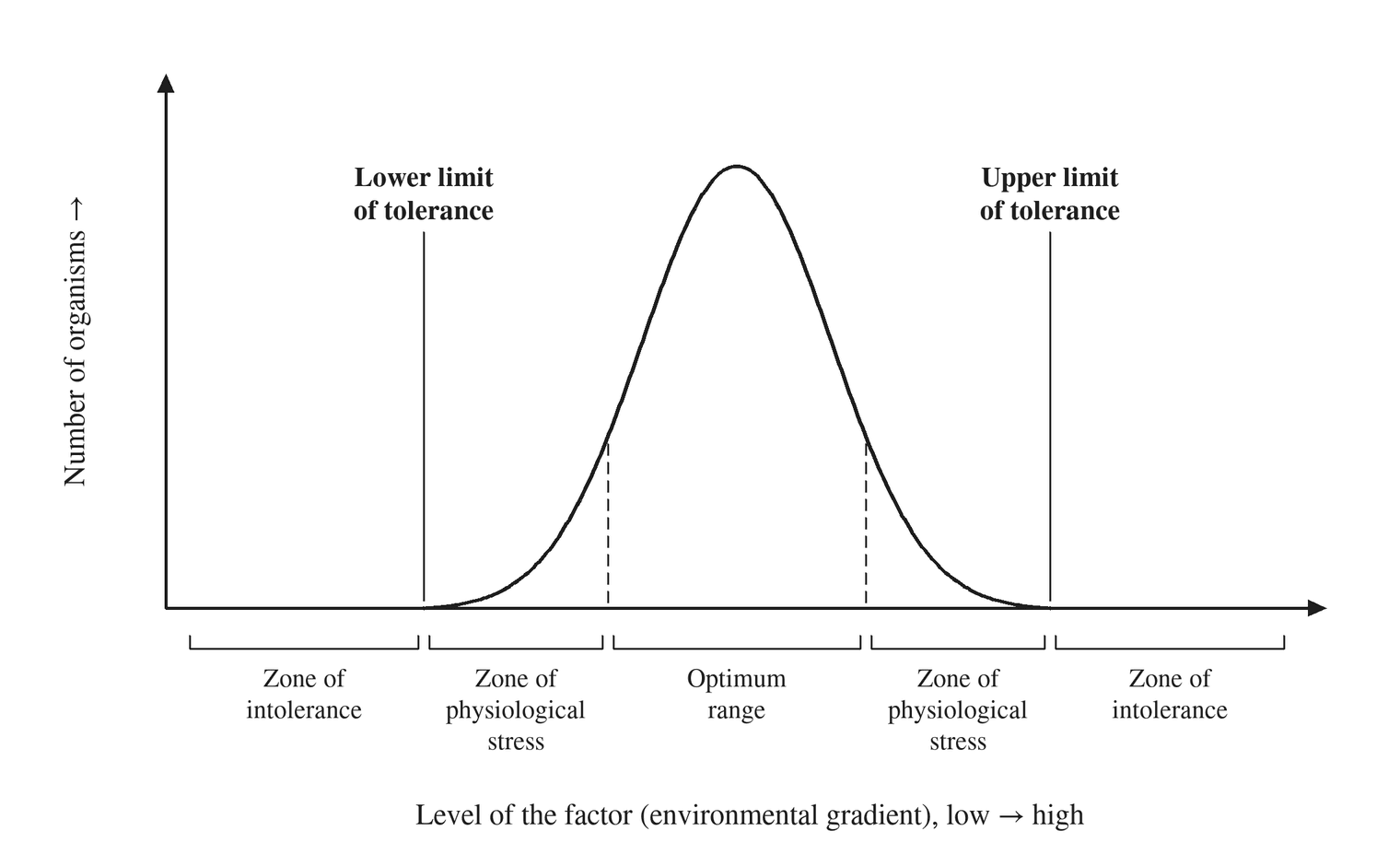
Step 2 — Explain the optimum range.
The middle of the bell is the optimum range. Here the factor is at the level best suited to the organism, so growth, reproduction and survival are highest and the organisms are most abundant.
Step 3 — Explain the zones of physiological stress.
On both sides of the optimum are the zones of physiological stress. The factor is somewhat too low on one side and too high on the other, so the organisms are under stress. Only a few survive here, and they grow and reproduce poorly.
Step 4 — Explain the zones of intolerance.
Beyond the stress zones are the zones of intolerance, where the factor is far too low or far too high. The organisms cannot survive there at all, so they are absent.
Step 5 — Explain the limits of tolerance.
The lower and upper limits of tolerance are the points where the stress zones meet the zones of intolerance. The distance between them is the range of tolerance. Species with a wide range are called eury- (for example eurythermal for temperature), and those with a narrow range are steno- (for example stenothermal).
Step 6 — Relate the curve to limiting factors.
A factor that is near or beyond a limit of tolerance limits the growth and spread of the population, even if all other factors are at their optimum. Such a factor is called a limiting factor, for example water in deserts or phosphorus for phytoplankton in many lakes.
Therefore, the bell-shaped curve of tolerance shows that organisms are most abundant in the optimum range of a factor, fewer in the zones of physiological stress on either side, and absent in the zones of intolerance beyond the lower and upper limits of tolerance.
- 1055 marks
Question 105
What are adaptations? How is cactus adapted to dry and hot conditions? How does CAM pathway help xerophytes? List the adaptations shown by animals living in arid regions.
Solve with AIWritten solution
Solution:
Key idea: An adaptation is any feature of an organism, of structure, physiology or behaviour, that helps it survive and reproduce in its habitat. Adaptations arise over many generations by natural selection. In hot deserts the main challenges are shortage of water and high daytime temperature.
Step 1 — Define adaptations.
Adaptations are morphological, physiological or behavioural features that enable an organism to live and reproduce successfully in its environment.
Step 2 — Explain how a cactus is adapted to dry, hot conditions.
A cactus has several water-saving features. Its leaves are reduced to spines, which cuts water loss by transpiration and protects it from grazing animals. Its thick, green, fleshy stem stores water and carries out photosynthesis instead of leaves. The stem has a thick, waxy cuticle and few, sunken stomata. Its roots are shallow and widely spread, so they quickly absorb rain water that soaks only a little way into the soil.
Step 3 — Explain how the CAM pathway helps xerophytes.
In CAM (crassulacean acid metabolism) plants, the stomata stay closed during the hot day and open at night, when it is cooler and the air is less dry, so far less water is lost. At night carbon dioxide is taken in and stored as malic acid in the vacuoles. During the day the malic acid releases the carbon dioxide inside the leaf or stem, and it is used in the Calvin cycle with the stomata closed. So the plant can photosynthesise while losing very little water.
Step 4 — Describe the adaptations of the kangaroo rat.
The kangaroo rat of North American deserts can live without drinking water. It meets its water needs from the metabolic water formed when it oxidises its food. Its kidneys produce very concentrated urine and it passes almost dry faeces. It stays in a cool, moist underground burrow by day and comes out at night (nocturnal).
Step 5 — Describe the adaptations of the camel.
A camel can go about two weeks without drinking in hot weather and can tolerate losing water equal to about a quarter or more of its body mass, far more than most mammals. It then drinks very quickly; over 100 litres in about 10 minutes has been recorded. It lets its body temperature rise by about 6 °C during the day (from about 34–35 °C in the cool morning to about 40–41 °C), so it stores heat instead of sweating it away. A camel does have sweat glands, but it starts to sweat only near this upper limit, and it loses the stored heat in the cool night. It passes little, concentrated urine and dry faeces. Its hump stores fat, not water, and its thick fur on the back shields it from the sun.
Step 6 — Describe behavioural adaptations of desert lizards.
Desert lizards have no physiological way of keeping a constant body temperature, so they control it by behaviour. They bask in the sun to warm up when their body temperature is low and move into shade or burrows when it becomes too hot.
Therefore, adaptations are features that help organisms live in their environment; a cactus saves water with spines, a fleshy stem, waxy cuticle and sunken stomata; CAM lets xerophytes take in carbon dioxide at night with little water loss; and desert animals save water and avoid heat through metabolic water, concentrated urine, dry faeces, nocturnal habits and behavioural temperature control.
- 1065 marks
Question 106
List a few adaptations found in submerged hydrophytes. What are the special adaptations found in the mangrove plants?
Solve with AIWritten solution
Solution:
Key idea: Hydrophytes live where water is plentiful but oxygen and light are limited. Mangroves are halophytes that grow in salty, waterlogged coastal mud, which is poor in oxygen and physiologically dry because the salt makes water hard to absorb.
Step 1 — Describe the stem of submerged hydrophytes.
Submerged hydrophytes such as Hydrilla, Vallisneria and Potamogeton have thin, soft stems with large air spaces (aerenchyma). The air spaces keep the plant buoyant and store oxygen and carbon dioxide for respiration and photosynthesis. Supporting tissues and xylem are poorly developed, since the water supports the plant.
Step 2 — Describe the leaves of submerged hydrophytes.
The leaves are thin and narrow, finely divided or ribbon-like (Vallisneria), so they offer little resistance to flowing water and absorb gases and minerals over their whole surface. They have no cuticle and no stomata, since water loss is not a problem and gases diffuse directly into the cells.
Step 3 — Describe the roots of submerged hydrophytes.
The roots are poorly developed and are mainly for anchorage, because water and minerals are absorbed over the whole surface of the plant. Root hairs are usually absent.
Step 4 — Describe the roots of mangroves.
Mangroves such as Rhizophora have stilt and prop roots that grow down from the stem and branches and anchor the plant in the soft, shifting mud. Avicennia has pneumatophores, which are roots that grow upwards out of the mud (negatively geotropic). Their many pores (lenticels) take in air, because the waterlogged mud has almost no oxygen.
Step 5 — Describe vivipary in mangroves.
In mangroves such as Rhizophora the seed germinates while the fruit is still attached to the parent plant. This is vivipary. The seedling grows a long root, and when it drops it can lodge in the mud or float until it settles. Germinating on the parent protects the young seedling from the salty water and gives it a head start in the tidal mud.
Step 6 — Describe how mangroves cope with salt.
Mangroves deal with the salt in several ways. Some keep most salt out at the root surface (Rhizophora), some get rid of salt through salt glands on the leaves (Avicennia), and many have succulent leaves that dilute the salt. They also build up compatible solutes such as proline in their cells.
Therefore, submerged hydrophytes have aerenchyma, thin leaves without cuticle or stomata and poorly developed roots, while mangroves have stilt roots, pneumatophores, vivipary and salt-excluding or salt-secreting features.
- 1075 marks
Question 107
Explain the significance of mycorrhizae for plants growing in oligotrophic soil. Enumerate the adaptations shown by animals to resist and survive in extreme colds.
Solve with AIWritten solution
Solution:
Key idea: Mycorrhizae are mutualistic associations between fungi and the roots of plants, in which the fungus helps the plant absorb water and minerals and the plant gives the fungus sugars. Animals of very cold regions survive by keeping heat in, by tolerating or avoiding freezing, or by escaping the cold.
Step 1 — Describe oligotrophic soil.
Oligotrophic soils are very poor in nutrients. In tropical rainforests, for example, heavy rain washes (leaches) minerals out of the soil, and most nutrients are held in the living plants rather than in the soil.
Step 2 — Explain how mycorrhizae help plants in such soil.
The fungal hyphae spread far beyond the root and greatly increase the absorbing surface. They take up water, phosphorus, nitrogen and other minerals and pass them to the plant, while the plant gives the fungus carbohydrates. The hyphae also capture nutrients released from decaying litter before rain can wash them away.
Step 3 — Describe the two types of mycorrhizae.
Ectomycorrhizae form a sheath around the root and grow between the outer cells; they are found in pines, oaks and Eucalyptus and help absorb nitrogen and phosphorus from humus. Endomycorrhizae (arbuscular mycorrhizae) grow into the cells of the root cortex; they are found in most crop plants and mainly help phosphate uptake. Seedlings of pines planted in soil without their fungi grow poorly, which shows how much they depend on mycorrhizae.
Step 4 — Describe body features of animals that keep heat in.
Birds and mammals of cold regions have thick fur or feathers and a thick layer of fat (blubber in seals and whales) that insulate the body. They tend to have shorter ears and limbs than related species of warm regions (Allen's rule), which reduces the surface area through which heat is lost.
Step 5 — Describe freeze-tolerant animals.
Some cold-climate insects, intertidal snails and the wood frog can survive freezing of part of their body water. Ice-nucleating proteins in their body fluids make ice form slowly in the spaces outside the cells, not inside them. The cells lose some water and survive, because ice crystals inside cells would destroy them.
Step 6 — Describe freeze-avoiding animals.
Other insects avoid freezing altogether. Before winter they convert glycogen into glycerol and other sugar alcohols and make antifreeze proteins, which lower the freezing point of their body fluids so that they can stay unfrozen (supercooled) far below 0 °C. Polar fishes also have antifreeze proteins in their blood.
Step 7 — Describe escape from the cold.
Many animals avoid the coldest season instead of resisting it. Birds migrate to warmer regions, and animals such as bats, hedgehogs and ground squirrels hibernate, lowering their metabolic rate and body temperature until spring.
Therefore, mycorrhizae help plants of nutrient-poor soil by greatly increasing the absorption of water, phosphorus and nitrogen, and animals survive extreme cold by insulation and smaller extremities, by tolerating extracellular freezing, by antifreeze substances that prevent freezing, or by migration and hibernation.
- 1085 marks
Question 108
Explain Batesian mimicry with an example. What is migration? Explain with the help of an example.
Solve with AIWritten solution
Solution:
Key idea: In mimicry one species resembles another and gains protection from predators, which learn to avoid animals with a warning pattern after tasting a harmful one. Migration is a regular, seasonal movement of animals from one place to another and back.
Step 1 — Define Batesian mimicry.
In Batesian mimicry a harmless, palatable species (the mimic) resembles a harmful or distasteful species (the model) in colour, markings and shape.
Step 2 — Explain how Batesian mimicry protects the mimic.
A predator that has tasted the model and found it harmful learns to avoid that pattern, and so it also avoids the mimic. Only the mimic gains from the resemblance. For example, harmless hoverflies have the yellow-and-black stripes of stinging wasps, and some female Common Mormon butterflies (Papilio polytes) look like the distasteful Common Rose butterfly. Among snakes, the harmless common wolf snake looks like the venomous common krait.
Step 3 — Define migration.
Migration is the regular movement of animals, at particular times of the year, from one region to another in search of food, a better climate or a breeding place, followed by a return to the original region when conditions there become favourable again. Migrating animals often build up fat reserves before the journey and use them as fuel.
Step 4 — Explain migration with an example.
The Arctic tern breeds in the Arctic during the northern summer and flies south to spend the southern summer in Antarctic waters, then returns north again. Tracking studies published in 2010 showed that each bird travels on average about 70,000 km a year, the longest known migration of any animal. It moves to where long daylight and plentiful food are available at each end of the earth.
Step 5 — Give an example from India.
Every winter, ducks, geese, waders and other birds from Siberia and Central Asia migrate to Indian wetlands such as Keoladeo National Park, Bharatpur, to escape the severe cold, and return north when summer begins.
Note: Older textbooks give the Viceroy butterfly mimicking the Monarch as Batesian mimicry, but tests in 1991 showed that Viceroys are also distasteful, so that pair is now treated as Müllerian mimicry. Siberian cranes once wintered at Keoladeo but have not been seen in India since about 2002.
Therefore, Batesian mimicry is the resemblance of a harmless species to a harmful one, which protects the mimic (as in hoverflies resembling wasps), and migration is the seasonal movement of animals to a better place and back, as in the Arctic tern and the winter birds of Keoladeo.
- 1095 marks
Question 109
How do living organisms maintain homeostasis? Explain briefly with respect to:
(i) regulators,
(ii) conformers,
(iii) migration,
(iv) suspension.
Solve with AIWritten solution
Solution:
Key idea: Homeostasis is the maintenance of a nearly constant internal environment (body temperature, osmotic concentration and so on) in spite of changes outside. Organisms respond to stressful changes in their abiotic environment in four ways: they regulate, conform, migrate or suspend activity. Only regulators truly maintain homeostasis; the other three are ways of coping with the stress.
Step 1 — Explain how regulators respond.
Regulators keep their body temperature and osmotic concentration constant by physiological (and sometimes behavioural) means. All birds and mammals, and very few other vertebrates and invertebrates, can do this. Humans keep a body temperature of about 37 °C: in hot weather they sweat, and evaporation of sweat cools the body; in cold weather they shiver, which produces heat. Plants have no such mechanism to keep their internal temperature constant.
Step 2 — Explain how conformers respond.
Conformers cannot keep their internal environment constant, so their body temperature or osmotic concentration changes with the surroundings. About 99 % of animals and nearly all plants are conformers. Regulation costs a lot of energy, especially for small animals: a small body has a large surface area for its volume and loses heat fast, so shrews and hummingbirds must spend much energy to stay warm and are rarely found in polar regions. Some organisms are partial regulators, regulating over a limited range and conforming beyond it.
Step 3 — Explain migration as a response.
An organism can move temporarily from a stressful habitat to a more favourable one and return when the stressful period is over. For example, thousands of birds from Siberia and other northern regions come to Keoladeo National Park, Bharatpur, every winter to escape the extreme cold.
Step 4 — Explain suspension as a response.
Some organisms survive a stressful period by slowing or stopping their activity. Bacteria, fungi and lower plants form thick-walled spores, and seeds of higher plants stay dormant with a very low metabolism until conditions improve. Some animals such as bears go into a winter sleep (hibernation), some snails and fishes go into a summer sleep (aestivation), and many zooplankton species in lakes and ponds enter diapause, a stage of suspended development.
Therefore, regulators maintain homeostasis by physiological means such as sweating and shivering, conformers let their internal conditions change with the environment, and other organisms cope with stress by migrating to a better place or by suspending activity through dormancy, hibernation, aestivation or diapause.
- 1105 marks
Question 110
List three important adaptation in each of the following:
(i) halophytes,
(ii) submerged plants,
(iii) drought-enduring plants,
(iv) heliophytes,
(v) plants in oligotrophic soils.
Solve with AIWritten solution
Solution:
Key idea: Each group of plants has adaptations to the main stress of its habitat: salt for halophytes, lack of oxygen and light for submerged plants, lack of water for drought-enduring plants, strong light for heliophytes, and lack of nutrients for plants of oligotrophic soils.
Step 1 — List three adaptations of halophytes.
Halophytes grow in salty soil, where water is hard to absorb. Three of their adaptations are as follows.
- Many are succulent, with fleshy stems or leaves that store water and dilute the salt.
- They remove salt through salt glands on the leaves (Avicennia) or keep it out at the roots (Rhizophora).
- They build up compatible solutes such as proline and sorbitol in their cells, so they can still draw water from salty soil. (Mangroves also have pneumatophores, stilt roots and vivipary.)
Step 2 — List three adaptations of submerged plants.
Submerged plants live under water, where oxygen and light are limited. Three of their adaptations are as follows.
- Stems and leaves have large air spaces (aerenchyma) for buoyancy and for storing gases.
- Leaves are thin, narrow or ribbon-like and have no cuticle or stomata, so they absorb gases and minerals over their whole surface.
- Roots are poorly developed and mainly for anchorage, usually without root hairs.
Step 3 — List three adaptations of drought-enduring plants.
Drought-enduring plants survive long dry periods. Three of their adaptations are as follows.
- Long tap roots reach deep water, as in Prosopis and Acacia.
- Leaves are small or shed in the dry season, as in Acacia nilotica, or the plant is almost leafless with a green stem, as in Capparis decidua, which reduces transpiration.
- A thick, waxy cuticle and few, sunken stomata reduce water loss, and growth is slow during drought.
Step 4 — List three adaptations of heliophytes.
Heliophytes grow in full sunlight. Three of their adaptations are as follows.
- They have high rates of photosynthesis and respiration and need high light to grow well.
- Their leaves are thick, with a thick cuticle and well-developed, often several-layered palisade tissue.
- Many have strong, woody stems and a large crown that exposes the leaves to the sun, as in mango, neem and peepal.
Step 5 — List three adaptations of plants in oligotrophic soils.
Plants of nutrient-poor soils must get and keep scarce minerals. Three of their adaptations are as follows.
- Their roots form mycorrhizae, whose fungal hyphae absorb water, phosphorus and nitrogen from a much larger volume of soil.
- Many have a dense mat of fine roots near the surface that quickly takes up nutrients released from decaying litter, and they withdraw nutrients from old leaves before shedding them.
- Some get nitrogen in other ways: legumes have nitrogen-fixing root nodules, and insectivorous plants such as Drosera and Nepenthes digest insects.
Therefore, halophytes are succulent with salt glands and compatible solutes; submerged plants have aerenchyma, thin leaves without stomata and weak roots; drought-enduring plants have deep roots, small or shed leaves and a waxy cuticle; heliophytes have thick sun leaves and high photosynthetic rates; and plants of oligotrophic soils use mycorrhizae, surface root mats and other sources of nitrogen.
What Class 12 Biology Ch 17 covers
The sections of the chapter, in the order the book takes them. Every question above comes from one of these.
- 01Ecology and Levels of Organisation
- 02Organism and Its Environment
- 03Major Biomes
- 04Major Abiotic Factors
- 05Responses to Abiotic Factors and Range of Tolerance
- 06Ecological Adaptations
- 07Population Study
More ways to study this chapter
The same chapter asked three other ways. Practise it, revise it, and see what the board has set on Ch 17 before.
- Competency-Based Questions (CBQ)Case study questions: a situation, and the part of the chapter that answers it.40questionsOpen
- Previous Year QuestionsQuestions that have actually appeared in board papers, each tagged with its year.24questionsOpen
- Practice QuestionsExtra questions per chapter, for when one attempt at a method is not enough.163questionsOpen
Ch 17 in past ISC papers
The same chapter as the board has actually asked it. These are worded differently from the textbook exercise, which is the point of reading them.
- 11 mark
Board paper question 1
Give a scientific term for each of the following:
An animal behaviour which benefits others but is of no advantage to itself.
Solve with AIWritten solution
Solution:
Key idea: Behaviour in which an animal helps others of its own kind at a cost to itself has a special name in population ecology.
Step 1 — Recognise the behaviour.
The animal gains nothing for itself, and may even lose food, safety or its life, while other individuals benefit. Examples are worker honeybees that sting an intruder and die, or a bird giving an alarm call that draws a predator towards itself.
Step 2 — Name it.
Such self-sacrificing behaviour is called altruism. It usually helps close relatives, which share many of the same genes, so those genes still pass on (kin selection).
Therefore, the term is altruism (altruistic behaviour).
- 21 mark
Board paper question 2
Give a brief answer for each of the following:
What is symbiosis?
Solve with AIWritten solution
Solution:
Key idea: Organisms of different species often live in close physical association; the word "symbiosis" means "living together".
Step 1 — Define the term.
Symbiosis is a close and long-lasting association between individuals of two different species living together.
Step 2 — Give the common usage with an example.
In most ISC textbooks the word is used for an association in which both partners benefit (mutualism), for example a lichen, where a fungus gives shelter and absorbs water and minerals while an alga makes food by photosynthesis, or mycorrhiza (fungus with plant roots).
Note: In a broad sense, ecologists also include commensalism and parasitism under symbiosis, since these too are close associations of two species.
Therefore, symbiosis is a close, long-term association of two different species living together, usually to the benefit of both, as in lichens.
- 31 mark
Board paper question 3
Each of the following question(s)/statement(s) has four suggested answers. Choose the correct option in each case.
Type of Interaction where an individual sacrifices its own welfare (life) for the benefit of another animal of its own species is:
Solve with AIAnswer
- Correct
(A) Altruism
(B) Scavenging
(C) Protocooperation
(D) Commensalism
Answer: (A) Altruism
Key idea: Interactions within one species (intraspecific) include competition, cooperation and altruism. In altruism an individual lowers its own welfare, even its life, to help another member of its species.
Step 1 — Read what the stem describes.
The individual sacrifices its own welfare for the benefit of another animal of its own species.
Step 2 — Match it to the term.
This self-sacrifice is altruism, for example sterile worker bees defending the hive.
Why the others are wrong:
- (B) Scavenging is feeding on dead animals or remains; it gives no sacrifice for another individual.
- (C) Protocooperation is an interaction between two different species in which both gain, but neither depends on it; nobody sacrifices.
- (D) Commensalism is an interaction between two different species in which one gains and the other is neither helped nor harmed.
Therefore, the interaction is altruism, option (A).
- 41 mark
Board paper question 4
Give a reason for each of the following :
Equilibrium of a forest ecosystem can be disturbed by uncontrolled hunting of big predators.
Solve with AIWritten solution
Solution:
Key idea: Predators keep the populations of their prey under control. They are a natural check that links the trophic levels of a forest.
Step 1 — State the role of big predators.
Big predators such as tigers and leopards feed on herbivores like deer. They keep herbivore numbers close to what the vegetation can support.
Step 2 — Explain what happens when they are hunted out.
If the predators are removed by uncontrolled hunting, the herbivore population grows unchecked. The large herbivore population overgrazes the plants, the vegetation is destroyed, food runs out and the soil is exposed, so many other species lose their food and shelter.
Therefore, uncontrolled hunting of big predators lets herbivore numbers explode, which leads to overgrazing and upsets the balance of the forest ecosystem.
- 51 mark
Board paper question 5
Give one significant contribution of each of the following scientist:
R. Mishra
Solve with AIWritten solution
Solution:
Key idea: Professor Ramdeo Misra (often written R. Mishra) of Banaras Hindu University is revered as the Father of Ecology in India.
Step 1 — State his main contribution.
He built up ecology as a science in India. Under his leadership research was done on the ecology of tropical plant communities and their succession, on the responses of plant populations to their environment, and on productivity and nutrient cycling in tropical forest and grassland ecosystems.
Step 2 — Add his other contributions.
He framed the first postgraduate course in ecology in India, and his efforts led to the setting up of the National Committee for Environmental Planning and Coordination (1972), which paved the way for the Ministry of Environment and Forests, set up in 1985 (now the Ministry of Environment, Forest and Climate Change).
Note: Some textbooks give the year of the ministry as 1984; it was formed in 1985, from the Department of Environment set up in 1980.
Therefore, R. Mishra (Ramdeo Misra), the Father of Indian Ecology, pioneered research on tropical plant communities, productivity and nutrient cycling, and laid the base for environmental planning in India.
- 61 mark
Board paper question 6
Define the following
Carrying Capacity
Solve with AIWritten solution
Solution:
Key idea: Every habitat has limited resources (food, space, water), so it can support only a certain number of individuals of a species.
Step 1 — Define the term.
Carrying capacity is the maximum number of individuals of a species that a habitat can support indefinitely with its available resources.
Step 2 — Link it to population growth.
It is shown by the letter K. In logistic growth, the population rises and then levels off at K, where births balance deaths.
Therefore, carrying capacity (K) is the largest population size that the resources of a habitat can sustain for a long time.
All 24 board paper questions for this chapter, solved the same way.
Class 12 Biology Ch 17 questions students ask
How many questions are there in Class 12 Biology Ch 17?
110 questions. Every one is solved step by step on this page.
Are these Class 12 Biology solutions free?
Yes. Every question and its full working is free to read, with no account needed.
Can I download the Class 12 Biology Ch 17 solutions as a PDF?
There is no PDF to download. Every solution is on this page instead, which means it is searchable, always the current syllabus, and readable on a phone. Use your browser's print option if you want it on paper.