
Opening your dashboard
Class 12 Biology Chapter 17 Organisms and Populations: Practice Questions
163 questions on Chapter 17, each worked through on its own page with the AI tutor. Class 12 Biology, ICSE 2026-27.
163 questions
1–10 marks · Mixed difficulty
- 11 mark
Question 1
Ecological (higher) levels of organisation form a hierarchy from the organism up to the biosphere. Which statement about this hierarchy is correct?
- 22 marks
Question 2
Name the branch of ecology to which each study belongs.
(a) A scientist compares the genetic make-up of rice populations growing in saline fields with that of rice populations growing in non-saline fields.
(b) A forest department plans how the land, water and timber of a forest can be managed properly for the benefit of people.
- 33 marks
Question 3
A school pond contains water lilies, fish, frogs and snails. Its other parts are the water, the mud at the bottom and the air above it.
(a) Which of these together form the biotic community of the pond?
(b) Which of these are its abiotic components?
(c) The pond, taken as an ecosystem, is called an open system. What does this mean in terms of its energy?
- 41 mark
Question 4
A student says two warbler populations in a forest cannot belong to two different species because they occupy exactly the same ecological niche. Which way of defining a species is the student using?
- 51 mark
Question 5
Environmental change is studied on different time scales. On which time scale do the green-house effect and global warming fall?
- 62 marks
Question 6
On the same afternoon, a student records the conditions on the floor of a dense forest and in an open clearing next to it. Give two ways in which the forest floor would differ from the clearing, and the reason for the difference.
- 73 marks
Question 7
A clean, fast-flowing stream is rich in dissolved oxygen. It has both mayfly nymphs and Tubifex worms. Sewage is later released into one part of the stream, and the oxygen content of the water there falls sharply.
(a) Which of the two animals is more likely to remain in the polluted part? Give a reason.
(b) Why is the other animal likely to disappear from that part?
(c) The Tubifex worms live in the soft mud of the stream bed. What name is given to such a small area within a habitat whose special conditions suit particular organisms?
- 82 marks
Question 8
State whether each statement describes weather or climate, and give a reason.
(a) In Mumbai, the sky was cloudy and a strong wind blew all of Tuesday afternoon.
(b) Mumbai receives most of its rain from June to September every year.
- 93 marks
Question 9
The table gives the climate of three forest sites in India. (Hypothetical data.)
Site Mean annual temperature (°C) Mean annual rainfall (mm) Dry months in the year X 25 2,800 2 Y 30 1,200 7 Z 12 700 4 A dry month is one in which rainfall is less than 50 mm. Name the forest type found at each site, using these typical ranges:
Forest type Temperature (°C) Rainfall (mm) Dry months Tropical rainforest 23–27 2,000–3,500 2–3 Tropical deciduous forest 22–32 900–1,600 6–8 Temperate broad-leaf forest 6–20 1,000–2,500 3–5 Temperate needle-leaf forest 6–15 500–1,700 3–5 - 101 mark
Question 10
A class visits a sal and teak forest in the plains of India. Which feature are they most likely to record there?
- 111 mark
Question 11
A hot desert near the Tropic of Cancer receives about 95 mm of rain a year. On the basis of its rainfall, it is classed as
- 122 marks
Question 12
Give reasons:
(a) Grasses remain the dominant plants of a grassland, and woody plants do not take over.
(b) A grassland receiving 70 cm of rain a year produces more plant matter than one receiving 30 cm.
- 131 mark
Question 13
A town at 1,000 m altitude has an air temperature of 30 °C. Temperature falls by 6.5 °C for every 1,000 m rise in height. What is the expected temperature at the same time at a hill station 3,500 m above sea level?
- 142 marks
Question 14
Water is one of the most important abiotic factors. Give two reasons why, one concerning the body of an organism and one concerning the climate.
- 153 marks
Question 15
The temperature range in which three animals P, Q and R can live is given below. (Hypothetical data.)
Animal Lowest temperature tolerated (°C) Highest temperature tolerated (°C) P 6 36 Q 1 3 R 10 14 (a) Which animal is eurythermal? Show the width of its range.
(b) Which animals are stenothermal?
(c) Which animal is likely to have the widest geographical distribution? Give a reason.
- 161 mark
Question 16
A deep pond receives a heavy load of organic waste from a nearby dairy. Which abiotic factor is most likely to become limiting for the animals living in it?
- 171 mark
Question 17
Along a slope from wet to dry soil, a shrub species is found at one site with only a few plants, which survive with difficulty and seldom reproduce. On the range-of-tolerance curve, this site lies in the
- 184 marks
Question 18
Organisms cope with stressful conditions by regulating, conforming, migrating or suspending activities. Name the way shown in each case.
(a) A person shivers on a very cold morning, and the shivering produces heat.
(b) Birds from Siberia arrive at the Keoladeo National Park, Bharatpur, in the Indian winter and return when summer sets in.
(c) A mango tree has no mechanism to keep its temperature constant; the temperature of its leaves rises and falls with the air temperature.
(d) Snails go into a summer sleep to escape heat and desiccation.
- 192 marks
Question 19
In autumn, a female insect lays eggs that stop developing and do not hatch until the next favourable season.
(a) Name this state of suspended development.
(b) State two warning signals that the insect receives before it enters this state.
- 201 mark
Question 20
Phytoplankton in a deep lake grow poorly even though light and temperature at the surface suit them. According to the idea of a limiting factor, which factor is most likely to be in the least amount?
- 214 marks
Question 21
Draw a labelled graph to show how the population size of an organism changes along the gradient of a single environmental factor, such as temperature. Mark the optimum range, the stress zones and the zones of intolerance.
- 223 marks
Question 22
Plants of one species growing on a river bank are tall with broad leaves, while plants of the same species on a dry slope are short with small leaves. Seeds from both places are sown side by side in the same garden. (Hypothetical example.)
(a) If the plants from both sets of seeds grow alike in the garden, what explains the difference seen in the wild?
(b) If the two sets still differ in the garden, but can interbreed, what are the two populations called?
(c) In which of the two cases is there a genetic difference between the populations?
- 231 mark
Question 23
On a halophyte growing in a tidal marsh, white salt crystals are often seen on the surface of the leaves. This shows that the plant copes with salt by
- 243 marks
Question 24
An aquatic plant grows fully under water. It has thin, ribbon-like long leaves, stem stalks with long tunnels of air spaces, no cuticle or stomata, and a poorly developed root system.
(a) To which group of hydrophytes does it belong?
(b) Name one plant with these features.
(c) State one way in which the air spaces help the plant.
- 251 mark
Question 25
In a section of a plant root, fungal hyphae are found inside the cells of the root cortex, and very little fungus is seen outside the root. Which statement about this association is correct?
- 261 mark
Question 26
A rectangular grassland plot measures 20 m by 10 m. A count shows 600 plants of one grass species in it (hypothetical data). What is the population density of this grass?
- 273 marks
Question 27
A wildlife sanctuary has 800 spotted deer at the start of a year. During the year 120 fawns are born, 30 deer arrive from a nearby forest and settle, 70 deer die and 40 deer leave the sanctuary permanently (hypothetical data).
(i) Calculate the population at the end of the year.
(ii) Is the population increasing or decreasing? Give the reason in terms of organisms added and lost.
(iii) In the next year 100 are born, 20 arrive, 90 die and 30 leave. What kind of growth is this, and what is the population at the end of that year?
- 283 marks
Question 28
During the rainy season an insect population grows with no check from environmental resistance. Its intrinsic rate of natural increase is per week (hypothetical data).
(i) Find the rate of increase of the population when it has 500 insects.
(ii) Find the rate when it has 2000 insects.
(iii) What shape of growth curve does this give, and why can such growth not go on for ever?
- 294 marks
Question 29
A deer population in a forest shows logistic growth with carrying capacity and per year (hypothetical data).
(i) Find the rate of growth when .
(ii) Find it when .
(iii) Find it when .
(iv) What is the rate when reaches 1000, and what is this phase of the curve called?
- 301 mark
Question 30
The table gives the percentage of individuals in each ecological age group in four populations (hypothetical data).
Population Pre-reproductive Reproductive Post-reproductive P 45% 40% 15% Q 33% 34% 33% R 50% 35% 15% S 15% 35% 50% Which population is declining?
- 311 mark
Question 31
Which of the following events, on its own, does NOT change the size of a population when counted over a whole year?
- 321 mark
Question 32
Which pair of organisms breeds only once in its lifetime?
- 333 marks
Question 33
Species X releases about two million tiny eggs each time it spawns. Species Y produces a single large offspring at a time (hypothetical data).
(i) Name the reproductive strategy of each species.
(ii) Give one example from each group.
(iii) What are populations trying to maximise when they evolve such different strategies?
- 341 mark
Question 34
Which feature is true of a territory but NOT of a home range?
- 353 marks
Question 35
A worker honey bee returns to the hive and dances on the vertical comb in a figure of eight. The straight waggle run in the centre of the figure points 60° to the right of the vertical line (hypothetical example).
(i) What does the angle of the waggle run tell the other workers?
(ii) Which feature of the dance tells them how far away the food is?
(iii) What would the bees learn if the worker had performed a round dance instead?
- 362 marks
Question 36
Give reasons:
(i) A pecking order in a flock of hens is useful to the flock.
(ii) When seeds of one plant fall very close together, many of the seedlings remain weak and die.
- 371 mark
Question 37
Which of the following is correctly matched with its kind of group formation?
- 382 marks
Question 38
A female monkey regularly carries and cares for the baby of her sister.
(i) Name this kind of behaviour.
(ii) How does it benefit the helper genetically?
- 391 mark
Question 39
Goats were introduced on Pinta (Abingdon) Island in the Galapagos in 1959, where the Abingdon tortoise lived. The goats browsed the island's plants far more efficiently than the tortoises, and by the early 1970s only one tortoise of this kind was left on the island. Which idea explains the loss of the tortoises?
- 403 marks
Question 40
In a laboratory test (hypothetical example), termites whose gut protozoa (Trichonympha) had been removed were given only wood to eat. They could not obtain nourishment from the wood.
(i) Name the interaction between the termite and Trichonympha.
(ii) Explain why the termites could not use the wood.
(iii) What does Trichonympha gain from the termite?
- 411 mark
Question 41
In a field experiment on a rocky sea coast, all the starfish Pisaster were removed from an intertidal area and kept out. Within a few years about half of the invertebrate species living there had disappeared from the area, as mussels spread over the rock. What does this show?
- 423 marks
Question 42
A tapeworm living in the human intestine has no digestive system, has a scolex with hooks and suckers, and is covered by a tough outer body covering (tegument). Explain how each feature helps it to live in its host.
- 432 marks
Question 43
The malarial parasite Plasmodium spends part of its life in the female Anopheles mosquito, yet malaria is a disease of humans.
(i) What role does the mosquito play?
(ii) Describe how the parasite passes from one person to another.
- 441 mark
Question 44
Two closely related species of flour beetle are kept together in a laboratory (hypothetical data). When fresh flour is added in excess every day, both species survive for months. When only a small fixed amount of flour is given, one species dies out within a few weeks. What does this show?
- 451 mark
Question 45
A student climbs down an observation tower in a well-developed rainforest. Just after passing below the dense canopy, which stratum of vegetation does the student reach first?
- 463 marks
Question 46
In a forest, pine trees far outnumber all other plants. A few beavers living in a stream of the same forest build dams that turn parts of the stream into ponds used by many plants and animals (hypothetical example).
(i) Which is the dominant species and what will the community be called?
(ii) Which is the keystone species? Give a reason.
(iii) What would happen to the community if the beavers were removed?
- 472 marks
Question 47
A survey records 40 species in a forest, 30 species in the adjoining grassland and 52 species in the transition zone between them. Six of the 52 species are found only in the transition zone (hypothetical data).
(i) Why does the transition zone have more species than either community?
(ii) What are species like the six called?
- 482 marks
Question 48
A forest of tall trees and a grassland lie side by side.
(i) What determines the physiognomy of a community?
(ii) Compare the physiognomy of the two communities.
- 493 marks
Question 49
Twenty quadrats were laid at random in a meadow. Species A was present in 15 quadrats, species B in 6 and species C in all 20 (hypothetical data).
(i) Calculate the frequency of species A and species B.
(ii) What is the frequency of species C, and what does it tell you?
(iii) Is frequency an analytic or a synthetic character? Is it qualitative or quantitative?
- 501 mark
Question 50
Which of these community characters is a qualitative analytic character?
- 511 mark
Question 51
The outward movement of members of a species is known as
- 521 mark
Question 52
The natality is also known as
- 531 mark
Question 53
The maximum capacity of an organism to reproduce or increase in number is termed as
- 541 mark
Question 54
A stronger species like lion and deer being benefitted at the cost of another weak species is an example of
- 551 mark
Question 55
The relationship of sea anemone and hermit crab is called
- 561 mark
Question 56
The interaction of Rhizobium with root nodules of legume plants is called
- 571 mark
Question 57
In commensalism, the relationship of species A and species B is such that
- 581 mark
Question 58
Community is defined as aggregation of
- 591 mark
Question 59
Parasite can be explained as an organism which depends on others
- 601 mark
Question 60
Select the statement which best explains parasitism
- 611 mark
Question 61
A group of individuals inhabiting a particular area form a
- 621 mark
Question 62
A large regional, terrestrial unit characterised by a major vegetation type and associated fauna forms
- 631 mark
Question 63
The short-term changes of the atmosphere at a given place and time form the
- 641 mark
Question 64
The functional role of an organism in the ecological system is referred as
- 651 mark
Question 65
A thin layer of ozone is present in
- 661 mark
Question 66
In troposphere, the temperature
- 671 mark
Question 67
Which of the following is photosynthetically active radiation?
- 681 mark
Question 68
The shallow water zone around the edge of the lake is called
- 691 mark
Question 69
Another term for cold-blooded animals is
- 701 mark
Question 70
During summer stratification, the upper layer of water is called
- 711 mark
Question 71
Upper limit of water availability in the soil is also called
- 721 mark
Question 72
The fresh leaves and recognisable litter are found in the following horizon of soil
- 731 mark
Question 73
Genetically adapted local populations of a species (that have a wide range of distribution) are called
- 741 mark
Question 74
Plants adapted to shade or low intensity are called
- 751 mark
Question 75
Sunken stomata can be seen in
- 761 mark
Question 76
Pneumatophores are special features of plants growing in
- 771 mark
Question 77
Adaptation to low temperature and freezing in animals occurs due to the production of
- 781 mark
Question 78
________ refers to the increase in number of individuals by birth, hatching or germination.
- 791 mark
Question 79
The environmental check on population size is called ________.
- 801 mark
Question 80
The maximum number of individuals of a population that can be sustained in a given habitat represent its ________.
- 811 mark
Question 81
The aggregation of individuals of species is called ________.
- 821 mark
Question 82
The relationship where one organism is benefitted, while the other is neither benefitted nor harmed, is referred as ________.
- 831 mark
Question 83
Organisms preying on animals are called ________.
- 841 mark
Question 84
An association of two species in which both species are benefitted is called ________.
- 851 mark
Question 85
In competition one of the species is benefitted and the other one is ________.
- 861 mark
Question 86
In symbiosis if one species is benefitted the other one is ________.
- 871 mark
Question 87
A parasite lives on another organism. The other organism is called ________.
- 881 mark
Question 88
Lichen is an example of ________.
- 891 mark
Question 89
The transition zone between two communities is known as ________.
- 901 mark
Question 90
________ is the transition layer between troposphere and stratosphere.
- 911 mark
Question 91
Visible light occurs in the wavelength of ________ nm.
- 921 mark
Question 92
Ozone layer absorbs ________ rays which on reaching earth are harmful to the organisms.
- 931 mark
Question 93
During summer, the upper warm layer of water is separated from the deeper cold water by a ________.
- 941 mark
Question 94
In ________ soils, the top soil has little or no humus.
- 951 mark
Question 95
Shade-tolerant plants are called ________ while the sun-adapted plants are called ________.
- 961 mark
Question 96
________ plants possess CAM pathway of photosynthesis.
- 971 mark
Question 97
Plants growing in nutrient-poor soils possess ________ which help in efficient absorption of nutrients.
- 981 mark
Question 98
An ecosystem consists of various biotic communities interacting with each other and influencing the environment.
- 991 mark
Question 99
Tropical rainforest biome in India are present in Assam in North–Eastern Himalaya and Western ghats.
- 1001 mark
Question 100
Eurythermal organisms are the ones that can tolerate only a narrow range of temperature.
- 1011 mark
Question 101
Hygroscopic water of soil is the most readily available water for the plants.
- 1021 mark
Question 102
Cold-blooded animals like frogs undergo winter sleep called hibernation.
- 1031 mark
Question 103
Benthic zone is a shallow zone near the edge of a lake.
- 1041 mark
Question 104
Halophytic plants occur in tidal marshes and mangroves.
- 1051 mark
Question 105
Lichens is an example of commensalism.
- 1061 mark
Question 106
A non-poisonous snake mimics the poisonous snake. It is an example of Mullerian mimicry.
- 1071 mark
Question 107
A zone where two communities meet and blend together is called ecotone.
- 1087 marks
Question 108
Match the following:
Column A Column B 1. Rhizobium in root nodules (a) Protocooperation 2. Sea anemone and hermit crab (b) Predator–prey 3. Epiphytes growing on trees (c) Keystone species 4. Tiger eating a deer (d) Mutualism 5. Cuscuta living on a flowering plant (e) Commensalism 6. Fig trees in a tropical rainforest (f) Ectoparasite 7. Leaf insect on a leaf (g) Camouflage - 10910 marks
Question 109
Match the following:
Column A Column B 1. Hydrophytes (a) Oligotrophic soil 2. Bat (b) Glycerol 3. Antifreeze (c) Aerenchyma 4. Mycorrhizae (d) Echolocation 5. Xerophytes (e) Succulents 6. Warm layer (f) Stratosphere 7. Dark region (g) Epilimnion 8. Ozone (h) Profundal zone 9. Halophytes (i) Shade tolerant 10. Sciophytes (j) Vivipary - 1101 mark
Question 110
A set of populations connected by dispersing individuals.
- 1111 mark
Question 111
Death rate of a population.
- 1121 mark
Question 112
Kind of association shown by sea anemone and hermit crab.
- 1131 mark
Question 113
Species having much greater influence on community, relative to their low abundance.
- 1141 mark
Question 114
Transition zone between two communities.
- 1151 mark
Question 115
Community characters that are derived from the measurement of analytic characters.
- 1161 mark
Question 116
Quantity of living material per unit area, indicating growth of a species.
- 1171 mark
Question 117
An interaction in which one species gets the benefit while the other neither gets benefit nor is harmed.
- 1181 mark
Question 118
Aerial respiratory roots present in plants growing in mangroves.
- 1191 mark
Question 119
Maximum size of the population that can be supported in a given habitat.
- 1201 mark
Question 120
Another term for cold-blooded animals.
- 1211 mark
Question 121
Maintenance of relatively constant internal environment.
- 1221 mark
Question 122
Dead and fallen leaves and partially decomposed plant and animal material.
- 1231 mark
Question 123
Gradual physiological adjustment to slowly changing new environment.
- 1241 mark
Question 124
Plants adapted to grow in saline environments.
- 1251 mark
Question 125
Mutualistic association of fungi and roots of higher plants.
- 1261 mark
Question 126
Movement of arctic tern in summer and autumn.
- 1271 mark
Question 127
Capacity to blend with surroundings.
- 1281 mark
Question 128
Palatable species mimics the distasteful model.
- 1291 mark
Question 129
Winter sleep during cold environment by certain animals.
- 1301 mark
Question 130
Assertion (A): Habitat is a specific place, locality or a portion of ecosystem where an organism can be found.
Reason (R): A habitat contains many niches and supports a variety of species.
- 1311 mark
Question 131
Assertion (A): Capillary water is readily available and easily utilised by the plants.
Reason (R): Capillary water fills the finer pores and is held around the soil particles by capillary forces against the force of gravity.
- 1321 mark
Question 132
Assertion (A): Species are groups of potentially interbreeding natural populations which are isolated from other such groups.
Reason (R): Distinctive morphological characters are displayed due to reproductive isolation.
- 1331 mark
Question 133
Assertion (A): Leaf butterfly and stick insect show mimicry to dodge their enemies.
Reason (R): Mimicry is a method to acquire body colour blending with the surroundings.
- 1341 mark
Question 134
Assertion (A): Acclimatisation is the gradual physiological adjustment of an organism in the slowly changing new environmental conditions.
Reason (R): An organism undergoes morphological, physiological and behavioural adaptations to survive well in an environment.
- 1351 mark
Question 135
Assertion (A): The prickly pear cactus introduced into Australia in early 1920s caused havoc by spreading rapidly.
Reason (R): When certain exotic species are introduced into a geographical area, they become invasive and start spreading fast because the invaded land does not have the natural predators.
- 1361 mark
Question 136
Assertion (A): The community of an ecotone commonly contains the organisms of each of the overlapping communities and in addition the organisms which are restricted to the ecotone.
Reason (R): The tendency for increased variety and density at community junctions is known as the edge effect.
- 1371 mark
Question 137
Assertion (A): The rate at which a population can be expected to grow in the future can be assessed graphically by means of a population pyramid.
Reason (R): A triangular population pyramid is characteristic of a country whose population is stable, neither growing nor shrinking.
- 1381 mark
Question 138
Assertion (A): Relationship between sea anemone and hermit crab is said to be an example of obligate mutualism.
Reason (R): Obligate mutualism is a negative harmful interaction between two species.
- 1391 mark
Question 139
Assertion (A): Competitive exclusion principle is the tendency for competition to bring about an ecological separation of closely related, or otherwise similar species.
Reason (R): If two species compete for the same resources, they could avoid competition by choosing different times for feeding or different foraging patterns.
- 1403 marks
Question 140
How is diapause different from hibernation?
- 1412 marks
Question 141
If a marine fish is placed in a freshwater aquarium, will the fish be able to survive? Why or why not?
- 1422 marks
Question 142
Define phenotypic adaptation. Give one example.
- 1432 marks
Question 143
Most living organisms cannot survive at temperature above 45°C. How are some microbes able to live in habitats with temperatures exceeding 100°C?
- 1442 marks
Question 144
List the attributes that populations but not individuals possess.
- 1453 marks
Question 145
Name important defence mechanisms in plants against herbivory.
- 1462 marks
Question 146
An orchid plant is growing on the branch of mango tree. How do you describe this interaction between the orchid and the mango tree?
- 1472 marks
Question 147
What is the ecological principle behind the biological control method of managing with pest insects?
- 1482 marks
Question 148
List the various abiotic environmental factors.
- 1492 marks
Question 149
Give an example for:
(i) An endothermic animal
(ii) An ectothermic animal
(iii) An organism of benthic zone
- 1502 marks
Question 150
Define population and community.
- 1511 mark
Question 151
Select the statement which explains best parasitism.
- 1522 marks
Question 152
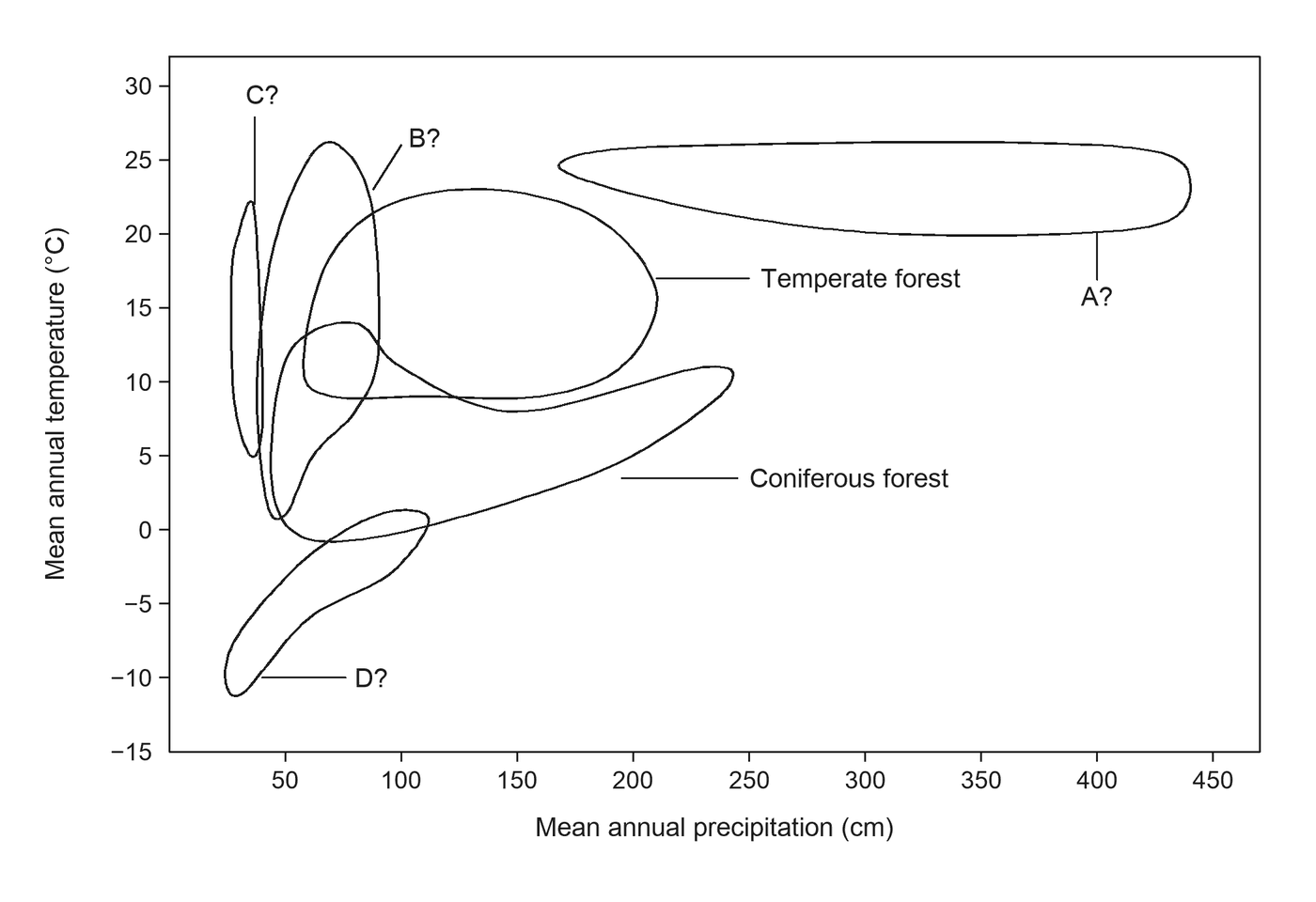
Identify the biome distribution with respect to annual temperature and precipitation from the following graph and identify A, B, C and D.
- 1532 marks
Question 153
From the following ecological pyramid find out the pyramid showing
(i) Range of environmental condition, beyond which they are stable population.
(ii) Out of A, B and C which is the declining population?

- 1542 marks
Question 154
Why small animals are rarely found in polar region?
- 1552 marks
Question 155
How does the special photosynthetic pathway like CAM supports desert plants?
- 1562 marks
Question 156
Name the type of population interaction A, B, C, D between the species A and B as per the tabular column given below.
Species A Species B Name of interaction + + A − − B + − C + − D - 1572 marks
Question 157
Why the male bee "pseudocopulates" with the flower of Mediterranean orchid?
- 1582 marks
Question 158
Five species of warblers co-existed on a tree without any sort of competition. How did they avoid competition?
- 1591 mark
Question 159
Define brood parasitism.
- 1601 mark
Question 160
Define stenothermal organisms.
- 1611 mark
Question 161
Which organisms constitute the last trophic level?
- 1621 mark
Question 162
Equilibrium of a forest ecosystem can be disturbed by uncontrolled hunting of big predators.
- 1632 marks
Question 163
Study the graph given below and answer the questions that follow:

(i) In the absence of predators which one of the two curves would appropriately depict the prey population? Give a reason.
(ii) Time has been shown on X-axis and there is a parallel dotted line shown above. Explain the significance of this dotted line.