
Opening your dashboard
Class 12 Biology Chapter 17 Organisms and Populations: Competency-Based Questions (CBQ)
40 questions on Chapter 17, each worked through on its own page with the AI tutor. Class 12 Biology, ICSE 2026-27.
40 questions
1–5 marks · Mixed difficulty
- 11 mark
Question 1
A satellite image of a district in the Western Ghats shows an area bounded naturally by a river on one side and a ridge of hills on the other. Inside it lies a patchwork of evergreen forest, grassland, tea gardens and a reservoir, each of which is an ecosystem by itself. In ecology, this whole unit is best called a
- 21 mark
Question 2
On a school field trip to a forest, students turn over a fallen, rotting log. Beneath it is a cool, damp and dark space where fungi, beetle larvae and earthworms live; just beside it, the open forest floor is drier and brighter, and these organisms are not found there. For these organisms, the space under the log is best described as
- 34 marks
Question 3
Students of a school in Dehradun trek up a slope in the western Himalayas and note the dominant trees at three stations. (Hypothetical observations.)
Station Altitude Dominant trees and what the students saw 1 600 m Sal (Shorea robusta) trees 10–20 m tall; many trees had shed their leaves in the dry summer; some trunks had thick bark with old fire marks 2 2,000 m Several oak (Quercus) species with broad, evergreen leaves; climbers and epiphytes common 3 2,800 m Pine, deodar and silver fir with long needle leaves and cone-shaped crowns (a) Name the type of forest at each station.
(b) The forest at Station 1 is grouped with the tropical forests, yet it is called deciduous. Explain why, and state the length of the dry season such a forest usually faces.
(c) Their teacher tells them that broad-leaf oak forests usually grow at 1,500–2,400 m and needle-leaf forests at 1,700–3,000 m in the western Himalayas. Between which altitudes might the students expect oaks and conifers growing together? Give one feature of the leaves they could use to tell the two kinds of tree apart there.
- 41 mark
Question 4
Assertion (A): Ecologists usually identify and name a biome by its animal species.
Reason (R): A biome is a large terrestrial community with distinct climatic conditions and specific kinds of plant and animal species.
- 53 marks
Question 5
A marine research station on the Gujarat coast rears young sea urchins of one species, all of the same age and size, in three tanks that differ only in water temperature. (Hypothetical data.)
Tank Water temperature (°C) Mean diameter at the start (mm) Mean diameter after six months (mm) 1 16 10 22 2 22 10 31 3 28 10 40 (a) Calculate the increase in diameter in each tank. What relation between temperature and growth do the data show?
(b) Explain how the temperature of the water can change the rate at which the sea urchins grow.
(c) Why must the three tanks differ only in temperature? Name two other abiotic factors of the water that the station should keep the same in all three tanks.
- 64 marks
Question 6
Students collect soil from three places and analyse it. They also pour 100 mL of water on an equal amount of each dry sample in a funnel and measure the water that drains out in 30 minutes. (Hypothetical data.)
Sample Sand (%) Silt (%) Clay (%) Water drained out (mL) P 86 8 6 78 Q 10 25 65 18 R 50 25 25 45 (a) Identify the type of soil in each sample.
(b) Calculate the water held back by each sample. Explain the difference between P and Q in terms of their particles.
(c) A gardener has to grow vegetables in soil like P. Suggest what she should mix into it and how this helps. Why would soil like Q harm plant roots if it were watered heavily?
- 71 mark
Question 7
Assertion (A): The water of a lake lying on limestone rock contains carbonates and bicarbonates.
Reason (R): Carbon dioxide dissolves readily in water to form carbonic acid, which reacts with the limestone.
- 81 mark
Question 8
A flower grower near Pune finds that her plants normally flower only in one season. She then switches on lamps for a few hours after sunset every evening, and the plants flower at a different time of the year. Which feature of light has she changed, and which response of the plants does it control?
- 91 mark
Question 9
Assertion (A): Mammals have succeeded in living in places as different as Antarctica and the Sahara desert.
Reason (R): Mammals maintain a constant body temperature by regulation, whatever the temperature outside.
- 101 mark
Question 10
A mountaineer from Chennai plans a climb in Ladakh. Instead of climbing high at once, she spends several days at a moderate height and goes higher only slowly, so that her body adjusts step by step to the changing conditions. This gradual adjustment of her body is called
- 114 marks
Question 11
A class visits the Thar desert near Jaisalmer in August, soon after the brief rains, and again in April of the next year. They record three kinds of plants. (Hypothetical observations.)
Plant In August (after the rains) In April (dry season) P A small annual grass; flowers and sets seed within about five weeks of the first rain No living plants; only dry seeds in the sand Q A slow-growing shrub with small leaves; a long tap root traced deep into the soil Still alive; the root reaches the deep, moist layers near the water table R Thick, fleshy green stem; leaves reduced to spines; roots spread widely just below the soil surface Stem still fleshy and green (a) Name the group of xerophytes to which P, Q and R belong.
(b) P is said to escape the drought, while R is said to resist it. Using the observations, explain the difference between the two ways of coping.
(c) Suppose no rain at all falls in the next year. Which of the three would depend least on that year's rain, and why? In what form would P survive the year?
- 124 marks
Question 12
In a school laboratory, green Hydra, whose gastrodermal cells contain the unicellular alga Chlorella, are kept without any food for three weeks. Set 1 is kept in light and set 2 in complete darkness; all other conditions are the same. (Hypothetical data.)
Observation after three weeks Set 1 (light) Set 2 (dark) Hydra alive (out of 20) 18 7 Mean body length (% of length at the start) 85 45 (a) Calculate the percentage of Hydra that survived in each set.
(b) Neither set was fed. Explain why many more Hydra survived in the light.
(c) What does Chlorella receive from Hydra? Name the kind of association between them and state how it differs from protocooperation.
- 131 mark
Question 13
Assertion (A): The leaves of lotus (Nelumbo) have a waxy layer on their upper surface.
Reason (R): Lotus is a submerged hydrophyte whose whole body remains under water.
- 141 mark
Question 14
Assertion (A): A sparrow that eats grain seeds is not a predator, because it does not kill any animal.
Reason (R): Predation is nature's way of transferring the energy fixed by plants to higher trophic levels.
- 154 marks
Question 15
Twenty deer of a species were released on a forested island where the species had never lived before. There were no predators and no hunting. Wildlife staff counted the deer every two years. (Hypothetical data.)
Year 0 2 4 6 8 10 12 14 16 18 Number of deer 20 28 50 105 210 330 382 396 400 398 (a) Name the type of growth shown. Which years show the lag phase and which the stationary phase?
(b) Estimate the carrying capacity (K) of the island for this deer. What does K mean?
(c) In which two-year interval did the population add the most deer? The deer were still breeding after that interval; explain why the growth slowed down.
- 161 mark
Question 16
A student wants to report the population density of a phytoplankton species that floats in a lake. Which unit of space S should she use in D = N/S, and why?
- 171 mark
Question 17
Assertion (A): Pacific salmon breed only once in their lifetime.
Reason (R): Pelagic fishes produce a large number of small-sized offspring.
- 184 marks
Question 18
In a dry area near Bikaner, students notice that the adult shrubs of one species stand widely spaced, with almost no seedlings of the same species close to them. To test why, they sow 100 seeds of this shrub in each of three pots, kept with the same water and light. (Hypothetical data.)
Pot Soil used Seeds germinated 1 Soil from around the roots of an adult shrub 12 2 Soil from open ground 10 m away from any shrub 71 3 Soil from around the roots of an adult shrub, washed many times with water before sowing 64 (a) Calculate the percentage germination in each pot. What does comparing pots 1 and 2 suggest?
(b) What does pot 3 add to the conclusion?
(c) Name the kind of interaction between the adult shrubs and the seedlings of their own species, and explain how it helps the shrubs in a place where water is scarce. Name one other way in which plants reduce the crowding of their own seedlings.
- 194 marks
Question 19
In a shallow lake visited by flamingos every winter, tiny zooplankton in the water are eaten by both the flamingos and the fish that live in the lake all year. Researchers fence off one part of the lake with a fine net that keeps the fish out but lets the flamingos wade in and feed. In mid-winter they record: (Hypothetical data.)
Observation Fenced part (fish kept out) Open lake (fish present) Zooplankton per litre of water 180 60 Flamingos feeding per hectare 24 9 (a) Name the interaction between the flamingos and the fish, and show its effect on each with + / − / 0 signs.
(b) What does this example show about the kinds of species that can take part in this interaction?
(c) How many times more zooplankton was there in the fenced part? Use this to explain why more flamingos fed there.
- 204 marks
Question 20
Students compare two plant communities near Udaipur: a dry thorn scrub on a rocky hill and a moist forest in a valley. In sample plots they record: (Hypothetical data.)
Character recorded Thorn scrub Valley forest Species with small leaves (%) 70 15 Species with medium leaves (%) 25 45 Species with large leaves (%) 5 40 Living plant mass (kg per m²) 1.5 18 (a) Name the community character recorded in the first three rows and the one in the last row. How many times larger is the last-row value of the forest than that of the scrub?
(b) What do the leaf-size data indicate about the scrub plants? Explain how small leaves help them.
(c) A student concludes that the scrub must have fewer species because its plant mass is lower. Is this conclusion supported by the data? Explain.
- 211 mark
Question 21
Assertion (A): Cattle egrets are often seen walking close to grazing cattle.
Reason (R): In commensalism, the host may sometimes derive a minor benefit from its partner.
- 221 mark
Question 22
Assertion (A): An aquarium kept in a classroom is an ecosystem.
Reason (R): Only natural units, such as forests and lakes, can be called ecosystems.
- 231 mark
Question 23
Near a village in Rajasthan, a cow that died of old age is left in an open field. Within two days, vultures and jackals have eaten almost all of its flesh. Which interaction does this show, and what is its role in nature?
- 244 marks
Question 24
In a tropical rainforest of the Western Ghats, a researcher records for one year how many tree species carry ripe fruit in each season. Fig trees make up only about 2% of all the trees in her plots. Monkeys, birds and bats are seen feeding on the fruits. (Hypothetical data.)
Season Tree species with ripe fruit Of these, fig species January–March (dry) 3 3 April–May (dry) 2 2 June–September (monsoon) 41 4 October–December 18 3 (a) For each season, calculate what percentage of the tree species with ripe fruit are figs. What does this show about the fig trees?
(b) Predict what would happen to the monkeys, birds and bats of this forest in the dry months if the fig trees were cut down.
(c) Using your answers, explain how a kind of tree that forms only about 2% of the trees can matter so much to the whole community. What name is given to such a species?
- 251 mark
Question 25
In a survey of a sal forest, a student lays a 10 m × 10 m quadrat and measures how much of the ground lies under the crowns of the sal trees. She records it as 60% of the quadrat area. Which character of the community is she measuring?
- 265 marks
Question 26
Read the sources given and answer any four from the questions given below.
Animals like kangaroo rat and camel live in dry and hot regions like desert and face acute shortage of water. They show various adaptations to survive in such conditions by reducing water loss and tolerating desert conditions. Kangaroo rat conserves water by excreting highly concentrated urine and forms almost completely dry faeces. It obtains all its water needs from its food and metabolic water, i.e., water produced during cell respiration. To reduce water loss, it is active only during the night (nocturnal) when the temperature is low and lives in its underground burrow where the moisture is high.
Camel can survive without drinking water for 10–16 days. It saves several litres of water by not sweating or perspiring. Its faeces contain very little water and excretes very little, hypertonic urine.
1. The adaptations in an animal help it to
(a) have long life span (b) have good mobility in environment (c) survive well in environment (d) be part of a food chain
2. What is metabolic water?
(a) water present in interstitial spaces in body (b) water needed for metabolic activities (c) water produced during cell respiration (d) water excreted by kidneys
3. Animals living in dry and hot regions minimise water loss by
(a) producing dry faeces (b) producing highly concentrated urine (c) not sweating or perspiring (d) all of these
4. Camel minimises water loss by
(a) being without drinking water for days (b) being active at early morning (c) using water from food (d) by not sweating and perspiring
5. Kangaroo rat is nocturnal. How does this adaptation help the animal?
(a) low temperature at night helps in reducing water loss (b) food is plenty at night in desert (c) can see well at night (d) has few predators at night
- 275 marks
Question 27
Read the sources given and answer any four from the questions given below.
There are a number of examples of mutualism and co-evolution in plant–animal relationship. Figs and tiny fig-pollinating wasps both benefit each other. The female wasps enter the figs inflorescence, pollinate female flowers and lay eggs into some of the flowers. When larvae come out, they feed on the developing seeds within the fig fruit. Hence in return for pollination, fig offers the site as well as food for developing larvae.
The orchids have beautiful floral patterns, many of which have evolved to attract the bees and bumble bees to ensure pollination. The structure, shape, colour and markings on Ophrys flower resemble a specific species of female bumble bee. The male bumble bee gets attracted towards this flower, assuming it to be a female bee for mating. As the male bee visits the flower, it gets dusted with the pollen from the flower and on visiting another flower transfers pollens to it, thus bringing pollination. Even a slight change in the markings of the Ophrys flower, pollination does not occur, hence it shows both mutualism and co-evolution.
1. Where do the wasps that pollinate figs lay eggs?
(a) Fig leaves (b) Fig flowers (c) Fig seeds (d) Fig branches
2. The markings on the orchid flower Ophrys resemble the
(a) male species of a bee (b) female species of a bee (c) a specific beetle (d) another species of orchid flower
3. The relationship between Ophrys and bumble bee is of
(a) co-evolution (b) mutualism (c) both (a) and (b) (d) none of these
4. Why is the relationship between fig and wasp called mutualism?
(a) Fig flowers get pollinated and offer food for wasp larvae (b) Fig flowers get pollinated and wasp gets a place to live (c) Colour of fig flower matches that of wasp markings (d) Fig flower and wasp originated on land at the same time
5. What happens if the markings on the Ophrys flower are changed?
(a) fertilisation does not occur (b) female bumble bee does not recognise it (c) male bumble bee does not recognise it (d) both (a) and (c)
- 285 marks
Question 28
Read the sources given and answer any four from the questions given below.
In temperate cold regions thermal stratification occurs in lakes and deepwater bodies during summer and winter. During summer, the top layer of water becomes warmer than the bottom layer. The warm top layer does not mix with the bottom cold layer of water. As a result, a distinct zone forms between the top and the bottom layer of water called thermocline and the stratification is called summer stratification. Upper, warm circulating water is called epilimnion and the bottom, non-circulating colder water is called hypolimnion.
In autumn, the temperature of upper layer lowers and becomes same as of hypolimnion. It is called autumn turnover. During winter, the surface water cools below 4°C, it expands, becomes lighter and freezes. The temperature in the lower layers remains at about 4°C and so water remains in liquid state. This is called winter stratification.
In spring, when ice melts, water becomes warmer and heavier and sinks to the bottom. It leads to mixing of water in the whole lake and results in uniform mixing of oxygen and nutrients in the lake. This is called spring turnover.
During autumn and spring turnover, there is redistribution and mixing of oxygen and nutrients and this results in the bloom of phytoplankton growth. During summer and winter stratification, the oxygen availability and nutrient supply is greatly reduced and so is phytoplankton growth.
1. Where is thermocline present?
(a) upper layer of water in summers (b) bottom layer of water in summers (c) a layer of water between upper and bottom layer of water in autumn (d) a layer of water between upper and bottom layer of water in summers
2. Which statement is true for summer stratification?
(a) no mixing of warm and cold water (b) epilimnion is at 4°C (c) hypolimnion is very warm (d) thermocline zone forms above epilimnion
3. The phytoplankton bloom occurs due to the
(a) mixing of oxygen and nutrients during summer (b) mixing of oxygen and nutrients during autumn (c) presence of thermocline layer (d) high oxygen content in hypolimnion
4. The lower layers of water in winter are
(a) at less than 4°C (b) frozen as ice (c) lighter and remain as liquid water (d) at 4°C and in liquid state of water
5. Thermocline zone is present in the following season
(a) winter (b) summer (c) autumn (d) both (a) and (b)
- 295 marks
Question 29
Define the following terms and give one example for each:
(i) Commensalism
(ii) Parasitism
(iii) Camouflage
(iv) Mutualism
(v) Interspecific competition
- 303 marks
Question 30
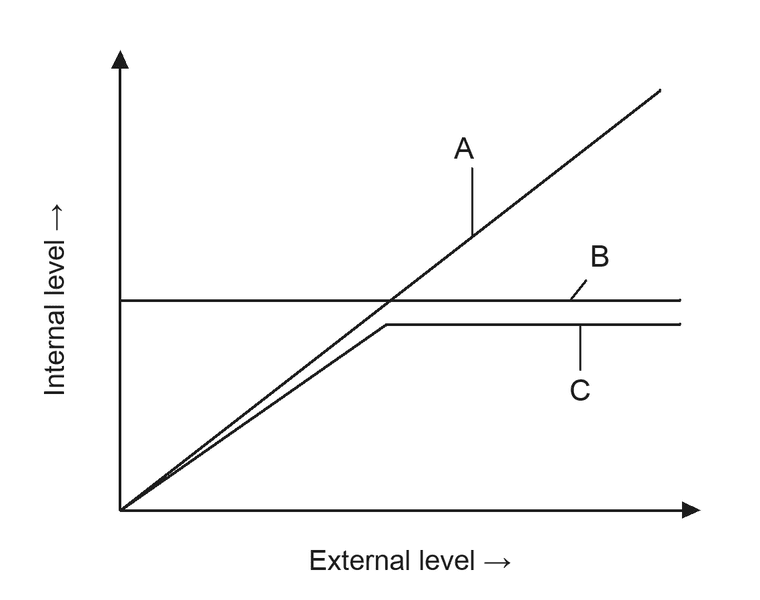
What does the graph A, B and C represent with reference to organismic response to homeostasis?
- 313 marks
Question 31
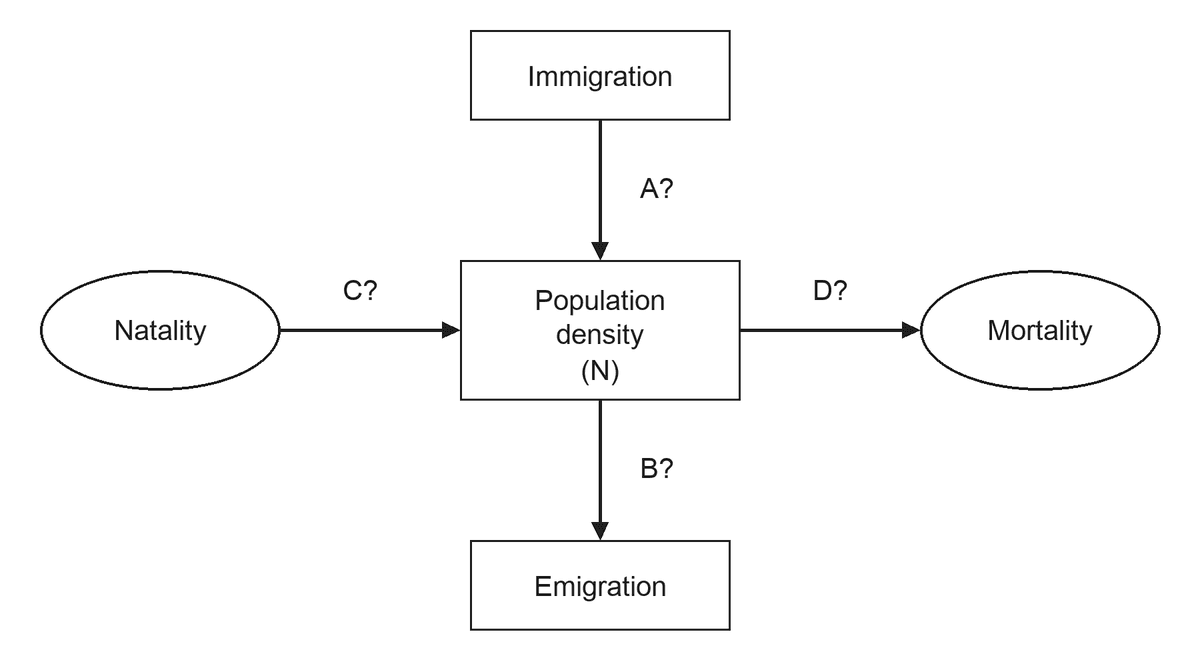
Which of the following A, B, C, D represent increase and decrease in population growth? Why?
- 323 marks
Question 32
With the help of neatly labeled diagrams, explain the different types of age pyramids of human population.
- 331 mark
Question 33
Biologists study a small fish that gives birth to live young, in two hill streams of the same region. In stream X, a large predatory fish eats mainly the adult fish. In stream Y, the only predator is a small fish that eats mainly the newborn young. Fish caught in each stream are bred for two generations in identical laboratory tanks with plenty of food and no predators, and their grandchildren are compared. (Hypothetical data.)
Trait of the laboratory-bred grandchildren Line from stream X Line from stream Y Age at first breeding (days) 48 75 Young born per brood 22 9 Mass of each newborn (mg) 0.9 1.6 Which conclusion is best supported by these results?
- 341 mark
Question 34
Assertion (A): In a grassland where food is plentiful, some healthy adult birds of a territorial species may still fail to breed in a season.
Reason (R): Breeding territories are guarded and defended vigorously, and the territories of different pairs do not overlap.
- 351 mark
Question 35
In a feeding trial, young insect-eating birds that had never seen butterflies are tested one at a time. Butterfly P is brightly coloured and distasteful. Butterfly Q looks almost exactly like P but is palatable. Butterfly R is dull brown and palatable. In week 1, the birds of group 1 are offered only P, and the birds of group 2 are offered only R. In week 2, the birds of both groups are offered only Q, and the number eaten is recorded. (Hypothetical data.)
Bird group Butterflies offered in week 1 Q butterflies eaten in week 2 (out of 40 offered) 1 Only P 6 2 Only R 35 Which conclusion is best supported by these results?
- 362 marks
Question 36
An abandoned field near Jodhpur is grazed every day by goats and cattle. After three years, the grasses and most other herbs in it are cropped close to the ground. However, the field is now dotted with green, uneaten shrubs of Calotropis (aak), and their number rises every year.
(a) Why do the goats and cattle leave the Calotropis shrubs alone?
(b) Why does the number of Calotropis shrubs keep rising in the grazed field?
- 372 marks
Question 37
To protect a brinjal field near Varanasi from the shoot-and-fruit borer moth, an agriculture officer hangs traps in the field. Each trap holds a small rubber piece that slowly releases a synthetic chemical copying the scent given out by the female moth of this species. Within a week the traps fill with moths, and nearly all of them are males of this one species.
(a) Which kind of communication between members of a species does the trap make use of? Why are nearly all the moths caught males of this species?
(b) A farmer thinks the moths are attracted by the bright colour of the trap, not by the scent. Design a simple field test to find out which is true.
- 383 marks
Question 38
In a well-developed evergreen forest of the Western Ghats, a researcher measures the light reaching the top of each layer of vegetation at mid-day, as a percentage of the full sunlight above the forest. She also counts the plant species found in each layer in her sample plots. (Hypothetical data.)
Layer of vegetation Light reaching the top of the layer (% of full sunlight) Plant species recorded in the layer Emergent trees (above 40 m) 100 6 Main canopy (25–40 m) 90 28 Understorey trees (10–25 m) 10 35 Shrubs (1–10 m) 4 41 Herbs (ground level) 1.5 52 (a) Name the characteristic of the community shown by these layers. How many times as much light reaches the top of the main canopy as reaches the herb layer?
(b) Using the data, explain how this arrangement allows so many plant species to live in the same forest.
(c) Loggers fell all the canopy and emergent trees on one hectare of this forest. Predict what will happen to the shrubs and herbs of that hectare, giving a reason.
- 393 marks
Question 39
A small frog of the Western Ghats breeds only in rain-filled rock pools on a laterite plateau. During the rains, adults move between pools that lie 1–2 km apart. Forest staff check 10 pools every year for breeding frogs. (Hypothetical data; "Breeding" = frogs found breeding, "—" = no frogs.)
Pool 2021 2022 2023 2024 1 Breeding Breeding — Breeding 2 Breeding — — Breeding 3 — Breeding Breeding Breeding 4 Breeding Breeding Breeding — 5 — — Breeding Breeding 6 Breeding Breeding — — 7 Breeding — Breeding Breeding 8 — Breeding Breeding — 9 Breeding Breeding — Breeding 10 — — Breeding Breeding (a) What name is given to such a set of local populations? Between 2021 and 2022, how many local populations died out, and how many empty pools were colonised?
(b) Explain how the frog survives on the plateau although its local populations keep disappearing.
(c) A road that frogs cannot cross is planned across the plateau, cutting pools 1–5 off from pools 6–10. An engineer says, "Each side keeps five pools, so the frog will survive just as well." Evaluate this claim.
- 404 marks
Question 40
A grower near Pune raises capsicum in a polyhouse. Aphids, small insects that suck the sap of the leaves, begin to multiply on the plants. Instead of spraying an insecticide, the grower releases ladybird beetles, whose adults and larvae eat aphids, in week 2, and none are released after that. A farm worker counts the aphids and the ladybirds (adults and larvae) on the same 50 marked leaves every two weeks. (Hypothetical data.)
Week 0 2 4 6 8 10 12 Aphids on 50 leaves 120 600 900 300 80 60 90 Ladybirds on 50 leaves 0 10 40 70 30 12 10 (a) By what percentage did the aphid count fall from week 4 to week 8? How many weeks after the aphids reached their peak did the ladybirds reach theirs?
(b) No ladybirds were removed, yet their number fell after week 6. Explain why.
(c) The grower says, "The ladybirds failed, because the aphids were not wiped out. Next time I will spray an insecticide as well." Evaluate this view.