
Opening your dashboard
Class 11 Maths Chapter 18: Introduction to 3-D Geometry Solutions
58 textbook questions with step-by-step answers, free to read, for ISC 2026-27.
Get talked through Ch 18, not just shown the answer
Reading a finished solution is not the same as being able to do it. The AI tutor takes one question at a time and works it with you, in your own words, until you can.
- Ask it out loud, in your own words
- It gives you the next step, not the answer
- Stuck on part (ii)? Start there
58 questions with solutions
1–3 marks · Mixed difficulty
The first 14 solutions are on this page. This chapter is a long one, so the rest open on their own page to keep this one quick to load.
- 13 marks
Question 1
Find the distance from the origin to each of the points:
(i)
(ii)
(iii)
(iv)
Solve with AIWritten solution
Solution:
Concept: The distance formula in space: the distance between and is
In particular, the distance of from the origin is .
Step 1 — Apply the formula to each point. We square each co-ordinate, add the squares and take the square root.
(i) For :
(ii) For :
(iii) For :
(iv) For :
Watch out: The square of a negative number is positive: , not .
Therefore, the distances are (i) , (ii) , (iii) and (iv) units.
- 23 marks
Question 2
Find the distance between each of the following pairs of points:
(i) and
(ii) and
(iii) and
Solve with AIWritten solution
Solution:
Concept: The distance formula in space: the distance between and is
In particular, the distance of from the origin is .
Step 1 — Find the differences and apply the formula. For each pair we subtract the co-ordinates, square the three differences, add them and take the square root.
(i) For and :
(ii) For and :
(iii) For and :
Therefore, the distances are (i) , (ii) and (iii) units.
- 33 marks
Question 3
Show that the triangle with vertices , , is a right-angled triangle, and find its area.
Solve with AIWritten solution
Solution:
Concept: The distance formula in space: the distance between and is
In particular, the distance of from the origin is .
By the converse of Pythagoras' theorem, a triangle is right-angled when the square of one side equals the sum of the squares of the other two; the right angle is opposite that longest side.
Step 1 — Name the vertices. We call the points , and .
Step 2 — Find the squares of the sides. We use the squared distance so that no square roots appear yet:
Step 3 — Test Pythagoras. We add the two smaller squares:
This equals , so the triangle is right-angled, with the right angle at (the vertex opposite the longest side ).
Step 4 — Find the area. The two sides and that meet at the right angle act as base and height:
Since , we have , and the area simplifies:
The figure shows the triangle in space with the right angle at .
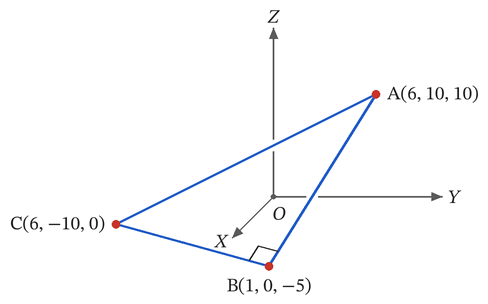
Therefore, the triangle is right-angled at and its area is sq. units.
- 43 marks
Question 4
Show that the triangle with vertices , , is isosceles.
Solve with AIWritten solution
Solution:
Concept: The distance formula in space: the distance between and is
In particular, the distance of from the origin is .
A triangle is isosceles when two of its sides are equal.
Step 1 — Find the squares of the sides. We work with squared lengths and compare them:
Step 2 — Compare. Equal squares mean equal lengths, so and are equal, each of length
while is different. Two sides are equal.
Therefore, and are both units long, so triangle is isosceles.
- 53 marks
Question 5
Show that , , and are the vertices of an equilateral triangle.
Solve with AIWritten solution
Solution:
Concept: The distance formula in space: the distance between and is
In particular, the distance of from the origin is .
A triangle is equilateral when all three sides are equal.
Step 1 — Name the points. We call them , and .
Step 2 — Find the squares of the sides. We compute each squared length:
Step 3 — Compare. All three squares are , so , and have the same length:
Therefore, the three sides are each units, so the points are the vertices of an equilateral triangle.
- 63 marks
Question 6
Show that the points , and are collinear.
Solve with AIWritten solution
Solution:
Concept: The distance formula in space: the distance between and is
In particular, the distance of from the origin is .
Three points , , are collinear when the sum of two of the distances , , equals the third.
Step 1 — Name the points. We call them , and .
Step 2 — Find the three distances. We apply the formula to each pair:
Step 3 — Add the two shorter distances. We compare their sum with the longest one:
This equals , so lies on the segment .
Therefore, , and the three points are collinear.
- 73 marks
Question 7
Derive the equation of the locus of a point equidistant from the points and .
Solve with AIWritten solution
Solution:
Concept: To find a locus, take a general point of it, write the given condition in co-ordinates (using the distance formula ), and simplify. Squaring both sides removes the square roots.
Step 1 — Write the condition. Let be any point of the locus, and . The condition is , and we square it so that
Step 2 — Write both sides in co-ordinates. We use the distance formula:
Step 3 — Expand both sides. The terms , , appear on both sides and cancel, which leaves
Step 4 — Collect the terms. We take everything to the right-hand side:
Therefore, the locus is the plane .
- 83 marks
Question 8
Derive the equation of the locus of a point twice as far from as from .
Solve with AIWritten solution
Solution:
Concept: To find a locus, take a general point of it, write the given condition in co-ordinates (using the distance formula ), and simplify. Squaring both sides removes the square roots.
Step 1 — Write the condition. Let be any point of the locus, and . The point is twice as far from as from , so . Squaring gives
Step 2 — Write both sides in co-ordinates. We use the distance formula:
Step 3 — Expand the left side. We expand each square and add the constants :
Step 4 — Expand the right side. Inside the bracket the constants add to , and then everything is multiplied by :
Step 5 — Equate and simplify. We move every term of the left side to the right side:
Therefore, the locus is (a sphere).
- 93 marks
Question 9
Find the equation of the locus of a point whose distance from the -axis is equal to its distance from .
Solve with AIWritten solution
Solution:
Concept: For a point , the foot of the perpendicular on the -axis is , so the distance of from the -axis is . In the same way, its distance from the -axis is and from the -axis is . Its distance from the -plane is , from the -plane and from the -plane .
Step 1 — Write the two distances. Let be any point of the locus. The foot of the perpendicular from on the -axis is , so the distance of from the -axis is . Its distance from is .
Step 2 — Equate and square. The two distances are equal, so their squares are equal:
Step 3 — Expand the right side. We expand each square:
Step 4 — Cancel and collect. The terms and cancel from both sides, leaving
Therefore, the locus is .
- 103 marks
Question 10
Find the equation of the locus of a point whose distance from the -plane is equal to its distance from the point .
Solve with AIWritten solution
Solution:
Concept: For a point , the foot of the perpendicular on the -axis is , so the distance of from the -axis is . In the same way, its distance from the -axis is and from the -axis is . Its distance from the -plane is , from the -plane and from the -plane .
Step 1 — Write the two distances. Let be any point of the locus. Its distance from the -plane is . Its distance from is .
Step 2 — Equate and square. Squaring removes both the modulus and the square root:
Step 3 — Expand the right side. We expand each square:
Step 4 — Cancel and collect. The term cancels, and the constants add to :
Therefore, the locus is .
- 113 marks
Question 11
A point moves so that the difference of the squares of its distances from the -axis and the -axis is constant. Find the equation of its locus.
Solve with AIWritten solution
Solution:
Concept: For a point , the foot of the perpendicular on the -axis is , so the distance of from the -axis is . In the same way, its distance from the -axis is and from the -axis is . Its distance from the -plane is , from the -plane and from the -plane .
Step 1 — Write the squared distances. Let be the moving point. Its squared distances from the two axes are
Step 2 — Use the condition. The difference of these squares is a constant; we call the constant :
Step 3 — Simplify. The terms cancel, which leaves
Note: Taking the difference the other way round gives , which is the same family of surfaces, since can be any constant.
Therefore, the locus is , where is a constant.
- 123 marks
Question 12
Find the equation of the locus of a point whose distance from the -axis is equal to its distance from the -plane.
Solve with AIWritten solution
Solution:
Concept: For a point , the foot of the perpendicular on the -axis is , so the distance of from the -axis is . In the same way, its distance from the -axis is and from the -axis is . Its distance from the -plane is , from the -plane and from the -plane .
Step 1 — Write the two distances. Let be any point of the locus. The foot of the perpendicular from on the -axis is , so its distance from the -axis is . Its distance from the -plane is .
Step 2 — Equate and square. The two distances are equal, so
Step 3 — Write it in standard form. We bring every term to one side:
This surface is a cone with its vertex at and the -axis as its axis.
Therefore, the locus is .
- 133 marks
Question 13
Find the coordinates of the points which divide the join of the points and in the ratio internally.
Solve with AIWritten solution
Solution:
Concept: The section formula: the point dividing the join of and in the ratio (measured from ) is
The division is internal when and have the same sign and external when they have opposite signs (external division in the ratio uses and ). The mid-point is the case of the ratio .
Step 1 — Identify the data. Here , , and , so .
Step 2 — Apply the formula to each co-ordinate. We multiply each co-ordinate of by and each co-ordinate of by , add, and divide by :
Therefore, the required point is .
- 143 marks
Question 14
Find the coordinates of the points which divide the line joining the points , in the ratio
(i)
(ii) .
Solve with AIWritten solution
Solution:
Concept: The section formula: the point dividing the join of and in the ratio (measured from ) is
The division is internal when and have the same sign and external when they have opposite signs (external division in the ratio uses and ). The mid-point is the case of the ratio .
Let and .
(i)
Step 1 — Use , . The ratio has opposite signs, so the division is external; here .
The point is , which lies outside the segment , beyond .
(ii)
Step 2 — Use , . Both numbers are positive, so the division is internal; here .
The point is .
Therefore, the points are (i) and (ii) .
- 153 marks
Question 15
Find the ratio in which the line joining the points , is divided by the -plane.
- 163 marks
Question 16
The three points , , are collinear. Find in what ratio each point divides the segment joining the other two.
- 173 marks
Question 17
Find the coordinates of the points which trisect given that and .
- 183 marks
Question 18
Find the coordinates of the point which is three-fifths of the way from to .
- 193 marks
Question 19
Show that the point is common to the lines which join to and to .
- 203 marks
Question 20
Find the lengths of the medians of the triangle whose vertices are , , .
- 213 marks
Question 21
Find the point of intersection of the medians of the triangle with vertices , , .
- 223 marks
Question 22
Find the ratio in which the join of and is divided by the plane . Also, find the coordinates of the point of division.
- 233 marks
Question 23
The mid-points of the sides of a triangle are , and . Find its vertices.
- 243 marks
Question 24
Three vertices of a parallelogram are , and . Find the coordinates of the fourth vertex .
- 253 marks
Question 25
What is the locus of a point for which
(i)
(ii)
(iii)
(iv)
(v)
(vi) ?
- 263 marks
Question 26
What is the locus of a point for which
(i)
(ii)
(iii)
(iv)
(v)
(vi) ?
- 271 mark
Question 27
What are the coordinates of a point lying on the -axis?
- 281 mark
Question 28
In which octant do the points
(a)
(b)
(c)
(d) lie?
- 291 mark
Question 29
Find the distance between the points and .
- 301 mark
Question 30
Find the distance of the point from the -axis.
- 311 mark
Question 31
What is the distance of the point from the -plane?
- 321 mark
Question 32
If , , be the feet of the perpendiculars from a point on the , and axes, then find the coordinates of , and .
- 331 mark
Question 33
Show that if , then the point is at a distance unit from the origin.
- 341 mark
Question 34
Find the coordinates of the point which divides the line segment joining the points and internally in the ratio .
- 351 mark
Question 35
Find the coordinates of the mid-points of the line joining the points and .
- 361 mark
Question 36
Find the coordinates of the image of the point in
(i) -plane
(ii) -plane
(iii) -plane.
- 371 mark
Question 37
The point lies in the octant
- 381 mark
Question 38
The equations and represent
- 391 mark
Question 39
-axis is the intersection of the planes
- 401 mark
Question 40
A plane is parallel to -plane, so it is perpendicular to
- 411 mark
Question 41
The distance between the points from the -axis is
- 421 mark
Question 42
The perpendicular distance of the point from -plane is
- 431 mark
Question 43
Reflection of the point in -plane is
- 441 mark
Question 44
The perimeter of the triangle with vertices at , and is
- 451 mark
Question 45
The points , , and
(A) form a rectangle which is not a square
(B) form a rhombus which is not a square
(C) form a parallelogram which is not a square
(D) are collinear
- 461 mark
Question 46
The points , , and are the vertices of
- 471 mark
Question 47
The point on the -axis equidistant from the points and is
- 481 mark
Question 48
The point in the -plane which is equidistant from the points , and is
- 491 mark
Question 49
If the extremities of a diagonal of a square are and , then the length of a side is
- 501 mark
Question 50
Perpendicular distance of the point from the -axis is
- 511 mark
Question 51
Given that the points , and are collinear the ratio in which divides internally is
- 521 mark
Question 52
The ratio in which -plane divides the line segment joining the points and is equal to
- 531 mark
Question 53
What is the ratio in which the line segment joining the points and is divided by the -plane?
- 541 mark
Question 54
-plane divides the line joining the points and in the ratio
- 551 mark
Question 55
The point which divides the line joining the points and internally in the ratio is
- 561 mark
Question 56
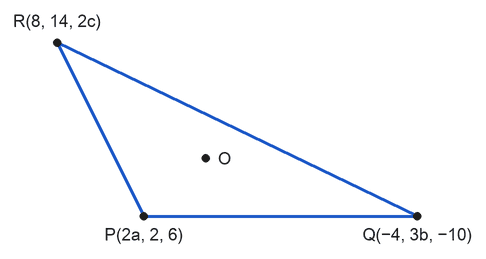
If origin is the centroid of a triangle with vertices , and , the value of , , are respectively
- 571 mark
Question 57
If a parallelopiped is formed by planes drawn through the points and parallel to the coordinate planes then the length of diagonal of the parallelopiped is
- 581 mark
Question 58
If the line joining and is divided by the point in the ratio , then is
What Class 11 Maths Ch 18 covers
The sections of the chapter, in the order the book takes them. Every question above comes from one of these.
- 01Coordinate Axes, Coordinate Planes and Octants
- 02Distance between Two Points in Space
- 03Section Formula, Mid-point and Centroid in Space
More ways to study this chapter
The same chapter asked three other ways. Practise it, revise it, and see what the board has set on Ch 18 before.
Class 11 Maths Ch 18 questions students ask
How many questions are there in Class 11 Maths Ch 18?
58 questions. Every one is solved step by step on this page.
Are these Class 11 Maths solutions free?
Yes. Every question and its full working is free to read, with no account needed.
Can I download the Class 11 Maths Ch 18 solutions as a PDF?
There is no PDF to download. Every solution is on this page instead, which means it is searchable, always the current syllabus, and readable on a phone. Use your browser's print option if you want it on paper.