
Opening your dashboard
Class 11 Maths Chapter 18 Introduction to 3-D Geometry: Competency-Based Questions (CBQ)
40 questions on Chapter 18, each worked through on its own page with the AI tutor. Class 11 Maths, ICSE 2026-27.
40 questions
1–5 marks · Mixed difficulty
- 14 marks
Question 1
Competency: Application
Geographers often locate places in an Earth-centred frame: the origin is the centre of the Earth, the -axis passes through the point of the equator at longitude , the -axis through the point of the equator at longitude E, and the -axis through the North Pole, so the -plane is the plane of the equator. Taking the Earth as a sphere of radius about km and unit km, New Delhi is at and Sydney is at , with the co-ordinates rounded to two decimal places.
(a) Name the octant in which each city lies.
(b) Find the distance of New Delhi from the plane of the equator and from the Earth's axis (the -axis), in km.
(c) A straight tunnel through the Earth would join the two cities. Find its length, to the nearest km.
- 21 mark
Question 2
Competency: Application
The probe of a co-ordinate measuring machine moves in straight lines. Taking a corner of its table as the origin, with lengths in mm, the probe moves from to and then from to . (Hypothetical data.)
What is the total length of the probe's path from to through ?
- 31 mark
Question 3
Competency: Analysis
Assertion (A): If all three vertices of a triangle lie in octant I, then its centroid also lies in octant I.
Reason (R): Each co-ordinate of the centroid of a triangle is the mean of the corresponding co-ordinates of its three vertices.
- 44 marks
Question 4
Competency: Application & Analysis
An air-traffic radar on level ground is the origin ; the -axis points east, the -axis north and the -axis vertically up, with lengths in km. At one moment two aircraft are at and . In a simplified form of the real rule, two aircraft are safely separated if their horizontal distance (the distance between the points of the ground directly below them) is at least km ( nautical miles), or if their heights differ by at least km (about ft). (Hypothetical data.)
(a) Find the horizontal distance between and .
(b) Find the straight-line distance , correct to three decimal places, and decide whether and are safely separated.
(c) A third aircraft is directly above the mid-point of the ground points of and . Find the heights at which is safely separated from both and .
- 51 mark
Question 5
Competency: Application
A diving instructor uses a frame with its origin at a marker buoy on the sea surface, the -axis pointing east, the -axis pointing north and the -axis vertically up, with lengths in metres. A diver is m west and m north of the buoy, m below the surface. (Hypothetical data.)
In which octant is the diver?
- 61 mark
Question 6
Competency: Analysis
Assertion (A): If the mid-point of a segment lies on the -plane, then and lie on opposite sides of the -plane.
Reason (R): For and , the -co-ordinate of the mid-point of is .
- 74 marks
Question 7
Competency: Application & Analysis
One wall of a dance studio is m wide, and a mirror covers its full width from m to m above the floor. Take a floor corner of this wall as the origin , the mirror wall as the -plane, the floor as the -plane and the -axis pointing into the room, with lengths in metres. A small lamp is at and a dancer's eye is at . Light from that reflects in the mirror and reaches travels as if it came in a straight line from the image of in the mirror, and it strikes the mirror at the point where meets the mirror. (Hypothetical data.)
(a) Find the co-ordinates of .
(b) Find the length of the light's path from to the mirror and on to .
(c) Find , and check that the light does strike the glass.
- 81 mark
Question 8
Competency: Application
A surveyor's laser rangefinder sits on a tripod at , measured in metres from the point of level ground directly below it, with the -axis vertically up. It measures the straight-line distance to a reflector on the top edge of a building as m. The point of the ground directly below is . (Hypothetical data.)
How high is the top edge of the building above the ground?
- 91 mark
Question 9
Competency: Analysis
Assertion (A): Every point of the -axis is at the same distance from and .
Reason (R): The points that are at the same distance from and are exactly the points of the -axis.
- 104 marks
Question 10
Competency: Application
In a crystal of iron at room temperature, the atoms sit at the corners of cubes of edge , with one more atom at the centre of each cube (a body-centred cubic cell). Take one corner atom as the origin and the three edges through it along the axes, so that the opposite corner is . The lattice constants, rounded, are nm for iron and nm for copper.
(a) Write the co-ordinates of the atom at the centre of the cube.
(b) Show that is nearer to the corner atom than two neighbouring corner atoms are to each other, and find the distance for iron, in nm correct to three decimal places.
(c) In a copper crystal the atoms sit at the corners of the cubes and at the centre of every face (a face-centred cubic cell). Find the distance from the corner atom to the atom at the centre of the face that lies in the -plane, in nm correct to three decimal places.
- 111 mark
Question 11
Competency: Analysis
A spotlight on a stage truss is at , and its beam is aimed at a singer's head at ; the origin is a corner of the stage floor, the -axis is vertical and lengths are in metres. Four decorations hang above the stage at the points given in the options. (Hypothetical data.)
Which decoration lies on the beam between and ?
- 124 marks
Question 12
Competency: Application
A triangular patch of sloping ground has corners , and , in metres, where the -plane is a level reference plane (the datum) and is the height above it. Builders use this rule: the volume of earth to be removed to bring the patch down to the datum is the area of the triangle's plan (the triangle on the datum straight below ) multiplied by the height of the centroid of . The rule is exact when the ground between the corners is a flat sloping surface. (Hypothetical data.)
(a) Find the centroid of the triangle and its height above the datum.
(b) Find the volume of earth to be removed.
(c) A drain is to be laid in a straight line from to the mid-point of . Find its length, correct to two decimal places.
- 131 mark
Question 13
Competency: Analysis
Assertion (A): For and the origin , the length equals .
Reason (R): The point lies in octant IV.
- 144 marks
Question 14
Competency: Application & Analysis
A football of radius m (a size-5 ball is about cm across) rests in a corner of a room, touching the floor and both walls. Take the corner as the origin , the floor as the -plane and the two walls as the -plane and the -plane, with the room in octant I and lengths in metres.
(a) Find the co-ordinates of the centre of the football and the distance from to the corner .
(b) Find the shortest distance from the corner to the surface of the ball, and the distance of from the vertical edge where the two walls meet.
(c) A table-tennis ball of radius m is pushed into the same corner so that it also touches the floor and both walls. Decide whether it fits there without touching the football.
- 151 mark
Question 15
Competency: Analysis
Assertion (A): For any two points and , the distance between their images in the -plane is equal to .
Reason (R): Reflection in the -plane changes the sign of the -co-ordinate of every point and leaves its - and -co-ordinates unchanged.
- 161 mark
Question 16
Competency: Analysis
A kingfisher on a branch at dives in a straight line to catch a fish at . The origin is a point of the bank at water level, the -axis runs along the bank, the -axis points out across the pond and the -axis is vertically up, so the -plane is the water surface; lengths are in metres. (Hypothetical data.)
Which co-ordinate planes does the bird's straight path cross?
- 174 marks
Question 17
Competency: Application & Analysis
An articulated lamp on a watch-repairer's workbench has a base pivot , an upper arm and a lower arm ending in the lamp head ; both joints can turn in every direction. With the origin at a corner of the bench, the -axis vertical and lengths in metres, at one moment the lamp has , and . Ignoring the limits of the joints, the head can reach exactly those points whose distance from lies between the difference and the sum of the two arm lengths. (Hypothetical data.)
(a) Find the lengths of the two arms.
(b) Find the present distance of the lamp head from the pivot, correct to two decimal places.
(c) Decide which of the points and the lamp head can reach.
- 181 mark
Question 18
Competency: Analysis
Let and be two distinct points.
Assertion (A): The points that divide internally in the ratios and are at equal distances from the mid-point of .
Reason (R): The point that divides internally in the ratio is .
- 194 marks
Question 19
Competency: Application & Analysis
A ball-tracking system films a cricket ball after it bounces. Take the base of the middle stump at the batter's end as the origin , the -axis along the pitch towards the bowler, the -axis across the pitch and the -axis vertically up, with lengths in metres. The stumps then stand in the -plane and fill the region , . The centre of the ball is tracked at and then at , and the system predicts that it keeps moving along the segment produced. Treat the ball as a point at its centre. (Hypothetical data.)
(a) Find the ratio in which the -plane divides the segment , and say whether the division is internal or external.
(b) Find the point where the predicted path meets the plane of the stumps.
(c) Decide whether the ball is predicted to hit the stumps, and find how far it travels from to , correct to two decimal places.
- 201 mark
Question 20
Competency: Application
At night a street lamp shines from m above the foot of its pole. Take as the origin, the ground as the -plane and the -axis vertically up, with lengths in metres, so that is . A post of height m stands with its foot at and its top at . The tip of the post's shadow is where the straight line from through meets the ground. (Hypothetical data.)
How long is the shadow ?
- 213 marks
Question 21
Competency: Application
A corner reflector, like those on bicycles and the ones placed on the Moon by the Apollo astronauts, has three flat mirrors at right angles to one another. Model the mirrors as the three co-ordinate planes, treating each as a whole plane, with lengths in cm, and put a small lamp at in octant I. The image of in the -plane mirror is ; the image of in the -plane mirror is ; and the image of in the -plane mirror is . (Hypothetical data.)
(a) Write the co-ordinates of , and .
(b) Name the octant of each of , and .
(c) Show that the corner is the mid-point of , and find the distance .
- 221 mark
Question 22
Competency: Understanding
Assertion (A): The point lies in octant VII.
Reason (R): Every point of octant VII has all three co-ordinates negative.
- 231 mark
Question 23
Competency: Analysis
Two radio beacons are mounted on poles in a flat car park, at and , measured in metres from a point of the ground, which is the -plane. A tracker lying on the ground finds that it is m from and m from . (Hypothetical data.)
Which of the following could be the position of the tracker?
- 241 mark
Question 24
Competency: Analysis
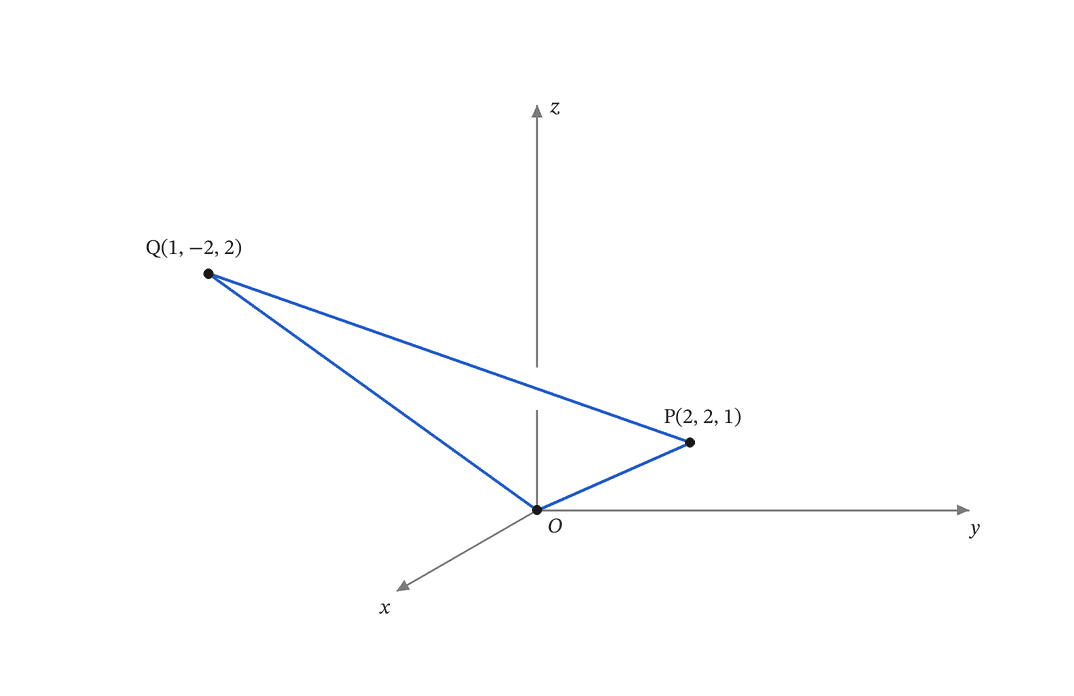
Assertion (A): The triangle with vertices , and has a right angle at .
Reason (R): In this triangle, .
- 254 marks
Question 25
Competency: Application & Analysis
A crate m long, m wide and m high holds three small heavy parts, of masses kg at , kg at and kg at . The origin is a bottom corner of the crate, its edges run along the axes, the -axis is vertical and lengths are in metres; ignore the mass of the crate itself. The centre of mass of a mass at and a mass at divides internally in the ratio , and two masses may be replaced by their total mass placed at their centre of mass. (Hypothetical data.)
(a) Find the centre of mass of the parts at and .
(b) Find the centre of mass of all three parts.
(c) The crate is lifted by a hook directly above its centre , and it hangs level when lies on the vertical line through . Decide whether it does, and find the distance .
- 261 mark
Question 26
Competency: Application & Analysis
In a basement, a gas pipe runs along the edge where the back wall meets the floor. Take this edge as the -axis, the floor as the -plane and the -axis vertically up, with lengths in metres. A safety rule says that every electrical junction box must be at least m from the gas pipe. Four junction boxes are fixed on brackets at the points given in the options. (Hypothetical data.)
Which junction box breaks the safety rule?
- 271 mark
Question 27
Competency: Analysis
A delivery drone takes off from a pad at the origin . The - and -axes run along the level ground, the -axis is vertically up and lengths are in metres. Its flight log records these points and times. (Hypothetical data.)
Point Position Time (s) The drone flies in a straight line on each leg , and . On which leg is its average speed the greatest, and what is that speed?
- 281 mark
Question 28
Competency: Application
The telescopic boom of a truck-mounted lift turns about a pivot on the truck, and the bucket is at the other end of the boom, at . The - and -axes run along level ground, the -axis is vertically up and lengths are in metres. Without turning, the boom is pushed out along its own line until it is one and a half times its present length. (Hypothetical data.)
Where is the bucket now?
- 291 mark
Question 29
Competency: Analysis
In a maths-club treasure hunt, a token is hidden at a point of a hall, with none of , and equal to . The club's app gives three clues:
Clue 1:
Clue 2:
Clue 3:
In which octant is the token hidden?
- 301 mark
Question 30
Competency: Understanding & Analysis
A student types the equation into a 3-D maths app, expecting to see a straight line, as on the squared paper she uses for the -plane.
Assertion (A): In space, the equation represents a plane parallel to the -plane.
Reason (R): Every point that satisfies lies on the line through parallel to the -axis.
- 311 mark
Question 31
Competency: Analysis & Evaluation
Three hikers on a hillside are at points , and , not all on one straight line, measured from their base camp , with the -axis vertically up. They agree to meet at the centroid of the triangle .
Assertion (A): The meeting point can be farther from the base camp than each of the three hikers is.
Reason (R): The centroid lies on each median of the triangle, two-thirds of the way from the vertex to the mid-point of the opposite side.
- 322 marks
Question 32
Competency: Application & Analysis
A glass aquarium is a cuboid cm long, cm wide and cm high, open at the top and full of water. Take one bottom corner as the origin , with the three edges at along the axes: the -axis along the cm edge, the -axis along the cm edge and the -axis up the cm edge. A small fish is at . Ignore the thickness of the glass. (Hypothetical data.)
Which of the five glass faces is the fish nearest to, and at which point of that face should a cleaning magnet be placed so that it is as close to the fish as possible?
- 332 marks
Question 33
Competency: Analysis
A small drone hovers in a hall. Take one floor corner as the origin and the three edges of the hall at (two floor edges and the vertical edge) as the -, - and -axes, with lengths in metres. Sensors on the three edges report that the drone's shortest distances from the -axis, the -axis and the -axis are m, m and m. (Hypothetical data.)
Find the distance of the drone from the corner .
- 342 marks
Question 34
Competency: Creativity
A designer of a 3-D maze game places the origin at the centre of a cubic room of side units, with the -axis vertically up, so that the -plane is the horizontal plane through the centre of the room. Every trap must be at a point with integer co-ordinates, in octant VII, exactly units from .
Give two such trap points that are at different distances from the -plane, and show that each one meets all the conditions.
- 352 marks
Question 35
Competency: Evaluation & Analysis
A large hall is decorated with paper lanterns for Diwali. Take the centre of the hall as the origin, with the -axis vertically up. Lantern hangs in octant I and lantern in octant VII, and a third lantern is to hang at the mid-point of . Riya says: "If is in octant I and is in octant VII, then the mid-point of must lie in octant I or in octant VII."
Decide whether Riya is right, and justify your answer.
- 363 marks
Question 36
Competency: Analysis & Evaluation
A climbing instructor wants to run a straight rope through three anchor bolts on a cliff, at , and , measured in metres with the -axis vertically up. A trainee works out the distances correct to two decimal places and gets m, m and m. Since , she says that the three bolts are in a straight line. (Hypothetical data.)
Check her distances, and decide exactly whether the three bolts are in a straight line.
- 373 marks
Question 37
Competency: Creativity
For a light show, three drones , and must form a triangle whose centroid is at the marker point above a stadium. The - and -axes run along the level ground, the -axis is vertically up and lengths are in metres. For safety, every drone must fly between m and m above the ground, and every two drones must be at least m apart. (Hypothetical data.)
Choose positions for the three drones that meet all these conditions, and explain how the third position can be found once the first two are chosen.
- 383 marks
Question 38
Competency: Application & Analysis
The dome of a planetarium is a hemisphere of radius m standing on a level floor. Take the centre of the dome's circular base as the origin , the floor as the -plane and the -axis vertically up, with lengths in metres. (Hypothetical data.)
(a) Find the equation satisfied by every point of the dome's surface.
(b) A circular catwalk runs round the inside of the dome, touching it, at a height of m. Find the radius of the catwalk.
(c) A projector is to be fixed at . Decide whether is inside the dome, and find how far is from .
- 395 marks
Question 39
Competency: Analysis & Evaluation
A weather station releases a small pilot balloon and tracks it by radar, recording its position every seconds from the moment taken as . In a steady wind the balloon drifts and rises at the same time. The - and -axes run along level ground, the -axis is vertically up and lengths are in metres. (Hypothetical data.)
Time (s) Point Position (a) Show that and divide internally in the ratios and , so that all four points lie on one straight line.
(b) Show that the balloon covered equal distances in the three intervals, and find its speed.
(c) The balloon keeps moving along the same line at the same speed. The base of a layer of low cloud is m above the ground. Find the ratio in which the point where the balloon reaches the cloud base divides , the co-ordinates of , and the time at which the balloon reaches .
- 405 marks
Question 40
Competency: Application & Analysis
At a football stadium, a camera hangs from four cables, one from the top of each of four vertical masts. The masts stand at the corners of a rectangle on level ground, and each is m tall. Take as the origin, and , so that is , with the -axis vertically up and lengths in metres. The tops of the masts above , , and are , , and . At one moment the camera is at . (Hypothetical data.)
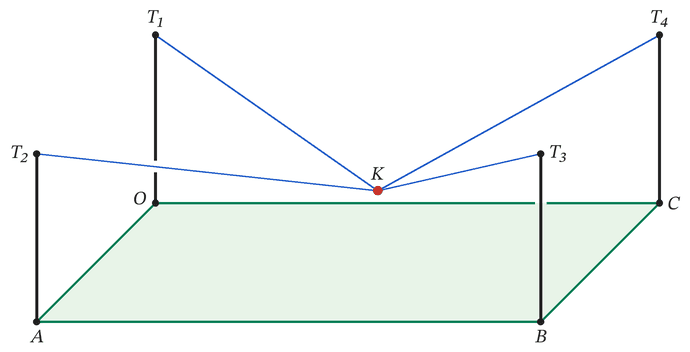
(a) Find the lengths of the four cables , , and .
(b) The camera is raised vertically from until the cables and are each m long. Find the new height of the camera.
(c) The director wants the camera at a height of m, with all four cables of equal length. Find where the camera must be, and the length of each cable.