
Opening your dashboard
Class 11 Maths Chapter 18 Introduction to 3-D Geometry: Practice Questions
50 questions on Chapter 18, each worked through on its own page with the AI tutor. Class 11 Maths, ICSE 2026-27.
50 questions
1–4 marks · Mixed difficulty
- 11 mark
Question 1
For a non-zero real number , the point always lies in
- 21 mark
Question 2
The points and lie in the same octant. The set of all values of for which this happens is
- 33 marks
Question 3
The cuboid has its base on the -plane, with on the positive -axis, on the positive -axis, units and units. The vertices , , and lie units vertically above , , and respectively.
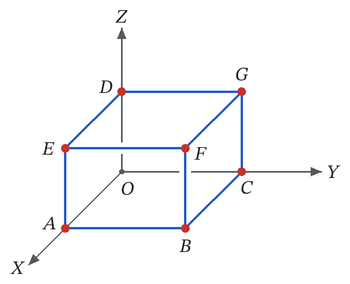
(a) Write the co-ordinates of all eight vertices.
(b) Name the four vertices that lie on each of the three co-ordinate planes.
(c) Write the equations of the three faces that do not pass through .
- 41 mark
Question 4
A point lies in octant VII. Its distances from the -plane, the -plane and the -plane are , and units respectively. The co-ordinates of are
- 51 mark
Question 5
The point is the image of in the -axis, that is, the -axis meets at right angles at its mid-point. The co-ordinates of are
- 63 marks
Question 6
The line is drawn through parallel to the -axis.
(a) Write the co-ordinates of a general point of .
(b) Find the point where meets the -plane.
(c) Name the two octants through which passes.
- 72 marks
Question 7
(a) Name the co-ordinate plane that separates octant I from octant II, octant I from octant IV, and octant I from octant V.
(b) Name the three octants that share a boundary face (part of a co-ordinate plane) with octant VII, and the one octant that meets octant VII only at the origin.
- 81 mark
Question 8
A point lies in octant II. Which of the following must be true?
- 91 mark
Question 9
The points on the -axis that are at a distance of units from are
- 102 marks
Question 10
(Hypothetical data.) A vertical mobile-signal mast stands at the origin of a level field, with its top at . The - and -axes run along the ground, the -axis is vertical, and distances are in metres. Two straight guy wires run from to anchors and on the ground.
(a) Find the length of each guy wire.
(b) Find the distance between the two anchors.
- 111 mark
Question 11
A point is at a distance of units from the origin and units from the -plane. Its distance from the -axis is
- 123 marks
Question 12
Let be the origin and . Let , and be the feet of the perpendiculars from to the -plane, the -plane and the -plane respectively.
(a) Write the co-ordinates of , and .
(b) Find , and , and show that .
- 133 marks
Question 13
The points , and form a triangle with a right angle at .
(a) Find the value of .
(b) Find the length of the side opposite the right angle.
- 141 mark
Question 14
If the distance between and is units, then equals
- 153 marks
Question 15
(Hypothetical data.) A hall is a cuboid m wide, m long and m high. Take a floor corner as the origin , the -axis along the m floor edge, the -axis along the m floor edge and the -axis up the vertical edge (unit m). A security camera is fixed at the ceiling corner directly above . It can identify faces only up to m away.
(a) Find the distance from to the floor corner diagonally opposite , and to the ceiling corner directly above .
(b) A person's face is about m above the floor. Can the camera identify the face of a person standing at the corner ?
- 161 mark
Question 16
A point in octant I is at the same distance from each of the three co-ordinate axes. Which of the following could be that point?
- 173 marks
Question 17
Find the point that is at the same distance from each of the four points , , and , and find this common distance.
- 181 mark
Question 18
As varies over all real numbers, the least distance of the point from the origin is
- 193 marks
Question 19
(Hypothetical data.) The mast of a tower crane stands along the -axis, with its foot at the origin of a level building site; the - and -axes run along the ground and distances are in metres. The horizontal jib is m above the ground, and the trolley on the jib is at . The hook hangs on a vertical cable straight below .
(a) Find the horizontal distance of the trolley from the mast.
(b) The hook is lowered until it is m below the jib. Write its co-ordinates , and find its distance from the top of the mast .
- 203 marks
Question 20
(Hypothetical data.) A hot-air balloon lifts off from the point of a level field and rises vertically at m/s. At the same moment a cyclist leaves the origin and rides along the -axis at m/s. The -axis is vertical and distances are in metres.
(a) Write the positions of the balloon and the cyclist after seconds.
(b) Find when they are m apart.
- 213 marks
Question 21
(Hypothetical data.) In a room, a floor corner is the origin, the - and -axes run along two walls and the -axis is vertical (unit m). The room is m long in the -direction. A Wi-Fi router is fixed at , and its signal is reliable up to m from it. A laptop is placed on a long desk whose top runs parallel to the -axis, so the laptop is at with .
Find all positions of the laptop on the desk where the signal is reliable.
- 223 marks
Question 22
(Hypothetical data.) A pyramid tent at a school fair has a square base of side m on level ground, and its top is m vertically above the centre of the base. Take as the origin, on the -axis, on the -axis and the -axis vertical (unit m).
(a) Write the co-ordinates of , , , and .
(b) Find the length of each of the four slanting poles , , and .
(c) Find the distance from to the mid-point of the base edge .
- 233 marks
Question 23
Let be the origin and . Let be a point on the -axis and the foot of the perpendicular from to the -plane.
(a) Explain why the triangle has a right angle at and the triangle has a right angle at .
(b) Use Pythagoras' theorem twice to find and then , and check with the distance formula.
- 242 marks
Question 24
(Hypothetical data.) In a warehouse, the charging dock of a picking robot is at the origin ; the - and -axes run along the floor aisles and the -axis is vertical (unit m). A parcel sits on a shelf at . The robot can move only parallel to the axes: along , then along , and then it raises its arm vertically.
(a) Find the total distance moved from the dock to the parcel.
(b) A small drone flies in a straight line from to . Find the length of its flight and how much shorter it is than the robot's route.
- 254 marks
Question 25
A cube has edge , one vertex at the origin and three edges along the positive axes. Consider the four vertices , , and .
(a) Show that the six distances , , , , and are all equal, so that is a regular tetrahedron (a solid with four equilateral triangular faces).
(b) Find if each edge of this tetrahedron is units, and find then the length of the cube's diagonal from to .
- 261 mark
Question 26
The mid-point of the segment joining and lies on the -plane. Then equals
- 273 marks
Question 27
(Hypothetical data.) A ladder m long leans against a vertical wall. Take the corner where the wall meets the floor as the origin , the -axis along the floor at right angles to the wall and the -axis vertically up the wall (unit m), so that the wall lies in the -plane. The foot of the ladder is on the -axis and its top is on the -axis.
(a) The foot is m from the wall. Find the co-ordinates of and of the mid-point of the ladder.
(b) The foot now slides away from the wall while the top stays on the wall. Show that the mid-point of the ladder always stays m from .
- 281 mark
Question 28
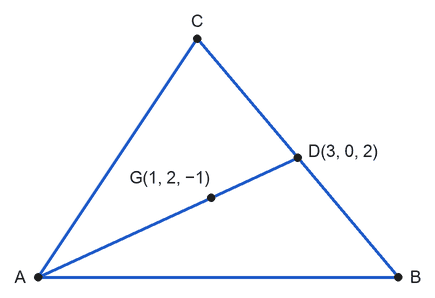
In a triangle , the centroid is and the mid-point of is . The vertex is
- 294 marks
Question 29
A tetrahedron has vertices , , and .
(a) Find the centroid of the face , and the point that divides internally in the ratio .
(b) Find the centroid of the face , and show that the point dividing internally in the ratio is the same point .
(c) Show that each co-ordinate of is the average of the matching co-ordinates of , , and .
- 303 marks
Question 30
The points , , and are the mid-points of the sides , , and of the quadrilateral with , , and .
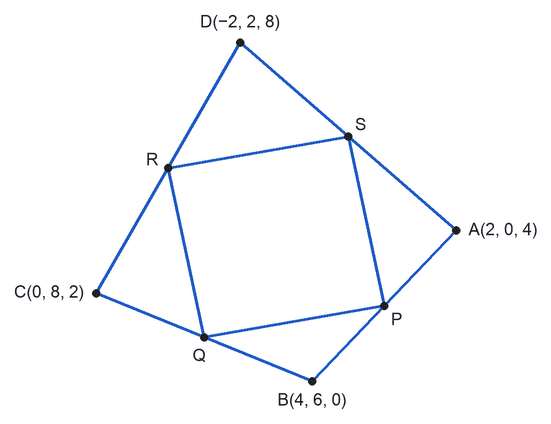
(a) Find , , and .
(b) Show that is a parallelogram.
- 311 mark
Question 31
The point divides the join of and internally in the ratio , where . The point lies in octant I exactly when
- 323 marks
Question 32
(Hypothetical data.) A straight cable runs from the top of a pole standing at the origin to a fixing point on the wall of a building. The - and -axes run along level ground, the -axis is vertical and the unit is m.
(a) Find the ratio in which the point of the cable lying m above the ground divides , and the co-ordinates of .
(b) Find the distance from the foot of the pole to the point of the ground straight below .
- 331 mark
Question 33
The mid-point of is , where lies on the -axis and lies on the -plane. Then
- 343 marks
Question 34
(Hypothetical data.) In a factory, a straight inclined conveyor belt runs from on the floor to at a loading platform. The -axis is vertical and the unit is m.
(a) Find the length of the belt.
(b) A sensor is fixed on the belt m from . Find the ratio in which it divides , its co-ordinates and its height above the floor.
- 351 mark
Question 35
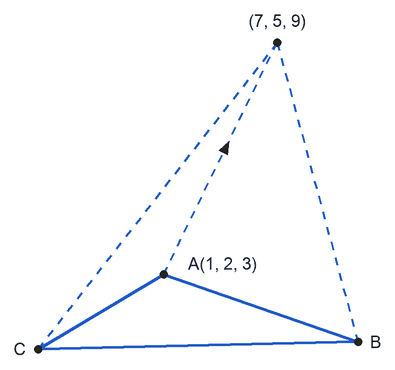
The vertex of a triangle is moved from to , while and stay where they are. The centroid of the triangle moves through a distance of
- 363 marks
Question 36
Does the segment joining and meet the -axis? If it does, find the point where it meets the -axis and the ratio in which this point divides .
- 371 mark
Question 37
The mid-points of the sides of a triangle are , and . The centroid of the triangle is
- 383 marks
Question 38
The points , and are collinear.
(a) Use the -co-ordinates to find the ratio in which divides .
(b) Hence find and .
- 391 mark
Question 39
For two distinct points and and positive numbers and , there is no point dividing externally in the ratio exactly when
- 404 marks
Question 40
Let and .
(a) Find the points and that divide internally and externally, respectively, in the ratio .
(b) Show that divides internally and divides externally in the same ratio, and find this ratio.
- 412 marks
Question 41
The real numbers , , are not all equal.
(a) Show that the centroid of the triangle with vertices , and has all three co-ordinates equal.
(b) Find the distance of this centroid from the origin when .
- 421 mark
Question 42
The point divides the segment joining and internally in the ratio . The length is
- 432 marks
Question 43
The triangle has vertices , and . The points and are the mid-points of and .
 Show that .
- 442 marks
Question 44
(Hypothetical data.) Two survey drones hover at and , measured in metres from a ground station at the origin , with the -axis vertical. A relay drone is placed at the mid-point of , and the relay link works only up to m from .
Find and its distance from , and decide whether the relay drone is within range.
- 453 marks
Question 45
The triangle has vertices , and . The bisector of the angle meets at .
 Use the angle-bisector theorem, , to find the co-ordinates of .
- 461 mark
Question 46
The points , and form a triangle with centroid . If is the origin, the distance is
- 473 marks
Question 47
The cuboid has at the origin, , , , and , , , lying units vertically above , , , respectively.
(a) Show that the four diagonals , , and have the same mid-point , and find it.
(b) Show that the four diagonals are equal in length, and that is at the same distance from all eight vertices.
- 484 marks
Question 48
The triangle has vertices , and , centroid , and is the origin.
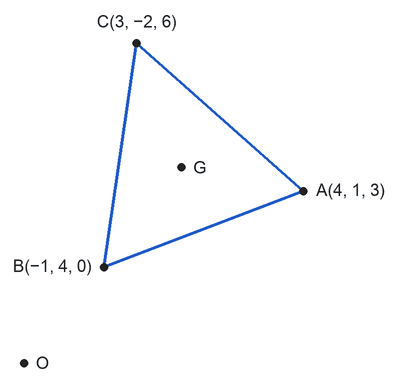
(a) Find .
(b) Verify that .
- 491 mark
Question 49
In which octant does the centroid of the triangle with vertices , and lie?
- 503 marks
Question 50
The triangle has vertices , and .
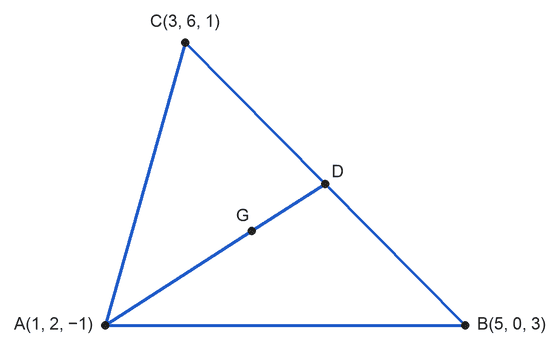
(a) Find the centroid and the mid-point of .
(b) Find and with the distance formula, and show that .