
Opening your dashboard
Class 11 Maths Chapter 17: Hyperbola Solutions
37 textbook questions with step-by-step answers, free to read, for ISC 2026-27.
Get talked through Ch 17, not just shown the answer
Reading a finished solution is not the same as being able to do it. The AI tutor takes one question at a time and works it with you, in your own words, until you can.
- Ask it out loud, in your own words
- It gives you the next step, not the answer
- Stuck on part (ii)? Start there
37 questions with solutions
1–3 marks · Mixed difficulty
The first 7 solutions are on this page. This chapter is a long one, so the rest open on their own page to keep this one quick to load.
- 13 marks
Question 1
Find the equation of the hyperbola whose focus is , directrix , and eccentricity .
Solve with AIWritten solution
Solution:
Concept: A hyperbola is the path of a point whose distance from a fixed point (the focus) is times its perpendicular distance from a fixed line (the directrix), where the eccentricity is greater than .
So every point of the curve satisfies .
The distance of from the line is .
Squaring removes the square root and the modulus.
Step 1 — Take a general point and write its two distances. Let be any point on the hyperbola. We write the directrix as ; the divisor for its distance is :
Step 2 — Use and square. Squaring both sides doubles , and :
We multiply both sides by :
Step 3 — Expand both sides. We expand the left side first:
Then we expand the square of the three-term bracket on the right:
Step 4 — Bring everything to one side. The terms and appear on both sides and cancel, so
We collect every term on the right:
Check: The point satisfies . Its distance from is , and its distance from the directrix is ; multiplying the second by gives again, as the definition requires. The equation can also be written , a hyperbola with centre .

Therefore, the equation of the hyperbola is .
- 23 marks
Question 2
Find the equation to the hyperbola whose eccentricity is , whose focus is and whose directrix is .
Solve with AIWritten solution
Solution:
Concept: A hyperbola is the path of a point whose distance from a fixed point (the focus) is times its perpendicular distance from a fixed line (the directrix), where the eccentricity is greater than .
So every point of the curve satisfies .
The distance of from the line is .
Squaring removes the square root and the modulus.
Step 1 — Take a general point and write its two distances. Let be any point on the hyperbola. The directrix is , and the divisor for the distance from it is , or :
Step 2 — Use and square. Squaring multiplies by , and :
Step 3 — Expand both sides. We expand each square:
Step 4 — Bring everything to one side. We move all the terms to the right side and collect like terms:
Check: The point lies on this curve, because .
Its distance from is , or .
Its distance from the directrix is , or . Twice this is , as the definition requires.

Therefore, the equation of the hyperbola is .
- 33 marks
Question 3
Find the equation to the conic section whose focus is , directrix is the line , and eccentricity is . State whether the conic section is an ellipse or a hyperbola.
Solve with AIWritten solution
Solution:
Concept: A conic section is the path of a point whose distance from a fixed point (the focus) is times its distance from a fixed line (the directrix). It is an ellipse when and a hyperbola when . The distance of from the line is .
Step 1 — Write the two distances. Let be any point on the conic. We divide the directrix equation by ; so the directrix is the line , and
Step 2 — Use and square. Multiplying by gives , so
Step 3 — Expand both sides. We expand each square:
The term is on both sides and cancels.
Step 4 — Collect the terms. We bring the terms to the left and the constants to the right:
Step 5 — Divide by . This is allowed when ; it makes the right side :
Step 6 — Decide the type. We look at the sign of :
- If , then , both denominators are positive, and the equation is an ellipse.
- If , then , so the second term carries a minus sign: the equation reads , which is a hyperbola (with ).
Therefore, the conic is ; it is an ellipse if and a hyperbola if .
- 43 marks
Question 4
Find the equation of the hyperbola whose axes are along the coordinate axes and which passes through and .
Solve with AIWritten solution
Solution:
Concept: A hyperbola whose axes are the co-ordinate axes has an equation in which and have opposite signs. A point on the curve satisfies the equation, so two given points give two equations for and .
Step 1 — Use the two points. We substitute and then in :
Step 2 — Eliminate . We multiply the first equation by and the second by :
Subtracting the second from the first removes :
Step 3 — Find . We put the value of in the first equation:
Step 4 — Write the equation. We substitute and and multiply through by :
Since and have opposite signs, the curve is a hyperbola; the term is positive, so its transverse axis is the -axis.
Check: For the left side is , or .
For the left side is , or .

Therefore, the equation of the hyperbola is .
- 53 marks
Question 5
Find the eccentricity of the hyperbola whose equation is .
Solve with AIWritten solution
Solution:
Concept: For a hyperbola in standard form, is the denominator under the positive square term and the denominator under the negative one. Two facts link them with the eccentricity and the focal distance (the distance from the centre to each focus):
- (equivalently, );
- .
Step 1 — Write the equation in standard form. We divide both sides by :
Step 2 — Read off and . The term is positive, so
Step 3 — Find . We use :
Therefore, the eccentricity is .
- 63 marks
Question 6
Find the eccentricity and the coordinates of the foci of the curve .
Solve with AIWritten solution
Solution:
Concept: The two standard forms of a hyperbola have these facts:
- : transverse axis along the -axis; vertices ; foci ; directrices .
- : transverse axis along the -axis; vertices ; foci ; directrices .
In both forms is the denominator under the positive square term, each latus rectum has length , and ; so the focal distance (from the centre to each focus) satisfies .
Step 1 — Write the equation in standard form. We divide both sides by :
Step 2 — Read off and . The term is positive, so the transverse axis is the -axis and
So .
Step 3 — Find . We use :
Step 4 — Find the foci. The foci are :
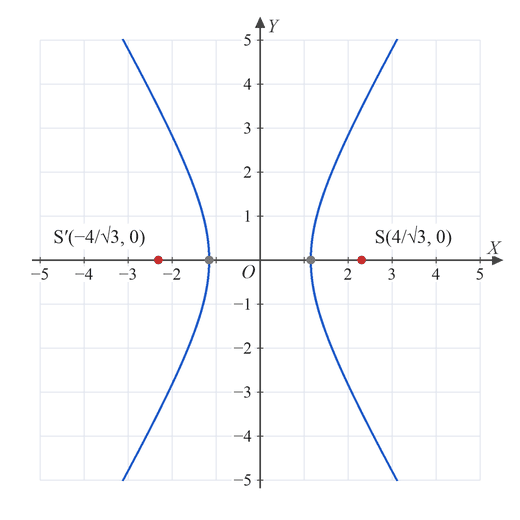
Therefore, the eccentricity is and the foci are .
- 73 marks
Question 7
Find the coordinates of the foci, vertices, eccentricity and the length of the latus rectum of the hyperbola
(i)
(ii)
(iii)
(iv)
Solve with AIWritten solution
Solution:
Concept: The two standard forms of a hyperbola have these facts:
- : transverse axis along the -axis; vertices ; foci ; directrices .
- : transverse axis along the -axis; vertices ; foci ; directrices .
In both forms is the denominator under the positive square term, each latus rectum has length , and ; so the focal distance (from the centre to each focus) satisfies .
Watch out: The letter always belongs to the transverse axis (the positive square term), even when that term is the term.
(i)
Step 1 — Write the equation in standard form. We divide both sides by so that the right side becomes :
The positive term is the term, so the transverse axis is the -axis.
Step 2 — Read off and . We compare with the standard form:
So and .
Step 3 — Find the focal distance . We use :
Step 4 — Find the eccentricity. We divide by :
Step 5 — Find the length of the latus rectum. We use the formula :
So the foci are and the vertices are . The figure shows the two branches, the foci , , the vertices and the latus rectum through .

(ii)
Step 1 — Write the equation in standard form. The equation is already in standard form:
The positive term is the term, so the transverse axis is the -axis.
Step 2 — Read off and . We compare with the standard form:
So and .
Step 3 — Find the focal distance . We use :
Step 4 — Find the eccentricity. We divide by :
Step 5 — Find the length of the latus rectum. We use the formula :
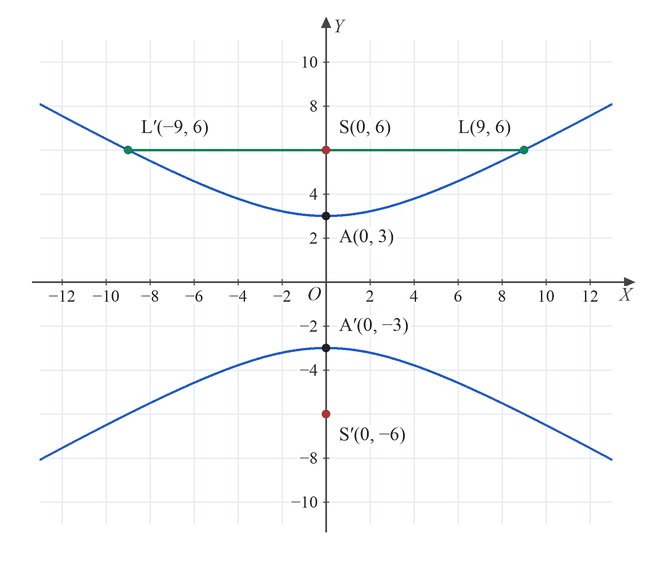
So the foci are and the vertices are . The figure shows the two branches, the foci , , the vertices and the latus rectum through .
(iii)
Step 1 — Write the equation in standard form. We divide both sides by so that the right side becomes :
The positive term is the term, so the transverse axis is the -axis.
Step 2 — Read off and . We compare with the standard form:
So and .
Step 3 — Find the focal distance . We use :
Step 4 — Find the eccentricity. We divide by :
Step 5 — Find the length of the latus rectum. We use the formula :
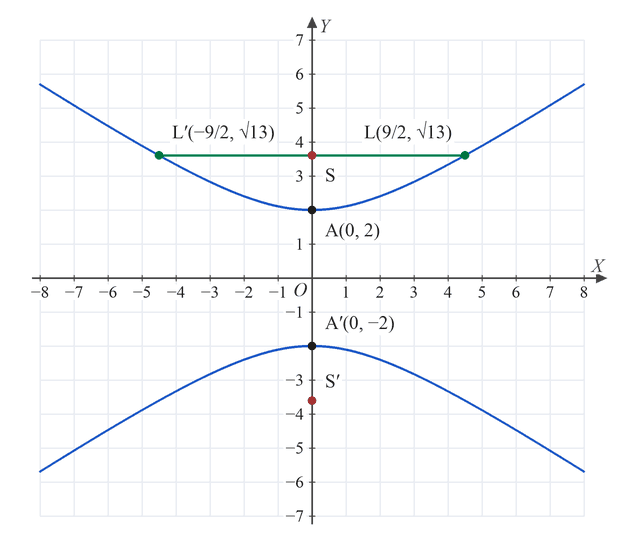
So the foci are and the vertices are . The figure shows the two branches, the foci , , the vertices and the latus rectum through .
(iv)
Step 1 — Write the equation in standard form. We divide both sides by so that the right side becomes :
The positive term is the term, so the transverse axis is the -axis.
Step 2 — Read off and . We compare with the standard form:
So and .
Step 3 — Find the focal distance . We use :
Step 4 — Find the eccentricity. We divide by :
Step 5 — Find the length of the latus rectum. We use the formula :
So the foci are and the vertices are . The figure shows the two branches, the foci , , the vertices and the latus rectum through .
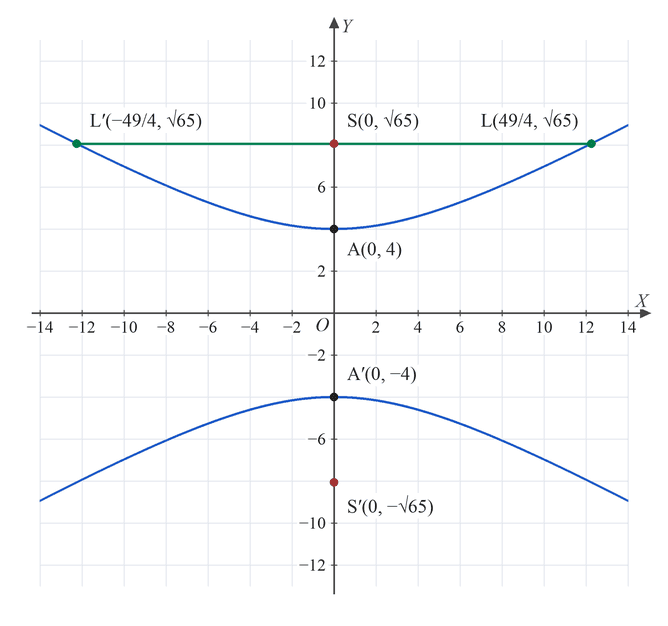
Therefore, (i) foci , vertices , , latus rectum ; (ii) foci , vertices , , latus rectum ; (iii) foci , vertices , , latus rectum ; (iv) foci , vertices , , latus rectum .
- 83 marks
Question 8
In the hyperbola , find the length of the axes, the coordinates of the foci, the eccentricity, and the latus rectum, and the equations of the directrices.
- 93 marks
Question 9
Find the equation of the hyperbola, referred to its axes as the axes of coordinates,
(i) whose transverse and conjugate axes are in length respectively and ;
(ii) whose foci are and and eccentricity equal to ;
(iii) the distance between whose foci is and whose eccentricity is ;
(iv) whose conjugate axis is and the distance between whose foci is ;
(v) vertices are and foci ;
(vi) foci are and transverse axis of length ;
(vii) foci are and conjugate axis of length ;
(viii) vertices are and ;
(ix) foci are and and eccentricity is .
- 103 marks
Question 10
Find the equation of the hyperbola, referred to its axes as the axes of coordinates, whose conjugate axis is and which passes through the point . Find also the equation of the conjugate hyperbola.
- 113 marks
Question 11
Find the locus of a point such that the difference of its distances from and is always equal to . Name the curve.
- 121 mark
Question 12
Find the length of the latus rectum of the hyperbola .
- 131 mark
Question 13
The eccentricity of the hyperbola is ............
- 141 mark
Question 14
Find the coordinates of the foci of the hyperbola .
- 151 mark
Question 15
Find the eccentricity, vertices, foci and length of the latus rectum of the hyperbola .
- 161 mark
Question 16
Find the equation of the hyperbola whose focus is , directrix and . Find also the equation of the transverse axis.
- 171 mark
Question 17
Find the equation of the hyperbola whose eccentricity is and the sum of whose semi-axis is .
- 181 mark
Question 18
Find the equation of the hyperbola whose foci are and the length of the conjugate axis is .
- 191 mark
Question 19
Find the eccentricity of the hyperbola whose vertices and foci are and respectively.
- 201 mark
Question 20
Find the eccentricity of the hyperbola .
- 211 mark
Question 21
Find the equation of the hyperbola given foci and transverse axis of length .
- 221 mark
Question 22
Find the eccentricity of the hyperbola which passes through the points and .
- 231 mark
Question 23
Find the equation of the hyperbola given vertices and foci .
- 241 mark
Question 24
The equation represents
- 251 mark
Question 25
The eccentricity of the hyperbola is
- 261 mark
Question 26
If is the eccentricity of the ellipse and eccentricity of the hyperbola , then is equal to
- 271 mark
Question 27
If is the directrix of the hyperbola , then the corresponding focus is
- 281 mark
Question 28
The length of conjugate axis of a hyperbola is greater than the length of the transverse axis. Then the eccentricity is
- 291 mark
Question 29
The foci of the hyperbola are
- 301 mark
Question 30
The distance between the foci of the hyperbola is and its eccentricity is . Its equation is
(A)
(B)
(C)
(D)
- 311 mark
Question 31
Equation of the hyperbola with eccentricity and foci at is
- 321 mark
Question 32
Let the eccentricity of the hyperbola be reciprocal to that of the ellipse , then the ratio equals
- 331 mark
Question 33
The line segment joining the foci of the hyperbola is one of the diameters of a circle. The equation of the circle is
- 341 mark
Question 34
Find the eccentricity of the hyperbola whose latus rectum is and conjugate axis is equal to half of the distance between the foci.
- 351 mark
Question 35
The eccentricity of the conic is
- 361 mark
Question 36
The sum of the squares of the eccentricities of the conics and is
- 371 mark
Question 37
If and are the eccentricities of hyperbola and its conjugate, then
What Class 11 Maths Ch 17 covers
The sections of the chapter, in the order the book takes them. Every question above comes from one of these.
- 01Definition of a Hyperbola and its Standard Equation
- 02Vertices, Foci, Eccentricity, Directrices and Latus Rectum
- 03Conjugate Hyperbola and Special Hyperbolas
- 04Finding the Equation of a Hyperbola from Given Conditions
More ways to study this chapter
The same chapter asked three other ways. Practise it, revise it, and see what the board has set on Ch 17 before.
Class 11 Maths Ch 17 questions students ask
How many questions are there in Class 11 Maths Ch 17?
37 questions. Every one is solved step by step on this page.
Are these Class 11 Maths solutions free?
Yes. Every question and its full working is free to read, with no account needed.
Can I download the Class 11 Maths Ch 17 solutions as a PDF?
There is no PDF to download. Every solution is on this page instead, which means it is searchable, always the current syllabus, and readable on a phone. Use your browser's print option if you want it on paper.