
Opening your dashboard
Class 11 Maths Chapter 17 Hyperbola: Competency-Based Questions (CBQ)
40 questions on Chapter 17, each worked through on its own page with the AI tutor. Class 11 Maths, ICSE 2026-27.
40 questions
1–5 marks · Mixed difficulty
- 14 marks
Question 1
Competency: Application
A table lamp with an open cylindrical shade, the bulb at its centre, stands with the bulb cm from a flat wall. Light leaves through the open top and the open bottom of the shade and makes two lit patches on the wall, one above and one below the level of the bulb. Take the point of the wall nearest to the bulb as the origin, the horizontal line through on the wall as the -axis and the vertical line through as the -axis, with lengths in cm. It can be shown that the edges of the patches are the two branches of a hyperbola , whose transverse axis lies along the -axis and whose semi-conjugate axis equals the distance of the bulb from the wall; each patch lies on the side of its branch away from . The lowest point of the upper patch is cm above . (Hypothetical data.)
(a) Write the equation of the edge of the patches.
(b) Find the width of the upper patch along the horizontal line cm above .
(c) Find the eccentricity of the hyperbola and the height above at which the upper patch is exactly cm wide. Show that this horizontal line passes through a focus of the hyperbola.
- 21 mark
Question 2
Competency: Application
The roof of a sports pavilion is a saddle-shaped surface. On the floor plan, with lengths in metres, the points of the roof that are m above the floor lie on the hyperbola , whose transverse axis lies along the -axis. Two pendant lamps hang at the same height, directly above the two foci of this hyperbola. (Hypothetical data.)
How far apart are the two lamps?
- 31 mark
Question 3
Competency: Analysis
In Rutherford's scattering experiment, an alpha particle passing close to a gold nucleus is repelled by it. Its path is one branch of a hyperbola, and is the focus that lies on the outer (convex) side of that branch. Let the hyperbola have semi-transverse axis and eccentricity , with its transverse axis along the -axis, and let be its other focus, the one inside the branch.
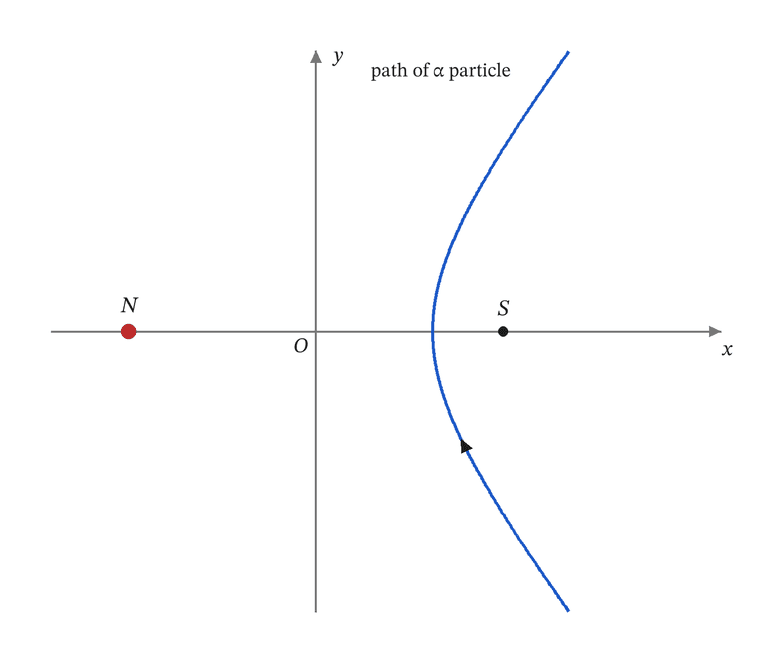
Assertion (A): The least distance of the alpha particle from is .
Reason (R): Every point of the branch satisfies .
- 44 marks
Question 4
Competency: Application & Analysis
In a ripple tank, two dippers vibrating together send out circular waves of wavelength cm from two points and that are cm apart. At a point of the water surface the waves cancel (a nodal point) when the path difference is an odd multiple of half a wavelength (here cm, cm, …). Take the mid-point of as the origin and the line as the -axis, with on its positive side and lengths in cm. (Hypothetical data.)
(a) Show that the nodal points with path difference cm lie on a hyperbola whose transverse axis is along the -axis, and find its equation.
(b) The edge of the tank is the straight line . Find the points where the nodal lines of part (a) meet this edge.
(c) Find the equation of the hyperbola on which the nodal points with path difference cm lie, and the points where it crosses the line .
- 51 mark
Question 5
Competency: Application
A laser engraver is programmed to cut the curve on a wooden board, with lengths in cm. The transverse axis of this hyperbola is parallel to the -axis, along the line . The engraver must also drill a small hole at the focus of the right-hand branch. (Hypothetical data.)
At which point must the hole be drilled?
- 61 mark
Question 6
Competency: Analysis
Consider the hyperbola .
Assertion (A): The vertices of lie on the -axis, and its transverse axis runs along the -axis.
Reason (R): In the equation , the coefficient of is larger in size than the coefficient of .
- 74 marks
Question 7
Competency: Application & Analysis
In a Cassegrain telescope, light from the large main mirror heads for a point , but a small convex secondary mirror reflects it back towards a point behind the main mirror. The secondary mirror is part of the branch, nearer to , of a hyperbola with foci and . In one telescope and are cm apart, and the vertex of the mirror lies on the line , cm from and cm from . Take the mid-point of as the origin and the line as the -axis, with on the positive side, so that the transverse axis lies along the -axis; lengths are in cm. (Hypothetical data.)
(a) Find , and the equation of the hyperbola.
(b) Find the eccentricity and the directrix that goes with the focus , and check that obeys the focus–directrix property.
(c) The mirror is cm across, so its rim lies on the lines . Find how far the rim lies from along the axis (the depth of the curve of the mirror), in millimetres correct to two decimal places.
- 81 mark
Question 8
Competency: Application
A stained-glass panel shows the hyperbola , whose transverse axis lies along the -axis, together with its conjugate hyperbola , with lengths in cm. A straight strip of lead is fixed along one latus rectum of , between the two points where that latus rectum meets . (Hypothetical data.)
How long is the strip?
- 91 mark
Question 9
Competency: Analysis
Consider hyperbolas with and , each with its transverse axis along the -axis and eccentricity .
Assertion (A): For every such hyperbola, the latus rectum is longer than the transverse axis.
Reason (R): The eccentricity of every hyperbola is greater than .
- 104 marks
Question 10
Competency: Application & Analysis
A gardener marks a curved edge for a flower bed on a lawn. The gardener drives two pegs and into the ground cm apart. A straight rod cm long is pivoted at so that it can turn about , and a string cm long is tied from the free end of the rod to the peg . A marker holds the string tight against the rod, so that the string runs from along the rod to and then straight to . As the rod turns, marks a curve. Take the mid-point of as the origin and the line as the -axis, with on the positive side; lengths are in cm. (Hypothetical data.)
(a) Show that is the same for every position of , and find its value.
(b) Hence show that moves on a hyperbola whose transverse axis lies along the -axis, and find its equation.
(c) The marked curve ends when arrives at . Find the co-ordinates of the two ends of the curve.
- 111 mark
Question 11
Competency: Application
A neon sign is made of glowing tubes bent along both branches of the hyperbola , whose transverse axis lies along the -axis, with lengths in cm. The upper branch is cut off at the line , and a straight tube joins its two ends. (Hypothetical data.)
How long is this straight tube?
- 121 mark
Question 12
Competency: Analysis
The points and are given. Consider every hyperbola that has and as its foci; each such hyperbola has its centre at the origin and its transverse axis along the -axis.
Assertion (A): None of these hyperbolas passes through the point .
Reason (R): For every point of a hyperbola with foci and , the larger of and minus the smaller is less than .
- 134 marks
Question 13
Competency: Application & Analysis
A designer draws a logo made of a hyperbola , whose transverse axis lies along the -axis, and its conjugate hyperbola , whose transverse axis lies along the -axis; lengths are in cm. The designer joins the two vertices of and the two vertices of to make a rhombus. The sides of the rhombus are cm long, its area is cm², and its horizontal diagonal is longer than its vertical diagonal. (Hypothetical data.)
(a) Find and .
(b) Write the equations of and , and find their eccentricities.
(c) Find the length of the latus rectum of each hyperbola.
- 141 mark
Question 14
Competency: Analysis
Consider the hyperbola , whose transverse axis lies along the -axis.
Assertion (A): The point is an end of a latus rectum of this hyperbola.
Reason (R): The length of the latus rectum of is .
- 151 mark
Question 15
Competency: Application
A decorative steel panel has a slot cut along a hyperbola whose centre is the origin and whose transverse axis lies along the -axis, with lengths in cm. The foci of the hyperbola are cm apart, and its latus rectum is cm long. (Hypothetical data.)
Which of these is the equation of the hyperbola?
- 164 marks
Question 16
Competency: Application & Analysis
On the site plan of a park, with lengths in metres, two curved paths together follow the curve . This curve is a hyperbola whose transverse axis is parallel to the -axis, and lamps stand at its two foci. When its equation is written in the standard form , a point of the plan lies between the two paths exactly when . (Hypothetical data.)
(a) Write the equation in standard form, and state the centre and the semi-axes and .
(b) Find the positions of the two lamps.
(c) A fountain stands at and a tree at . Decide whether each of them lies between the two paths.
- 171 mark
Question 17
Competency: Analysis
Let be the hyperbola , whose transverse axis lies along the -axis, and let be its conjugate hyperbola , whose transverse axis lies along the -axis.
Assertion (A): The conjugate hyperbola of is .
Reason (R): and have the same transverse axis.
- 181 mark
Question 18
Competency: Application
A metalworker bends a brass rod along one branch of a hyperbola for a lamp stand. On the drawing, with lengths in cm, the foci of the hyperbola are and , so its transverse axis lies along the -axis, and the rod passes through the point . (Hypothetical data.)
What is the length of the transverse axis of this hyperbola?
- 194 marks
Question 19
Competency: Application & Analysis
A space probe flies past Jupiter. Relative to Jupiter, its path is one branch of a hyperbola, with the centre of Jupiter at the focus inside that branch. The probe's least distance from is km. When the probe crosses the line through at right angles to the transverse axis of its path, it is km from . Work in units of km, with the centre of the hyperbola as the origin and its transverse axis along the -axis, being on the positive -axis. (Hypothetical data.)
(a) Show that the eccentricity of the path is , and find the semi-transverse axis .
(b) Find the equation of the path and the co-ordinates of .
(c) Find the points of the path at which the probe is km from .
- 201 mark
Question 20
Competency: Analysis
Consider the hyperbola , whose transverse axis lies along the -axis, with eccentricity .
Assertion (A): Both directrices of this hyperbola lie between its two vertices.
Reason (R): The vertices of this hyperbola are the points and .
- 211 mark
Question 21
Competency: Application
An engineering drawing of a curved guide rail shows a hyperbola with its centre at the origin and its transverse axis along the -axis, with lengths in cm. One vertex is , and the directrix nearer to is the line . (Hypothetical data.)
Which of these is the equation of the hyperbola?
- 224 marks
Question 22
Competency: Application & Analysis
A gardener marks out rectangular flower beds, each of area m², in the corner of a lawn between two straight fences at right angles. Each bed has one corner at the corner of the lawn and two sides along the fences. Take as the origin and the fences as the positive - and -axes, with lengths in m, so that the far corner of a bed m by m is the point with . (Hypothetical data.)
The curve , with , is a hyperbola with centre , whose transverse axis lies along the line , and whose transverse and conjugate axes are equal in length (a rectangular hyperbola).
(a) Find the vertex of the branch on which the far corners lie, and hence the semi-axes and of the hyperbola .
(b) Find the eccentricity and the foci of this hyperbola.
(c) For the bed m by m, let be its far corner, the focus in the first quadrant and the other focus. Show that .
- 231 mark
Question 23
Competency: Analysis
A hyperbola with semi-axes and has its transverse axis along the -axis and eccentricity . Its conjugate hyperbola, with transverse axis along the -axis, has eccentricity .
Assertion (A): For a suitable choice of and , the product equals .
Reason (R): .
- 244 marks
Question 24
Competency: Application & Analysis
A school robotics club programs a robot to move on a large floor so that its distance from a beacon is always times its distance from a straight white line painted on the floor. The beacon is m from the line. (Hypothetical data.)
(a) The robot's path crosses the perpendicular from to at two points, one on each side of . Find how far each point is from , and the distance between the two points.
(b) Take the mid-point of these two points as the origin and the perpendicular from to as the -axis, so that the transverse axis of the path lies along the -axis, with on the positive side. Find the equation of the path, the co-ordinates of and the equation of .
(c) Find how far the robot is from when it is level with (on the line through parallel to ).
- 251 mark
Question 25
Competency: Application
A greeting card is printed with the hyperbola , whose transverse axis lies along the -axis, with lengths in cm. A gold border is printed as the rectangle whose corners are the four ends of the two latera recta of the hyperbola. (Hypothetical data.)
What is the perimeter of the gold rectangle?
- 264 marks
Question 26
The fixed points are and . A point moves so that , that is, its distance from always exceeds its distance from by .
(a) Show that lies on the hyperbola , whose transverse axis is along the -axis.
(b) Explain why moves on only one branch of this hyperbola, and say which branch.
(c) Find the point where the path of meets the -axis.
- 274 marks
Question 27
The hyperbola has its transverse axis along the -axis and foci and , with on the positive -axis.
(a) Find and .
(b) Find all the points of the hyperbola for which .
(c) For the point in the first quadrant, find and , and verify that their difference equals the length of the transverse axis.
- 284 marks
Question 28
The ellipse and the hyperbola have their major axis and transverse axis, respectively, along the -axis.
(a) Show that they have the same foci and , with on the positive -axis.
(b) Find the points where they meet.
(c) For the point where they meet in the first quadrant, find and . Check that their sum agrees with the ellipse and their difference agrees with the hyperbola.
- 291 mark
Question 29
Competency: Analysis
(Hypothetical data.) A workshop cuts four stencils, each with an edge shaped like a hyperbola. For each stencil a student measures the distance between the two vertices, the distance between the two foci and the length of the latus rectum. Exactly one row of the table cannot belong to any hyperbola.
Stencil (cm) (cm) Latus rectum (cm) P Q R S Which row has been recorded wrongly?
- 301 mark
Question 30
Competency: Analysis & Evaluation
The hyperbola has its transverse axis along the -axis and its foci at and . The point lies on its left-hand branch.
Assertion (A): The distance is .
Reason (R): For every point of this hyperbola, its distance from is , where is the eccentricity.
- 311 mark
Question 31
Competency: Analysis
(Hypothetical data.) The hyperbola , with lengths in cm, is printed on a rubber sheet, with its centre at the origin and its transverse axis along the -axis. The sheet is then stretched sideways only, so that every point of the print moves to . The stretched print is still a hyperbola with the same centre and with its transverse axis along the -axis.
What is the eccentricity of the stretched hyperbola?
- 321 mark
Question 32
Competency: Analysis & Evaluation
A student wants to fix a hyperbola , with its centre at the origin and its transverse axis along the -axis, by making it pass through the two marked points and .
Assertion (A): Exactly one hyperbola of this form passes through both and .
Reason (R): If a point lies on , then the point also lies on it.
- 331 mark
Question 33
Competency: Application
(Hypothetical data.) An architect designs a window whose outline follows both branches of a hyperbola , with its transverse axis along the -axis. A straight brass bar runs along each latus rectum, and a small lamp sits at each focus. The architect wants each brass bar to be exactly as long as the distance between the two lamps.
What must the eccentricity of the hyperbola be?
- 342 marks
Question 34
Competency: Analysis & Evaluation
(Hypothetical data.) The edge of a steel bracket on an engineering drawing follows the hyperbola . A student puts the equation into standard form as follows.
Line 1:
Line 2:
Line 3:
Line 4: The centre is , and the hyperbola is .
Find the line in which the first mistake is made and explain it. Then give the correct standard form and the vertices of the hyperbola.
- 352 marks
Question 35
Competency: Application & Analysis
(Hypothetical data.) The edge of a lawn follows the right-hand branch of the hyperbola , with its transverse axis along the -axis and lengths in metres. Two lamps stand at the foci and . A bench is to be placed at a point on this edge that is twice as far from as from .
Find , and the -coordinate of . How many points of the edge are suitable for the bench?
- 362 marks
Question 36
Competency: Analysis
(Hypothetical data.) Two stencils have hyperbolic edges with the same vertices , with lengths in cm. Their edges are and , both with their transverse axis along the -axis.
Find the eccentricity of each, and the width of the right-hand branch of each along the line (the distance between its upper and lower points on that line). Which stencil opens out more widely, and how is this linked to the eccentricity?
- 373 marks
Question 37
Competency: Analysis
(Hypothetical data.) In a computer game two towers stand at and . A drone is programmed so that the slope of multiplied by the slope of is always . The drone is never on the lines or , so both slopes are always defined.
(a) Show that the drone moves on the hyperbola , whose transverse axis lies along the -axis.
(b) The points and satisfy this equation. Explain why the drone is never at or .
(c) Find the eccentricity and the foci of the hyperbola.
- 383 marks
Question 38
Competency: Creativity & Analysis
(Hypothetical data.) A mechanical drawing toy has two straight slotted rods that move when a knob is turned. When the knob is at setting (any non-zero number), the rods lie along the lines and , and a pen sits where the two rods cross.
(a) Show that the pen always lies on the hyperbola , whose transverse axis lies along the -axis.
(b) Design a pair of rod positions, in the same style, for which the pen draws the conjugate hyperbola of . Check your design.
(c) For the toy in part (a), find where the pen is when and when , and say which values of draw the left-hand branch of .
- 394 marks
Question 39
Competency: Analysis & Evaluation
(Hypothetical data.) A school wants a steel arch over the entrance to its sports ground. On the design drawing the ground is the -axis and the -axis is the vertical line of symmetry of the arch, with lengths in metres. The arch follows the lower branch of a hyperbola , whose transverse axis lies along the -axis. The top of the arch is the vertex of this branch, and the arch meets the ground at its two feet. A lamp will hang at the focus of the lower branch. The requirements are:
- the top of the arch is m above the ground;
- the two feet are between m and m apart;
- the lamp is at least m above the ground.
Proposal P is , and proposal Q is .
(a) For each proposal, find the centre, and , and the height of the top of the arch.
(b) Find how far apart the feet are for each proposal.
(c) Find the height of the lamp for each proposal. Decide which proposal meets all three requirements.
- 405 marks
Question 40
Competency: Application & Evaluation
(Hypothetical data.) An aircraft flies level at a height of km at twice the speed of sound. In a simple model (still air, with the same speed of sound at all heights), the shock wave that causes the sonic boom is a cone that trails behind the aircraft, with the aircraft at its tip and the line of flight as its axis. At this speed the half-angle of the cone is . So a point that is km behind the aircraft, measured parallel to the line of flight, lies on the cone when its distance from the line of flight is km.
On a ground plan, take the point directly below the aircraft as the origin. The ground track (the line on the ground directly below the line of flight) is the -axis, with measured backwards from , and the -axis is level and at right angles to the track; lengths are in km. The figure shows the curve along which the cone meets the ground at this instant (the boom edge). It meets the track at .
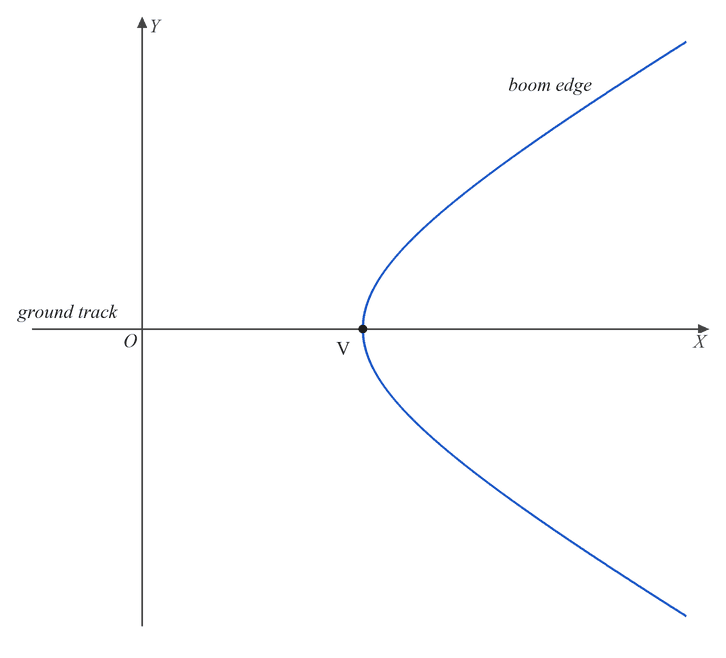
(a) A ground point with is km from the line of flight. Show that the boom edge is the branch, with , of the hyperbola , whose transverse axis lies along the -axis. How far behind is ?
(b) Find the eccentricity and the foci of this hyperbola, and the length of its latus rectum through the focus behind the aircraft. What does this length tell you about the boom edge km behind ?
(c) Three villages lie at these distances from the ground track.
Village P Q R Distance from the track (km) For each village, find how far the aircraft has gone past it, measured along the track, when the boom edge reaches it. Give each answer to the nearest km. A news report says: “Village R is four times as far from the track as village P, so the aircraft is four times as far past R as past P when the boom arrives.” Is the report right?